
Realism in Art: Unfiltered View, Artists & Enduring Legacy
Dive into Realism, the 19th-century art revolution that championed an unfiltered view of modern life. Explore its origins, characteristics, artists, and enduring legacy.

What is Realism in Art? The Definitive Guide to the Unfiltered View, Artists & Legacy
What if the most 'real' art isn't the one that looks most like a photograph, but the one that forces us to confront uncomfortable truths? For years, I thought 'realism' was simple: an apple painted so perfectly you could almost bite into it – that's realism, right? As I dabbled in my own art journey, I believed that was the whole story. But I was spectacularly wrong. While realism (lowercase 'r') is a broad term for any artwork striving for accuracy across any period – think a meticulously rendered Renaissance portrait, the lifelike sculptures of ancient Greece, or even the detailed narratives in medieval manuscripts – this guide focuses squarely on Realism (with a capital 'R') – a full-blown, table-flipping 19th-century revolution. It wasn't just about how things looked; it was about why and what an artist chose to depict, driven by a revolutionary intent to present an unfiltered view of the modern world. This audacious approach didn't just change painting; it fundamentally reshaped how we view art's purpose and paved the way for nearly every major artistic innovation that followed. Join me as we demystify Realism, exploring its surprising origins, core characteristics, pivotal artists, and its enduring, transformative legacy across art and culture.
Capital 'R' Realism isn't just a technique; it's an attitude. It’s the movement that decided to stop painting gods, goddesses, and powdered aristocrats, and instead point its brushes at the gritty, sweaty, and often mundane reality of everyday life. It was a revolution, and frankly, it's one of the most important shifts in the history of art. It demanded that art acknowledge the real world, not just an idealized fantasy. Artists started to paint what they saw around them, not what they were told to paint. They aimed to depict life as it truly was, without the rose-tinted glasses. What a concept, right? To simply look.
So, let's get into it. What exactly is this movement that decided a bunch of farmers were more interesting than a pantheon of gods?
The Birth of a Revolution: Why Realism Happened
Imagine the art world in mid-19th century France. The official, state-sanctioned art, the stuff that won awards at the prestigious Paris Salon (the official art exhibition of the Académie des Beaux-Arts), was dominated by the grand narratives of Neoclassicism (think heroic battle scenes, idealized reason) and the stirring passions of Romanticism (dramatic mythological tales, intense emotion). These movements, while powerful, often presented a world detached from the daily struggles of ordinary people, speaking to bygone eras or idealized visions far removed from the dirt and toil of actual citizens. It was the blockbuster cinema of its day—epic, idealized, and largely disconnected from the messy, complex lives unfolding outside the Salon doors.
Then the Industrial Revolution happened. Cities swelled, factories churned out smoke, and a new working class emerged, facing unprecedented hardships and social disparities. This wasn't just about new machines; it was about massive urbanization, the rise of the bourgeoisie (the burgeoning middle class, often associated with commerce and industry), and a profound shift in societal structures. Complementing this societal upheaval was a growing sense of secularism (a detachment from purely religious explanations) and a new scientific rigor. Philosophers like Auguste Comte championed Positivism, arguing that true knowledge comes only from sensory experience and empirical observation – what we can prove we saw. This scientific mindset directly influenced artists to ground their work in empirical observation, much like a scientist records data, asking 'What can I see and prove?' rather than 'What grand narrative should I illustrate?' It was a shift from idealized narratives to verifiable truth, essentially telling artists: "If you can't see it, don't paint it, and if you do see it, paint it exactly as it is." Meanwhile, the rise of illustrated journalism and mass media meant that contemporary social issues and daily realities were increasingly exposed to a wider public, creating an audience primed for art that mirrored their world.
And then, in the 1830s, photography burst onto the scene, offering an entirely new way to capture reality with unflinching detail. Early photographic processes like daguerreotypes provided a new standard for objective, instantaneous depiction, prompting painters to rethink their purpose: if a camera could replicate reality perfectly (a process known as mimesis, or imitation), what was painting for? Paradoxically, photography's capacity to capture a perfect, static image freed painters from the burden of pure replication, urging them to explore deeper truths beyond mere surface imitation – the fleeting impressions, emotional resonance, and subjective observation that lay beyond the lens. It also profoundly influenced compositional choices, encouraging candid moments, unusual cropping, and asymmetrical arrangements, mirroring the 'snapshot' quality of early photographs and making painted scenes feel less staged and more like life caught in motion.
Proto-Realist Tendencies: Seeds of the Unfiltered View
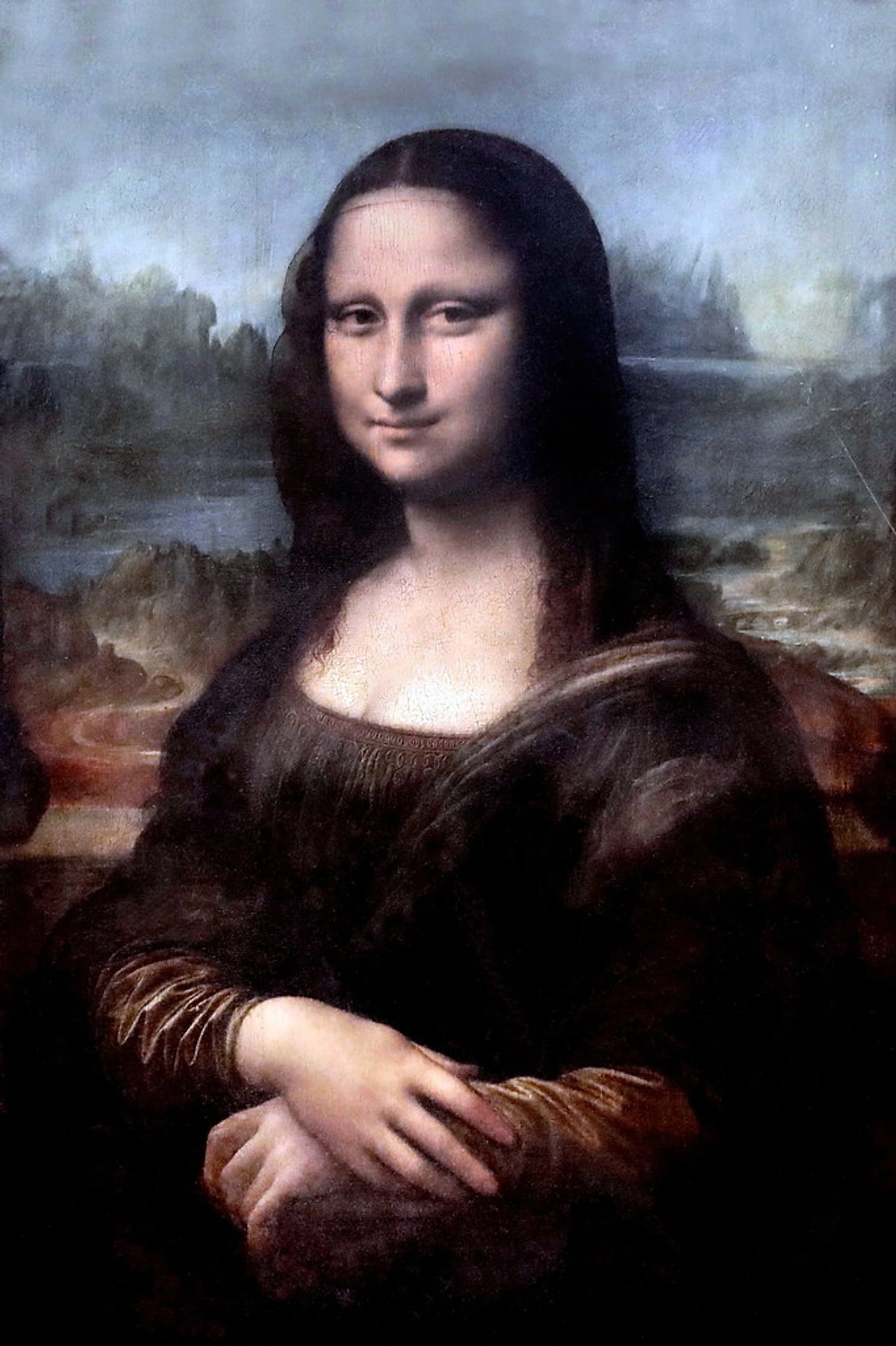
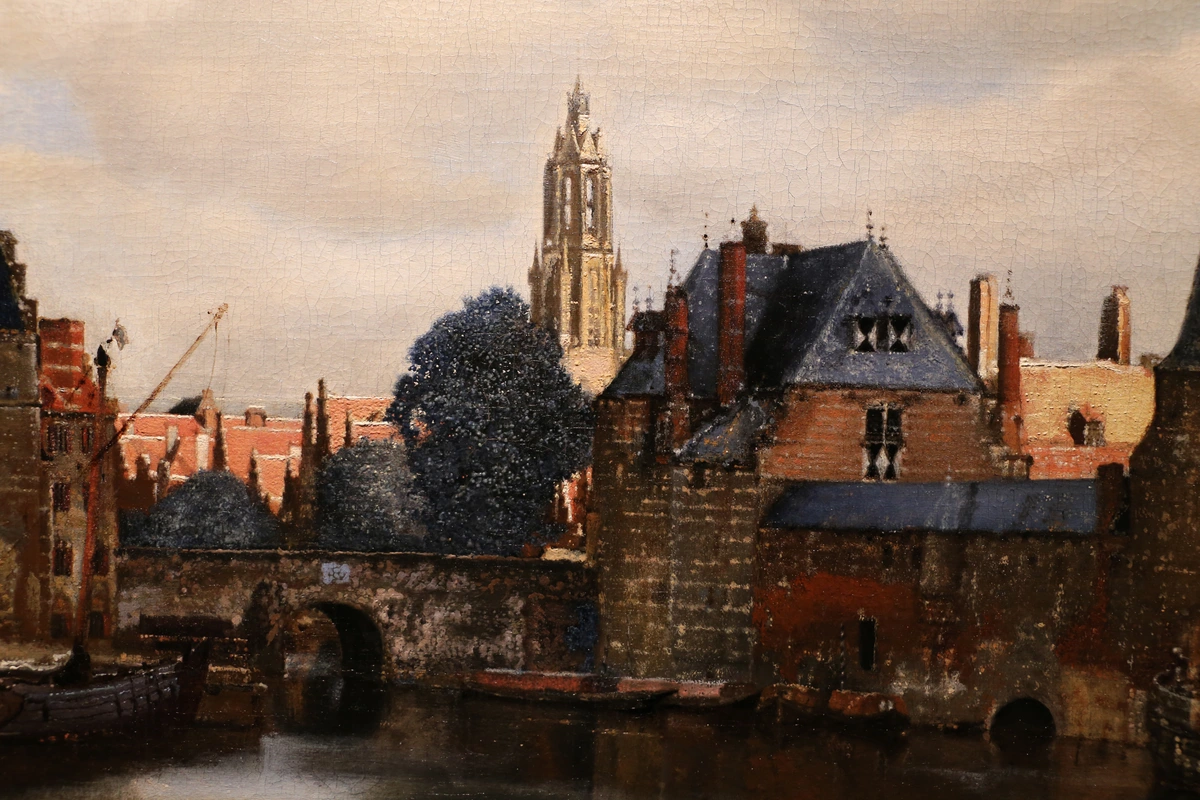
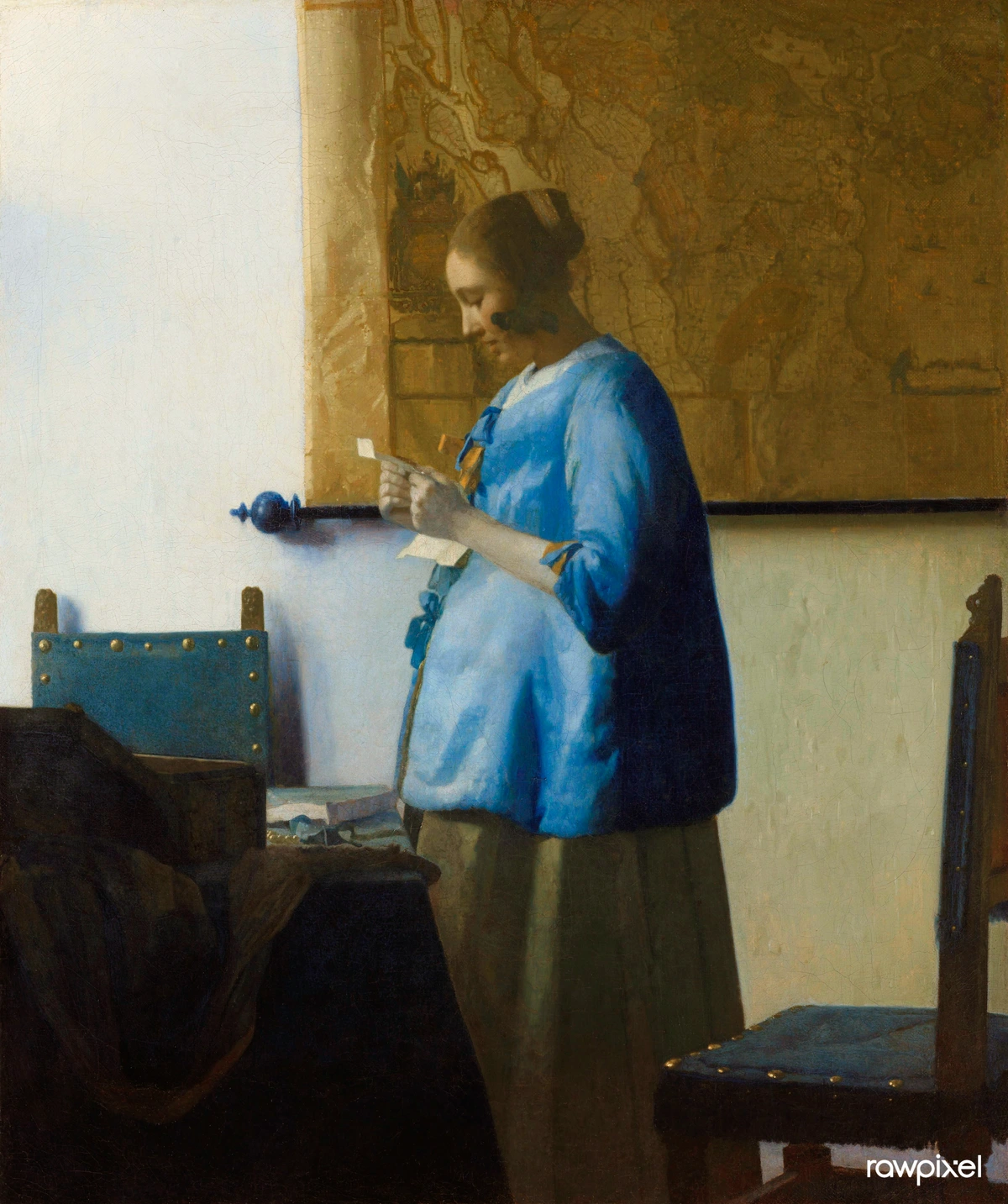
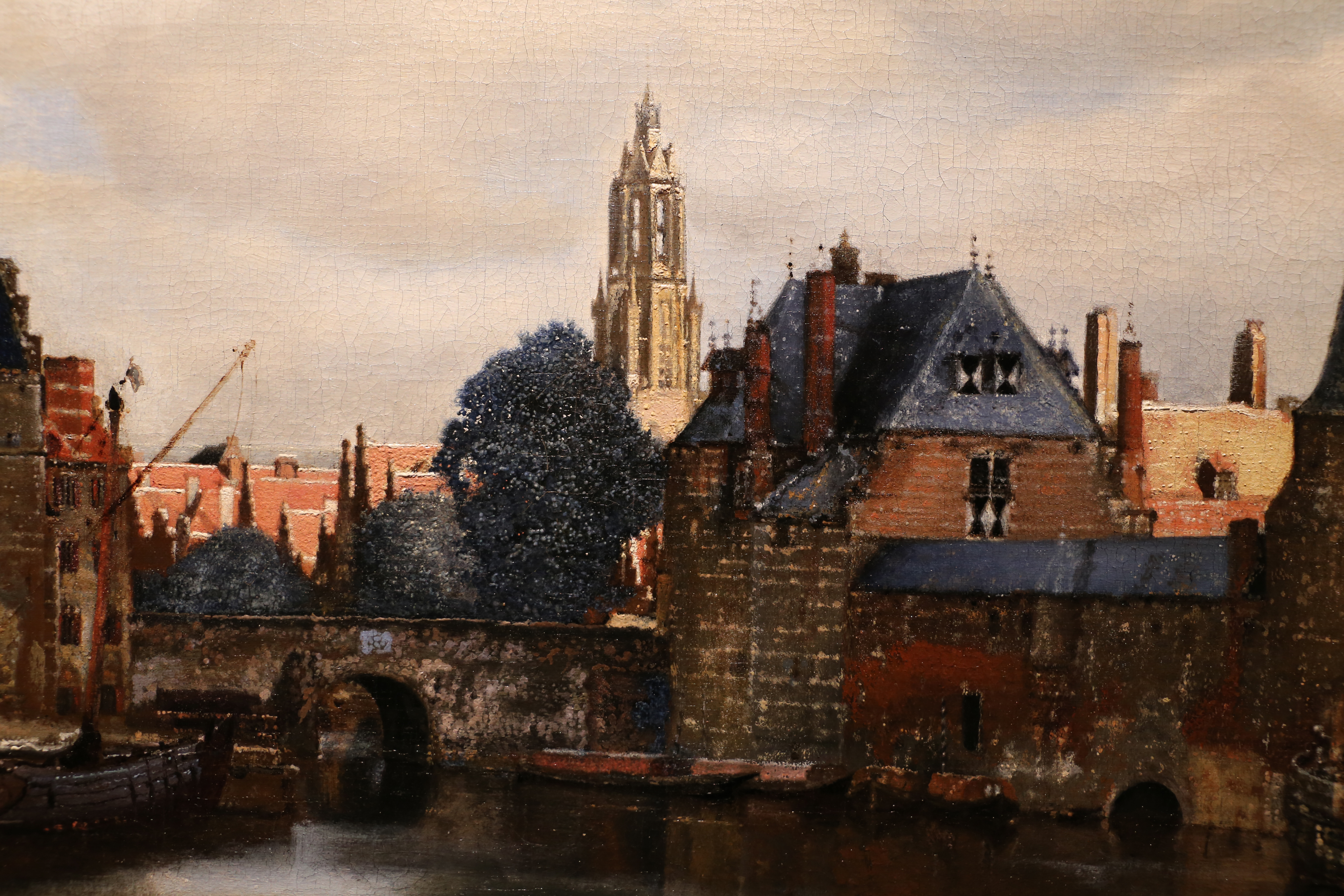
While Realism as a movement solidified in the mid-19th century, its roots run deeper than many realize. Artists across different eras had, at times, demonstrated a 'realistic' impulse, capturing everyday life or unidealized subjects long before Courbet picked up a brush. Think of the detailed genre paintings of the Dutch Golden Age – scenes of everyday life, rather than historical or mythological subjects – depicting domestic interiors, market life, and portraits of ordinary citizens with an almost photographic eye, showing their lives unvarnished. Artists like Jan Steen, Pieter de Hooch, or Johannes Vermeer offered intimate glimpses into the Dutch household, capturing the quiet dignity or bustling activity of common folk. Or consider certain Enlightenment-era portraiture, such as those by William Hogarth or Francisco Goya (in his more critical works like The Disasters of War or his later Black Paintings), that focused on capturing individual character without excessive flattery, presenting people as they truly were, with their flaws and unique expressions, rather than idealized archetypes. Hogarth, for instance, used detailed observation to satirize societal ills, while Goya's portraits often conveyed the psychological depth and even the grim realities of his subjects' lives. Even earlier, elements of realism can be found in the humanistic, emotionally charged figures of Giotto or the meticulous detail of Flemish Renaissance painters like Robert Campin or Jan van Eyck. These were not 'Realism' with a capital R, but they were crucial historical precedents, showing a recurring desire to ground art in the observable world.
Artists like Gustave Courbet looked around and thought, "Why are we painting Venus when there are stone breakers right outside my window?" It was a radical idea: that the lives of common people—their labor, their joys, their sorrows—the unvarnished truth of their existence—were worthy subjects for "high art." This wasn't just an artistic choice; it was a profound political and social statement. When his massive painting, A Burial at Ornans (1849-1850), was exhibited, critics were horrified. Why? Because depicting an ordinary, small-town funeral with the monumental scale (over 10 by 20 feet!) usually reserved for historic events or religious epics, populated by everyday people with ordinary expressions, not idealized mourners, and featuring portraits of local villagers, was seen as a vulgar lack of decorum and a direct affront to established artistic propriety. It was like putting a snapshot from your family barbecue onto the scale of a Hollywood epic – scandalous! Courbet famously said, "Show me an angel and I will paint one," encapsulating his unwavering commitment to painting only what he could directly observe and experience, dismissing subjects beyond the tangible. This wasn't just a witty remark; it was a defiant declaration, almost a personal manifesto, against the romanticized, allegorical art of his time, aligning perfectly with the burgeoning philosophy of Positivism. His works like The Stone Breakers (1849) further cemented his dedication to depicting the harsh, unromanticized realities of working-class life, giving dignity and monumental presence to those usually overlooked by academic art. The rough, textured brushwork in such pieces emphasized the very materiality of the stone and the laborers' worn hands, connecting form to content.
The art establishment, as you can imagine, was not amused. Critics deemed Courbet's work vulgar, common, and lacking the elevated subject matter expected of fine art. When his work was repeatedly rejected from the official Paris Salon, he defiantly staged his own independent exhibition, "The Pavilion of Realism," in 1855. This was more than just a show; it was a direct challenge to the established Salon system and an early assertion of artistic autonomy, laying a foundational stone for modern art's independence. This bold declaration that artists could define their own subjects and dictate their own terms echoed through the entire history of modern art. In essence, he created the blueprint for what we now understand as a private gallery or an independent artist-run space – a truly revolutionary act of self-empowerment that paved the way for the avant-garde, fostering a sense of community among like-minded rebel artists.
Key Characteristics of Realism Art: What Defines the Movement?
Having understood the societal forces and artistic shifts that birthed the Realism art movement, let's now look at the defining traits that make a work truly 'Realist.' So, how do you spot a Realist painting? It's not always about photorealistic detail, though it can be. It’s more about the what and the how—a deliberate choice to engage with the immediate, tangible world around us, and to depict it with a certain truthfulness. Think of it as painting life as it truly is, without the rose-tinted glasses. What did these artists prioritize, and what specific elements distinguish a Realist work?
Characteristic  | Description | Example Artist/Work | Goal/Emphasis |
|---|---|---|---|
| Subject Matter | Focused on the everyday, the mundane, and the unidealized. Peasants, laborers (e.g., stone breakers, gleaners), urban street scenes, domestic interiors, and ordinary landscapes became the main event. These were often chosen for their social significance and inherent dignity, elevating the lives of common people (like factory workers or laundresses) to 'high art' status. | Gustave Courbet's A Burial at Ornans (depicting an ordinary funeral on a monumental scale) | Dignifying the ordinary, reflecting contemporary life, giving voice to the marginalized. |
| Objective Depiction | Artists aimed to depict the world as they saw it, without romanticizing, sentimentalizing, or overtly dramatizing. This meant a faithful, almost scientific observation of reality, often portraying the harsh realities of life with an implicit critique of societal norms. The presentation aimed for impartiality, offering an unvarnished truth without overt emotional manipulation, a powerful counter to the melodramatic and idealized narratives of Romanticism. | Jean-François Millet's The Gleaners (focusing on unvarnished observation of rural labor and poverty) | Empirical truth, avoidance of idealization or sentimentality, a direct gaze at reality. |
| Social Commentary | While often presented with an objective eye, many Realist works implicitly or explicitly critiqued societal injustices, economic disparities, or the rigid conventions of the art world, giving voice and dignity to the marginalized and overlooked. The very choice of a common subject on a grand scale was a potent social statement, directly challenging the status quo. This could be conveyed through stark juxtapositions of wealth and poverty, the depiction of grueling labor, or satirical caricatures exposing hypocrisy (e.g., urban poor contrasting with the affluent bourgeoisie). | Honoré Daumier's satirical caricatures (e.g., Gargantua, critiquing political corruption and social inequality) | Critiquing society, raising awareness of social issues, advocating for change or exposing uncomfortable truths. |
| Rejection of Idealization | No more airbrushing. Realists painted wrinkles, dirt, torn clothing, tired expressions, and the physical toll of labor. It was about authenticity over manufactured beauty, showing life as it truly was—raw, imperfect, and sometimes deliberately 'ugly' to provoke thought and confront uncomfortable truths. This was a direct affront to genteel academic standards and a radical expansion of what could be considered 'beautiful' in art. For instance, the worn, patched clothes of the stone breakers in Courbet's work, or the unvarnished depiction of a contemporary courtesan in Manet's Olympia. | Édouard Manet's Olympia (confronting uncomfortable truths with a direct, challenging gaze and visible imperfections) | Authenticity, confronting reality, expanding aesthetic boundaries beyond conventional beauty. |
| Earth Tones & Varied Palettes | The color palette often leaned towards dark, earthy tones—browns, greys, and greens—reflecting the gritty reality of the subject matter and a deliberate departure from the vibrant, idealized hues of Romanticism. This muted palette reinforced the sober, unadorned vision of reality. However, some artists like Manet began to use sharper contrasts, flatter areas of color, and even more vibrant colors when depicting modern urban life, reflecting the artificial lighting of Parisian cafes or the visual dynamism of the city, showing a divergence from a purely somber palette to reflect the multifaceted modern experience. | The works of the Barbizon School painters (reflecting gritty reality in naturalistic landscapes); Manet's later urban scenes (reflecting modern life's dynamism) | Grounding art in visible reality, sometimes reflecting urban dynamism and the shifting visual landscape of modernity. |
Visual Techniques of Realism Painting
Understanding what Realist artists chose to depict is essential, but how they chose to depict it—through specific visual strategies—is equally crucial to grasping their revolutionary aims. Beyond just subject matter, Realist painters also employed distinct visual techniques that reinforced their commitment to observable reality and often departed dramatically from academic traditions:

- Unembellished Brushwork: While not always as overtly visible as later Impressionist strokes, Realist brushwork aimed for clarity and directness, often reflecting the texture of the subject itself. For some, like Courbet, it could be quite painterly and textural, emphasizing the materiality of paint itself rather than trying to completely disappear into an illusionistic surface (the polished, almost invisible brushwork favored by academic artists). This 'unembellished' quality wasn't about invisibility, but about honestly conveying the substance of the world or the paint, often reflecting the rough-and-tumble nature of their subjects (e.g., the rough texture of stone in The Stone Breakers or coarse fabric). For others, like some American Realists, the finish could be smoother, mimicking photographic detail, but still focused on objective rendering rather than academic polish or idealized forms.
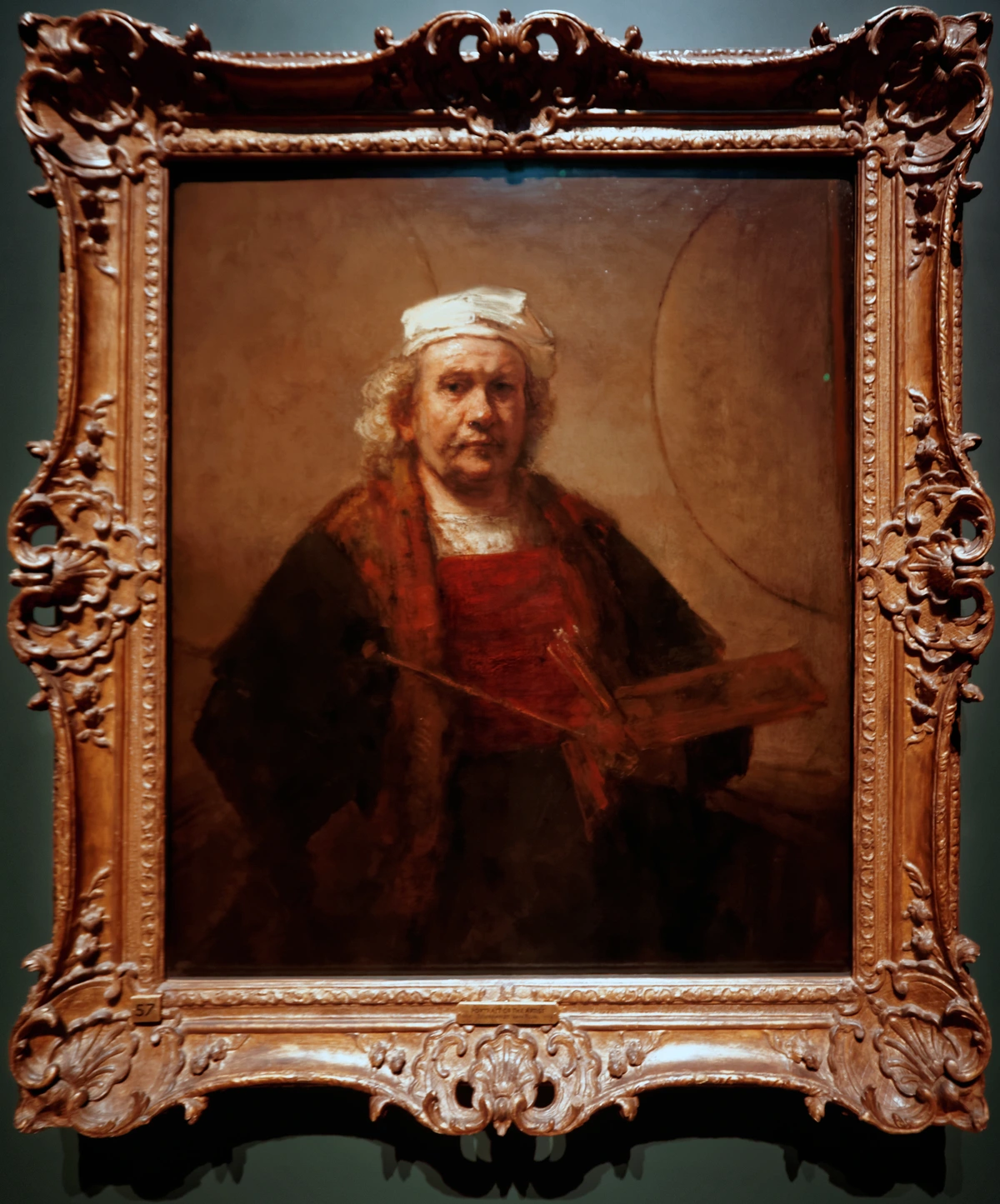
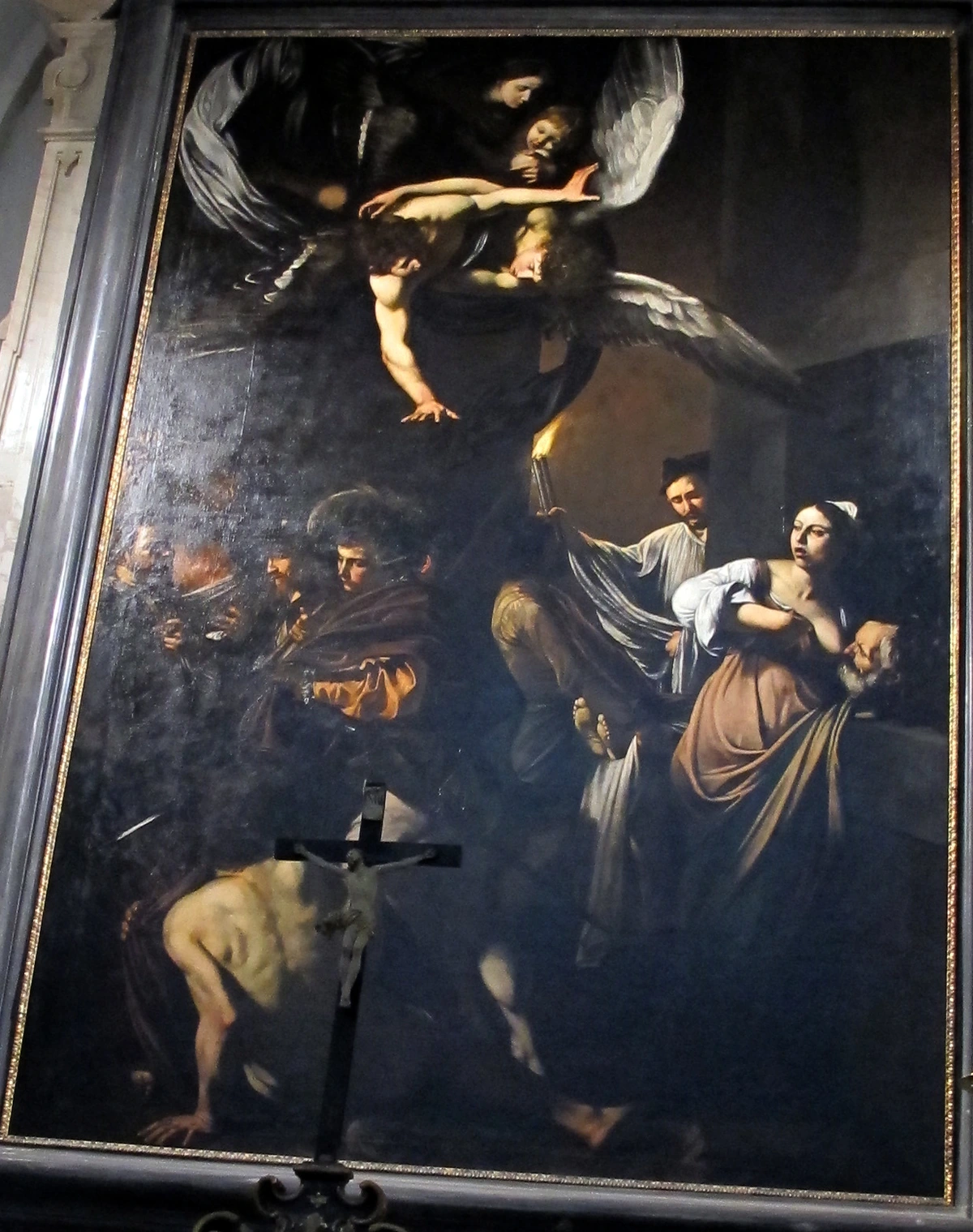
- Natural Light and Shadow: Realists typically avoided the dramatic, theatrical lighting of Romanticism or the strong chiaroscuro of earlier periods (like Caravaggio or Rembrandt), which often added an air of drama or mystery. Instead, they often favored diffused, natural light that revealed forms and textures without idealizing them, making scenes feel grounded in everyday observation. They meticulously studied how light truly fell on objects and figures in ordinary settings, often creating a sense of quiet authenticity and a palpable sense of the time of day.
- Candid Compositions: Heavily influenced by photography and its 'snapshot' quality, Realist artists often adopted compositions that felt less staged and more like a captured moment of life. This could include asymmetrical arrangements, figures cropped at the edges of the canvas (as if seen through a camera lens), or a seemingly random distribution of elements, mirroring the unposed, fleeting nature of real life. Think of a figure half out of frame, or a seemingly insignificant detail taking prominence, giving a sense of immediacy and authenticity, breaking from the symmetrical, idealized arrangements of academic art.
- Focus on Texture and Materiality: Realists were meticulous in rendering the texture of fabric, skin, wood, or stone. They wanted the viewer to feel the roughness of a peasant's clothes, the worn quality of tools, or the dampness of the earth, creating a powerful, visceral sense of tangible reality and immersing the viewer in the physical world of the painting. This tangible quality brought the viewer closer to the unvarnished truth of the subject.
Realism vs. Naturalism vs. Verism: Nuances of the Unfiltered View
These terms are often used interchangeably, which can be confusing. I know I mixed them up for years. Here’s a quick breakdown to help clarify things, because while related, they each have distinct nuances, particularly in their philosophical underpinnings and intensity of depiction. Understanding these distinctions helps us appreciate the specific aims of Realism and its offshoots.
Term | Main Idea | Key Difference | Artistic/Literary Example | Goal/Emphasis |
|---|---|---|---|---|
| Realism | An art movement focused on depicting contemporary life and society, often with a pronounced political or social edge and a commitment to observed reality, giving dignity to the mundane. | It's about the subject matter (everyday life) and the artist's social consciousness in the mid-19th century, often aiming to dignify ordinary existence through an objective lens. Its revolution was in what was painted and why. | Gustave Courbet's The Stone Breakers (painting common laborers with monumental scale and dignity) | Elevating the ordinary, social critique, objective portrayal of contemporary life. |
| Naturalism | A broader style or theory aiming to represent reality in a highly detailed, objective, and often scientific way, deeply influenced by ideas of determinism. This means that human actions and character are largely shaped by their environment, heredity, and social conditions, much like a scientific experiment. In art, this often manifests in bleak or tragic narratives where characters have little agency, serving as products of their harsh environment, emphasizing the crushing power of external forces in shaping human fate. | It’s more of a philosophical stance – often leading to grittier, sometimes more pessimistic portrayals than Realism, focusing on environmental and hereditary determinism over individual agency. It emphasizes the brutal logic of cause and effect in human lives. | Émile Zola's novels (e.g., Germinal, depicting the inescapable cycle of poverty and labor) or the stark urban scenes of the Ashcan School, depicting individuals as products of their harsh environment. | Scientific observation, grim depiction of determinism, analysis of social conditions and their impact on individuals. |
| Verism | An extreme form of Naturalism, particularly prominent in Italian opera and literature, but also evident in visual art. It focuses on the brutal, violent, and sordid aspects of life, pushing for maximum emotional or social impact, often to shock the viewer into confronting reality. In art, think of unflinching portraits that highlight every flaw and imperfection or theatrical scenes embracing the sensational or grotesque to reveal a deeper truth about societal issues. | It's Naturalism with the intensity turned up to eleven. Maximum grit and unvarnished truth, often to the point of deliberate ugliness for emotional impact, to shock the viewer into confronting reality. It amplifies the raw, often harsh, and even sordid aspects of life, sometimes bordering on the grotesque, for heightened emotional or social impact and visceral connection (e.g., Roman Republican portraiture's unflinching depiction of age and experience). | Italian verismo opera (e.g., Pagliacci, with its raw portrayal of jealousy and murder) or unflinching, raw portraits emphasizing physical flaws and intense emotion. | Shocking awareness, visceral impact, intense emotional truth, often through explicit and sometimes grotesque representation. |
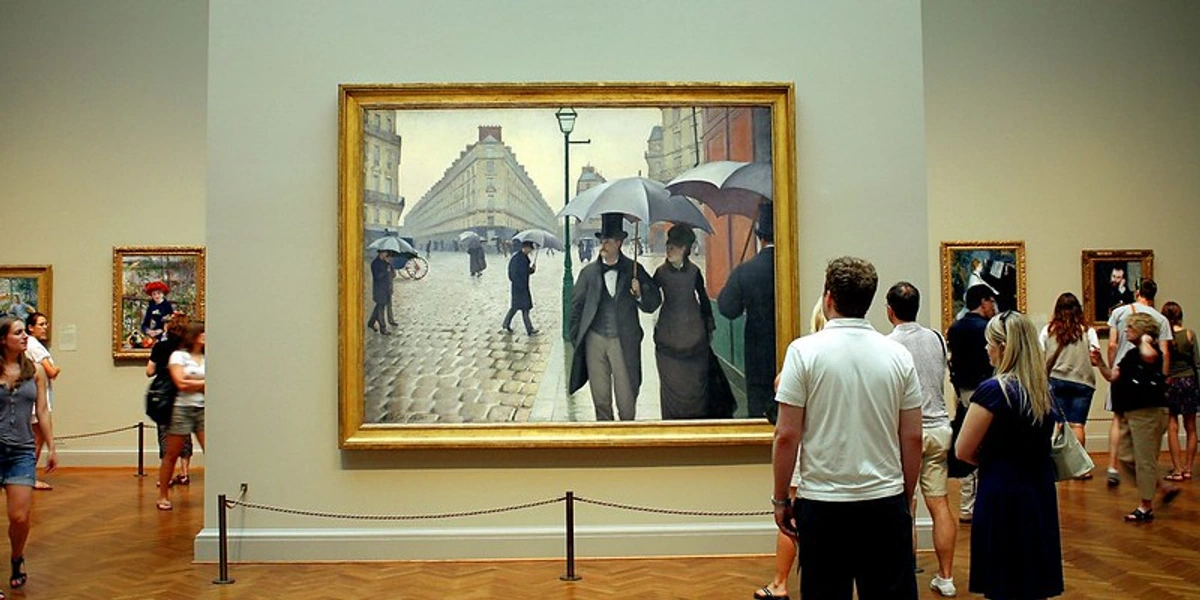
The Pioneers of Realism: Shifting the Gaze
You can't talk about Realism without tipping your hat to the artists who braved the critics and forged this new path, redefining what art could be. They were the ones who dared to paint the world as it was, not as society wanted it to be.
Gustave Courbet (1819-1877): The Firebrand and Provocateur
The undisputed leader and firebrand of the movement. Courbet was a provocateur who explicitly rejected academic conventions and romanticized subjects. When his massive painting, A Burial at Ornans (1849-1850), was exhibited, critics were horrified. Why? Because depicting an ordinary, small-town funeral with the monumental scale (over 10 by 20 feet!) usually reserved for historic events or religious epics, populated by everyday people with ordinary expressions, not idealized mourners, and featuring portraits of local villagers, was seen as a vulgar lack of decorum and a direct affront to established artistic propriety. It was like putting a snapshot from your family barbecue onto the scale of a Hollywood epic – scandalous! Courbet famously said, "Show me an angel and I will paint one," encapsulating his unwavering commitment to painting only what he could directly observe and experience, dismissing subjects beyond the tangible. This wasn't just a witty remark; it was a defiant declaration, almost a personal manifesto, against the romanticized, allegorical art of his time, aligning perfectly with the burgeoning philosophy of Positivism and empiricism. His works like The Stone Breakers (1849) further cemented his dedication to depicting the harsh, unromanticized realities of working-class life, giving dignity and monumental presence to those usually overlooked by academic art. The rough, textured brushwork in these pieces emphasized the very materiality of the stone and the laborers' worn hands, connecting form to content. Another key work, The Painter's Studio (1855), presented itself as an allegorical reflection on Courbet's own artistic life and the society around him, blurring the lines between self-portrait, genre scene, and social commentary. His independent "The Pavilion of Realism" exhibition in 1855, staged after repeated Salon rejections, was a foundational act of artistic autonomy, fostering a sense of community among other rebellious artists and setting a precedent for the avant-garde to challenge institutional gatekeepers. What a shift in power, right?
Jean-François Millet (1814-1875): The Poet of Rural Labor
Millet focused on rural life, but unlike previous artists who romanticized peasants, he depicted their back-breaking labor with a sense of quiet dignity, solemnity, and almost religious reverence. His work gave a profound, monumental quality to the lives of agricultural laborers. The Gleaners (1857), showing three women picking leftover wheat after the harvest, is a perfect example of finding monumentality in the mundane. The figures' bent forms and the vast field behind them subtly highlight the stark economic realities of rural poverty—the contrast between the landowner's abundance and the meager gleanings of the poor. This sympathetic portrayal of the working class often drew criticism from the elite, who saw it as potentially revolutionary because it hinted at class struggle without overt melodrama. His work asked viewers to confront the quiet hardship of those who sustained society. His The Sower (1850) and The Angelus (1857-1859), depicting two peasants pausing in a field to pray, further exemplify his ability to imbue everyday tasks with spiritual depth, transforming common toil into a moment of grace and elevating the inherent humanity in the labor of peasants, even if the subject carried religious undertones, the focus remained on the unvarnished reality of peasant piety.
Édouard Manet (1832-1883): The Bridge to Modernity
Manet is a fascinating figure, often seen as the bridge between Realism and Impressionism. While he never fully identified as a Realist, his unflinching embrace of modern life as subject matter and his revolutionary approach to painting positioned him firmly within the Realist impulse. His subjects were modern Parisian life – cafe scenes, portraits of friends, or scandalous depictions of contemporary nudes. His paintings Déjeuner sur l'herbe (1863) and Olympia (1863) famously shocked the art world not just with their nudity, but with their direct gaze, visible, almost 'flat' brushstrokes, and their subversion of classical art historical tropes. Déjeuner sur l'herbe scandalized viewers because it presented a nude woman casually picnicking with two fully clothed men in a contemporary outdoor setting, staring directly out at the viewer – a direct affront to traditional mythological or allegorical nudes. Olympia, in particular, further challenged Victorian sensibilities by depicting a contemporary courtesan rather than an idealized goddess, staring boldly and unapologetically at the viewer, confronting them with an undeniable, unadorned reality. What did 'flatness' mean in this context? It was Manet's deliberate reduction of traditional three-dimensional illusion, using less modeling and starker outlines, bringing the figures forward and emphasizing the canvas as a flat surface – a radical departure from academic polished realism aiming for deep spatial illusion (think of it less like looking through a window, and more like a scene staged on a shallow stage). His deliberate use of visible brushstrokes and flattened planes themselves reflected the new, fast-paced, and often fragmented experience of modern urban life, breaking from the polished finish expected of academic art. This stylistic choice, far from being a flaw, was an intentional declaration of the artist's subjective experience and technique as much as the subject itself, pushing art further towards modernity.
American Realism: Rugged Individualism and Urban Grit
Across the Atlantic, Realism took on a distinctly American flavor, often focusing on the rugged individualism and the developing modern landscape. Artists like Thomas Eakins captured the raw physicality of rowing in The Champion Single Scull (1871) or the stark realities of surgery in The Gross Clinic (1875). This painting was so unflinching in its depiction of a real-life medical procedure, with visible blood, the doctor's direct engagement with the patient, and the mother's pained reaction – a true embodiment of objective depiction and rejection of idealization – that it was initially rejected for exhibition and seen as too brutal and scientifically cold for public display, challenging the era's more genteel artistic representations of medicine. Winslow Homer, on the other hand, depicted the lives of fishermen and farmers with unvarnished truth, celebrating their resilience against nature in powerful maritime scenes like The Fog Warning (1885), showing the raw struggle and respect for the elements and underscoring humanity's vulnerability and psychological fortitude. George Caleb Bingham's depictions of frontier life and riverboatmen also captured the unidealized realities of the American West, often focusing on moments of quiet observation or the social dynamics of river trade and politics.
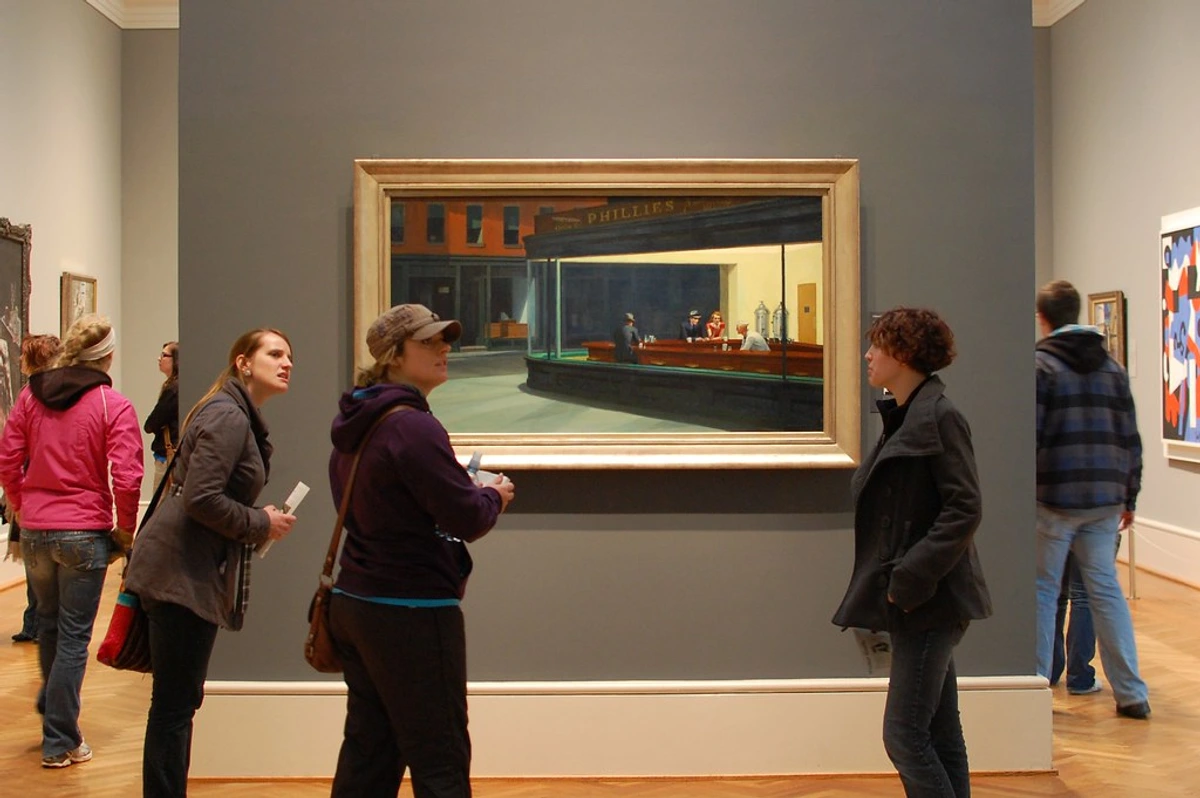
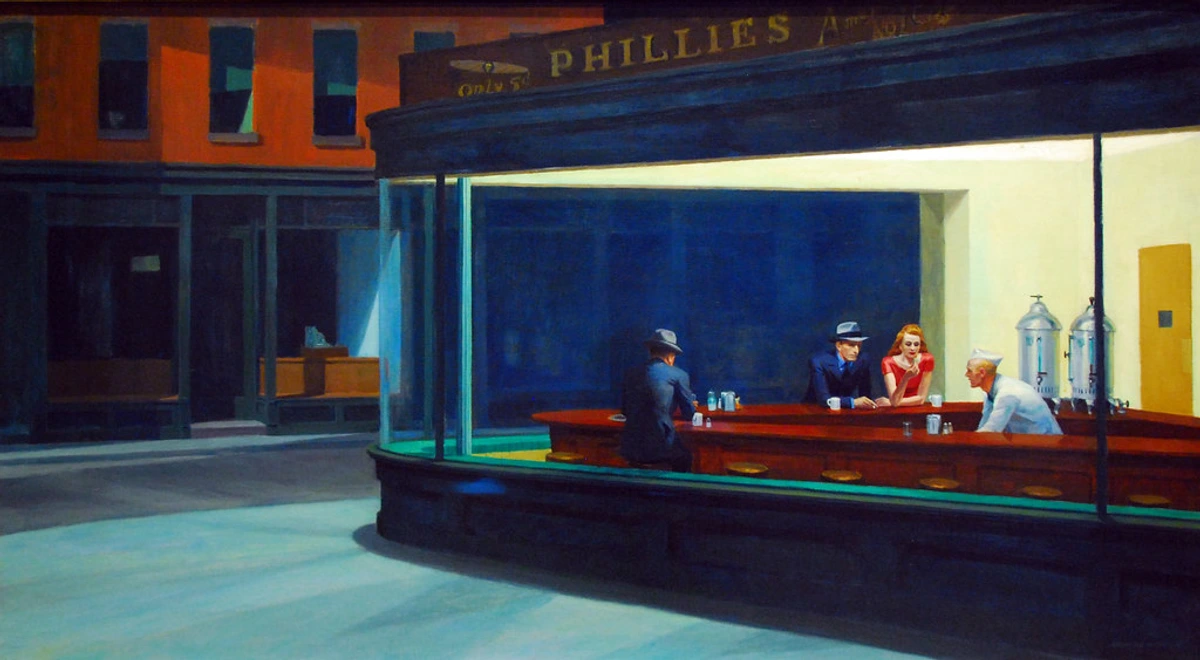
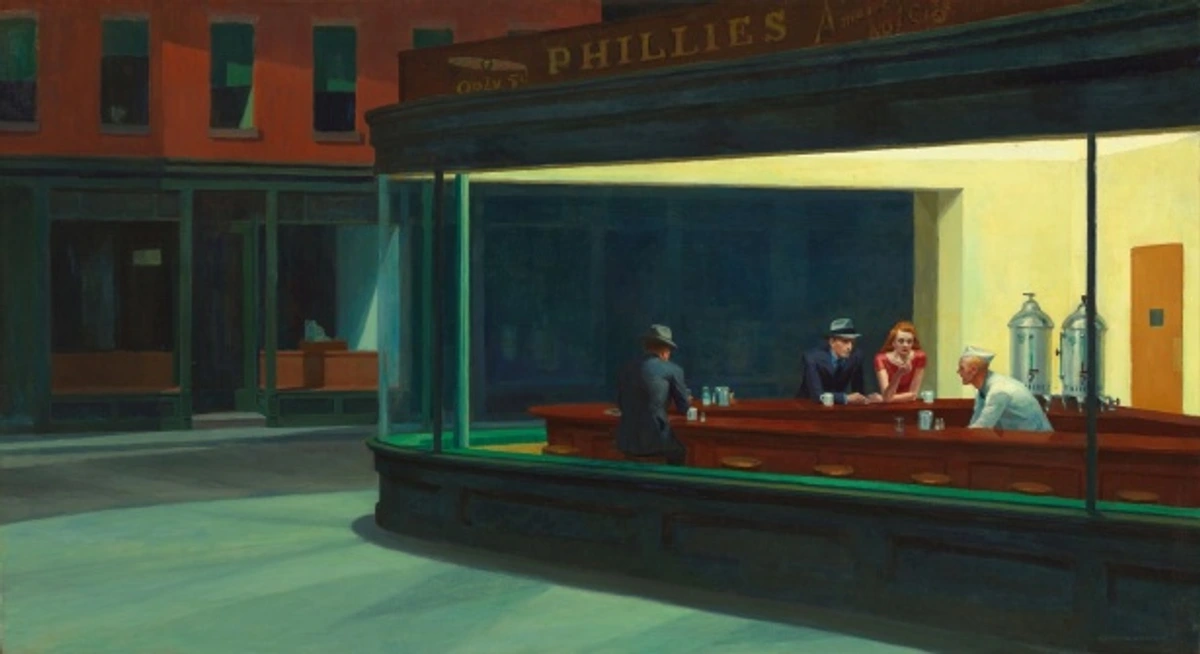
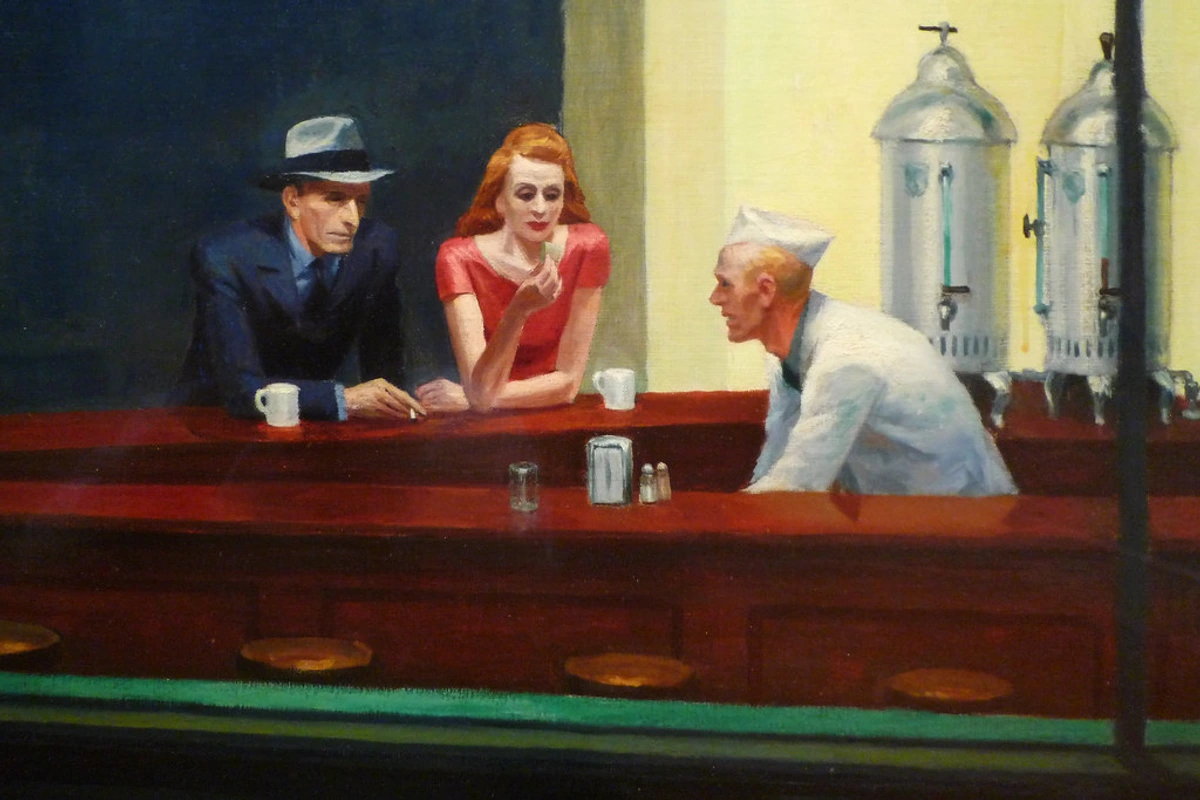
Later, this tradition evolved into the Ashcan School in the early 20th century, which explicitly focused on the gritty realities of urban life in New York City. Artists like Robert Henri, John Sloan (McSorley's Bar), George Luks, and William Glackens depicted street scenes, tenements, and boxing matches, embracing the vitality and challenges of the working class with a direct, unvarnished style. This gave us icons like Edward Hopper, whose focus on the alienation, introspection, and quiet dramas of ordinary urban life solidified the continuation of Realism's focus on the modern condition, but with a deeper, often melancholy, psychological dimension, making it a profound and enduring form of American Realism.
Realism Beyond France and America
While France was the birthplace, the spirit of Realism resonated globally, taking on local characteristics and addressing distinct national concerns:
- Russian Realism: Artists like Ilya Repin (Barge Haulers on the Volga, 1870-1873) powerfully depicted the sheer physical toil and dehumanizing labor under Tsarist rule and the lingering impacts of serfdom, making it a stark indictment of social hierarchy and class exploitation. The visual details – the strain on their faces, the weary posture, the endless rope, the vast, empty landscape – conveyed the brutal reality of their existence and evoked deep empathy from viewers. Vasily Perov used Realism to critique social injustices and depict the struggles of the working class and peasantry, often focusing on issues like alcoholism, poverty, and the plight of orphans, with a profound sense of psychological depth and empathy, making powerful social statements about human suffering and labor exploitation. Ivan Kramskoi's portraits, too, captured the inner lives of ordinary Russians with unflinching honesty and psychological insight.
- British Realism: Though less cohesive as a formal movement, British artists like Luke Fildes (Applicants for Admission to a Casual Ward, 1874), with its stark depiction of Victorian urban poverty and the harsh realities of industrialization and inequality, and Hubert von Herkomer depicted social issues with a journalistic eye. Their work often functioned as a form of social reportage, exposing societal ills to a wider public and reflecting concerns about the profound changes brought by the industrial age, focusing on the plight of the working class and the marginalized. Even the early works of the Pre-Raphaelite Brotherhood, with their meticulous detail and focus on observable reality (before their later turn to romanticized subjects), showed a strong realist impulse in their dedication to optical truth, rendering textures and details with almost scientific precision.
- Other European Forms: Artists across Europe similarly turned to depicting local life. In Germany, painters like Wilhelm Leibl explored rural scenes and portraiture with meticulous, almost Flemish-like detail, often focusing on the quiet dignity and authentic character of ordinary rural folk in their specific environments. Spain saw artists like Joaquín Sorolla depicting everyday life, often focusing on the light and vibrancy of his subjects like fishermen and beachgoers while still rooted in observable reality and capturing the light and texture of daily Spanish life, aligning with Realism's focus on the contemporary and unidealized. In Italy, the Macchiaioli group, active from the 1850s, sought to capture the 'macchia' (patch or spot) of color and light in their depictions of landscapes and everyday military or rural life, aiming for an immediate, truthful impression of reality.
Realism in Other Mediums: Beyond the Canvas
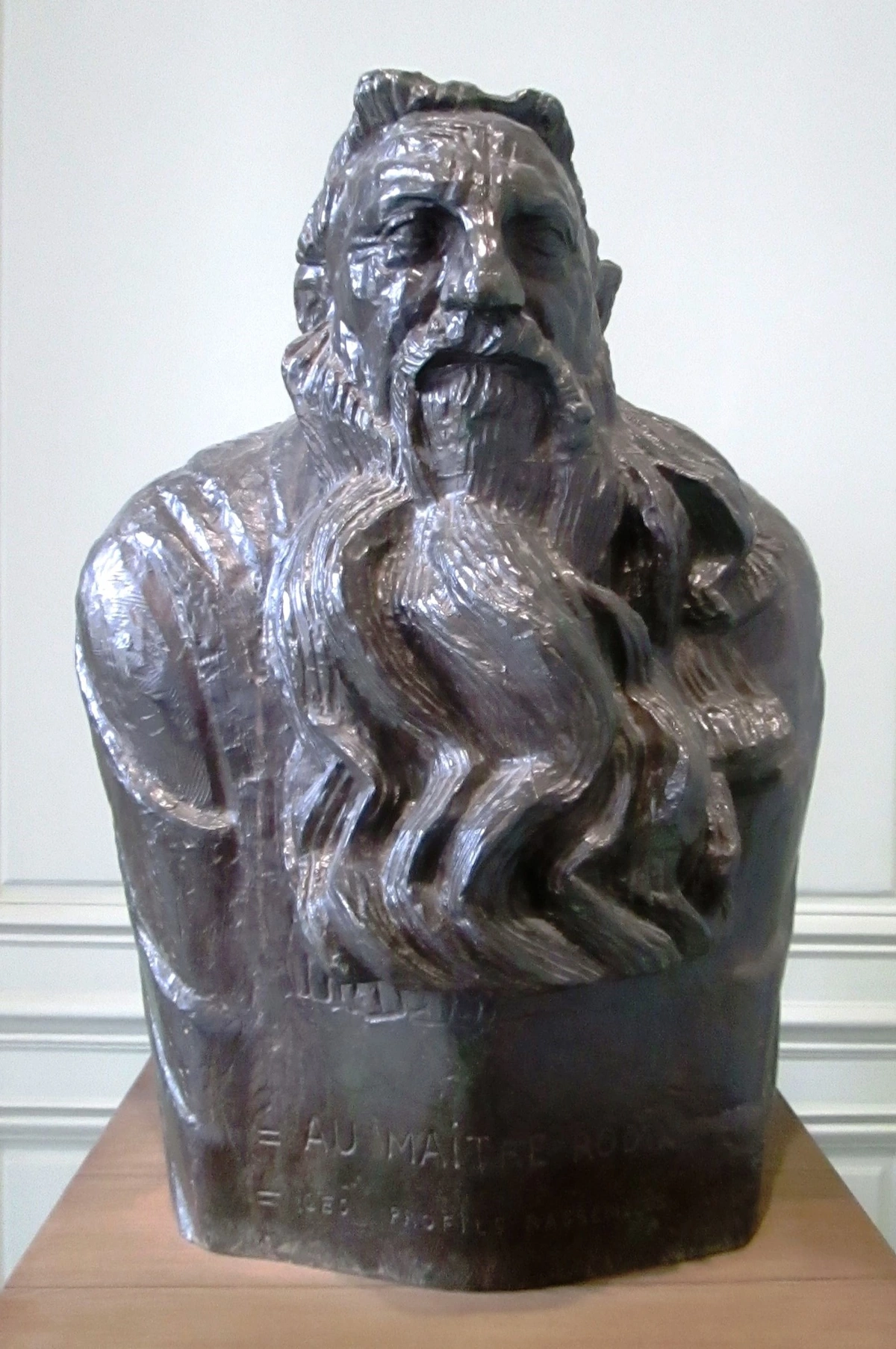
While painting dominated the Realist movement, its principles of depicting observable reality and addressing contemporary life naturally extended to other art forms. In sculpture, artists like Auguste Rodin, while often blending naturalism with strong emotional expression and later Symbolist tendencies, created figures that felt intensely real, imbued with the raw physicality and psychological depth of human experience. His detailed renderings of the human form, as seen in works like The Thinker or the raw emotion of The Burghers of Calais, even when part of allegorical works, demonstrated an unflinching observation of the body and its capacity for introspection and struggle – a clear connection to Realist principles despite his broader stylistic scope. The powerful texture and expressive poses of his figures conveyed a palpable sense of lived reality.
In literature, Naturalism (as discussed earlier, championed by Émile Zola) flourished, using scientific observation to depict characters as products of their environment and heredity, often in grim, unvarnished detail. Authors like Guy de Maupassant (with his unflinching portrayals of peasant life and bourgeois hypocrisy) and Anton Chekhov (exploring the mundane realities and psychological nuances of Russian society) also explored the contemporary world with psychological depth and a keen eye for social observation. Realism's influence also laid groundwork for later forms of visual storytelling, including early cinema and documentary photography, which aimed to capture life as it happened, without artificiality or idealization. Pioneers like the Lumière brothers, with their early 'actualités' simply recording everyday scenes like workers leaving a factory or a train arriving at a station, were essentially applying Realist principles to a new medium, capturing the raw, unposed truth of modern existence.
The Enduring Legacy: How Realism Changed Art Forever
Realism's impact is hard to overstate. By breaking the stranglehold of academic art and insisting that anything could be a subject for art, it opened the floodgates for modernism and countless subsequent movements. It fundamentally changed the artist's role and the purpose of art itself. Without Realism, the art world we know today would be entirely different. I've often thought about this while wrestling with my own creative process; sometimes you have to know the rules of reality before you can break them in a meaningful way.
Here's what I see as its most profound contributions:
1. It Made the Modern World the Primary Subject of Art
Before Realism, grand narratives dominated. After, the ordinary became extraordinary. Realism validated the subjectivity of contemporary experience, arguing that the artist's personal vision of their own time was as valid, if not more so, than depicting historical or mythological events. It legitimized the here and now as worthy of artistic contemplation. Without Realism, there would be no Impressionists painting Parisian cafes (Impressionism directly built on Realism's focus on modern life, adding an emphasis on fleeting light and momentary sensation), no Cubists analyzing guitars and newspapers as reflections of modern fragmentation (a direct evolution from Realism's engagement with the contemporary), and certainly no contemporary artists using their iPhone cameras to document street life. It paved the way for the Ashcan School, documentary photography, and much of today's street art. It also mirrored the rise of social sciences like sociology and urban studies in the late 19th century, showing how art was increasingly engaging with, and reflecting, the empirical observation and analysis of society. Realism essentially opened the door for art to become a mirror of contemporary society, rather than just a window to the past.
2. It Established the Artist as an Independent Voice and Social Commentator
Courbet holding his own exhibition after being rejected by the Salon was a declaration of artistic independence that reverberates to this day. It directly contributed to the concept of the avant-garde—artists and works that are experimental or innovative, pushing the boundaries of what is accepted as the norm. Realism showed that art could be a powerful tool for social critique, inspiring movements like Social Realism in the 20th century, and the work of countless contemporary activists who use art to highlight injustice. The idea that an artist doesn't need external validation from institutions to create meaningful work, and can instead challenge institutional gatekeepers, that's pure Realism. What a shift in power, right?
3. It Pushed the Boundaries of Aesthetic Truth
By daring to depict the ugly, the gritty, and the unidealized, Realism expanded our understanding of beauty. It challenged the notion that art had to be 'pretty' or classical to be profound, a direct affront to Victorian sensibilities. Realism expanded the definition of "beauty" to include authenticity, truthfulness, and even the starkness of unvarnished reality, challenging the idea that art must be aesthetically pleasing in a conventional sense to be valuable. This paved the way for movements like Expressionism, which embraced subjective emotional truth as a reaction against purely objective representation, and later, even Hyperrealism, which, despite their differing techniques, share Realism's intense commitment to observable reality and an unflinching gaze at the world, sometimes pushing illusionism to its extreme.
Limitations and Criticisms
While Realism revolutionized art, it wasn't without its critics or perceived limitations. Some found its strict focus on the mundane to be uninspired or lacking the elevated emotional and spiritual content of earlier Romantic art, arguing that by strictly adhering to observable reality, Realism risked sacrificing imagination or deeper symbolic meaning. Critics accustomed to grand narratives or moral allegories sometimes dismissed Realist works as mere documentation or journalistic reporting, lacking the 'higher purpose' of art. They felt that by presenting life "as is," without overt moralizing or clear allegorical lessons, Realism left too much to the viewer, which some found unsettling, as they preferred art that offered clear moral guidance. This perceived limitation – the idea that truth sometimes needed more than just observation, but also interpretation, symbolism, or subjective emotion – directly spurred the rise of movements like Symbolism, which sought to imbue art with deeper, often mystical, meanings. Honestly, there are days in my studio where I wrestle with this balance myself. How much 'truth' do I convey, and how much 'interpretation' do I allow? It's a constant dance; I remember one time trying to capture a complex emotion, and I found myself pulling back from literal representation because the 'truth' I wanted to convey felt deeper than what I could simply observe.
Realism's Influence on Propaganda and Visual Communication
Realism's direct, legible, and unvarnished depiction of everyday people and situations made it an incredibly effective tool for mass communication. By presenting scenes that felt immediately relatable and true, Realism could convey powerful messages and evoke strong emotional responses from a broad audience, proving art's capacity to engage directly with political and social narratives. For instance, depicting a stoic, hardworking farmer could symbolize national resilience, or a suffering factory worker could highlight the need for social reform. In later eras, its principles were widely adopted by movements like Soviet Realism, the Works Progress Administration (WPA) murals in the US during the Great Depression (which used realist imagery to foster national identity and social cohesion), and countless war posters and political art across the globe, leveraging its visual accessibility and emotional resonance to appeal to and mobilize the masses. It showed how art could be a powerful, accessible mirror of society, used to shape public perception and convey specific ideological messages.
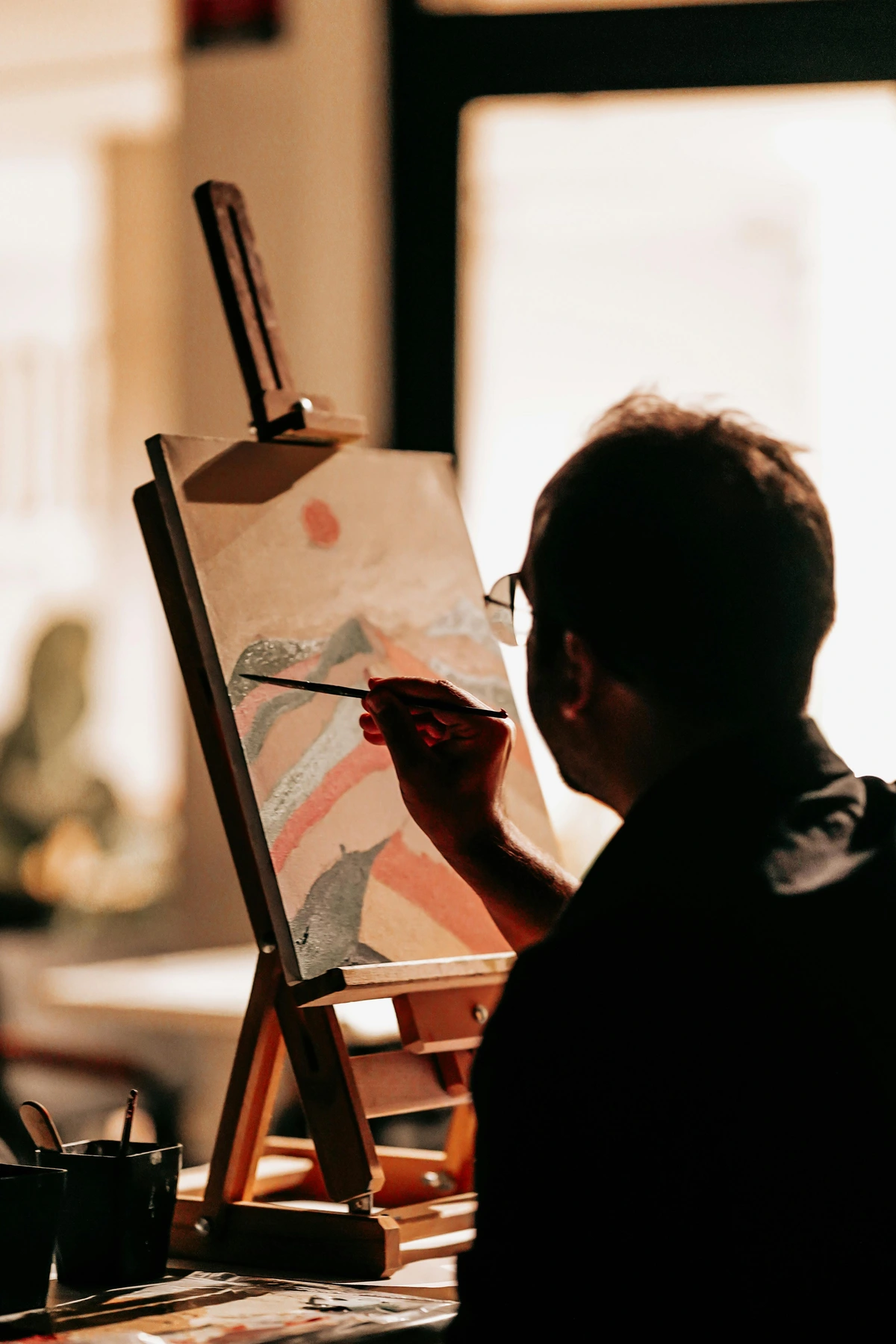
Even today, the impulse to capture the unvarnished truth of our time continues. You see it in documentary photography, in hyperrealistic sculpture, and in the work of countless contemporary painters. My own work, while often abstract, is still rooted in observing the real world—the light, the colors, the energy. It’s about stripping away the superfluous to get to an essence, much like Realism stripped away idealization to reveal truth. Just as Realism sought the core truth of its subjects, I strive to strip away literal representation to reveal the essential energy and emotional truth of what I observe, transforming the raw energy of urban street scenes or the subtle interplay of light and shadow into form and color. While my work diverges into abstraction, the impulse to strip away the superficial to reveal an essential truth – the very core of Realism – remains a guiding principle. Sometimes, you have to know the rules of reality before you can break them in a meaningful way, a lesson Realism taught profoundly. If you're interested in how I translate these observations into my own pieces, you can see some of my work for sale on the /buy page, or explore my artistic journey on my /timeline.
Frequently Asked Questions (FAQ) about Realism Art
What's the difference between Realism (capital R) and realism (lowercase r)?
Realism (capital R) refers specifically to the revolutionary 19th-century art movement, primarily in France, led by artists like Courbet, focusing on contemporary social issues and unidealized subjects. It was a conscious choice and a radical artistic statement against academic traditions. realism (lowercase r) is a broader term that describes any artwork, from any period (e.g., ancient Egyptian portraits, Roman busts, medieval illuminated manuscripts, Renaissance paintings), that aims to represent its subject matter truthfully and accurately. For example, a meticulously rendered Renaissance portrait, while incredibly realistic, is not part of the Realism movement. It's crucial to understand this distinction to appreciate the revolutionary nature of the 19th-century movement and its specific social and artistic intentions.
Is photography a form of Realism?
The invention of photography in the 1830s had a huge influence on Realism. It offered a new standard for objective representation and encouraged painters to look at the world in a new, unmediated way, directly inspiring artists to capture observable reality. While photography can certainly be a tool for realism (and often is, especially documentary photography), it is its own distinct art form. Realism in painting was about choosing what to represent and how to challenge artistic conventions by focusing on truth rather than idealism, something photography inherently did by simply existing and recording the world. Realist painters imbued their chosen subjects with intention, selection, and interpretation, even when aiming for objectivity, offering a curated truth rather than a mere optical copy. Photography both inspired and challenged Realist painters, pushing them to explore deeper subjective truths and the emotional resonance of a scene, rather than mere surface accuracy that the camera could now achieve effortlessly. Whether a photograph is 'Realism' in spirit often depends on the photographer's intent to capture unvarnished social truth or critique society, rather than just technical accuracy.
Why was Realism so controversial?
Realism was profoundly controversial because it challenged the very definition of what art was supposed to be. It rejected traditional standards of beauty, elevated common people and mundane scenes to the status of worthy subjects (often on monumental scales), and frequently carried a subversive political or social message that made the ruling classes and art establishment uncomfortable. Its directness was often seen as vulgar, lacking decorum, and even morally questionable by those accustomed to idealized or heroic narratives. The depiction of 'ugly' or ordinary subjects was a direct affront to bourgeois sensibilities that preferred idealized beauty. It essentially told the establishment, "The world you ignore is the world that matters." The controversy also stemmed from its democratic impulse – it leveled the playing field, suggesting that the lives of ordinary people were as important and worthy of artistic representation as those of kings, queens, and gods. This challenged the social and artistic order inherent in traditional art. Furthermore, the lack of overt moralizing or clear allegorical lessons in Realist works was often seen as unsettling, leaving moral judgment to the viewer rather than providing a clear narrative or comforting moral message.
Who is considered the father of Realism?
Gustave Courbet is widely regarded as the leading figure and 'father' of the Realism movement. His defiant attitude, open rejection of academic conventions, and his unwavering commitment to painting "only what he could see" perfectly embodied its principles and set the stage for its development. His influence was not just in his body of work but in his attitude and declarations about art and its purpose, making him a true pioneer who inspired countless artists to break from tradition.
Was Realism only a French movement?
While Realism (capital R) as a distinct art movement primarily originated and flourished in France, its core principles resonated globally. Artists in other countries like Russia, Britain, America, Germany, and Spain developed their own distinct forms of realism, often reflecting their unique social and cultural contexts and addressing specific national concerns. For example, Russian Realism confronted Tsarist social injustices, American Realism explored frontier life and industrialization, and British Realism documented Victorian urban poverty. So, while French Realism was central, the realist impulse—the broader quality of representing truth—was a widespread artistic and intellectual phenomenon that the 19th-century movement amplified significantly.






What are some famous Realism paintings and artists?
Some of the most iconic Realism paintings include: Gustave Courbet's A Burial at Ornans and The Stone Breakers; Jean-François Millet's The Gleaners and The Angelus; Édouard Manet's Olympia and Déjeuner sur l'herbe; and in America, Thomas Eakins' The Gross Clinic and Winslow Homer's powerful maritime scenes like The Fog Warning. Other notable examples include Ilya Repin's Barge Haulers on the Volga (Russian Realism) and Luke Fildes' Applicants for Admission to a Casual Ward (British Realism). Key artists also include Honoré Daumier, Robert Henri, and Edward Hopper.
Is Realism still relevant today?
Absolutely. The core principles of Realism—observing the world honestly, finding meaning and dignity in the everyday, and using art to comment on social issues—are still incredibly powerful and influential for artists working today across all mediums. Every time an artist depicts a contemporary scene, tackles a social injustice, or challenges idealized notions of beauty, they are, in some way, echoing the spirit of Realism. It taught us to look closer, question assumptions, and find profound truth in the unvarnished reality around us. Its legacy is a constant reminder of art's capacity to engage directly with life. You see its direct influence in social documentary photography, street art that captures urban life, and figurative painters focusing on contemporary social issues. Its emphasis on authenticity continues to resonate profoundly in our current artistic landscape. We're still grappling with what it means to truly see and represent our world, making Realism's lessons as vital as ever.
A Final Thought: The Enduring Power of the Unfiltered View
Realism did more than just change what paintings looked like. It changed what art was for. It took art out of the ivory tower and put it on the streets, in the fields, and in the factories. It insisted that the world, in all its imperfect, messy, and beautiful reality, was worth looking at, worth documenting, and worthy of profound artistic engagement. And that, to me, is a principle that never gets old. It's a constant reminder to keep your eyes open, to question idealized notions, and to seek the profound truth hidden in plain sight—a lesson I try to carry with me every time I step into my studio. Even when I'm working with pure abstraction, I find myself drawn to the raw energy of urban street scenes I've observed or the subtle interplay of light and shadow, striving to capture an essence that feels undeniably real. Just as Realism stripped away idealization to reveal the truth of the subject, I strive to strip away literal representation to reveal the essential energy and emotional truth of what I observe, transforming the raw energy of urban street scenes or the subtle interplay of light and shadow into form and color. While my work diverges into abstraction, the impulse to strip away the superficial to reveal an essential truth – the very core of Realism – remains a guiding principle. Sometimes, you have to know the rules of reality before you can break them in a meaningful way, a lesson Realism taught profoundly. What aspects of our contemporary reality do you feel are most often overlooked or idealized in art today, and why is it important for artists to explore these 'unfiltered' perspectives?