Who Was Edward Hopper? Unpacking the Master of American Realism
Dive deep into the world of Edward Hopper with me. Explore his life, iconic works like 'Nighthawks,' and how he captured the soul of urban isolation and modern life in American art.

Edward Hopper: Unpacking the Master of American Realism and Modern Alienation – Your Definitive Guide
I remember the first time I really saw an Edward Hopper painting, not just glanced at it. It was like a punch to the gut, but a gentle one, if that makes any sense. There’s a quiet intensity, a stillness that pulls you in, making you feel like you’ve stumbled into a private moment, even if that moment is just someone sitting alone in a diner at 3 AM. He just gets that feeling of quiet introspection, that subtle hum of loneliness that often underscores modern life. It’s why, for me, Hopper isn't just an artist; he's a chronicler of a very particular human experience – one that has seeped into film, literature, and even photography, shaping our understanding of modern alienation and beauty. His canvases don't just depict scenes; they distill emotions, inviting a profound, often unsettling, self-reflection. They linger in your mind, whispering stories of unspoken desires and the quiet dignity of existence.
I've spent countless hours staring at his works, trying to decipher the stories behind those stoic faces and stark cityscapes. And honestly, I still feel like I'm only scratching the surface. But isn't that the beauty of truly great art? It keeps giving. If you're here to figure out who this enigmatic American painter was, or just to deepen your appreciation, you've come to the right place. This article is designed to be your definitive, comprehensive guide to understanding the man, his methods, and the timeless themes he explored, presented through my own lens of artistic appreciation. We're going to dive deep, peel back the layers of this fascinating character, and discover why his work continues to resonate so profoundly today – a quiet rebellion against the clamor of the modern world, offering a space for genuine contemplation. So grab a coffee, settle into your favorite armchair, and let's unravel the silent narratives of Edward Hopper together.
Who Was Edward Hopper? The Man Behind the Canvas
You know, it’s easy to look at Hopper’s later, hugely famous works and imagine he was an overnight sensation. But like so many artists whose work we now revere – and trust me, I’ve had my own share of trying to make art work – his path was anything but smooth. Edward Hopper was born in Nyack, New York, way back in 1882, into a comfortable, middle-class family. His father, Garret Henry Hopper, was a shopkeeper who provided a stable but not particularly artistic environment. His mother, Elizabeth Griffiths Smith Hopper, however, was a key influence, actively fostering his burgeoning artistic interests from a very young age. This early encouragement, often overlooked, was absolutely crucial in nurturing his innate talent and allowing him to pursue art as more than a mere pastime. His childhood home, overlooking the Hudson River, instilled in him an early appreciation for the subtle shifts of light and the quiet grandeur of the American landscape, elements that would reappear throughout his career, often transformed into his evocative coastal scenes or stark urban vistas. From a young age, Hopper showed a strong aptitude for drawing and painting, often retreating into solitary contemplation rather than engaging in more boisterous social activities. This preference for quiet observation wasn't a sign of shyness so much as a nascent artistic sensibility, a deep internal world already taking shape. He wasn't some flamboyant character, craving the spotlight; quite the opposite. He was tall, reserved, often described as taciturn, even by his own wife, Josephine Nivison. Can you imagine being married to someone so outwardly reserved, yet knowing they saw the world with such profound emotional depth and expressed it so powerfully on canvas? This quiet, observant nature was a defining trait, shaping both his personal life and his unique artistic vision, laying the groundwork for the profound psychological realism that would define his art. His early sketches often depicted local architecture and river scenes, revealing an innate sensitivity to form and light and an early preoccupation with the structures and spaces that would later dominate his canvases.
Early Life and Artistic Awakening
He initially studied illustration, a path that, in retrospect, makes perfect sense given the powerful narrative quality embedded in his mature paintings. Every Hopper canvas, to me, feels like a meticulously chosen frame from a deeply atmospheric, yet unseen, film. His formal training took place at the New York School of Art from 1900 to 1906, where he encountered a truly pivotal figure: Robert Henri. Henri, a prominent leader of the Ashcan School, championed an artistic philosophy that urged students to paint the unvarnished reality of everyday life around them, focusing on the dynamic energy of modern urban scenes. This radical emphasis on American Realism resonated deeply with Hopper, forming a bedrock for his style even as many of his contemporaries were lured by the siren call of European abstraction, exploring paths like Cubism or the vibrant hues of Fauvism. Henri’s emphasis on direct observation and depicting the vibrancy and grittiness of urban life provided a critical foundation for Hopper’s own unique artistic voice. Crucially, while the Ashcan artists often focused on overt social commentary, Hopper would eventually delve deeper into the psychological introspection of his subjects, transforming external realities into quiet dramas of internal states – a subtle but profound distinction I've always found fascinating.
Beyond Henri, Hopper's instructors at the New York School of Art included other influential figures like William Merritt Chase, a celebrated American Impressionist known for his elegant portraits and still lifes, and Kenneth Hayes Miller, a painter who championed academic realism. While Hopper ultimately forged a distinct path, one that diverged significantly from both Impressionism's fleeting brushwork and strict academic conventions, the exposure to such diverse artistic perspectives during these formative years undoubtedly contributed to his unique synthesis of European techniques and American subject matter. It was a crucible of ideas, where he had to actively decide where his own burgeoning voice fit in amongst these established and emerging styles. This period wasn't just about learning techniques; it was about forging an identity, a process I can relate to as an artist trying to find my own voice amidst so many influences.
Formative European Trips: A Selective Absorption of Modernity
Hopper undertook several formative trips to Europe, primarily Paris, between 1906 and 1910. While there, he experienced the explosion of modern art firsthand, witnessing movements like Cubism and Fauvism electrifying the Parisian art scene. Yet, unlike many American expatriates who fully immersed themselves in and adopted European modernism, Hopper seemed to process it through a uniquely American filter. He wasn't chasing the avant-garde; instead, he was steadfastly focused on capturing an essential, often understated, truth he observed in his own country. It's almost as if he took the lessons of light and composition he saw in European masters – particularly the stark realism and keen observations of contemporary life found in artists like Edgar Degas, Jean-Louis Forain, and Édouard Manet – stripped away the overt drama, and reapplied them to the quiet dignity of American scenes. He wasn't interested in superficial mimicry; he wanted to understand the why behind their techniques, their mastery of capturing a moment, and then apply it to his own burgeoning vision. His Parisian experiences, while not leading to a direct adoption of European styles, certainly refined his understanding of light, composition, and the psychological potential of subtle human interaction – elements that would become critical to his mature work. He absorbed influences, but always with an eye toward his own singular vision, further solidifying the groundwork for his profound psychological realism that would define his art. These trips weren't about conforming to trends; they were about strengthening his own nascent, distinctly American artistic voice.
The Ashcan School: Capturing the Gritty Realism of Urban Life
The Ashcan School: Capturing the Gritty Realism of Urban Life and Hopper's Nuance
Speaking of Robert Henri, it's impossible to discuss Hopper's early influences without touching on the Ashcan School. This informal group of American artists, active in the early 20th century, rebelled against the academic traditions of the time. They were less interested in idealized landscapes or genteel portraits and far more captivated by the raw, often gritty, realities of urban life in New York City. Think tenement houses, street urchins, boxing matches, and bustling markets – scenes famously captured by artists like John Sloan in his vibrant depictions of city life, or George Bellows with his powerful boxing match canvases. Key figures, alongside Henri, included John Sloan, George Bellows, William Glackens, Everett Shinn, and George Luks, all of whom shared a commitment to unflinching depictions of urban life and a desire to capture the pulse of the burgeoning metropolis.
While Hopper was never a formal member, the Ashcan School’s ethos of depicting what was real, immediate, and distinctly American profoundly shaped his approach. He learned to observe, to distill the essence of a moment, and to find beauty and narrative in the mundane – lessons that would become foundational to his iconic style. Hopper, however, often transcended the overt social commentary of the Ashcan School, which sometimes verged on social activism. Instead, he delved deeper into the psychological states of his subjects, focusing on their interior worlds and the universal emotions they evoked, rather than solely on their external circumstances. His realism was less about social critique and more about the interior landscape of the individual, a crucial pivot that makes his work so uniquely profound. It was as if he took their gritty urban scenes and infused them with a quiet, almost existential, drama.
The Impact of Commercial Illustration
The Impact of Commercial Illustration: A Reluctant Apprenticeship
It might seem counterintuitive, given his later fame, but Edward Hopper's early career was heavily intertwined with commercial illustration. For over two decades, from around 1905 to 1925, he worked on magazine covers for publications like Scribner's Magazine, Recreation, and Hotel Management, created advertising posters for various companies, and designed evocative movie posters. This period, which he reportedly disliked intensely, was not without its lessons; rather, it served as a crucible for honing the very skills that would define his fine art. It sharpened his ability to compose compelling visual narratives, to simplify forms to their essential elements, and to use light and shadow dramatically to convey a specific mood – techniques that would become unmistakable hallmarks of his masterpieces.
The relentless demands of commercial art, I believe, unconsciously shaped his precise compositions and his knack for storytelling through stillness. The necessity of creating clear, impactful imagery for mass consumption forced him to master visual economy, to convey a scene's essence with minimal, yet powerful, detail. He learned to distill complex ideas into striking visual metaphors, a discipline that served his later, more introspective, paintings remarkably well. Imagine having to meet tight deadlines and client demands, all while dreaming of your true artistic vision. It’s a grind, a constant negotiation between commercial necessity and artistic integrity, but it built resilience and sharpened his craft, even if he resented it at the time, ultimately providing a crucial, albeit difficult, foundation for his later masterpieces. It's a powerful reminder that sometimes, the detours in our creative paths are actually the most formative.
The Struggle and the Breakthrough
For a significant period, spanning over two decades, Hopper largely sustained himself through commercial illustration – a profession he, by all accounts, thoroughly disliked. I mean, can you imagine dedicating your entire being to fine art, pouring your soul into canvases, only to find yourself shackled to the relentless demands of drawing magazine covers and advertisements to simply pay the bills? It's a struggle many artists know intimately, a precarious tightrope walk between commercial necessity and personal artistic integrity. Despite this commercial grind, he painted tirelessly in his own time, but sales of his fine art were painfully slow, often non-existent. For many years, only one oil painting was sold, Sailing (1911), which didn't exactly fund a lavish lifestyle.
His long-awaited breakthrough didn't arrive until he was over 40, a stark reminder that true artistic validation rarely adheres to a conventional timeline. In 1924, a solo exhibition of his watercolors at the Frank K.M. Rehn Gallery in New York, largely championed by his wife Josephine Nivison, finally brought him significant critical and financial recognition. The entire collection sold out, generating much-needed income and critical acclaim, marking a pivotal turning point in his career. This initial success was soon followed by his first oil painting sale to a major institution in 1930, House by the Railroad (1925), a haunting image of a solitary Victorian mansion next to train tracks, acquired by the Museum of Modern Art, solidifying his growing reputation. Other important early acquisitions included Automat (1927) by the Des Moines Art Center in 1931, Chop Suey (1929) by a private collector but widely exhibited and recognized, and New York Pavements (1924) by the Whitney Museum of American Art in 1932. This delayed appreciation, I believe, wasn't a hindrance but rather a crucible. It imbued him with an even profounder empathy for the quiet, often overlooked moments and the solitary figures that would become the indelible hallmarks of his celebrated work. He truly understood the struggle, the waiting, the introspection. It's a powerful reminder that sometimes, the longest paths lead to the most profound destinations, and that artistic integrity, even in the face of commercial necessity, ultimately pays off. From this point forward, he was able to largely abandon commercial illustration and focus on his true passion: fine art.
Year  | Event | Significance |
|---|---|---|
| 1924 | Solo exhibition of watercolors at Frank K.M. Rehn Gallery | First major critical and financial success; all works sold out. |
| 1925 | Paints House by the Railroad | Iconic oil painting, later acquired by MoMA. |
| 1927 | Completes Automat | Key early oil painting; explored themes of urban isolation. |
| 1929 | Completes Chop Suey | Depicts women in a Chinese restaurant, further exploring urban life. |
| 1930 | Museum of Modern Art acquires House by the Railroad | First oil painting sale to a major museum, cementing reputation. |
| 1931 | Des Moines Art Center acquires Automat | Further institutional recognition. |
| 1932 | Whitney Museum of American Art acquires New York Pavements | Continued support from a leading American art institution. |
| 1933 | Museum of Modern Art hosts first retrospective | Major validation, solidifying his place in American art. |
| 1934 | First solo exhibition at the Museum of Modern Art | Further cemented his status as a major American artist. |
The Hopper-Nivison Dynamic: A Creative Partnership
It’s impossible to talk about Edward Hopper without acknowledging the profound and often tumultuous influence of his wife, Josephine 'Jo' Nivison Hopper. An accomplished artist in her own right, who had exhibited alongside artists like Man Ray and trained with Robert Henri herself, Jo became Edward's primary model for nearly all his female figures, whether in the quiet solitude of an apartment (Automat, Hotel Room, Morning Sun) or amidst the New England landscape (Cape Cod Evening, Two Puritans). But her role extended far beyond that of a muse; she was a fierce advocate for his work, instrumental in securing his pivotal 1924 exhibition at the Frank K.M. Rehn Gallery, a turning point that lifted him from decades of commercial illustration. She meticulously cataloged his paintings, often annotating them with titles and dates, managed his appointments, and served as his most direct, albeit sometimes brutally honest, critic. Their creative partnership, while often strained by artistic rivalry (Jo eventually gave up her own painting career to support Edward's, a decision that caused her immense personal artistic frustration and, I suspect, a quiet resentment she carried) and personality clashes, was a symbiotic force that deeply shaped Hopper's output. Jo’s sharp observations and unwavering presence provided both inspiration and practical support, proving that even the most solitary artist rarely creates in a vacuum. It's a classic, bittersweet example of how behind many great artists, there's often another, equally dedicated, if less recognized, creative force. I mean, who else would put up with a genius's quirks, day in and day out, if not a fellow artist who truly understands the obsession? Her influence extended to the very titles of his paintings, often more poetic than his own pragmatic suggestions, a subtle but significant contribution to their enduring mystique.
The World Through Hopper's Eyes: Key Themes and Style
The World Through Hopper's Eyes: Key Themes and Style – Unpacking the Emotional Landscape
Hopper and the City: An Ode to Urban Experience
It’s undeniable: much of Edward Hopper’s iconic work is deeply rooted in the American city, particularly New York. He lived and worked in Greenwich Village for decades, and the bustling, often anonymous, urban landscape became his muse. His cityscapes are rarely celebratory; instead, they capture the subtle dramas and psychological undercurrents of modern urban life. Think of the endless rows of apartment buildings, the solitary figures framed by vast windows, the quiet hum of street life at odd hours. Paintings like Early Sunday Morning (1930) transform a simple row of storefronts into a monumental, almost desolate, portrait of a sleeping city, imbued with a quiet dignity. New York Pavements (1924) or Manhattan Bridge Loop (1928) capture the grandeur and isolation of urban infrastructure. He didn't just paint buildings; he painted the feeling of being in the city – a blend of excitement, isolation, anonymity, and the ever-present sense of unseen lives unfolding behind every lit window. He understood that the city, while offering connection, could also amplify a profound sense of solitude, a concept I've often pondered myself while navigating crowded streets. It’s a paradox he brilliantly captured.
What truly defines a Hopper painting, beyond the subject matter, is the feeling it evokes. It’s not just what you see, but what you feel when you look at it. He was a master of portraying the psychological landscape of modern life. His art delves into the unspoken, the overlooked, and the deeply personal, inviting viewers to engage in a profound act of introspection. It’s a silent conversation between the canvas and the observer, a mirroring of internal states that transcends simple depiction. This isn't just about what's visible; it's about the emotional resonance beneath the surface, the weight of unarticulated thoughts and feelings, making his work an enduring exploration of the human condition. It’s this profound emotional depth that truly sets him apart, turning simple scenes into complex psychological portraits.
Hopper and Nature: Landscapes of Solitude
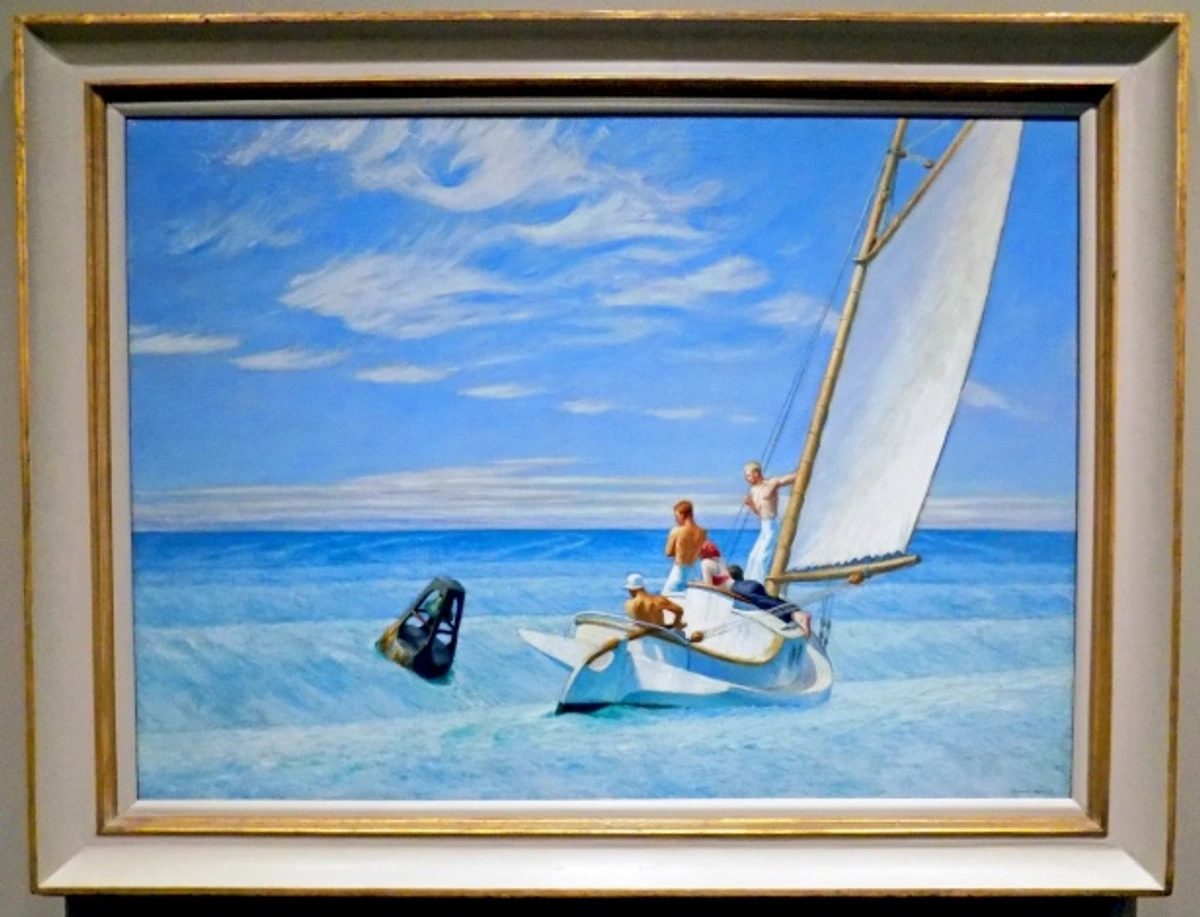
While his urban scenes are famously evocative, Edward Hopper also held a profound connection to nature, particularly the coastal landscapes of New England and the rugged beauty of rural America. His landscapes are not picturesque postcards; they are imbued with the same profound solitude and dramatic light that define his cityscapes. Lighthouses, isolated houses, and stretches of serene sea feature prominently, acting as silent sentinels against the vastness of nature. Works like Lighthouse Hill (1927), The Long Leg (1935), and Ground Swell (1939) aren’t just depictions of scenery; they are emotional landscapes, reflecting human introspection and resilience against an indifferent, yet awe-inspiring, natural world. He found a different kind of quiet dignity in these scenes, a primal connection to the elements that echoed the internal struggles of his urban figures. For me, it shows that the human condition, with all its complexities, plays out just as powerfully on a windswept coast as it does in a dimly lit diner.
Hopper's Masterful Composition
Beyond the choice of subject or the interplay of light, Hopper was an absolute master of composition. His paintings are meticulously structured, often employing strong geometric forms, stark diagonals, and a keen sense of balance to draw the viewer's eye and reinforce the psychological mood. He understood that how elements are arranged on the canvas is just as crucial as what those elements are. Think of the way a window frame acts as a barrier, or a street corner creates a sense of spatial isolation. He often used high or low vantage points, or cropped scenes tightly, to create a feeling of voyeurism or to emphasize a particular perspective. The strategic use of negative space, the often-empty areas around his subjects, is also crucial, amplifying the sense of isolation or vastness. His compositions are often deceptively simple, yet every line, every plane, every negative space is carefully considered, contributing to the overall narrative of stillness, tension, or quiet drama. It’s a masterclass in visual economy, ensuring that no element is superfluous and every detail serves to deepen the emotional impact. It’s like he meticulously choreographed every element to tell a story without saying a word, a technique I constantly strive for in my own compositions.
The American Scene: Capturing the National Psyche
While not strictly a 'movement' in the same way as Cubism, The American Scene was a broad artistic trend in the early to mid-20th century that saw artists turning away from European influences to focus on authentically American subjects. This umbrella term encompassed movements like Regionalism (depicting rural life) and Social Realism (focusing on the urban working class), but Hopper's work often transcended simple categorization. He wasn't overtly sentimental like some Regionalists, nor was he as politically charged as the Social Realists. Instead, his contribution to the American Scene was through his profound psychological realism, capturing the quiet dignity, hidden anxieties, and evolving character of American life—both urban and rural—during a period of immense change. He painted the gas stations, main streets, lighthouses, and solitary figures that defined a nascent national identity, imbuing these everyday scenes with a universal sense of introspection and existential weight. His art became synonymous with the feeling of America itself, a quiet yet powerful commentary on its landscapes and its soul. This movement was, in many ways, a search for an authentic American identity in art, a deliberate rejection of European dominance and the clamor of abstraction. Hopper’s nuanced vision perfectly encapsulated this cultural shift, offering a more introspective and less didactic view than some of his contemporaries. He painted the soul of a changing nation, finding its quiet grandeur in the everyday, rather than its idealized mythologies.
Urban Isolation and the Human Condition
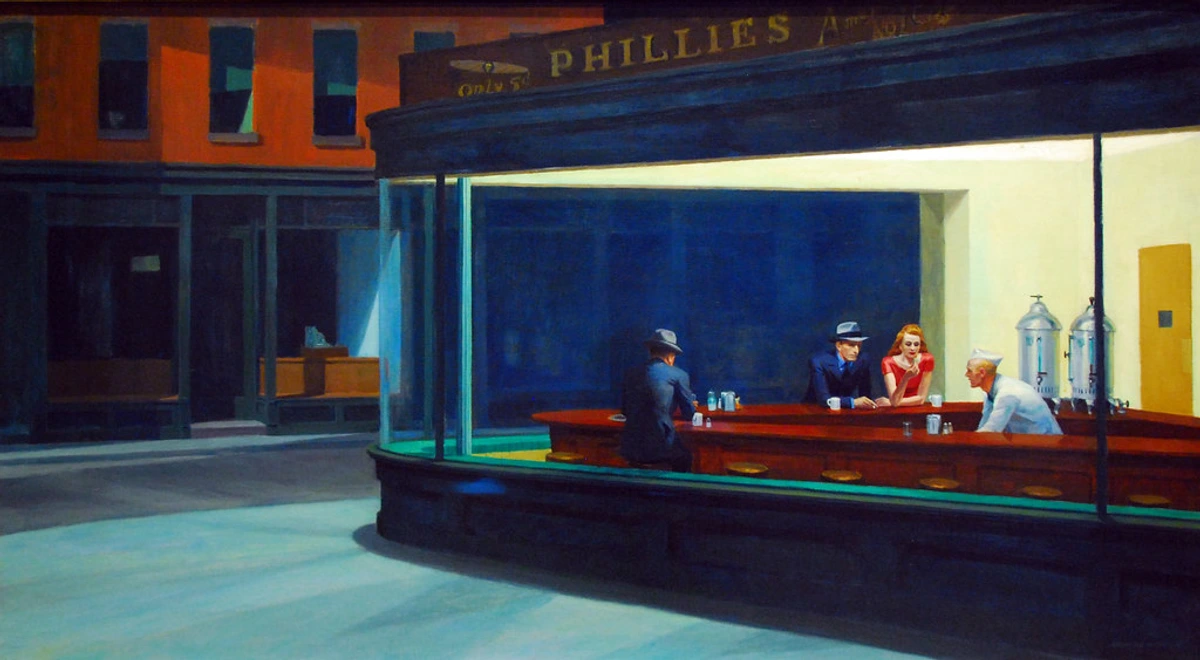
Without a doubt, this is the most consistently discussed and emotionally resonant aspect of Hopper's oeuvre. His canvases are frequently populated by figures who, even when sharing a space with others, appear utterly self-contained, adrift in their own internal worlds. Consider the iconic tableau of Nighthawks (1942), where the patrons, though physically close, remain emotionally distant, each lost in a private reverie. Or the countless solitary figures inhabiting hotel rooms, office spaces, or gazing out at a vast, indifferent sea. Paintings like Chop Suey (1929), depicting two women at a restaurant table who appear to exist in separate realities, Room in New York (1932), showing a man reading a newspaper and a woman at a piano seemingly oblivious to each other, or New York Movie (1939), showing an usherette lost in thought in a dimly lit cinema, further exemplify this recurring motif, speaking to a profound sense of urban isolation and introspection – a psychological landscape that became increasingly pervasive in the rapidly modernizing 20th century. Works like Office at Night (1940), showing a secretary engrossed in her work while a man stands contemplating in the background, Hotel Room (1931), featuring a lone woman sitting on a bed, gazing out a window, Compartment C, Car 293 (1938), depicting a woman reading alone on a train, and Excursion into Philosophy (1959), where a man sits in bed, head in hands, while a nude woman sleeps, further highlight this pervasive sense of detachment, even in shared workspaces, public transit, or ostensibly private settings. These figures are not merely alone; they are profoundly separate, encapsulated in their own internal worlds, a powerful commentary on the anonymity and psychic distance that can accompany modern urban existence. Even when he depicts couples, like in Cape Cod Evening (1939), there's often an emotional chasm, a silent, unbridgeable space between them that speaks volumes, challenging the very notion of shared experience.
It’s fascinating, isn't it? We navigate a world ostensibly more 'connected' than ever before, yet that occasional, sharp pang of disconnect, that quiet alienation, feels eerily familiar. Hopper captured this pervasive sentiment decades before the advent of social media or the internet. He masterfully illustrated that true loneliness isn't merely about physical solitude; it's an internal state, a subtle yet profound detachment that can, paradoxically, intensify amidst the anonymous throng of a bustling city. This feeling, this exquisite ache of modern solitude, is what keeps us coming back to his canvases, seeing ourselves reflected in their silent dramas, understanding that this is a universal human truth.
The Paradox of Stillness: Solitude vs. Loneliness
This leads me to a crucial distinction in understanding Hopper: the subtle yet significant difference between solitude and loneliness. While many immediately associate his work with loneliness, I think it's more nuanced, far more complex than a single emotion. Solitude, in its purest form, can be a chosen state, a moment of peaceful contemplation and self-reflection, a necessary retreat from the world, a wellspring for creativity. Loneliness, however, often carries a heavier, more melancholic weight, a sense of unwanted separation or yearning for connection, a yearning that often remains unfulfilled on Hopper's canvases. Hopper’s figures often hover in this liminal space, leaving us to wonder: Are they yearning for connection, or are they finding quiet dignity and a profound sense of self in their chosen detachment? The ambiguity is precisely what gives his work its enduring power. He doesn't tell us; he invites us to ponder our own experiences within his silent narratives. This delicate balance, where figures are both self-possessed and vulnerable, creates a powerful emotional resonance that allows viewers to project their own experiences onto the canvas, making his work timelessly relatable. It’s this psychological ambiguity that elevates his art beyond mere social commentary, pushing us to confront our own relationship with isolation and connection. Are they trapped by circumstance, or have they found a quiet refuge within themselves, a profound sense of identity in their independence, a quiet resilience? Hopper doesn't give us easy answers, but instead invites a deeper, more personal interrogation, a quiet conversation that continues long after you've left the museum. It’s this enduring ambiguity, this open-ended invitation to reflect, that gives his work its profound and lasting appeal.
The Play of Light and Shadow
If you ask me, Edward Hopper wasn't just a painter; he was a virtuoso, a veritable wizard, with light. He didn’t merely illuminate his scenes; he wielded light as a powerful narrative instrument, almost a sentient character within the drama of his canvases. Consider the almost surgically bright, artificial glow of a late-night diner, casting long, sharp shadows (Nighthawks, 1942), the sharply defined shafts of morning sun slicing into an empty room (Morning Sun, 1952), or the long, stark shadows cast by indifferent urban buildings in the early hours (Early Sunday Morning, 1930) – each instance contributes profoundly to the overarching mood and the unspoken story. It’s a technique that feels inherently theatrical, almost cinematic, creating a sense of heightened reality. He wasn't simply rendering visual information; he was conveying the emotional felt experience of being bathed in that specific light, at that particular, often poignant, time of day or night. The way light falls across a woman's face in A Woman in the Sun (1961) or illuminates an empty street is not accidental; it is meticulously calculated to evoke specific feelings of vulnerability, exposure, or quiet contemplation, sometimes even a sense of being under a spotlight.
This meticulous manipulation of light and shadow, a technique sometimes called chiaroscuro (a term you might usually associate with earlier masters, especially in the work of artists like Rembrandt van Rijn, Caravaggio, or Georges de La Tour), creates dramatic contrasts and emphasizes certain elements, drawing your eye and shaping your emotional response. Consider the way light floods through a window in Sunlight in a Cafeteria (1958) or the dramatic pools of darkness and illumination in Rooms by the Sea (1951) – each is a carefully constructed element of the narrative, often creating a psychological tension between illumination and obscurity. Hopper, however, innovatively applied this classical technique to the mundane, to the quotidian American scene, elevating it from mere observation to profound psychological inquiry. He used light to both reveal and conceal, to create a sense of vast emptiness or intimate enclosure, turning the seemingly ordinary into something extraordinary.
Architectural Narratives: Buildings as Characters
Symbolism in Hopper's Art: More Than Meets the Eye
One of the most captivating aspects of Hopper's work, for me, is the subtle yet profound symbolism embedded within his seemingly straightforward scenes. He wasn't an allegorical painter in the classical sense, but his recurring motifs often carry significant metaphorical weight, inviting deeper interpretation. Windows, for instance, are rarely just transparent panes; they act as psychological thresholds, revealing glimpses into private worlds while simultaneously creating barriers between subjects and viewers. They can signify yearning for connection, a detached observation of the world, or even a sense of entrapment. Similarly, light and shadow are not merely tools for realism but potent symbols of revelation and concealment, hope and despair, comfort and anxiety. The stark, artificial light of an interior might represent a harsh reality, while the gentle natural light of dawn could suggest new beginnings or quiet contemplation. Doors and hallways often symbolize transitions, escape, or the path not taken. Even the isolated figures themselves become symbols of the universal human experience of solitude in the modern age. He invites us to look beyond the surface, to consider the 'why' behind each element, turning his paintings into rich visual poems of the subconscious.
Beyond the human figures, Hopper’s architecture often takes on a life of its own. His buildings – whether they are majestic lighthouses along the New England coast, like in The Long Leg (1935) or Lighthouse Hill (1927), isolated Victorian houses by a railroad track (House by the Railroad, 1925), anonymous city apartment blocks (New York City series), or humble gas stations (Gas, 1940) – are rarely just backdrops. They are characters, imbued with a palpable presence and often reflecting the psychological states of their inhabitants, or perhaps their very absence. The stark angles, flat planes, and strong shadows of his architectural compositions create a sense of solidity and permanence, yet they can also feel imposing, isolated, or strangely vulnerable. Consider House by the Railroad (1925), which stands as a silent sentinel, embodying a profound sense of isolation and almost tragic dignity, a relic of a bygone era. Or think of the deserted facades in Early Sunday Morning (1930), which speak volumes about the quietude and perhaps the underlying melancholy of a sleeping city. I often find myself wondering what stories these silent structures could tell if they could speak, and Hopper invites us to do just that. They stand as testaments to human presence, even in absence, imbued with a quiet dignity or a haunting sense of memory, often reflecting the changing face of America itself. Consider The City (1927), a sweeping view of urban rooftops and facades, or the unsettling geometries of Queensborough Bridge (1913). These aren't just buildings; they're psychological landscapes in their own right, reflecting the aspirations, loneliness, and resilience of the American spirit, becoming silent witnesses to the dramas of human life and the relentless march of modernity.
Cinematic Quality and Narrative
It’s no surprise that a long list of legendary filmmakers, from the master of suspense Alfred Hitchcock to the contemplative German director Wim Wenders, have explicitly cited Hopper as a profound influence. His compositions are, quite simply, incredibly cinematic. Each painting feels like a perfectly framed movie still, imbued with a palpable sense of anticipation or the weighty aftermath of an unseen event. When I gaze at a Hopper piece, my mind immediately begins to construct narratives, filling in the blanks: What just transpired? What emotional drama is about to unfold? Who are these enigmatic figures?
He doesn't rely on explicit action to tell his stories; instead, he communicates through powerful suggestion, immersive atmosphere, and the potent weight of the unspoken. It's a subtle narrative approach, yes, but its effectiveness is undeniable. Hitchcock reportedly used House by the Railroad as inspiration for the Bates Motel in Psycho, specifically for its unsettling sense of isolated grandeur and looming mystery. Ridley Scott's Blade Runner owes a clear debt to Hopper's evocative cityscapes, especially in its portrayal of a desolate, neon-lit urban environment that hums with a quiet melancholia and anonymous figures. Even directors like David Lynch, known for his surreal American dreamscapes and unsettling small-town narratives, and Wim Wenders, with his contemplative road movies and themes of alienation and quiet observation, have acknowledged Hopper's profound influence on their visual language and thematic explorations. The Coen Brothers, too, often evoke a similar sense of isolated figures in vast, indifferent landscapes, where the ordinary becomes infused with existential weight. His ability to craft compelling, visual narratives without grand gestures is a masterclass in visual storytelling, a skill that resonates deeply with my own artistic explorations. Beyond directors like Hitchcock, Scott, Lynch, and Wenders, filmmakers like George Stevens (known for Giant) and even contemporary directors exploring themes of Americana, like Paul Thomas Anderson (There Will Be Blood) and Terrence Malick (Badlands), have echoed Hopper's stark aesthetics and thematic concerns. His influence extends to graphic novelists, playwrights, and even music video directors who seek to evoke a similar sense of existential weight and atmospheric tension through carefully composed scenes and solitary figures. It's a testament to the universality of his visual language, a visual poetry that transcends mediums.
American Realism
American Realism: A Window into the National Soul
Edward Hopper stands as a quintessential figure in American Realism, an art movement that emerged in the early 20th century with a clear mission: to depict contemporary American life, its landscapes, and its people in an honest, straightforward, and often unromanticized manner. This wasn't about idealizing the past or escaping into fantasy; it was about confronting the present, capturing the evolving social fabric and individual experiences of a nation in transition. Unlike the shimmering, fleeting brushstrokes of Impressionism or the raw, often distorted emotional intensity of Expressionism and later movements like Abstract Expressionism, Hopper's brand of realism was characterized by its stark precision, clean lines, and a haunting sense of melancholic beauty, a style often termed Psychological Realism.
He didn't concern himself with grand historical narratives or idealized, heroic figures. Instead, his canvas became a stage for gas stations, deserted diners, anonymous hotel rooms, and ordinary people caught in their everyday, yet profoundly introspective, moments. He found the epic in the mundane, revealing the inner lives of ordinary Americans. While sharing some thematic similarities with early Expressionism in its emotional depth, his distinct style is most firmly rooted in realism. His work often evokes a quiet drama that resonates deeply with the human experience, making the ordinary feel extraordinary. It’s a trick I try to master in my own art: finding the profound in the everyday – elevating the commonplace to the profound.
Hopper's Technique and Mediums: A Careful Craft
Hopper's Technique and Mediums: A Master of Deliberate Craft
Hopper's approach to painting was as deliberate and precise as his compositions, almost architectural in its planning. He primarily worked in oil on canvas, a traditional medium that allowed him to achieve rich, luminous colors and crisp details, building up layers of subtle texture. His process was painstaking and unhurried: he often created numerous preparatory sketches and compositional studies in charcoal or pencil, meticulously planning every element before ever touching a brush to canvas. He famously said, "I paint to articulate what I feel deeply." This deep feeling was translated through a controlled application of paint, typically smooth, with visible brushstrokes minimized to create a seamless, almost photographic surface. This careful craftsmanship allowed the emotional content to emerge unhindered by overt painterly gestures, ensuring that the subject and mood remained paramount.
Beyond oils, Hopper was also an accomplished watercolorist, particularly for his landscapes and scenes from his summers in New England. These watercolors often display a lighter, more fluid quality, yet still retain his characteristic sense of compositional strength and dramatic light, showcasing a different facet of his mastery. He also produced a significant body of etchings and commercial illustrations in his early career, which further honed his skills in composition, line, and the evocative use of light and shadow. His dedication to craft, irrespective of the medium, underscores his unwavering commitment to translating his unique vision with clarity and profound psychological insight.
Art Movement | Key Characteristics | Hopper's Connection / Contrast |
|---|---|---|
| American Realism | Depiction of contemporary life, objective, often unromanticized | Leading figure; focused on everyday American scenes and profound psychological states. |
| Ashcan School | Urban realism, gritty scenes, social commentary, vibrant brushwork | Influenced by Robert Henri; shared subject matter but Hopper was more psychologically nuanced and less overtly social, focusing on internal rather than external drama. |
| Impressionism | Capturing fleeting light and atmosphere, energetic brushstrokes, subjective perception | Contrasted with Hopper's precise lines and controlled compositions, though he absorbed crucial lessons on capturing the effect of light. |
| Expressionism | Conveying inner emotion, often distorted forms, vivid colors, psychological intensity | Shares emotional depth and focus on internal states, but Hopper's style is far less overtly distorted or abstract, grounding emotion in stark reality. |
| Post-Impressionism | Reaction against Impressionism; emphasis on symbolic content, structure, and emotion | While he observed it, Hopper filtered elements like structure and a strong sense of formal organization through a uniquely American lens, not adopting the symbolic or abstract aspects directly. |
| Regionalism | Focus on rural American scenes, idealized and sentimentalized depictions of heartland life | Hopper shared an interest in American landscapes but avoided the sentimentality, preferring stark realism and often an undertone of solitude. |
| Precisionism | Focus on industrial and urban landscapes with crisp, sharp lines and simplified forms | Shares the clean lines and architectural focus, but Hopper infused his scenes with more psychological depth and human presence. |
| Symbolism | Emphasized ideas and emotions over objective reality, using symbolic forms. | Hopper's depth is psychological rather than overtly symbolic, though his objects often carry symbolic weight; he grounded emotion in reality. |
| Surrealism | Explored dream states and the subconscious through illogical juxtapositions. | Hopper's work has an eerie, dreamlike quality at times, but he maintained a basis in reality, exploring psychological states rather than surreal dreamscapes. |
| Fauvism | Characterized by strong, vibrant colors and a wild brushwork, emphasizing painterly qualities. | Hopper's palette was more controlled and muted, serving mood rather than overt emotional expression through vibrant color. |
Iconic Works: Glimpses into Solitude and the American Landscape
Let's dive into some of his masterpieces. These are the paintings that, once you see them, stick with you forever. Each one tells a story, or rather, invites you to tell a story, prompting a dialogue between the canvas and your own inner world.
Cape Cod Morning (1950): Expectation and Solitude
Cape Cod Morning (1950) is a quintessential Hopper, showcasing a lone woman gazing intently out a large bay window, her face partially obscured by the shadow cast by the house. She is looking into the early morning light, at something unseen beyond the frame, perhaps a distant ship or just the vastness of the sea. The vibrant green of the surrounding trees and the brilliant morning light contrast with the interior space, which feels both inviting and isolating. The high horizon line emphasizes the expanse she is contemplating, yet she remains physically confined. The painting perfectly captures that feeling of quiet anticipation or longing, a silent drama unfolding within a seemingly ordinary domestic scene. It’s a powerful image of introspection, where the subject’s internal world is mirrored by the external landscape, leaving us to wonder about her thoughts and desires, her expectations for the day, or perhaps a lingering internal reverie. The painting hints at untold stories and the profound inner life often hidden beneath a calm exterior.

Nighthawks: The Quintessential Hopper
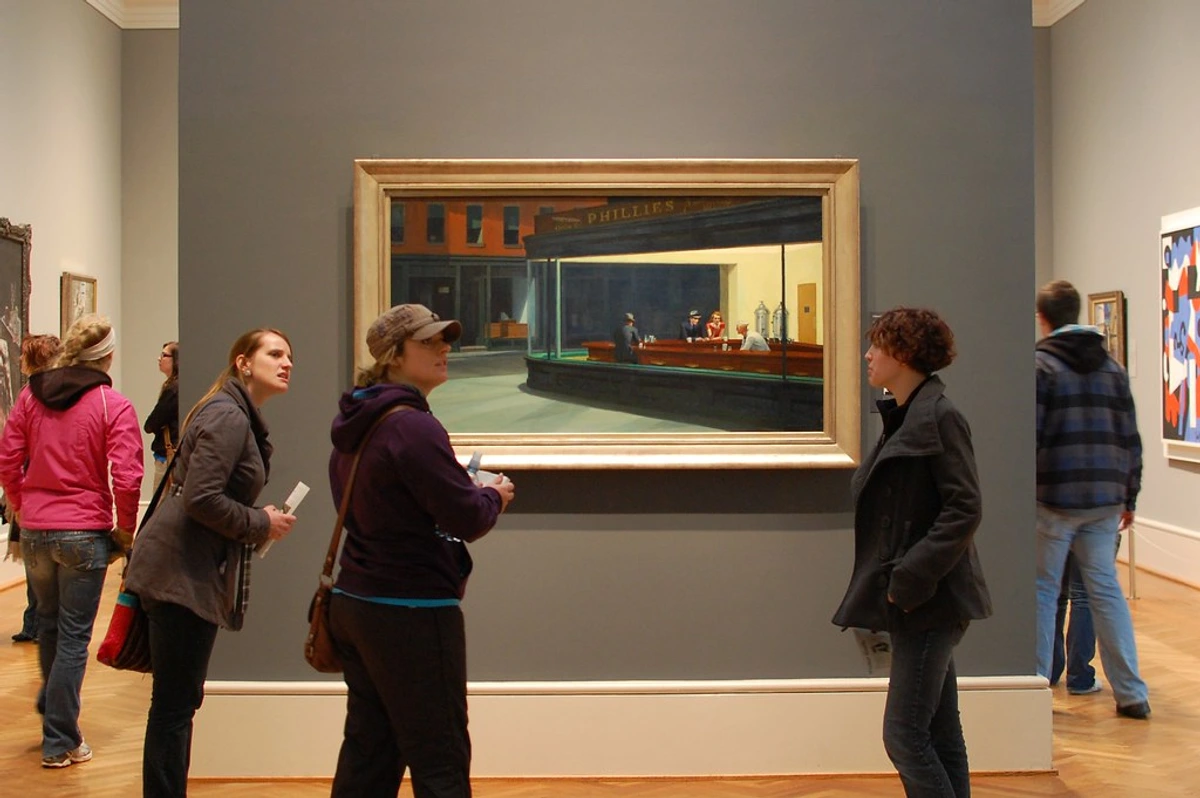
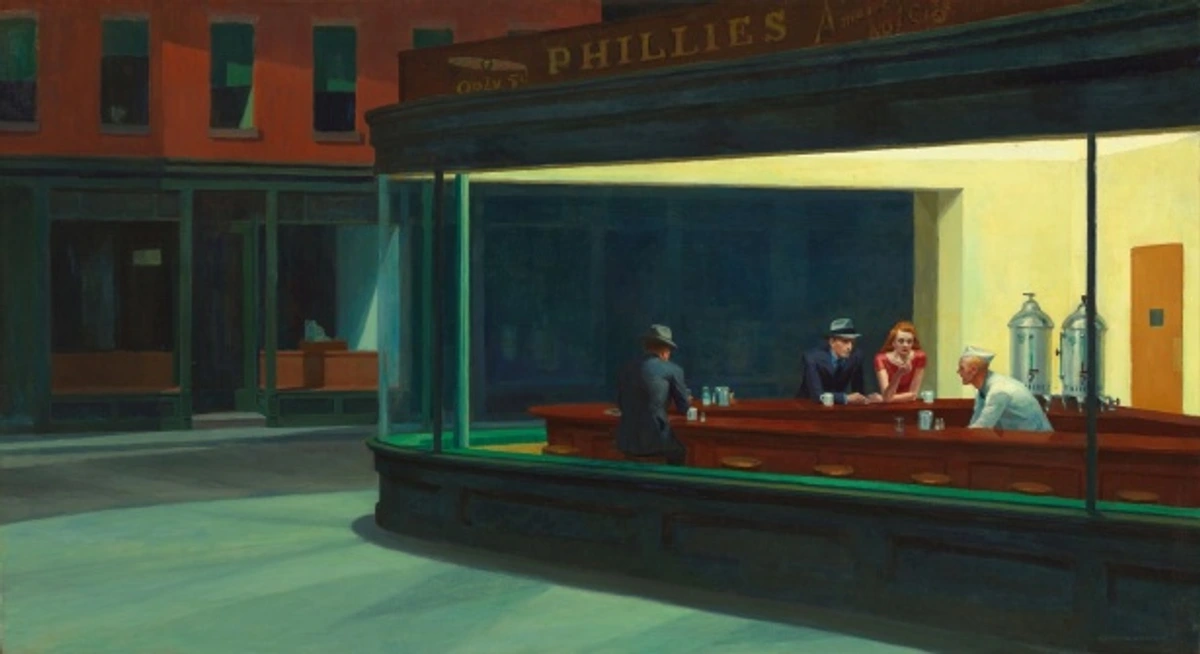
If there’s one Hopper painting that has permeated global consciousness, it’s undoubtedly Nighthawks (1942). And what an utterly compelling piece of art it is!

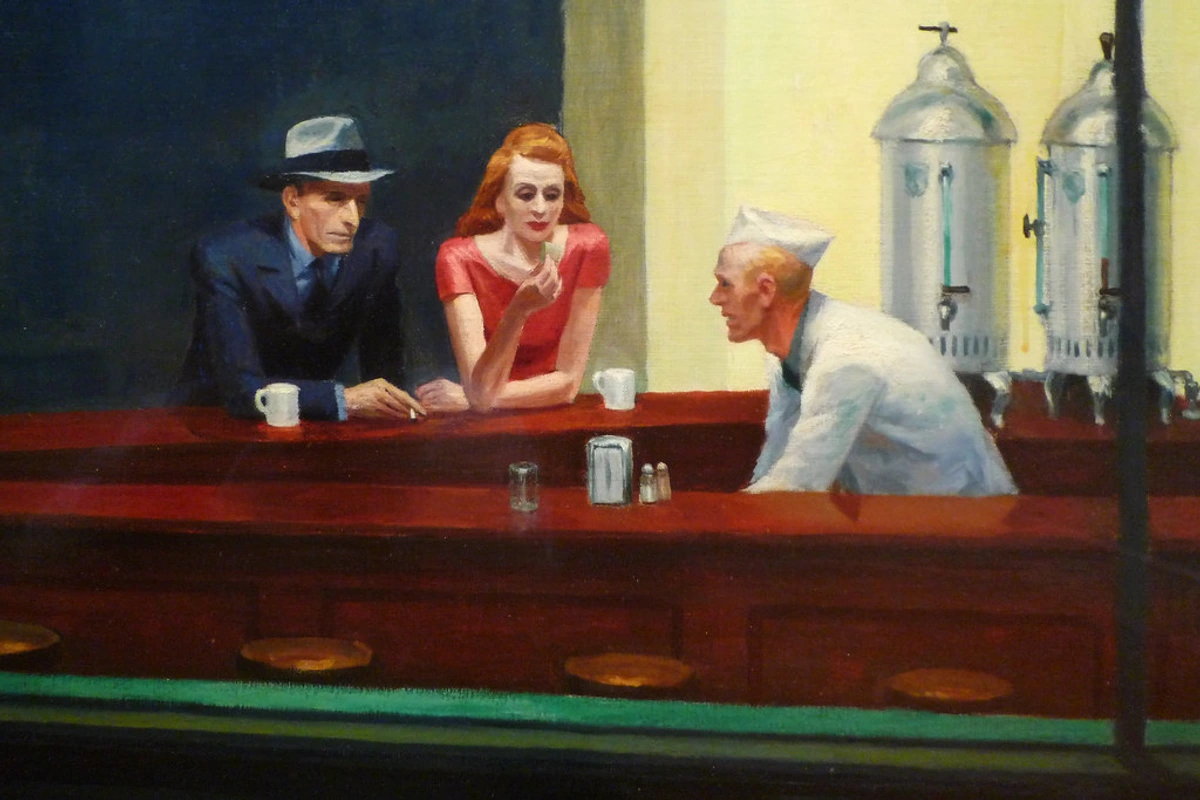
The scene unfolds in a late-night diner, casting a stark, almost clinical fluorescent glow onto the darkened, anonymous street outside. We see four figures: three patrons and a lone server. A couple sits together, yet apart, barely interacting. A solitary man with his back to us adds to the sense of isolation, while the server, stoic and absorbed, attends to his duties. There's no visible entrance, no clear escape route, fostering a sense of enclosure. Each figure seems utterly encapsulated within their own silent world, a testament to the profound anonymity that can exist even in shared spaces. The stark geometry of the diner and the dramatic lighting create a stage-like setting, enhancing the feeling of a captured, almost theatrical, moment. It's a snapshot, yes, but one that feels loaded with backstory and unspoken futures. For a deeper dive, you might explore what-is-the-meaning-of-edward-hoppers-nighthawks.
It's a powerful snapshot of urban alienation, a quietly unfolding human drama painted during the height of World War II, a time when fear and uncertainty were widespread, adding another layer of anxiety beneath the surface calm. Hopper’s meticulous brushwork, though seemingly smooth, builds layers of subtle texture, and his deliberate color palette – the sickly green of the counter, the drab yellows, the piercing white of the overhead lights – all contribute to the painting’s almost palpable mood of quiet desperation. The woman’s vibrant red dress provides a singular splash of color in an otherwise muted palette, drawing the eye, yet even she seems lost in a deep, private thought. Every single time I encounter Nighthawks, my mind races with questions about their individual stories, about the unspoken reasons that have drawn them to this brightly lit, yet lonely, refuge at such an hour. It's a painting that masterfully poses profound questions rather than offering easy answers. Its enduring appeal lies in its ability to reflect back our own experiences of connection and disconnection in the modern world. It’s truly a masterpiece of psychological insight, offering a window into the existential condition of modern urban life. The precise composition, the dramatic interplay of artificial light, and the anonymity of the figures create a sense of palpable tension, making it an endless source of fascination and interpretation. It's a painting that demands questions, offering few definitive answers, and that's precisely where its power lies.
Element | Interpretation |
|---|---|
| Fluorescent Light | Harsh, artificial, revealing, yet isolating; illuminates the scene but highlights detachment. |
| Figures | Proximate yet distant; embodying urban isolation and individual introspection. |
| Diner Setting | A common American space transformed into a stage for human drama and psychological states. |
| Darkened Street | The vast, indifferent urban environment pressing in, enhancing the sense of enclosure. |
| Red Dress | A singular burst of color, drawing attention, yet unable to break the emotional barrier. |
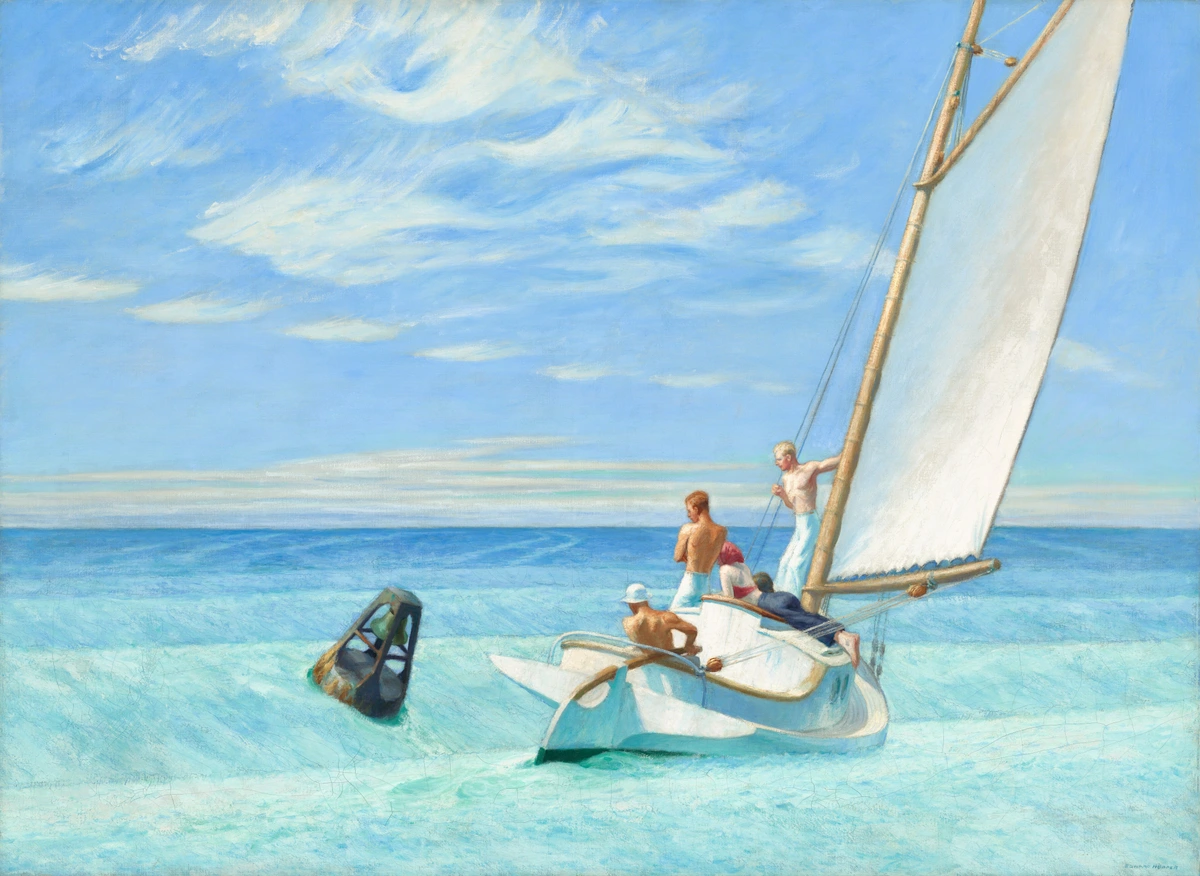
Ground Swell: A Different Kind of Solitude
While Nighthawks masterfully captures the city's quiet, nocturnal hum, Ground Swell (1939) presents an entirely different, yet equally profound, form of introspection, set against the vast, almost indifferent expanse of the sea. It's a testament to Hopper's range that he could evoke such similar feelings in dramatically different environments.
In this captivating work, we observe several figures aboard a sailboat, seemingly together, yet once again, there's a distinct, almost unsettling, lack of overt interaction. Each individual is engrossed in their own thoughts, gazing out at the distinctive yellow buoy that punctuates the otherwise serene, undulating ocean. This buoy, for me, acts almost like a silent witness or a distant, perhaps unattainable, point of navigation in their individual journeys, a small anchor in a boundless world. The light here is bright, almost dazzling, and the colors are far more vivid than in his urban scenes, yet that unmistakable Hopperesque feeling of quiet contemplation and internal detachment persists. This scene speaks to a unique kind of shared solitude, where individuals are physically close but mentally distant, united only by the vastness of the ocean and the silent swell beneath them. It's a powerful statement on the individual's place within the grandeur of nature, and the sense of latent energy before the 'ground swell' itself encapsulates a moment of suspended animation, a fleeting instant where human presence is dwarfed by the immense, powerful forces of nature, hinting at unknown challenges or changes ahead.
This painting, set against the backdrop of the New England coast, speaks to the silent journey of existence, the shared yet intensely individual experience of being immersed in nature's grandeur. I've always found it profoundly intriguing how Hopper consistently managed to evoke these powerful sentiments of isolated thought, whether his subjects were ensconced within the anonymous bustle of a city or adrift on the boundless, open sea. It highlights a universal human experience that transcends setting. It's a powerful reminder that introspection isn't confined to a specific environment; it's a fundamental aspect of being human, whether in a bustling metropolis or on the quiet, open water. The composition, with its high horizon line and vast expanse of sky and sea, emphasizes this sense of human insignificance against nature's might, yet the figures maintain a quiet dignity, a quiet defiance against the vastness. It’s almost as if the vastness of the sea mirrors the vastness of their inner worlds, a concept that truly fascinates me – a vast, open space for reflection and contemplation.
Clamdigger: Rustic Reflection and the Dignity of Labor
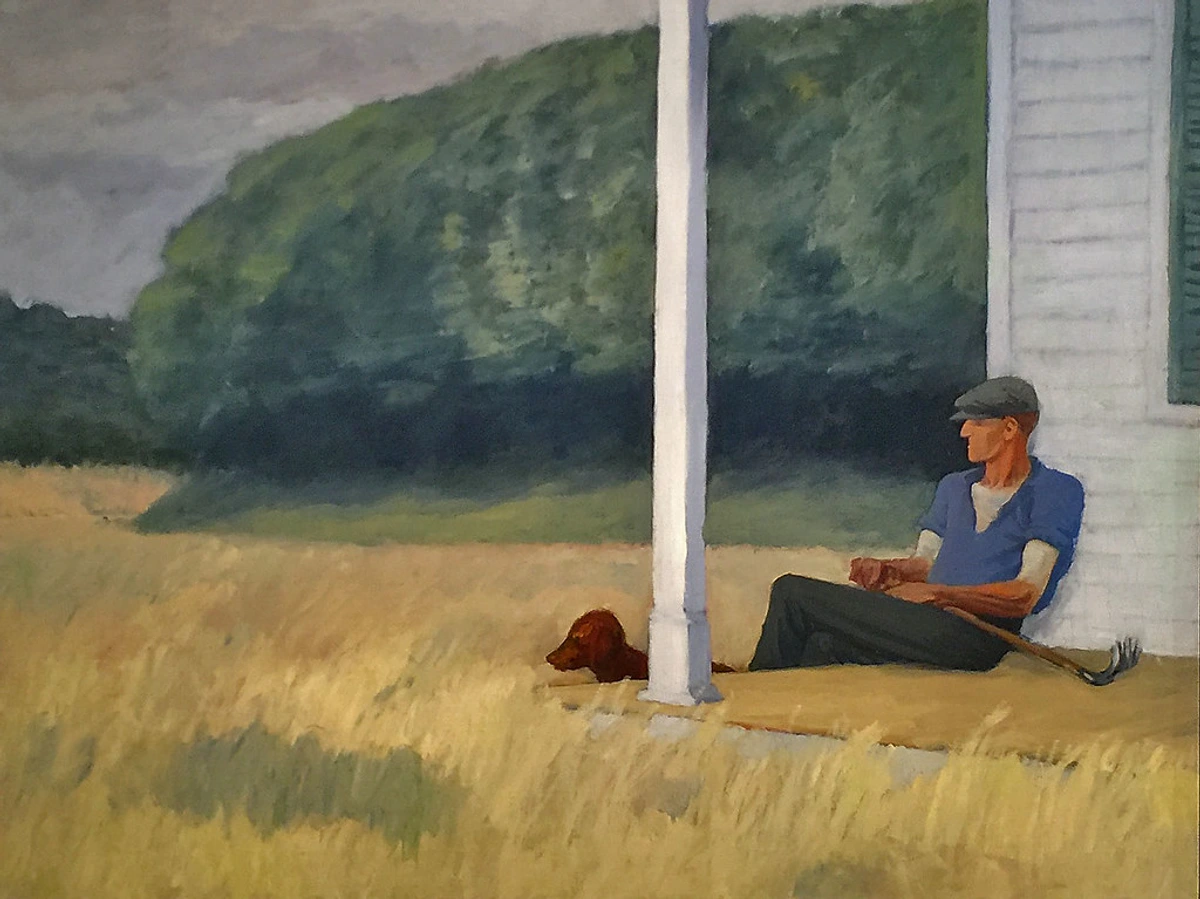
Moving away from the urban grit and maritime expanse, Clamdigger (1935) offers us a poignant glimpse into a more rustic, elemental form of solitude. Here, the focus shifts to a single individual engrossed in his task by the water, a scene that resonates with a quiet, almost meditative quality.
This powerful painting centers on a lone clamdigger, captured in a moment of respite, sitting by the water and gazing contemplatively towards the distant horizon. The narrative here feels distinctly different from his city scenes; it's less about urban angst and more about the inherent quiet dignity of manual labor and the profound, almost spiritual connection one can forge with nature in moments of profound stillness. The figure, bent over his task, or pausing from it, becomes a symbol of quiet resilience and connection to the earth, echoing themes found in American Regionalism. The subdued, earthy tones and the unwavering focus on the individual, seemingly lost in thought against a vast, indifferent backdrop of sky and water, are quintessential Hopper. It beautifully illustrates his impressive thematic range, while simultaneously underscoring the unwavering consistency of his core explorations of the human condition. It's a reminder that true meaning can often be found in the simplest, most fundamental acts of existence, and that even in hard work, there can be moments of profound peace and introspection. This subtle homage to the working class, stripped of any overt political message, speaks to a deeper, universal human experience of labor and reflection, a timeless testament to human resilience, and a quiet affirmation of dignity in the everyday grind.
House by the Railroad (1925): Architectural Isolation
One of Hopper's earliest and most haunting oil paintings to achieve significant recognition, House by the Railroad (1925) is a masterclass in architectural narrative and the depiction of profound isolation. It features a grand, isolated Victorian mansion, strikingly elegant yet eerily vacant, situated directly beside a desolate railroad track. The sharp angles and flat, almost theatrical lighting give the house a stark, almost monumental presence, but also a sense of vulnerability, as if it has been left behind by the march of progress, a silent sentinel against the encroachment of modernity. The unseen train, implied by the tracks, suggests movement and connectivity, which only serves to intensify the house's profound solitude and detachment from the modern world, a poignant symbol of a vanishing past. It's a painting that famously inspired Alfred Hitchcock for the Bates Motel in Psycho, and it's easy to see why – it exudes a quiet menace and a sense of forgotten histories, a palpable psychological tension. This work perfectly embodies Hopper's ability to imbue inanimate structures with powerful emotional weight, making the building itself a character that silently speaks volumes about loss, memory, and the enduring presence of the past, a silent witness to time's relentless passage. The stark, almost theatrical presentation of the house, isolated against an indifferent sky and the relentless march of the railroad, transforms a mundane structure into a monument to human experience and transience. It's a visual poem about the quiet dignity of forgotten places and the emotional echoes they hold, a testament to the artist's ability to find profound depth in the everyday American landscape, a truly haunting and unforgettable image. It reminds me that sometimes, the most dramatic stories are told by the most silent observers.
### Automat (1927): The Modern Diner's Isolation
Automat is another seminal work that predates Nighthawks but explores similar themes of urban isolation in a public space. Here, a solitary woman, elegantly dressed, sits at a table in a brightly lit automat (a type of self-service restaurant common in the early 20th century). She stares into a cup of coffee, her hat casting a deep shadow over her face, almost obscuring her identity, almost as if she's trying to disappear into the anonymity of the space. The empty chairs, the stark, receding lines of the interior, and the darkened window reflecting the city lights all amplify her profound aloneness. The artificial light, much like in Nighthawks, highlights her presence but also underscores her detachment from the unseen world outside, creating a stark contrast between the internal and external worlds. It's a haunting portrayal of vulnerability and self-absorption in the anonymous urban environment, a quiet moment of introspection amidst the bustling city. The cool, almost sterile interior of the automat contrasts sharply with the potential warmth of human connection, further emphasizing her isolation. It's a quiet moment, yet one that speaks volumes about the experience of modernity and the subtle feelings of detachment that can accompany it. The artificial glow, the solitude of the woman, and the implied anonymity of the urban setting create a haunting tableau of introspection, emphasizing her vulnerability amidst the city's relentless pulse. It's a potent commentary on the human search for solace and identity within the impersonal architecture of the modern city. This piece, for me, really captures the essence of a fleeting, almost melancholic, moment in the urban daily grind, a universal feeling many of us can relate to.
Other Notable Works by Edward Hopper
While Nighthawks, Automat, and House by the Railroad often grab the spotlight, Hopper's oeuvre is rich with other iconic paintings that further explore his signature themes. Here's a brief look at some more works that are equally compelling:
Painting | Year | Key Themes | Significance |
|---|---|---|---|
Room in New York | 1932 | Urban isolation, emotional distance, domestic quietude | Depicts a couple in a room, seemingly engaged in separate worlds, reinforcing emotional disconnect. |
New York Movie | 1939 | Solitude in public spaces, introspection, cinematic atmosphere | An usherette lost in thought in a dimly lit cinema, a classic Hopper narrative. |
Office at Night | 1940 | Corporate isolation, quiet contemplation, voyeurism | A secretary working late, observed by a man, highlighting unspoken narratives. |
Gas | 1940 | American landscape, isolation, foreboding atmosphere | A lone gas station at dusk, a stark symbol of roadside America. |
Hotel Room | 1931 | Loneliness, vulnerability, transient existence | A solitary woman on a bed, gazing into space, emblematic of hotel room anonymity. |
Morning Sun | 1952 | Light and introspection, feminine solitude | A woman bathed in sunlight, lost in thought, a poignant study of light and mood. |
Rooms by the Sea | 1951 | Nature's grandeur, existential contemplation, boundary | An open door to the ocean, evoking a sense of vastness and mystery. |
Summertime | 1943 | Light, urban heat, psychological tension | A woman in a sheer dress, bathed in harsh sunlight, symbolizing exposure and inner warmth. |
Hotel Window | 1955 | Isolation, detachment, urban anonymity | A woman looking out a hotel window, a common motif of observing and being observed. |
Cape Cod Evening | 1939 | Rural solitude, unspoken tension between figures, twilight atmosphere | A couple and a dog outside a house at dusk, with a dense forest in the background, suggesting hidden depths and quiet discord. |
Seven A.M. | 1948 | Rural architecture, solitude, early morning light | An isolated house bathed in early morning light, evoking quiet contemplation. |
New York Office | 1962 | Corporate anonymity, female solitude, late career introspection | A woman working alone in an office, a sparse, almost stark depiction of urban work life. |
People in the Sun | 1960 | Group isolation, light and shadow, vulnerability | Figures sitting in chairs, bathed in bright sunlight, yet each lost in their own thoughts. |
Excursion into Philosophy | 1959 | Marital discord, existential questioning, interior life | A man sitting on a bed, head in hands, while a nude woman sleeps, hinting at deep psychological tension. |
Summer Evening | 1947 | Couple dynamics, light and shadow, quiet intimacy/distance | A couple on a porch at dusk, subtly hinting at their internal worlds and relationship dynamics. |
Chop Suey (1929): Shared Space, Separate Worlds
Following just a couple of years after Automat, Chop Suey (1929) offers another glimpse into urban social dynamics, or rather, the lack thereof. Here, two women are seated at a table in a Chinese restaurant, a common and bustling public space. Yet, despite their proximity, they appear entirely detached from each other and their surroundings. One woman faces the viewer, her gaze distant and introspective, while the other looks away, engrossed in her own private world. The stark artificial light, typical of Hopper's interiors, illuminates the scene but fails to foster any sense of warmth or connection between the figures. The title itself, referring to a popular Americanized Chinese dish, subtly points to a cultural blending and a certain anonymity found in the rapidly modernizing city, a fleeting moment of cultural consumption. It's a profound statement on how even in a shared, bustling space, individuals can remain profoundly isolated, each inhabiting their own psychological sphere. The composition, with its strong verticals and horizontals, further compartmentalizes the space, mirroring the emotional distance between the subjects, creating a sense of palpable detachment.
Hopper's Enduring Legacy and My Own Reflection
Edward Hopper's influence is not merely undeniable; it is profoundly woven into the fabric of 20th and 21st-century visual culture. He didn't just carve out a unique space in art history; he created an entire aesthetic, one that feels both deeply specific to his era and remarkably, hauntingly timeless. His distinctive vision has seeped into popular culture in ways he probably never fully envisioned, inspiring generations across various mediums. Think about the stark visual language of film noir, the evocative panels of graphic novels, the carefully constructed mood of certain music videos, or even the subtle psychological tension in contemporary photography – countless creators owe an unmistakable debt to his moody, intensely evocative scenes. Legendary filmmakers like Alfred Hitchcock (who famously used House by the Railroad as a visual cue for the Bates Motel in Psycho), Ridley Scott (whose Blade Runner drips with Hopperesque urban melancholy), and David Lynch (with his unsettling American dreamscapes and themes of hidden suburban anxieties) have all, I'm pretty sure, kept a Hopper print somewhere in their studios as a source of inspiration. Even photographers like Robert Adams and Walker Evans, writers like Joyce Carol Oates and Truman Capote, and musicians continue to draw inspiration from his ability to distill complex emotions into singular, striking images. His quiet, suggestive narratives have proven to be a fertile ground for countless creative explorations, making his work a touchstone in discussions of American identity, urban sociology, and psychological states. Beyond the explicit citations, his aesthetic permeates subtle visual cues in advertising, music videos, and even video game design, where a sense of atmospheric quietude and psychological depth is desired. The 'Hopperesque' has become an adjective, a shorthand for a particular mood – one that is universally understood, even by those unfamiliar with his actual paintings. It's like a secret language we all instinctively understand, a feeling that resonates deep in our contemporary psyche.
He taught us an invaluable lesson: that the everyday can be imbued with profound significance, that quiet, seemingly unremarkable moments can hold immense, simmering drama, and that the rich, often unarticulated interior lives of ordinary people are vast tapestries worth exploring. His work continually reminds me that even in the most mundane or overlooked settings, there’s an underlying narrative, an emotion, a fleeting feeling, a profound moment just waiting to be observed and appreciated. As an artist myself, this is a powerful, almost spiritual lesson: the magic isn't always found in the grand, sweeping gesture, but often, and more truthfully, in the meticulous, empathetic observation of the subtle. It's about seeing, not just looking, and that's a skill that applies far beyond the canvas, informing my own approach to color in art.
Key Legacy Aspect | Description | Representative Works |
|---|---|---|
| Psychological Realism | Depicting the inner lives and emotional states of individuals, often through external setting. | Nighthawks, Automat, Hotel Room |
| Urban Alienation | Capturing the sense of disconnect and solitude in modern city life. | Nighthawks, Chop Suey, New York Movie |
| Master of Light | Using light and shadow not just for illumination, but as a narrative and emotional tool. | Sunlight in a Cafeteria, Room in New York, Office at Night |
| Cinematic Influence | Compositions that resemble film stills, inspiring filmmakers and visual storytellers. | House by the Railroad, Nighthawks |
| American Identity | Unflinching portrayal of the American landscape and its evolving social fabric. | Gas, Early Sunday Morning, Cape Cod Evening |
Further Reading and Exploration
If you want to dive deeper into art movements that either influenced or starkly contrasted with Hopper's unique approach, I’d highly recommend exploring Post-Impressionism for its structural qualities. You might also find it interesting to contrast his psychological depth with the more overtly symbolic works of Salvador Dalí, just to see the vast spectrum of artistic expression. For a deeper dive into the roots of American landscape painting, consider exploring the Hudson River School, whose romanticized views offer a stark contrast to Hopper's unadorned realism. And if you're curious about how American art evolved beyond realism, contrasting his work with something like Abstract Expressionism (artists like Jackson Pollock or Willem de Kooning) can be incredibly illuminating, showcasing the vast stylistic shifts within 20th-century American art.
For those interested in other American artists who captured the essence of their time with a unique perspective, you could explore the bold forms of Georgia O'Keeffe or the emotionally charged narratives of Frida Kahlo – though stylistically different, they share a profound psychological depth. If you appreciate the contemplative quality of Hopper's work, diving into the minimalist grids of Agnes Martin might offer a different kind of quietude. Or, for a striking contrast in urban depiction, compare his work with the vibrant energy of Jean-Michel Basquiat. For further exploration of modern masters, you might also consider the profound psychological portraits of Zeng Fanzhi or the raw emotionality of Adrian Ghenie, to see how the exploration of the human condition continues today. And for a truly different take on American narrative, exploring the compelling figures in the art of Kara Walker offers a powerful contemporary counterpoint. The world of art is vast and interconnected, and understanding Hopper often means understanding what he stood both with and against.

His art isn't designed to hand you easy answers or neatly packaged conclusions; rather, it’s an open invitation – an unspoken summons into a conversation, a quiet, introspective meditation on themes of loneliness, elusive beauty, and the profound complexities of the human condition. And frankly, in our increasingly noisy, perpetually 'on' world, that invitation feels not just timely, but more necessary than ever before. It serves as a potent reminder for me, and hopefully for you, to slow down, truly look around, and perhaps even take a moment to deeply reflect on your own 'nighthawks' moments – those quiet instances of introspection and feeling. Perhaps it's even the spark you need to create something yourself, and if you do, you might find some inspiration in my own timeline as an artist. Or, if you're ever near the Netherlands, you could always pop by the Den Bosch Museum to see some incredible pieces of art in person.
His art, I believe, is a profound act of empathy, inviting us to recognize our shared humanity in moments of quiet reflection. It’s a testament to the fact that even in our solitude, we are, paradoxically, connected by the very universal emotions he so masterfully depicted.
Frequently Asked Questions (FAQ)
What was Edward Hopper's relationship with modernism?
Edward Hopper had a complex and often resistant relationship with the various modernist movements sweeping through Europe and America during his formative years and mature career. While he was certainly aware of avant-garde styles like Cubism, Fauvism, and later Abstract Expressionism, he steadfastly chose to pursue his own distinct path rooted in realism. He absorbed lessons on light and composition from European masters, particularly the French Impressionists and realists, but he wasn't interested in their formal experiments or symbolic abstraction. Instead, he distilled his observations through a uniquely American lens, focusing on tangible reality and profound psychological depth rather than radical stylistic innovation. His 'modernism' lay not in breaking down forms, but in capturing the emotional landscape of modern life and its impact on the individual, making him a distinctly modern artist despite his traditional techniques. He forged a singular vision that stood apart from the dominant trends, proving that profound artistic statements could still be made through representational art. He wasn't afraid to be out of step with the avant-garde, choosing instead to explore the profound modernities inherent in the psychological landscape of ordinary American life. His work thus became a powerful counter-narrative, showing that innovation isn't solely about formal experimentation but also about deepening our understanding of the human condition through familiar forms. This deliberate choice cemented his unique place in art history, demonstrating a quiet defiance of prevailing trends, a testament to the power of a singular vision over fleeting trends.
What was Edward Hopper's overall artistic philosophy?
What was Hopper's approach to line and form?
Edward Hopper's approach to line and form was characterized by a distinct clarity, precision, and an almost architectural solidity. He preferred strong, clean lines to define shapes, whether it was the sharp angles of a building, the contours of a human figure, or the edge of a horizon. His forms are often simplified and geometric, lending a monumental quality to even ordinary subjects. This meticulous delineation creates a sense of permanence and structure, making his compositions feel incredibly solid and deliberately constructed. He used line not just to outline, but to create mass and volume, giving his figures and objects a palpable presence. This deliberate clarity in his forms often reinforces the sense of quiet drama and psychological weight, making the subjects feel both real and profoundly iconic. It's a testament to his belief that simplicity in form can lead to profound emotional impact.
Hopper's artistic philosophy was rooted in depicting the unvarnished reality of American life, stripped of sentimentality or overt drama, yet imbued with deep psychological resonance. He believed in the power of observation and the ability of seemingly mundane scenes to reveal universal truths about the human condition. His work wasn't about telling a specific story, but about evoking a mood, a feeling, or a moment of introspection that allowed viewers to connect on a deeply personal level. He sought to capture the 'truth of his own experience' and translate that into a visual language that spoke to the collective experience of modernity, often highlighting themes of isolation, solitude, and quiet contemplation. His philosophy was rooted in a deep, almost spiritual, belief in the expressive power of realism, a commitment to presenting reality not just as it appears, but as it feels. He wasn't interested in moralizing or storytelling in the conventional sense, but in evoking a mood, an unarticulated feeling, or a moment of profound psychological insight that viewers could recognize within themselves. It was about creating art that felt true to the inner life, a kind of distilled essence of human experience. He famously said, "Great art is the outward expression of an inner life in the artist, and this inner life will result in his personal vision of the world." This sentiment perfectly encapsulates his approach, emphasizing the profound connection between his interior world and the external realities he depicted, and ultimately, our own.
Did Hopper have a specific artistic routine or studio practice?
Edward Hopper was known for his deliberate and solitary artistic routine. He maintained a studio in Greenwich Village, New York City, for most of his adult life, often working in silence with his wife, Jo, present. His process was painstaking and unhurried; he would spend weeks or even months conceiving a painting, making numerous preparatory sketches and compositional studies in pencil or charcoal before ever applying paint to canvas. He rarely worked en plein air (outdoors) for his oil paintings, preferring to work from memory, imagination, and preliminary sketches in the controlled environment of his studio, allowing him to distill scenes to their psychological essence. This methodical approach ensured every element served his overall vision, contributing to the timeless and carefully constructed quality of his finished works.
What was the socio-political context of Hopper's art?
Hopper’s art, while not overtly political or didactic, was deeply steeped in the socio-political landscape of 20th-century America. He lived through two World Wars, the Roaring Twenties, the Great Depression, and significant periods of rapid urbanization and social change. His depictions of isolated figures in diners, offices, and hotel rooms subtly reflect the growing sense of alienation, anonymity, and introspection that accompanied modernity. The starkness of his landscapes, whether urban or rural, often hints at the economic realities of the Depression era, even if not explicitly stated. His work often captures the quiet anxieties and shifts in American identity during a period of immense transformation, serving as a subtle yet powerful commentary on the psychological impact of these broader societal forces. He was, in a way, a silent chronicler of the emotional pulse of his time, reflecting the evolving American psyche through his unvarnished realism. His depictions, though seemingly apolitical, subtly captured the anxieties of the post-World War I era, the burgeoning consumer culture, the lingering effects of the Great Depression, and the rapid urbanization that reshaped the American landscape, often with a subtle undercurrent of unease. He painted a nation in transition, grappling with new forms of anonymity and psychological introspection, making his art a poignant, if understated, historical document. His work provides a window into the existential condition of modern Americans, reflecting the quiet drama of a nation undergoing profound societal shifts and challenging established norms.
What is Edward Hopper best known for?
Edward Hopper is preeminently known for his stark, profoundly realistic paintings of American life. His canvases are celebrated for their evocative depictions of urban isolation, the quiet dignity of solitude, and his masterful, almost theatrical, use of light and shadow. His most iconic and universally recognized work is, without a doubt, Nighthawks, a painting that has become a cultural shorthand for urban loneliness. He captured the underlying mood of 20th-century America, often portraying a sense of quiet introspection and subtle melancholy that resonates deeply with viewers even today. His distinctive vision of American life, stripped of sentimentality yet imbued with profound emotion, is what truly sets him apart and makes his work instantly recognizable. He redefined what American art could be, moving away from academic conventions to capture the raw, psychological truth of the modern experience, transforming mundane scenes into profound statements about the human condition.
Did Hopper paint landscapes primarily?
While Edward Hopper is renowned for his urban scenes and isolated figures within cityscapes, his oeuvre also includes a significant and often overlooked body of landscape paintings, particularly those depicting the rugged beauty of the New England coast and the Cape Cod area where he spent many summers. Works like Lighthouse Hill (1927), The Long Leg (1935), Coast Guard Station (1929), Manhattan Bridge Loop (1928, an urban landscape), and Ryder's House (1933) demonstrate his deep appreciation for natural and built environments. Even in his landscapes, however, Hopper infused the scenes with his characteristic sense of quietude, dramatic light, and often a subtle undertone of solitude, focusing on the essential forms and emotional resonance rather than picturesque detail. These landscapes are never merely topographical; they are psychological spaces that reflect the same introspective themes found in his urban works. He found the same sense of quiet drama in a solitary lighthouse or a deserted road as he did in a bustling city diner, imbuing them with a distinctly Hopperesque mood.
What art movement is Edward Hopper associated with?
Edward Hopper is firmly cemented as a key figure in American Realism, a movement that sought to capture the unvarnished truth of American life, often with a profound psychological undertone. While his early training under Robert Henri provided a foundational link to the Ashcan School, and his work certainly shares certain thematic and emotional characteristics with movements like Expressionism (especially in its profound psychological depth), his distinct and instantly recognizable style is most resolutely rooted in realism. He focused on a precise, unvarnished, yet deeply evocative representation of everyday American scenes and subjects, imbuing them with universal human truths. His rejection of overt abstraction and his steadfast focus on the tangible, albeit psychologically charged, world set him apart. His realism was not merely descriptive; it was infused with an underlying sense of narrative and psychological tension, making it far more than a simple documentation of reality. He wasn't interested in simply copying reality; he was interested in capturing its emotional resonance and psychological weight, often creating a sense of dramatic ambiguity.

What were Hopper's favorite subjects or motifs?
Edward Hopper returned to several key subjects and motifs throughout his career, refining his exploration of their psychological resonance. His favorite subjects included solitary figures in urban settings (diners, hotel rooms, offices), gas stations, lighthouses and coastal scenes (especially from New England), Victorian houses (often isolated by railroad tracks), and quiet street scenes. Windows and doorways were recurring motifs, acting as symbolic thresholds between inner and outer worlds, or as frames for dramatic light. His choice of these seemingly ordinary subjects was deliberate, allowing him to imbue the mundane with profound psychological depth and universal human experience. He found beauty and narrative in the overlooked corners of American life.
What are the main themes in Hopper's art?
The principal, recurring themes woven throughout Hopper's powerful body of work are multifarious yet cohesive. They invariably include urban isolation and profound solitude, the pervasive alienation of modern life, a deep dive into the nuanced psychology of individuals, and, crucially, the dramatic interplay of light and shadow. He consistently elevated ordinary scenes – diners, gas stations, hotel rooms, and quiet city streets – transforming them into stages imbued with a captivating sense of quiet drama and deep introspection. He often explored the tension between individual freedom and societal constraints, and the complex inner lives of his figures. Beyond these, a keen sense of nostalgia for a vanishing America, the quiet poetry of architecture (often reflecting the psychological states of their inhabitants and creating a sense of narrative), and a profound appreciation for the American landscape, both urban and rural, are also frequently evident. He consistently explored the themes of modern life's impact on the individual, the delicate balance between appearance and reality, and the search for meaning in a rapidly changing world. These core explorations delve into the profound psychological states of his subjects, the subtle interplay between intimacy and distance, the poetic resonance of everyday objects and places, and a pervasive sense of nostalgia for a disappearing America. He painted the human experience in its most unvarnished, yet deeply felt, forms. He truly believed in finding the universal in the particular, and that's a powerful lesson for any artist – the capacity to imbue the ordinary with the extraordinary.
Where can I see Edward Hopper's paintings?
Did Edward Hopper achieve international recognition during his lifetime?
While Edward Hopper is deeply rooted in American art and culture, he certainly achieved significant international recognition during his lifetime, particularly as his career matured. His work was exhibited in Europe, and his themes of urban alienation, solitude, and the modern condition resonated far beyond American borders. For instance, Nighthawks, painted in 1942, quickly gained global recognition and remains one of the most recognizable American paintings worldwide. His influence on European filmmakers and artists is well-documented, showing that his unique vision spoke to universal human experiences. He wasn't just an American phenomenon; he was an artist whose profound psychological insights transcended geographical and cultural boundaries, earning him a respected place on the global art stage.
Many of Edward Hopper's most celebrated and iconic works are housed in major museums predominantly across the United States. Key institutions include the Art Institute of Chicago (the proud home of Nighthawks), the Museum of Modern Art (MoMA) and the Whitney Museum of American Art, both prominent in New York City, and the Boston Museum of Fine Arts. Other significant collections include the Pennsylvania Academy of the Fine Arts and the Toledo Museum of Art. Beyond these, important pieces can also be found in esteemed international collections, allowing a global audience to experience his unique vision. For example, House by the Railroad is held at the Museum of Modern Art, while Gas is at the Museum of Modern Art, New York. Automat can be seen at the Des Moines Art Center, and Chop Suey is part of a private collection, but has been exhibited widely. It's always a treat to see his work in person; the scale and subtle nuances, the texture of the paint, and the exact interplay of light and shadow are often lost in reproduction. The immersive quality of his paintings truly comes alive when viewed directly, creating a quiet dialogue that's impossible to replicate on a screen.
Did Edward Hopper paint portraits?
While human figures are undeniably central to much of Edward Hopper’s body of work, his creations are rarely traditional portraits in the conventional sense – that is, explicitly capturing an individual’s precise likeness and distinct personality. Instead, his figures predominantly serve to embody and articulate the broader themes of loneliness, introspection, and urban alienation within a larger environmental scene. They function more as archetypes, representing universal human experiences, rather than specific, identified individuals. His wife, Josephine Nivison Hopper (an artist herself), was indeed a frequent model for many of his female figures (e.g., Morning Sun, Automat, Hotel Room), but even in those instances, the artistic emphasis remained on the overarching mood, narrative, or psychological state rather than a direct, personal portraiture. He was more interested in the idea of a person within a setting than a specific person themselves, focusing on their universal emotional resonance. It's a subtle but crucial distinction, and one that gives his work its universal appeal. This approach allowed his paintings to transcend individual stories and tap into a collective consciousness, making them resonate with a broader audience. Beyond the explicit citations by filmmakers and writers, Hopper's visual grammar has subtly permeated advertising, graphic design, and even popular music, where his aesthetic of quiet contemplation and dramatic lighting is used to evoke a sense of thoughtful detachment or poignant solitude. Contemporary photographers, in particular, continue to draw heavily from his compositional strategies and his ability to infuse ordinary scenes with extraordinary emotional depth. So, while you might find a face, it's often a mirror for a mood, not a window to a singular soul.
What painting techniques did Edward Hopper use?
Edward Hopper primarily worked in oil on canvas, a traditional medium that allowed him to achieve the rich colors and precise detail characteristic of his style. He was known for a meticulous, deliberate process, often making numerous preparatory sketches in charcoal or pencil, planning every element with architectural precision. His application of paint was generally smooth, avoiding overt brushwork in favor of clean lines and stark compositions, which gives his work a timeless, almost photographic quality, often described as a 'frozen moment.' He employed thin layers of paint, building up depth and luminosity without sacrificing clarity. He also made extensive use of watercolors, especially for his landscapes and maritime scenes, which often have a lighter, more fluid quality than his oils, capturing the fleeting effects of light with remarkable freshness. He had a keen eye for architectural detail and often incorporated these observations into his precise compositions. He wasn't afraid to embrace traditional techniques, but he always found a way to make them uniquely his own. His meticulous preparatory sketches, often in charcoal or pencil, demonstrate his deliberate approach to composition and his careful consideration of every element before committing to paint. He would often spend weeks, even months, conceptualizing a painting before ever touching a brush to canvas, a testament to his deliberate and thoughtful approach. It’s a level of dedication to craft that truly inspires me as an artist. This deliberate and painstaking method was integral to achieving the profound psychological depth and visual impact for which he is renowned.
What was Hopper's approach to the human figure?
While Hopper's figures are often seen as embodying universal themes of isolation, his approach to depicting them was meticulously observed and deeply psychological. He rarely painted conventional portraits designed to capture a specific individual's likeness. Instead, his figures, often modeled by his wife Jo, became archetypes – vehicles for exploring the inner lives, emotional states, and unspoken narratives of modern people. He focused on posture, gesture, and how figures interacted (or failed to interact) with their environments, allowing the viewer to project their own experiences onto these quiet protagonists. Their faces are often shadowed or turned away, enhancing their enigmatic quality and inviting introspection, rather than revealing explicit emotion. It's this subtle, yet profound, approach to the human figure that allows his work to resonate so universally.
What was Josephine Nivison's role in Hopper's art?
Did Hopper incorporate humor or wit into his art?
While Edward Hopper's art is primarily known for its serious, contemplative, and often melancholic mood, overt humor or wit is rarely a direct feature of his paintings. His work leans into introspection and psychological realism, rather than satire or comedic observation. However, one could argue that a subtle, almost wry irony sometimes permeates his scenes – the inherent contradiction of physical proximity amidst profound emotional distance, or the quiet absurdity of profound existential thought in mundane settings. This isn't humor in the laugh-out-loud sense, but a more intellectual, observational wit embedded in the human condition he so keenly observed. If there's humor, it's often a dark, understated one, found in the quiet tension of his human dramas rather than in explicit comedic elements. So, no, you won't find slapstick in Hopper, but you might find a subtle smile of recognition at the quiet ironies of life he so deftly captured.
Josephine 'Jo' Nivison Hopper was far more than just Edward Hopper's wife; she was an accomplished artist in her own right and an absolutely crucial, though often overlooked, figure in his career. She served as his primary model for nearly all of his female figures, whether in urban settings or rural landscapes (e.g., Cape Cod Morning, Sunlight in a Cafeteria, New York Movie). Beyond modeling, Jo was also instrumental in promoting his work, particularly in securing his first major gallery exhibition in 1924, which proved to be his breakthrough after decades of struggle. She managed his appointments, meticulously cataloged his works (often annotating them with titles and dates, and even suggesting titles), and was a constant, albeit sometimes contentious, companion and critic. Their relationship was complex, marked by both deep affection and artistic rivalry (Jo largely gave up her own painting career to support his, a decision that caused her immense personal artistic frustration), but her unwavering presence and keen artistic eye undoubtedly shaped his output, even if her own artistic career was largely overshadowed by his fame. It’s a classic, bittersweet story of artistic partnerships. Her keen eye and critical feedback, though sometimes a source of tension, undoubtedly contributed to the refinement and depth of Hopper's artistic output. She was not just a model; she was a collaborator, a confidante, and a crucial support system throughout his challenging career. Jo not only posed for countless figures but also kept meticulous records of his works, often noting details about color and light that proved invaluable. Their relationship, while famously complex and marked by artistic tensions, was an undeniable force in shaping Edward Hopper's enduring legacy. She was his first, and often most rigorous, audience, making her contribution truly indispensable.
How did Hopper influence photography and literature?
What was the role of women in Edward Hopper's art?
Women frequently take center stage in Edward Hopper's paintings, often serving as powerful conduits for his exploration of modern life, introspection, and solitude. His wife, Josephine Nivison Hopper, was his primary model, appearing in countless works (e.g., Morning Sun, Automat, New York Movie). Hopper's women are rarely passive; they are often depicted in moments of deep contemplation, gazing out windows, lost in thought, or engaged in private routines. They embody vulnerability, resilience, and a quiet sense of self-possession amidst urban anonymity or rural isolation. While some interpretations suggest they symbolize loneliness or objectification, many art historians argue that Hopper's women represent an inner strength and independence, reflecting the evolving role of women in 20th-century America. They invite viewers to ponder their inner lives and narratives, becoming archetypes for the complexities of the human condition, rather than mere decorative elements. They are central to his psychological dramas, giving voice to unspoken emotions.
Edward Hopper’s influence extends far beyond the realm of painting, profoundly shaping photography and literature. His cinematic compositions, stark lighting, and emphasis on atmospheric mood provided a rich visual vocabulary for photographers seeking to capture the quiet dramas of American life, urban or rural. Artists like Robert Adams, Walker Evans (with his iconic Depression-era photographs), Stephen Shore (known for his color photography of American landscapes), and even contemporary photographers like Todd Hido (with his haunting night-time suburban scenes) and Gregory Crewdson (with his elaborately staged, cinematic tableaux) clearly echo Hopper's aesthetic of quiet observation and poignant solitude. In literature, his ability to imbue everyday scenes with psychological tension and unspoken narratives has resonated with countless writers. Authors like Joyce Carol Oates, with her explorations of American psychological landscapes, and even writers of detective fiction like Raymond Chandler and short story masters like John Updike and Eudora Welty, have drawn inspiration from his sense of brooding atmosphere and existential solitude. His work provides a blueprint for evoking profound emotion through understated realism, making him an enduring muse across various artistic disciplines, proving that his unique vision transcended the canvas and became a universal language for modern ennui and beauty.
How did Hopper finance his early career?
Did Edward Hopper have a teaching career?
No, Edward Hopper did not pursue a formal teaching career. Unlike many artists who supplemented their income or engaged with the academic art world through teaching, Hopper largely abstained from it. His primary means of support during his early, struggling years was commercial illustration, which he reportedly disliked intensely. Once his fine art career took off after 1924, he was able to dedicate himself almost exclusively to his painting. His solitary and intensely private nature, coupled with his deliberate and slow working process, likely made the demands of teaching an unsuitable fit for his artistic temperament. He preferred to communicate through his canvases rather than in a classroom setting.
Before his artistic breakthrough in 1924, Edward Hopper faced a prolonged struggle to support himself solely through fine art. For nearly two decades, he largely financed his career by working as a commercial illustrator. This involved creating magazine covers for publications like Scribner's and Recreation, advertising posters, and movie posters. While he reportedly disliked the commercial constraints and deadlines intensely, this work provided him with a steady, albeit meager, income. It also inadvertently honed his skills in composition, visual storytelling, and the dramatic use of light and shadow – techniques that would become hallmarks of his later fine art. This period of commercial illustration, though resented, was a crucial foundation that allowed him to continue pursuing his true artistic passion until he could sustain himself through painting sales.
Did Hopper paint during the Great Depression?
Absolutely, Edward Hopper created some of his most iconic and emotionally resonant works during the Great Depression (roughly 1929-1939). While his art was rarely overtly political or a direct commentary on the economic hardship, the pervasive sense of isolation, quiet despair, and sparse surroundings in paintings like Room in New York (1932), New York Movie (1939), Cape Cod Evening (1939), Office at Night (1940), and Gas (1940) can certainly be interpreted as reflecting the psychological impact of that era. His figures often appear economically stable, but their emotional isolation spoke to a deeper societal malaise that transcended class. He captured the mood of a nation grappling with profound uncertainty and a sense of collective introspection, even if his subjects weren't overtly struggling with poverty. His ability to distill these complex societal feelings into individual, introspective moments is part of his genius, creating an emotional landscape that resonated deeply with the era's collective consciousness.
Are there real-life locations for Hopper's paintings?
Yes, many of Edward Hopper's paintings are indeed inspired by real-life locations, though he rarely depicted them with strict, journalistic accuracy. He often combined elements from various places, simplifying or altering details to serve his artistic vision and enhance the emotional impact. For instance, Nighthawks is widely thought to be inspired by a diner at the intersection of Greenwich Avenue and Seventh Avenue in Greenwich Village, New York City, though the exact spot remains debated, adding to its mystique. His lighthouse paintings often reflect his deep love for the New England coast, particularly around Cape Cod, where he spent many summers. Many of his Victorian houses, like House by the Railroad, draw from observations in Nyack, his hometown, or other northeastern towns. He also found inspiration in the specific architecture and light of towns in Maine and Vermont. He used reality as a starting point, distilling it to its essential form to create something universally resonant. He wasn't a documentarian; he was an interpreter, taking the bones of reality and infusing them with psychological depth. It's how artists work, right? We take what we see and make it our own. This transformative process allowed him to create scenes that, while recognizable, possessed a powerful, universal resonance that transcended their specific geographical origins.
What was Hopper's connection to Broadway and theater?
Given the dramatic, almost cinematic quality of his compositions, it's no surprise that Edward Hopper had a strong connection to theater and Broadway. In his earlier career, he designed theatrical posters, and throughout his life, he was an avid theatergoer. This lifelong interest undoubtedly influenced his sense of mise-en-scène – the arrangement of scenery, props, and actors on a stage. Many of his paintings, particularly his interiors, feel like stage sets, carefully constructed to evoke a specific mood or to capture a paused moment in a larger narrative. The dramatic lighting, the distinct viewpoints, and the way figures are often isolated within these spaces all echo theatrical staging. Paintings like New York Movie (1939), which depicts an usherette lost in thought in a dimly lit cinema, directly draw from this world, highlighting the quiet dramas that unfold not only on stage or screen, but also in the audience and behind the scenes.
What was the significance of his use of windows?
Windows are an incredibly recurring and significant motif in Edward Hopper's work, often serving as a powerful metaphorical device. They act as boundaries between interior and exterior worlds, representing both a connection to the outside and a barrier to intimacy. His figures often gaze out windows, lost in thought (Morning Sun, Hotel Window, Girl at Sewing Machine), suggesting introspection, longing, or a detachment from their immediate surroundings. Conversely, windows also allow the outside world (and the viewer) to peer into private moments, creating a sense of voyeurism or exposure (Office at Night, Night Windows). The light streaming through windows is meticulously rendered, becoming a character in itself, shaping mood and revealing the psychological state of the inhabitants – often illuminating a private drama. They are portals to unseen narratives, highlighting themes of isolation, observation, and the permeable boundary between public and private self. For me, they often symbolize the barrier between hope and despair, connection and disconnection, adding layers of poignant meaning to his compositions and inviting us to look deeper into the internal lives of his subjects.
How was Hopper's art received by critics and the public?
Edward Hopper's art received a mixed, yet ultimately triumphant, reception throughout his career. Initially, he struggled for recognition, with critics and the public largely ignoring his fine art paintings in favor of his commercial work. His breakthrough in 1924, championed by his wife Jo, marked a turning point, earning him critical acclaim and financial success for his watercolors. From the 1930s onward, his major oil paintings, like Nighthawks and House by the Railroad, were increasingly acquired by prominent museums, cementing his reputation. While some critics initially found his work too stark or literal compared to European modernism, his unique blend of realism and profound psychological depth eventually earned him widespread respect. The public, in particular, resonated deeply with his evocative depictions of American life and the universal themes of solitude and introspection, ensuring his enduring popularity. He carved out a unique and beloved space in American art, largely on his own terms.
What are some common misconceptions about Edward Hopper's work?
What was Edward Hopper's view on art critics?
Edward Hopper had a somewhat complex and often guarded relationship with art critics. While he certainly appreciated positive reviews, he was generally reticent about discussing his own work in theoretical terms and was often dismissive of overly intellectualized interpretations of his art. He believed that the painting itself should speak, and that excessive critical analysis could detract from the direct emotional experience of the viewer. He famously stated, "The whole answer is there on the canvas." This suggests a preference for intuitive understanding over intellectual deconstruction. He was wary of being categorized or having his work confined by critical labels. For him, the true value lay in the direct connection between the artwork and the viewer, and the feeling it evoked, rather than how it was dissected or defined by the art establishment. This stance, I think, speaks to his quiet integrity and his deep belief in the power of visual communication.
One of the most common misconceptions about Edward Hopper's work is that it's always about loneliness. While solitude and detachment are undoubtedly prevalent themes, his art is more nuanced, often exploring the distinction between chosen solitude (a moment of peaceful introspection) and unwanted loneliness. Another misconception is that his figures are entirely static or devoid of emotion; instead, their stillness often masks a deep psychological intensity or a nascent drama, inviting the viewer to project their own narratives, making his paintings feel like pauses in a larger, unseen film. Some also mistakenly believe his landscapes are purely realistic reproductions; however, Hopper frequently altered details or combined elements from various locations to serve his artistic vision and enhance the emotional impact, making them more 'real' in a felt sense than a literal one. Finally, while his style is distinctive, it's often oversimplified as just 'realism'; it's a profound psychological realism that transcends mere depiction, delving into the human condition with an almost existential depth. Another common misconception is that he only painted urban scenes; his stunning landscapes and maritime works demonstrate a rich thematic and environmental range. Some also believe his art is solely about sadness, overlooking the quiet dignity, resilience, and occasional glimmers of hope and beauty that permeate his work. He was a master of conveying a spectrum of emotions, not just one, but a complex tapestry of human experience that resists easy categorization.
How did Hopper's art evolve over his career?
Edward Hopper's art didn't undergo radical stylistic shifts, but rather a deepening and refinement of his core themes and visual language over his long career. His early work as an illustrator and student showed influences of Henri's realism, but he quickly moved towards a more psychologically introspective approach. His European trips, while not leading to adoption of avant-garde styles, solidified his mastery of light and composition. His breakthrough in watercolors led to a surge in oil painting, where his iconic style of stark realism, dramatic lighting, and themes of urban isolation truly solidified in the 1920s and 30s. Throughout the 40s, 50s, and 60s, he continued to explore these themes, often with increasing spareness and an even more profound sense of quietude and existential weight, pushing his figures further into moments of private contemplation. While the subjects remained recognizably American, the emotional depth and formal control only intensified, culminating in a powerful, consistent vision until his death.
How did Hopper use color?
Hopper's use of color is subtle yet highly deliberate, serving his overarching themes and contributing significantly to the mood of his paintings. He often employed a somewhat muted palette, dominated by earthy tones, blues, and grays, which can evoke a sense of solemnity or melancholia. However, he was also a master of using stark contrasts and sudden bursts of color—like the vibrant red of the woman's dress in Nighthawks or the strong yellows and blues of his sunlit scenes—to draw the viewer's eye, create tension, or signify a moment of intensity. His light, whether artificial or natural, often dictates his color choices, creating distinct atmospheres, from the harsh glow of an interior to the deep shadows of a city street. He understood that color wasn't just decorative; it was an emotional and psychological tool. It's all about intentionality, about every element serving the larger purpose of the piece. I try to apply that to my own use of color in art, making sure every hue is pulling its weight. This precise and intentional application of color is a hallmark of his genius, allowing him to infuse his realistic depictions with profound emotional depth. His palette, though often muted, was always purposeful. The jarring artificial yellows of a diner, the cool blues of predawn light, the vibrant red of a dress, or the deep greens of a forest are not accidental. They are carefully chosen to amplify mood, guide the viewer's eye, and contribute to the overarching psychological narrative. He understood that color could evoke visceral emotions, making his quiet scenes profoundly impactful. This deliberate approach to color is one of the many reasons his work continues to captivate and challenge me as an artist.




Conclusion: Why Hopper Still Resonates
So, there we have it: Edward Hopper. A man often described as taciturn, yet whose canvases scream with emotion and profound psychological insight. His art, for me, transcends being merely a window into 20th-century America; it functions as a powerful, unsettling mirror, reflecting universal human experiences that remain acutely relevant today. That pervasive sense of quiet yearning, the undeniable beauty found within the most mundane settings, and the stoic dignity of individual existence – these are not just themes; they are foundational elements of the human condition that effortlessly transcend time and place. He understood, deeply, what it meant to be a modern human, navigating a world that was rapidly changing yet still burdened by age-old feelings of connection and isolation. That's why his work still feels so fresh, so raw, so us, speaking directly to the quiet anxieties and enduring hopes of contemporary life.
And that, I truly believe, is the enduring reason why we, as viewers, are perpetually drawn back to his paintings, why they continue to captivate, challenge, and resonate so deeply within us. In a world that often demands constant connection and outward expression, Hopper’s art offers a profound invitation to introspection. It reminds us that our quiet moments, our internal landscapes, are not just valid but vital, shaping who we are as much as our external interactions. Ultimately, his work has a remarkable capacity to make us feel, paradoxically, a little less alone in our own quiet moments of contemplation and solitude, a shared experience of the human condition. He didn't just paint scenes; he painted feelings, and those feelings, I think, are timeless. His legacy is not just in the canvases he left behind, but in the way he taught us to see the profound in the ordinary, and to value the quiet spaces within ourselves, prompting us to pause and truly see – to observe the subtle dramas unfolding around us, and within us. His art is a timeless echo of the human spirit, a silent conversation across generations, and for that, I am eternally grateful. It’s a gift that continues to unpack itself, just like those quiet, profound moments he so brilliantly captured.