Edward Hopper's Nighthawks: The Ultimate Guide to Isolation, Light, and Legacy
Uncover the profound layers of Edward Hopper's 'Nighthawks' in this ultimate guide. Delve into its urban isolation, WWII context, masterful composition, cinematic light, and enduring cultural impact. Explore key interpretations, Hopper's unique vision, and why this masterpiece continues to resonate with the modern human experience of solitude.

Edward Hopper's Nighthawks: The Ultimate Guide to Isolation, Light, and Legacy
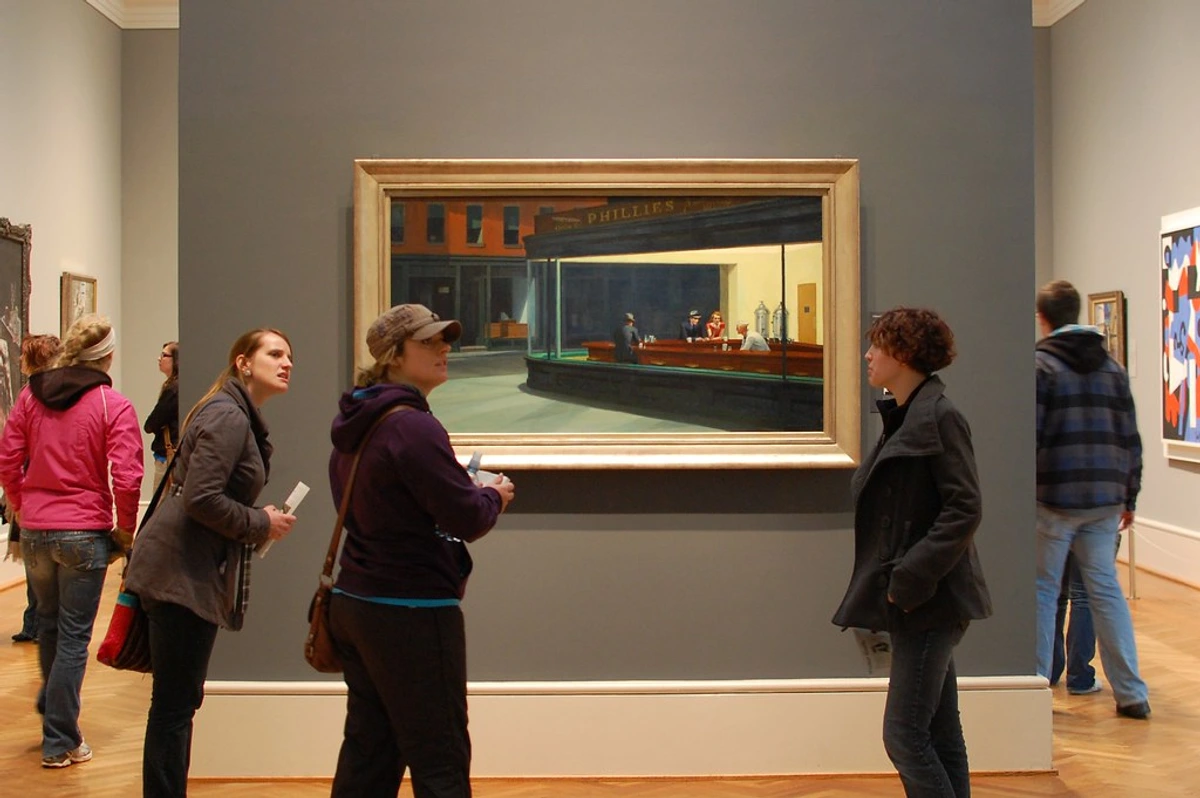
Have you ever found yourself in a bustling city, feeling utterly alone, a solitary observer in a world that rushes past? That profound, quiet chill of recognition – do you know that feeling? For me, encountering Edward Hopper's 'Nighthawks' at the Art Institute of Chicago wasn't just seeing a painting; it was like stumbling upon a whispered secret about urban life. In that moment, the museum's vibrant hum faded, and I was drawn into the glowing solitude of that diner, a voyeur and a participant all at once. 'Nighthawks' has always been a poignant meditation on connection, or rather, the striking lack thereof, amidst modern existence. It's more than canvas and oil; it's an atmosphere, a question, a memory begging us to confront our own experiences with solitude.
If you're anything like me, constantly seeking deeper meaning in art, you'll find 'Nighthawks' a wellspring of quiet desperation and enduring relevance, speaking to the timeless paradox of being alone, together. In this ultimate guide, I want to unpack the layers of this masterpiece, from its historical heartbeat to its subtle brushstrokes of light and shadow, revealing why it continues to resonate so profoundly with our own experiences of modernity and isolation. We'll delve into its historical undercurrents, dissect its visual language, and explore the enduring philosophical questions that make it a true cultural touchstone.
Echoes of a World Holding Its Breath: Historical Context and Urban Alienation
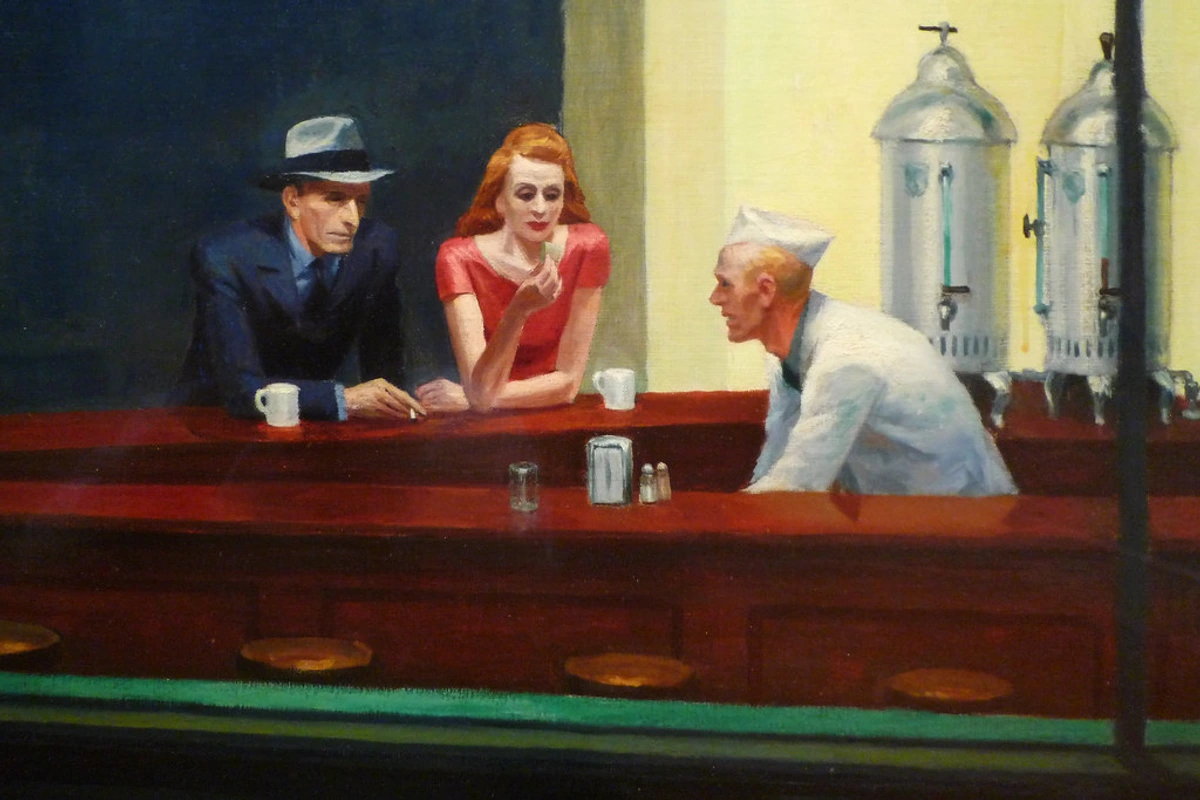
Just look at it. It's late. Very late. The city outside is a dark, deserted canvas, and then there's this diner, glowing like a stage set under stark lights. Hopper painted 'Nighthawks' in 1942, right in the thick of World War II. You can almost feel that undercurrent of anxiety, that pervasive sense of the world holding its breath. American cities during the war experienced blackout drills, rationing, and a profound shift in social dynamics. Men went to war, women entered the workforce, and public spaces sometimes felt eerily quiet or intensely transient. The collective national purpose was strong, yet individually, anxieties about the future, loss, and the rapidly changing social fabric led to a new kind of quiet introspection, a psychological burden often carried silently. It was a time when the very fabric of daily life was strained, and the traditional anchors of community often felt distant. Think of it: a silent, collective holding of breath, a city hushed not by slumber but by an anxious wait.
Hopper himself, famously reticent about the political implications of his work, denied any direct wartime influence, stating he "didn't consciously try to paint the war." But here's the thing, I believe art rarely exists in a vacuum. This feeling of urban isolation isn't just a byproduct of war; it's a persistent thread in the tapestry of modern life, magnified by the societal shifts of the early 20th century. Rapid industrialization and urbanization drew people away from traditional, close-knit communities into sprawling, often anonymous cities. Sociologists like Ferdinand Tönnies were already theorizing about the shift from Gemeinschaft (community, based on intimate bonds) to Gesellschaft (society, based on impersonal, transactional relationships), a concept that perfectly describes the psychological distance Hopper captures. This meant that even amidst the vibrant bustle of a city, individuals could find themselves adrift in a sea of anonymity, a feeling Hopper masterfully distilled into the visual language of his paintings. The war merely amplified this existing hum of detachment.
This was also an era grappling with the shimmering promise and harsh disillusionment of the American Dream. Bustling cities, once symbols of unbounded progress, could now also feel increasingly alienating, like grand stages where individual dramas played out largely unnoticed, echoing the lingering shadows of the Great Depression and the stark uncertainties of global conflict. The diner itself, a quintessential symbol of American comfort and accessibility, here feels devoid of genuine warmth, becoming a stage for a more profound, existential unease. Hopper, who lived and worked in Greenwich Village, New York City, didn't paint a specific diner, but rather drew on the commonplace—the subtle shifts in storefronts and street corners—to create a composite scene that felt universally recognizable. In 'Nighthawks,' Hopper masterfully employs visual storytelling techniques, not through overt action, but by distilling profound emotion from quiet, observant details, inviting us to fill in the unspoken narratives.
A Symphony of Solitude: Figures, Composition, and the Unseen Exit
My eyes always gravitate to the figures. There are four of them: a couple, a lone man, and the server. And here's the kicker, the point that truly resonates with me: they're all together, yet utterly alone. The couple sits side-by-side, their hands almost touching, but their gaze is distant, unengaged. Are they sharing a secret, or are they merely two islands of consciousness drifting side-by-side, their proximity a cruel reminder of their distance? There's no eye contact, no shared glance, just a palpable psychological chasm. The man with his back to us, perched on a stool, seems lost in his own thoughts, perhaps contemplating the bottom of a coffee cup with an almost monastic intensity. And the server? He's serving, sure, but there's no warmth, no genuine interaction in his expression. It's like a tableau of parallel lives, a perfect illustration of psychological distance, a silent drama playing out in fluorescent light. Even the subtle variations in their subdued clothing colors contribute to this sense of individual enclosure rather than shared experience.
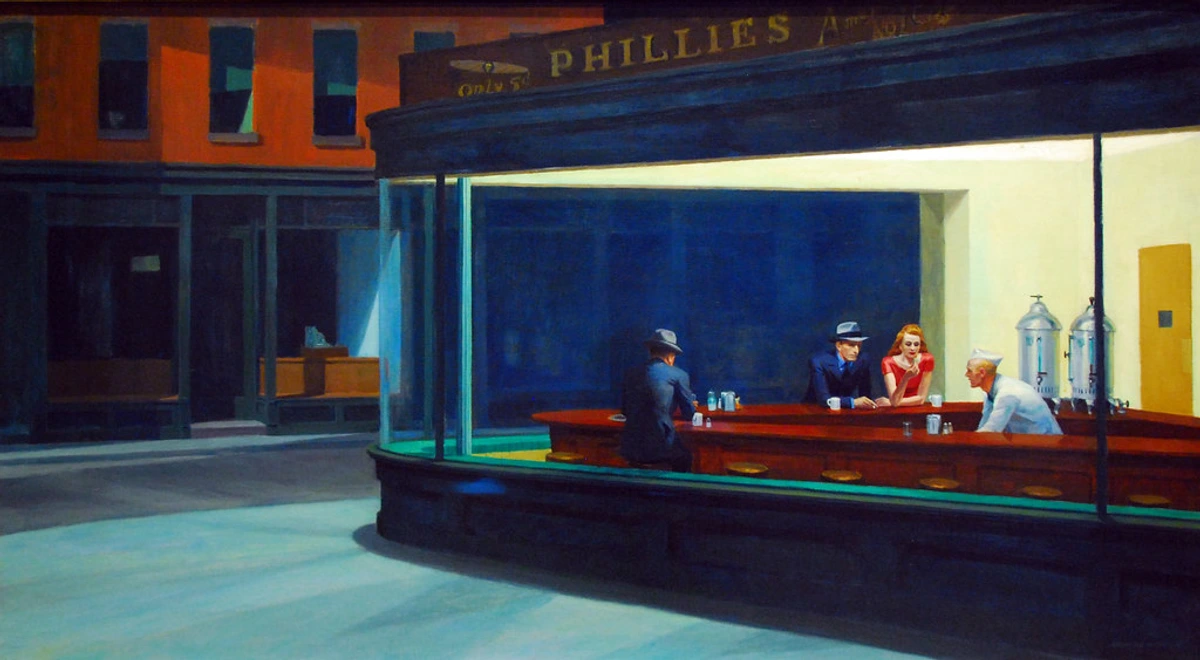
Hopper masterfully uses the diner's counter, the stark contrast of light and shadow, and precise compositional elements to create invisible barriers between them, almost suggesting that despite sharing a physical space, they inhabit entirely separate psychological worlds. The strong horizontal lines of the counter and the street intersect with the verticality of the figures and the streetlights, creating a sense of uneasy balance and subtle tension. His cropped framing, the precise angles of the counter, and the averted gazes of the patrons all contribute to this feeling of detachment. It's a brilliant study in understanding balance in art composition, where visual equilibrium is used not for harmony, but to emphasize emotional disequilibrium and spatial separation. Even the mundane objects, like the cold gleam of coffee urns and the silent stoicism of salt shakers, sit quietly on the counter, witnesses to the silent drama of routine and solitude.
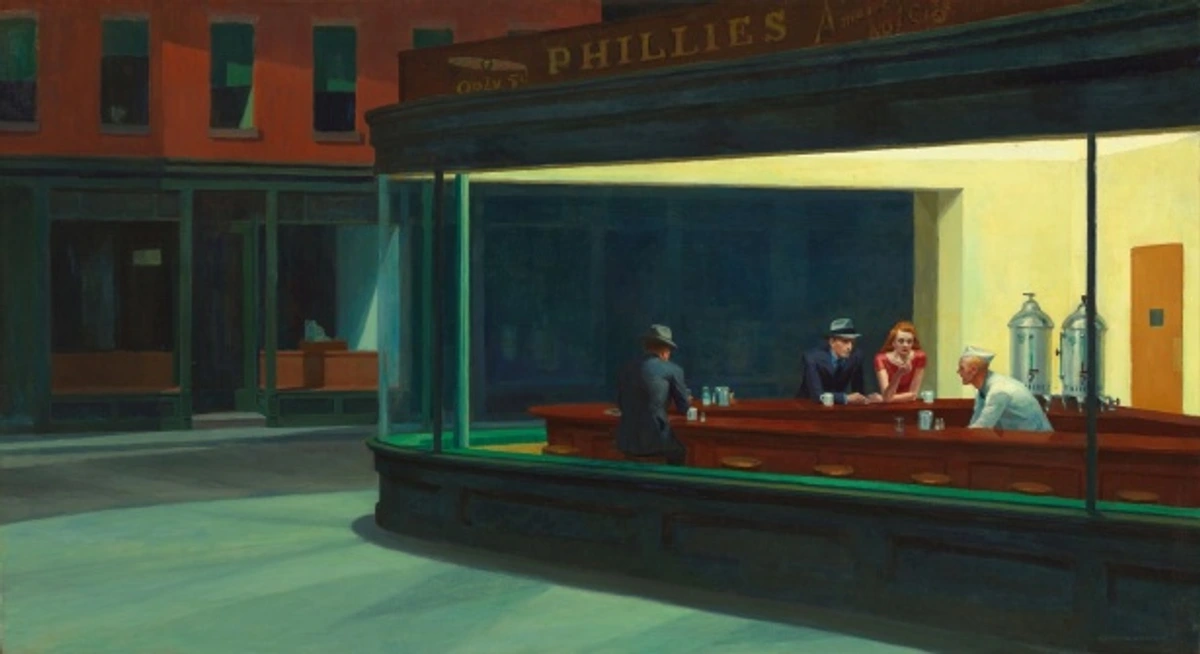
One detail that always nags at me, in the best possible way, is the absolute lack of a visible door for the patrons to exit. They seem... contained. Trapped, even, in this glowing box, illuminated but unyielding. This isn't accidental; it's a deliberate choice by Hopper to reinforce that feeling of existential ennui, of being stuck in a moment, hinting at a broader sense of urban confinement or even the dehumanizing aspects of modern, consumer-driven existence. The sharp, uninviting angle of the building's corner further enhances this sense of enclosure. If you look at other Hopper works like Automat (1927), where a lone woman sips coffee, equally enclosed, or Office at Night (1940), where figures are isolated within a rigid architectural frame, you see this recurring theme of subtle imprisonment. This deliberate omission transforms the diner from a place of transient rest into a potent symbol of existential entrapment, a visual metaphor for being stuck within one's own consciousness or societal confines. This subtle yet powerful narrative choice adds so much weight to the entire scene, doesn't it? The glass facade, rather than offering transparency, acts as a psychological barrier, inviting observation but resisting connection.
Hopper's Artistic Vision and Meticulous Craft: Painting What Was Felt
Hopper wasn't just painting scenes; he was painting feelings. His work consistently explored themes of isolation, introspection, and the quiet melancholy that often accompanies modern life, particularly in urban or semi-urban American settings. He captured the mundane with a profound sense of drama, elevating everyday moments into timeless narratives. While rooted in American Realism, and often associated with the broader American Scene Painting movement that depicted realistic scenes of American life, his style was distinct. American Scene Painting, popular from the 1920s to the 1940s, generally aimed to capture the diverse landscapes and people of America, often with a nationalist or optimistic sentiment. Hopper shared the subject matter but diverged dramatically in emotional tone; he wasn't merely documenting reality; he was distilling the emotional essence of experience. His composition, light, and perspective were always carefully manipulated to evoke a specific emotional response. This wasn't the journalistic immediacy of some realists; it was a carefully constructed emotional landscape, a deep dive into what is design in art as a means of expressing complex emotions, where every element is deliberately placed to serve an overarching feeling.
Hopper's artistic journey was deeply influenced by his training and early European travels, where he absorbed the works of French realists and Impressionists like Edgar Degas and Édouard Manet. From Degas, he took a knack for capturing figures in candid, almost snapshot-like moments, often from unusual angles, and a mastery of compositional cropping that heightened psychological tension – think of Degas's ballerinas caught in unguarded moments. Manet's influence can be seen in his bold use of light and shadow, and his interest in modern urban subjects, particularly how figures exist within contemporary spaces. Yet, he filtered these influences through a distinctly American lens, developing a unique brand of realism that focused on psychological states rather than overt social commentary in the vein of the Ashcan School. He had a way of painting what was felt rather than just what was seen. His commitment to portraying this quiet anxiety of modern life is unwavering, a consistent thread throughout his oeuvre.
Hopper's Deliberate Palette: Color as Emotional Resonance
Hopper's use of color was never arbitrary. He employed a restrained palette, often favoring earthy tones, cool blues, and muted greens, to create a pervasive sense of atmosphere and introspection. This deliberate muting of colors amplifies the somber mood, making the occasional splash of red (like the woman's dress and the server's lips in Nighthawks) all the more striking. That vibrant red acts as a visual jolt, pulling your eye, perhaps symbolizing a flicker of passion or life against the prevailing coolness, or even a warning of internal turmoil. The bright yellows and oranges of the diner's interior, rather than feeling warm and inviting, come across as sterile and exposing, amplifying the cool, distant nature of the setting. Meanwhile, the cool blues and deep greens of the exterior amplify the chill and emptiness of the urban night, enhancing the feeling of loneliness. While my own work often leans towards bold, saturated colors to evoke energy and emotion, Hopper's masterful use of a subdued palette in Nighthawks demonstrates that restraint can be equally powerful in conveying psychological depth, truly a testament to how artists use color as a powerful tool. He created composite scenes like 'Nighthawks' not to depict a specific place, but to capture a universal feeling or atmosphere, allowing countless viewers to project their own experiences onto his evocative canvases.
Hopper's Method Behind the Melancholy
But how did Hopper translate this profound vision into such a resonant image? His meticulous method was as crucial as his philosophical outlook. Hopper was deliberate in his process, often making numerous preparatory sketches and even building small architectural models for his scenes to carefully plan light and shadow. Yet, he wasn't interested in direct transcription of reality. As I mentioned earlier, many of his iconic urban scenes, including 'Nighthawks,' are composites – built from fragments of observation, memory, and imagination, rather than a single, specific location. This deliberate approach ensured the scene's universal resonance. He once commented that the 'Nighthawks' diner was "suggested by a restaurant on Greenwich Avenue where two streets meet," but stressed that he "simplified the scene a great deal and made the restaurant bigger." This deliberate abstraction from a specific reality to an imagined, yet recognizable, space is key.
He famously said, "I don't think I ever tried to paint the American scene; I'm trying to paint myself." This powerful statement reveals a fundamental aspect of his philosophy: art for him was a vehicle for introspection, a way to externalize internal psychological states. This quiet, often introverted nature of Hopper himself is reflected in the contemplative mood of his figures. He wasn't a social commentator in the direct sense, but rather a profound observer of the human condition, believing that by capturing the subtle anxieties and quiet dramas of individual lives, he could speak to universal truths. His studio, a quiet space in Greenwich Village, was where these observations were distilled, transformed from fleeting glimpses into enduring canvases. This deliberate, contemplative approach is why his work feels so carefully constructed, each element serving the overarching emotional narrative.
Light, Shadow, and a Cinematic Quality: The Genius of Illumination
Hopper was a master of light, wasn't he? In 'Nighthawks,' he uses it almost like a stage director, or perhaps a cinematographer in a classic Hollywood drama. The harsh, artificial light from the diner floods the scene, creating dramatic contrasts with the inky blackness outside. This isn't the nuanced play of natural light you might see in a Rembrandt, where what is tenebrism in art adds depth and an earthy drama, often obscuring as much as it reveals with its dramatic chiaroscuro. Here, the light is cold, revealing, almost surgical. Its cool fluorescent glow strips away comfort, exposing the vulnerability of the figures, leaving no place for shadows to hide intimate secrets. It's a spotlight on human solitude, amplifying every quiet gesture and distant gaze, an almost clinical examination of isolation.
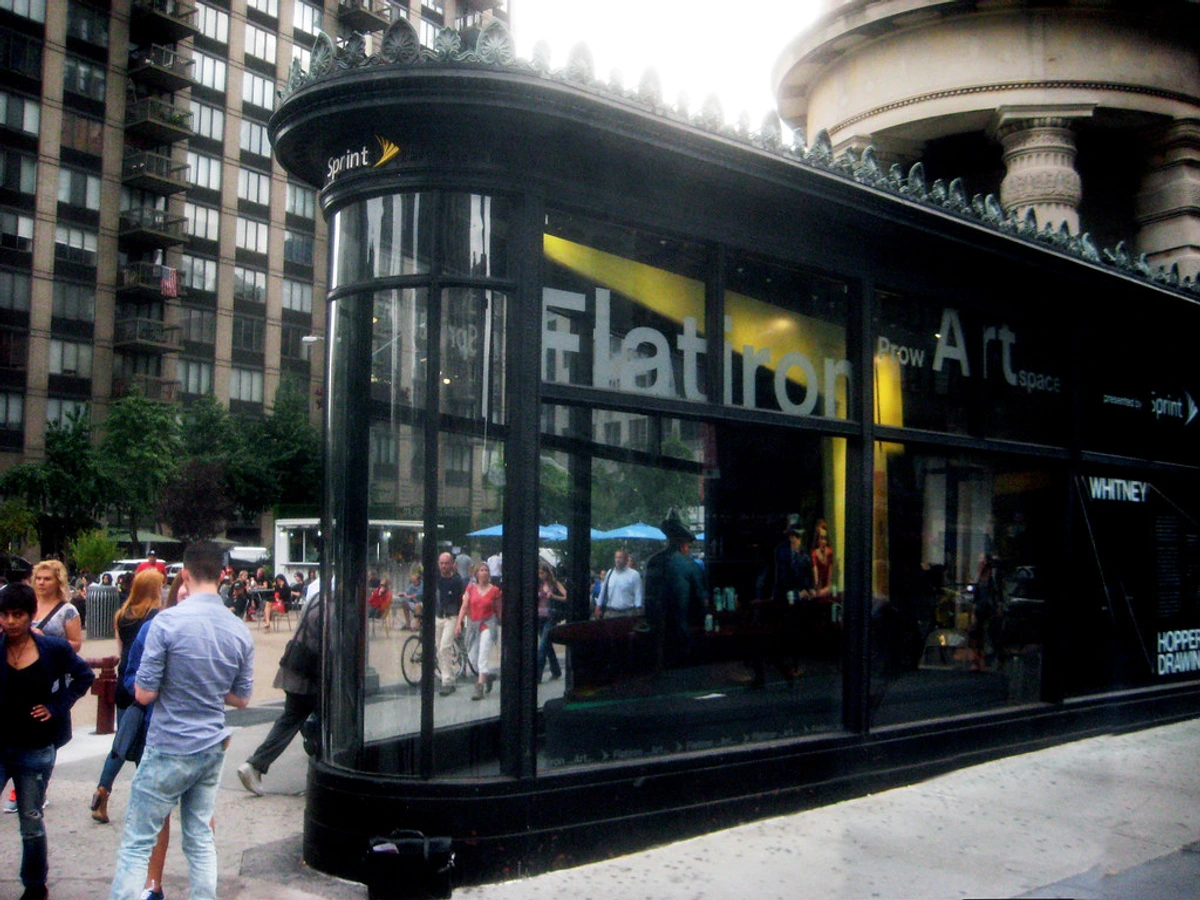
credit, licence
This masterful manipulation of light and shadow not only shapes the mood but also contributes to the painting's striking cinematic quality, a characteristic frequently noted by critics. The stark, almost theatrical illumination, the cropped framing, and the pervasive sense of unspoken narrative are uncannily prescient of the iconic film noir aesthetic that would define Hollywood cinema in the following decade. It predates much of classic film noir, yet it perfectly captures that genre's mood: mystery, detachment, moral ambiguity, and a sense of quiet drama unfolding under harsh, artificial lights in an impersonal urban landscape. Think of early film noir classics like The Maltese Falcon or Double Indemnity, with their stark chiaroscuro lighting and protagonists grappling with internal conflict in dimly lit urban settings – the atmosphere feels uncannily similar to Hopper's diner. You can almost hear the soft jazz, the clinking of glasses, the unspoken narratives playing out. It creates a mood that's both inviting and unsettling, pulling you in while keeping you at arm's length. For a deeper dive into how artists harness this fundamental element, check out our definitive guide to understanding light in art.
Related Works by Edward Hopper: Consistent Themes of Solitude
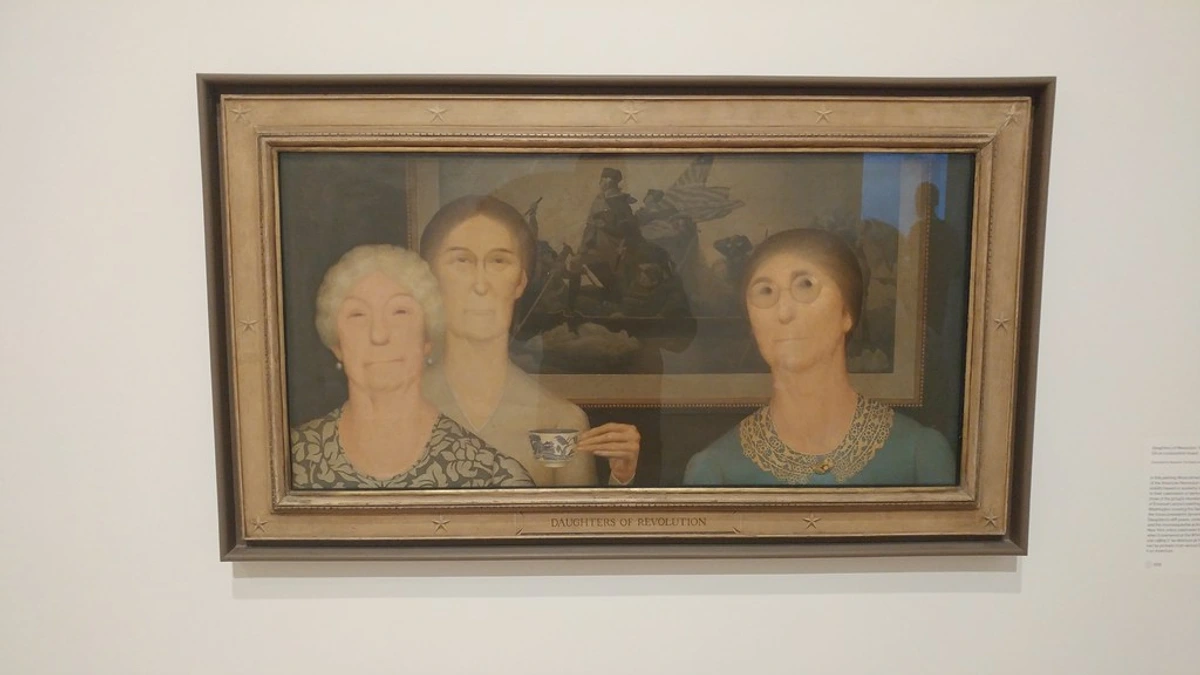
Hopper's fascination with isolation, urban life, and introspective figures wasn't a one-off for 'Nighthawks.' It's a deeply embedded thread throughout his oeuvre, as seen in these other iconic works:
- Automat (1927): A lone woman sits in a brightly lit automat, a self-service restaurant, sipping coffee and lost in thought. The empty chairs, the stark reflection in the window, and her solitary posture powerfully convey a similar sense of urban alienation and introspection as seen in 'Nighthawks.' She is surrounded by artificial comfort, yet utterly alone.
- Office at Night (1940): This painting depicts two figures, a man and a woman, in a brightly lit office late at night. Though sharing a space, they are emotionally distant, separated by a desk and an invisible psychological barrier. The scene emphasizes the isolation that can exist even within shared working environments, mirroring the disconnectedness of the 'Nighthawks' patrons.
- Gas (1940): A lone attendant stands by his pumps at a gas station, under the ominous glow of a single light, against a backdrop of encroaching darkness and a dense forest. This image, like 'Nighthawks,' uses stark artificial light to create a sense of heightened drama and isolation, presenting the attendant as a solitary sentinel in a vast, dark expanse, a poignant symbol of quiet vigilance and loneliness in modernity.
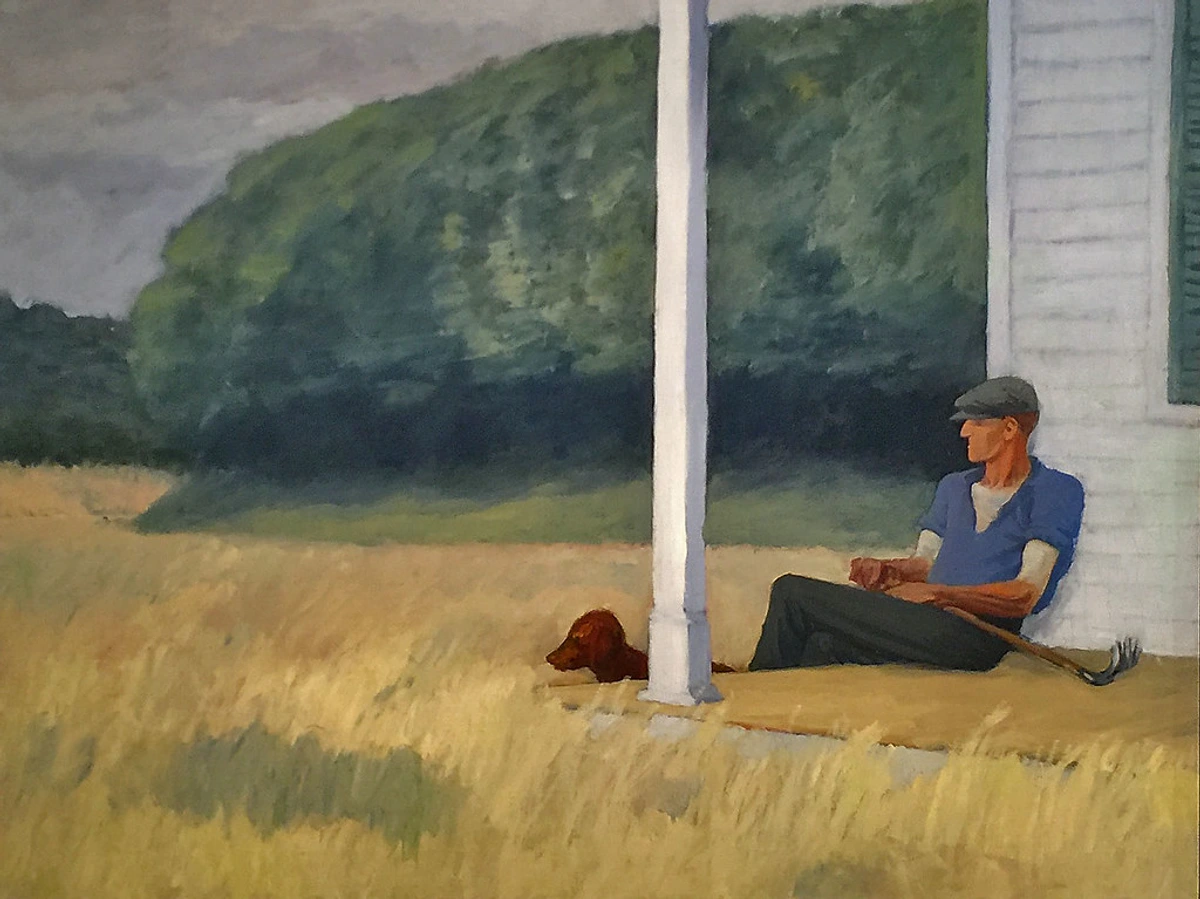
- Clamdigger (1935): Even in a natural landscape, Hopper's figures are often solitary and contemplative. This painting depicts a lone man on a dock, looking out to sea, dwarfed by the expansive environment. It evokes a similar sense of introspection and quietude, demonstrating that isolation was a universal theme for Hopper, extending beyond the urban setting.
These works collectively underscore Hopper's consistent focus on the human condition in the face of burgeoning modernity, making 'Nighthawks' not an anomaly, but a pinnacle expression of his lifelong artistic inquiry.
Enduring Influence and Critical Acclaim: A Timeless Reflection
'Nighthawks' was purchased by the Art Institute of Chicago in 1942, just months after its completion for a sum of $3,000, a significant acquisition at the time. It has remained a cornerstone of their collection ever since. Its initial reception was largely positive, lauded for its unique portrayal of American life. Over the decades, its reputation has only grown, influencing countless artists, filmmakers, writers, and musicians. It's been parodied, referenced, and reimagined across popular culture – from Blade Runner's rain-slicked, neon-drenched urban landscapes echoing Nighthawks' desolate, illuminated spaces, to The Simpsons' witty homages that often play on the painting's iconic composition and themes of isolated characters, and even inspiring album covers (like Tom Waits' Nighthawks at the Diner) and theatrical sets. This pervasive presence is a testament to its universal and timeless appeal.
While the dominant narrative often centers on loneliness, some art historians and viewers offer a more nuanced perspective. Perhaps the figures aren't purely desperate but are finding a quiet refuge, a moment of respite from the chaotic world outside. Could their solitude be a form of self-possession, a space for introspection rather than pure despair? This ambiguity, this invitation for what is the meaning of art to be co-created by the viewer, is precisely why it remains so compelling. Hopper's genius lies in his ability to create a visual invitation, compelling us to step into the frame, project our own stories, and thus become active participants in the artwork's ongoing meaning-making. Hopper famously said, "I don't think I ever tried to paint the American scene; I'm trying to paint myself." I believe this openness allows us to project ourselves into the diner, finding our own reflections there, whether that's quiet despair or a comforting solitude.
Standing before it today, as many visitors do daily at the Art Institute of Chicago (a city I love, by the way, for its vibrant art scene and impressive collections, much like you'd find in an art lover's guide to Chicago), you can feel its power. It transcends its specific time and place, speaking to a perennial aspect of the human condition in the modern world. It's a painting that makes you pause, reflect, and perhaps even feel a little less alone in your own moments of quiet introspection.
Key Interpretations of Nighthawks
To summarize the depth we've explored, here are the core lenses through which 'Nighthawks' is most commonly interpreted:
Interpretation  | Description | Visual Evidence/Rationale |
|---|---|---|
| Isolation and Urban Alienation | A profound commentary on modernity's impact on the human spirit, especially the sense of disconnectedness despite physical proximity in urban settings, a feeling amplified by rapid industrialization and anonymous city life. | The four figures are physically together but psychologically separate, with gazes averted and no apparent interaction, set against an empty city street. Hopper's compositions often emphasize this spatial and emotional gap through precise placement and negative space. |
| The Unseen Exit / Trapped Existence | The lack of a visible exit reinforces feelings of existential ennui and being stuck in a moment or a broader sense of urban confinement, hinting at a loss of agency and the psychological weight of being observed yet unable to connect. | There are no discernible doors leading out of the diner for the patrons, creating a sense of containment or an inescapable moment. The glass seems to act more as a barrier than an opening, a deliberate artistic choice suggesting psychological or societal confinement. The sharp, uninviting angle of the building's corner further enhances this sense of enclosure. |
| Artificial Light and Psychological Exposure | The harsh diner light acts like a stage light, exposing vulnerability and stark reality rather than offering warmth or comfort, stripping away illusions and amplifying feelings of unease and a lack of privacy, an almost clinical examination of isolation. | The bright, almost sterile, fluorescent light illuminates the figures starkly, casting deep shadows and revealing their somber expressions. It creates a cold, almost surgical atmosphere, quite different from natural light that might offer solace or comfort, highlighting a sense of emotional nakedness and making them appear 'on display.' |
| Cinematic Narrative and Film Noir Parallels | The painting's mood evokes mystery, detachment, unspoken tension, and quiet drama, akin to the visual storytelling and atmosphere of classic film noir, hinting at untold stories and hidden struggles within the urban landscape. | The dramatic lighting, cropped composition, enigmatic figures, and the sense of an untold story create a scene that feels like a still from a movie, hinting at suspense and hidden narratives. The oblique angles and long shadows are characteristic of film noir aesthetics. The viewer feels like a voyeur, peering into a private, unfolding drama. |
| Dehumanizing Aspects of Modernity/Consumerism | A critique of how modern urban life and its consumer-driven spaces can strip away individuality and genuine human connection, leaving individuals as passive consumers or observers within standardized, impersonal environments. | The standardized, sterile environment of the diner, the anonymity of the figures, and their lack of interaction suggest a critique of the impersonal nature of modern urban existence. The uniform nature of the counter and stools, the standardized coffee mugs, and the lack of personal embellishments in the diner's decor all contribute to an environment where individuality can feel subsumed by efficiency and uniformity. The glowing diner, a beacon of commerce, offers only superficial comfort. |
| Post-War Anxiety and the American Dream Questioned | Reflects the national mood of desperation, loneliness, and doubt about the traditional American dream during WWII and the societal shifts that accompanied it, subtly questioning the ideals of effortless American comfort and optimism. | Painted in 1942, the desolate street, isolated figures, and overall somber mood capture the anxieties of a nation at war – a time of rationing, blackout drills, and the constant news of casualties creating a pervasive sense of national introspection and uncertainty. The diner itself, a symbol of American comfort, feels devoid of genuine warmth and connection, mirroring a collective, subdued mood and challenging the traditional narrative of prosperity. |
| Ambiguity and Viewer Participation | Hopper resisted specific narratives, deliberately leaving details ambiguous to invite viewers to project their own experiences and meanings onto the scene, making it universally relatable and co-creating its meaning. | The lack of clear interaction, definite relationships between figures, or a defined plot encourages viewers to fill in the blanks, making the painting universally relatable and open to myriad personal interpretations. Hopper famously said, "I don't think I ever tried to paint the American scene; I'm trying to paint myself." This suggests a subjective experience, inviting the viewer's own, making them an active participant in constructing the artwork's meaning. |
Frequently Asked Questions (FAQ)
What is the primary meaning of Nighthawks?
While interpretations vary widely, a central and often debated theme is urban isolation and the profound feeling of disconnectedness within modern city life. The Nighthawks painting captures a sense of quiet desperation and loneliness, even when people are physically together but psychologically unable to connect – a powerful commentary on the paradox of the modern human experience. It resonates deeply with the anxieties explored in works like what is the meaning of The Scream by Edvard Munch or generally in art about anxiety, making it a timeless exploration of the human psyche that speaks to the shared human condition.
Why is Nighthawks considered so influential?
Its striking cinematic quality, masterful use of light and shadow to create drama, evocative mood and atmosphere, and its timeless commentary on the human condition have made it a touchstone in art history. It's also remarkably accessible; its visual impact and emotional resonance are immediate, even for those not deeply versed in art history. It resonates deeply with viewers across generations and disciplines, influencing everything from filmmaking to literature and our general understanding of modern art and the contributions of most important artists. It's a masterclass in how to evoke complex emotions with minimal narrative detail, demonstrating the enduring power of American realism.
When was Nighthawks painted?
Edward Hopper painted 'Nighthawks' in 1942, during the height of World War II.
Where is Nighthawks displayed?
The painting is permanently displayed at the Art Institute of Chicago, a truly magnificent place for exploring what is modern art and historical masterpieces alike. It's a key part of one of America's greatest art collections.
Does Nighthawks depict a specific place?
No, while inspired by Hopper's observations of Greenwich Village in New York City, the scene is not a direct depiction of a single, real location. Instead, it's a composite scene, an imagined space that enhances its universal themes of anonymity and urban isolation. Hopper often created composite scenes, blending elements from various observations to amplify emotional impact, a deliberate artistic choice rather than a documentary one. This approach allows the diner to represent any urban spot where quiet lives unfold, intensifying the feeling of a shared human experience of alienation rather than a specific geographical one. It captures the very essence of urban life itself.

What colors did Hopper use in Nighthawks?
Hopper's palette for 'Nighthawks' is intentionally subdued, dominated by a range of yellows and oranges for the diner's interior light, contrasted with deep greens and blues for the street and exterior buildings, and muted browns and grays for clothing and shadows. The striking red of the woman's dress and the server's lips provides a vital focal point, drawing the eye and adding a touch of melancholic drama. The bright yellows and oranges of the diner's interior feel sterile and exposing rather than warm and inviting, amplifying the cool, distant nature of the setting. Meanwhile, the cool blues and deep greens of the exterior amplify the chill and emptiness of the urban night, enhancing the feeling of loneliness and contributing significantly to the painting's powerful psychological impact. It's a masterclass in using a limited palette to maximum emotional effect, even if it contrasts with the vibrant hues often explored in abstract work.
How did Hopper compose Nighthawks?
Hopper used a tightly cropped, almost theatrical composition that draws the viewer into the diner, making us voyeurs peering through the large glass window. The strong horizontal lines of the counter and the street intersect with the verticality of the figures and the streetlights, creating a sense of uneasy balance and subtle tension. His use of deep perspective from the viewer's implied position across the street, along with subtle diagonal lines (like the counter), emphasizes the diner's glowing isolation within the dark urban landscape. This carefully planned structure, with its deliberate cropping and implied vanishing points, is designed not just to show a scene, but to evoke a feeling of detachment and inescapable observation, guiding the viewer's eye through the narrative. The way the figures are spaced and angled further reinforces their isolation from each other, despite their physical proximity. It's a true example of sophisticated definitive guide to perspective in art, meticulously crafted to contribute to the painting's powerful emotional impact and iconic status, akin to the precise arrangements seen in abstract geometric compositions.






My Personal Take: The Enduring Resonance of Quiet Desperation
'Nighthawks' isn't just a painting; it's a mirror. Every time I look at it, I find a new reflection of the modern human experience. The way Hopper makes us feel the weight of shared but unspoken moments, the paradox of being surrounded by others yet feeling utterly alone—it's profoundly relatable. It reminds me of those quiet evenings in a bustling city when you're caught in your own thoughts, observing the world, and sensing the multitude of parallel lives unfolding around you. Sometimes I wonder if the figures in the painting, lost in their thoughts, are actually more connected to each other through their shared solitude than if they were engaged in forced conversation. That's a curious thought, isn't it? Perhaps it's a form of connection that resonates deeply with anyone who cherishes quiet contemplation. While my own canvases explode with energetic hues and abstract forms, often striving for a visceral emotional release, Hopper's deliberate restraint in Nighthawks achieves a different, equally potent, form of psychological impact. My studio is a riot of colors, quite a contrast to Hopper's restrained elegance, I must admit, yet we both aim for emotional resonance – just through different palettes. It's a powerful reminder that there's no single path to conveying profound human truths in art.
It's a testament to Hopper's genius that a scene from 1942 can still capture so perfectly the subtle, persistent hum of urban alienation that many of us still feel today. It makes me feel a bit melancholic, yes, but also seen, understood. It's an invitation to pause, to reflect on our own connections—or the lack thereof—and perhaps to find a sliver of shared humanity in that quiet contemplation. This piece is a classic for a reason; it just keeps giving, continually revealing new layers of meaning about what it truly means to be human in a solitary, yet crowded, world. So, the next time you find yourself in a quiet moment, perhaps observing the world from a cafe window or a late-night bus, consider 'Nighthawks.' It's a potent reminder that in our shared experiences of solitude, there can be a profound, if quiet, connection. And honestly, isn't that what the best art always does? It's why masterpieces like 'Nighthawks' aren't just pictures on a wall; they're ongoing conversations we have with ourselves, with each other, and with the persistent paradox of being human in a solitary, yet crowded, world.