Uncovering the Brilliant Art of the So-Called 'Dark Ages'
Forget mud and misery. Dive into the surprisingly vibrant and intricate art of the Early Middle Ages, from dazzling manuscripts to monumental metalwork. It's time to shed some light on the 'Dark Ages'.

Uncovering the Brilliant Art of the So-Called "Dark Ages": An Ultimate Guide to Early Medieval Art
Let's be real, the term “Dark Ages” probably conjures up images of mud, misery, and maybe a rather uncultured Viking or two, right? For a long time, my own mind certainly went there—picturing crude carvings on a drinking horn if I thought of art at all, perhaps even a vague sense of artistic decline. But oh, how wonderfully wrong I was, and how much I love being proven wrong when it leads to such profound discoveries! This dramatic historical label is a master of disguise, concealing a period far more inventive and brilliantly lit than its gloomy nickname suggests. And honestly, it’s one of the most fascinating artistic eras I’ve ever delved into, a true testament to human creativity blossoming amidst profound change. This isn't just another historical overview; this article, I promise, will become your ultimate, most comprehensive guide to uncovering the vibrant, astonishing reality of the Early Middle Ages—an era spanning roughly 500 to 1000 AD—demonstrating definitively why this period of profound transformation and cultural fusion was anything but "dark." We're going to leave no stone unturned, exploring every facet—from the breathtaking intricacy of illuminated manuscripts to the groundbreaking ambition of monumental architecture and the dazzling artistry of metalwork and jewelry—revealing the sheer ingenuity, resilience, and profound creativity that defined this truly remarkable period across Europe and beyond.
So, grab a cup of tea – or something stronger if you prefer – and let's pull back the curtain on an era of art that is far more inventive and dazzling than its gloomy nickname suggests. We’ll dive deep into the complex influences, the groundbreaking styles, the incredible technological innovations, and the sheer human effort that birthed some of the most captivating artworks in history. I mean, we're talking about the very bedrock of Western art here, people! It's going to be an illuminating journey, one that will redefine your understanding of an entire thousand years of human ingenuity, showing how the "darkness" was, in fact, an explosion of light and form. This guide is your essential resource for understanding Early Medieval Art History, exploring the vibrant artistic styles of the Early Middle Ages, and appreciating the masterful craftsmanship that flourished during this transformative era.
Table of Contents
- First Off, Let's Talk About That Name: Why "Dark Ages" is So Misleading
- The Real Art of the Era: A Fusion of Styles and Profound Purpose
- Regional Diversity and Artistic Crossroads
- Echoes of Antiquity and the East: Early Christian and Byzantine Art as Foundations
- The Profound Role of Symbolism: A Visual Language of Faith
- The Art of the Book: Insular & Hiberno-Saxon Marvels
- The Sacred Labor of the Scriptorium: Crafting Divine Books
- Expanding Beyond Manuscripts: Insular Stone Crosses
- Charlemagne's Classical Comeback: The Carolingian Renaissance
- Building on the Dream: Ottonian Art
- Metalwork and Jewelry: Glittering Status Symbols and Sacred Objects
- The Enduring Allure of Fibulae
- Treasure Bindings: When Books Became Jewels
- Specific Artistic Techniques: Cloisonné, Filigree, and More
- Architecture: Foundations of Future Grandeur and Innovation
- Architecture as Imperial Statement: Power and Propaganda
- Early Medieval Vaulting and Structural Ingenuity
- Monastic Layouts: The Ideal of St. Gall
- Sculpture: From Portable Pieces to Monumental Statements and Narrative Power
- Carolingian and Ottonian Ivories: Miniature Masterpieces
- The Craftsman's World: Artists, Workshops, and Anonymity
- Daily Life and Artistic Production: Art in Context
- Key Styles of Early Medieval Art: A Comparative Overview
- From Darkness to Light: The Path to the High Middle Ages
- The Lingering Echoes: Early Medieval Art and Contemporary Creativity
- The Power Behind the Palette: Patronage in Early Medieval Art
- Glossary of Key Terms
- Frequently Asked Questions (FAQ) About Early Medieval Art
First Off, Let's Talk About That Name: Why "Dark Ages" is So Misleading
Before we dive into the gorgeous stuff, we absolutely have to address the elephant in the room: that persistent, problematic name, “Dark Ages.” It’s a bit of a marketing problem, isn’t it? The term was originally coined by later Renaissance humanists like Petrarch (Francesco Petrarca) in the 14th century, who, to put it mildly, were pretty big fans of their own work and the perceived glory of Classical Greece and Rome. These thinkers essentially saw the centuries between the collapse of the Western Roman Empire (traditionally 476 AD) and their 'enlightened' time as a long, dim, ignorant gap – a desolate valley of barbarism between two glorious peaks of civilization. This narrative, while deeply self-serving and driven by a desire to glorify their own era by contrasting it with a supposed decline, profoundly influenced subsequent historical perceptions for centuries, casting a persistent, unfair shadow over a period that was, in reality, one of profound transformation, cultural fusion, and astonishing innovation. It's a label that, to me, misses the entire point of human resilience and creativity. What a branding disaster for an entire millennium of human achievement, right? Imagine if your entire artistic output was dismissed as 'dark' simply because a later generation thought their art was shinier. It was a rhetorical sleight of hand that, for centuries, obscured the vibrant intellectual preservation, technological advancements, and profound spiritual expressions that actually characterized the era. This period truly laid the groundwork for everything that came after, demonstrating a resilience and adaptability that’s frankly awe-inspiring.
But here’s the thing: most historians today actively avoid the term because it’s incredibly misleading, and frankly, a bit unfair. This period, more accurately called the Early Middle Ages (roughly 500 to 1000 AD), was anything but a void. The idea of a “Dark Ages” isn't just inaccurate; it's a relic of a very specific historical moment. Renaissance scholars, eager to highlight their own rediscovery of classical antiquity, essentially cast the preceding centuries into shadow, conveniently ignoring the incredible intellectual and artistic vibrancy that actually flourished. It was a rhetorical move, a way for them to glorify their own era by diminishing another. I actually see it as a vibrant crucible of immense change, characterized by large-scale migrations and profound cultural fusion.
Migration Period Art: Portable Wealth and Dynamic Styles
Not coincidentally, the Migration Period (roughly 300-700 AD) gave rise to a distinct Migration Period art, deeply rooted in the portable wealth and rich symbolic world of these dynamic peoples, showcasing their intricate metalwork and highly stylized animal forms. Imagine a nomadic chieftain, his status clearly communicated by the dazzling fibulae fastening his cloak, each one a miniature masterpiece of abstract design. This was a profound fusion of cultures: the lingering echoes of the Roman Empire, the dynamic energies of the so-called “barbarian” tribes (like the Goths, Vandals, Saxons, Lombards, and Franks), and the inexorable rise of Christianity. Imagine that melting pot – in that chaotic, creative soup, a whole new kind of art was undeniably born, brimming with innovation and unexpected beauty, laying the groundwork for much of what we consider European identity today.
credit, licence
The Real Art of the Era: A Fusion of Styles and Profound Purpose
So, if they weren't just sitting in the dark, what were they making? The art of the Early Middle Ages is a fascinating blend of traditions, driven by distinct and powerful purposes. This wasn't "art for art's sake" in the modern gallery sense; instead, it was deeply intertwined with core societal functions: religious devotion, asserting royal and ecclesiastical power, commemorating the dead, and educating a largely illiterate populace. I like to think of it as a truly dynamic cultural remix: it took the intricate, energetic, often otherworldly geometric patterns of Celtic and Germanic tribes (think swirling animal motifs and complex interlace, echoing an almost animistic worldview, full of hidden meanings), mashed them up with the profound narratives and symbolic requirements of Christian subject matter, and often adopted the more naturalistic artistic forms, architectural structures, and sophisticated materials of the lingering Roman tradition. This interplay between the abstract, almost otherworldly patterns and the emerging attempts at naturalistic representation is one of the most compelling aspects of the period, demonstrating a remarkable synthesis of disparate visual languages.
Regional Diversity and Artistic Crossroads
One of the fascinating aspects of Early Medieval art is its inherent regional diversity. While broad styles like Insular, Carolingian, and Ottonian art provide a framework, each region and often each major monastery or court developed its own unique artistic flair, a testament to local traditions and the specific blend of influences. From the intricate interlace of Anglo-Saxon England and Celtic Ireland to the classical revival in Charlemagne's Frankish Empire and the emotionally charged works of Ottonian Germany, art was constantly being reinterpreted and remixed. This geographic spread meant a vibrant exchange of ideas, techniques, and iconography, creating a rich tapestry of visual expression across Europe. It’s like watching different musical genres emerge from a shared set of instruments, each with its own distinct rhythm and melody.
The result was something entirely new, often dazzlingly intricate, and frequently portable and precious. These were objects designed to travel with their owners – a testament to the nomadic or migratory lifestyles that characterized parts of the era – and to make a powerful statement wherever they went, whether in a monastic cell, a royal court, or on the battlefield. Think about it: a personal reliquary, a stunning brooch, or an illuminated Gospel book wasn't just beautiful; it was a mobile declaration of faith, wealth, and identity. This fusion is what gives the art of this period its unique character, a dynamic interplay between abstraction and nascent naturalism, between the spiritual and the earthly, reflecting a society in constant motion and profound spiritual transformation. For example, the magnificent Sutton Hoo helmet, a seventh-century Anglo-Saxon masterpiece found in England, perfectly embodies this fusion: a powerful functional object transformed into a dazzling symbol of status and cultural identity, blending Germanic animal style with hints of Roman imperial imagery. It's a truly stunning piece that gives me shivers just thinking about the skill involved.
Echoes of Antiquity and the East: Early Christian and Byzantine Art as Foundations
Before diving too deep into the specific styles of the Early Middle Ages, it’s crucial to acknowledge the foundational artistic languages that preceded and influenced it: Early Christian art and the burgeoning traditions of the Byzantine Empire. Emerging from the Roman Empire, Early Christian art developed new iconography and artistic conventions to serve the burgeoning Christian faith. While often drawing on Roman artistic techniques and forms (like those found in catacomb paintings, sarcophagi, and early basilicas), it transformed these to convey Christian narratives and beliefs. This art often presented a more symbolic and less naturalistic approach compared to classical Roman art, foreshadowing the symbolic richness that would define much of the Early Middle Ages. Key elements included the development of Christian symbols (like the fish, anchor, or Chi-Rho monogram), narrative scenes from the Bible, and portraiture of Christ, Mary, and saints.
Simultaneously, the Byzantine Empire (the Eastern Roman Empire), with its capital at Constantinople (modern-day Istanbul), developed a distinct and highly influential artistic style that would profoundly impact the Early Middle Ages, particularly in areas closer to its sphere of influence. Byzantine art was characterized by its lavish use of gold, shimmering mosaics, flattened, frontal figures, and an emphasis on spiritual transcendence. It conveyed imperial power and divine authority through rich iconography and sophisticated materials, often influencing Carolingian and Ottonian art with its regal portraits, hierarchical compositions, and opulent aesthetics. Think of the breathtaking mosaics of San Vitale in Ravenna, Italy, depicting Emperor Justinian and Empress Theodora in rich, gold-leafed glory, surrounded by their court and clergy. These weren't just pretty pictures; they were powerful visual declarations of imperial and divine authority, literally embedding the rulers within a sacred context. These traditions provided a rich visual vocabulary—a kind of spiritual and imperial shorthand—that subsequent early medieval artists would adapt, reinterpret, and fuse with their own indigenous styles, creating a potent synthesis of old and new.

The Profound Role of Symbolism: A Visual Language of Faith
Beyond aesthetics, Early Medieval art was a language in itself, rich with symbolism—a visual lexicon for a society steeped in faith and tradition. Every interlacing knot, every stylized animal, every vibrant color choice carried specific, often multifaceted meanings, deeply rooted in Christian theology, classical philosophy, or ancient cultural traditions. For instance, the Chi-Rho monogram (the first two Greek letters of "Christ") transformed into dazzling visual puzzles in manuscripts, while the Alpha and Omega symbolized God's eternal presence as the beginning and the end. But the symbolism extended further: the peacock often represented immortality, the lamb stood for Christ's sacrifice, and even the simple fish was an acronym for "Jesus Christ, Son of God, Savior." The anchor often represented hope and steadfastness in faith. The lion could represent Mark the Evangelist, but also Christ's resurrection or even evil depending on context, making interpretation a subtle art! These symbols were far more than mere decoration; they were powerful didactic tools, helping to convey complex religious narratives, moral lessons, and the very essence of faith to a largely illiterate populace. Imagine flipping through a manuscript and understanding the stories not just through text, but through the vivid, intentional iconography that surrounded it. It’s a testament to the power of visual communication, a precursor to many modern forms of visual storytelling. For more on how imagery conveys meaning, you might find our guide to visual storytelling techniques in narrative art interesting!
To make sense of this visual language, a quick overview of some common symbols can be incredibly helpful:
Symbol  | Common Meaning(s) |
|---|---|
| Chi-Rho | Christ, often representing his divine presence |
| Alpha & Omega | God's eternal presence as the beginning and end |
| Fish (Ichthys) | Jesus Christ, Son of God, Savior (acronym) |
| Lamb | Christ's sacrifice, innocence |
| Peacock | Immortality, eternal life (due to belief its flesh didn't decay), resurrection |
| Anchor | Hope, steadfastness in faith |
| Lion | Mark the Evangelist, Christ's Resurrection, or evil/sin (ambiguous) |
| Dove | Holy Spirit, peace, purity |
| Vine/Grapevine | Christ as the "true vine," Eucharist, abundance, fertility |
| Eagle | John the Evangelist, resurrection, ascension of Christ, imperial power |
| Serpent | Evil, temptation, but also healing (Moses' bronze serpent) |
| Tree of Life | Immortality, connection between heaven and earth, spiritual growth |
| Hand of God | Divine intervention, blessing, authority |
| Phoenix | Resurrection, eternal life, rebirth |
The Art of the Book: Insular & Hiberno-Saxon Marvels
For me, the most mind-blowing art from this period happened on the pages of books. Seriously, what these monks achieved in terms of detail, devotion, and sheer endurance is just staggering. In the isolated monasteries of Ireland and Britain, far from much of the political turmoil of mainland Europe, monks created some of the most complex and beautiful objects ever made. This flourishing is known as Insular art (or Hiberno-Saxon), a true testament to the monastic scriptorium (the room dedicated to copying texts) as a vibrant center of artistic innovation and profound spiritual dedication, and a literal beacon of light in an often turbulent world. The very act of creating these illuminated manuscripts (manuscripts in which the text is supplemented with elaborate decoration, initials, borders, and miniature illustrations, often using gold and silver) was a form of spiritual discipline, a way to honor the divine word through unparalleled beauty and meticulous craftsmanship. These monastic communities weren't just preserving knowledge; they were actively fostering an artistic renaissance unique to their geographic isolation. Their remoteness, while challenging, allowed for the development of highly original artistic conventions, often less constrained by mainland European trends and more deeply connected to indigenous Celtic and Germanic artistic traditions. They were true cultural powerhouses, developing distinct artistic conventions and techniques that would influence art far beyond their islands.
The Sacred Labor of the Scriptorium: Crafting Divine Books
To truly appreciate Insular art, you have to imagine the daily life of a monk or nun in a scriptorium. It was a place of immense focus, quiet devotion, and often physical hardship. Working by natural light or flickering candlelight (a huge fire hazard, by the way!), these dedicated individuals would spend countless hours meticulously preparing vellum (treated animal skin, typically calf, lamb, or goat, painstakingly prepared to be a smooth, luminous surface, far more durable than papyrus) – a process involving soaking, stretching, scraping, and whitening that could take weeks, resulting in a flexible, luxurious canvas. They would then meticulously rule the pages, grind precious pigments derived from a surprising array of sources: brilliant ultramarine blue from Afghanistan's rare lapis lazuli, rich reds from insects like kermes or cinnabar, vibrant greens from malachite, yellows from arsenic sulphide (orpiment), and lustrous golds from powdered minerals or gold leaf. These were painstakingly mixed with binders like egg white (tempera) or gum arabic. Finally, they would render these complex designs with quill and fine brushes, often making their own durable inks from oak galls, soot, or iron salts. This wasn't merely transcription; it was a form of "penitential labor," where the arduous act of creation was itself a profound prayer. Each stroke, each carefully placed dot of color, was an act of worship, transforming sacred texts into genuine treasures, or codices as they were known, designed to inspire awe and devotion. The communal and solitary nature of this work underscores the profound dedication to both scholarship and artistry, turning the production of a book into a sacred act. Monastic centers like Iona, Kells, and Lindisfarne were particularly renowned for their scriptoria and distinct artistic styles.
These monastic artists weren't just copyists; they were master designers. They created incredible "carpet pages"—entire pages of pure, dazzlingly complex geometric ornament, full of spirals, knots, and stylized animals, designed to prepare the reader for the sacred text that followed. The level of detail is almost beyond human comprehension, often demonstrating a characteristic horror vacui (a fear of empty space, leading to every surface being filled with decoration). It’s a kind of focused, meditative devotion that feels almost alien in our current age of distraction. You can truly see how the careful, deliberate creation of every swirl and interlacing band becomes a profound form of worship, where the arduous act of making was as important as the finished piece itself. It's a masterclass in the elements of art, especially line, but also in understanding the elements of design in art and how artists use color to create such vibrant effects. The intricate interlace patterns, zoomorphic designs (stylized animal forms), and dazzling spiral motifs that fill these pages are not just decoration; they are visual puzzles, meditative journeys, and profound expressions of faith and interconnectedness. These patterns, often seemingly endless and interconnected, symbolize eternity, divine complexity, and the intricate weave of creation, with no discernible beginning or end. The animal forms, sometimes biting, intertwining, or dissolving into abstract patterns, represent the dynamism of life, the spiritual struggle between good and evil, or even specific virtues or vices. It's fascinating how many of these complex patterns echo earlier prehistoric art, like the spirals found at Newgrange in Ireland, seamlessly woven into new Christian contexts, showing a deep respect for indigenous artistic traditions while giving them profound new meanings. This cultural continuity is a testament to the enduring power of these visual languages!
Famous examples you should absolutely Google right now are the Book of Kells and the Lindisfarne Gospels. The Book of Kells, specifically, is renowned for its extravagant decoration of the four Gospels, featuring full-page depictions of the Evangelists and intricate narratives like the Temptation of Christ, often transforming letters into elaborate works of art themselves. Its famous Chi-Rho page is a dizzying vortex of intertwined patterns and hidden creatures, designed to humble and awe the viewer. The Lindisfarne Gospels, on the other hand, showcases a different, though equally masterful, approach with its distinct 'carpet pages' and sophisticated blend of Mediterranean, Anglo-Saxon, and Celtic styles. But don't stop there; also check out the slightly earlier Book of Durrow, which is considered one of the earliest truly illuminated Gospel books of the Insular tradition, and the magnificent Armagh Gospels for their unique style. Beyond Gospels, scriptoria produced various other liturgical books like Psalters (books of Psalms), Lectionaries (collections of biblical readings for Mass), and Sacramentaries (books of prayers and blessings for the priest). And for incredible metalwork from the same artistic tradition, the breathtaking Tara Brooch is a must-see – we'll talk more about metalwork soon, but trust me, it's a showstopper! These are, without exaggeration, masterpieces of graphic design, calligraphy, and painting, often utilizing precious and carefully prepared materials. Think shimmering gold leaf that caught the flickering candlelight, and vibrant, often expensive pigments imported from afar. These pigments, like ultramarine blue from Afghanistan's lapis lazuli, or rich reds from insects, show just how far they would go for color and brilliance. Imagine the dedication to create these! The physicality of preparing the vellum, grinding these precious pigments, and then meticulously rendering these complex designs with quill and brush, often as a form of "penitential labor" or intense spiritual focus. It truly required immense patience and skill, a level of meditative focus that I, in my easily distracted modern life, can only dream of achieving. It really puts our digital age into perspective, making me think about the definitive guide to texture in abstract art and how different materials truly shape the final artistic vision. This era truly understood that the medium is part of the message.
Expanding Beyond Manuscripts: Insular Stone Crosses
While the illuminated manuscripts often steal the show, Insular art wasn't confined to the pages of books. Monumental stone crosses, like those found at Monasterboice and Clonmacnoise in Ireland, represent another significant artistic achievement, showcasing a monumental scale for Insular design. These towering crosses, often reaching several meters in height, are intricately carved with biblical scenes from both Old and New Testaments, complex interlace patterns, and solemn figures of Christ and saints. They served multiple crucial functions: as important territorial markers for monastic settlements, places of public assembly, preaching, and burial, and as powerful, enduring symbols of Christian faith. They were, in essence, open-air sermons carved in stone, educating and inspiring the faithful through their detailed iconography, demonstrating the same artistic sophistication and narrative ambition found in the smaller, portable works. The skillful relief carving on these monumental pieces represents a significant sculptural achievement, translating the delicate patterns of manuscripts into robust, public statements, and making them a fantastic example of how art adapts its scale and purpose while maintaining a distinct regional style. These crosses were not just decorative; they were didactic, literally carving Christian narratives and dogma into the landscape for all to see, a powerful public expression of faith and community identity.

Charlemagne's Classical Comeback: The Carolingian Renaissance
Meanwhile, on the continent, a ruler named Charlemagne decided he wanted to restore the glory of the Roman Empire, both politically and culturally, envisioning a unified Christian empire. Around 800 AD, he launched a massive cultural revival known as the Carolingian Renaissance. His goal was incredibly ambitious: to standardize and elevate everything—from administration and law to liturgy, education, writing, and especially art. He deeply understood that a vast, strong empire needed a strong, unified cultural and intellectual foundation to thrive and maintain control. He actively invited scholars and artists from across Europe to his court at Aachen, sparking a deliberate revival of Classical learning and artistic forms, particularly focused on what he perceived as the "correct" Roman models. Figures like Alcuin of York, a prominent Anglo-Saxon scholar, played a crucial role in leading the Palace School at Aachen, a key intellectual center. It was, in many ways, an attempt to reconstruct the Roman legacy after its fragmentation, seeing art as a powerful tool for imperial unity and spiritual righteousness, effectively creating a "Christian Roman Empire" in the West. This wasn't just about aesthetics; it was a strategic move to consolidate power, unify disparate regions under a common cultural identity, and establish a new imperial grandeur that echoed Rome itself. Charlemagne's vision extended keenly to education, promoting literacy through the establishment of cathedral and monastic schools, and advocating for the accurate copying of classical and Christian texts (leading to the development of Carolingian minuscule), making the monasteries crucial centers of learning and artistic production once again. He even standardized weights and measures and reformed the coinage system – seriously, this guy was busy! His ambition was truly holistic, aiming to bring order and excellence to every aspect of his vast realm. And for art, that meant a deliberate, almost scholarly, appropriation of classical Roman and Byzantine models.
Carolingian art, therefore, consciously looked back to Classical Rome and even the Byzantine Empire for inspiration, often directly copying or adapting antique models. Artists attempted to draw the human figure more realistically, to create a sense of three-dimensional space, and to bring a new clarity and order to their work. This was a significant shift from the more abstract Insular styles. Manuscripts from this period are less about wild, energetic patterns and more about legible script—the famed Carolingian minuscule was developed precisely for readability, a boon for widespread literacy—and stately, dignified illustrations. Think of the dynamic and narrative Utrecht Psalter, a truly unique manuscript known for its vivid, almost frenetic pen-and-ink drawings that seem to burst with narrative energy, illustrating each psalm with an almost cinematic quality. Or consider the lavish Coronation Gospels (also known as the Schatzkammer Gospels), designed for imperial display, with its classically inspired Evangelist portraits (depictions of the four Evangelists: Matthew, Mark, Luke, and John, often with their symbolic animals) and use of purple-dyed vellum, echoing ancient imperial manuscripts. These aren't just books; they're artistic statements.
Carolingian Frescoes and Wall Paintings: Traces of a Lost Splendor
While much of the Carolingian artistic output focused on portable, precious objects and manuscripts, it’s crucial to remember that monumental wall paintings (frescoes) also played a significant role, even if their survival rate is tragically low. Churches, chapels, and imperial palaces were often brightly adorned with painted narratives from the Bible, lives of saints, and even secular scenes, intended to instruct and inspire a largely illiterate populace. Though fragmentary, notable examples like those at St. Johann in Müstair (Switzerland) and Lorsch Abbey (Germany) offer tantalizing glimpses into this lost art form, revealing attempts at classical figural representation and complex narrative cycles. These large-scale paintings served a powerful didactic purpose, literally bringing sacred stories to life across vast wall surfaces, creating immersive spiritual environments that are difficult for us to fully imagine today.
Carolingian Architecture: Imperial Grandeur Reborn
This period also saw significant architectural endeavors, from grand imperial palaces to monastic complexes and impressive basilicas. The impressive Palatine Chapel at Aachen, for example, is a central-plan building that intentionally referenced Roman and Byzantine models like San Vitale in Ravenna, projecting a sense of imperial continuity and divine authority. Its innovative use of a gallery level and a clear spatial hierarchy was profoundly influential. It served as Charlemagne's private chapel, imperial throne room, and a reliquary chapel all in one, a true microcosm of his ambitions.
Beyond Aachen, Carolingian builders experimented with westworks (monumental, multi-story entrance sections at the western end of churches, often with towers and a chapel or imperial lodge, designed for imperial display and processional routes), and the adaptation of Roman basilica plans for new Christian worship spaces, asserting a unified, Christian, and very Roman identity for Charlemagne's new empire. The Gatehouse at Lorsch Abbey is another remarkable example, showcasing classical elements like engaged columns and arches, often seen as a conscious nod to Roman triumphal arches, but reinterpreted for a monastic context. These architectural innovations, blending classical forms with new functions, were crucial for the development of later Romanesque and Gothic styles.
Carolingian Ivory Carvings: Miniature Classical Revivals
We also see beautifully crafted ivory carvings from this period, often used as book covers (known as treasure bindings) or small devotional objects, which also demonstrate a classical revival in their elegant figural compositions. These intricate works, usually in relief, depicted biblical scenes or portraits of Christ and saints, often with a newfound grace and realism, reflecting the artistic aspirations of the Carolingian court. The Lothair Crystal, a stunning engraved rock crystal depicting scenes from the story of Susannah, is another exceptional example, though technically not ivory, demonstrating the refined taste and skilled craftsmanship of the era for portable luxury objects.

Building on the Dream: Ottonian Art
After the Carolingian Empire fractured, leading to a period of political fragmentation and the dissolution of Charlemagne's grand vision, the torch was powerfully passed to the Ottonian rulers in Germany (roughly 900-1000 AD). They established what would become known as the Holy Roman Empire, and with it, cultivated a distinct artistic style: Ottonian art. This period truly built on Carolingian foundations but, if you ask me, absolutely cranked up the emotional volume. Their art possesses a real weight, monumentality, and intense spirituality, reflecting a new imperial and spiritual authority that felt both grand and deeply personal. It was an era where the emperors—most notably Otto I, Otto II, and Otto III—saw themselves as successors to both Roman emperors and Christian apostles, a weighty combination that found powerful expression in their art. The Ottonians, through their ambitious patronage, sought to establish a visual language that communicated both their earthly power and their divine mandate, often in dramatic and emotionally compelling ways. The establishment of the Holy Roman Empire was no small feat, and its emperors, like Otto I, II, and III, consciously used art and architecture to visually assert their legitimacy and connection to both the Roman past and divine sanction. It was a bold declaration of continuity and power in a challenging political landscape.
You see truly monumental works like the Gero Cross at Cologne Cathedral, a powerful, nearly life-sized sculpture of the crucified Christ that emphasizes suffering and human vulnerability with an unprecedented emotional intensity. It’s a piece that really hits you in the gut, making you feel the human aspect of divine sacrifice. Then there are the colossal bronze doors of St. Michael's at Hildesheim, which aren't just big; they feature dramatic, emotionally charged narrative panels that tell biblical stories with vivid pictorial quality – a monumental achievement, representing the first large-scale bronze sculptures since antiquity. Imagine the sheer engineering feat of casting these doors! We also see magnificent illuminated manuscripts, produced in influential monastic centers often referred to as "schools," like the renowned Reichenau School (responsible for masterpieces like the Gospels of Otto III and the Pericopes of Henry II), and vibrant scriptoria at Hildesheim and Regensburg. These works combine Byzantine influences with a distinct Ottonian grandeur, characterized by powerful, often abstract backgrounds and emotionally charged figures, often using lavish gold backgrounds to signify divine space. There’s a new confidence and a powerful, almost stern spirituality in Ottonian art. It’s less about the elegant Classicism Charlemagne sought and more about raw, imperial power infused with deep, fervent piety, a truly Germanic take on the Roman legacy, creating an art that speaks volumes about faith and authority.
Ottonian Reliquaries and Devotional Objects: Sacred Power Made Manifest
Just as during the Carolingian period, Ottonian art placed immense emphasis on precious objects, particularly reliquaries (ornate containers for sacred relics) and other liturgical items. These weren't merely beautiful; they were seen as direct conduits to the divine, housing the physical remains or associated objects of saints. Ottonian reliquaries, often crafted from shimmering gold, silver, and adorned with precious jewels, pearls, and elaborate enamelwork, were designed to inspire awe and devotion. The Cross of Mathilde and the Otto-Mathilde Cross are superb examples, demonstrating the era's fusion of intricate goldsmithing with emotionally resonant figural sculpture. Such objects were central to pilgrimage and public veneration, literally embodying the spiritual power and imperial piety of the Ottonian rulers. The richness of the materials was understood as a reflection of the divine glory contained within, making these pieces profound spiritual statements.
Metalwork and Jewelry: Glittering Status Symbols and Sacred Objects
While illuminated manuscripts often get a lot of the spotlight, please don't underestimate the sheer artistry, technological skill, and economic importance that went into metalwork and jewelry during the Early Middle Ages. These weren't just "pretty baubles" by any stretch of the imagination; they were potent symbols of status, wealth, power, and faith, often imbued with protective or magical qualities. From intricate brooches (like the famous Tara Brooch we mentioned earlier, a truly breathtaking piece of Insular metalwork, shimmering with tiny details, and the King Alfred Jewel from Anglo-Saxon England) to elaborate reliquaries (ornate containers for sacred relics, often commissioned by wealthy patrons and venerated by pilgrims, like the Staff of St. Patrick or the Shrine of St. Patrick's Bell) and lavish weapon adornments, metal was the medium for some of the era's most dazzling and significant creations. This was an era where the lines between art, craft, and technology were beautifully blurred; the mastery required to transform raw metal and precious stones into such exquisite forms is truly astounding, reflecting both advanced technical knowledge and profound artistic vision.
Artists mastered sophisticated techniques like cloisonné (where enamel, glass, or gemstones are meticulously set into tiny compartments, or cloisons, formed by thin metal strips, creating dazzling, jewel-like surfaces), champlevé enamel (where hollows are carved or etched into a metal surface and filled with vitreous enamel, then fired and polished), and filigree (delicate wirework, often in gold or silver, twisted into intricate patterns that create a lace-like effect). They also employed granulation (where tiny spheres of metal are meticulously fused to a surface, creating a textured, shimmering effect, often seen in delicate jewelry and a technique inherited from antiquity) and repoussé (hammering thin metal sheets from the reverse side to create a raised design in relief, allowing for intricate figures and scenes without extensive carving). Early forms of casting were also used for larger, more sculptural objects like bells, architectural fittings, or monumental doors. The tools of the goldsmith were simple but wielded with immense skill: hammers, punches, chisels, gravers, and various forms of heating apparatus. Gold, silver, and precious stones weren't just valuable for their rarity; their inherent brilliance and reflective qualities were seen as tangible reflections of divine light, heavenly splendor, and imperial grandeur, making these objects profoundly powerful visual and spiritual statements. Think of the Sutton Hoo helmet – a masterwork of metalwork that blended Germanic animal style with hints of Roman imperial imagery, speaking volumes about the wealth and cultural sophistication of its owner, a warrior-king whose burial goods rivaled anything from the Roman world. It’s these glittering objects that truly bring the period to life for me, showing a love for intricate beauty and a profound connection to the sacred. These objects often served multiple functions: adornment, protection, and a display of spiritual allegiance or political power.
Early Medieval Coinage: Art and Economic Power
Beyond elaborate jewelry and reliquaries, coinage also represents a significant, often overlooked, aspect of early medieval metalwork and artistic production. Though often small, these coins were miniature works of art and powerful tools of propaganda. They bore the effigies of rulers, religious symbols, and inscriptions, communicating imperial authority, Christian piety, and economic stability across vast territories. From the gold solidi of the Byzantine Empire to the silver deniers of the Carolingians, each coin was a carefully designed artifact. Their iconography could convey complex messages to a wide populace, and their widespread circulation helped disseminate particular artistic styles and symbols. The artistry involved in die-cutting for these coins, often in miniature, was highly skilled, making them valuable historical documents and artistic treasures in their own right.
One particularly ubiquitous and fascinating type of metalwork from the Migration Period and Early Middle Ages is the fibula (plural: fibulae). These ornate brooches, used to fasten garments, were not merely functional. They were often miniature works of art, intricately crafted from bronze, silver, or gold, and adorned with intricate cloisonné enamel, delicate filigree, and shimmering gemstones. Their designs often featured the characteristic animal style and interlace patterns, reflecting the identity, tribal affiliation, and status of their wearers. They acted as portable declarations of wealth, allegiance, and even as protective amulets, evolving in style across different regions and centuries (from the Visigothic eagle fibulae to the Lombard crossbow fibulae), but consistently demonstrating exceptional craftsmanship and a profound aesthetic sense. From small, humble examples to elaborate imperial pieces, fibulae offer a microcosm of the period's artistic ambitions and technological prowess, providing a tangible link to the personal artistry and social hierarchies of the time.
Architecture: Foundations of Future Grandeur and Innovation
When we think of grand medieval cathedrals, our minds often jump straight to the soaring heights of Gothic masterpieces. But I always argue that the Early Middle Ages laid the absolutely crucial foundations for all that grandeur. Early Christian basilicas, often adapted from Roman administrative buildings, set the conceptual and structural stage for subsequent church design across Europe, introducing elements like the nave (the central and principal part of a basilica, extending from the entrance to the transepts), aisles (passageways parallel to the nave), apse (a semicircular or polygonal projection from a building, typically at the east end of a church), and transept (the part of a cruciform church that crosses the nave, usually between the nave and choir), that became standard. This cruciform plan, in particular, became a powerful symbolic and functional layout for churches, literally shaping the spiritual experience. Carolingian and Ottonian rulers, understanding the power of monumental buildings, invested heavily in architecture, constructing vast monasteries, imposing imperial palaces, and impressive cathedrals. While often more modest than their later Romanesque and Gothic descendants, these were truly monumental for their time and technological capabilities, showcasing remarkable feats of engineering and organization. They represented a deliberate effort to reassert order and permanence in a world still grappling with the aftershocks of empire, using stone and mortar to build a new religious and political landscape.
Think of the Palatine Chapel at Aachen (Charlemagne’s chapel), a central-plan building that intentionally referenced Roman and Byzantine models like San Vitale in Ravenna, projecting a sense of imperial continuity and divine authority. Its innovative use of a gallery level and a clear spatial hierarchy was profoundly influential. Or consider the groundbreaking monastic complexes like the one envisioned at St. Gall in Switzerland, whose meticulously detailed plan (though never fully executed in that exact form) showcased an ideal, self-sufficient Benedictine monastery layout, influencing monastic architecture for centuries. This plan, with its precise organization of liturgical, residential, and agricultural spaces—from churches and cloisters to bakeries, infirmaries, and workshops—offers an incredible glimpse into the monastic ideal of self-sufficiency and ordered communal life. These structures were built with an eye toward projecting power, legitimizing rule, and facilitating Christian worship. They often incorporated elements salvaged from Roman ruins (spolia, the reuse of architectural or sculptural elements from earlier buildings in new constructions), a tangible and symbolic link to the past glory they sought to revive and even surpass. Regional variations also emerged, with distinct styles developing in Anglo-Saxon England (like timber-framed structures with stone elements and distinctive square-ended chancels, such as Escomb Church) and Visigothic Spain (featuring horseshoe arches and distinct basilica plans), showing a dynamic adaptation of architectural forms across different cultural landscapes, proving that architectural innovation was far from dormant.
Architecture as Imperial Statement: Power and Propaganda
Beyond their spiritual function, early medieval architectural commissions, particularly under Carolingian and Ottonian patronage, served as powerful statements of imperial authority and propaganda. Think of how Charlemagne consciously echoed Roman imperial models, not just in style but in scale, to legitimize his rule as a successor to the Roman emperors. The Palatine Chapel at Aachen, for instance, with its rich materials and centralized plan, visually asserted his divine right and connection to the glories of Byzantium and Rome. Similarly, Ottonian emperors used monumental cathedrals and church complexes to project their vast wealth, pious devotion, and undeniable political power. These buildings weren't just places of worship; they were stages for imperial rituals, designed to impress subjects and rivals alike with the grandeur and stability of their reigns. They solidified a Christian empire through monumental stone and impressive design, carving a new narrative of power and belief into the European landscape.

Early Medieval Fortification and Domestic Structures
While grand churches and monasteries often dominate our understanding of early medieval architecture, it's vital to acknowledge the prevalence of defensive structures and domestic buildings. The period's political instability and frequent raids necessitated the construction of fortifications—from simple wooden palisades around settlements to more sophisticated stone burhs (fortified towns in Anglo-Saxon England) and early castles. These structures were not always purely utilitarian; their imposing presence was itself a form of architectural propaganda, projecting power and security. Domestic architecture, primarily timber-framed, has largely vanished, but archaeological evidence and textual sources indicate a varied landscape of halls, houses, and agricultural buildings, many incorporating decorative elements or carved details. Understanding these less monumental, but equally crucial, aspects of early medieval building provides a fuller picture of the built environment and its connection to daily life.
Sculpture: From Portable Pieces to Monumental Statements and Narrative Power
For a period often mistakenly seen as lacking large-scale sculpture, the Early Middle Ages actually saw significant and fascinating developments, particularly during the Ottonian period. Initially, and for much of the early part of the era, early medieval sculpture was primarily portable and crafted from precious materials. Think of intricate metal figurines, and decorative elements on precious books or reliquaries. These pieces often carried the intricate interlace patterns and expressive animal forms seen in manuscript art, showcasing incredible detail on a small scale, making them personal and powerful devotional aids or symbols of rank. The skill required to work with such unforgiving materials, often on a miniature scale, is truly breathtaking. This early focus on the portable reflected the nomadic traditions of some Germanic tribes and the widespread movement of relics and pilgrims, making art both precious and mobile, and thus incredibly valuable during a time of upheaval. The stylistic evolution of early medieval sculpture is a fascinating journey, moving from the highly abstract and ornamental forms of Migration Period art and Insular crosses towards a renewed interest in more naturalistic and emotionally charged figural representation, particularly under Carolingian and Ottonian patronage. This shift wasn't linear, but rather a dynamic interplay of styles and influences.

Carolingian and Ottonian Ivories: Miniature Masterpieces
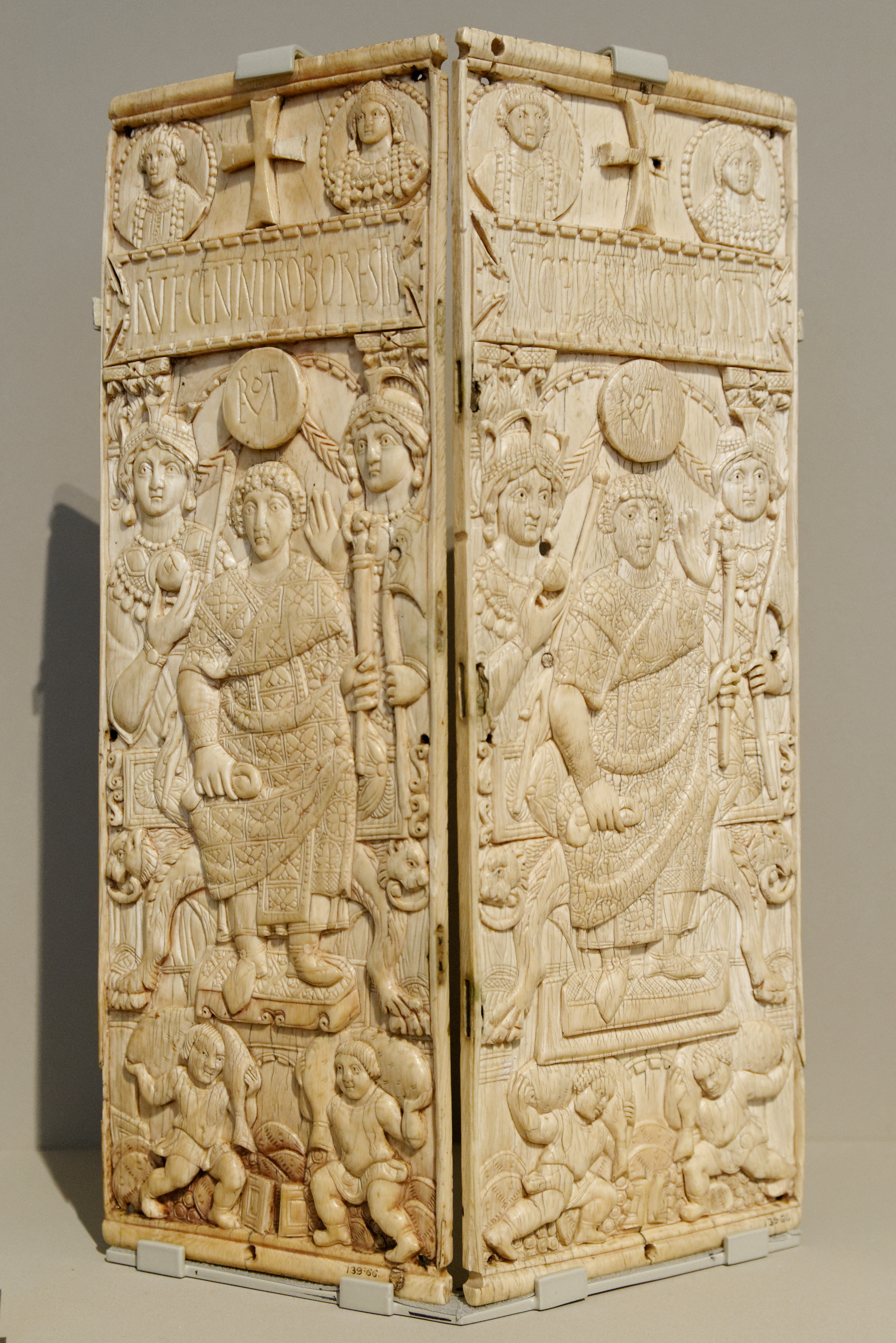
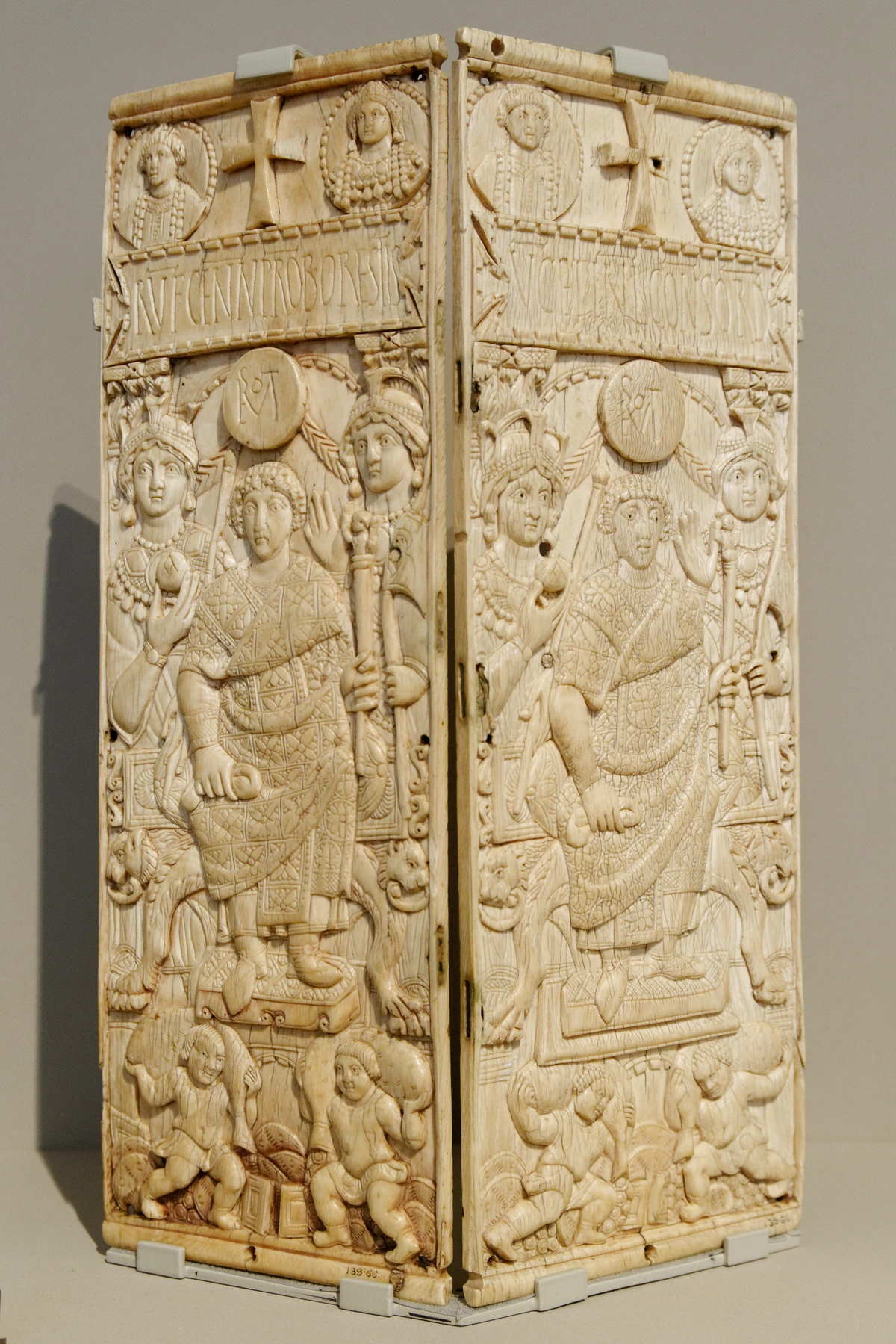
Among the most exquisite portable sculptures were the ivory carvings, meticulously carved from elephant or walrus tusk using fine tools. During the Carolingian period, these ivories often displayed a graceful, classical revival style, reflecting the court's artistic aspirations, and were frequently used as book covers for precious manuscripts (known as treasure bindings) or for small liturgical objects. By the Ottonian era, these ivory carvings became even more emotionally charged, featuring dramatic, expressive figures and narrative scenes from Christ's life or the lives of saints. They served as powerful devotional aids, episcopal combs, crozier heads, or small altarpieces, demonstrating a remarkable ability to convey profound spiritual messages within a miniature format. The detail and craftsmanship involved in transforming a tusk into such a refined, expressive work of art is nothing short of miraculous.
Early Relief Sculpture: Narrative Power in Stone
Beyond ivories and the grand stone crosses, early medieval artists also engaged in various forms of relief sculpture, often on sarcophagi, architectural fragments, and liturgical furnishings. While sometimes less prominent than in later periods, these works demonstrate a continuous tradition of narrative and symbolic carving. Early Christian sarcophagi, for instance, often featured scenes from the Old and New Testaments, adapting Roman carving techniques to Christian iconography. Carolingian and Ottonian periods saw renewed interest in relief sculpture for altar frontals, pulpits, and church decoration, often characterized by a strong sense of line and expressive, if not fully naturalistic, figures. These pieces, though sometimes fragmentary, are invaluable for understanding the evolving sculptural ambitions and narrative strategies of the era.
However, by the Ottonian period, monumental sculpture made a powerful and emotional comeback. The Gero Cross at Cologne Cathedral is a prime example, a powerful, nearly life-sized wooden crucifix that emphasizes Christ's suffering with an unprecedented emotional intensity and realism for its time. It’s a work that directly engages the viewer’s emotions, drawing them into the pathos of the narrative, and its influence can be seen in later crucifixion depictions. The colossal bronze doors of St. Michael's at Hildesheim also mark a monumental achievement, not just in their scale but in their vibrant, almost pictorial quality. These cast bronze doors depict biblical narratives in dramatic relief, making them potent didactic tools that conveyed Christian stories and dogma to a largely illiterate population through powerful imagery. This shift from small, precious objects to large-scale, public declarations of faith and power is truly remarkable, demonstrating a growing confidence in monumental forms and a desire to communicate sacred stories on a grander, more accessible scale. These were public art pieces, designed to impress and instruct, standing as powerful symbols of imperial and ecclesiastical authority.
Textiles and Decorative Arts: Ephemeral Beauty and Rich Symbolism
It’s a bittersweet truth that much of the early medieval artistic output, particularly textiles, has been lost to time due to the perishable nature of the materials. However, what little survives, along with textual accounts and artistic depictions, suggests a vibrant tradition of textile production and other decorative arts that played a crucial role in expressing wealth, status, and religious devotion. Think of elaborate embroidered vestments for clergy, rich tapestries adorning aristocratic halls (like the famed Bayeux Tapestry, which, though Romanesque, gives us a window into early medieval textile narratives), finely woven hangings for churches, and intricately patterned clothing. These weren't just functional items; they were often lavishly decorated with precious threads (gold and silver), dyed with expensive pigments, and imbued with symbolic imagery drawn from Christian and earlier Germanic traditions. The skill involved in weaving, dyeing, and embroidering was immense, making these textiles valuable, portable expressions of culture and artistry. Beyond textiles, other decorative arts like pottery, glass, and wood carving, though less frequently surviving in grand forms, also contributed to the everyday aesthetic and symbolic landscape of the Early Middle Ages.
Key Styles of Early Medieval Art: A Comparative Overview
It can be a lot to take in, I know. Sometimes, even for me, a simple table really helps to get the main ideas straight and clarify the distinctions between these vibrant periods. This overview will help you grasp the unique character of each major style and how they built upon one another, much like layers of paint on a canvas creating a complex, unified image.
Feature | Insular Art (c. 600-850 AD) | Carolingian Art (c. 780-900 AD) | Ottonian Art (c. 950-1050 AD) |
|---|---|---|---|
| Dominant Influence | Celtic-Germanic patterns & Christian themes | Classical Roman & Byzantine art, Early Christian | Carolingian traditions, Byzantine, and expressive intensity |
| Key Characteristic | Intricate, abstract, energetic patterns (interlace, spirals, zoomorphic), horror vacui | Order, clarity, revival of classical naturalism, emphasis on legible text, figural art | Monumental, expressive, emotionally charged, asserting imperial & spiritual authority, raw power |
| Religious Context | Primarily monastic, preservation of Christian texts, evangelization | Imperial Christian unity, standardization of liturgy & doctrine | Holy Roman Empire's spiritual legitimacy, intense piety, dramatic narrative |
| Common Materials | Vellum, Gold Leaf, Pigments, Enamel, Stone | Vellum, Gold Leaf, Pigments, Ivory, Stone, Fresco | Wood, Bronze, Vellum, Gold Leaf, Ivory, Stone |
| Main Mediums | Illuminated Manuscripts, Metalwork (brooches, reliquaries), Stone Crosses | Manuscripts, Ivory Carvings, Architecture (palaces, basilicas), Frescoes | Large-scale Sculpture (wood, bronze), Manuscripts, Goldsmithing, Monumental Architecture |
| Geographic Focus | Ireland, Britain (monasteries) | Frankish Empire (modern France, Germany, Italy) | Holy Roman Empire (primarily Germany, northern Italy) |
| Primary Patronage | Monastic Orders | Emperor Charlemagne & imperial court | Ottonian Emperors & powerful bishops |
| Notable Examples | Book of Kells, Lindisfarne Gospels, Tara Brooch, Monasterboice Cross | Utrecht Psalter, Coronation Gospels, Palatine Chapel, Lorsch Gatehouse | Gero Cross, Hildesheim Doors, St. Michael's Hildesheim |
| Feel & Vibe | Meditative, energetic, otherworldly, spiritual focus, intricate | Stately, controlled, educational, intellectual revival, ordered | Powerful, dramatic, spiritual, raw emotional intensity, profound piety |
| Key Innovation | Unique blend of Celtic pagan and Christian motifs; highly refined manuscript art | Standardization of script, conscious revival of classical figural forms in art and architecture | Emphasis on dramatic narrative in sculpture; monumental bronze casting; expressive religious imagery |
From Darkness to Light: The Path to the High Middle Ages
This entire period set the stage for what was to come. I always see it as a thrilling prelude! The storytelling traditions evident in pieces like the famous Bayeux Tapestry (which is technically Romanesque, but feels like a direct culmination of this era's narrative art, showing a continuous thread of visual communication, a narrative almost like a graphic novel) and the growing skill in monumental sculpture, especially from the Ottonian period, led directly to the explosion of creativity in the next phase: the Romanesque period. Romanesque art, with its massive stone churches, grand tympanums, and robust sculpture, took the structural and artistic innovations of the Early Middle Ages—such as barrel vaults, cruciform plans, and the increasing sophistication of relief carving—and scaled them up dramatically, paving the way for even grander visions of divine space and monumental expression. The solid, weighty feel of Ottonian architecture, for instance, is a direct aesthetic ancestor to the Romanesque. We see the clear lines of influence, a continuous artistic conversation unfolding over centuries. For instance, the early experiments in vaulting and monumental scale in Carolingian and Ottonian architecture directly prefigure the massive Romanesque cathedrals that would soon dominate the European landscape. It’s like watching an artist develop their signature style, starting with foundational sketches and moving towards monumental canvases, where the earlier phases are indispensable.

The stone sculptures that began to adorn Ottonian churches, with their increasing naturalism and emotional intensity, would soon evolve into the breathtaking sculptural programs of Gothic art, where figures emerged organically from the very fabric of the architecture, becoming integral to the structural and narrative whole. This transition from relief carving to freestanding figures, and the development of complex narrative cycles, is a direct lineage. And crucially, without the diligent work of the monastic scriptoria, particularly during the Carolingian period, where classical texts were meticulously copied and preserved, much of the knowledge of the ancient world might never have survived to fuel the great intellectual and artistic flourishing of the Renaissance. It’s a profound thought: these humble monks, toiling in flickering candlelight within the quiet confines of their scriptoria, were the silent, often unsung, guardians of an intellectual and artistic legacy that would redefine Western civilization centuries later. Their meticulous copying wasn't just about preserving sacred texts; it encompassed classical literature, philosophy, scientific treatises, and legal documents, making them the indispensable cultural custodians of the age. Without their painstaking efforts, much of the ancient world's wisdom might have been irrevocably lost. Their painstaking efforts forged a bridge across the chasm of time, allowing later generations to build upon the wisdom and beauty of antiquity. We owe them an immense debt of gratitude, I think, for the sheer preservation of human knowledge, not just of classical literature but also of scientific and philosophical treatises, ensuring that the flame of learning continued to flicker and eventually ignite a new era. They were the original librarians and cultural custodians, whose quiet dedication laid the intellectual groundwork for Europe's later cultural explosions.

The Craftsman's World: Artists, Workshops, and Anonymity
It's easy to look at the masterpieces of the Early Middle Ages and forget the actual human hands that created them. Unlike later periods where individual artists gained renown (think of the Renaissance masters!), the vast majority of early medieval artisans remain anonymous to us. This wasn't due to a lack of skill, but rather a societal and spiritual context where the glory belonged to God, the patron, or the community, not the individual creator. Artists were often seen as craftsmen or skilled laborers, their status varying depending on their specific trade and the patron they served. Most art was produced in collaborative workshops, often within monastic scriptoria, cathedral schools, or at imperial courts, where skills were passed down through apprenticeships and a master-apprentice model. These workshops were collaborative environments, with specialists in different fields – scribes for text, illuminators for decoration, goldsmiths for metalwork, sculptors for stone, masons for architecture, and even master builders coordinating vast projects. The emphasis was on meticulous craftsmanship and faithful adherence to established iconographic traditions and artistic conventions, rather than personal innovation or individual stylistic expression. Yet, within these constraints, individual flair and brilliance shine through, a testament to the enduring human drive to create beauty, even when uncredited. It's a humbling thought, really, to consider the thousands of unnamed masters who shaped this era, their hands crafting a legacy that speaks volumes even without their names.
Music and Liturgy: The Sonic Landscape of the Early Middle Ages
While this article primarily focuses on visual arts, it would be a disservice to overlook the profound role of music in the Early Middle Ages, particularly in religious contexts. Gregorian chant, a form of monophonic (single-line melody) sacred song, was standardized during the Carolingian Renaissance and became the dominant form of liturgical music across Western Europe. This vocal music, often unaccompanied, was not just a sonic backdrop; it was an integral part of the spiritual experience, enhancing contemplation and devotion. Manuscripts were often illuminated with musical notation, and the architecture of churches was designed to amplify and resonate these sacred sounds, creating a complete sensory environment for worship. The interplay between the visual splendor of an illuminated manuscript, the symbolic richness of a reliquary, and the ethereal beauty of chant created an immersive spiritual world for early medieval Christians, demonstrating that art in this period was a truly multi-sensory experience.

Daily Life and Artistic Production: Art in Context
While we often focus on grand religious or imperial art, it's important to remember that art was interwoven with the fabric of daily life, even if the surviving examples lean towards the sacred and precious. The practicality of the era, marked by migrations and less settled populations, directly influenced the prevalence of portable art – fibulae, jewelry, and small devotional objects that could travel. These personal items were not only expressions of individual and tribal identity but were also frequently handled and viewed in daily rituals, celebrations, and even battles. Even larger architectural projects, like monasteries and churches, were central to the daily rhythms of monastic communities and towns, serving as places of worship, communal gathering, and sometimes even refuge. Art served as a powerful didactic tool for a largely illiterate populace, communicating Christian narratives and moral lessons through imagery embedded in churches and manuscripts that were actively read and processed. The materials used, from animal skins for vellum to locally quarried stone, connected art directly to the land and the resources available, reflecting local economies and trade networks. This deep integration meant art wasn't a separate, elite activity reserved for galleries; it was a fundamental aspect of communicating beliefs, asserting identity, structuring both the spiritual and temporal worlds of early medieval people, and enriching their everyday existence.
The Lingering Echoes: Early Medieval Art and Contemporary Creativity
Even in our hyper-connected, digital world, the spirit of Early Medieval art finds surprising echoes, demonstrating the timelessness of fundamental artistic principles. Think about the intricate patterns we see in contemporary graphic design, the focus on craft and materiality in the modern art world, or even the way artists use strong lines and simplified forms to convey powerful emotions. While perhaps not directly influenced in every instance, the dedication to intricate detail, the profound symbolism, and the sheer expressive power of this 'dark' age continues to inspire. As an artist, I often find myself drawn to the way these early masters communicated such depth with what might seem like limited means. It reminds us that creativity thrives in any era, and true artistic vision transcends time, adapting to new contexts. For anyone exploring their own artistic voice, there’s a timeless lesson in their dedication to craft and meaning, much like in finding artistic voice in unexpected places or exploring texture. The way these artists used visual elements to tell stories, evoke spiritual states, and assert power remains a blueprint for effective visual communication, whether you're designing a logo or creating a large-scale installation. You can see parallels in the meticulous detail of certain graphic novels, the resurgence of artisan crafts, or even the bold, simplified forms in some contemporary sculpture. The idea that every surface can tell a story, or that abstract patterns can convey profound meaning, is a powerful legacy that continues to resonate, demonstrating that human visual ingenuity is an unbroken thread.
The Power Behind the Palette: Patronage in Early Medieval Art
When we look at these incredible artworks, it's easy to forget that someone had to pay for them! Art, especially monumental or lavish art, is rarely created in a vacuum, and the Early Middle Ages was no exception. Patronage played an absolutely critical role in shaping what was made, how it looked, and for what purpose. It was a complex ecosystem where power, piety, and prestige all converged to fund magnificent creations. This era reminds us that art has always been intertwined with the forces that shape society, from the grandest empires to the humblest monasteries.
The primary patrons during this era fell into two main categories:
- The Church (Monastic Orders & Bishops): Unsurprisingly, the Church was a colossal force in artistic production. Monasteries, with their scriptoria, were self-contained hubs of artistic creation, producing illuminated manuscripts for liturgical use, education, and as symbols of their wealth and piety. Bishops commissioned impressive cathedrals and their furnishings, aiming to inspire awe and devotion among the faithful. Their motivations were deeply spiritual and often didactic, intending to communicate Christian doctrine and the lives of saints to a largely illiterate populace.
- Imperial and Royal Courts: Rulers like Charlemagne and the Ottonian emperors understood the immense power of art as a tool for political legitimation. They commissioned lavish palaces, chapels, and precious objects (crowns, scepters, regalia, such as the Imperial Crown of the Holy Roman Empire) to assert their authority, connect themselves to the legacy of Rome, and showcase their divine right to rule. These objects and buildings were not just beautiful; they were propaganda in the best sense of the word, designed to project an image of unwavering power and God-given legitimacy. Aristocratic families also commissioned smaller, precious objects to display their status and piety, like the opulent fibulae and jewelry found in many Migration Period burials.
The relationship between patron and artist was often complex, with the patron typically dictating subject matter and scale, while the artist (often an anonymous monk or craftsman) brought incredible skill and interpretation to the execution. This system ensured a steady stream of commissions and allowed for the development of distinct regional styles, driven by both spiritual fervor and political ambition. It makes me think about how even today, the funding and intent behind art can profoundly shape its outcome, whether it's a commissioned public sculpture or a gallery exhibit. In essence, patronage was the engine that powered the artistic creativity of the Early Middle Ages, providing the resources and direction for many of the masterpieces we still admire. This dynamic, where powerful individuals and institutions shaped the artistic landscape, is a fascinating precursor to later art historical periods, and it’s a constant reminder that art rarely exists in a vacuum – it's always intertwined with the powers that be.
Glossary of Key Terms
Navigating historical art periods can be a bit like learning a new language – there are so many specialized terms! So, I've put together a few essential terms here to help you out, especially those that frequently pop up when discussing the Early Middle Ages. These are the building blocks to truly understanding this rich era:
- Animal Style: A characteristic artistic style, particularly prominent in Migration Period and Insular art, featuring highly stylized animal motifs—often intertwined, biting, or dissolving into abstract patterns—and complex interlace. Found extensively on metalwork, jewelry, and illuminated manuscripts, it reflects a deep connection to the natural world, often with totemic, protective, or symbolic significance within pagan and later Christian contexts.
- Apse: A semicircular or polygonal projection from a building, typically at the east end of a church, often containing the altar.
- Basilica: An Early Christian church plan, often adapted from Roman administrative buildings, characterized by a long nave, side aisles, and an apse, forming the basic structure for many later medieval churches.
- Burh: A fortified town or settlement, particularly in Anglo-Saxon England, designed for defense and administration during the Early Middle Ages.
- Carpet Page: A full page in an illuminated manuscript devoted entirely to ornamental designs, often geometric and highly intricate, resembling oriental carpets. These were central to Insular art and served a meditative, spiritual purpose.
- Carolingian Minuscule: A standardized, clear, and legible script developed during the Carolingian Renaissance, crucial for the widespread dissemination of texts and the improvement of literacy.
- Carolingian Renaissance: A cultural and intellectual revival during the reign of Charlemagne (c. 780-900 AD), characterized by a deliberate return to classical Roman models in art, architecture, and scholarship, aiming for clarity and standardization.
- Champlevé Enamel: An enameling technique where hollows are carved or cast into a metal surface and then filled with vitreous enamel, which is then fired and polished. It creates a bold, colorful effect.
- Cloisonné: A sophisticated metalwork technique where enamel, colored glass, or precious gemstones are meticulously set into individual compartments (cloisons) formed by thin metal strips, creating intricate, colorful patterns. It's truly a jewel-like effect.
- Codex (plural: Codices): A revolutionary format for books, made of folded, stacked, and bound pages, distinct from the cumbersome scrolls of antiquity. Illuminated manuscripts were almost exclusively produced as codices, representing a significant technological and artistic advancement in book production that greatly improved readability, portability, and storage.
- Cruciform Plan: An architectural plan for a church shaped like a cross, typically formed by the intersection of a nave and transept, symbolizing the crucifixion of Christ and becoming a standard layout for Christian churches.
- Early Middle Ages: The accurate historical period in Europe following the fall of the Western Roman Empire, roughly from 500 to 1000 AD, and the term historians prefer instead of the misleading "Dark Ages."
- Evangelist Portrait: A depiction of one of the four Evangelists (Matthew, Mark, Luke, John), often accompanied by their traditional symbols (angel, lion, ox, eagle). These were significant elements in illuminated manuscripts, especially during the Carolingian and Ottonian periods.
- Fibula (plural: Fibulae): An ornate brooch or pin used to fasten garments, often elaborately crafted from metal and adorned with intricate patterns, serving as both functional objects and status symbols during the Migration Period and Early Middle Ages.
- Filigree: Delicate ornamental work created from fine, usually gold or silver, wire twisted into intricate patterns, often used in jewelry and metalwork, giving a lace-like appearance.
- Gold Leaf: Extremely thin sheets of gold applied to surfaces for decoration, extensively used in illuminated manuscripts and metalwork to signify divinity, wealth, and brilliance.
- Goldsmithing: The art and craft of working with gold and other precious metals to create jewelry, ornaments, and other art objects, a highly valued skill in the Early Middle Ages.
- Gregorian Chant: A form of monophonic (single-line melody) sacred vocal music, standardized during the Carolingian Renaissance and central to Christian liturgy in the Early Middle Ages.
- Horror Vacui: Latin for "fear of empty space," a characteristic artistic tendency, particularly evident in Insular manuscripts (like the Book of Kells) and some Migration Period metalwork, where artists meticulously fill every available surface with intricate, dense decoration, often with interlace, spirals, and zoomorphic forms. This often creates a sense of dazzling complexity and can be interpreted as a reflection of spiritual devotion or a desire to imbue every inch with meaning.
- Iconography: The visual images and symbols used in a work of art or the study or interpretation of these. In Early Medieval art, it's crucial for understanding the religious and political meanings embedded in the imagery.
- Illuminated Manuscript: A manuscript in which the text is supplemented with elaborate decoration, such as initials, borders, and miniature illustrations, often using gold and silver. These were the ultimate luxury items of the age.
- Insular Art (Hiberno-Saxon): The distinct artistic style produced primarily in the monasteries of Ireland and Britain (c. 600-850 AD), renowned for its intricate interlace patterns, spirals, and zoomorphic designs, most famously seen in illuminated manuscripts.
- Interlace: A ubiquitous decorative motif found across Insular and other Early Medieval art, consisting of intertwined ribbons or bands, often forming complex knot-like patterns, symbolizing eternity or interconnectedness.
- Lectionary: A liturgical book containing a collection of biblical readings appointed for the celebration of Mass throughout the ecclesiastical year, often illuminated.
- Migration Period Art: The art produced by the various Germanic and Celtic tribes during their extensive migrations across Europe (roughly 300-700 AD), characterized by animal style, abstract patterns, and a focus on portable luxury objects like jewelry and weapon fittings.
- Ottonian Art: The powerful and emotionally charged art produced during the reign of the Ottonian emperors in Germany (c. 950-1050 AD), building on Carolingian traditions but with a new emphasis on monumentality, expressive figures, and the assertion of imperial and spiritual authority.
- Parchment: A material made from treated animal skin (typically sheep, goat, or calf) used as a writing surface. Vellum is a particularly fine type of parchment.
- Patronage: The support, encouragement, privilege, or financial aid that an organization or individual bestows on another. In the Early Middle Ages, the Church and imperial courts were primary patrons of art.
- Psalter: A liturgical book containing the Book of Psalms, often richly illuminated and used for prayer and study in monastic communities.
- Relief Sculpture: A sculptural technique where the sculpted elements remain attached to a solid background of the same material, projecting out from it. It can be high-relief (projecting boldly) or low-relief (shallow projection).
- Reliquary: A sacred container, often elaborately crafted from precious metals, jewels, and other valuable materials, designed to house holy relics (e.g., bones of saints, fragments of clothing), reflecting the immense spiritual importance of its contents.
- Sacramentary: A liturgical book containing the prayers and blessings spoken by the priest during Mass, often elaborately illuminated during the Early Middle Ages.
- Scriptorium: Literally "a place for writing," this was a dedicated room or workshop in medieval monasteries where manuscripts were meticulously copied, illustrated, and bound, acting as vital centers for the preservation of knowledge and artistic creation.
- Spolia: The reuse of architectural or sculptural elements from earlier buildings in new constructions. Common in Early Medieval architecture, symbolizing continuity and the appropriation of past glory.
- Treasure Binding: Elaborate and often jeweled covers for manuscripts, particularly during the Carolingian and Ottonian periods, transforming the book into a precious, sacred object worthy of its divine contents. These were significant sculptural and metalwork achievements.
- Tympanum: In architecture, the semi-circular or triangular decorative wall surface over an entrance, door or window, which is bounded by a lintel and an arch. Often elaborately carved with narrative scenes in the Romanesque period, its precursors existed in the Early Middle Ages.
- Vellum: A high-quality parchment made from prepared animal skin (typically calf, lamb, or goat), known for its durability and smooth surface, used as a luxurious writing surface for illuminated manuscripts.
- Westwork: A monumental, multi-story entrance section at the western end of Carolingian and Ottonian churches, often featuring towers, a central chapel, and an upper imperial loge, symbolizing the emperor's authority and providing a defensive facade.
- Zoomorphic: Art featuring animal forms or motifs, often highly stylized and integrated into intricate patterns, common in Insular and Migration Period art.
Frequently Asked Questions (FAQ) About Early Medieval Art
I often get asked a lot of questions about this period, so I thought it would be helpful to gather some of the most common ones here. This is where I try to tackle those lingering curiosities!

Where can I see Early Medieval art today?
Many masterpieces of Early Medieval art are wonderfully preserved in museums, libraries, and churches across Europe. You can see the legendary Book of Kells at Trinity College Dublin in Ireland, the exquisite Lindisfarne Gospels at the British Library in London, and the unique Utrecht Psalter at the Utrecht University Library in the Netherlands. Major collections of metalwork, jewelry, and sculpture can be found at world-renowned institutions like the British Museum (London), the Metropolitan Museum of Art (New York), and various cathedral treasuries and historical museums, especially in Germany (e.g., Aachen, Hildesheim, Cologne). Don't forget, these objects are often incredibly delicate, so seeing them in person is a real treat!
So why is it still sometimes called the "Dark Ages" today?
Honestly, it's mostly due to lingering historical inertia and popular misconception, which is a shame! As we've discussed, it's a historical nickname given by later scholars during the Renaissance who were trying to highlight their own perceived "rebirth" of classical learning and art. They conveniently viewed the preceding centuries as a "dark" period of decline. Most historians now firmly reject this biased label and prefer the more accurate and neutral term "Early Middle Ages," recognizing the vibrant cultural and artistic innovations—the intellectual preservation, technological advancements, and profound spiritual expressions—that actually took place. Far from "dark," this was a formative period, a crucible where the foundations of modern Europe were forged, aesthetically, intellectually, and socially.
What is considered the most famous artwork from this period?
That's a tough one, as "famous" can be subjective and depend on your area of interest! However, several works stand out. The Book of Kells is arguably the most famous example of Insular art due to its incredible detail and artistic complexity. For the Carolingian period, the Utrecht Psalter is a key masterpiece for its energetic pen-and-ink drawings and narrative power. And for Ottonian art, the Gero Cross is a truly powerful and life-sized sculpture of the crucified Christ that revolutionized the depiction of suffering, while the Hildesheim Doors are monumental achievements in bronze casting. Each holds a special place, representing the pinnacle of their respective styles.
What materials were commonly used by Early Medieval artists?
Early Medieval artists made remarkable and often ingenious use of available and frequently precious materials. For manuscripts, vellum (treated animal skin, offering exceptional durability and a smooth surface) was the primary canvas. They used vibrant pigments derived from minerals (like lapis lazuli for blue, imported from Afghanistan!), plants (such as woad for blues and madder for reds), and even insects (like kermes for crimson), often lavishly enhanced by gleaming gold leaf for illumination, symbolizing divine light. For metalwork, gold, silver, bronze, and iron were expertly shaped using techniques like cloisonné, filigree, granulation, and casting, often adorned with colorful enamel, cut glass, and semi-precious gemstones. In architecture, locally sourced stone and timber were the primary building blocks, frequently incorporating spolia (reused elements from older Roman buildings). It’s amazing what they achieved with the resources they had, often traveling vast distances to acquire the most brilliant and meaningful materials!

What was the specific role of monasteries in Early Medieval art?
Monasteries were absolute powerhouses of artistic production and intellectual preservation during the Early Middle Ages. Far from being isolated havens, they were vibrant cultural centers. Each monastery often boasted a scriptorium, a dedicated workshop where monks and sometimes nuns meticulously copied, illustrated, and bound manuscripts. This wasn't just about preserving sacred texts; they also copied classical literature, philosophical treatises, and scientific works, effectively safeguarding much of ancient knowledge from oblivion. Beyond books, monasteries were also centers for metalwork, ivory carving, and architectural innovation, commissioning and producing art for their own liturgical needs, for powerful patrons, and for spreading Christian doctrine. They were, in essence, the universities, art schools, and publishing houses of their time, fostering a continuous tradition of art and learning.
How did the rise of Christianity impact artistic themes?
The rise of Christianity was the single most defining influence on Early Medieval art. It fundamentally shifted artistic themes from primarily pagan or imperial Roman subjects to Christian narratives, figures, and symbols. Art became a powerful tool for teaching Christian doctrine to a largely illiterate populace, for reinforcing the spiritual authority of the Church, and for inspiring devotion. Biblical stories, the lives of saints, Christ's miracles, and complex theological concepts were visually translated into manuscript illuminations, wall paintings, sculpture, and metalwork. This profound religious shift drove the demand for new forms of art, like illuminated Gospels and Psalters, reliquaries, and monumental church architecture, shaping both the content and the purpose of artistic creation for centuries to come.
What "lost" art forms are we missing from the Early Middle Ages?
It’s a truly fascinating, and somewhat melancholy, thought to consider all the art from the Early Middle Ages that hasn't survived. While we have incredible examples of metalwork, stone sculpture, and illuminated manuscripts (which endured due to their materials and careful preservation), we're missing a vast amount of material. Think of elaborate wooden sculptures and carvings that would have decorated churches and homes, textiles like tapestries and embroideries (beyond the singular Bayeux Tapestry, which is an outlier in its survival), and particularly wall paintings (frescoes). Many early medieval churches were brightly adorned with painted narratives and figures, but these were often perishable, victims of damp, fire, and later renovations or iconoclastic movements. Imagine the vibrant, colorful interiors that would have surrounded the faithful! These lost works would undoubtedly offer an even richer picture of the artistic landscape of the era, and I sometimes wish I had a time machine just to get a glimpse.
Was there any large-scale art like paintings or sculptures in the Early Middle Ages?
Yes, absolutely, though much of it, particularly large-scale wall paintings (frescoes), hasn't survived the ravages of time and subsequent renovations. For a long stretch, the focus was indeed on precious, portable objects like manuscripts, jewelry, and reliquaries. However, we have clear evidence of wall frescoes in churches, especially during the Carolingian period, often decorating monastic churches and imperial chapels (as discussed earlier!). These wall paintings, though often fragmentary, tell us a great deal about the narrative ambitions of the period, conveying biblical stories to a wider audience. And as we discussed, by the Ottonian period, monumental bronze and wood sculpture was making a powerful comeback with works like the Gero Cross and the Hildesheim Doors. These were not small feats of engineering or artistry! It's incredible to think of these vibrant, large-scale narratives adorning church interiors, most of which are now lost to time, but their existence speaks to an ambition that was far from 'dark.' The sheer scale of these works often surprises people, challenging the popular misconception of a period devoid of grand artistic gestures.
What was the significance of relics in Early Medieval art?
Relics—physical remains of saints or objects associated with them—held immense spiritual power and importance in the Early Middle Ages. They were believed to possess healing powers, provide protection, and serve as tangible links to the divine. This veneration directly influenced art through the creation of elaborate reliquaries: precious containers, often crafted from gold, silver, jewels, and enamel, designed to house and display these sacred fragments. These reliquaries were among the most lavish and significant artworks of the period, reflecting the immense devotion and resources poured into honoring saints and securing divine favor. Pilgrimage to sites housing important relics also stimulated artistic production, from memorial crosses to devotional objects.
Why was so much Early Medieval art portable?
The portability of art in the Early Middle Ages is a really key characteristic, directly reflecting the dynamic and often unsettled nature of the period. Unlike later eras with more stable urban centers and monumental, static art, the Early Middle Ages saw significant migrations of peoples (the Migration Period!), frequent movements of rulers and their courts, and the widespread practice of pilgrimage. For these mobile societies, art that could travel with them—like exquisite jewelry (fibulae!), personal reliquaries, and, crucially, illuminated manuscripts—was incredibly valuable. These portable treasures served as concentrated expressions of wealth, status, faith, and identity that could be easily transported, safeguarded, and displayed wherever their owners went. They were tangible anchors in a world constantly in motion, a pragmatic and artistic response to the realities of the time.
How did daily life influence Early Medieval art?
Daily life played a significant, if indirect, role in shaping the art of the Early Middle Ages. The constant movement of people during the Migration Period, for instance, led to a preference for portable art like jewelry and illuminated manuscripts, which could be easily carried. The largely agrarian society meant that animal motifs and natural forms were omnipresent, even when stylized into complex patterns. And the profound religiosity of the era naturally infused almost all artistic creation with Christian themes and didactic purposes. So, while we might not see literal depictions of daily peasant life, the societal structures, spiritual beliefs, and practical necessities of the time deeply informed the forms, functions, and symbolic content of the art produced.
What was the specific role of women in Early Medieval art production?
While largely anonymous in records, women played crucial roles in Early Medieval art, primarily within monastic communities as nuns and abbesses. Many convents had scriptoria where nuns engaged in the copying, illuminating, and binding of manuscripts, creating breathtaking works of devotion and scholarship. Evidence suggests some abbesses, such as Gisela of Chelles (Charlemagne's sister), were significant patrons, commissioning lavish artworks and influencing intellectual discourse for their foundations. Beyond monastic life, aristocratic women also commissioned precious objects for personal devotion or as gifts, influencing metalwork and textile arts. Their contributions, though often unsung, were vital to the artistic output and preservation of culture during this period, often serving as cultural intermediaries and patrons in their own right.
Were there any secular art forms during the Early Middle Ages?
Yes, absolutely, though sacred art tends to dominate the surviving record due to its durability and careful preservation. Secular art existed primarily in the form of portable luxury goods such as elaborate jewelry (like fibulae and rings), weapon adornments (on swords, shields, and helmets), and fine textiles for royal and aristocratic courts. These objects showcased wealth, status, and tribal identity, often incorporating the intricate animal styles and interlace patterns seen in sacred art. While large-scale secular architecture is less common, evidence of decorated halls and palaces exists, albeit often in ruins. The Bayeux Tapestry, while narrating a historical event, also offers glimpses into secular life and military culture, despite its quasi-religious function for a church.

How did economic factors influence Early Medieval art?
Economic factors were profoundly influential. The availability and cost of materials dictated much of artistic production. Precious metals like gold and silver, and rare pigments like lapis lazuli, were incredibly expensive and often imported, making lavish works available only to wealthy patrons like emperors, bishops, or powerful abbots. The economic stability (or instability) of a region directly impacted the scale and ambition of architectural projects or the production of manuscripts. Furthermore, the economic importance of monasteries as centers of learning and production meant they could sustain scriptoria and workshops, fostering artistic skill and innovation. Art was often an investment, a display of wealth, and a means of accumulating spiritual merit.
What distinguished Early Medieval art from Roman or Greek art?
Early Medieval art diverged significantly from classical Roman and Greek art in several key ways. While it often borrowed classical forms, its primary purpose shifted from celebrating human achievement, civic virtue, or idealized naturalism to expressing spiritual devotion and Christian doctrine. It moved away from the classical emphasis on realistic human anatomy and three-dimensional space, favoring instead more abstract, symbolic, and two-dimensional representations. The intricate, non-naturalistic interlace patterns and animal style of Germanic and Celtic traditions became dominant, contrasting sharply with classical figural sculpture. Furthermore, the focus often shifted from public, monumental sculpture and architecture to precious, portable objects like illuminated manuscripts and metalwork, reflecting a less centralized, more migratory society. It was a transformation from the earthly and ideal to the spiritual and symbolic.

What was the main purpose of art in the Early Middle Ages?
Art during this period served several critical purposes far beyond mere aesthetics, often making it integral to society. It was primarily a tool for religious devotion and instruction, conveying Christian stories, dogma, and the lives of saints to a largely illiterate population through powerful visual narratives embedded in manuscripts, frescoes, and sculpture. It also served to assert political power and status, with rulers commissioning lavish objects and monumental buildings to legitimize their authority, showcase their wealth and piety, and reinforce their divine mandate. Furthermore, particularly through the monastic scriptoria, art was vital for preserving knowledge and connecting with the classical past, especially through the meticulous copying and illustrating of ancient texts, acting as a bridge to future generations and the flourishing of later intellectual movements. So, art was a functional, spiritual, and political powerhouse, weaving together belief, authority, and culture into every creation!

How did Early Medieval art influence later artistic periods?
The influence was immense and utterly foundational! The Early Middle Ages was not a dead end; it preserved classical knowledge, developed new artistic techniques (like sophisticated metalwork and manuscript illumination), and established much of the visual language of Christian art in Europe. The architectural innovations, particularly in vaulting and planning, and the growing skill in monumental sculpture, directly paved the way for the soaring cathedrals and intricate art of the Romanesque and Gothic periods. Without the meticulous work of copying ancient texts, the intellectual and artistic flourishing of the Renaissance simply would not have had the foundational knowledge it needed. It truly was the bedrock upon which so much Western art was built.
A Final Thought
The next time you hear someone mention the "Dark Ages," I hope you'll feel empowered to gently correct them. This wasn't an age of darkness, not by a long shot. It was an age of flickering candlelight, of gleaming gold and polished gems, of brilliant ink on painstakingly prepared vellum. It was an age where art wasn't just for decoration; it was a tool for survival, a vessel for faith, and a crucial bridge connecting a shattered past to an uncertain future. To me, it was an era of profound creative light, a testament to the enduring human spirit that shines brightest when the world seems darkest. And its legacy, quietly preserved and powerfully expressed, continues to resonate through the grand cathedrals, the priceless manuscripts, and even the subtle influences on contemporary design that we cherish today. So let's celebrate this "brilliant art," shall we? It's a journey into the heart of human ingenuity, resilience, and an unwavering drive to create beauty, no matter the circumstances. And if you're ever looking for a tangible piece of enduring artistry, remember you can always explore a curated collection of contemporary works at our shop or delve deeper into art history through our timeline. You can even see how these ancient ideas of visual storytelling are still relevant in modern art, perhaps influencing the very elements of design in art or how artists use color today. Perhaps it even influences how an artist today might find artistic voice in unexpected places or explore texture in abstract paintings. And that, I think, is a lesson for all artists, in any age—a reminder that creativity finds a way, even in the most challenging of times.