Piet Mondrian's 'The Red Tree': The Crucible of Abstraction
Unpack Piet Mondrian's 'The Red Tree,' a pivotal work revealing his transition from emotional representation to abstraction. Explore its Fauvist colors, Cubist-influenced lines, Theosophical depth, and how it paved the way for Neoplasticism. The ultimate guide to Mondrian's early evolution.

Piet Mondrian's 'The Red Tree': The Crucible of Abstraction
I know what you're thinking: Piet Mondrian, right? Black lines, primary colors, perfect grids. A universe of controlled harmony, objective balance, and serene, almost spiritual purity. But what if I told you that the very foundation of that iconic style, the calm after the storm, began with a painting that was anything but serene? It began with a raw, almost violently emotional outburst of color and line, a tree caught in a hurricane of artistic re-evaluation.
For me, few works capture the electrifying moment of an artist daring to shed an old skin quite like Piet Mondrian’s 'The Red Tree' (also known by its original Dutch title, 'Avond; De rode boom'). This isn't the Mondrian most people recognize. This isn't the final destination, but the crucial, messy, and intensely personal journey to that destination. 'The Red Tree' is a confession on canvas, a powerful precursor to abstraction where Mondrian grappled with his past and future. It's why I find it so profoundly compelling, not just as a piece of art history, but as a roadmap for any creative soul pushing the boundaries of their own familiar landscapes. Let’s dissect this monumental transition, shall we?
The Seeds of Rebellion: Mondrian Before the Grid (circa 1908-1910)
To truly appreciate the seismic shift embodied in 'The Red Tree', we need to rewind a bit and picture Mondrian before he became Mondrian. In the early 1900s, he was a technically proficient, if conventional, Dutch landscape painter. His canvases often depicted moody, atmospheric scenes – tranquil rivers, serene farmhouses, and windswept trees, all deeply rooted in observed reality. Works like 'The Last Farmland' (1899), 'Farmhouse with Laundry' (1900), or his numerous depictions of windmills show a mastery of traditional techniques, often with a hint of Dutch Luminism (a local variant of Impressionism focused on light effects) or Hague School influences. Look closely at these early pieces, and you might sense a growing restlessness: a simplification of form, an emphasis on verticality, or a heightened sense of atmosphere that edges beyond mere depiction.
He was a sponge, absorbing every seismic shift happening in the European art world. Van Gogh's raw, intensely emotional brushwork had already upended traditional notions of expression, showing how paint could convey inner turmoil and spiritual fervor directly, not just depict a scene. Then, the Fauves exploded onto the scene in Paris, with artists like Matisse using color not merely to describe reality, but for its intrinsic emotional and expressive power. This radical idea—that color could be a language unto itself, conveying feeling directly—was a complete game-changer for many artists, including Mondrian. For me, that concept resonates deeply even today, influencing how I explore emotional depth in my own abstract works. You can explore this further in my guide to how artists use color.
It was during this period of intense artistic ferment, between 1908 and 1910, that Mondrian grappled, in real-time, with these revolutionary ideas. He was taking a familiar subject—a tree—and transforming it into a vibrant vessel for feeling, a conduit for his own internal ferment. This wasn't just about painting what he saw; it was about painting what he felt and what he knew lay beneath the surface, pushing the boundaries of what art could represent. This was the nascent stage of his journey towards what we now call abstraction. To understand the broader historical context of this period, I often recommend exploring the definitive guide to the history of abstract art.
Theosophy's Whisper: A Search for Inner Harmony
Crucially, around this same period (roughly 1908-1910), Mondrian became deeply involved with Theosophy, a spiritual movement that sought universal truths beyond material reality, popularized in Europe by figures like Helena Blavatsky. Theosophy, for Mondrian, wasn't just an abstract philosophy; it was a lens through which he began to perceive the world and, consequently, his art. It posited that an underlying spiritual order governed the universe, and that art could serve as a conduit to reveal these fundamental, harmonious principles. He was particularly drawn to ideas of cosmic evolution and the belief that material forms were merely transient manifestations of deeper spiritual energies. For an artist, this was a revelation: art could move beyond mere observation to become a direct portal to universal truth.
This spiritual quest profoundly influenced his artistic trajectory. He wasn't just observing the world; he was seeking its essence, its spiritual core. For Mondrian, this meant a conscious effort to peel back the layers of superficial, incidental appearance to reveal the underlying, universal structure and harmony. He believed that certain visual elements – vertical and horizontal lines, primary colors – resonated with these universal principles. This pursuit of universal harmony through increasingly simplified forms and pure colors would become the bedrock of his later Neoplasticism, but the seeds of this profound spiritual inquiry are visibly and vibrantly sown in 'The Red Tree'. This wasn't just an aesthetic experiment; it was a philosophical declaration, painted with every stroke.
Deconstructing 'The Red Tree': Form and Emotion in Flux
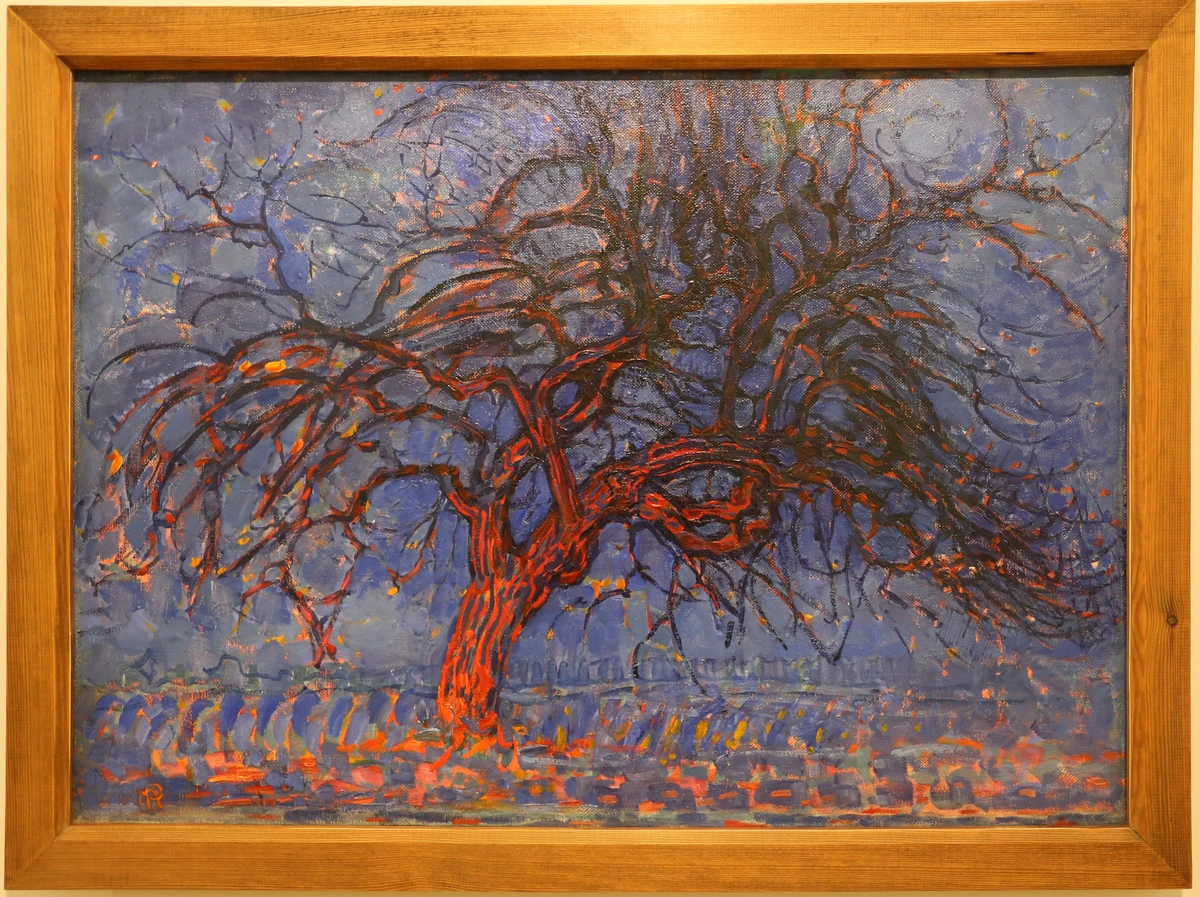
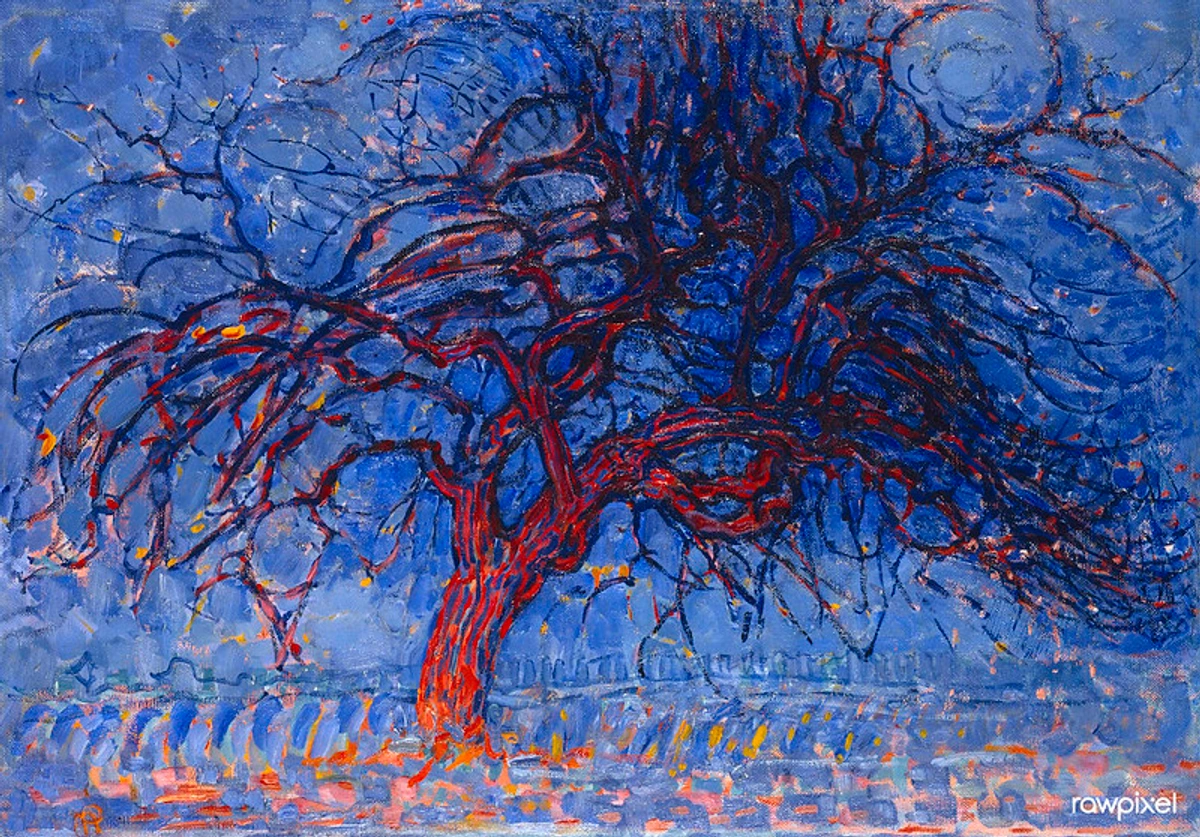
Now, let's zoom in on the canvas and perform our own "autopsy" of this fascinating piece. What strikes you immediately? It's undeniably a tree, yes, but it's a tree unlike any you'd casually stroll past in a park. It feels... intensely alive, almost tormented, as if caught in a profound internal struggle. The branches don’t merely extend outwards; they twist, writhe, and reach like visceral tendrils or a frantic nervous system, clawing against a stark, almost electric blue background. This isn't passive observation; this is active, emotional interpretation, a window into Mondrian’s soul at a pivotal moment. The raw energy here feels familiar to me; it's the chaotic push-and-pull I often experience when an abstract composition starts to reveal its own truth, fighting against my initial intentions.
The Color: A Fauvist Fever Dream of Emotion
The most arresting element, without question, is the color. That fiery, almost violent cadmium red that dominates the canvas. This isn't the gentle, earthy red of an autumn leaf; this is a symbolic red. It absolutely screams with raw life force, intense energy, passion, perhaps spiritual fire, or even a deep, primal pain. Mondrian isn't merely painting the color of the tree; he's painting the essence of the tree, its vital spirit, its struggle for existence. This bold, non-naturalistic use of color to express an inner reality is a core concept he inherited from both Fauvism (think of Henri Matisse's daring palettes, like in 'Open Window, Collioure') and Expressionism, and it's a key element in this early Mondrian masterpiece. He's using color as an emotional language, a direct communication of feeling, much like a musician uses a searing melody to convey anguish.
He contrasts this blazing red with a deep, consuming cobalt blue background. For me, this is where a subtle genius resides. The blue isn't just the sky; it’s a palpable mood, a cosmic vastness, a profound emptiness. It embodies the quiet, melancholic "evening" hinted at in the title ('Avond'). It creates a profound void that makes the red tree feel simultaneously heroic in its defiant vitality and terribly isolated against an almost existential backdrop. Think of the brooding skies in Edvard Munch's 'The Scream' – that same sense of overwhelming atmosphere is present here, a potent emotional landscape. Understanding de psychologie van kleur in abstracte kunst is absolutely key to unlocking the emotional depth of paintings like this.
Element  | Traditional Representation | Mondrian's Interpretation | Emotional & Symbolic Impact (My Take) |
|---|---|---|---|
| Tree Color | Browns, greens, oranges | Fiery, cadmium red | Primal life force, desperate vitality, passionate struggle, intense aliveness, spiritual fire, profound inner turmoil |
| Sky/Background | Pale blue, grey, sunset hues | Deep, electric cobalt blue | Profound melancholy, cosmic vastness, existential isolation, quiet despair, spiritual void, backdrop to an inner drama |
| Form | Realistic, detailed branches | Gnarled, expressive, simplified lines | Anguish, raw struggle, potent energy, search for underlying structure, vital sinews, a skeletal diagram of forces |
The Composition: From Organic Form to Fundamental Line
Now, let’s consider the structure. The branches are far more than just organic extensions; they are a network of aggressive, dark lines that spread across the canvas, seemingly clawing at its edges. Mondrian, in this period, is clearly less concerned with making the tree look photographically realistic and far more interested in its underlying structure—its dynamic interplay of lines. He's trying to find the fundamental forces at play, almost as if he’s X-raying reality to reveal its energetic core. This intense focus on lines as independent, expressive forces is a key part of the elements of art: line.
This, for me, is the critical clue, the first undeniable whisper of his future. He’s starting the profound process of deconstructing reality, breaking down a complex, organic form into its fundamental elements of line and color. He’s essentially dissecting the visual world to understand its core components, much like a scientist seeking the essence of a phenomenon. While he would later take this much, much further under the direct influence of Cubism – particularly the analytical phase of Picasso and Braque, where objects were fractured into multiple viewpoints – the essential seed of abstraction is planted right here. He's learning hoe je kunst abstraheert from the ground up, not just copying nature but interpreting its underlying forces and rhythms. The aggressive energy of these lines draws my eye, creating a sense of restless movement across the canvas, almost as if the tree itself is caught in a moment of intense transformation. This focus on line and structure is a direct precursor to his later grid paintings.
The Tree as a Stepping Stone: A Visual Timeline of Abstraction
'The Red Tree' wasn't an isolated experiment; it was a crucial, fiery chapter in a sustained series of Piet Mondrian paintings. Mondrian returned to the subject of the tree again and again, each iteration stripping away more incidental detail, pushing the subject further towards pure abstraction. It’s a remarkable artistic evolution to observe, a slow-motion unraveling of reality on canvas that directly led to his groundbreaking contributions to De Stijl and Neoplasticism. Watching this series unfold is like observing a scientist meticulously refine an experiment, slowly but surely revealing a universal principle.
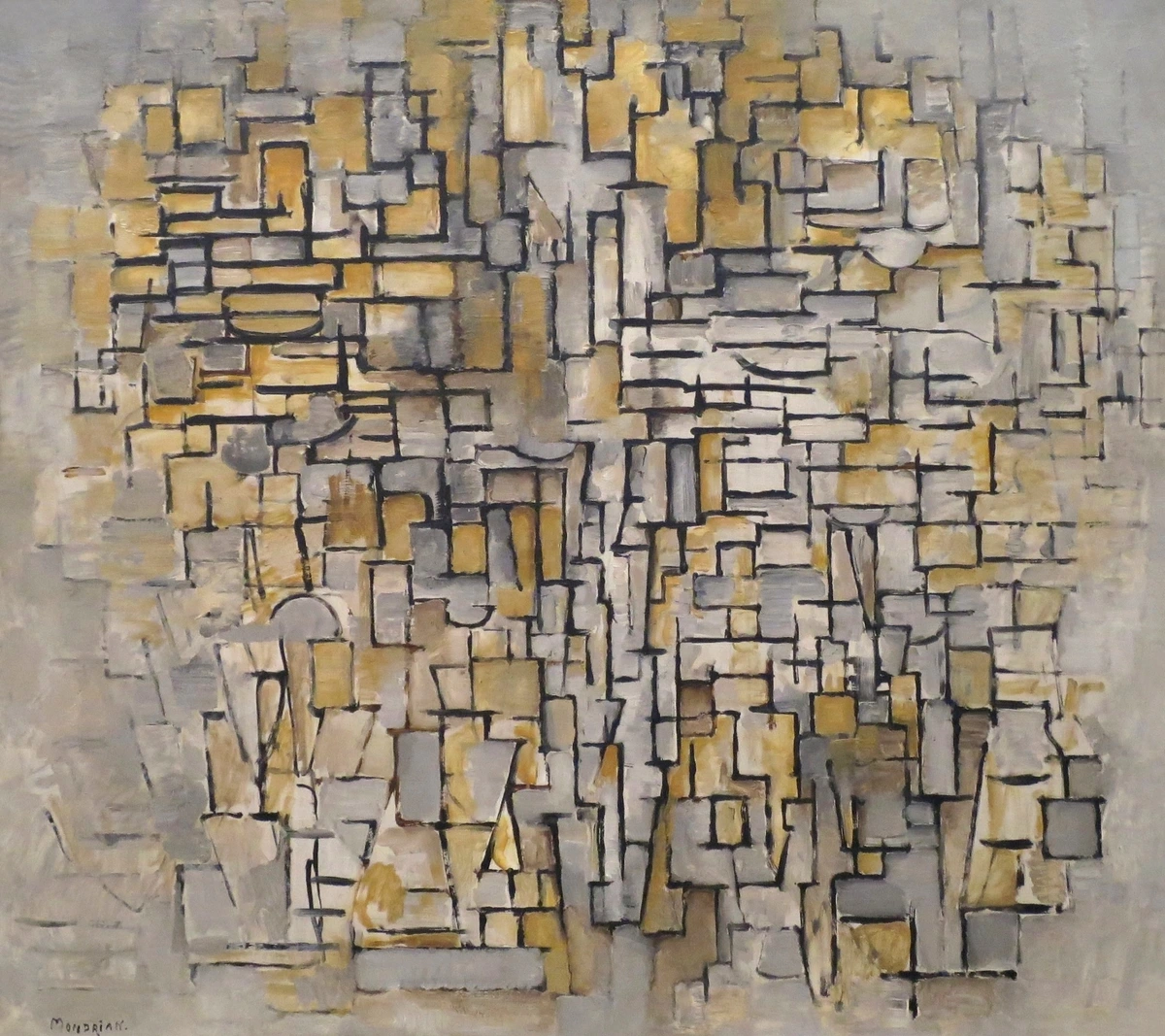
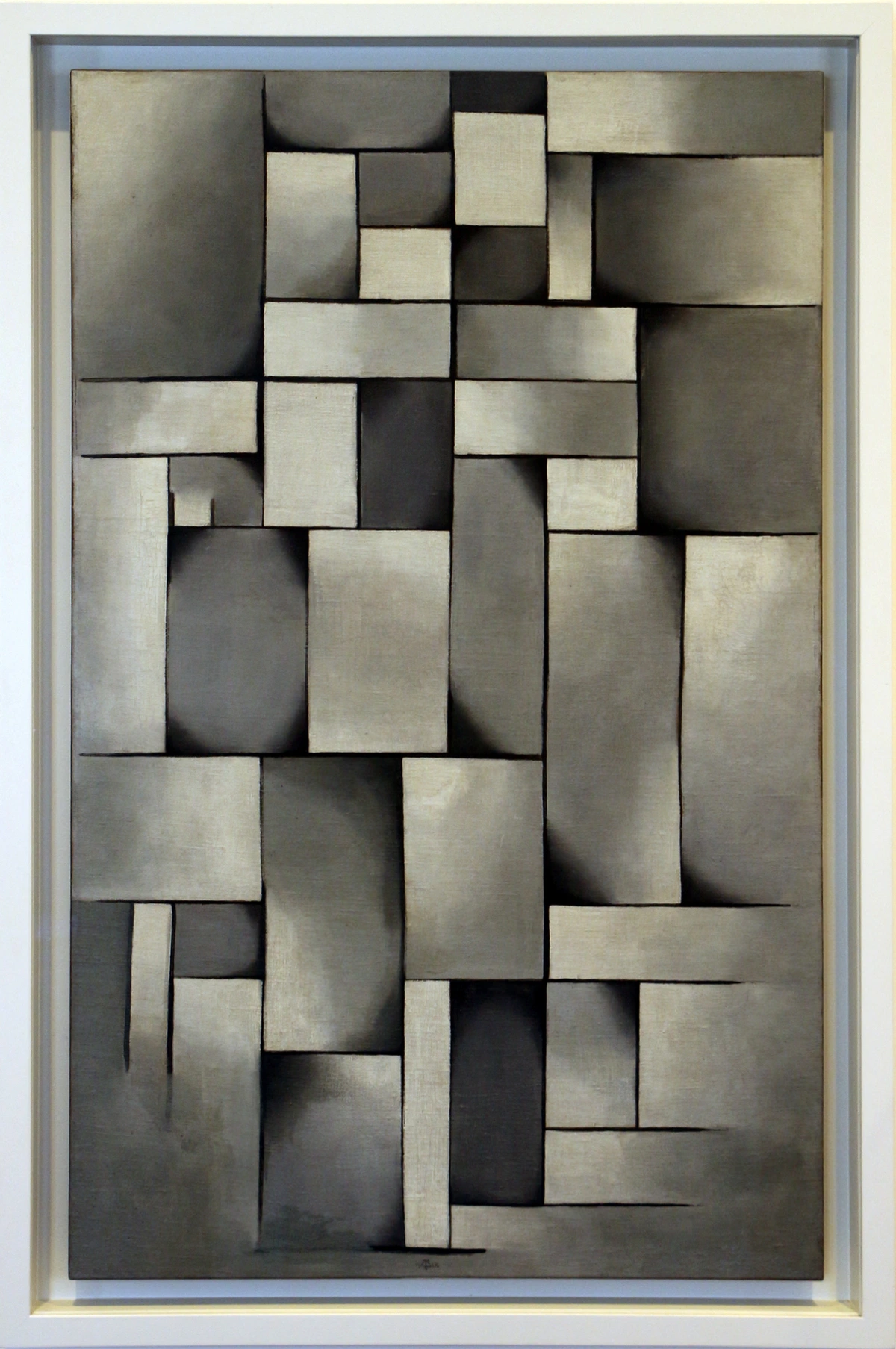
- The Gray Tree (1911): Housed at the Gemeentemuseum Den Haag, here, color is almost entirely gone, replaced by a subdued, monochrome palette of grays and ochres. The tree’s form is significantly more fragmented, shattered into a dense, almost Cubist web of intersecting, angular lines. The tangible influence of Analytical Cubism, which fractured objects into multiple viewpoints to explore multiple realities simultaneously, is undeniable. The tree becomes less of an object and more of a structural puzzle, a skeletal diagram of forces. You can clearly see Mondrian moving away from raw emotional expression towards a rigorous structural analysis, seeking the underlying geometric order that, to him, represented universal harmony. It’s a profound intellectual leap from the visceral 'Red Tree'.
- Flowering Apple Tree (1912): This one, found at the Kröller-Müller Museum, is barely a tree anymore in any recognizable sense. It’s an explosion of delicate, curving lines and rhythmic dashes, a vortex of movement. He’s captured the sensation or the energy of a blossoming tree without painting a single recognizable leaf or petal. It's an internal impression made visible, a dance of pure line and rhythm, almost vibrating with the pulse of nature, but filtered entirely through his abstracting mind. Here, the last vestiges of representational form give way to pure abstract rhythm, a clear precursor to his later non-objective work.
Looking at these three paintings in chronological order is like watching a slow-motion video of a singular artistic mind evolving, shedding the superfluous to find the essential. It’s a journey many artists, myself included, undertake—documenting this evolution on my personal /timeline. From the fiery, emotional object of 'The Red Tree' to a complex web of lines in 'The Gray Tree', and finally, to the pure, spiritual geometry of Neoplasticism, this series is a testament to the power of persistent inquiry, a profound artistic evolution. For a deeper understanding of how these transformations laid the groundwork for entirely new artistic languages, consider exploring the ultimate guide to abstract art movements.
What Mondrian was ultimately striving for in this journey was a universal, objective harmony, a visual language that transcended individual emotions and specific representations to tap into a deeper spiritual order. This ambition would lead him to co-found De Stijl (The Style) movement in 1917 with Theo van Doesburg, advocating for a purified art form stripped down to its most fundamental elements. The dynamic, almost chaotic energy of 'The Red Tree' and the subsequent expressive explorations had to be thoroughly explored and exhausted before he could arrive at the serene, objective balance of his later, iconic grid paintings that define Neoplasticism. These early works are the indispensable precursors, the brave acts of bridge-building, to his groundbreaking mature period, revealing the intellectual rigor behind his seemingly simple final forms.
credit, licence
For a complete overview of the artist himself, don't miss the ultieme gids voor Piet Mondrian.
FAQ: Unpacking 'The Red Tree' and Mondrian's Transition
Let's tackle some of the questions I often hear about this fascinating transitional piece by Piet Mondrian. It's one of those paintings that rewards repeated viewing and deep contemplation, sparking conversations long after you've walked away from it.
What style is 'The Red Tree' and what movements influenced it?
It’s a magnificent hybrid, which is precisely what makes it so captivating and historically significant. It sits at the crossroads of several major early 20th-century movements, demonstrating Mondrian's active experimentation and synthesis of contemporary ideas:
- Post-Impressionism: You can clearly see the influence of artists like Van Gogh in the expressive brushwork, the subjective approach to nature, and the intense emotional charge this painting conveys. It moves beyond merely capturing light to expressing profound internal feeling.
- Fauvism: This is vividly evident in the bold, non-naturalistic use of color—particularly that vibrant red and electric blue—where color serves to express feeling and inner reality rather than simply describe objective appearance. Mondrian embraced color as an independent expressive element, much like the Fauves did, liberating it from its descriptive role.
- Expressionism: The painting's primary focus on conveying Mondrian's inner emotion and subjective experience of the tree, rather than its objective appearance, aligns strongly with Expressionist ideals. The gnarled, almost tortured form of the tree is an outward manifestation of an inner state, a visual scream of artistic urgency.
- Early Cubism: While not fully Cubist in the fragmented, multiple-perspective way Picasso or Braque were, the way Mondrian begins to break down the tree's organic form into a network of dominant lines and hints at underlying structure shows a clear engagement with the analytical principles that would lead to Cubism. It foreshadows his later, more explicit Cubist phases, where he meticulously deconstructed forms to explore multiple perspectives simultaneously. The focus on structural elements over superficial appearance is key here.
- Symbolism: While often overlooked, the deep spiritual undercurrents (especially through Theosophy) and the use of color to evoke emotional or metaphysical states also connect 'The Red Tree' to Symbolism, an earlier movement that sought to represent abstract ideas through symbolic forms. The red and blue are not just colors; they are carriers of deeper meaning.
It’s a painting that refuses to be neatly categorized, a testament to Mondrian's active experimentation and his relentless search for a new artistic language, bridging older sensibilities with radical new approaches. This synthesis of influences is what makes it such a vital document in the journey towards modern abstraction.
Is 'The Red Tree' considered an abstract painting?
Not fully, no. I would categorize it as a work of semi-abstraction or, more accurately, a transitional piece. The subject—a tree—is still clearly recognizable, albeit highly stylized and distorted. However, the treatment of that subject (the highly expressive color, the gnarled and simplified lines, the deliberate distortion of form) is a massive leap away from pure representation and firmly towards abstraction. If you imagine a spectrum from a photographic landscape to a purely geometric Mondrian grid, 'The Red Tree' sits decisively in the middle, leaning heavily towards the abstract end. It’s a crucial bridge between representational art and pure abstract art, retaining a recognizable form while heavily prioritizing emotional and structural elements over objective reality. It perfectly captures the moment Mondrian was questioning and pushing the boundaries of what a painting could be, leading him away from literal depiction towards a more universal language of form and color. You can find more insights on this journey in what is abstract art and the definitive guide to understanding abstraction.
What does the red tree symbolize or represent?
Art, like life, is deeply personal, so its symbolism can resonate differently with each viewer. However, several interpretations commonly emerge, often informed by Mondrian's own spiritual journey:
- Potent Life Force & Struggle: For me, that fiery red powerfully represents a potent life force, a desperate struggle for existence, perhaps even a defiant vitality against the vast, indifferent blue of the world. It’s a testament to endurance and an almost primal scream of being, mirroring the intense inner experience of life itself. The gnarled branches seem to fight for space, for breath, for their very existence.
- Spiritual Essence & Evolution: Given Mondrian's deep engagement with Theosophy, the tree can be seen as a symbol of nature's spiritual essence, stripped of incidental detail to reveal a deeper, universal truth. The vibrant red could signify spiritual energy, vitality, or even the fiery purification necessary for spiritual awakening. The tree becomes a metaphor for the cosmic evolution Theosophy championed, where material forms evolve towards a more refined, spiritual state.
- Artist's Self-Portrait: Some scholars and viewers also interpret it as a kind of self-portrait of Mondrian himself: a solitary figure, full of artistic fire and intellectual curiosity, pushing relentlessly against the entrenched boundaries of traditional art, caught in his own internal transformation. It mirrors his own creative struggle and evolution, a visual diary of an artist on the brink of a monumental breakthrough.
It speaks volumes about nature's raw power and the resilience of the human spirit, especially the creative spirit.
What was Mondrian's artistic goal with 'The Red Tree'?
His goal, I believe, was profoundly ambitious: to reconcile the visible world with his inner spiritual quest for universal harmony. He was trying to find a balance between the emotional expression he admired in artists like Van Gogh and the underlying order he sought through Theosophy. 'The Red Tree' is his attempt to express the essential vitality of nature, not just its outward appearance, and to explore how far he could push color and line to convey that internal reality without abandoning the subject entirely. It was a crucial, experimental step in his journey to discover a universal artistic language that could reflect a deeper spiritual truth. This quest for "universal harmony" meant distilling reality to its most fundamental visual components—lines, shapes, and primary colors—a path that would ultimately pave the way for Neoplasticism. He was seeking a way to paint the soul of the world, not just its skin.
What was the contemporary reception of 'The Red Tree'?
Unfortunately, specific records detailing the immediate critical and public reception of 'The Red Tree' upon its initial exhibition (likely in Amsterdam) are scarce. However, we can infer some general attitudes. Works that dared to depart from traditional representation, especially with such bold, non-naturalistic color and distorted forms, were often met with bewilderment, criticism, or even outright ridicule by conservative critics and the public. It would have been seen as radical, perhaps even crude, by those accustomed to academic realism or Impressionistic subtlety. Its Fauvist and Expressionist leanings would have marked it as avant-garde, aligning it with a small, progressive segment of the art world. It was certainly not an instant crowd-pleaser; it was a work for those willing to engage with a new, challenging visual language that defied conventional beauty standards.
Where is 'The Red Tree' located today?
The painting is a cherished masterpiece housed at the Kunstmuseum Den Haag in The Hague, Netherlands. It’s an absolute must-see if you're ever in the area, offering a profound glimpse into a master's mind and a pivotal moment in the history of abstract art.
The Final Word: Embracing the Messy Middle
'The Red Tree' is far more than just a beautiful painting; it’s a profound creative roadmap for any artist, for any creative pursuit, really. It teaches us that true artistic evolution—or any significant personal growth—isn't typically a sudden, blinding flash of lightning. Instead, it’s a courageous process of questioning, of relentless experimentation, and of daring to break your own established rules, even if it feels a bit chaotic at the time. I know this feeling deeply, having spent countless hours in my own studio grappling with form and color, trying to find that perfect balance between expression and order. Just last month, I was wrestling with a series of abstract landscapes that felt utterly wild, almost like a primordial soup of color and line. There were days I wanted to throw the canvas out, convinced it was a failure. But I knew, instinctively, that I had to push through that "messy middle" to arrive at something new, something that held a deeper, more authentic truth. It reminds me of Mondrian’s journey, and the crucial insights gained from works like this.
Mondrian, bless his disciplined heart, had to paint this fiery, almost chaotic tree, wrestling with its emotional intensity and structural deconstruction, before he could find the calm, universal harmony of his iconic grids. He had to explore the depths of expressive representation before he could transcend it. He needed to find his 'Red Tree' to arrive at Neoplasticism, a journey mirrored by many artists, myself included, on my personal /timeline.
It’s a powerful, tangible reminder—especially on those days when I’m staring at a half-finished canvas in my own studio, wondering if I'm on the right track—that sometimes the most important work you do isn't the polished, final product. It’s the messy stuff in the middle, the transitional works, the experiments, the brave acts of artistic bridge-building between what you know and where you desperately need to go. What's your 'Red Tree' right now? What chaotic, expressive experiment are you undertaking that feels right, even if it doesn't quite make sense yet? That, to me, is the enduring legacy of this Piet Mondrian painting, and a lesson I return to again and again in my own artistic journey. Perhaps you can find your own turning point in its vibrant chaos too. If you're inspired by artistic evolution and seeking pieces that speak to this journey, do consider visiting my den-bosch-museum or looking to kunst te kopen die zo'n diepe geest vangt.




credit, licence