St. Peter's Basilica Art: An Artist's Guide to Masterpieces & History
Explore St. Peter's Basilica through an artist's lens: Michelangelo's Pietà, Bernini's Baroque wonders, the colossal dome, deep architectural history, hidden art gems & essential Vatican City visitor tips.

St. Peter's Basilica Art: An Artist's Guide to Masterpieces, History & Your Ultimate Vatican Visit
There's a moment for everyone when they first walk into St. Peter's Basilica where their senses just... get overloaded. You step over the threshold, and the sheer scale of the place hits you like a physical force, actively sculpting your perception of faith, power, and human achievement. The colossal dimensions trick your brain, making you feel like a tiny speck in a cavern of gold and marble, incredibly small yet profoundly connected to something so human, so divinely ambitious. I remember the first time I visited, I honestly felt a catch in my breath, a physical sensation of being utterly overwhelmed. It was in that moment, once the initial shock subsided, that I started to truly see the art. Not just the colossal scale, but the intricate human genius within. As an artist myself, I've found that understanding the why behind such monumental creations – the intent, the technique, the sheer audacity – unlocks a deeper appreciation and even enriches my own creative process. This isn't merely a building; it’s a profound architectural statement, a testament to enduring faith, fierce artistic rivalry, and a place designed to actively sculpt your perception. This guide aims to be your personal curator, blending historical depth, meticulous artistic analysis, and essential practical advice, unlocking the stories and techniques that transform stone and pigment into something truly eternal and positioning us as your most comprehensive resource. We'll begin with essential practical tips for your visit, then delve into the Basilica's fascinating architectural history, explore its iconic masterpieces, uncover hidden artistic gems, and finally address common questions you might have, ensuring you leave with a richer understanding and a deeper sense of connection to this unparalleled site within Vatican City, an independent state whose unique status has profoundly influenced its art and preservation efforts.
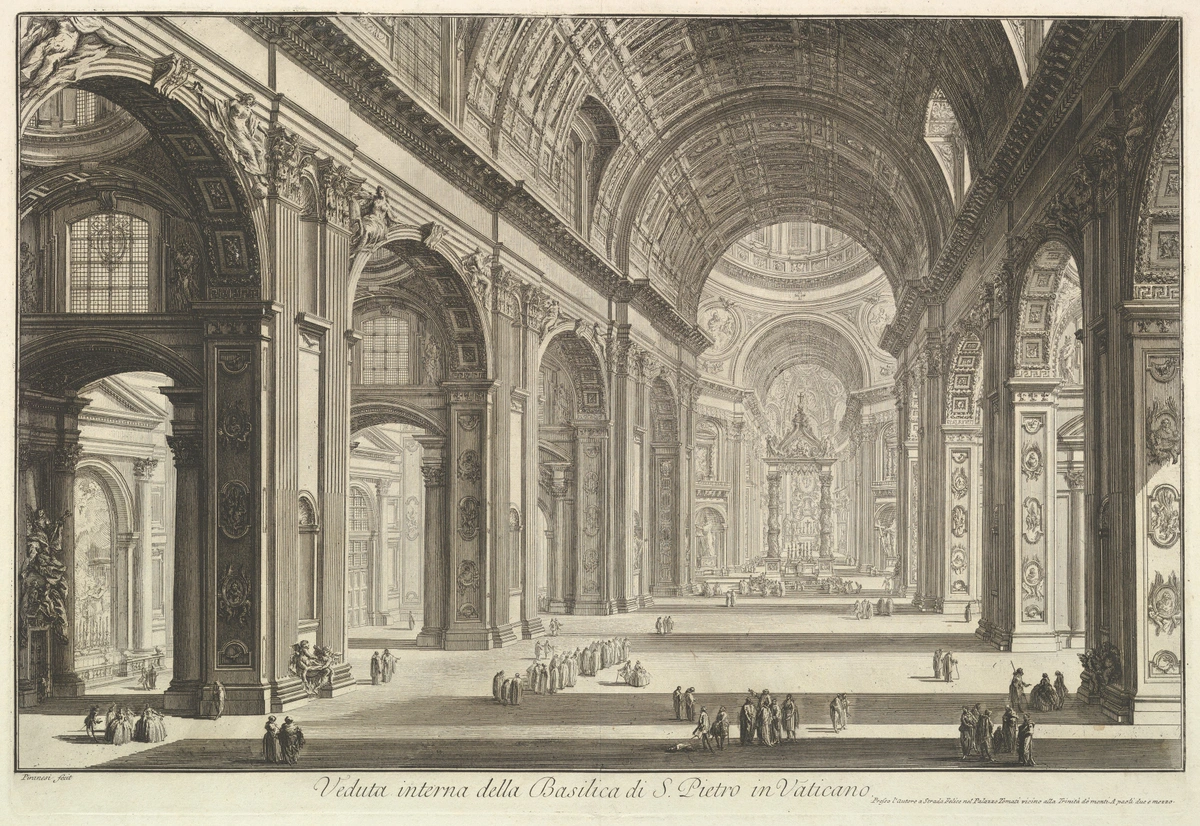
That feeling of being overwhelmed is exactly what it was designed to do. This isn't just a church; it's a statement of faith, power, and artistic genius by the Catholic Church. But once your senses adjust – and trust me, they will – you start to notice the details. And that's where the real magic is. This building is home to some of the most profound pieces of art ever created by human hands, and to truly appreciate it, we need to look beyond the immediate awe. I'm not here to give you a stuffy art history lesson. Think of this as me walking through it with you, pointing out the things that make me stop and stare every single time, delving into the stories and techniques that make these works immortal. My goal with this guide is to cut through the noise and offer you a comprehensive, yet personal, look at the art that defines St. Peter's Basilica.
Practicalities & Preparations: Your St. Peter's Reality Check
Okay, before we properly dive into the art, a quick word to the wise. St. Peter's Basilica, located in Vatican City, is not just an art gallery; it's an active, and incredibly important, place of worship for the papacy and the global Catholic Church. Respect for this sacred space is paramount, and a little planning goes a long way to ensure your visit is as serene as possible. One more thing to note: while the Basilica strives for universal accessibility, its ancient architecture can pose challenges. There are ramps and elevators available, but some areas, especially the dome climb, have physical limitations. Always check the official Vatican website for the most up-to-date accessibility information if you have mobility concerns. I know what you're thinking: "Free?! Awesome!" And it is. But that security line? It can be a beast.
Aspect  | What You Need to Know | An Artist's Insight |
|---|---|---|
| Dress Code | Cover your shoulders and knees. No shorts, miniskirts, or bare midriffs. This is strictly enforced. | They are very serious about this – you don't want to be the one sent back to the hotel for a fashion faux pas after a long journey! I've seen countless people turned away at the entrance, sometimes even for having a scarf tied around their waist instead of over their shoulders. Just pack a light scarf or wear longer clothing like trousers or a knee-length skirt with a t-shirt or blouse that covers your shoulders; it's about showing respect for the millennia of faith held within these walls. Historically, religious garments and artistic depictions of modesty also influenced these codes, reminding us that art is often entwined with cultural and spiritual expectations. The quiet satisfaction of being prepared allows for a much more relaxed visit. |
| Security Checks | All visitors must pass through metal detectors and bag checks. Large bags, sharp objects, and certain liquids are prohibited. | This is non-negotiable and can add significant time to your entry. Travel light if you can, and be prepared for airport-style security. Larger bags or bulky camera equipment (like DSLRs with large lenses, tripods, or selfie sticks) can be particularly cumbersome in crowds and might even be questioned or prohibited, detracting from your focus on the art and potentially causing a safety hazard. I've learned the hard way that a small backpack is much easier to manage than a giant tote, especially when navigating crowds; it allows me to keep my hands free to gesture wildly when explaining a particularly brilliant carving! |
| Entry | Entry into the Basilica itself is free. You will go through a security line, which can be long. You need to buy a ticket if you want to climb the dome or visit the Vatican Museums and Sistine Chapel (which is a separate entrance). | Consider booking a guided tour if you want to skip part of the queue for the Basilica, or at least be prepared to wait. This is a crucial distinction: while the Basilica is free, many tours offer valuable 'skip-the-line' access, which can be well worth the investment for time-strapped visitors. Crucially, don't make the common mistake: the Sistine Chapel is accessed via the Vatican Museums, not directly from the Basilica. They are completely separate experiences with separate entrances and tickets, each demanding its own focused visit. This distinction is vital for planning your artistic pilgrimage. |
| Booking in Advance | For the dome climb or guided tours that allow queue-skipping, tickets should be booked online well in advance. | This is my absolute top tip! Spontaneity is great, but waiting hours in line isn't. Pre-booking saves precious time and guarantees your spot for popular activities like the dome climb. For peak seasons (spring/summer) or holidays, booking dome climb tickets even 2-3 months in advance is advisable. The ascent offers a unique perspective on Michelangelo's dome construction, an architectural and artistic experience impossible to gain from below, making advance booking essential for this marvel and any serious art study. |
| Opening Hours | Generally, St. Peter's Basilica is open from 7:00 AM to 7:00 PM (April to September) and 7:00 AM to 6:00 PM (October to March). These can vary, especially for special events or holidays, so always check the official Vatican website. | My best advice? Aim to be there right at opening at 7 AM. You'll experience a quiet, almost spiritual atmosphere that’s impossible to find later in the day. It's truly magical to see the first rays of light illuminate the mosaics and sculptures, revealing nuances in color and texture often lost in the midday glare, without a throng of people. These hours can be subject to change on short notice, particularly for major papal events or holidays, reinforcing the need to always consult the official Vatican website. |
| Best Time to Visit | Early morning (7:00 AM) or late afternoon (after 3:00 PM) are ideal to avoid the largest crowds. | I've learned from countless visits that fighting the midday crowds is a losing battle. The quiet of the early morning is unparalleled, offering a truly contemplative space to appreciate the art without distraction. Navigating the midday crowds is less an art appreciation experience and more an extreme sport. My strategy? Embrace the early bird or the twilight wanderer – your sanity (and your view) will thank you. |
| Photography | Photography is generally permitted for personal use, but flash photography is prohibited, and you should be respectful of ongoing services and other visitors. Professional equipment or tripods are generally not allowed without special permission. | While capturing memories is natural, I've found that sometimes, the best photograph is the one I don't take, the one that exists only in my memory and my interpretation, allowing the real moment to imprint itself deeply. The subtle textures of marble, the shimmering depth of a mosaic, the way light shifts across a sculpture – these nuances are often lost through a lens. If Mass is underway, it's best to observe quietly from a respectful distance or avoid that area entirely, allowing worshippers their sacred space. Sometimes, the most profound artistic insights come not from the lens, but from quiet contemplation, allowing the scale and emotion of a masterpiece to truly resonate without the filter of a camera. |
| Crowds | It gets busy. Like, really busy. Especially midday. | The best advice I can give is to go either as early as possible in the morning (right at opening) or later in the afternoon (after 3 PM) to avoid the main crush of tour groups. The midday crush can make it impossible to get close to intricate details on sculptures or to properly observe the scale of mosaics. You'll thank me when you can actually see the art without elbowing your way through a human river. I remember once trying to fight the midday current – never again! |
| Time | Don't rush it. Give yourself at least a couple of hours for the Basilica alone, more if you plan to climb the dome. | Trying to 'do' St. Peter's in 30 minutes is like trying to understand a symphony by listening to only three notes. The true genius lies in the interplay of elements, the gradual reveal of detail, and the emotional arc. The details here are what truly matter. Let the scale wash over you, then lean in to appreciate the intricate beauty. I often find the most profound insights come during those unhurried moments. |
| Mass | St. Peter's is a functioning church. Daily masses are held, and the main altar area may be restricted during services. | I personally find attending a mass here to be an incredibly moving experience, especially if you can get in. But be aware that this means certain areas might be temporarily inaccessible to tourists, as the main altar is the holiest part of the church, reserved for liturgical use during services. Witnessing a service can also reveal how the art is used to enhance worship – how specific altarpieces or sculptures become focal points during prayers and rituals. Check the Vatican's schedule if you plan your visit around a service or wish to avoid one. Always remember this is a living, sacred space, not just a museum. |
| Dome Climb | Climbing the dome costs a separate ticket (approx. €8-10). You can take an elevator for the first part, then it's 320 steps. Or you can climb all 551 steps from the ground floor. The final stretch is narrow, steep, and spiraling. | Is it worth climbing the dome? 100% yes, if you are physically able and not claustrophobic. The elevator only takes you to the base of the dome's drum; the final ascent is entirely on foot via a narrow, winding staircase. The journey up is an experience in itself – I remember thinking my lungs would give out on that last, curved, and frankly claustrophobic squeeze – but the view, looking down into the Basilica and out across Rome, is something you will never, ever forget. The climb offers an unparalleled architectural study of Michelangelo's dome, revealing the engineering marvels and structural elements rarely seen from below, like the innovative internal iron chains designed to counteract outward thrust. It truly puts the entire city into perspective, making the physical effort of the climb a powerful metaphor for the spiritual ascent this sacred space is designed to evoke. |
| Footwear | You'll be doing a lot of walking, and standing on hard marble floors. | Wear comfortable, broken-in shoes. Seriously. Your feet will thank you. Supportive walking shoes or comfortable sneakers are your best friends here. Comfortable shoes aren't just practical; they allow you to linger, to really get lost in the details of a mosaic or the musculature of a sculpture, an essential for any deep artistic engagement. I once made the mistake of wearing fashionable but unsupportive shoes – my enthusiasm for art was severely tested that day! |
| Water & Restrooms | Restrooms are available outside the Basilica, before security, and very limited inside. Bring a refillable water bottle, as fountains are scarce. | Hydration is key! You'll be doing a lot of walking and waiting. Make sure to use the facilities before you enter the security line; options inside are sparse and often far. You can typically refill water bottles at designated fountains outside the Basilica or within the Vatican Museums' restroom areas. Being prepared ensures you can spend your limited time focused on the art, rather than searching for facilities or battling dehydration. And if you're like me, planning an extended stay or a long climb, a discreet, compact travel urinal might be a surprisingly practical companion. |
Now that we're equipped with practical knowledge, let's rewind and explore the very foundations and architectural evolution that made this sacred space possible. Understanding the 'how' and 'why' of the Basilica's creation adds an unparalleled depth to appreciating its art.
The Centuries-Long Saga: From Ancient Roots to Renaissance Grandeur
St. Peter's Basilica isn't just a building; it's a testament to centuries of ambition, faith, and fierce artistic rivalry. Its very foundations rest on a site of immense historical and spiritual significance, believed to be the burial place of Saint Peter himself. The sheer temporal span of its creation – over 150 years for the current structure, built upon foundations dating back to the 4th century – is mind-boggling. It makes you appreciate how truly monumental projects require generational commitment and vision, a stark contrast to our often instant-gratification world. As an artist, my own sense of proportion often warps in spaces like this; I'm simultaneously humbled by the immense human effort and inspired by the audacious vision required to even conceive such a structure.
The Vatican Necropolis: Peter's Resting Place
Beneath the grandeur of the current Basilica lies the Vatican Necropolis, an ancient Roman cemetery that predates Christianity. The term "necropolis" literally means "city of the dead," and these burial grounds were typically situated along roads leading into ancient cities. This is where, tradition holds, Saint Peter was crucified and buried after his martyrdom around 64 AD, a period of intense persecution for early Christians in Rome. Archaeological excavations in the mid-20th century uncovered a remarkably preserved pagan and early Christian burial ground directly beneath the Basilica's high altar. Here, an aedicula (a small shrine) and an ossuary containing what are believed to be Saint Peter's bones were discovered, alongside graffiti inscribed with "Petrus roga Christus Iesu" (Peter, pray to Christ Jesus). This discovery, often referred to as the "Petrine confirmation," offered compelling archaeological evidence corroborating the sacredness of the site, establishing it as a primary pilgrimage destination even before the first basilica was built. For me, this tangible link to the earliest days of Christianity adds an almost overwhelming layer of historical depth to the entire complex, directly influencing the placement and scale of later architectural and artistic decisions. It speaks to a continuous thread of veneration, a profound human connection to a sacred past.
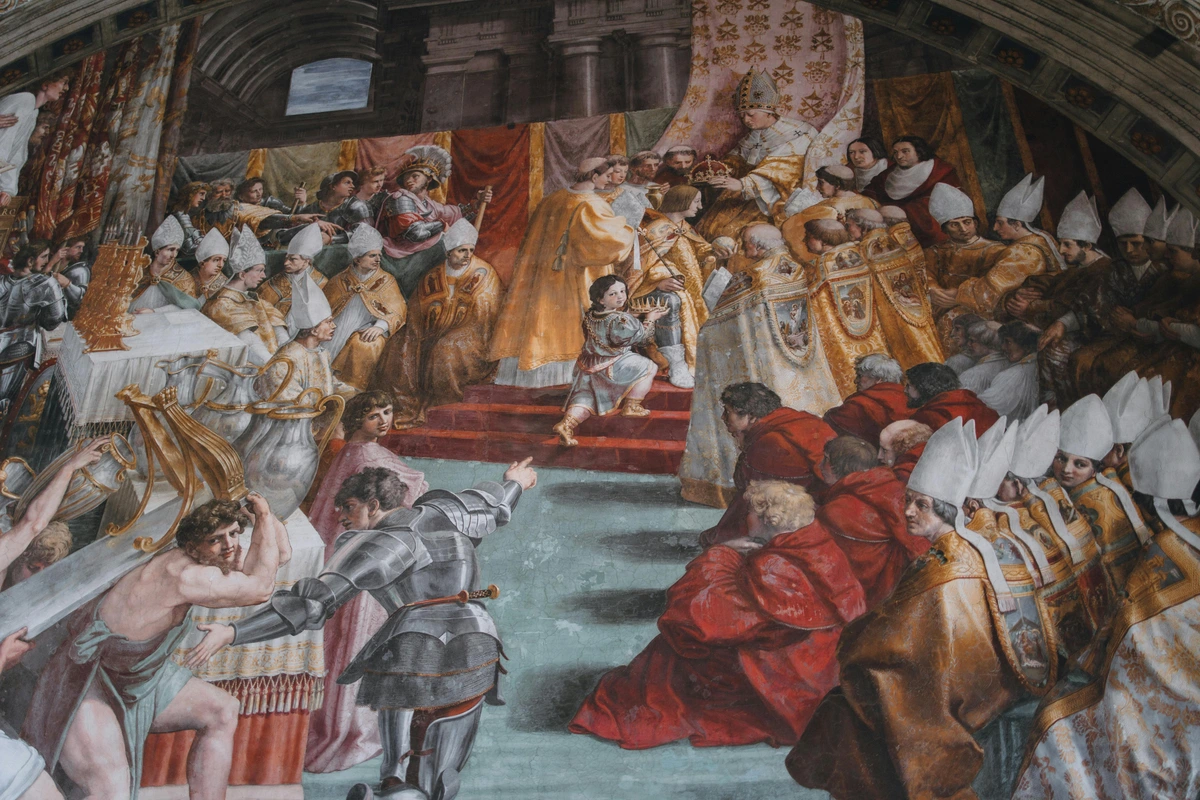
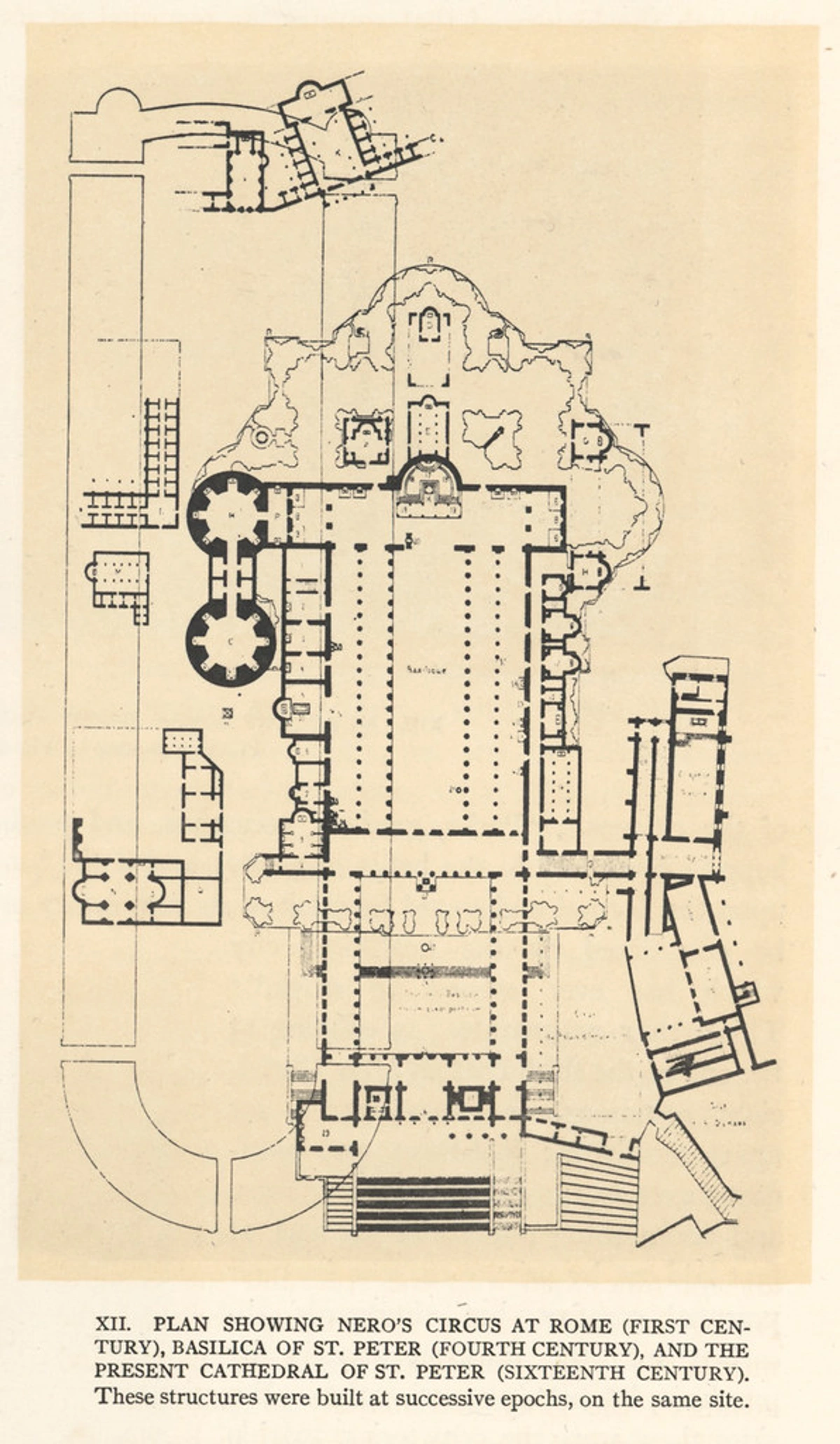
Imagine, it was right here, around 320 AD, that Emperor Constantine the Great ordered the construction of the Old St. Peter's Basilica. His famous Edict of Milan in 313 AD had paved the way for open Christian worship, fundamentally changing the landscape and making monumental church building possible for the nascent Christian community. This colossal five-aisled early Christian basilica, often referred to as the Constantinian Basilica, featured a vast timber-roofed nave supported by rows of repurposed classical columns, and likely included a large atrium or forecourt, typical of early Christian basilicas. Visually, it created a processional space that emphasized community and movement towards the altar. Its nave was even longer than the current one, though less grand in its ornamentation. For over a millennium, this original structure stood as the primary pilgrimage site for Christians, embodying early Romanesque and Byzantine influences in its architectural simplicity and vast internal spaces. However, by the 15th century, centuries of neglect, limited maintenance, and the unstable political climate of Rome meant the grand basilica was in dire disrepair, threatening to collapse. Its deteriorating state, coupled with the burgeoning wealth and ambition of the Renaissance papacy, led to a monumental and controversial decision: to tear it down and erect something even grander. This audacious demolition, while pragmatic for the new construction, was seen by some contemporaries as a "ruina di San Pietro" (the ruin of St. Peter's), lamenting the loss of such an ancient, revered structure. The rebuilding aimed to create a powerful visual argument for the Catholic Church's enduring authority in the face of the nascent Protestant Reformation, a monumental statement of unwavering power, divine inspiration, and artistic supremacy, all funded by papal patronage.
This project, which spanned over 150 years (from 1506 to 1626), attracted the greatest minds and most ambitious artists of the age, transforming the landscape of Vatican City and pushing the boundaries of engineering and art. Popes such as Julius II (who commissioned Bramante's initial plans), Paul III (who brought Michelangelo back to the project), Urban VIII (who championed Bernini's grand Baroque interventions), and Alexander VII (who commissioned the colonnade) were not merely patrons; they were driving forces, often using the Basilica's construction to assert their authority and legacy, fueling rivalries among the era's greatest artists as they vied for prestigious commissions and sought to outdo each other in grandeur. This included a competition of ideas, like Bramante's early centralized plan versus the later Latin cross adaptations. The new Basilica, with its immense scale and lavish decoration, utilized vast quantities of precious materials. Carrara marble, prized for its pure white appearance and fine grain, was used for iconic sculptures like the Pietà due to its workability and luminous quality – for me, it speaks of divine transcendence and purity. Rosso antico (a deep red porphyry) and giallo antico (a rich yellow marble) often symbolized imperial power and divine presence, quarried from ancient Roman sites or freshly extracted, symbolizing the Church's triumph and enduring legacy by repurposing classical materials. Jasper, with its often striated or patterned appearance, added visual complexity and could symbolize the suffering of Christ. Even the exterior's robust travertine, a light-colored limestone, conveys permanence and solidity. The sheer prevalence of gilded bronze and gold leaf isn't just opulent; it's an artistic choice meant to convey the divine light of heaven, a palpable manifestation of eternal glory. The deliberate choice of every stone, every metal, every color was a conscious artistic decision, contributing to a grand narrative of faith, power, and enduring beauty that resonates through the ages. For a deeper dive into its construction, check out our guide on St. Peter's Basilica Architecture History.
A Pantheon of Architects: Rivalry and Genius
The construction of the new St. Peter's involved a veritable pantheon of architectural giants, each leaving an indelible mark and often clashing in their artistic visions. It was a grand artistic competition, fueled by papal patronage and the desire to create the most awe-inspiring church in Christendom. The intense rivalry meant architects often critiqued or even demolished parts of their predecessors' work, constantly striving for a more perfect, more impactful design that would secure their legacy. This century-long collaboration and artistic evolution is a remarkable testament to sustained artistic endeavor and papal patronage. The sheer audacity of it all is breathtaking. It makes you contemplate what we, as humans, are capable of when driven by profound belief and artistic vision.
Let's walk through the key players and their contributions:
- Donato Bramante (High Renaissance Mastermind, 1506-1514): Bramante was the first chief architect, appointed by Pope Julius II in 1506. His bold vision for the new Basilica was a pure Greek cross plan (a cross with four arms of equal length), topped by a massive central dome inspired by the ancient Roman Pantheon. This design, with its harmonious classicism and rational geometry, perfectly embodied the ideals of the High Renaissance, emphasizing balance, proportion, and a centralized focal point, seeking divine perfection in form. Bramante meticulously applied classical principles of symmetry, proportion, and the use of classical orders (like Doric, Ionic, Corinthian columns) to create a centralized, ideal space, a departure from the longitudinal churches of the past. His ambition set the tone for the entire project, though his early death meant others would take up his mantle. Famously, Bramante's early design garnered both admiration and criticism, with some contemporaries coining the phrase "ruina di San Pietro" (the ruin of St. Peter's) due to his enthusiastic demolition of the old basilica and the immense scale of his new, uncompleted foundations. His earlier work on the Tempietto in Rome also showcased his mastery of classical proportions.
- Michelangelo (The Unfinished Dome & Beyond, 1546-1564): Though initially reluctant, Michelangelo took over the project in 1546 at the age of 71, returning to Bramante's Greek cross plan and simplifying some of the earlier designs. His most enduring contribution was the design for the colossal dome, a feat of engineering and aesthetics influenced by Brunelleschi's Duomo in Florence and a direct response to the Pantheon. While he didn't live to see it completed, his vision for the dome profoundly shaped the Basilica's iconic silhouette, a true pinnacle of Renaissance architecture. The dome's construction posed immense challenges: from calculating the immense outward thrust (which Michelangelo ingeniously addressed with hidden iron chains embedded within the drum to resist lateral pressure) to devising hoisting mechanisms for its colossal stone segments. It required innovative scaffolding and a continuous supply of skilled masons and engineers, making it one of the most ambitious construction projects of its time. The dome itself is a double-shelled structure, consisting of two distinct masonry layers (an inner, lighter shell and an outer, heavier shell) connected by ribs, a sophisticated design ensuring both structural integrity and a vast internal canvas for later decoration. The actual completion of Michelangelo's dome after his death was overseen by Giacomo della Porta (who introduced the steeper, more dynamic outer profile) and Domenico Fontana (who managed the complex hoisting and construction of the lantern), ensuring his grand vision became a reality. We'll delve deeper into the dome later; trust me, it deserves its own moment.
- Carlo Maderno (Bridging Renaissance to Baroque, 1603-1629): By the early 17th century, the Counter-Reformation (the Catholic Church's response to the Protestant Reformation, emphasizing grand, emotive art to inspire faith) called for a return to the traditional Latin cross plan (a longer nave), better suited for large congregations during papal ceremonies by providing more processional space and better visibility for the faithful. Carlo Maderno, appointed in 1603, was tasked with this monumental shift. He extended Michelangelo's central plan to the east, creating the nave we see today, and designed the magnificent facade. This facade, with its colossal order of columns and pilasters, dramatically transformed the Basilica's exterior, bridging the elegant order and rational harmony of the Renaissance with the dynamic theatricality and emotional intensity of the emerging Baroque style. Maderno's facade, with its immense scale and dramatic projections, effectively acts as a grand visual overture, preparing visitors for the spiritual and artistic journey within. His work ensured the Basilica could accommodate the vast crowds gathering for papal blessings and events, a practical consideration that reshaped the initial Renaissance ideal. Maderno's earlier work on the Santa Susanna church also demonstrates his early embrace of Baroque elements.
- Gian Lorenzo Bernini (The Baroque Master, 1629-1680): Bernini, whose masterpieces we'll explore in detail, dominated the later stages of the Basilica's completion, particularly during the mid-17th century. He was responsible for many of the interior decorations, including the Baldacchino and the Cathedra Petri, and the iconic St. Peter's Square colonnade outside. His dramatic flair and emotional intensity defined the Baroque aesthetic within the Basilica, transforming it into a sensory spectacle, designed not just to instruct but to move the faithful. His designs integrated sculpture, architecture, and even light to create immersive spiritual experiences. As an artist, I constantly marvel at how he orchestrated a complete, multi-media experience, a defining aim of Baroque art to overwhelm the senses and evoke strong emotions. This grand collaboration, marked by both rivalry and genius, laid the foundation for the artistic wonders we see today, a living textbook of architectural history, each stone whispering tales of genius and ambition, a grand collaboration across generations of famous Renaissance artists and Baroque masters.
The Four Pillars of Artistic Awe: Masterpieces You Cannot Miss
Okay, you're inside. You've had your moment of awe, navigated the crowds. But where do you go first to really see the art? While the entire Basilica is an artistic marvel, there are four absolute must-see masterpieces that, for me, form the core of the St. Peter's artistic experience – works that not only define the Basilica but also mark pivotal moments in art history. These aren't just masterpieces; they're powerful expressions of sacred art – art not merely for aesthetic pleasure, but to instruct, inspire, and connect the faithful to the divine.
1. Michelangelo's Pietà: A Heartbreak in Marble
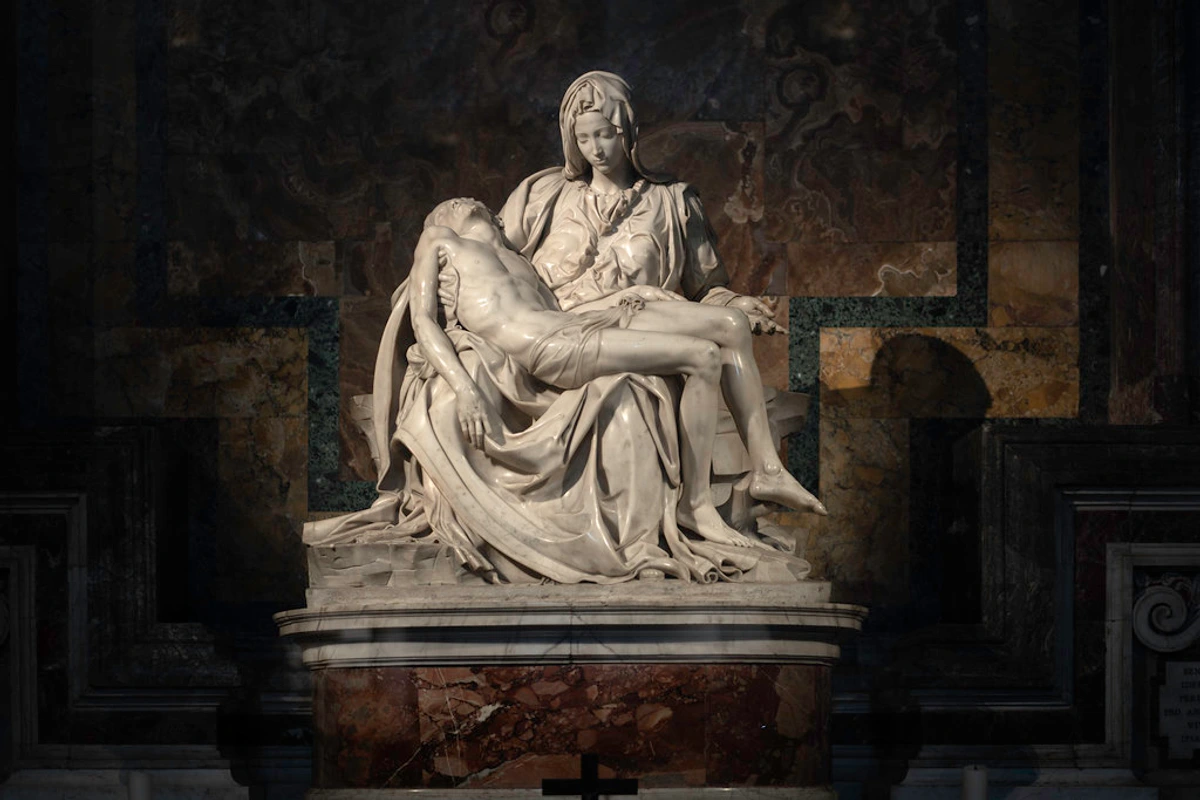
Immediately to your right as you enter the Basilica, you'll see a crowd. They're gathered around a sculpture behind bulletproof glass. That's the Pietà. And honestly, if this was the only thing in the entire Basilica, the trip would still be worth it. Prepare to be moved by a masterwork of profound grief and divine beauty.
Michelangelo carved this from a single block of exquisite, fine-grained, luminous Carrara marble when he was only 24. Twenty. Four. It captures Mary cradling the body of Christ after the crucifixion. But the way he did it... it's just devastatingly human. There's no gore or exaggerated anguish, which was common for the time. Instead, there's a profound, quiet, and deeply personal grief in Mary's face, a sorrow that feels universal. This emotional restraint was groundbreaking, a departure from more overtly gruesome or anguished Pietà depictions by other artists, particularly contrasting with the more dramatic Baroque interpretations that would follow. What truly astounds me, every single time, is the technical miracle of it. The way the marble seems to turn into soft flesh, the flowing fabric of Mary's drapery (note the complex contrapposto pose, a masterful use of diagonal lines creating natural movement, where the weight shifts to one leg creating an S-curve in the body), the delicate veins – it’s as if he didn't carve stone, but breathed life into it. As an artist who grapples with translating form and emotion onto canvas, I am continually awestruck by how Michelangelo achieved such an illusion of softness, such tactile reality, from unforgiving marble. It's a masterclass in transforming material and establishing a benchmark for sculptural realism. Michelangelo's daring decision to portray Mary as eternally youthful, rather than a woman in her late 40s (the age she would have been), was initially controversial. This choice symbolized her eternal purity and grace, suggesting that her divine status transcended the physical tolls of age and grief, adding immense symbolic resonance to the sculpture's profound impact and emphasizing her role as the Virgin Mother. This isn't merely a sculpture; it’s a study in profound emotion, a blend of divine subject matter and intense human feeling that marks the absolute peak of Renaissance sculpture and indeed, the High Renaissance itself. It's the only work Michelangelo ever signed – a bold assertion of authorship (especially for a young artist) and a testament to his immense pride and the sheer difficulty of achieving such perfection, something I, as an artist, can truly appreciate – a quiet assertion of genius amidst divine subject matter. The fact that it now stands behind bulletproof glass (added after a senseless act of vandalism by Laszlo Toth in 1972) is a poignant reminder of its immense value and also its fragility against the human impulse to damage, even if unintentionally.
2. Bernini's Baldacchino: Theatrical, Audacious, and Unforgettable
You can't miss this one. It's the gigantic, twisted, bronze canopy that towers over the main altar, directly under Michelangelo's dome. It's called the Baldacchino, and it's the undisputed masterpiece of Gian Lorenzo Bernini, the absolute master of the Baroque period. Prepare for a full-blown opera of artistic glory – a defining statement of Baroque art.
If Michelangelo’s Pietà is about quiet introspection, Bernini's Baldacchino is a full-blown opera of material and spiritual grandeur. It is the ultimate theatrical stage for faith, designed to make your breath catch, to overwhelm your senses and pull you into a drama of divine presence. Standing nearly 100 feet (over 30 meters) tall and weighing tons, it's a colossal work of art and engineering, meticulously crafted primarily from gilded bronze. The construction involved complex lost-wax casting and assembly of numerous bronze elements at the Vatican Foundry, painstakingly shaped and then gilded to achieve its shimmering effect. The sheer scale of the bronze casting required here is astounding; envisioning the immense furnaces, the meticulous lost-wax process on such a monumental scale… it’s a testament to engineering and artistic ambition fused together. What always makes me raise an eyebrow (and then immediately drop it in admiration) is that much of the bronze for this audacious creation was stripped from the portico of the ancient Roman Pantheon – a controversial move even back then, sparking the famous Pasquino quip, "Quod non fecerunt barbari, fecerunt Barberini" ("What the barbarians didn't do, the Barberini did"). This act of appropriating pagan materials for Christian glory was both pragmatic and symbolically charged, a triumph of faith over ancient traditions, and a powerful visual counter-argument to the growing austerity of early Protestantism during the Counter-Reformation. The twisting, Solomonic columns give it this incredible sense of energy and movement, like they're surging upwards towards the heavens, celebrating the Eucharist below. These columns, whose spiral form is said to be inspired by those from the ancient Temple of Solomon in Jerusalem, add a deep biblical resonance, linking the new St. Peter's to ancient sacred traditions and symbolizing the continuity of divine presence – Christ's presence in the Eucharist, mirroring the sacredness of the Old Testament Ark of the Covenant. Look closely, and you'll see intricate heraldic bees of the Barberini family (Pope Urban VIII, Maffeo Barberini, was the commissioner of the work) and other symbolic elements woven into the design, including laurel branches for victory and playful putti (cherubic figures). The Barberini bees, for instance, symbolized not just the Pope's lineage but also qualities like diligence, community, and the perfect design found in nature. It perfectly frames the high altar, drawing your eye up through its dramatic flourish, connecting the earthly space with the divine dome above. Bronze, with its ability to be cast, molded, and gilded, allows for a dramatic dynamism and rich interplay of light and shadow (chiaroscuro) that stone or marble simply cannot achieve, making it the perfect medium for Bernini's theatrical vision and a defining characteristic of Baroque sculpture.
3. The Chair of Saint Peter (Cathedra Petri): More Than Just a Seat
Walk past the Baldacchino, all the way to the back of the Basilica's apse. You'll find what looks like a monumental, golden explosion of angels and clouds, and in the center of it all, a throne. This is Bernini again, flexing his multi-media muscle, and it's called the Cathedra Petri, or the Chair of Saint Peter. This is where Bernini transforms a simple relic into a dazzling, symbolic affirmation of papal authority.
The whole sculpture is actually a reliquary – an ornate container for a sacred relic – built around a simple wooden chair believed to have been used by St. Peter himself. Bernini encased this humble relic in a spectacular gilded bronze shell, intricately worked with various textures and finishes to create dynamic light reflections, held aloft by four massive statues of the Doctors of the Church: Saint Ambrose, Saint Augustine, Saint Athanasius, and Saint John Chrysostom. These towering figures, representing both the Latin (Western) and Greek (Eastern) traditions of Christianity, symbolize the profound theological foundations and intellectual strength that support the papacy and its teachings. Saint Ambrose (340-397 AD) was a formidable defender of orthodox Christianity and a Doctor of the Latin Church, often depicted with a bishop's mitre and staff; Saint Augustine (354-430 AD) was a pivotal theologian whose writings profoundly shaped Western Christianity, known for his burning heart and intellectual depth; Saint Athanasius (296/298-373 AD) was a staunch defender of Christ's divinity against Arianism and a Doctor of the Greek Church, often shown with a book or scroll; and Saint John Chrysostom (347-407 AD) was renowned for his eloquence as a preacher and a Doctor of the Greek Church, often depicted with an open book. Their presence here is a truly brilliant touch, emphasizing the intellectual and spiritual pillars of the Church and their divine guidance of the papacy. Above it, an oval stained-glass window of a dove, representing the Holy Spirit, floods the apse with golden light, creating a breathtaking celestial vision. This light isn't merely decorative; it symbolizes divine inspiration and wisdom emanating from the Holy Spirit, directly guiding the Pope. The quality of this light, filtering through the colored glass (often blue for heavenly purity and gold for divinity), transforms the gilded bronze, making it shimmer and appear ethereal, contributing to the overall sense of divine presence. This masterful integration of materials – wood, bronze, marble, and colored glass – and the carefully controlled influx of natural light create a deeply spiritual and dramatic experience. It's over-the-top, majestic, and an absolute masterpiece of multi-media Baroque art, something that continues to inspire my own exploration of light and form, a hallmark of Bernini's expansive oeuvre.
4. The Dome: Michelangelo's Crowning Glory
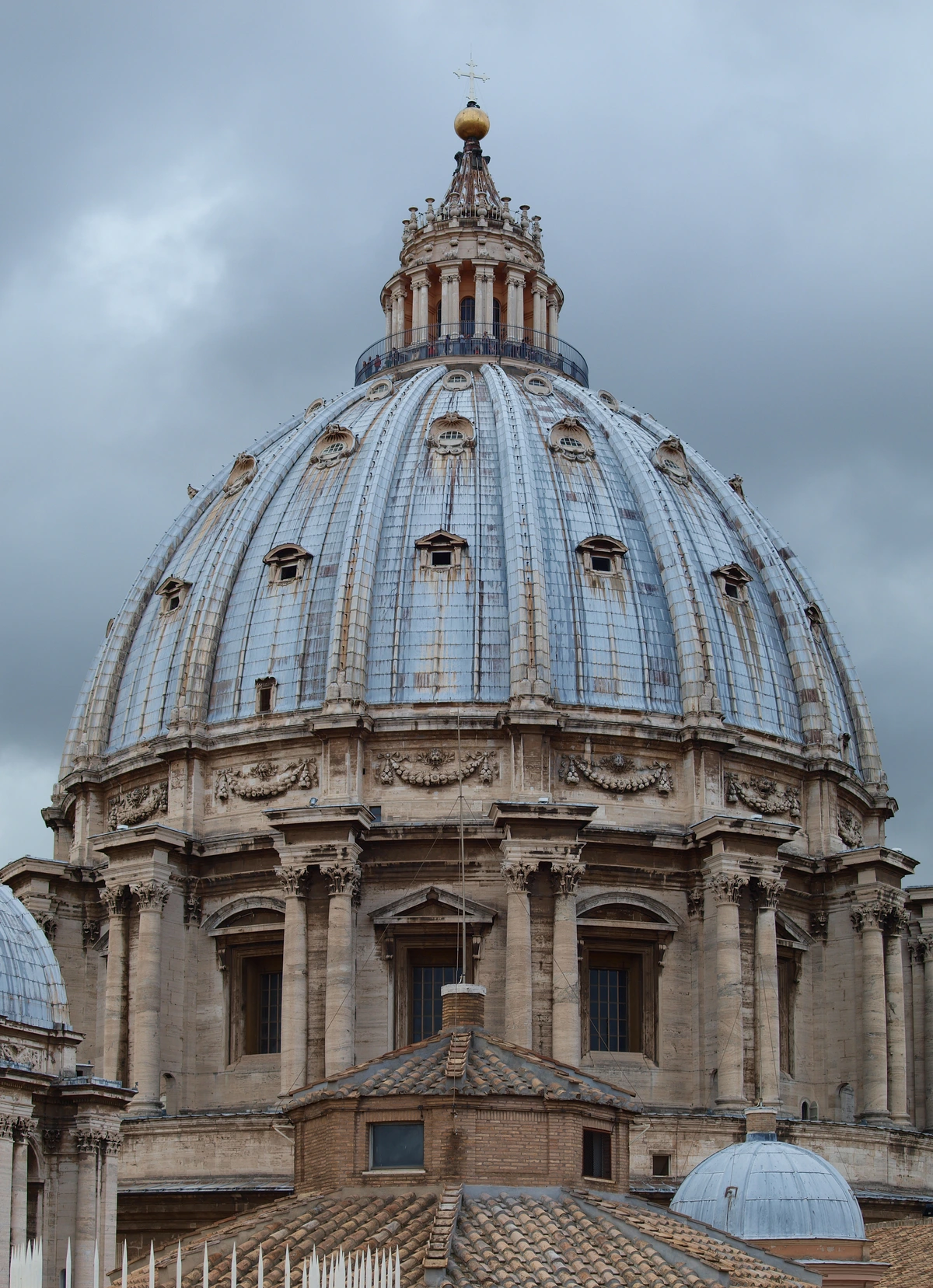
Now, look up. No matter where you are in the Basilica, the dome dominates. Standing at an impressive 448 feet (136.5 meters) high to the cross and with an internal diameter of 138 feet (42 meters), it's truly monumental. Though Michelangelo didn't live to see it completed – that honor fell to Giacomo della Porta (who introduced the steeper, more dynamic outer profile) and Domenico Fontana (who managed the complex hoisting and construction of the lantern) – the design is largely his, an engineering marvel inspired by Brunelleschi's Duomo in Florence and ancient Roman structures like the Pantheon. Its construction was an engineering feat of monumental proportions for its time, requiring innovative techniques and incredible skill to support its immense weight and span, a true testament to Renaissance ingenuity and Baroque completion.
Engineering Marvels and Structural Genius
Michelangelo grappled with the immense outward thrust of the dome, a challenge he partly addressed through ingenious structural elements like hidden iron chains embedded within the drum to resist lateral pressure. Imagine a giant tent needing internal supports to keep its shape against the wind – these chains perform a similar, invisible function. The logistical challenges were staggering: how to hoist colossal stone segments hundreds of feet into the air, and how to coordinate hundreds of specialized laborers. The dome is a double-shelled structure, consisting of two distinct masonry layers (an inner, lighter shell and an outer, heavier shell) connected by ribs, a sophisticated design ensuring both structural integrity and a vast internal canvas.

The inside of the dome is decorated with glorious mosaics that shimmer in the light pouring through the windows at its base. These intricate mosaics depict a celestial hierarchy, typically starting with Christ in glory at the apex, surrounded by apostles, saints, angels, and evangelists (often the Four Evangelists: Matthew, Mark, Luke, and John) in concentric circles, all leading up to a representation of God the Father. This visual ladder to heaven reinforces the Basilica's sacred purpose. These aren't just paintings; they are meticulously crafted images formed from countless tiny tesserae – small, precisely cut pieces of colored glass (often with gold leaf embedded for extra luminescence, evoking divine light) or stone – which capture light in a way that frescoes or oil paintings cannot, ensuring their brilliance endures. The mosaicists even manipulate the angle of the tesserae, creating subtle tonal shifts and a sense of dynamism akin to delicate brushstrokes. The sheer scale is hard to comprehend, even when you're standing beneath it. The letters you see running around the base of the dome, proclaiming "TU ES PETRUS ET SUPER HANC PETRAM AEDIFICABO ECCLESIAM MEAM ET TIBI DABO CLAVES REGNI CAELORUM" (You are Peter, and on this rock I will build my church, and I will give you the keys of the Kingdom of Heaven)? This inscription, from Matthew 16:18-19, is fundamental to establishing the papacy's authority and Peter's foundational role as the rock of the Church, solidifying the "Petrine Charge" – the authority and the keys to the Kingdom of Heaven passed down through successive popes. They're six feet tall! I remember feeling a genuine sense of vertigo just trying to read them. If you're feeling adventurous (and not claustrophobic, as I mentioned), the climb to the top offers unparalleled views, a physical journey that culminates in a profound visual reward, looking down into the very heart of the Basilica and out across the Eternal City. During the climb, you can observe the double-shell construction of the dome and the ingenious brickwork, offering unique insights into Michelangelo's structural genius. The physical effort of the climb, too, lends itself to a sense of spiritual ascent and accomplishment. It's an experience that truly puts everything into perspective – the grand plan, the centuries of effort, all laid out before you. These four masterpieces are just the beginning; the Basilica is filled with layers of artistic wonder, waiting to be discovered.
Beyond the Icons: Discovering St. Peter's Deeper Artistic Layers
While these four titans of art are essential, St. Peter's Basilica is a treasure trove that rewards deeper exploration, revealing layers of artistry often missed in a cursory visit. It's easy to treat a visit like a checklist, running from one famous piece to the next. But some of the most moving parts of St. Peter's are the smaller details, the quieter expressions of faith and artistry that often go unnoticed. Trust me, slow down, look around, and you'll find treasures everywhere. For me, these are the moments where the colossal structure truly feels intimate, revealing layers of art inside St. Peter's Basilica that you might otherwise miss. The very materials of the Basilica – from the robust travertine of the exterior to the luxurious Carrara marble, jasper, porphyry, and even shimmering lapis lazuli (a deep-blue metamorphic rock, often symbolizing heaven and royalty) within – are themselves works of art, each type carefully chosen for its color, texture, and symbolic resonance, conveying durability, wealth, and divinity. These subtle, often overlooked elements collectively create the profound spiritual and artistic resonance that makes the experience truly immersive.
Feature to Notice | What it is & Where to Find It | An Artist's Insight |
|---|---|---|
| The Bronze Statue of St. Peter | An ancient bronze statue near the crossing, on the right side of the nave. | Its right foot has been worn smooth and shiny by centuries of pilgrims touching and kissing it as a sign of veneration and devotion, seeking blessings. There's ongoing debate among historians whether it's an ancient Roman work repurposed from a pagan deity (perhaps Jupiter) or a medieval creation from the 13th century (possibly by Arnolfo di Cambio), but either way, it’s a tangible, physical link to millions of past visitors, a living testament to enduring faith and artistic repurposing. This wear and tear, to me, is a form of "living art," a collaborative sculpture shaped by countless hands and silent prayers across generations. I always make a point to touch it and feel that connection, a quiet moment of shared history. |
| Papal Tombs & Vatican Grottoes | Downstairs, beneath the Basilica floor. Access is usually near the crossing, close to the Baldacchino. | Here, in the quiet, humble Vatican Grottoes, you can walk through the crypts where numerous popes are buried, including the traditional site of St. Peter's tomb itself. You'll find the resting places of revered figures like Pope John Paul II, Pope Pius XII, and Pope John XXIII, alongside grander monuments such as Bernini's elaborate tomb for Alexander VII or Antonio Canova's Neoclassical masterpiece for Clement XIII. While the deepest Vatican Necropolis (Peter's actual archaeological burial site, requiring a separate, pre-booked tour through the Ufficio Scavi) lies further below, the Grottoes offer a powerful, tangible, and solemn link to history that always gives me pause. It's a hushed, reverent counterpoint to the grandeur upstairs, a place where sacred history unfolds in miniature, reminding me that even the grandest statements of faith find their roots in humble beginnings. |
| The Inlaid Marble Floors | The intricate patterns beneath your feet, throughout the entire Basilica. | These are masterpieces in their own right, with complex geometric designs – often Cosmatesque work, a distinctive style of inlaid marble geometric patterns originating in medieval Rome from the Cosmati family workshops. Cosmatesque work uses small, cut and polished pieces of colored marble and stone (often repurposed from ancient ruins) to create intricate geometric mosaics, a technique that visually grounds the grand space and connects it to a rich medieval artistic tradition. Common patterns, like circles within squares, can symbolize the celestial within the earthly, echoing ancient sacred geometry. Next time, pause and look down; the patterns are mesmerizing and speak to the endless dedication to beauty, a kind of unsung art right beneath your very steps, demanding a moment of quiet appreciation. As an artist, I appreciate the meticulous detail and geometric precision that goes into such often-overlooked elements, creating enduring beauty that contrasts with the overwhelming verticality of the architecture. The way the light catches the polished stone, revealing depths of color and texture, is a subtle performance in itself. |
| The Confessionals | Large wooden booths lining the sides of the nave. | Look at the signs above them indicating which languages the priest inside speaks. It’s a powerful, subtle reminder of the Basilica’s global role and its mission to serve a worldwide congregation, a quiet acknowledgment of the universal nature of faith that resonates across cultures. These functional architectural elements, often intricately carved, serve as artistic solutions to a profound spiritual need. For an artist, it's a beautiful metaphor for how art also strives to speak across languages and boundaries, offering connection and solace through its design and purpose. |
| The Sacristy and Treasury Museum | Located off the south aisle, accessible from within the Basilica. | This often-overlooked area contains an astonishing collection of liturgical vestments, precious papal regalia, reliquaries, and sacred works of art donated over centuries. You might find reliquaries crafted from gold, silver, and precious gems, intricately carved chalices, or vestments embroidered with stunning detail, often reflecting the artistic styles of their creation. It's a smaller, quieter museum within the Basilica, offering intimate insights into the Church's material culture and artistic patronage, revealing a different, more intimate kind of artistic expression, far from the madding crowds. |
| The Holy Door (Porta Santa) | One of the five doors at the main entrance, usually sealed. It's on the far right. | This door, with its intricate bronze reliefs depicting moments from salvation history (like the Annunciation, Baptism of Christ, the Crucifixion, and the Resurrection), is only opened for Jubilee Years – special holy years, typically occurring every 25 years (or declared for extraordinary events). Walking through it symbolizes a path to spiritual renewal, forgiveness, and special indulgences granted by the Church. Artistically, its opening and closing ceremonies, and the detailed craftsmanship of its bronze reliefs, represent a dramatic, ceremonial unveiling, a passage to grace. If you're lucky enough to visit during a Jubilee, walking through it as part of its solemn opening and closing ceremonies is an experience of a lifetime, charged with deep spiritual and artistic meaning. |
| Facade Sculptures | The colossal statues adorning the top of the Basilica's facade, including Christ the Redeemer, St. John the Baptist, and eleven of the Apostles. | As you approach the Basilica, look up at these powerful figures, designed by artists like Carlo Maderno and his contemporaries (Stefano Maderno and Cristoforo Roncalli). These monumental Baroque sculptures, characterized by their dynamic poses and realistic drapery, offer a breathtaking example of artistic skill, welcoming pilgrims and standing as eternal guardians. The iconography typically places Christ centrally, flanked by St. John the Baptist and the Apostles (excluding St. Peter himself, who is represented by the Basilica), symbolizing the foundation of the Church. The sheer scale and emotional presence are truly awe-inspiring, a grand overture to the interior wonders, a monumental welcome that sets the tone for the grandeur within. |
| Other Notable Chapels & Altars | Throughout the side aisles and transepts. | Beyond the major works, countless smaller altars and chapels hold significant artworks. For example, the monument to Pope Clement XIII by Antonio Canova (a later Neoclassical master) in the right aisle is a stunning example of sculptural elegance. Its smooth, idealized marble figures, sleeping lions, and dramatic drapery showcase a contrasting artistic period, revealing the Basilica's continuous artistic evolution beyond the Baroque, moving towards the idealized forms and serene emotion of Neoclassicism. Many altarpieces, such as the one depicting the Transfiguration (after Raphael), are intricate mosaics, meticulously replicating famous paintings by masters like Domenichino, Guido Reni, Giovanni Lanfranco, or Cavalier d'Arpino, showcasing the enduring art of mosaicists. |
| Relics of St. Peter's | Various altars and chapels. | Beyond the Cathedra Petri's central relic, the Basilica houses numerous venerated relics, some displayed at altars like the Altar of St. Longinus (containing a fragment of the spear that pierced Christ's side) or the Altar of St. Andrew (with a fragment of his head). These objects are deeply significant to the faithful and often enclosed in precious reliquaries, which are themselves exquisite works of art, crafted from gold, silver, and adorned with gems, designed to honor and protect their sacred contents, often reflecting the artistic styles of their creation. |
| St. Peter's Square: Bernini's Colonnade, Fountains, and Obelisk | The vast oval piazza leading up to the Basilica. | While technically outside, Bernini's magnificent colonnade, composed of 284 Doric columns made of travertine, is an integral part of the Basilica's design. Conceived as the "motherly arms of the Church," embracing pilgrims, its monumental scale and dramatic sweep create a breathtaking approach, preparing you for the spiritual and artistic journey within. The rhythmic arrangement of the columns draws the eye towards the central facade. At its heart stands the Egyptian obelisk, transported from Heliopolis and originally brought to Rome by Caligula. This obelisk not only served as a gnomon for a sundial but also powerfully symbolized the Church's triumph over pagan antiquity – another layer of artistic and historical significance that ties the space together and showcases the continuity of sacred sites. The twin fountains by Carlo Maderno and Gian Lorenzo Bernini themselves are dynamic sculptural works, adding movement and sound to the monumental space. The sheer scale of Bernini's colonnade always strikes me – it’s an architectural embrace, designed to make you feel both welcomed and dwarfed, a profound psychological effect that prepares you for the interior journey. |
The Art of Light and Stone: Enduring Mosaics & Celestial Ceilings
As you move through St. Peter's, you'll inevitably be struck by the interplay of light and surface. The very creation of these enduring mosaics, and indeed the preservation of all the Basilica's priceless artworks, is a testament to the Vatican's profound commitment to sacred art conservation. While Bernini’s multi-media approach often gets the spotlight, the art of painting, expressed through both fresco and mosaic, is equally vital to St. Peter's narrative, providing a different kind of visual texture and storytelling. Interestingly, many of what look like grand oil paintings throughout the Basilica are actually incredibly detailed mosaics – often referred to as "paintings in stone." And listen closely as you walk, for the immense scale and carefully designed acoustics amplify the murmurs of pilgrims and the sacred chants during services, reminding us that this space is also a stage for profound musical artistry.
Mosaics: A Testament to Enduring Craft and Strategic Preservation
Why this artistic deception? Because the humid conditions inside the vast space, combined with changing light exposure and the smoke from countless candles, were damaging to delicate frescoes and oil on canvas. The Papal Mosaic Studio, or Studio del Mosaico Vaticano, was established in the 16th century to meticulously replicate original paintings by masters like Raphael, Domenichino, and Guido Reni in more durable mosaic form, ensuring their longevity and preserving their visual impact for millennia. It's a fascinating example of strategic art conservation through artistic transformation, building upon the rich traditions of Byzantine art.
Take a closer look, for instance, at the magnificent mosaic altarpiece depicting the Transfiguration after Raphael, located in the second chapel on the right nave. This breathtaking reproduction captures the dramatic narrative of Christ's divine revelation on Mount Tabor, flanked by Moses and Elijah, while his disciples below struggle with a demoniac boy – a moment of both sublime glory and earthly suffering. Raphael's original masterpiece, his final work, is housed in the Vatican Pinacoteca, providing crucial context for the mosaic's existence. You’ll also find powerful scenes in various side chapels, often depicting scenes of martyrdom or other biblical narratives, originally designed by artists like Giovanni Lanfranco or Cavalier d'Arpino, meticulously rendered in mosaic, replicating the characteristic Baroque dynamism of Lanfranco and the Mannerist elegance of d'Arpino. These mosaics are not mere reproductions; they are artistic marvels in their own right, composed of countless tiny tesserae (small, precisely cut pieces of colored glass, often embedded with gold leaf for extra luminescence, or stone, a technique known as opus tessellatum). These tesserae shimmer and shift with the light, offering a unique visual texture and luminous depth that traditional painters could only achieve through much more fragile means. The mosaicists even manipulate the angle of the tesserae, creating subtle tonal shifts and a sense of dynamism akin to delicate brushstrokes. It's a kind of reverse process from painting, isn't it? Where painting subtracts light through pigment, mosaic builds it up with glittering tesserae. As someone who works with color and texture daily, the sheer dedication of selecting, cutting, and placing each tiny piece of glass or stone to create a unified, luminous image is something I deeply admire. This painstaking craft, building an image from countless individual components, resonates deeply with my own artistic practice, where every brushstroke contributes to the larger whole. They represent an immense investment of time and skill, ensuring these sacred narratives would endure for millennia, a testament to the Church's unwavering commitment to both art and preservation.
The Role of Stained Glass & Natural Light
Beyond the mosaics, the use of stained-glass windows in St. Peter's, while less ubiquitous than in Gothic cathedrals, plays a crucial role in filtering and coloring the natural light that bathes the interior. Think of the dazzling dove of the Holy Spirit above Bernini's Cathedra Petri – it's a vibrant focal point, transforming sunlight into a celestial glow, using symbolic colors like blue for heavenly purity and gold for divinity. But beyond this iconic example, smaller stained-glass elements strategically placed throughout the Basilica contribute to the overall sacred atmosphere, coloring the light symbolically and enhancing the dramatic effect of the Baroque elements, guiding the eye and elevating the spiritual experience. The quality of natural light shifts throughout the day, transforming how we perceive the art – the early morning light revealing cool marble tones, while the late afternoon casts golden hues across gilded surfaces. Sometimes these smaller stained-glass elements even tell their own narratives, adding another layer of visual storytelling. It reminds me that light itself is a medium, an invisible artist shaping our perception of space and form. The way light transforms color is something I constantly explore in my own work. Here, it's used not just for beauty, but to create an ethereal, divine atmosphere, a palpable presence of the sacred.
Sacred Art Conservation: Protecting Timeless Treasures
Preserving a collection of masterpieces spanning centuries within an active church in a humid climate is an immense undertaking. The Vatican's commitment to sacred art conservation is continuous, employing state-of-the-art techniques to protect the Basilica's art from environmental damage, human touch, and the inevitable effects of time. Experts constantly monitor the condition of frescoes, mosaics, sculptures, and architectural elements, undertaking delicate restoration work to ensure these timeless treasures remain for future generations. This includes advanced techniques like laser cleaning for marble sculptures (removing grime without harming the stone), micro-encapsulation for fragile textiles, and comprehensive environmental monitoring systems that control humidity and temperature to prevent material degradation. Systematic conservation efforts at St. Peter's began in earnest in the 20th century, acknowledging the ethical imperative to preserve this global heritage site. Challenges include maintaining the brilliance of ancient mosaics against atmospheric pollutants, preventing erosion of marble from constant human interaction, and stabilizing frescoes against water infiltration. It's a humbling reminder that even the most monumental works require constant care, a quiet, ongoing artistry devoted to preservation, ensuring that the legacy of earlier artistic traditions, including the enduring influence of Byzantine art on Renaissance painting and subsequent eras, continues to be visible and understood through the preservation of its mosaic techniques and iconography.
Your Burning Questions Answered: Navigating St. Peter's Art
Even after spending hours wandering through its hallowed halls, questions about St. Peter's Basilica inevitably arise. Here are a few more common ones I often hear, and my thoughts on them:
Q: What is the most famous sculpture in St. Peter's? A: Without a doubt, it's Michelangelo's Pietà. It's one of the most famous sculptures in the entire world, not just in the Basilica. Its emotional depth, technical brilliance (especially in rendering soft flesh and drapery from marble), and poignant depiction of grief and divine grace are simply unparalleled, a true pinnacle of Renaissance sculpture. This work set a benchmark for emotional portrayal and sculptural realism that influenced generations of artists.
Q: Who designed St. Peter's Basilica? A: St. Peter's Basilica wasn't designed by one individual but is a testament to a multi-generational collaboration of genius across the Renaissance and Baroque periods. Here's a chronological overview of the key architects and their main contributions:
- Donato Bramante (1506-1514): Provided the initial grand vision for a centralized Greek cross plan, inspired by classical ideals of harmony and proportion.
- Antonio da Sangallo the Younger (1520-1546): Continued the project, proposing a more elaborate plan that shifted away from Bramante's purity, although much of his work was later revised or demolished.
- Michelangelo (1546-1564): Significantly refined the central plan and designed the iconic, colossal dome. Its completion was overseen by Giacomo della Porta and Domenico Fontana, who retained his vision while adding their own touches.
- Carlo Maderno (1603-1629): Extended the nave, transforming the layout into a traditional Latin cross plan to accommodate larger congregations, and designed the magnificent facade, bridging Renaissance order with Baroque dynamism.
- Gian Lorenzo Bernini (1629-1680): Completed much of the interior decoration, including the Baldacchino and Cathedra Petri, and created the embracing St. Peter's Square colonnade, defining the Baroque aesthetic of the Basilica.
Q: What are the main architectural styles present in St. Peter's Basilica? A: St. Peter's Basilica is a magnificent blend of architectural styles, reflecting its centuries-long construction:
- Early Christian/Constantinian: The original 4th-century basilica over St. Peter's tomb was a five-aisled, timber-roofed structure emphasizing processional space and communal worship.
- High Renaissance: The current structure began with Bramante's centralized, symmetrical plan and Michelangelo's dome, characterized by classical harmony, proportion, and balance, drawing inspiration from ancient Roman and Greek forms. This period championed rationality and idealized forms.
- Baroque: Carlo Maderno's nave extension and facade introduced dynamic, theatrical elements that bridged to the emerging Baroque style. Bernini then fully embraced the Baroque aesthetic in the interior, with its dramatic flair, emotional intensity, movement, and masterful integration of various arts (sculpture, architecture, painting, light) to create immersive spiritual experiences, often in response to the Counter-Reformation's goals of reasserting Catholic doctrine and inspiring faith.
Q: What are the key differences between the Old St. Peter's Basilica and the current one? A: The Old St. Peter's Basilica, commissioned by Emperor Constantine in the 4th century, was an early Christian basilica with a traditional five-aisled Latin cross plan and a timber roof. It was functional, vast, and emphasized communal worship, with simpler early Christian mosaics and frescoes. The current St. Peter's Basilica, built from the 16th to 17th centuries, is a grander, more monumental structure, dramatically surpassing the old in scale and artistic ambition. It evolved from a Greek cross plan (Bramante, Michelangelo) to a modified Latin cross plan (Maderno), featuring a massive dome, elaborate marble and bronze decoration, intricate later mosaics, and a focus on papal authority and Baroque spectacle. The newer basilica reflected the power and wealth of the Renaissance and Baroque papacies, utilizing a wider array of precious materials and sophisticated artistic techniques.
Q: Are there other works by famous Renaissance and Baroque artists? A: Absolutely! While Michelangelo and Bernini dominate, you'll find works or influences from many other famous Renaissance artists and Baroque masters. For example, some of the mosaics meticulously replicate famous paintings by masters like Raphael, Domenichino, and Guido Reni. Architects like Donato Bramante laid the original plans, and Carlo Maderno was responsible for extending the nave and adding the facade. Even later, Neoclassical masters like Antonio Canova contributed stunning funerary monuments (e.g., to Pope Clement XIII). It's a true collaborative effort across centuries, a veritable who's who of art history, with the finest talents of the age contributing to this architectural marvel.
Q: What symbolism can I find in the art of St. Peter's Basilica? A: Oh, the symbolism is incredibly rich and layered! The Baldacchino features twisting Solomonic columns, a direct reference to the Temple of Solomon, linking the new church to ancient sacred traditions, alongside the Barberini bees symbolizing Pope Urban VIII's family and diligence. The Cathedra Petri symbolizes papal authority, upheld by the four Doctors of the Church (representing both Eastern and Western Christianity) and illuminated by the Holy Spirit dove, signifying divine guidance. Even Michelangelo's choice to depict a youthful Mary in the Pietà carries deep symbolic weight, representing purity and divine grace. Keep an eye out for laurel wreaths (victory), putti (cherubic figures), anchors (symbolizing hope and Peter's martyrdom), keys (referencing Peter's role as holder of the keys to heaven, often depicted in pairs – one gold, one silver, representing spiritual and temporal power), and lambs (Christ as the Lamb of God). These and various papal emblems throughout each tell a story and deepen the narrative, reflecting the theology and aspirations of the Catholic Church. The very materials used – gold (divinity, eternity), bronze (durability, malleability), and specific types of marble (Carrara for purity, porphyry for imperial power, jasper for suffering, lapis lazuli for the heavens) – also convey powerful messages.
Q: What artistic techniques are most prominent in St. Peter's Basilica? A: The Basilica is a masterclass in diverse artistic techniques:
- Sculpture: From Michelangelo's delicate marble carving to Bernini's dynamic bronze work, sculpture is paramount.
- Architecture: The entire structure is a testament to monumental architecture, integrating classical, Renaissance, and Baroque principles, and pushing engineering boundaries (like the dome's structure).
- Mosaics: Countless intricate mosaics (especially in the dome and altarpieces) replicate paintings, offering incredible durability and luminous depth from tiny tesserae.
- Gilded Bronze & Marble Inlay: The lavish use of gilded bronze (e.g., Baldacchino) and intricate Cosmatesque marble inlay work on floors and walls adds immense richness, texture, and symbolic meaning.
- Fresco: While many original frescoes were replaced by mosaics for durability, some frescoes and painted decorations are still present in chapels and niches, showcasing different painting styles.
- Stained Glass: Though less prevalent than in Gothic cathedrals, strategically placed stained glass (like the dove in the Cathedra Petri) filters and colors light, enhancing the spiritual atmosphere.
Q: What are the most important mosaics in St. Peter's Basilica besides the dome? A: Beyond the awe-inspiring dome mosaics, St. Peter's Basilica features numerous significant mosaic altarpieces and decorations, often replicating famous paintings to ensure their longevity. Key examples include:
- The Transfiguration (after Raphael): Located in the second chapel on the right nave, this is a breathtaking mosaic reproduction of Raphael's last masterpiece, depicting Christ's divine revelation on Mount Tabor. It captures the dramatic narrative and emotional intensity of the original with remarkable fidelity.
- St. Sebastian (after Domenichino): Found in the Chapel of St. Sebastian, this mosaic intricately reproduces Domenichino's vibrant Baroque painting of the saint's martyrdom, celebrated for its dramatic light and dynamic composition.
- Communion of St. Jerome (after Domenichino): Another masterful mosaic after Domenichino, found in the Chapel of St. Jerome, portraying the saint receiving his last communion. This work exemplifies Baroque emotional intensity and dramatic composition through its detailed mosaic replication.
- St. Michael the Archangel (after Guido Reni): A striking mosaic in the Chapel of St. Michael, reproducing Reni's dynamic painting of the archangel defeating Satan, notable for its heroic figure and celestial drama.
- Mosaics in the Gregorian Chapel: These include elaborate scenes and figures meticulously crafted to honor the Virgin Mary and other saints, originally designed by artists like Muziano and Circignani, showcasing the richness of later Renaissance and early Baroque mosaic art.
Q: How has the Basilica's art been influenced by the Papacy's political and social role throughout history? A: The art of St. Peter's Basilica is profoundly intertwined with the Papacy's political and social role. Its construction was a direct assertion of papal power and Catholic identity during the Renaissance and Counter-Reformation. Popes like Julius II, Urban VIII, and Alexander VII used art as propaganda, commissioning grand works (like Bernini's Baldacchino and Cathedra Petri) to visually affirm their authority, legitimacy, and the Church's triumph. The shift from Bramante's centralized Greek cross to Maderno's Latin cross reflected the Counter-Reformation's emphasis on congregational worship and large-scale ceremonies, while also asserting the Church's dominance in a politically fragmented Europe. Materials like porphyry and gold leaf, often associated with Roman emperors, were used to underscore papal imperial claims and the Church's continuity with ancient power. Art, therefore, was not merely decorative but a powerful tool for theological instruction, spiritual inspiration, and the assertion of papal sovereignty in a complex political landscape.
Q: Is there significant music associated with St. Peter's Basilica? A: Absolutely. St. Peter's has a rich musical tradition, featuring its own choir (the Sistine Chapel Choir historically sang for papal services here) and magnificent organs. The acoustics are designed to amplify sacred music, creating an immersive spiritual experience during services. While not visual art, the music of St. Peter's is an essential part of its artistic and devotional fabric, an invisible art form that elevates the entire sensory experience of the sacred space.
Q: How long does it take to see St. Peter's Basilica? A: I generally recommend setting aside at least 2-3 hours for the Basilica alone, especially if you want to take your time and appreciate the details beyond the main highlights. If you plan to climb the dome, add another 1.5-2 hours. If you're combining it with the Vatican Museums and Sistine Chapel, that's a separate ticket and experience that easily demands half a day or more itself.
Q: How much does it cost to climb St. Peter's Dome? A: The cost to climb St. Peter's Dome is typically around €8-10, depending on whether you choose to take the elevator for the first section or climb all the steps. It's always best to check the official Vatican website for the most current pricing, as rates can change.
Q: What is the best time to visit St. Peter's Basilica? A: Hands down, the best time is first thing in the morning, right at opening (7:00 AM). The crowds are minimal, the light is beautiful, and you get a much more serene and contemplative experience, allowing for an intimate encounter with the art. Late afternoon (after 3:00 PM) can also be less crowded than midday, but nothing beats the peace of the early morning. Trust me, I've tried to fight the midday current, and it's never worth it.
Q: Can I attend a Papal audience or a mass with the Pope? A: Yes, it is possible! Papal Audiences are typically held on Wednesdays (weather permitting, often in St. Peter's Square or the Paul VI Audience Hall), where you can see the Pope and receive a blessing. These are generally less formal than a Mass. Papal Masses, particularly on major feast days, are also held in St. Peter's Basilica or Square and are full liturgical services. While entry is usually free, tickets are required for audiences and major masses and must be requested well in advance through the Vatican's Prefettura della Casa Pontificia. It's an incredibly unique experience that connects you directly to the living tradition of the Church, a truly memorable pilgrimage.
Q: What are the security procedures for entering St. Peter's Basilica? A: Security at St. Peter's Basilica is similar to airport security. All visitors must pass through metal detectors, and bags are subject to x-ray screening. Prohibited items include large bags, sharp objects (like knives), and glass bottles. Food and drinks are generally allowed if sealed, but large quantities might be questioned. Be prepared for queues, especially during peak seasons or major events. The dress code (shoulders and knees covered) is also strictly enforced before you reach the security check, so make sure you're properly dressed from the start to avoid being turned away – a small but essential detail that makes all the difference.
Q: What is the difference between the Vatican Grottoes and the Vatican Necropolis? A: This is a common point of confusion! The Vatican Grottoes are located directly beneath the Basilica floor and contain the tombs of many popes, including the traditional site of St. Peter's tomb. This area is generally accessible to visitors. The Vatican Necropolis, however, is the much older, pre-Constantinian burial ground found even deeper below the Grottoes. This is the actual archaeological site where St. Peter's probable tomb was discovered. Access to the Necropolis (and the tomb of St. Peter) is highly restricted, requiring a special guided tour booked months in advance through the Ufficio Scavi (Excavations Office) of the Vatican. These tours are limited in group size and duration, emphasizing the delicate archaeological nature of the site.
Q: Why are there so many mosaics replicating paintings in the Basilica? A: This is a brilliant example of practical art conservation! The humid environment inside the massive Basilica, combined with smoke from candles and the effects of varying light, proved very damaging to traditional frescoes and oil paintings. To preserve the artistic masterpieces, the Vatican established the Papal Mosaic Studio (Studio del Mosaico Vaticano) to painstakingly reproduce famous paintings by masters like Raphael and Domenichino in mosaic form. Mosaics, made from countless tiny pieces of colored glass (tesserae), are far more durable and resistant to environmental degradation, ensuring these sacred images endure for centuries with their original brilliance. They are, in essence, "paintings in stone."
Q: What is the cost of entry for St. Peter's Basilica? A: Entry into St. Peter's Basilica itself is free. There is no charge to enter the main body of the church. However, there are separate costs if you wish to climb the dome to the top (typically €8-10) or if you plan to visit the Vatican Museums and Sistine Chapel (which require a separate ticket and are accessed via a different entrance).
Q: Are there guided tours available for St. Peter's Basilica? A: Yes, numerous guided tours are available, both official Vatican tours and those offered by independent operators. I highly recommend considering a guided tour, especially one focused on art and history. Guides can provide invaluable insights into the Basilica's complex layers of artistry, symbolism, and historical context that you might otherwise miss. Many tours also offer skip-the-line access, saving you precious time and allowing for more focused art appreciation.
Q: What artistic differences exist between Bramante's plan and Michelangelo's dome for St. Peter's? A: Bramante's initial plan for St. Peter's was a pure Greek cross plan, aiming for a centralized, ideal Renaissance space with perfect symmetry and classical harmony, topped by a dome inspired by the Pantheon. Michelangelo, while returning to the Greek cross, adapted it for greater structural stability and monumentality. His dome design, with its distinct double shell, soaring profile, and integration of innovative elements like iron chains, moved beyond mere classical harmony towards a more dynamic, proto-Baroque grandeur, prioritizing the awe-inspiring visual impact of the dome as the Basilica's crowning glory and a powerful symbol on Rome's skyline. He was less concerned with pure classical ideals and more with dramatic visual impact.
Q: What is the art historical significance of Bernini's Baldacchino? A: Bernini's Baldacchino is a monumental landmark in art history, epitomizing the Baroque style. Its significance lies in its groundbreaking integration of sculpture and architecture, its theatricality designed to overwhelm the senses, and its masterful use of materials (especially the recycled Pantheon bronze). It visually frames the high altar and St. Peter's tomb, powerfully symbolizing papal authority, the Eucharist, and the continuity of sacred tradition through its Solomonic columns. Crucially, its bold use of bronze and dramatic spectacle directly countered the austerity and growing influence of early Protestantism, making it a powerful statement of Catholic triumph during the Counter-Reformation. It transformed the interior of the Basilica into a dynamic, spiritual drama, setting a new standard for ecclesiastical art.
Q: What is the art historical significance of Michelangelo's Pietà? A: Michelangelo's Pietà is a quintessential masterpiece of the High Renaissance, renowned for its profound emotional depth, unparalleled technical virtuosity in carving marble, and innovative artistic choices. Its significance stems from its depiction of Mary's quiet, internalized grief (a departure from more anguished portrayals common at the time), her idealized youthfulness symbolizing purity and divine grace, and the astonishing illusion of soft flesh and flowing drapery carved from hard stone. As the only work Michelangelo ever signed, it stands as a testament to his early genius and remains one of the most moving and technically perfect sculptures in art history, setting a benchmark for sculptural realism and emotional portrayal that continues to inspire.
A Final Thought: Art as a Timeless Dialogue
When you leave St. Peter's and walk back out into the piazza, you'll probably feel a little dazed, as I always do. The art inside isn't just decoration. It's a collection of masterpieces from some of the greatest artists who ever lived, like Michelangelo and Bernini, working at the absolute height of their powers during the High Renaissance and Baroque periods. Each piece tells a story, not just about religion, but about human ambition, genius, and our timeless attempt to capture something divine in stone, bronze, and mosaic. It's a dialogue across centuries, a conversation between faith, power, and the creative spirit, a powerful testament to humanity's enduring quest for meaning and beauty within Vatican City. The sheer ambition and vision of these masters serve as a constant inspiration, reminding me that art, in its highest form, seeks to connect us to something timeless and profound. The interplay of scale and detail, the deliberate use of light and color, the way form can evoke deep emotion – these are principles that resonate deeply with my own journey into abstract art, seeking to translate profound human experiences into color and form.
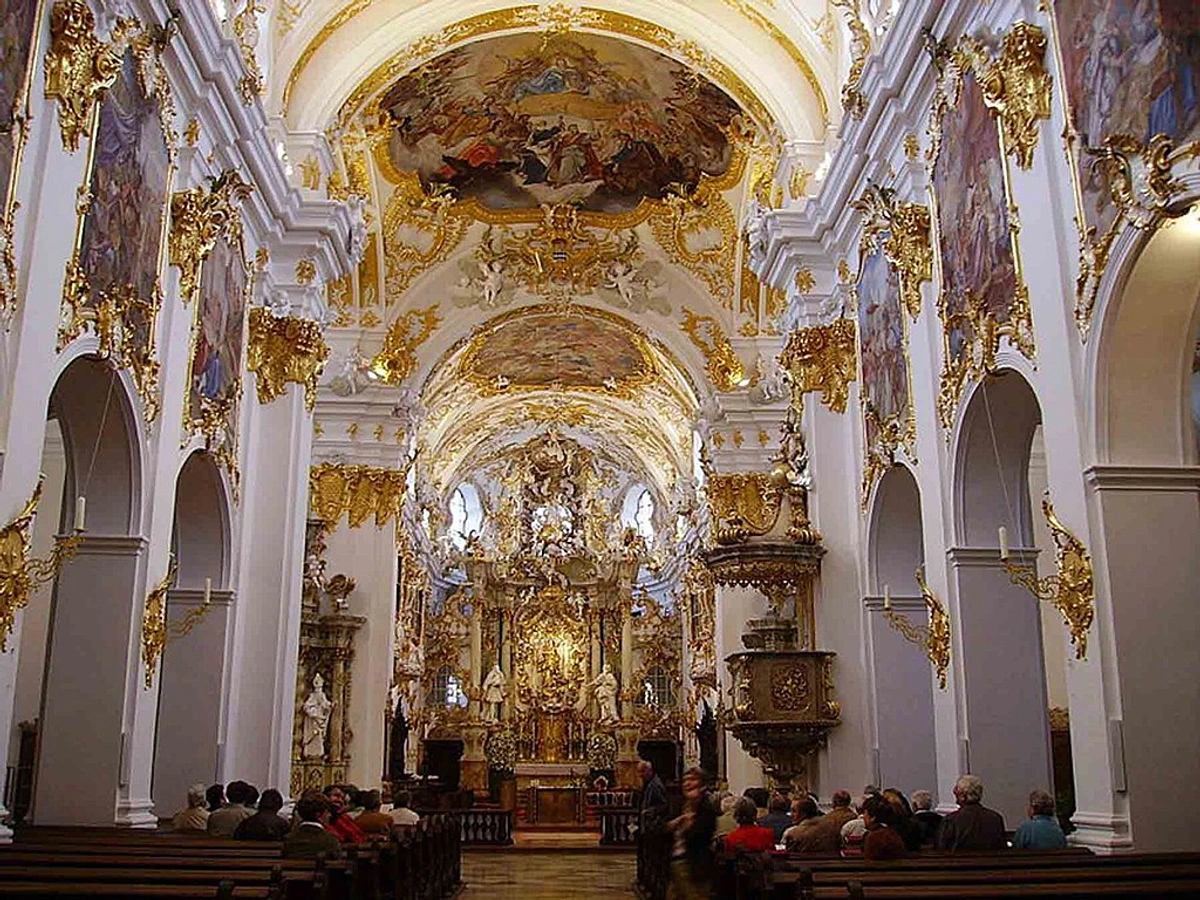
It's a place that stays with you long after you've left, a reminder that art can transcend time, culture, and even language, speaking directly to the human spirit. For me, it's a profound example of how art, whether a colossal dome or a tiny tessera, connects us to something larger than ourselves. I often find myself reflecting on the dedication and vision of these past masters, and how their ambition to create something eternally meaningful resonates with my own artistic journey, visible across my artistic timeline. If this journey through St. Peter's has sparked your own creative thoughts, perhaps you'd like to explore how contemporary art also strives to capture profound human experiences, a continuous thread visible across my artistic timeline. Or if you're ever in the Netherlands, consider visiting a smaller, yet equally profound art institution like the Kröller-Müller Museum to appreciate how diverse spaces can foster artistic reflection and connection, much like the grand scale of St. Peter's but with a different focus. And of course, if you're drawn to art that echoes these themes of connection, meaning, and vibrant expression, you can always explore my own abstract art, a contemporary continuation of this timeless dialogue.