A Sunday on La Grande Jatte: Seurat's Quiet Revolution in Art & Society
Dive deep into Seurat's 'La Grande Jatte.' Explore its Divisionist technique, scientific foundation, biting social critique of modern Parisian leisure, and lasting influence on Cubism, Fauvism, and abstract art. The ultimate guide.

A Sunday on La Grande Jatte: Georges Seurat's Masterpiece of Science, Society, and Silent Critique
There are paintings that shout their genius at you, demanding immediate awe. And then there are works like A Sunday on La Grande Jatte, which, at first glance, might just whisper. I have to confess, my initial encounter with a print of it left me utterly underwhelmed. "Okay," I remember thinking, "it's a park, some people, and a whole lot of tiny dots. Pretty static, maybe a bit sterile, definitely quiet." I was craving the raw, almost violent emotion of a Van Gogh, or the vibrant, fleeting spontaneity of an Impressionism work. This painting felt monumental, meticulously crafted, yes, but also strangely silent, almost unnerving in its stillness. Where was the life? Where was the movement? My first impression was of a cold, perhaps even boring, academic exercise.
It took me years – and a deep, almost obsessive dive – to grasp that this very stiffness, this calculated silence, is precisely the point. Georges Seurat wasn't just capturing a pleasant Parisian afternoon; he was performing a meticulous social autopsy with a paintbrush, dissecting the very fabric of modern leisure and revealing its hidden anxieties about class, connection, and the superficiality of newly-found public spaces. It's a dual masterpiece: a scientific exploration of color and light, and a biting social commentary on his rapidly changing world. You see, this isn't the fleeting, impressionistic snapshot of life you might see from his contemporaries. Think of Renoir’s bustling opera boxes or Monet’s sun-drenched gardens – full of movement, blurred edges, and immediate emotion. Seurat’s vision is something else entirely: calculated, scientific, and profoundly unsettling. And once you start to peel back its layers, once you understand the quiet revolution happening on this canvas, I promise you, you can never look at La Grande Jatte the same way again – you’ll see the scientific precision, the social critique, and the enduring power of Seurat's vision, all wrapped up in those seemingly simple dots.
Georges Seurat: The Scientist of Sight
To truly unpack La Grande Jatte, we have to understand the mind behind it. Georges Seurat (1859-1891) was an enigma. He wasn't one for the flamboyant bohemian lifestyle we often associate with artists of that era. Instead, he was reserved, methodical, and intensely private, a true artistic introvert. His personal inclination towards solitude and meticulous study seems to have directly informed his art, leading him to observe society from a detached, almost clinical perspective. He pursued a rigorous formal art education, studying at the École des Beaux-Arts and later at the Académie Julian, where he honed his drawing skills and absorbed traditional academic methods. His early works, such as academic studies of nudes and portraits, demonstrated a solid grounding in classical draftsmanship and an admiration for the monumental grandeur and ordered composition seen in earlier masters like Piero della Francesca and Raphael. This deep grounding in classical training, I think, ironically propelled him towards a radical departure. He saw the structure, the order, the timelessness of the Old Masters and sought to apply that same intellectual rigor to modern subjects, but with a completely new scientific language. I often imagine him less as a romantic painter, swayed by fleeting emotions, and more as a dedicated scientist in his studio, approaching art with the precision of a physicist, seeking universal laws rather than fleeting impressions. His ambition was immense: to create an art that was timeless, ordered, and structured, a deliberate intellectual counterpoint to the fleeting, subjective observations of Impressionism. He wasn't interested in capturing a moment; he wanted to construct an eternal monument to it.
The Books That Shaped a Vision
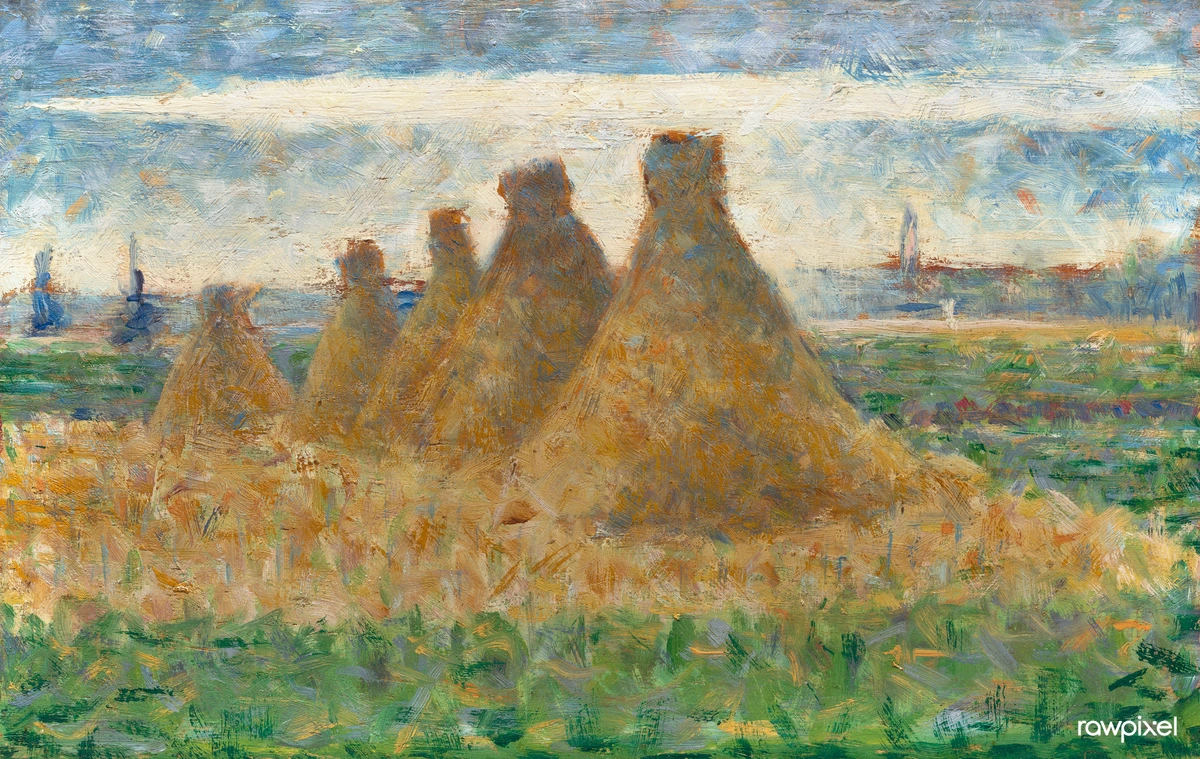
While someone like Monet was out chasing the ephemeral shifts of light on a haystack, Seurat was poring over dense color theory texts by figures like Michel Eugène Chevreul, Charles Blanc, and especially Ogden Rood. Chevreul's work on simultaneous contrast – the way colors appear to change depending on adjacent colors (think of how a grey square looks different against a red background versus a green one) – was foundational, showing Seurat how the eye itself actively participates in perceiving color. It wasn't just an external phenomenon; the viewer's brain was part of the equation. Rood's influential book, Modern Chromatics with Applications to Art and Industry (1879), became a cornerstone for Seurat. It didn't just explain how colors interact optically and how the human eye perceives them; it offered a scientific framework for color application that deeply resonated with Seurat's desire for an art grounded in rational principles and universal harmony. For Seurat, this wasn't about making pretty pictures; it was about understanding the very physics of sight and using that knowledge to construct a more luminous, stable, and ultimately, a more real reality on canvas. He sought an objective, calculated approach to painting, believing it could elevate art beyond mere subjective observation.
Beyond these specific texts, Seurat's era was also profoundly impacted by the rise of photography. Photography, a burgeoning technology of his time, profoundly challenged painting's traditional role as a purely representational medium. It captured 'reality' with an undeniable, unblinking accuracy, pushing artists to explore new ways of seeing and depicting. For Seurat, this wasn't a threat but an opportunity. It solidified his resolve to create an art that was not merely a copy of nature, which photography could now do instantly, but a scientifically constructed interpretation of it. He embraced photography's objectivity in observation but rejected its fleeting immediacy. Instead, he sought a way to imbue his observations with a structured permanence, emphasizing optical principles and a monumental clarity that photography, in its nascent form, couldn't replicate. He wasn't aiming for a snapshot, but for an eternal, constructed truth. He even studied the flattened perspectives and strong outlines often found in popular Japanese ukiyo-e prints, incorporating elements of their compositional clarity and decorative qualities into his own monumental works.
This singular focus, combined with his tragically short life, led him to pioneer a revolutionary technique he termed Divisionism, though we more commonly know it as Pointillism.
Before La Grande Jatte, he experimented extensively with these ideas in Bathers at Asnières (1884). This grand canvas, depicting working-class men by the Seine, already showed his move towards structured, monumental figures and a more controlled application of color. While its brushstrokes were broader and less uniformly dotted than those of La Grande Jatte, it was a crucial step, applying scientific color theory and formal composition to a modern subject. The figures in Bathers possess a similar monumental stillness, even a certain introspective languor, which would be replaced by the almost stark rigidity and the conscious performance of leisure in La Grande Jatte. You see the same large, sculptural forms, but in Bathers, the optical mixing feels more organic, less overtly segmented. It was, in many ways, the essential preparatory laboratory for the optical theories that would culminate in the later work's unsettling perfection. He continued to refine his optical theories in other significant works such as The Circus and The Parade, each pushing the boundaries of color and form, but none would achieve the iconic status and profound depth of La Grande Jatte.
Divisionism Unveiled: The Physics of Color and Light
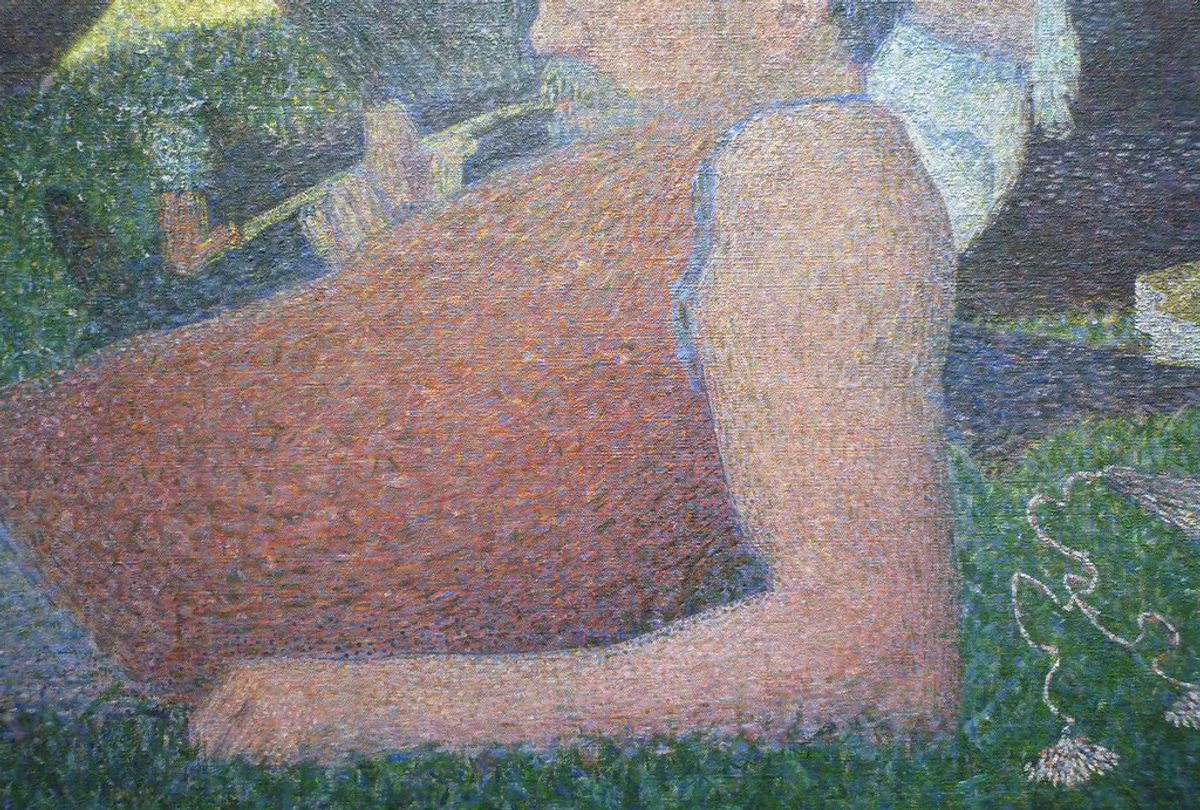
So, what exactly is Divisionism? And why did Seurat prefer to call it that? Think of it like this: your smartphone screen, or an old television, creates millions of colors from tiny red, green, and blue pixels. Or consider how distant streetlights of various colors at night don't appear as distinct individual lights, but rather blend into a richer, more luminous haze. Stand back, and your eye blends them seamlessly. Seurat did precisely that, but with pure, unmixed paint applied directly to the canvas, almost a century before the first color TV. He believed this optical mixing would create purer, more intense colors that would retain their luminosity better than pigments mixed on a palette, which he felt could appear dull or "dead." The philosophical underpinning here was profound: he sought to harness the very mechanics of human vision to create a more vibrant, truthful representation of light, turning the viewer's eye into an active participant in the creation of color.
Instead of mixing, say, a particular shade of vibrant green on his palette (and losing some of its luminosity in the process), he would meticulously place tiny, distinct dots of pure blue and pure yellow paint side-by-side on the canvas. When you step back from the painting, your eye performs the magic – the colors "optically mix" in your brain, creating a green that, to my eye anyway, feels far more vibrant and luminous than any green you could mix from pigments on a palette. Similarly, a shimmering orange might be achieved by placing tiny red and yellow dots next to each other, allowing the viewer's eye to do the blending. And crucially, he understood complementary colors – colors opposite each other on the color wheel, like red and green, or blue and orange. When placed next to each other, they don't blend into a dull grey but intensify each other, making both appear more vibrant. This phenomenon, often aided by simultaneous contrast (where adjacent colors affect each other's perception, making colors appear more intense when placed next to their complementary colors), was crucial to his method. It's a testament to the power of human perception and Seurat's profound understanding of color dynamics.
Seurat favored the term Divisionism because it emphasized the division of color into its constituent parts on the canvas, which the viewer's eye would then mix optically. It underscored the scientific, theoretical intent behind his method. Pointillism, on the other hand, merely describes the dot-like application of paint, without conveying the underlying optical theory. For Seurat, the technique was a means to a scientific end: achieving maximum luminosity and a sense of stable, harmonious color through optical mixing, rather than a mere stylistic choice of dots. To him, the dots were just the visible manifestation of a deeper, more rational theory of color perception.
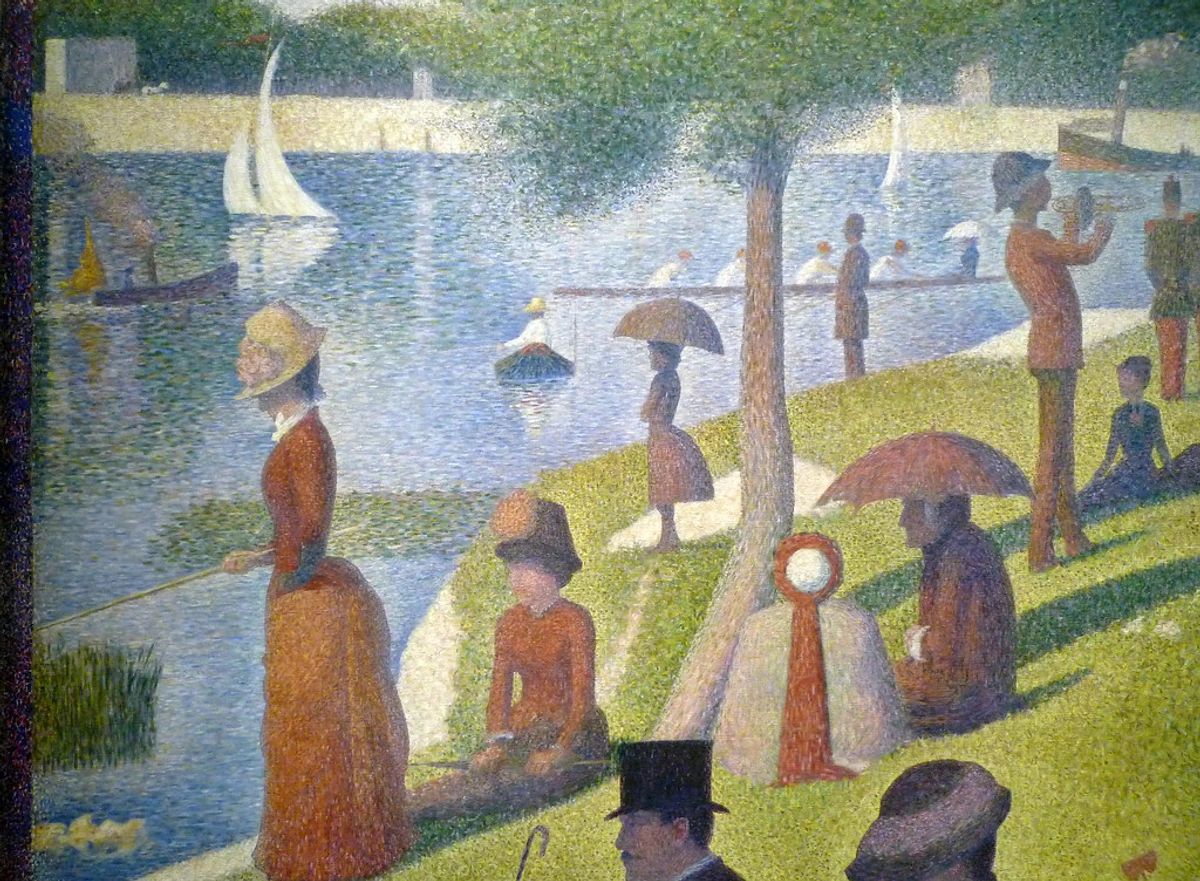
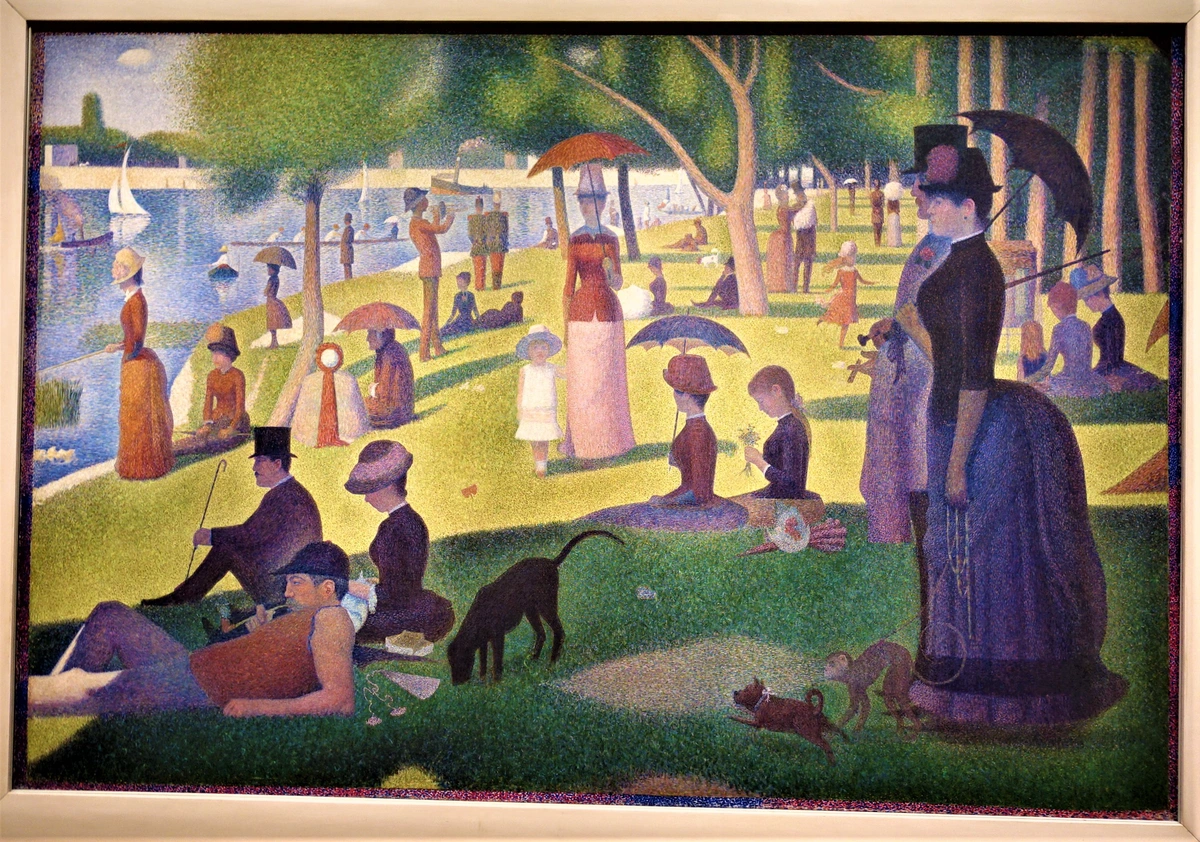
This might sound like a fascinating experiment, and it was. But it was also incredibly, painstakingly laborious. La Grande Jatte is truly enormous – roughly 7 by 10 feet (2 by 3 meters), a monumental scale that immerses the viewer – and comprised of literally millions of these tiny dots. It took Seurat a staggering two years, from 1884 to 1886, including dozens of preliminary drawings (many on paper, some heightened with conté crayon) and numerous oil studies on small wooden panels or linen canvas, to complete it. My own attempts at meticulousness usually involve finding matching socks, or maybe aligning my spice jars alphabetically (a rare triumph, I assure you!), so I can only imagine the sheer, unwavering dedication this required. This wasn't a sudden burst of inspiration; it was an act of supreme artistic and scientific willpower, a slow-burn revolution on canvas.
Notably, Seurat meticulously avoided using pure black pigment in his palette, choosing instead to create shadows and dark tones by juxtaposing complementary colors. He saw pure black pigment as dulling or "dead," a color that absorbs all light and thus, for a painter obsessed with luminosity, literally extinguished the light in a painting. Pigment black, when mixed, can indeed flatten a color, making it appear less vibrant. Seurat believed that by creating shadows and dark tones through the optical blending of complementary colors (like deep blue and burnt orange, or purple and yellow), the resulting 'black' would actually shimmer with an internal light, retaining the life and vibrancy of the scene. This commitment to pure color was radical, and critics sometimes found the resulting colors to be overly academic or even cold, precisely because of this methodical application. This careful construction of light and shadow, using only pure hues, is central to the painting's luminous, almost otherworldly atmosphere. Modern conservation analyses have repeatedly confirmed the stability of Seurat's pigments and the effectiveness of his optical mixing techniques over time, a testament to his scientific precision.
A Social Panorama: Decoding La Grande Jatte's Figures and Landscape
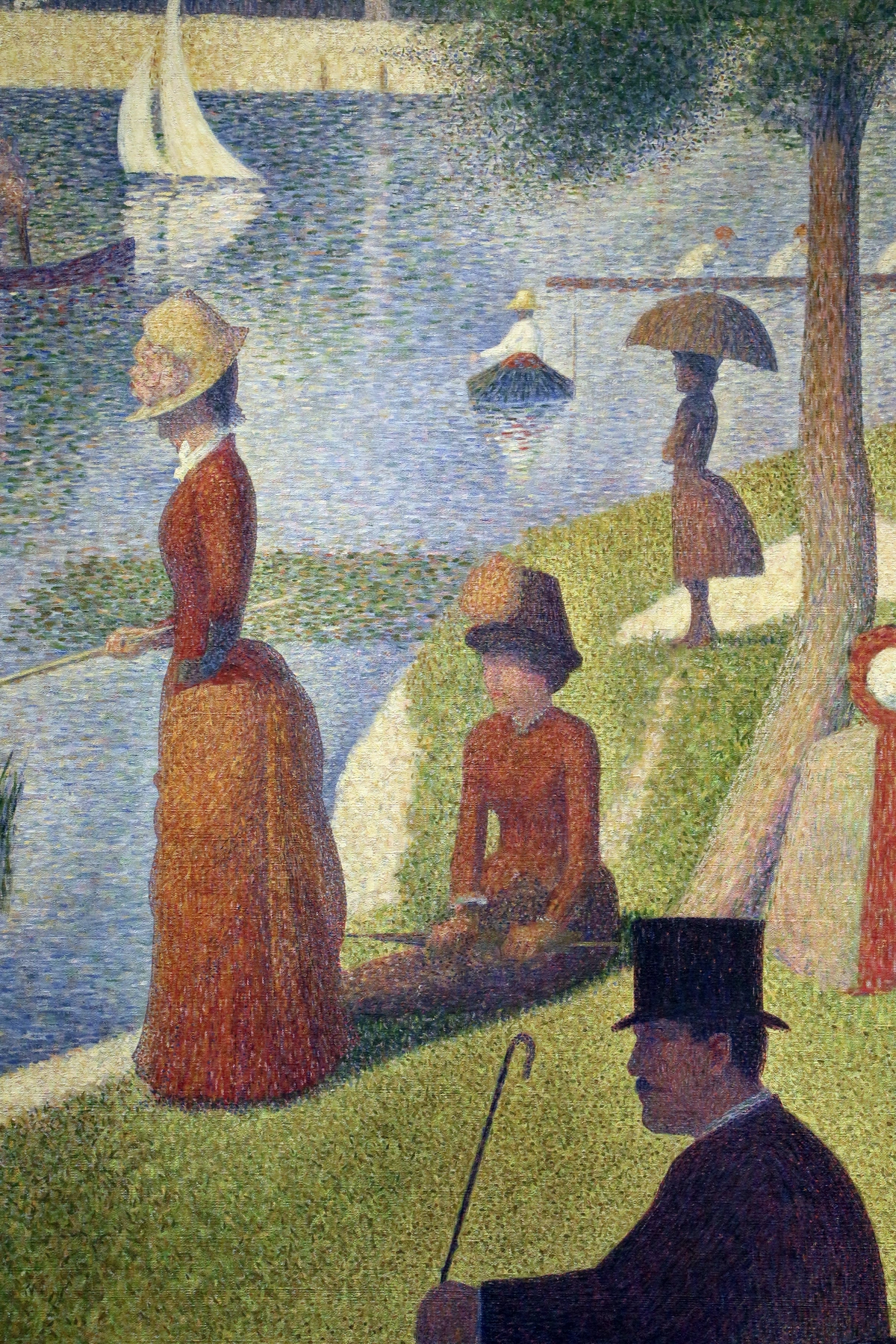
The island of La Grande Jatte, a real sandbar in the Seine just outside Paris, was a popular weekend escape for people from all walks of life – from the working class to the aspiring bourgeoisie. This wasn't just a picturesque spot; it was a newly emerging public space, a direct consequence of Baron Haussmann's ambitious renovations of Paris that reshaped the city with wide boulevards and parks. These new urban spaces, while seemingly democratic and offering unprecedented leisure opportunities for the burgeoning middle and working classes, also became melting pots that fostered both opportunities for social interaction and profound anxieties about class mixing, the erosion of traditional social hierarchies, and the very performance of leisure. It was a place for escape, for promenading, yet also a stage where societal anxieties played out, where people were meant to be seen enjoying themselves, perhaps more for show than for genuine relaxation – a silent theater of modern life.
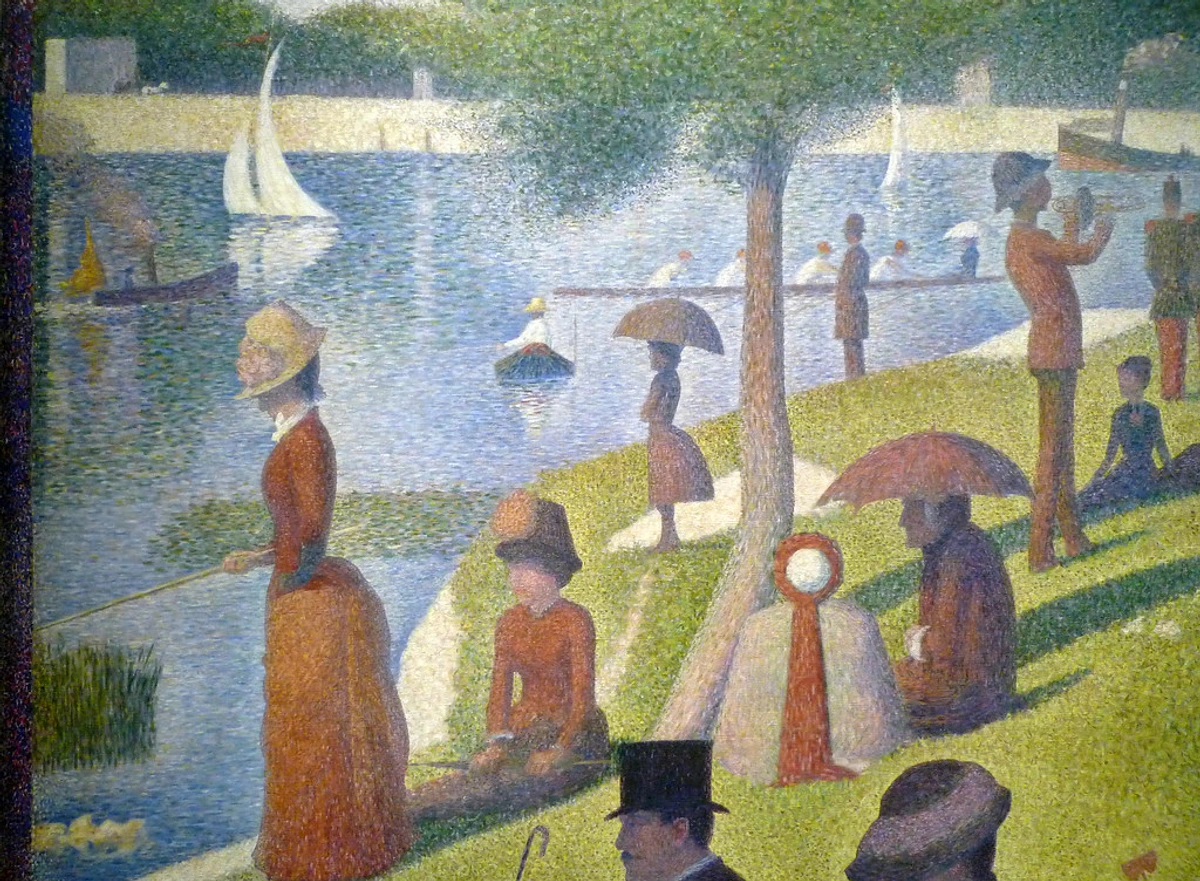
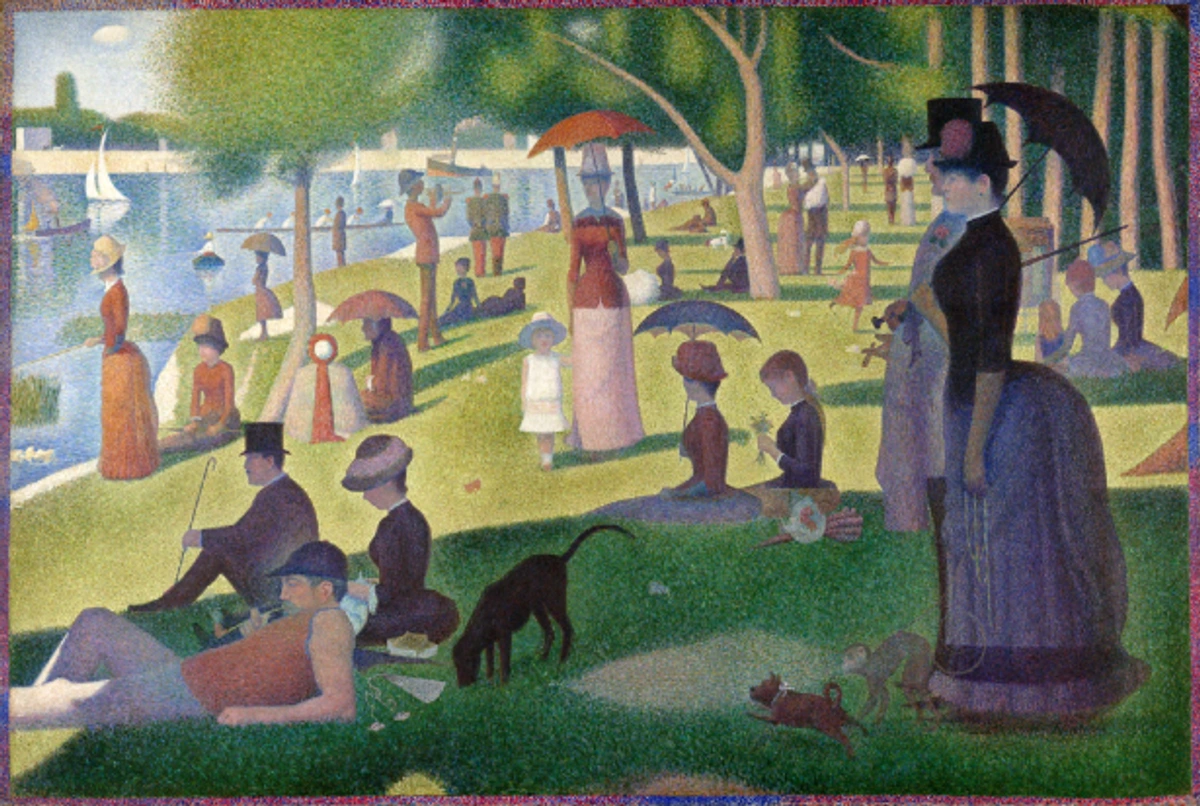
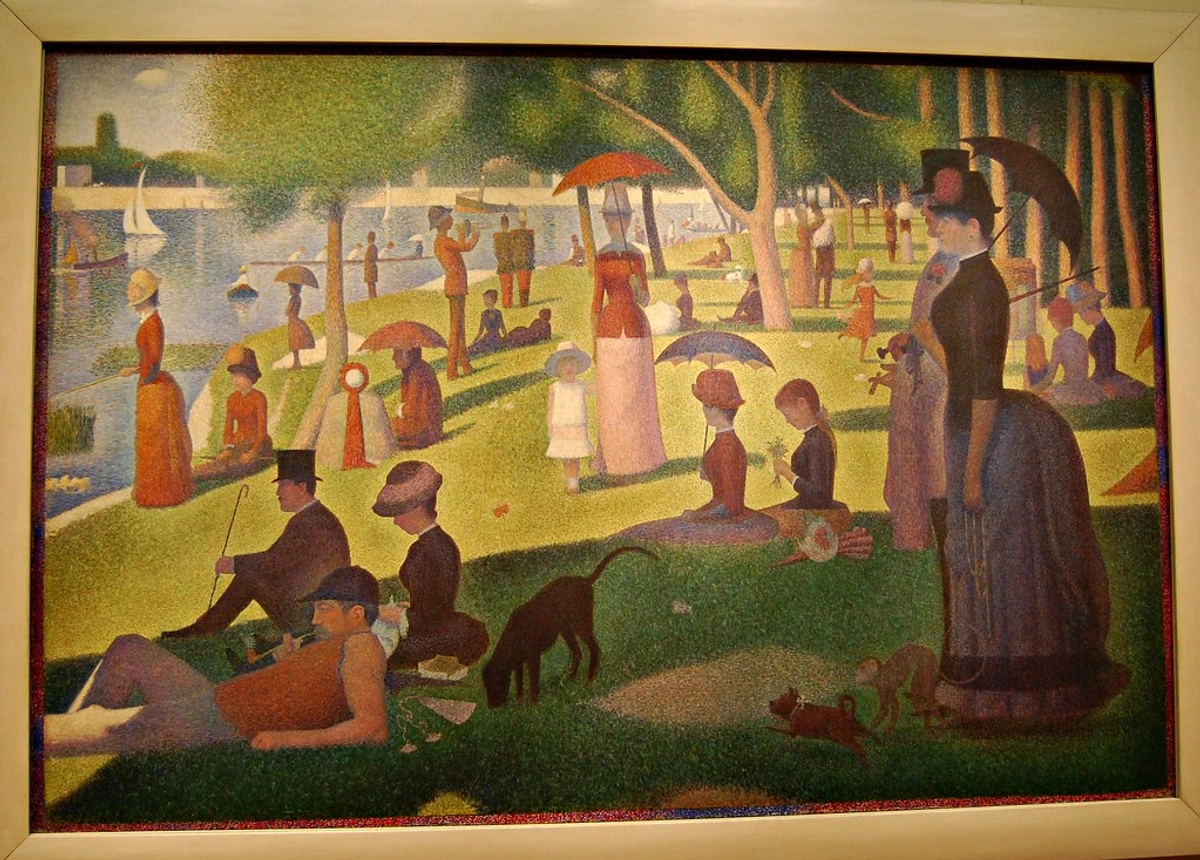
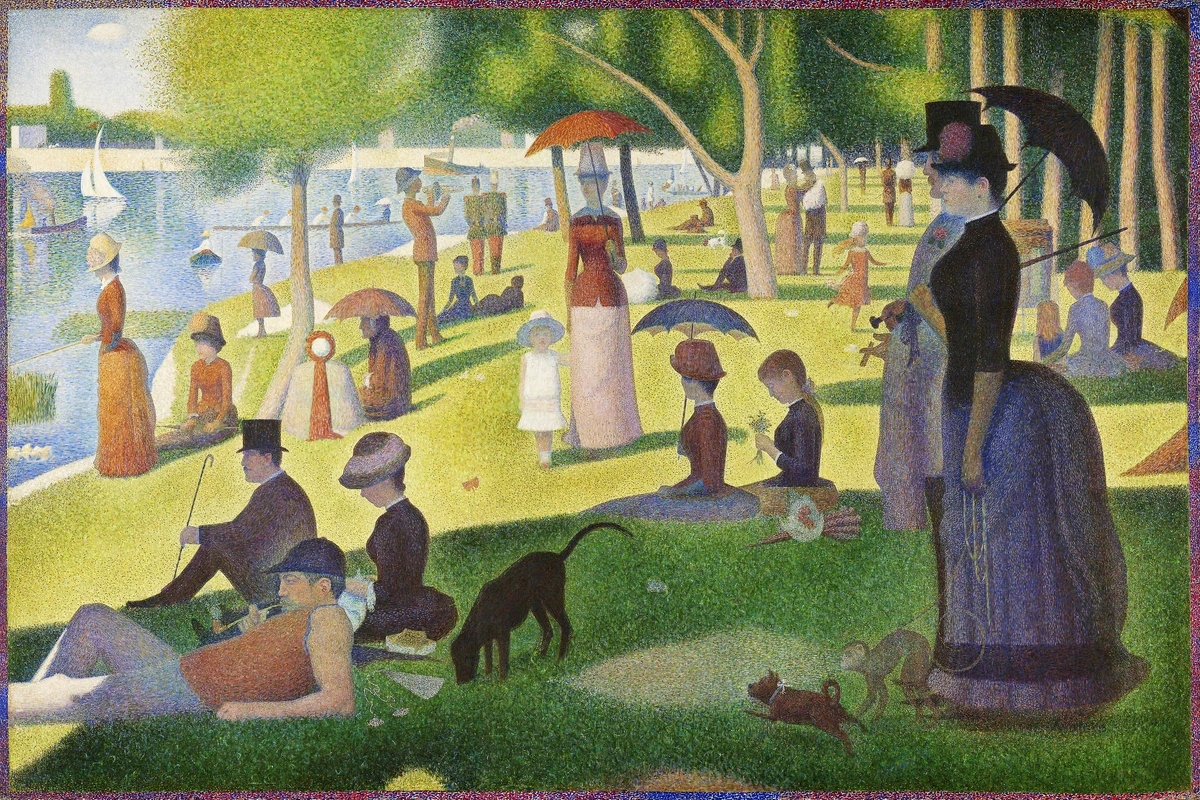
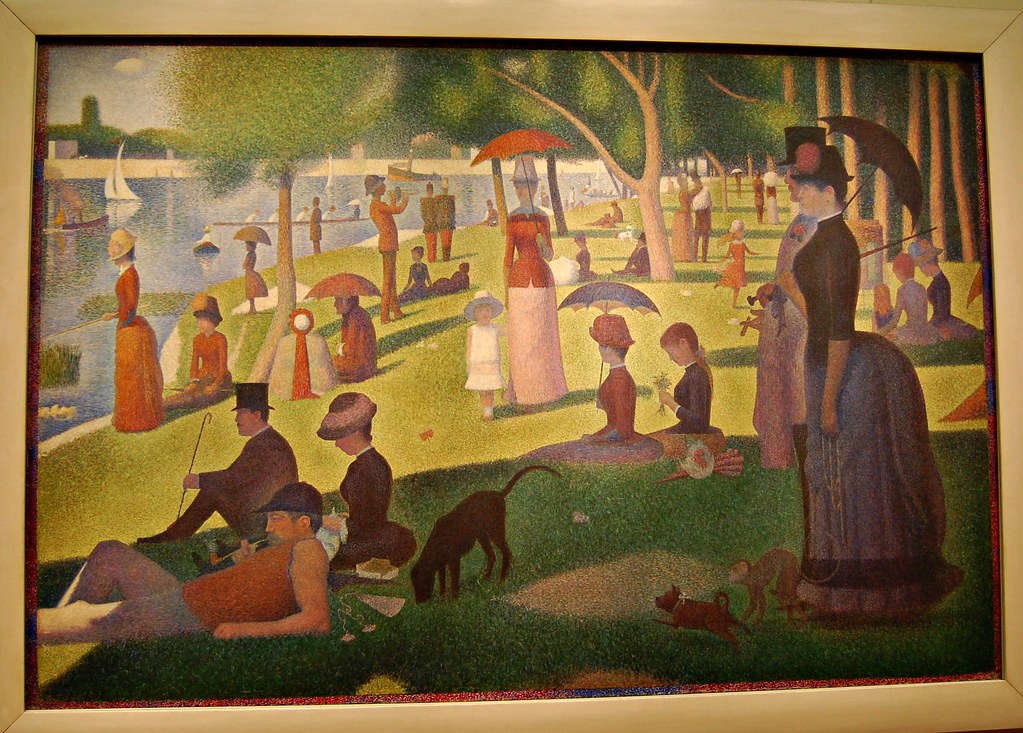
Seurat’s depiction is no joyous, bustling scene. Instead, he presents us with a meticulously arranged cast of characters, a social "zoo" where individuals share the same space yet remain profoundly isolated. Their postures are stiff, almost mannequin-like, as if frozen in a theatrical tableau. It feels less like a spontaneous gathering and more like a carefully observed, almost clinical study of human specimens, each playing a role in the grand theater of modern life. Doesn't that striking use of light and shadow create an almost uncanny theatricality? It makes you wonder: why this particular cast of characters, and what are they truly doing here, beyond simply existing in the same space?
Nature as an Accomplice
While the human figures capture much of our attention, the natural elements of La Grande Jatte are equally integral to Seurat's vision. The trees, the placid river Seine, and the dappled sunlight are not merely passive backdrop; they are active participants in the painting's mood and commentary. The meticulously dotted foliage creates an almost artificial, stage-like canopy, filtering light into precise, calculated pools of brightness and shadow. The stillness of the water mirrors the rigidity of the figures, refusing to offer the fleeting reflections or vibrant movement typical of Impressionism. This structured, almost geometric rendering of nature reinforces the painting's overall sense of order and artifice, suggesting that even the natural world is subjected to Seurat's scientific gaze and the rigid social codes of the era. The very atmosphere feels constructed, contributing to the unsettling harmony of the scene. Seurat, ever the meticulous observer, even alludes to the less idyllic aspects of modern Parisian life; some art historians suggest the industrial smokestacks visible in the distance across the Seine hint at the encroaching pollution and the underlying realities of industrial progress that juxtapose with this idealized leisure scene.

The Cast of Characters: A Tableau of Modernity
But who are these individuals, frozen in their quiet tableau? And what are they truly doing here, beyond simply existing in the same space? Let's dive into some of the key players and their potential roles in Seurat's incisive social commentary, revealing the underlying anxieties of a rapidly changing Parisian society:
Figure(s)  | Description | Potential Symbolism & Social Commentary |
|---|---|---|
| The Main Couple | The prominent, stiffly posed woman with an elaborate bustle and a man in a top hat, positioned on the right. She holds a monkey on a leash. | Represents the Parisian haute bourgeoisie, showcasing wealth and formality. Their rigid posture hints at the artifice of social etiquette and a lack of genuine connection. The monkey, a fashionable exotic pet of the era, can symbolize idle indulgence, vanity, or a subtle hint at concealed promiscuity – a "leashed desire" that mirrors the constrained emotions of the human figures. In 19th-century slang, 'guenon' (female monkey) was also slang for a prostitute, adding a layer of veiled moral commentary. |
| The Woman Fishing | A solitary woman on the far left, whose fishing line extends unnaturally straight into the water. | In 19th-century Parisian slang, "fishing" was often a euphemism for prostitution. She is "fishing" for clients among the weekend crowd, subtly highlighting the commercialization of leisure and the varied, often hidden, economies of the park, even in seemingly idyllic settings. Her presence underscores the social strata and hidden realities of public spaces, challenging the veneer of polite society. |
| The Two Soldiers | Standing stiffly at attention in the background, almost like sentinels. | Represents order, the state, and a different social class observing the leisure activities of others. Their presence underscores the structured, almost militaristic precision of the composition and the underlying social hierarchies, reminding us that even leisure operates within a rigid social order, under the watchful eye of authority. |
| The Nurse and Old Woman | A nurse or governess attending to an elderly, wealthy woman under a parasol, near the center-left. | Highlights themes of age, care, and dependence within the upper class, and the presence of hired labor even in leisure. The parasol itself, a symbol of luxury and protection from the sun, further delineates social strata, subtly commenting on the unseen labor that supports such displays of aristocratic leisure. |
| The Little Girl in White | The only figure in the center who appears to be in motion, running towards the viewer, her arms slightly raised. | Often interpreted as a potent symbol of innocence and perhaps hope, a stark contrast to the stiff, artificial adult world surrounding her. She is the single character who seems unburdened by the social conventions that freeze the others in their poses, suggesting a fleeting moment of genuine spontaneity amidst the constructed reality of adult social performance. |
| The Musician | A man playing a horn in the middle ground, near the center. | While music is often a unifier, here it seems to fail in connecting the isolated individuals. He plays, but the figures remain locked in their own worlds, reinforcing the theme of social fragmentation and the superficiality of shared leisure spaces. Does his music attempt to bridge the gaps, or does it merely underscore the pervasive silence and disconnection? |
| The Couple Embracing | Barely visible in the far background, a small embracing couple. | A tiny, almost hidden detail that suggests intimacy is either marginal, relegated to the distant background, or perhaps only exists for certain classes or away from the scrutinizing public eye. It further emphasizes the overall alienation of the foreground figures by contrasting it with a rare, almost clandestine moment of connection, hinting at the true cost of societal performance. |
| The Couple with Baby | A working-class couple with a baby, seated on the grass near the left foreground, representing a different social stratum enjoying the park. | This family unit offers a subtle counterpoint to the more formal bourgeoisie figures. Their relaxed posture, though still somewhat stiff, indicates a less constrained form of leisure. They represent the emergent middle and working classes, highlighting the diverse social tapestry of Parisian public spaces and the varying ways leisure was consumed, yet still part of the overall detached scene. |
| The Woman with Bonnet | A woman in the foreground on the left, elegantly dressed in a bonnet, seemingly part of the bourgeoisie. Her posture contributes to the formal detachment. | Another representative of the upper-middle class, her posture, like others, contributes to the overall sense of formal detachment. She's present but not truly engaged, a quiet observer in a scene of quiet observers, further illustrating the social performance inherent in these public gatherings and the pervasive anonymity of modern urban life. |
| The Boatmen | In the background, small figures can be seen in boats on the Seine, distinct from the promenading crowd. | These figures represent a different, perhaps more traditional, form of leisure or labor, further highlighting the diversity of activities and social classes converging on the island. Their presence adds to the panorama of Parisian life, underscoring the contrast between active engagement with the river and the more passive, observed leisure on the bank, a subtle nod to different forms of escape. |
Look closely, as I did for hours, and you'll notice something striking: almost no one is interacting. Figures are often seen in strict profile or front-on, reminiscent of ancient Egyptian friezes, emphasizing their two-dimensional, almost anonymous quality and static, timeless presentation. This wasn't an artistic oversight. Seurat was deliberately crafting a sense of timeless, almost eerie, stillness. He's showing us the alienation inherent in modern urban life – people physically close, yet emotionally and socially miles apart. It's a profound critique of the superficiality of newly-found leisure, where genuine connection is replaced by performance and detached observation. It's a world where individuals are on display, but rarely truly seen. La Grande Jatte thus becomes a social panorama, exposing the class divisions and superficial interactions even within spaces intended for communal enjoyment, highlighting the facade of communal leisure and the deeper societal fragmentations of the era.
The Unseen Structure: Seurat's Masterful Composition
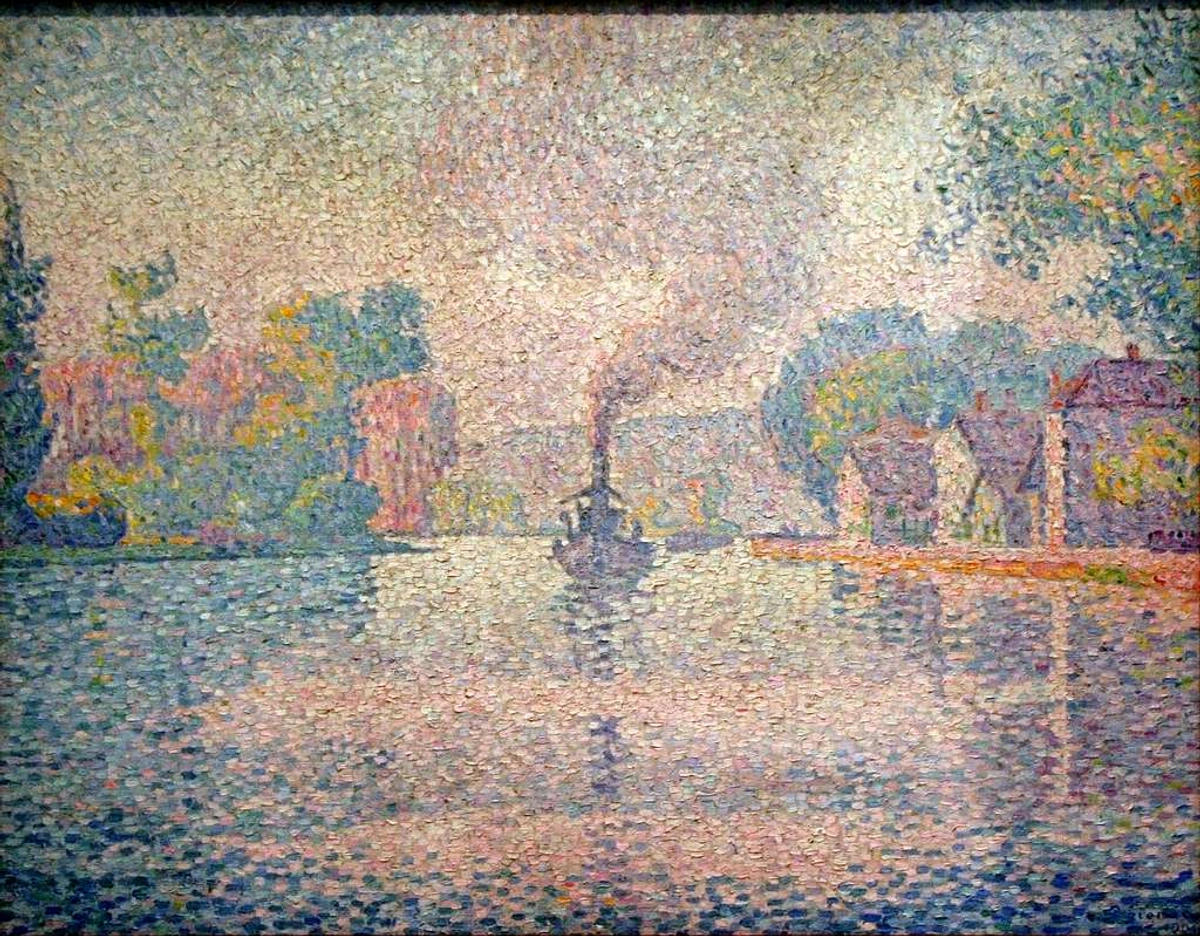
Beneath the shimmering surface of dots and the unsettling social narrative, La Grande Jatte is built on an architect's blueprint. Seurat was not just a painter but a master constructor, approaching composition like a mathematician. He built the entire scene on a rigorous scaffolding of horizontal and vertical lines, creating an overwhelming sense of stability and classical order that almost belies the disquieting narrative unfolding within. It's this fascinating tension between the ephemeral subject (a Sunday afternoon) and the eternal structure that makes the painting so compelling. This compositional rigor, I believe, amplifies his social commentary, locking his figures into their alienated roles with an almost inescapable geometric precision.
I find myself tracing these unseen lines and recognizing the underlying geometry whenever I look at it. It's a visual puzzle, and once you start seeing the grid, you can't unsee it. Let's explore the foundational elements that contribute to this monumental structure:

Building Blocks of Order
- Geometric Grid: The entire canvas is structured around a subtle but pervasive grid. For instance, the prominent horizontal lines of the riverbank and the distant shoreline anchor the vast composition, while the upright figures, the vertical masts of the boats, and the tree trunks act as precise vertical dividers, almost like architectural columns. Notice how the large, dark triangle created by the shadows in the foreground, particularly from the seated couple and the woman with the parasol, forms a powerful repoussoir that grounds the scene and directs our gaze inward. Even the placement of the figures adheres to these invisible lines, contributing to their static, almost frozen quality. You can almost feel the mathematical precision guiding every placement, as if each dot were plotted on a hidden graph.
- Repoussoir Figures: Seurat masterfully employs a classic artistic device called a repoussoir. These are the large, shaded figures in the foreground (like the woman on the far left with the parasol, or the central shadow of the seated couple). These figures don't just frame the scene; they act as visual "pushers," literally guiding our gaze deeper into the painting, creating a powerful sense of depth and inviting us into the world, even as the figures themselves maintain their rigid distance. Imagine them as architectural columns, ushering your eye into the carefully constructed world Seurat has built. It's a clever trick to engage the viewer while simultaneously emphasizing the emotional detachment within the scene.
- Light and Shadow: Seurat meticulously uses light and shadow not just to define form, but to sculpt the entire scene. The stark contrast between the sun-drenched areas and the deep, cool shadows contributes to the painting's almost artificial, theatrical quality, further emphasizing the staged nature of the leisure depicted. As mentioned, he achieved these vibrant shadows not with black, but with optically mixed complementary colors. It's as if the light itself is meticulously placed, rather than naturally falling, creating an almost uncanny luminescence, a radiant glow that feels carefully engineered.
- Golden Ratio & Classical Balance: Many art historians have identified adherence to the Golden Ratio and other classical principles of balance and harmony within the composition. The Golden Ratio, approximately 1.618, describes a proportion that is often found in nature and art, believed to be aesthetically pleasing – a kind of visual sweet spot. Seurat's precise arrangement of figures and elements, for instance, aligns the horizon line and significant vertical axes (like the standing woman's parasol or the mast) with these harmonious proportions, contributing to the painting's profound sense of stillness and permanence. (While Seurat himself never explicitly documented his use of the Golden Ratio, many art historians have identified its presence, suggesting an intuitive or deliberate application of these ancient principles within his precise arrangements.) It’s a complete rejection of Impressionism's free-flowing approach, a statement that art could be both modern and timelessly ordered.
- The Integral Frame: Seurat's commitment to color harmony extended beyond the canvas. He designed the painting's frame himself, applying a border of dots in complementary colors that optically blended with the edges of the artwork. This innovative approach wasn't mere decoration; it was an integral part of the piece, intended to intensify the optical mixing within the canvas and extend the color harmony to its very edges, ensuring the viewer's entire field of vision contributed to his precise optical effect.
This rigid geometry and calculated balance are a world away from the soft, blurry edges and seemingly spontaneous arrangements of Impressionism. Seurat was attempting to impose a kind of classical, permanent order on a fleeting modern scene, to elevate it from mere observation to a grand, intellectual statement. It's a fascinating and enduring testament to his vision.
Enduring Legacy: Neo-Impressionism and Beyond
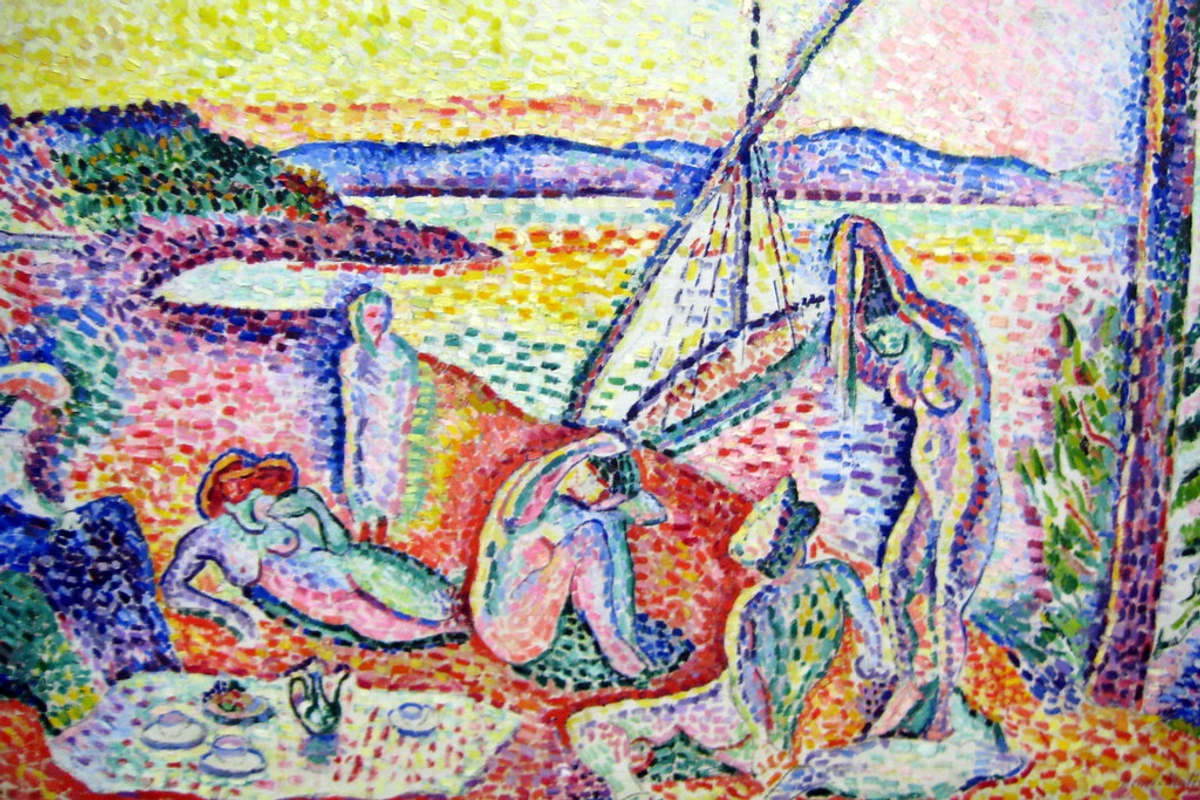
When Seurat unveiled La Grande Jatte at the eighth and final Impressionist exhibition in 1886, it was nothing short of an artistic bombshell. The monumental size alone would have been a shock, but its radically new technique and subject matter were even more jarring. The initial critical reception was largely one of bewilderment, and sometimes outright hostility. Critics scoffed at its "cold," "mechanical," and "scientific" approach, with some dismissing the meticulous dots as mere "confetti" or a "carpet of dots," seeing them as a betrayal of artistic spontaneity and traditional brushwork. Even some of the Impressionists themselves, who valued immediacy above all, disliked its rigid intellectualism, finding it antithetical to their principles. However, for a generation of younger artists, it was electrifying. It wasn't just a painting; it was a manifesto. It formally announced the arrival of a new movement: Neo-Impressionism, demonstrating that modern art could be founded on rigorous theory and order, not just subjective sensation. Paul Signac, a close contemporary and staunch advocate, quickly joined Seurat in developing and promoting these new ideas, further cementing the movement's theoretical underpinnings.
To fully appreciate the revolution Seurat ignited, it's helpful to understand what he was reacting against and building upon:
Feature | Neo-Impressionism (Divisionism/Pointillism) | |
|---|---|---|
| Goal | Capture fleeting moments, subjective perceptions of light and atmosphere. | Achieve maximum luminosity and harmony through scientific color theory; construct permanence. |
| Brushwork / Application | Loose, visible, spontaneous brushstrokes; "snapshot" feel. | Meticulous, discrete dots or dashes of pure, unmixed color; controlled, systematic. |
| Color Mixing | Primarily mixed on the palette; some optical mixing, but less systematic. | Primarily optical mixing in the viewer's eye; colors divided into constituent parts on canvas. |
| Subject Matter | Everyday life, landscapes, urban scenes, often spontaneous. | Similar subjects (leisure, landscapes), but with an emphasis on underlying structure and critique. |
| Philosophical Basis | Subjective observation, emotion, capturing "impression" of a scene. | Scientific theories of light and color, objectivity, rational construction. |
| Overall Effect | Vibrant, immediate, sense of movement, often diffuse and atmospheric. | Luminous, structured, static, often with a sense of quiet intensity or monumentality. |
Its influence, as I see it, rippled outward through the art world in profound and unexpected ways, shaping the trajectory of 20th-century art:
Movement | Connection to La Grande Jatte / Neo-Impressionism |
|---|---|
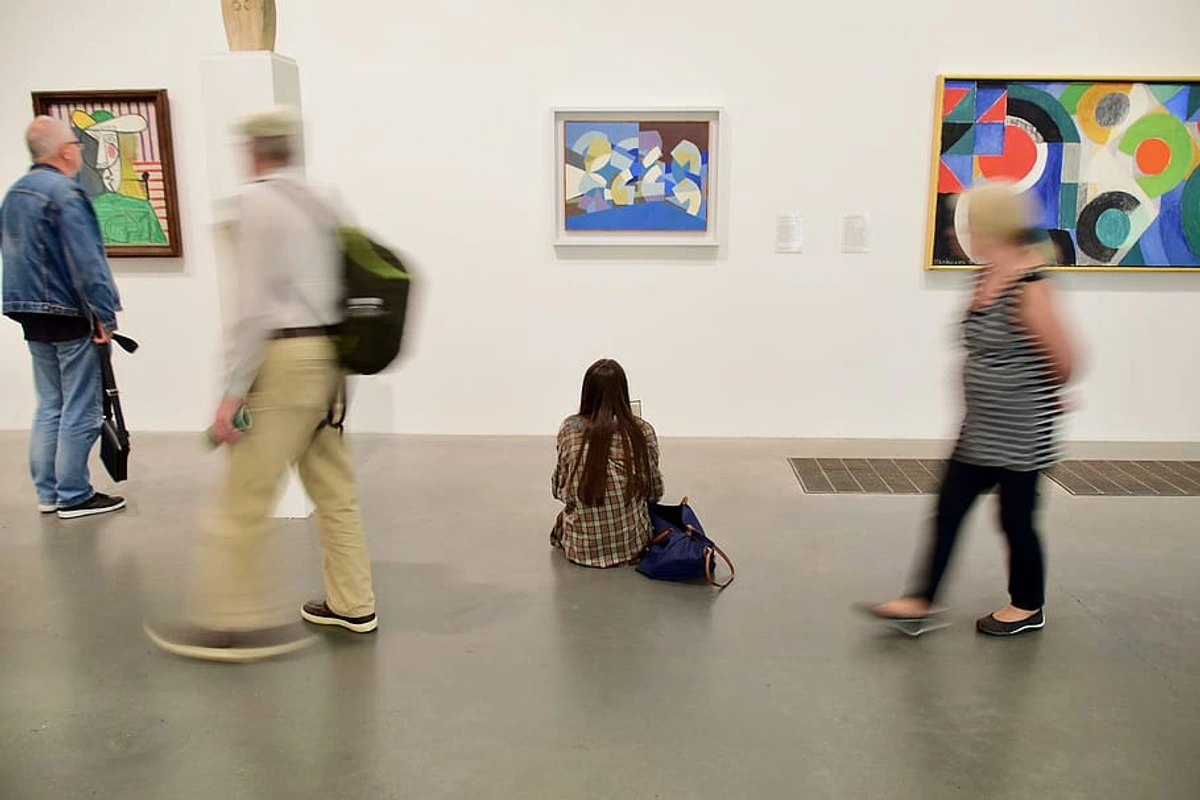
| Cubism | Seurat's emphasis on geometric structure, the reduction of figures to fundamental shapes (like the columnar forms of the women), and his analytical approach to composition laid a foundational groundwork. His insistence on underlying order and intellectual construction over pure sensory experience was a direct precursor to Cubist experimentation. For example, Picasso and Braque's early analytical Cubist works, characterized by fragmented forms and multiple viewpoints, directly built upon Seurat's deconstruction of visual reality into structured elements, paving the way for abstract geometric explorations. |
| Fauvism | While known for its wild, non-naturalistic color, Fauvism's systematic exploration of color's emotional and decorative power, rather than solely its representational accuracy, can be seen as a descendant of Seurat's scientific approach to color. Artists like Matisse and Derain pushed his color theories into a new, expressive, and subjective realm. Seurat had already liberated color from its descriptive role by dividing it into its components for optical mixing; the Fauves took this liberation and injected it with intense, subjective emotion, using color autonomously and expressively to convey feeling, leading to radical, often clashing color choices. |
| Later Abstraction | Seurat's methodical reduction of forms to their fundamental geometric shapes and his abstract treatment of color (even while representational) foreshadowed the move towards pure abstraction in the 20th century. His systematic approach to breaking down visual reality influenced movements from Russian Constructivism, with its focus on geometric abstraction, to Abstract Expressionism, inspiring artists interested in process-oriented art and the bridging of science and aesthetics. His attempt to find universal, objective principles in art paved the way for non-representational forms and a deeper engagement with the formal properties of art itself. |
| Popular Culture | Beyond high art, La Grande Jatte's iconic status is cemented in popular culture. Who can forget its famous, poignant cameo in Ferris Bueller's Day Off? Cameron, deep in existential angst, stares into the painting, its meticulous, almost suffocating order and the profound isolation of its figures perhaps mirroring his own internal paralysis and sense of being trapped. It's a moment that perfectly captures the painting's enduring psychological resonance. From that unforgettable scene to countless parodies, animated homages (hello, The Simpsons!), and artistic reinterpretations, it remains an instantly recognizable image, proving its timeless appeal and ability to provoke thought and emotion across generations. |




Critical reception of La Grande Jatte has also evolved dramatically. Initially met with bewilderment and even hostility, its radical aesthetic and profound social commentary gradually earned it a place as a canonical masterpiece. Art historians and critics now recognize it not merely as a technical marvel, but as a pivotal work that redefined the possibilities of modern art, bridging the gap between scientific inquiry and artistic expression. Today, it stands as a pilgrimage site for art lovers at the Art Institute of Chicago, a testament to its enduring power. The journey of the painting itself, from private collections to its permanent home in Chicago in 1924, is a story of growing recognition and appreciation for its revolutionary genius.
This painting taught me that art doesn't always have to shout to be profound. Sometimes, the most powerful statements are made through quiet, meticulous dedication and deeply thoughtful observation. Seurat crafted a world that is both arrestingly beautiful and profoundly unsettling, a perfect, enduring mirror of the beautiful and unsettling experience of modern life itself. For anyone seeking to understand the depths of artistic innovation and social commentary, La Grande Jatte remains an ultimate source. If you've ever felt like an outsider looking in, or if you appreciate the quiet power of observation, I suspect you'll find something deeply resonant here. Perhaps it's time to take another look, and let Seurat's dots reveal their hidden depths to you.
Key Takeaways
- Revolutionary Technique: Seurat pioneered Divisionism (or Pointillism), using tiny, unmixed dots of color for optical blending in the viewer's eye, creating unmatched luminosity and vibrancy.
- Scientific Foundation: His method was deeply rooted in color theory from scientists like Chevreul and Rood, transforming painting into a rational, objective science.
- Profound Social Critique: The painting offers a biting commentary on modern Parisian society, exposing the superficiality of leisure, class divisions, the pervasive isolation of individuals in new public spaces, and the underlying anxieties of rapid urbanization and industrialization.
- Masterful Composition: Built on a rigorous geometric grid, utilizing elements like repoussoir figures and the Golden Ratio, the artwork imposes classical order on a fleeting modern scene, making it timeless.
- A Silent Revolution: Seurat's meticulous dedication created a masterpiece that challenges perceptions, proving that the most powerful statements can be found in quiet, calculated observation.
Frequently Asked Questions (FAQ)
Where is 'A Sunday on La Grande Jatte' located today? This monumental painting is the crown jewel of the Art Institute of Chicago, where it has been a centerpiece since 1924. If you ever have the chance, seeing it in person is a truly different and awe-inspiring experience. Its enormous scale and meticulous detail simply don't translate fully to reproductions; the optical mixing truly comes alive, making it a pilgrimage site for art lovers and a testament to Seurat's mastery.
How long did it take to paint 'La Grande Jatte' and what materials were used? Georges Seurat dedicated approximately two full years to this masterpiece, from 1884 to 1886. This involved creating over 50 preparatory drawings (many on paper, some heightened with conté crayon) and numerous oil sketches on small wooden panels or linen canvas before embarking on the final, enormous canvas. The final work is an oil painting on linen canvas, executed using his signature Divisionist technique of pure, unmixed color dots. He carefully chose a specific palette of pure pigments, meticulously avoiding black, to achieve maximum luminosity through optical mixing. The binders in his oil paints were likely traditional linseed oil, allowing for the slow, precise application necessary for his technique. Each material choice was deliberate, contributing to the scientific rigor of his artistic process.
What exactly is Pointillism / Divisionism? Divisionism, often referred to as Pointillism, is a groundbreaking painting technique pioneered by Georges Seurat. It involves using tiny, distinct dots or strokes of pure, unmixed color placed side-by-side on the canvas. Instead of blending colors on the palette, the artist relies on the viewer's eye to optically blend the colors from a distance, creating a more luminous and vibrant effect than traditional mixing methods. Seurat believed that this optical mixing created purer, more intense colors that would fade less over time than pre-mixed pigments. He preferred "Divisionism" as it emphasized the scientific division of color into its constituent parts, which the eye would then mix, rather than merely describing the dot-like application (Pointillism). It's a scientific approach to color, light, and human perception, aiming for maximum luminosity and harmonious optical effects, essentially turning the viewer's eye into part of the artistic process. While Seurat was its pioneer, other notable artists like Paul Signac and Henri-Edmond Cross also adopted and further developed Divisionist principles, extending its influence beyond Seurat's tragically short career.
Why is there a monkey in the painting? Ah, the monkey! It's a fascinating detail, and its symbolism is much debated, adding a rich layer to the social critique. One interpretation is that keeping exotic pets like monkeys was a status symbol for the wealthy bourgeoisie of the era, indicating leisure, luxury, and social standing. Their playful, unbridled nature also subtly contrasts with the rigid formality and emotional constraint of the human figures, enhancing the sense of disconnect. Another perspective suggests a more symbolic or even risqué role: in art history, monkeys often symbolize folly, vanity, or untamed instinct, a "leashed desire" contrasting with human composure. Furthermore, in 19th-century Parisian slang, 'guenon' (the French word for a female monkey) was also slang for a prostitute, potentially linking to the themes of hidden economies and morality present in the park scene. It certainly adds another complex layer to Seurat's commentary on Parisian society and its veiled truths.
Is 'La Grande Jatte' an Impressionist painting? No, it is not an Impressionism painting. While it depicts a contemporary leisure scene, much like Impressionist works, its technique and underlying philosophy were a direct and deliberate reaction against Impressionism's spontaneity and subjective capture of fleeting moments. La Grande Jatte is considered a leading example of Post-Impressionism and the foundational work of Neo-Impressionism, emphasizing structure, scientific theory, meticulous application, and a pursuit of permanence and universal harmony over ephemeral sensation. It deliberately rejected the loose brushwork and ephemeral focus of its predecessors.
How does 'La Grande Jatte' critique modern society? Seurat's painting offers a powerful critique of modern urban society by presenting individuals who are physically together but socially and emotionally isolated. The stiff, mannequin-like poses, the pervasive lack of interaction between figures, and the symbolic elements (like the fishing woman, the leashed monkey, and the rigid postures) all combine to suggest a profound superficiality to modern leisure. It speaks to a profound alienation and sense of anomie inherent in new urban public spaces, where genuine connection is replaced by performance, and rigid class distinctions persist even in seemingly democratic settings. It's a powerful visual commentary on the human condition in a rapidly changing, industrializing world, subtly revealing the anxieties beneath the veneer of modern Parisian life, effectively making it a social panorama that exposes the class divisions and superficial interactions, even within spaces intended for communal enjoyment. It highlights the facade of communal leisure and the deeper societal fragmentations of the era, prompting us to question the authenticity of modern social gatherings. What do you see when you look at it?