Mark Bradford: Urban Archaeologist, Unearthing Social DNA Through Layered Abstraction & Décollage
Dive into Mark Bradford's revolutionary art. Explore his masterful layering, brutal décollage, and use of found urban materials to expose hidden social narratives. Learn how his process can transform your abstract art practice and worldview as an urban archaeologist.

Mark Bradford: Urban Archaeologist, Unearthing Social DNA Through Layered Abstraction & Décollage
When I stand before a Mark Bradford painting, I feel less like an art viewer and more like a detective at a crime scene… or perhaps, more accurately, an urban archaeologist. It's not a painting you simply look at; it’s a surface you urgently want to decipher, a palimpsest of lives lived and forgotten. The canvas, built up with layers upon layers of salvaged paper, shellac, and paint, then brutally sanded and torn back, doesn't just display an image—it embodies a history. My initial awe isn't just for its sheer visual impact, but for the profound question it immediately provokes: 'How in the world did he create (and then so intentionally un-create) this?' I remember once, peering closely at a particularly scarred section, discovering a flash of faded yellow text from an old flyer buried beneath a translucent amber layer of shellac. It was a delightful, almost primal artistic confusion that washed over me, a feeling that resonates deeply with my own explorations of layered abstraction.
That particular discovery brought me back to an early moment in my own journey with mixed media. I had accidentally torn through a carefully constructed layer, revealing a surprising under-texture. The initial panic, I confess, quickly turned into a profound realization: sometimes, the most honest truth lies just beneath the surface, waiting to be unearthed. It was a direct, unplanned lesson in the power of imperfection, a moment that completely reshaped my understanding of artistic 'mistakes' and the beauty of deliberate deconstruction—much like Bradford's own masterful process. This visceral connection to excavation and revelation, sparked by my own artistic journey, is precisely what drew me to truly understand Mark Bradford's core philosophy.
So, my friend, when I engage with Bradford's work, I'm not just appreciating a painting; I'm witnessing a physical, almost brutal dance of addition and subtraction that perfectly echoes the constant flux of a city. He’s less of a painter in the traditional sense and more of a construction worker, a cartographer, and an archaeologist all rolled into one. He gives his paintings a history before they even leave the studio, a layered narrative embedded deep within the canvas itself. To me, Bradford isn't just an artist; he's a cartographer of the unseen, a historian of the everyday, and a sculptor of urban memory. He meticulously maps the hidden geographies of social hierarchies, economic disparities, and the emotional landscapes etched onto a city's skin. But how does one sculpt memory? By physically imprinting and shaping the tangible traces, the very residual echoes, of discarded urban detritus into a permanent form. So, let’s grab a hard hat and dig in.
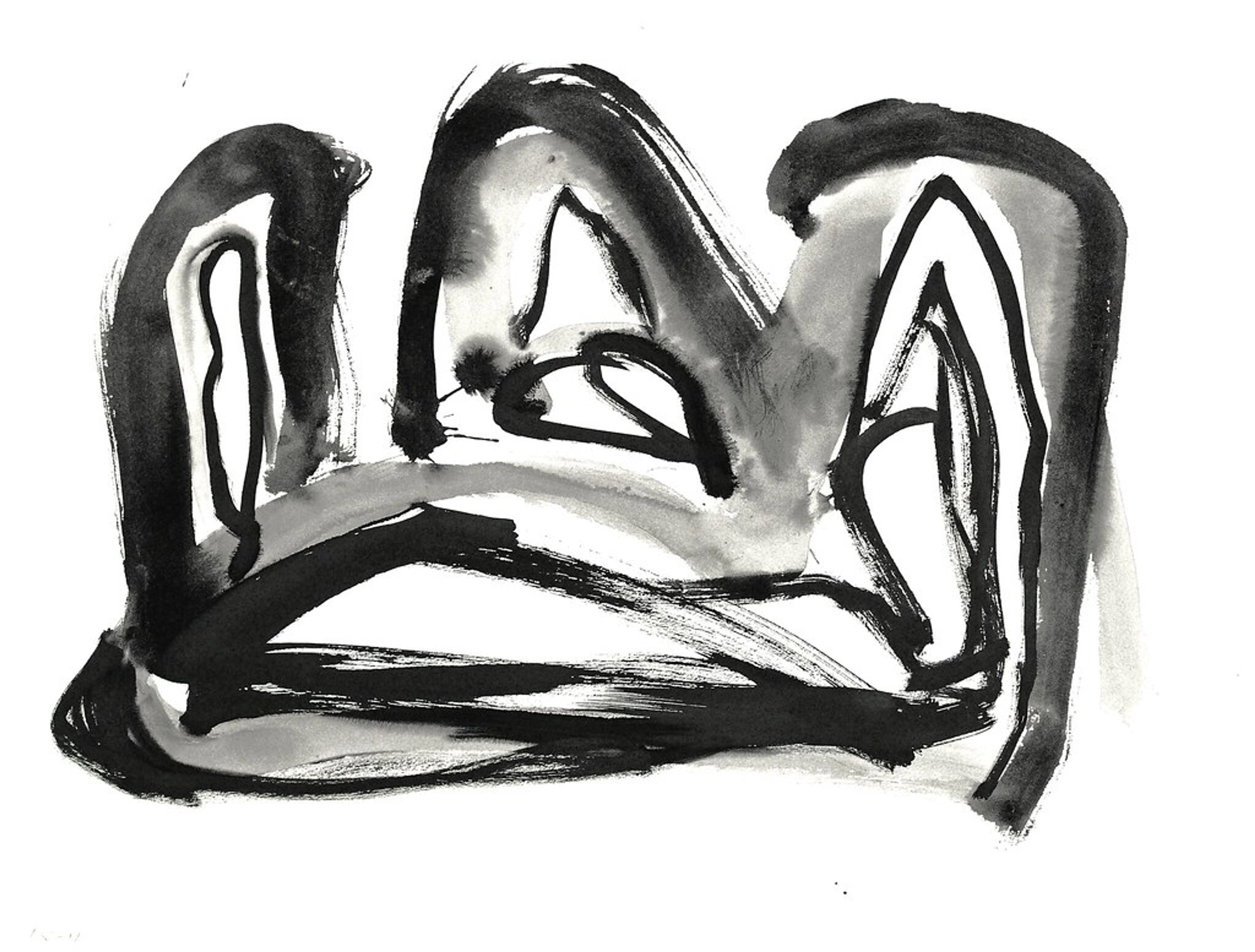
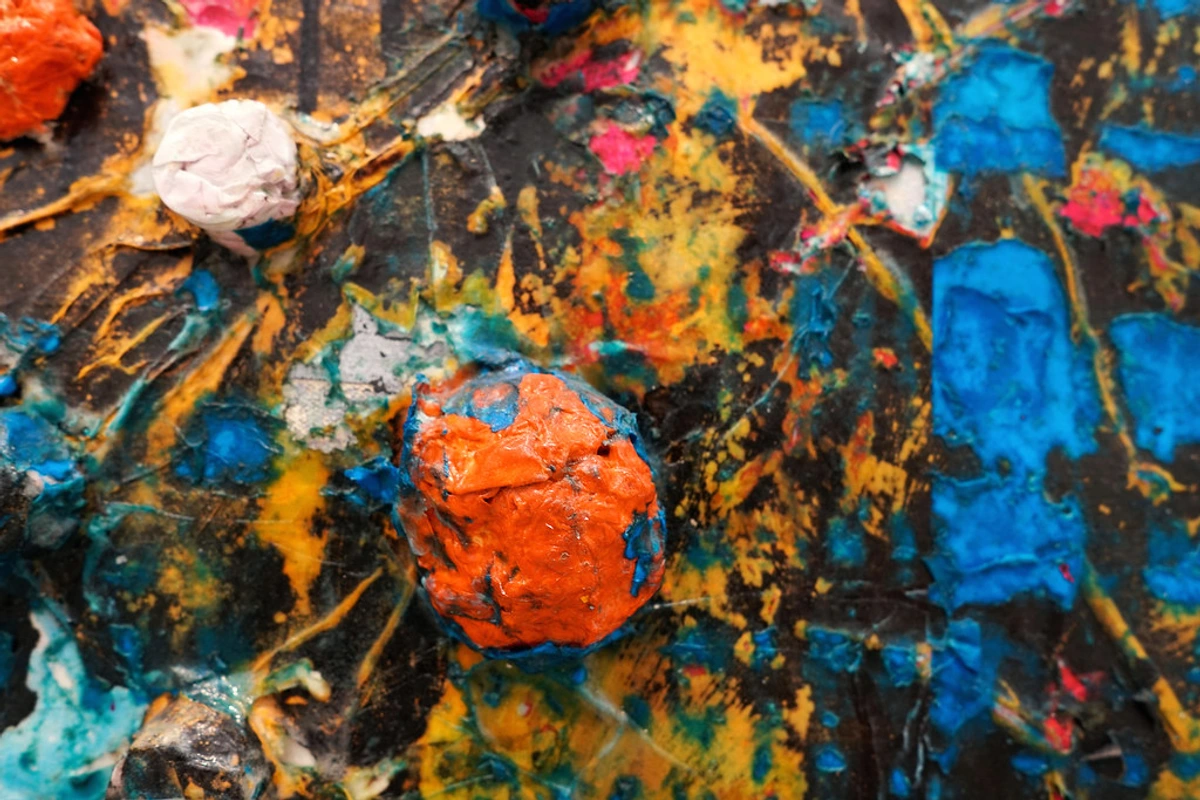
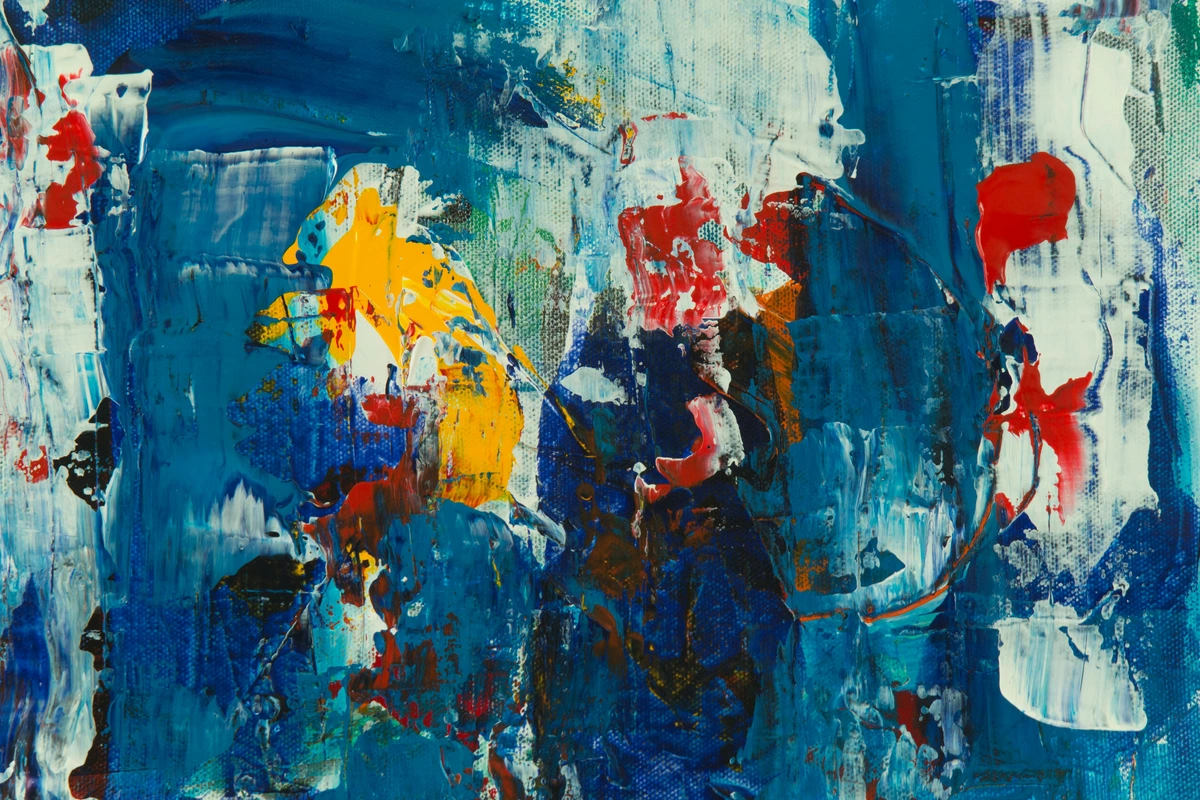
This image evokes the raw materiality and hands-on process at the heart of Bradford's work, a direct connection to the artist's tools and chosen pigments, echoing the physicality of his layered approach to art as urban archaeology.
The Philosophy: Decoding Urban DNA – Found Materials as Social Memory
Before we even get to the power tools (and yes, there are power tools, which is exactly why I suspect I'm so drawn to his work – it’s a controlled chaos I deeply resonate with, that exquisite tension between meticulous planning and brutal, decisive execution), you simply have to understand the why. Bradford isn't just using junk mail, comic books, or old advertising flyers for mere texture. He calls this stuff "merchant posters"—the ephemeral materials (meaning, materials designed to be temporary, like flyers and advertisements) that literally paper the unofficial, often unacknowledged, economy of his South Central Los Angeles neighborhood. These aren't random scraps; they are the direct, unvarnished voice of a community – the raw social DNA of a place, a visceral record of human activity and systemic realities.
Having grown up amidst these very streets and even working in his mother's beauty salon, Bradford's connection to these materials is profoundly personal. Imagine the buzzing salon, filled with the everyday chatter, dreams, and struggles of a vibrant community, surrounded by these hand-scrawled notices for missing pets, urgent eviction warnings reflecting a local housing crisis, flyers for local hair braiding services, garish fast-food ads, or political pamphlets for forgotten candidates highlighting systemic neglect. For Bradford, each piece of paper is imbued with hopes, struggles, and daily lives. The very act of using these materials—originally designed to persuade and sell—and recontextualizing them into high art is a powerful statement in itself. He’s making the unseen visible, bringing the margins to the very center of artistic discourse.
This isn't simply abstract art; it's a profound form of social commentary built from the very fabric of a city's untold stories, often exposing the "invisible labor" and unacknowledged narratives of marginalized communities. "Invisible labor" here refers to the countless, often unpaid or undervalued efforts that sustain communities, from informal economies to community organizing and care work, which are frequently overlooked by dominant narratives. Think of a faded flyer for an unlicensed auto mechanic working out of his garage, a handwritten sign offering affordable childcare in a low-income neighborhood, or urgent community alerts for a lost dog – these seemingly trivial documents collectively paint a rich picture of resilience and self-sufficiency often ignored by official records. Bradford makes this labor visible through the very materials that document its presence, celebrating the everyday heroism that goes unnoticed.
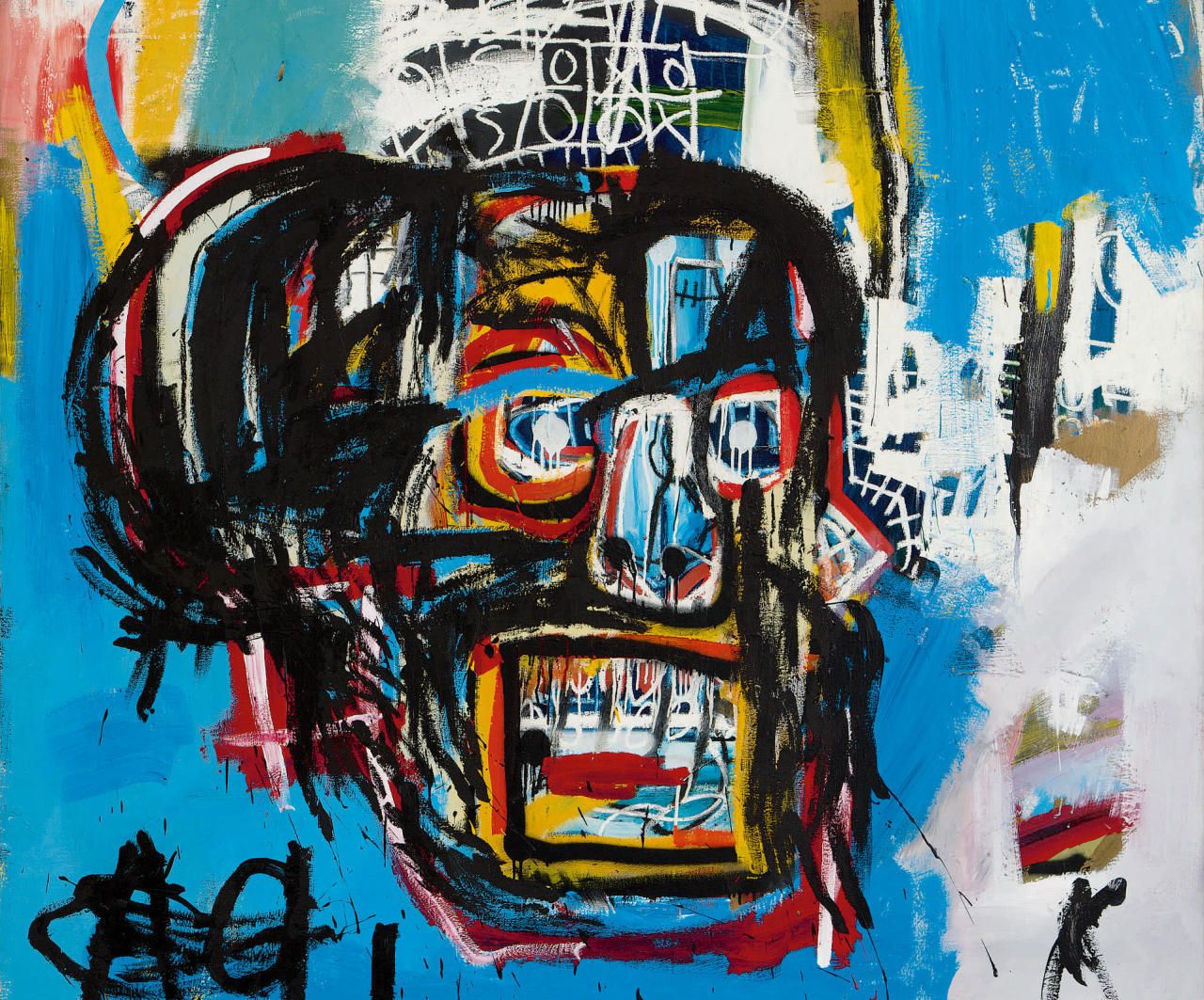
It's a similar spirit to how artists like Jean-Michel Basquiat or Keith Haring used the urban landscape to capture raw societal pulse, but with a crucial distinction. While Basquiat and Haring often used found surfaces as their canvas, marking them with direct figuration and text to critique society, Bradford creates a new canvas from the city's detritus, embedding its memory deeply within his abstracted narratives, rather than just marking its surface. This makes his work a deeper, more archeological excavation of social meaning, a purposeful unearthing rather than a spontaneous act of graffiti.
Christopher Wool's work, like Bradford's, often utilizes repetition and found elements to create a distinctive urban aesthetic, though Bradford's materiality is rooted in a more direct social critique and physical transformation of the found.
He's building his monumental paintings from the very materials that build up the complex, often unseen layers of a city itself. This approach transforms the canvas from a simple surface into a potent site of profound social commentary, making the invisible palpable. It’s a core idea I explore in my own work, this belief that materials carry meaning and memory, which you can read more about in my thoughts on my journey with mixed media. He once put it beautifully, "I was always interested in what was underneath, not just what was on top." This singular focus on revealing what lies beneath the surface is a defining characteristic of his vision.
Like street artists such as Banksy who engage directly with the urban environment through ephemeral markings, Bradford incorporates the city's very fabric into his art, but through a process of embedding and excavation that lends a deeper, more layered meaning.
The Core Techniques: Build, Excavate, Reveal – A Dialogue with Urban History
Bradford’s technique can truly be boiled down to a powerful three-part rhythm: layering materials up (the collage phase), gluing them into a solid, dense mass, and then digging back down into them (the décollage phase). It’s a cyclical dance of creation and excavation that imbues each piece with a palpable sense of history, struggle, and resilience, mirroring the constant flux and often hidden narratives of urban environments. How does he achieve this remarkable balance of meticulous construction and dramatic deconstruction? Let's peel back the layers and discover his secrets.
The methodical hands-on process of shaping and forming, as seen in pottery, parallels Bradford's intricate layering and construction of his canvases before their dramatic deconstruction, revealing a tactile history of touch and transformation.
1. The Stratigraphy: Layering the Urban Record (Collage)
This is the meticulous, almost geological, construction phase. Bradford starts with a stretched canvas and builds layer upon layer of paper. We’re talking dozens, sometimes hundreds, of layers. Imagine the geological formation of sedimentary rock, but with urban detritus as its strata – each layer a compressed moment in time, a fragment of city life. I'm absolutely mesmerized by the sheer audacity of building up what seems like an impenetrable wall of paper, knowing full well what’s coming next – the deliberate, controlled destruction that will define its final, raw form. This intricate layering process, reminiscent of sedimentary geology, is where the initial 'history' of the painting is physically laid down. The goal isn't just to create a surface, but to embed a complex, multi-layered urban narrative that can then be archaeologically revealed.
He uses a variety of papers, but his most iconic materials are endpapers (the monochrome, translucent papers traditionally found at the beginning and end of books) and billboard papers. He soaks them, manipulates them, and applies them to the canvas, often using shellac or acrylic medium as a binder. This binder is absolutely crucial; it transforms disparate sheets of paper into a dense, almost papier-mâché-like slab, setting the stage for the dramatic subtraction to come. Shellac, in particular, offers rapid drying and a uniquely brittle quality when cured—think of dried eggshells or old parchment, prone to cracking and splintering under pressure—making it ideal for the subsequent aggressive sanding and tearing. Its amber hue also subtly infuses the layers, adding a warm, aged patina that evokes the passage of time. He sources diverse billboard papers—from fresh, vibrant ads to sun-faded, weather-beaten remnants, each carrying its own visible and invisible history. The endpapers he favors often possess subtle hues, contributing an atmospheric depth that belies their simple appearance. He also embeds materials like string, rope, and caulking to create a kind of linear skeleton or subterranean infrastructure within the layers – elements that will later emerge as scars, pathways, or stark boundaries within the finished piece.
Material  | Role in the Process | Visual Effect / Significance | Conceptual Role / Metaphorical Significance |
|---|---|---|---|
| Billboard Paper | Provides large fields of color and commercial text/imagery, signifying public space and consumer culture. Can be new, glossy, or weathered, adding varied history. | Instantly recognizable urban texture; creates bold, fragmented statements, often hinting at consumerism and public messaging. A vibrant red billboard might be strategically buried under a muted gray, only to be partially revealed as a powerful 'scar' of commercial history. | Represents the dominant, often fleeting, narratives of a city – commerce, advertising, political promises, often masking deeper realities, the economic landscape of the everyday. |
| Endpapers | Used for their specific colors and translucency, building subtle, atmospheric layers and adding an archival, book-like quality. | Lends a softer, almost ghost-like depth; hints at hidden narratives within the artwork's internal 'text'. Their monochromatic nature allows for subtle shifts in tone. | Symbolizes the unseen, archival, or forgotten stories, the quiet backdrop to the louder urban pronouncements. Often associated with beginnings and endings, memory and oblivion, the personal narratives that underpin a community. |
| Newsprint/Junk Mail ('Merchant Posters') | Adds texture, socio-political text, and a direct, often ephemeral, link to the urban environment and its unspoken economy. | Provides tangible links to current events, local happenings, and community struggles, anchoring the abstraction in concrete reality. The text fragments become visual poetry, hinting at untold stories. | The raw, unmediated voice of a community – its struggles, aspirations, and daily rhythm. Directly embodies "social DNA," providing historical context and emotional resonance. |
| Shellac/Acrylic Medium | Acts as the crucial binder, transforming loose paper into a solid, dense, workable mass ready for excavation, and dictating how the surface will break. | Ensures structural integrity; allows for aggressive manipulation without disintegration, but also introduces a brittle quality essential for décollage. Imparts a subtle amber glow, hinting at age and preservation. | The force that unifies disparate elements into a singular, complex entity, capable of both holding together and breaking apart under pressure. A metaphorical glue of society, holding its disparate parts together, yet revealing its inherent fragilities. |
| Caulking/Rope | Embedded between layers to create raised lines that are later revealed as scars, pathways, or urban grids. | Creates physical relief; forms a topographical map of the artwork's internal 'city', resembling infrastructure, geological fault lines, or exposed utility conduits. These lines are not drawn, but exposed, like exposed electrical wiring within a building's walls, or a river cutting through a landscape. | Represents the underlying, often invisible, social and physical infrastructure of a city – its boundaries, divisions, and interconnectedness. The hidden systems, both literal and metaphorical, that shape daily life and power dynamics. |
This process of building history into a piece, anticipating the future archaeology, is something I'm truly obsessed with. It's all about the language of layers and how they create a sense of time and memory, much like the strata of a city itself. It also echoes the principles of assemblage, where disparate elements are brought together to form a new whole, much like I explore in my own process.
credit, licence
This collage artwork illustrates the principle of building up layers of disparate materials to create a unified, yet fragmented, image – a foundational step in Bradford's own process of creating a complex subsurface destined for excavation.
2. The Excavation: Unearthing the Narrative (Décollage and Sanding)
But what happens when the building stops and the un-building begins? Here’s where it gets really interesting, and frankly, quite intense. Once the layers are built up and dried into a solid, dense slab, Bradford physically attacks the surface. He uses power sanders—yes, the kind you get at a hardware store—to grind back down through the layers he just created. Think industrial-grade belt sanders for aggressive removal, or orbital sanders for a more nuanced, swirling effect. This isn't just sanding; it’s a controlled, violent act of un-creation, a visceral, brutal dance between intention and accident. My stomach actually clenches a little just thinking about the sheer force required, the tension between meticulous construction and the accidental beauty of disruption. I can almost smell the dust and hear the roar of the machinery, a true testament to the raw physicality he brings to his exploring texture. Yet, amidst this chaos, there is always a guiding hand; he’s not simply destroying, but sculpting the revelation.
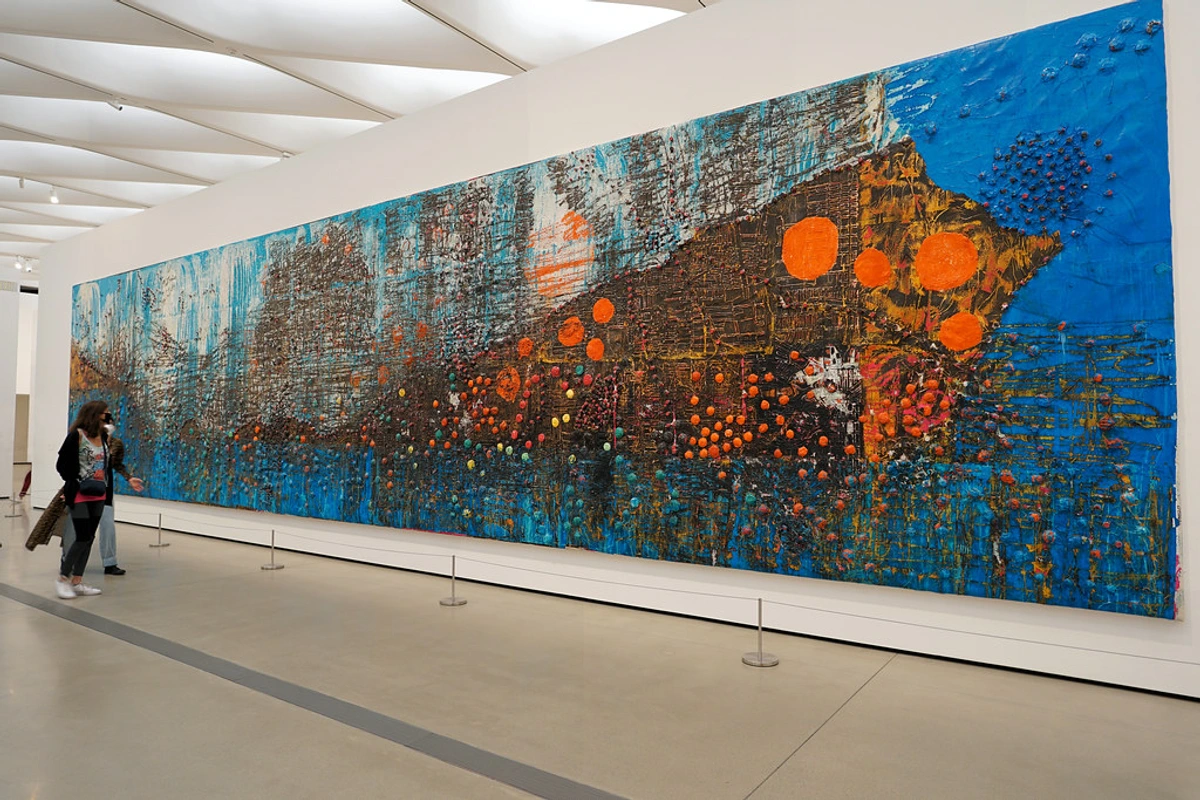
This isn't random destruction. He’s excavating with purpose. The pressure, speed, and angle of the sander create deep grooves, shallow canyons, and vast fields of abraded texture, much like how geological forces erode a mountain range over millennia. What emerges is a topography, a map of hidden histories, often hinting at forgotten events or marginalized communities. He’s not painting a picture from scratch; he’s finding one that already exists within the layers, revealing the past embedded in the present. Consider the monumental scale of works like "Mithra" (2008), a vast, sweeping canvas often exceeding 10 feet in width, which presents an almost aerial view of an abstracted urban sprawl with muted ochres, deep indigos, and flashes of unexpected crimson, its surface a network of delicate, abraded paths and torn edges. Within its tumultuous surface, décollage reveals fragments of discarded flyers and blurred text, giving voice to the quiet struggles of post-recession communities. Or "Helter Skelter I" (2007), a triptych even larger, its tumultuous, scarred surface, marked by violent ruptures and chaotic energy, directly evokes the racial tensions and systemic failures that led to the Watts Riots, with deep gouges exposing underlying layers of stark red and black, almost like open wounds on the canvas. The sheer vastness of these pieces amplifies the sense of an entire urban landscape being revealed, a city's skin peeled back to expose its living history.
The ancient, layered history evident in the intricate carvings of Newgrange offers a profound parallel to Bradford's process of excavating and revealing hidden narratives and textures from within his built-up canvases, highlighting the enduring nature of embedded stories across time.
This use of décollage – the opposite of collage, where you tear away materials to reveal what's underneath – has roots in earlier movements like Dada and Nouveau Réalisme. Artists like Mimmo Rotella were famous for décollage by tearing posters off city walls, often exposing multiple layers of advertisements in the process. Marcel Duchamp also explored similar ideas of found objects and deconstruction. However, for artists of Dada and Nouveau Réalisme, décollage was often a critique of consumerism, a commentary on urban decay, or an exploration of chance and serendipity, as they worked with pre-existing street layers. But Bradford takes it to an entirely new, internalized level: he creates the layers himself, only to then destroy and reveal them. This is a crucial distinction. Rotella's décollage was a serendipitous discovery of pre-existing street layers; Bradford's is a systematic, intentional unearthing of his own constructed history. This gives him a profound sense of agency over the artwork's history—an agency that manifests in his deliberate choice of materials, the controlled application of force, and the precise decisions made during the aggressive sanding process. This purposeful dialogue between creation and destruction makes his work a profound statement about how societal narratives are built, erased, and re-emerge, truly a powerful legacy from movements like Dadaism, and even echoing concepts found in Arte Povera's elevation of everyday materials to high art.
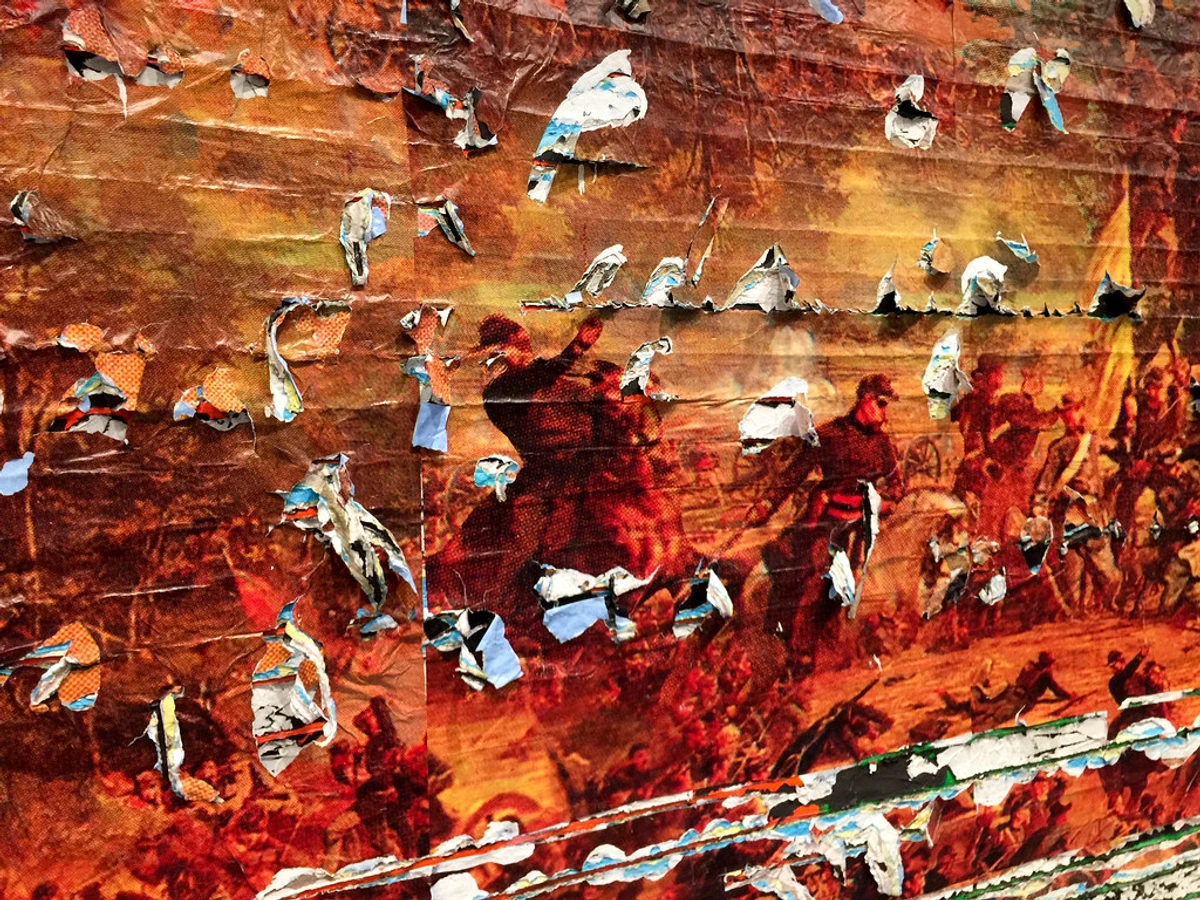
credit, licence
This image of an art discussion evokes the intellectual engagement Bradford's work demands, prompting viewers to delve deeper into its layers, history, and social commentary, and consider the artist's unique agency and the narratives he sculpts.
3. The Trace: Lines Etched by Time and Force
The final "lines" in a Bradford piece are rarely drawn on the surface with paint, at least not in a traditional sense. Instead, they are what’s left over from the excavation. The deep, jagged grooves and shallow, worn canyons left by the power sander become powerful gestural marks, acting as scars, pathways, or fissures across the canvas. These marks are often sharp, ragged, and imbued with the physical memory of the process. The caulking ropes he embedded earlier are revealed, forming raised, grid-like structures that look uncannily like city streets, exposed electrical grids, or geological fault lines seen from above. He doesn't just apply paint; he sculpts the very narrative of his canvases, creating maps that speak not of geography, but of human experience and the hidden infrastructures of daily life—the social support systems, communication networks, and power dynamics that shape an urban environment. A dense network of revealed ropes or deep, interconnected sanded grooves, for instance, could symbolize the resilient community ties that hold a neighborhood together despite systemic challenges, while a stark, abrupt fissure might speak to profound social divisions or forgotten histories. For me, this radically expands my understanding of what a line in art can be: not an application of pigment, but a physical wound in the surface of the painting, a remnant, a piece of history. It's a radical take on the language of line, where the mark is a physical wound in the surface of the painting, a testament to what was once there, a visual echo of an untold story.
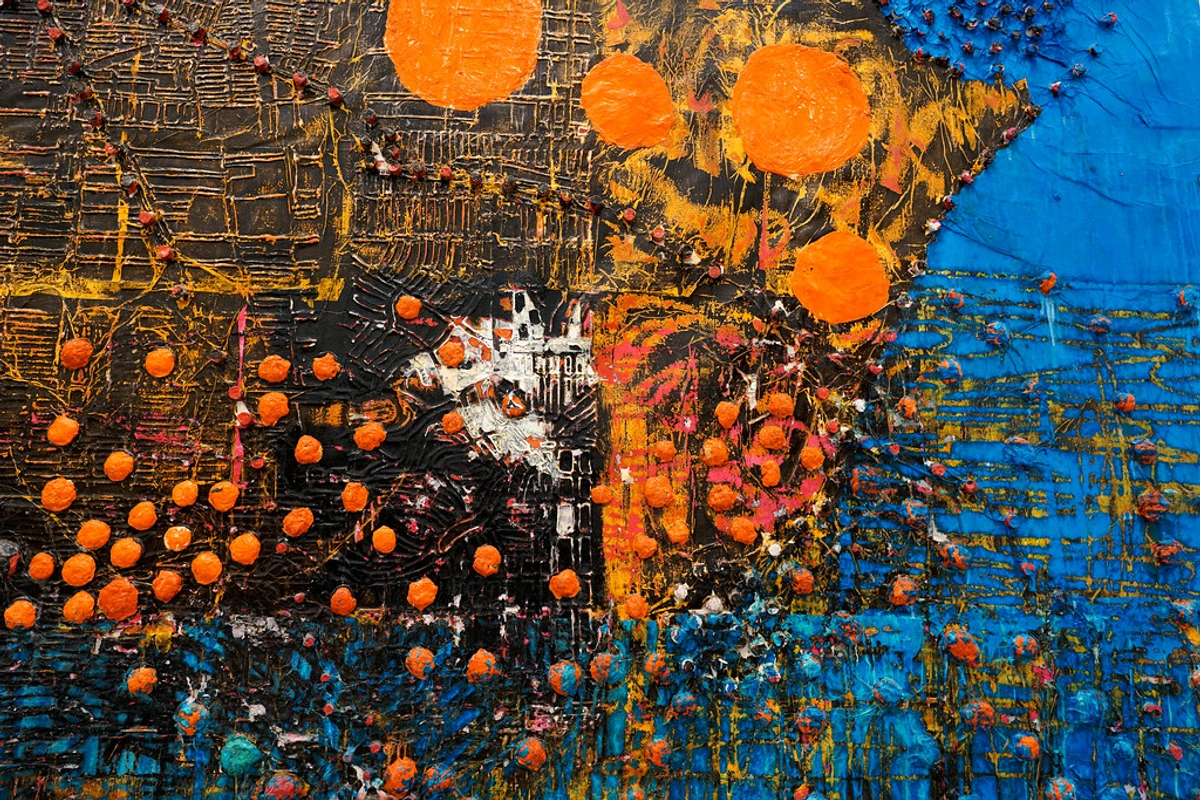
credit, licence
This image of textured, colorful abstract art on wood panels reflects the raw, dynamic, and layered surfaces that characterize Bradford's excavated canvases, where color and texture are revealed through a process of physical manipulation and purposeful deconstruction.
Trying the Bradford Vibe at Home: Your Own Urban Archaeology
Okay, aspiring urban archaeologists and fellow artists, I know what you're probably thinking: "I’m not going to fire up a belt sander in my second-floor apartment!" (And if you are, please invite me over—I’m endlessly curious). But the spirit of Mark Bradford's revolutionary approach – building, destroying, and revealing – is absolutely something you can adopt on a smaller, safer scale in your own studio. I find this process incredibly liberating, a direct conversation with the materials, pushing their boundaries, and often uncovering truths I hadn't intended to find. My own journey with the power of imperfection has certainly been shaped by this mindset. It’s about letting go of absolute control and embracing the unexpected beauty that emerges from intentional disruption, a truly profound way to engage with your art.
Here’s a practical guide to bringing Bradford's archaeological approach into your creative practice, safely and effectively:
Step | Bradford's Tool/Material | Your Studio Alternative (Targeting Artists & Students) | Impact on Your Art | Consideration/Tip |
|---|---|---|---|---|
| 1. Build Layers | Billboard Paper, Endpapers, Merchant Posters (junk mail, flyers) layered with Shellac/Acrylic Medium | Magazine pages, old posters, colored craft paper, recycled packaging, personal notes, receipts, newspaper clippings, fabric scraps. For an evocative sense of adventure and hidden journeys, try layering old comic book pages with torn maps. Layer these liberally with Acrylic medium, wood glue, PVA glue, diluted matte medium. | Introduces pre-existing colors, texts, and imagery, embedding a personal or cultural narrative without high cost. Creates a unique, dense subsurface rich with latent history. | Experiment with paper translucency and color order for varied effects when revealed. Think about the "story" each layer adds – what narratives are you burying for future discovery? |
| 2. Embed Structures | Caulking Rope embedded between layers | Regular string, yarn, hot glue lines, crumpled wire mesh, thick gesso paste applied with a syringe or palette knife, coarse sand mixed with medium. Think of these as the hidden infrastructure of your imagined urban landscape. | Develops internal linear structures that can be revealed for emphasis, compositional strength, or a unique topographical effect, mimicking urban grids, exposed utility lines, or geological fissures. | Ensure embedded elements are fully encased in medium to prevent later dislodgement. These are your hidden pathways, your buried secrets. |
| 3. Dry Thoroughly | Patience and time! | Ensure each layer, and especially the final combined mass, is completely dry before moving to excavation. This might take days, depending on thickness and humidity – don't rush the process! | Crucial for structural integrity and preventing soggy, unmanageable tearing. Allows for clean, crisp revelations and prevents mold. A properly dried surface will offer satisfying resistance. | Don't rush this stage! Incomplete drying leads to a messy, unworkable surface and poor, smudged results. Patience is truly key to successful "urban archaeology." |
| 4. Excavate & Reveal | Power Sander (belt, orbital) | Sandpaper blocks (various grits from fine to coarse for different effects), palette knives (your 'trowel' for precise excavation and scraping), wire brushes (a 'geological pickaxe' for subtle textures and distressing), carving tools, blunt scrapers, scrubbing brushes, etching needles. For magazine paper, start with a fine-grit sandpaper. For thicker cardboard, a blunt palette knife might be more effective. You can even experiment with wet sanding for different effects (but be careful with water-soluble materials!). | Creates dynamic textured surfaces, reveals unexpected underlying layers and colors, and allows for precise 'excavation' and intriguing visual interest. It's a fantastic exercise in letting go and embracing the beautiful surprises of the unknown! | Start gently with fine grit sandpaper to gauge how layers respond. Gradually increase pressure and coarseness. Always wear a mask for dust. Think like a patient archaeologist, slowly uncovering precious artifacts. |
| 5. Finish & Refine | Varies by piece | Varnish (matte or gloss), wax, or additional subtle applications of translucent acrylic washes to unify the surface, enhance revealed textures, and protect your unearthed history. | Protects the surface, deepens colors, and allows for a final layer of artistic intent to guide the viewer's eye through the unearthed history, acting as your final curated statement. | Consider a matte finish to preserve the raw, textural feel, or a gloss finish to intensify colors and depth. This is where you polish your unearthed narrative. |
Start small. Build up 10-20 layers of paper with acrylic medium. Let it dry completely. Then, go at it. Use sandpaper to gently wear away sections. Use a palette knife to scrape and gouge. See what you reveal. You might even try to build a narrative arc into your layers, placing specific words or images that you intend to be partially revealed, telling a fragmented story of your own. For me, connecting with that idea of fragmented stories, much like how memories surface in my own abstract art, adds an incredible layer of meaning. This hands-on process, for me, is a direct conversation with the materials, pushing their boundaries, and often uncovering truths I hadn't intended to find. It’s about embracing the unexpected and finding beauty in disruption, a creative philosophy that deeply informs my abstract acrylics and mixed media techniques.
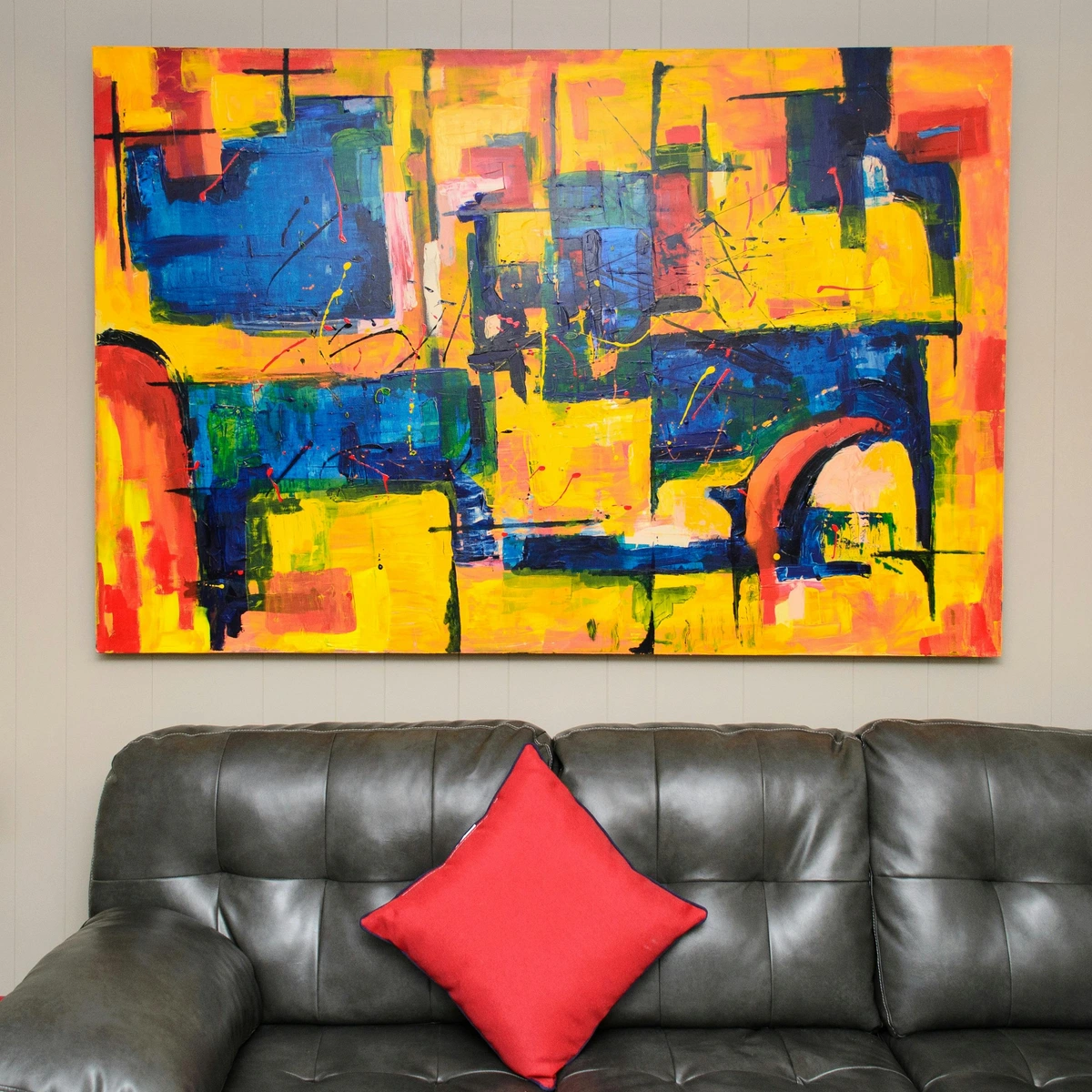
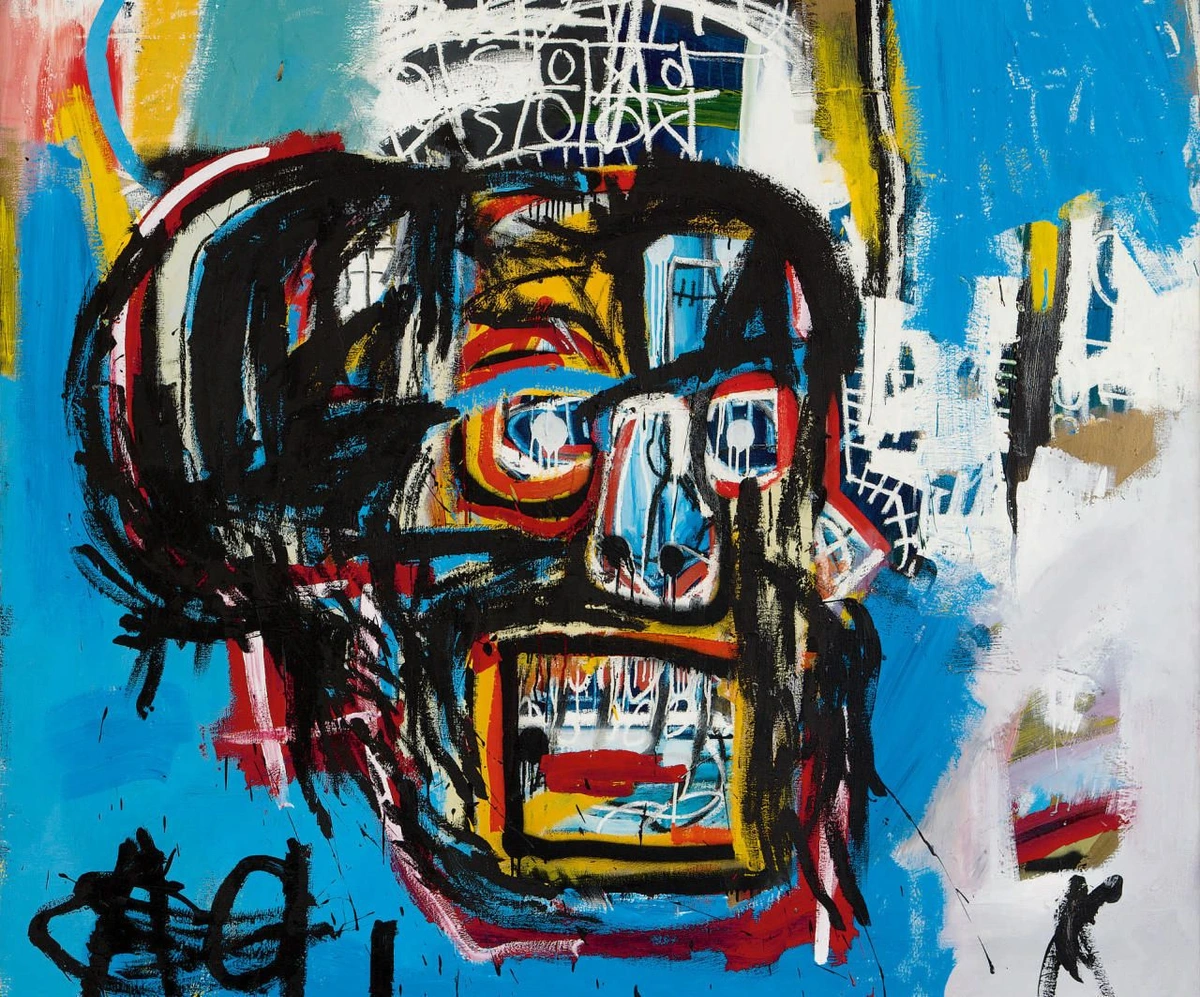
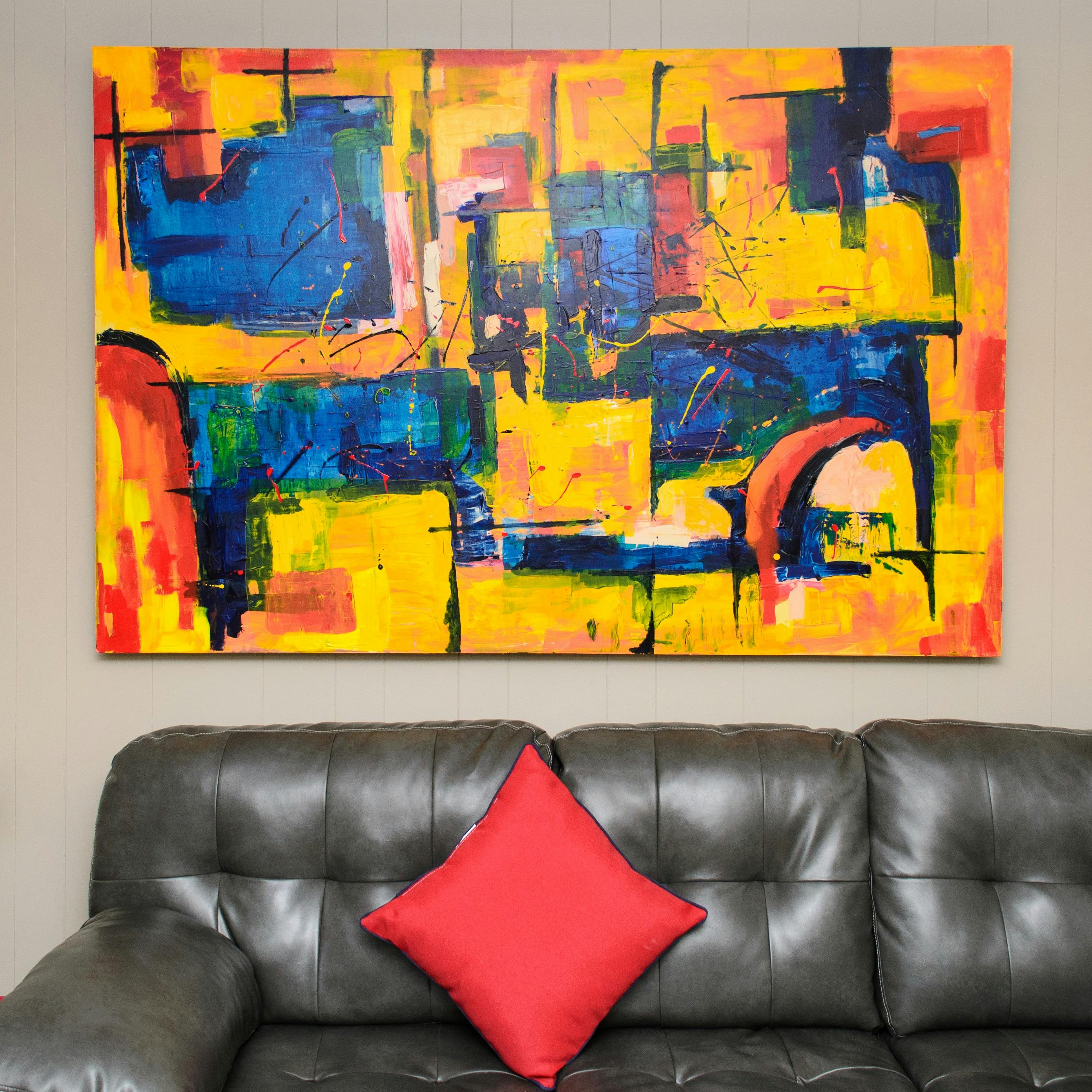
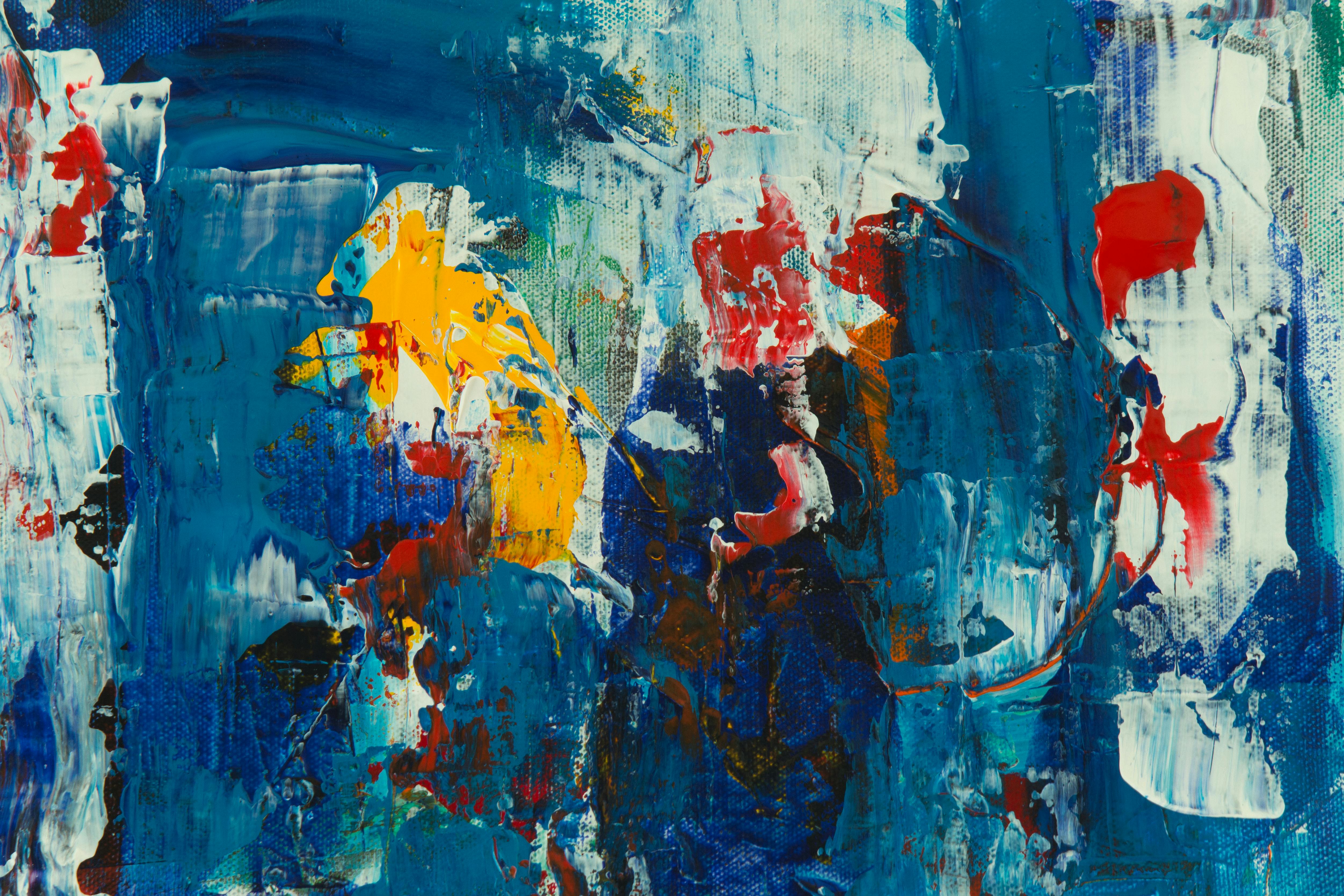
My own abstract works, such as this one, often integrate a sense of layered history and personal narrative, reflecting a similar journey of discovery through material exploration and expressive mark-making, much like Bradford's urban archaeology.
This kind of layered exploration, embracing both meticulous construction and deliberate deconstruction, has become a cornerstone of my own practice. I find it endlessly fascinating how different approaches to building and then excavating can evoke such a wide range of emotions and narratives in the viewer. It's a journey of discovery, both for the artist and for those experiencing the art.
The focused, hands-on nature of drawing with colored pencils on a wooden table echoes the careful and deliberate manipulation of materials inherent in Bradford's creative process, a testament to artistic agency and the physical act of creation.
Jackson Pollock's revolutionary drip paintings are a hallmark of Abstract Expressionism, a movement that, while sharing a focus on process, differs from Bradford's work in its direct engagement with urban detritus as material and its archeological deconstruction for social commentary.
Frequently Asked Questions (FAQ)
Here are some of the most common questions I hear about Mark Bradford's revolutionary art and his unique process:
What are Mark Bradford's key materials and how does he use them? Bradford primarily uses found paper materials like billboard paper (both fresh and weathered), endpapers, newsprint, and "merchant posters" (junk mail, advertising flyers, community notices) sourced directly from his South Central Los Angeles neighborhood. These are meticulously layered onto canvas with shellac or acrylic medium to form a dense, composite mass. He then uses power tools (like industrial sanders) and manual scraping to tear away and sand back these layers, revealing the hidden textures, colors, and texts beneath. He often embeds elements like rope or caulking for structural lines that emerge during this excavation. He intentionally selects materials not just for their aesthetic qualities, but for the inherent social information they carry and his own personal memories, making his art a direct, nuanced reflection of his community and upbringing. It’s an act of transforming the discarded into the profound.
How does décollage differ from collage in art, especially in Bradford's practice? Décollage is the inverse of collage. While collage involves adding and assembling materials onto a surface to build up an image or texture, décollage is the act of tearing, peeling, or sanding materials away to reveal what lies beneath. Historically, artists like Mimmo Rotella practiced décollage by stripping posters from city walls, often discovering multiple layers of advertisements. Their motivation was often to critique consumerism or urban decay. But Bradford takes it to an entirely new, internalized level: he meticulously builds his own layers only to deconstruct them. This gives him a unique agency over the revealed history, creating a dynamic dialogue between creation and destruction, surface and depth within the artwork itself, rather than relying on serendipitous finds. He's not just uncovering existing history; he's actively constructing and then exposing a new, curated history through his deliberate choice of materials and precise application of force.
Is Mark Bradford's work considered painting or sculpture? Both, and this duality is central to its power; his work profoundly challenges traditional art categories. It holds the scale, two-dimensionality, and wall-presence of a painting, yet its physical depth, raw materiality, and additive/subtractive process align it closely with sculpture. The extensive layering creates literal topographical relief, volume, and significant weight on the surface, pushing it beyond a flat canvas into the realm of relief sculpture. This physical build-up of paper and glue creates tangible dimensionality that is integral to the artwork's identity, not just an incidental byproduct. It embodies objecthood—the quality of existing as a physical object—as much as it does image. It is often described as a compelling hybrid, exploring the sculptural qualities of built-up, excavated surfaces, and physically embodying the narratives he unearths. His art is a testament to the idea that some of the most compelling contemporary art exists powerfully between established definitions.
How does Mark Bradford create his distinctive grid lines and pathways? The grid-like patterns and strong linear elements that appear in Bradford's work are not drawn on with paint, but are revealed through his process. During the layering (collage) phase, he meticulously embeds materials like caulking and rope between the paper layers. When he later sands and tears back the surface, the paper is removed around these embedded materials, exposing them as raised lines. These then create a topographical map or an exposed urban infrastructure on the canvas. They emerge as physical scars, boundaries, or remnants, a testament to the buried history within the artwork, often representing the unseen divisions, connections, or conduits within a community, a city's very nervous system made visible.
What is the typical scale of Mark Bradford's artworks, and how does this enhance his social commentary? Mark Bradford is renowned for his monumental works. While he creates pieces of varying sizes, many of his most impactful works are large-scale, often exceeding 10 feet in both height and width. These expansive canvases emphasize the urban landscape he depicts, immersing the viewer in a fragmented, layered topography that feels vast and all-encompassing. The sheer size amplifies the sense of an entire city or community's history being excavated and revealed before your eyes, making the experience deeply visceral and often overwhelming. This monumental scale allows for a more immersive experience of urban complexities, compelling the viewer to confront the widespread nature of the societal issues he addresses – from racial inequality to economic marginalization – making them impossible to ignore.
What are the emotional impacts of Mark Bradford's work on viewers? The emotional impact of Bradford's work is often profound and complex. Viewers frequently experience a sense of awe at the sheer scale and intricate detail, coupled with a feeling of disquiet or melancholia from the raw, scarred surfaces and fragmented narratives. There's an undeniable visceral quality – the implied violence and raw energy of the décollage process – that can evoke empathy for the struggles and personal histories of the communities he references, particularly his own upbringing in South Central Los Angeles. His work often encourages deep contemplation about urban decay, social inequality, and the hidden histories of cities, leaving many with a lasting sense of both the beauty and brutality of human experience. He prompts us to consider the layers beneath our own daily lives, fostering a deeper awareness of the unseen.
Does Mark Bradford use specific color palettes, or are his colors dictated by his materials? Bradford's color palettes are a masterful interplay between the found and the intentional. While the underlying layers do consist of the pre-existing colors of the billboard papers, newsprint, and other "merchant posters," his process is far from purely dictated by these. He strategically chooses papers with specific hues during the layering phase, knowing how they will interact when exposed. For example, he might intentionally layer a vibrant red billboard advertisement beneath a muted grey endpaper, knowing that the sanding will partially reveal the red as a surprising, almost violent, "scar" of commercial history. Crucially, the sanding and tearing process itself creates new colors and tonal variations by revealing partial layers and mixing pigments on the surface. The shellac also adds a warm, amber tone that unifies and ages the palette. So, while rooted in the urban detritus, his final palettes are carefully composed, often featuring muted ochres, deep blues, grays, and occasional flashes of vibrant, unexpected color that emerge from the buried history, each choice a deliberate act of orchestration.
How does Bradford's work fit into broader contemporary art trends? Bradford's practice is deeply resonant with several contemporary art trends. His emphasis on material exploration (using non-traditional, found materials) and process art (where the act of making is as important as the final product) are key. He also engages with post-minimalism through his monumental scale and the emphasis on raw, industrial processes, while his use of found objects connects him to traditions of assemblage and arte povera, elevating everyday detritus to high art. He explores socio-political themes through abstraction, grounding his work in concrete realities, and draws intellectual inspiration from fields like sociology and urban planning. While some contemporary discussions increasingly revolve around digital ownership like NFTs (and the challenges of proving art provenance with blockchain), Bradford's practice remains firmly rooted in the tangible, material history of physical artworks, pushing the boundaries of abstract art movements through material and process. His art reminds us of the enduring power of the physical over the purely digital.





This image of a digital Bitcoin symbol represents the modern discussions around blockchain and NFTs, a stark contrast to Bradford's deeply physical and material-focused art, highlighting the diverse directions in contemporary art and the enduring tangible nature of his works.
What are the conservation challenges for Mark Bradford's artworks? Given the complex, layered nature of his materials—various types of paper, glues (like shellac), caulking, and acrylics—conservation of Bradford's works is indeed a highly specialized and significant consideration. Shellac, for instance, can become brittle and discolored (often yellowing) over time, and is particularly sensitive to fluctuations in humidity and temperature, which can lead to cracking and delamination (the separation of layers). This inherent brittleness is problematic because it makes the surface highly susceptible to impact damage and exacerbates natural wear. The multiple paper layers themselves are susceptible to warping, tears, and acid degradation, including common issues like foxing (brown spots caused by fungal growth or impurities) and embrittlement. Stabilizing such large-scale paper constructions, especially those subjected to aggressive physical manipulation, requires advanced techniques beyond standard paper conservation. The sheer monumental scale of many of his pieces adds another layer of complexity for transport, handling, and storage. Conservators specializing in mixed media and contemporary art must employ specific, often innovative, methods to stabilize the works, mitigate future degradation, and address existing damage, ensuring these unique, layered histories are preserved for future generations. This is a challenging but crucial aspect of maintaining his artistic legacy and the integrity of his material storytelling.
Are there other artists who use similar layering and excavation techniques? While Mark Bradford's specific approach to internal décollage and the rigorous integration of urban social commentary is highly unique, other artists have explored layering, deconstruction, and the use of found materials. Artists like Wolfgang Laib use natural materials in sculptural installations, and in abstract painting, some artists build up thick impasto layers only to scrape them back. However, Bradford's systematic creation of layers with specific, socially charged found paper, followed by its aggressive, intentional deconstruction through sanding, sets his work apart as a distinct evolution of these concepts, blending painting, sculpture, and social archaeology in a way few others achieve. His use of a large studio team and assistants also allows for the monumental scale and meticulous process that characterizes his practice, an important factor in the consistent production of his complex works. He's not just using a technique; he's perfected a methodology of meaning-making.
What is the significance of the titles of Mark Bradford's works? Bradford's titles are rarely straightforward descriptions; instead, they serve as crucial entry points, often weaving together personal biography, local Los Angeles history, classical mythology, and broader social commentary. Titles can refer to specific events (like "Helter Skelter I" referencing the Watts Riots), mythological figures ("Mithra"), street names, or even specific moments from his past. They provide a narrative anchor, inviting viewers to delve deeper into the layers of meaning and connection embedded within the abstract forms. The titles often bridge the personal and the universal, connecting his localized urban archaeology to wider human experiences and historical narratives, giving a voice to the voiceless layers he reveals.
Where can I see Mark Bradford's art? Mark Bradford's significant contributions to contemporary art mean his works are featured in prominent collections worldwide. You can typically find his art in major institutions such as the Museum of Modern Art (MoMA) and the Whitney Museum of American Art in New York, the Los Angeles County Museum of Art (LACMA), the Tate Modern in London, and the Hammer Museum in Los Angeles, among many others. His work is also frequently exhibited in leading international galleries and art fairs, offering numerous opportunities to experience his powerful, layered canvases firsthand. For more abstract works that explore layers and narrative, you can also explore my own collection or visit my timeline for a journey through my artistic evolution.
It’s More Than a Technique, It’s a Worldview
Studying Mark Bradford’s process is about more than just learning a cool new mixed-media technique (though, let's be honest, it absolutely is that). It’s a profound lesson in seeing the world differently. It teaches you that a surface is never just a surface; it’s a history, a palimpsest of lives lived and forgotten. It shows that value can be created from discarded materials, and that beauty is often found not in what’s added, but in what’s stripped away. His work stands as a powerful benchmark in contemporary abstract art, demonstrating how material process can be deeply intertwined with social commentary and personal narrative. For me, encountering his unwavering commitment to his process—that controlled destruction—reinvigorated my own artistic resolve to push the boundaries of my materials and embrace the unexpected outcomes. It was a powerful reminder that sometimes, the true essence of a piece, and indeed of an idea, only emerges after some forceful, intentional removal. Ultimately, Bradford reminds us that the most interesting stories are often the ones buried just beneath the surface, waiting for someone brave enough to start digging. As you explore your own creative path, remember that the most resonant art often lies not just in what is created, but in what is bravely and intentionally revealed. Perhaps you'll find inspiration in my abstract art and join me on this journey of uncovering meaning within the layers.