Albrecht Dürer: Master Printmaker, Engineer of Art & Renaissance Visionary
Unlock Albrecht Dürer's genius: how this Northern Renaissance artist engineered art, revolutionized printmaking (engravings, woodcuts, etchings), pioneered artist branding, and shaped mass media. Discover his enduring legacy.

Albrecht Dürer: Master Printmaker, Engineer of Art & Renaissance Visionary
Imagine an artist who didn't just paint, but fundamentally re-engineered the very fabric of art, systematically dissecting and understanding the underlying principles of the visible world to achieve unprecedented results. For me, that artist is Albrecht Dürer. He stands as a true titan in the Northern Renaissance, and his vision of "engineering art" still fascinates me. He didn't merely practice printmaking—a craft often relegated to functional illustration—he meticulously transformed it into a powerful, democratic medium.
Born in Nuremberg in 1471, Dürer lived during a period of immense intellectual, religious, and artistic upheaval. His two formative journeys to Italy, first in 1494-1495 and again in 1505-1507, were pivotal, exposing him to classical antiquity and the revolutionary theories of the Italian Renaissance. Before Dürer, a masterpiece was typically a singular, precious object, commissioned by the church or the elite; after him, art could be a potent message for thousands, widely accessible and profoundly influential. It’s a seismic shift, one that laid the groundwork for everything from political cartoons to viral memes, and frankly, it still blows my mind.
I remember the first time I encountered a Dürer print in person. It wasn't one of the grand, famous pieces, just a smaller work in a quiet museum alcove. And honestly? My modern eye instantly made an anachronistic leap: I thought it could have been a laser print. The sheer, obsessive detail in the lines—the delicate texture of a dog's fur, the intricate wrinkles on a saint's face, the complex shimmer of light on metal—it seemed almost impossible that a human hand could have carved such precision into wood or metal over 500 years ago. That moment solidified it for me: Dürer wasn't just an artist. He was a kind of proto-hacker of visual media, systematically pushing the boundaries of what was technologically possible. He approached his craft with the rigor of an engineer, meticulously studying light, anatomy, and perspective, then applying that scientific understanding to his tools and materials to achieve unprecedented effects. He was obsessed with perfecting his tools, experimenting with different metal alloys for burins, refining ink recipes, and seeking out the finest papers—all in a relentless pursuit of the ultimate line.
This "proto-hacker" mindset meant Dürer didn't just accept existing printmaking technologies; he experimented relentlessly, optimized processes, and pushed his tools to their absolute limits. He built directly upon the seismic shift brought by Gutenberg’s printing press decades earlier, which had ignited an insatiable hunger for reproducible images and texts across Europe. Dürer saw this nascent mass media as a profound opportunity, transforming a humble craft into a high art form. His prints became powerful conduits, rapidly disseminating everything from religious narratives (crucial during the tumultuous Reformation) and scientific observations to humanist ideals and even propaganda. He figured out how to "paint with lines," and in doing so, he didn't just create beautiful pictures; he changed how information and ideas could be shared forever, laying the technical and conceptual groundwork for centuries of visual communication.
So, let's pull up a chair and explore how he actually did it. Forget the dry art history lecture for a moment; think of this as peering under the hood of a revolutionary machine, a deep dive into the precision and passion of a true master. What was it like for Dürer to work those blocks and plates, meticulously shaping not just images, but an entire era?
The World Dürer Entered: Printmaking's Humble Roots & Europe's Shifting Tides
To truly grasp the magnitude of Dürer's impact, I think it's crucial to understand the artistic and technological landscape he inherited, but also the vibrant, changing world around him. Before his arrival, around the late 15th century, printmaking was largely the domain of skilled artisans and craftspeople, rarely elevated to the status of "fine art" (meaning paintings or sculptures by individual masters). This context is important because it shows just how much Dürer had to innovate and elevate the medium. Europe itself was in a fascinating state of flux.
Johannes Gutenberg's movable type printing press, invented in the mid-15th century, had already unleashed a profound revolution, dramatically increasing literacy and creating an unprecedented demand across Europe for reproducible texts. What Dürer intuitively understood was that this same hunger for rapid, widespread dissemination extended powerfully to images. This wasn't just about religious narratives; the burgeoning merchant class, the rise of powerful urban centers, the expansion of universities, and the explosion of humanist ideals (which championed individual human potential and critical thought) across Europe yearned for visual information. They needed everything from scientific diagrams, maps, and classical stories to satirical broadsides. It was a world hungry for knowledge and visual communication, and Dürer stepped in to satisfy that hunger in a way nobody else could.
The Functional Art of Early Printmaking
Before Dürer, printmaking was often considered a "functional art" rather than a primary medium for profound artistic expression. Woodcuts, for instance, were typically quite crude, used primarily for playing cards, simple book illustrations, and basic devotional images for the less affluent. The material itself—wood—inherently limited the fineness of line and detail. Carving wood along the grain (plank-side) meant that very thin lines would splinter or break under pressure, forcing a bolder, more robust aesthetic. The block, the matrix (the surface from which an image is printed), from which the image was printed, was often simple. Engraving, on the other hand, was largely a goldsmith's technique, employed for decorating intricate metalwork rather than creating standalone works of art intended for wider distribution. These were functional crafts, valued for their utility and decorative qualities, but not yet recognized as a primary medium for profound artistic expression. This was the raw material Dürer would meticulously refine.
Dürer's Formative Years and Workshop Innovations
Dürer's early training was deeply steeped in this traditional artisan system. His father, Albrecht Dürer the Elder, was a highly skilled goldsmith, a profession that demanded meticulous precision in working with metal—a foundational skill that would prove invaluable for his son's future in engraving. Young Albrecht also apprenticed with the painter Michael Wolgemut in Nuremberg, a renowned workshop where he not only honed his prodigious drawing skills but also gained hands-on exposure to the complex process of woodcut production for book illustration. This rigorous, practical craft training, combined with his insatiable intellectual curiosity, provided the perfect crucible for his revolutionary approach.
While artists like Martin Schongauer had already elevated engraving to a new level of refinement, it was Dürer who, with his relentless pursuit of perfection and his almost scientific approach to art, would completely transform these humble beginnings. He recognized the untapped potential for mass communication where others saw only a craft, a way to move beyond the confines of the traditional guild system and directly engage a vast audience with his artistic and intellectual vision. He operated a highly successful workshop, employing skilled assistants who helped with the demanding, multi-step process of preparing blocks and plates, inking, printing, and distribution. His prints became the new pulpits and pamphlets of a rapidly changing world, with each step carefully managed to ensure consistent quality and widespread reach.
Dürer's Workshop & Tools: The Alchemist of the Line
Dürer's printmaking empire was built upon his masterful command of two core techniques, both demanding immense skill but yielding distinctly different visual and tactile results. To fully appreciate his genius, understanding the fundamental difference between these two primary processes—intaglio printing and relief printing—is absolutely key to unlocking the unique visual language he forged within each. Imagine looking inside a complex machine; these are its primary gears, each with a unique function, each pushed to its absolute limit by Dürer.
Defining the "Matrix" and Process Types
Before diving into the techniques, let's clarify a crucial term: the matrix. In printmaking, the matrix is the physical surface or material (like a woodblock or metal plate) from which the image is printed. It holds the design and transfers the ink to the paper. The two main process types Dürer worked with are:
- Relief Printing: The parts of the matrix that are not to be printed are cut away, leaving the image to be printed raised or in "relief." Ink is applied only to these raised surfaces. Think of a rubber stamp.
- Intaglio Printing: The image to be printed is incised or etched into the matrix. Ink is held within these incised lines, and the surface is wiped clean. The image is pulled from the grooves. Think of a reverse stamp, where the ink is in the channels.
Dürer's Printmaking Arsenal: Tools and Materials
Before we dive into the processes, let's consider Dürer's workshop—his laboratory for artistic innovation. He was a true engineer of art, meticulously selecting and often experimenting with his tools and materials to achieve specific effects. For Dürer, the choice of a burin, the alloy of a metal plate, or the consistency of his ink were as critical as the drawing itself. His diligent assistants, often specializing in different stages of the printmaking process, played a vital role in preparing the blocks, mixing inks, and managing the presses, enabling Dürer to oversee and refine the artistic vision.
- Burin: The quintessential tool for engraving, a specialized steel rod with a sharp, diamond or lozenge-shaped tip, fitted into a rounded wooden handle. Its design allows for clean, precise cuts into metal. Mastering it requires immense physical control and years of practice.
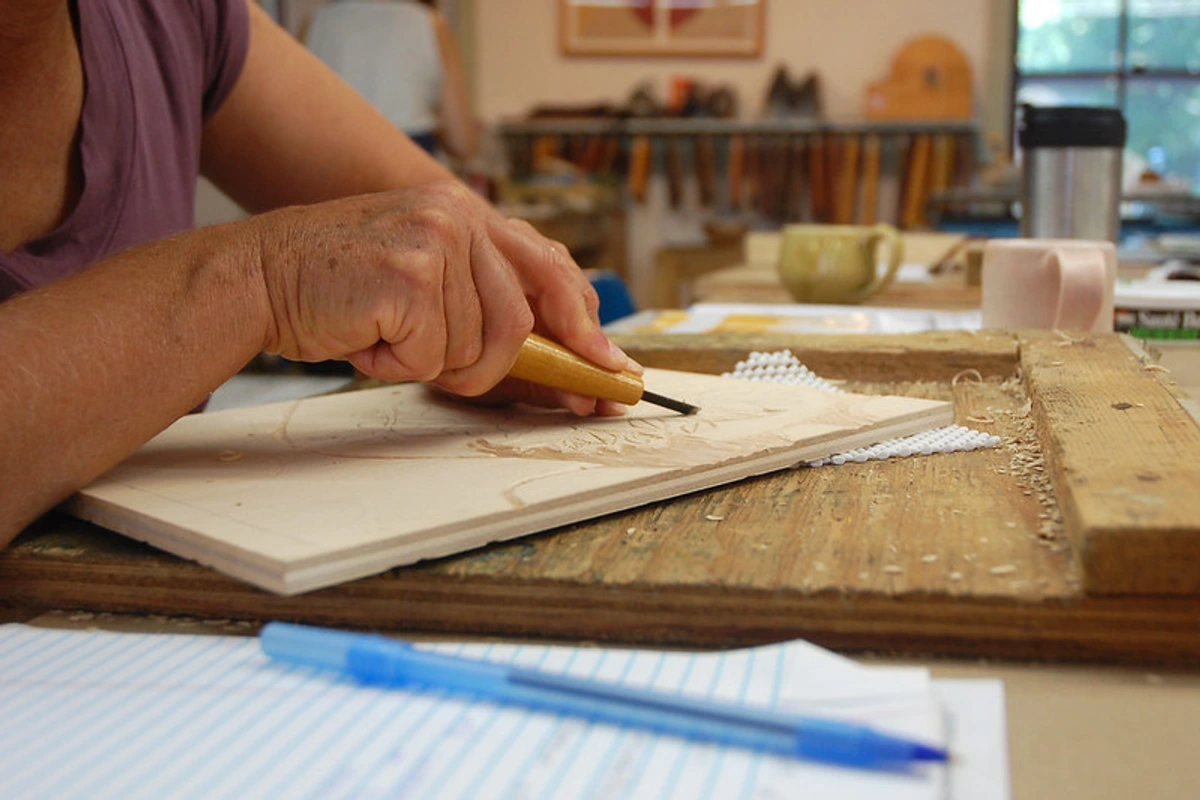
- Knives and Gouges: Essential for woodcut, these tools come in various shapes and sizes (V-shaped, U-shaped) to carve away wood from the block. The sharpness and angle of the cut significantly impact the final line.
- Etching Needle: A simple, sharp, pointed tool used to draw through the wax ground on an etching plate. It allows for a freer, more fluid line than a burin.
- Metal Plates: For engraving, Dürer primarily used highly polished copper plates. Copper's malleability allowed for incredibly fine lines and details, and its durability meant many impressions could be pulled. For etching, he initially experimented with iron plates, which were cheaper but offered less precision and consistency than copper (which would become standard later for its superior malleability and consistent etching properties).
- Wood Blocks: For woodcuts, Dürer often favored fine-grained woods like pear or boxwood. These were carefully seasoned and cut plank-side (along the grain) to provide a relatively smooth surface, though the natural grain still influenced the line quality. The wood's inherent resistance shaped the bolder aesthetic of his woodcuts. (It's worth noting that wood engraving, which uses end-grain wood blocks and tools similar to engraving burins, developed later and allowed for much finer detail in relief printing, effectively bridging the gap between the two techniques, but Dürer primarily worked with traditional plank-side woodcuts).
- Inks: Typically rich, oil-based black pigments, often finely ground lamp black mixed with linseed oil. Dürer likely experimented with different recipes to achieve the deepest blacks and optimal drying times. Consistency was key to ensuring the ink transferred cleanly from the matrix to the paper.
- Paper: Far from a simple substrate, paper quality was crucial. Dürer sought out fine papers, often from Italy, noting their absorbency and texture. The presence of watermarks (embedded designs during manufacturing) in his papers helps art historians date and authenticate his prints today. His demand for high-quality paper likely influenced paper manufacturers of the era.
Every element in his arsenal was carefully considered, refined, and wielded with unparalleled skill, transforming humble materials into objects of profound artistic and intellectual depth.
Mastering the Medium: Dürer's Core Printmaking Techniques
To make the distinctions super clear, and for anyone wanting a quick reference, here’s a breakdown of the primary printmaking techniques Dürer both mastered and explored. Understanding these differences is fundamental to appreciating his diverse output and groundbreaking innovations. It’s almost like having a cheat sheet for a very complex, historical craft.
Technique  | Process Type | Matrix Material | Primary Tool(s) | Key Characteristics of Lines | Audience Impact/Purpose |
|---|---|---|---|---|---|
| Engraving | Intaglio (ink in incised grooves) | Copper | Burin | Incredibly fine, precise, controlled, metallic crispness; allows for smooth tonal ranges via hatching/stippling. | Intellectual depth, nuanced detail, high artistic status |
| Woodcut | Relief (ink on raised surface) | Wood (pear, boxwood) | Knives, gouges | Bold, strong, graphic, robust; often shows subtle wood grain irregularities. | Mass appeal, powerful narrative, widespread dissemination |
| Etching | Intaglio (acid-bitten grooves) | Iron (later copper) | Etching needle, acid | Freer, sketch-like, expressive, painterly; variable depth allows for tonal range. | Spontaneity, artistic experimentation, drawing-like quality |
| Drypoint | Intaglio (incised groove + burr) | Copper or Iron | Drypoint needle | Velvety, soft, slightly blurred line due to the burr holding extra ink along the line. | Atmospheric effects, subtle textures, nuanced mood |
Engraving: The Meticulous Whisper of Precision (Intaglio Printing)
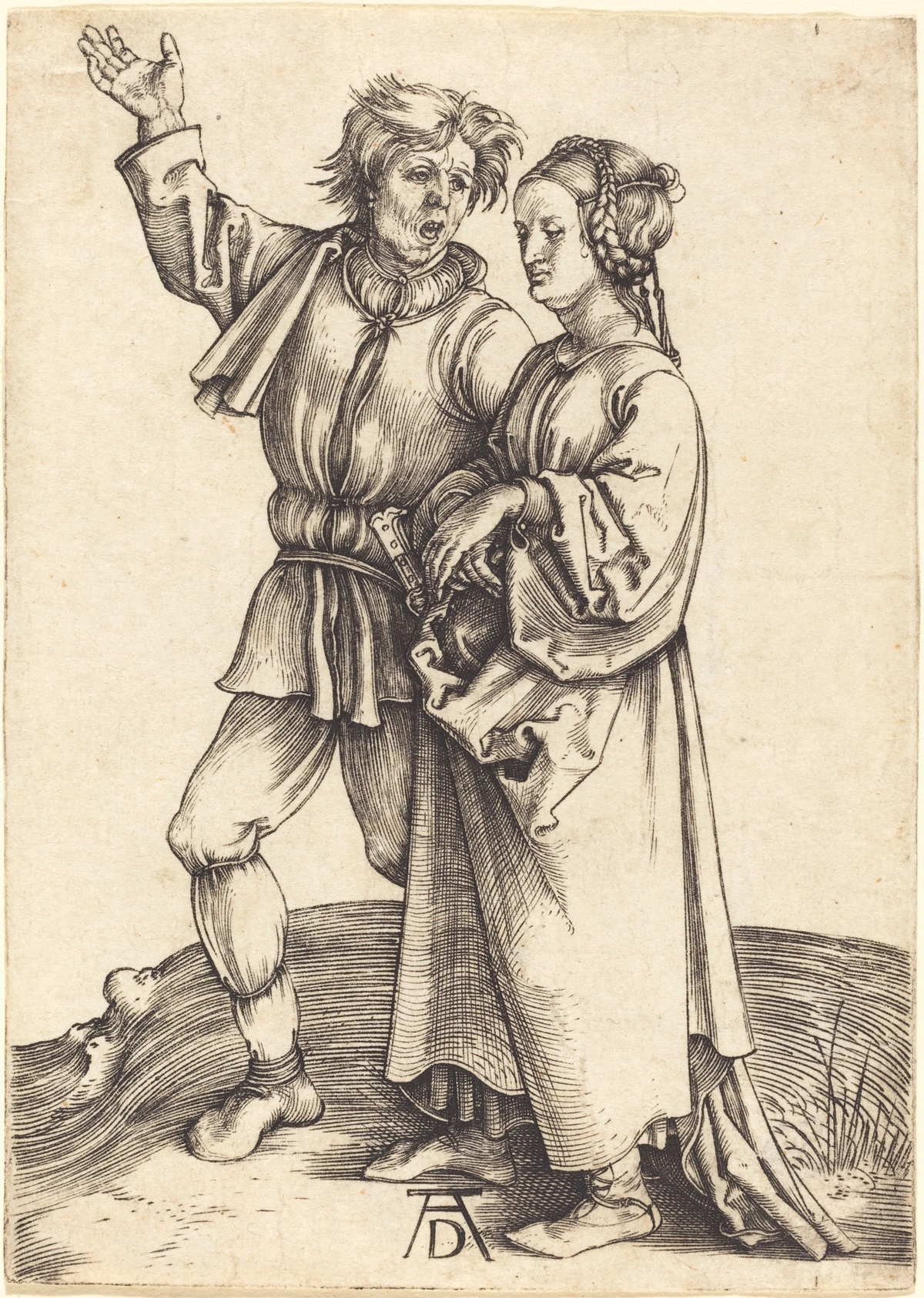
Engraving, for Dürer, was the meticulous whisper of intellectual depth and unparalleled precision. With engraving, you work with a highly polished copper plate—a relatively expensive material, but one that, unlike wood, could be worked with extreme finesse due to its malleability and durability. Your primary tool is a specialized, sharp, often diamond-shaped steel rod called a burin. Instead of carving away the background, you push the burin to carve the lines of your image directly into the metal. This is an intaglio process (from the Italian intagliare, meaning 'to incise' or 'to carve'). I always think of it as literally drawing into the surface, creating tiny, precise trenches or minute canals that will hold the precious ink. This is where Dürer's magic of "painting with lines" truly takes flight.
Here’s a simplified breakdown of the process:
- Preparation: A highly polished copper plate (matrix) is prepared, sometimes with a thin layer of wax to make the drawn lines more visible.
- Incising: The artist pushes a burin across the plate, incising the design directly into the metal. Every push is permanent, demanding immense control and foresight.
- Inking: Finely ground, oil-based ink (often lamp black and linseed oil) is smeared all over the plate, forced into the carefully carved grooves.
- Wiping: The surface of the plate is painstakingly wiped clean, often with a cloth and the palm of the hand, ensuring no ink remains on the un-carved, raised areas. Only the incised lines retain the ink.
- Printing: The inked plate is placed on a heavy roller press, covered with dampened paper, and subjected to immense pressure. This pressure forces the paper into the ink-filled grooves, pulling the ink out and onto the paper, creating the image.
This entire process demands immense control, as the burin offers absolutely no room for error; every push is permanent. Furthermore, maintaining a consistent sharpness on the tool itself is a craft that takes years of dedication to master. Just imagining the countless hours of focused, almost meditative work required gives me a headache sometimes. The very act of pushing a burin with precision and force demands a physical and mental discipline that few artists possess, and Dürer possessed it in spades.
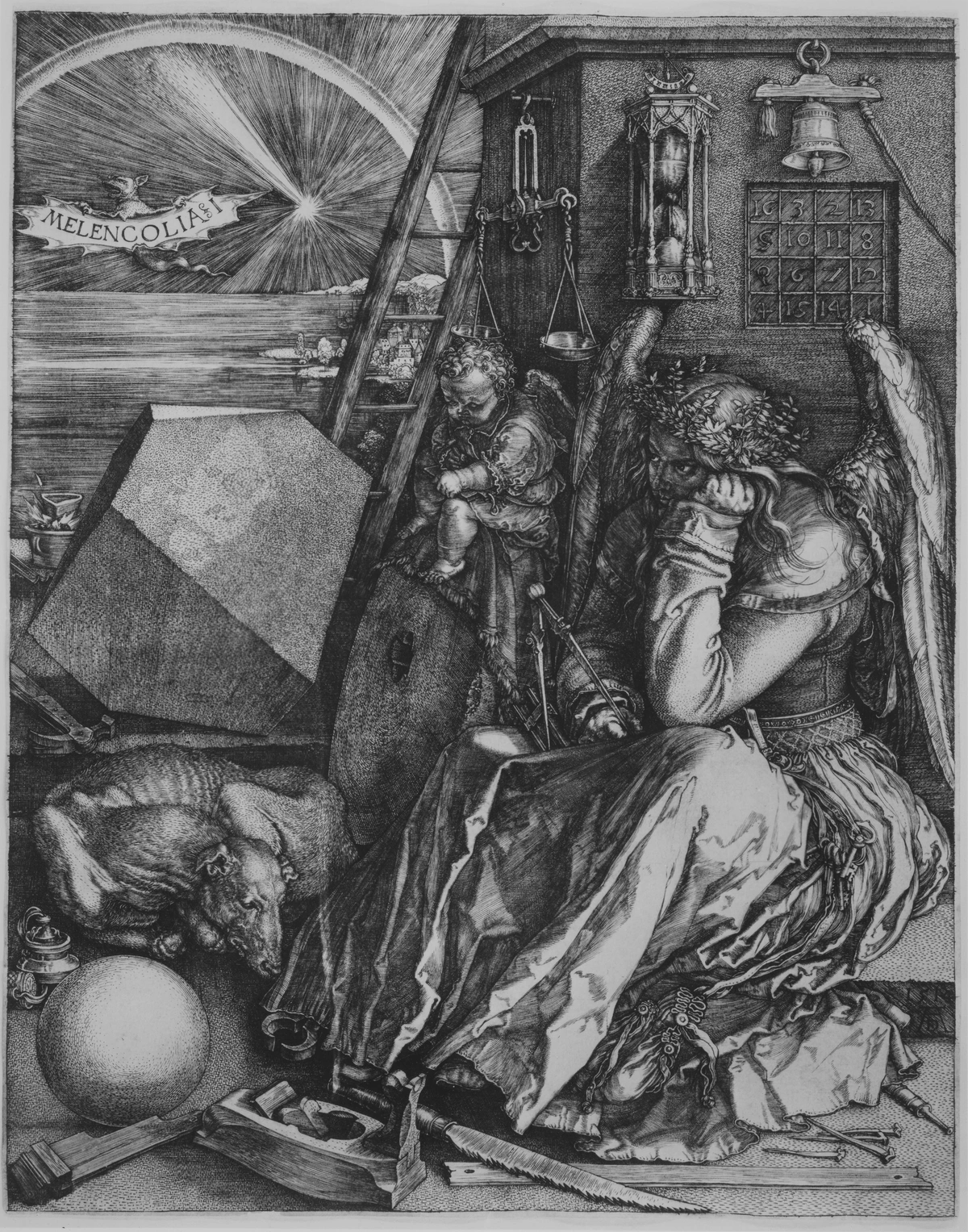
This is where Dürer truly becomes a technical wizard. Because you're carving into metal, you can achieve an almost unbelievable level of detail and subtlety. The lines can be microscopically fine, allowing for incredible control over tone and texture. He could create the most delicate textures, the deepest shadows, and the most luminous light, all by precisely varying the depth, density, and direction of his carved lines. He effectively painted with lines, employing sophisticated techniques like hatching (parallel lines drawn in one direction), cross-hatching (intersecting parallel lines, creating a mesh-like pattern to build up darker shades and texture), stippling (creating tone and texture using constellations of dots), and even subtle flick-and-dot techniques to mimic the full tonal range and chiaroscuro (strong contrasts between light and dark to create bold, dramatic effects and model form, making figures appear three-dimensional) of traditional painting. The meticulous nature of this process allows for a distinct crispness, and often a subtle metallic sheen, as the ink is quite literally pulled from those deeply set, precise lines.
When you look at a Dürer engraving, pay close attention to:
- Incredibly fine lines: Lines can be almost hair-thin, offering an astonishingly vast tonal range from the palest gray to the deepest black.
- Smooth tonal gradations: See how shadows subtly deepen and light gently brightens with minute shifts in line density, direction, and cross-hatching.
- Precise hatching, cross-hatching, and stippling: The intricate, almost mathematical patterns of lines and dots that meticulously build texture, volume, and the illusion of three-dimensionality.
- A sense of metallic crispness: A distinct sharpness and often a slight sheen from the ink pulled from deep, polished grooves, giving the impression of precision and permanence.
Dürer's Meisterstiche: Pinnacle of Engraving
This is the technique that defines his three so-called Meisterstiche (master engravings) from 1513-1514, widely considered among the greatest achievements not just in printmaking, but in all of art history. To truly appreciate them, try to imagine the countless hours of focused, almost meditative work, guiding a burin across a copper plate, where each cut is irreversible. These works also profoundly demonstrate how Dürer’s rigorous theoretical studies—especially those detailed in his treatises like Four Books on Measurement and Four Books on Human Proportion—directly informed his artistic practice. For example, his detailed studies in human proportion allowed for unparalleled anatomical accuracy, while his geometrical insights provided sophisticated perspective. This isn't just art; it's a profound integration of science, philosophy, and craft.
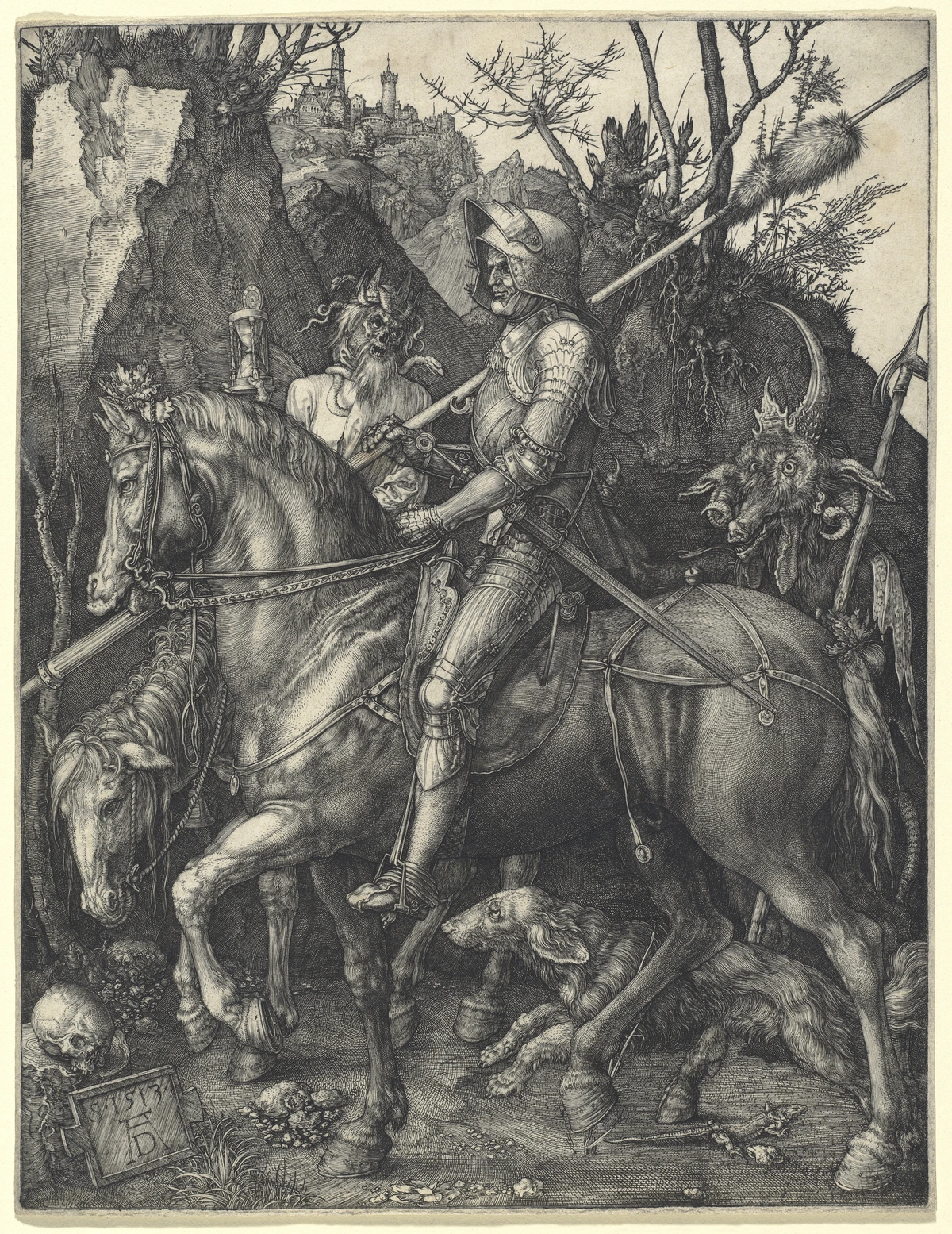
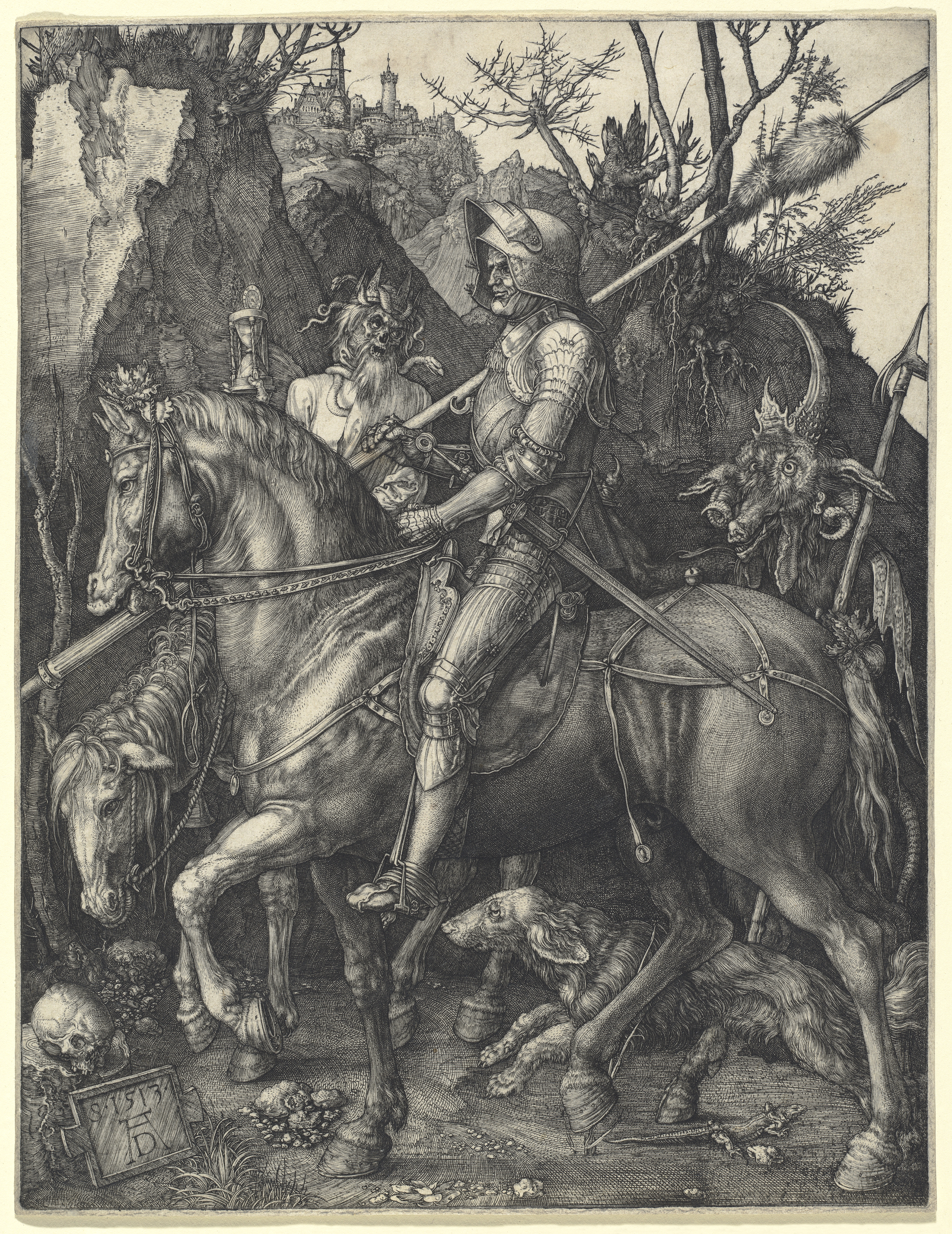
- Knight, Death, and the Devil (1513)This print is a masterclass in texture and moral allegory. Look closely at the distinct texture on the knight's gleaming armor compared to the shaggy hide of the devil or the horse's flowing mane. All of this astonishing tactile realism is achieved through tiny, deliberate lines, demonstrating an incredible range of linear effects. The polished, reflective armor contrasts powerfully with the rough, gnarly skin of Death and the Devil, all created through meticulous linear variation. Observe the coarse texture of Death's scraggly beard, the silky flow of the horse's mane and tail, or the minute scales on the serpent. It’s a powerful exploration of steadfast faith and moral courage amidst temptation and fear—a theme deeply resonant in the turbulent Northern Renaissance.
- St. Jerome in his Study (1514)The way the sunlight streams through the bull's-eye windowpanes and delicately illuminates the tranquil room is a masterclass in using light and shadow to create atmosphere. It feels incredibly warm and real, a serene domestic scene, and it's all rendered with breathtaking tonal subtlety using just black ink on paper. The meticulous details of the scholar's study—the precisely rendered books (each page and binding, the very texture of the paper), the hourglass, the lion (a traditional symbol of Jerome's taming of the wilderness), and the sleeping dog—all contribute to an overwhelming atmosphere of quiet contemplation and intellectual pursuit. Dürer's deep understanding of light in art is on full display here, demonstrating his unparalleled ability to create convincing spatial depth, palpable texture, and profound emotional resonance with purely linear means. It's almost cozy, isn't it? The way the light catches the small bell on the wall or softly illuminates the folds of St. Jerome's robe feels utterly tangible, inviting you into this moment of quiet scholarship.
- Melencolia I (1514)This is perhaps one of the most enigmatic and debated images in all of art history, a profound visual meditation on intellectual despair, creative block, and the human condition. The pervasive mood of introspection, the complex, layered symbolism (the winged, pensive figure of Melancholy, the scattered tools of creation lying unused, the enigmatic magic square—a grid of numbers where every row, column, and main diagonal sums to the same total, often symbolizing an attempt to impose order on chaos, or rationalize despair, or even a hidden code representing the limitations of human knowledge), and the meticulous rendering of every single object—from the precise folds of the drapery to the shaggy fur of the dog—make it an entire philosophical treatise captured in engraved lines. The palpable feeling of deep, intellectual despair reminds me of some of the works by Edvard Munch centuries later, but Dürer achieves it with sheer graphic power and an almost unsettling precision, a quiet anguish rendered with breathtaking control.
Woodcuts: The Bold Roar of Mass Communication (Relief Printing)
Woodcuts, for Dürer, were the powerful roar of mass communication. In relief printing, you start with a smooth block of wood. Now, envision taking a variety of knives and gouges, and meticulously carving away every part of the surface that you don't want to appear in your final image. The lines and shapes you leave standing, those raised areas, are what will ultimately receive the ink. This is the essence of a relief process, much like an incredibly detailed rubber stamp: the ink sits exclusively on these elevated surfaces, then transfers to the paper when pressed. Dürer, ever the perfectionist, often favored fine-grained woods like pear or boxwood, which, when cut plank-side (along the grain), allowed for significantly more intricate detail than the cruder woodcuts of his predecessors. The preparation of these blocks was crucial, involving careful seasoning to prevent warping and ensuring a perfectly flat surface for optimal carving and printing. The inks were typically rich, oil-based black pigments, applied with leather dabbers, and pressed onto paper using a simple screw press or by rubbing the back of the paper.
Here's a simplified breakdown of the woodcut process:
- Preparation: A smooth woodblock (the matrix), typically plank-side pear or boxwood, is carefully prepared.
- Carving: Using knives and gouges, the artist carves away the areas that are not to be printed (the negative space). The lines and shapes to be printed are left raised in relief.
- Inking: Ink is applied to these raised surfaces, often using a roller (brayer) or leather dabbers, ensuring only the relief areas are coated.
- Printing: Dampened paper is placed over the inked block and pressure is applied, either by rubbing the back of the paper (with a baren or spoon) or using a simple screw press. The ink transfers from the raised surfaces to the paper.
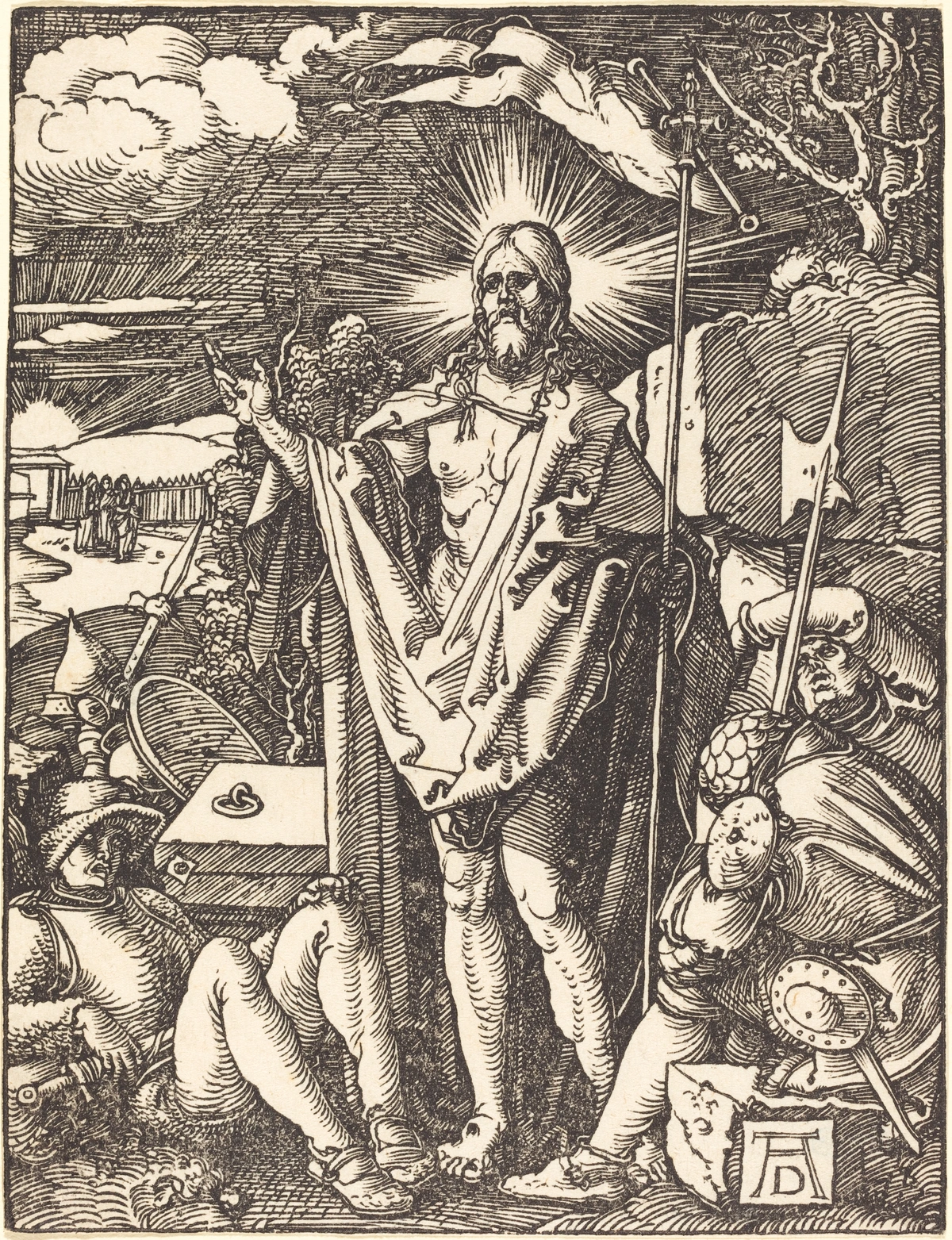
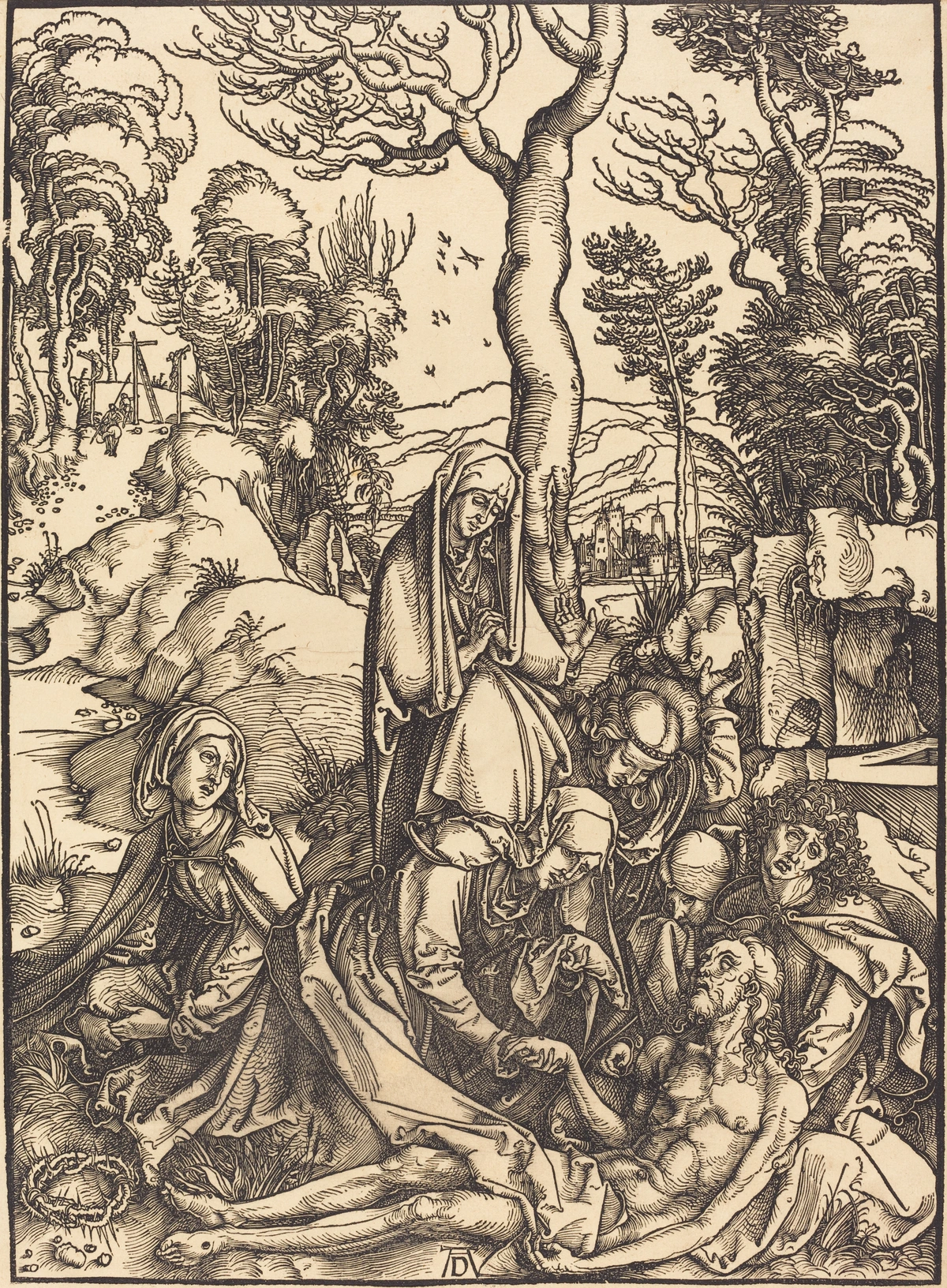
This was Dürer's early and powerful playground, where he developed a bold, graphic style that would become instantly recognizable. His woodcuts are forceful, often dramatic, and designed for immediate, visceral impact. The lines inherently possess a certain thickness and robust strength because, well, you can only carve a piece of wood so thinly along the grain before it becomes fragile and breaks under pressure. This inherent material limitation often forced a certain robustness and directness in the design, a technique that truly "shouts" its message rather than whispers. I often think of it as building an image out of solid, unyielding forms, a testament to art that doesn't shy away from making a powerful statement. When you closely examine a Dürer woodcut, make sure to notice:
- Bold, strong lines: Look for the inherent thickness and sturdy quality of the lines, often showing subtle irregularities that betray the wood grain.
- High contrast: The powerful interplay of strong black and white, often with fewer subtle gray tones, creating a dramatic visual impact.
- Graphic impact: Images that convey a powerful message quickly and dramatically, almost like visual headlines.
Iconic Woodcuts: Power & Dissemination
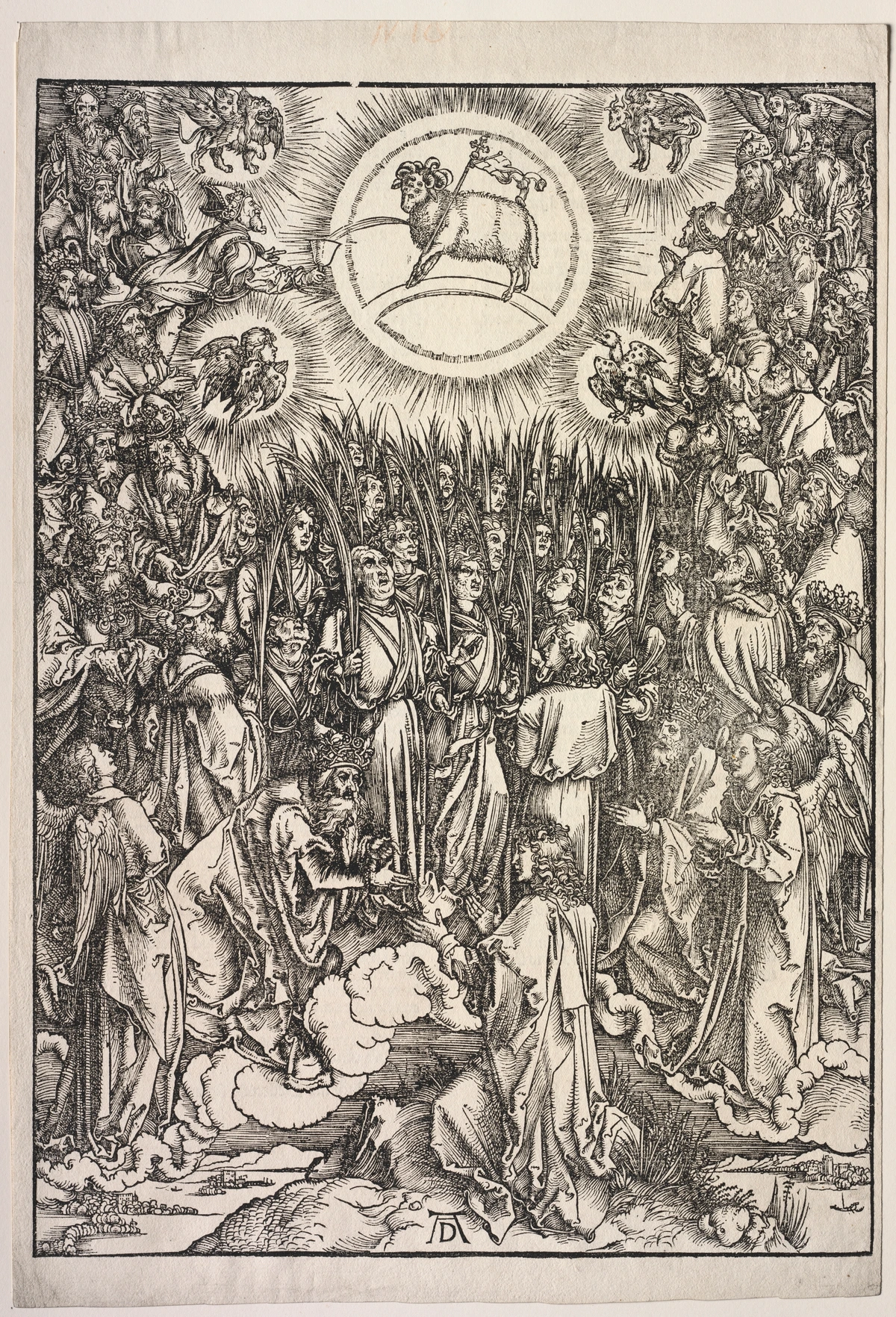
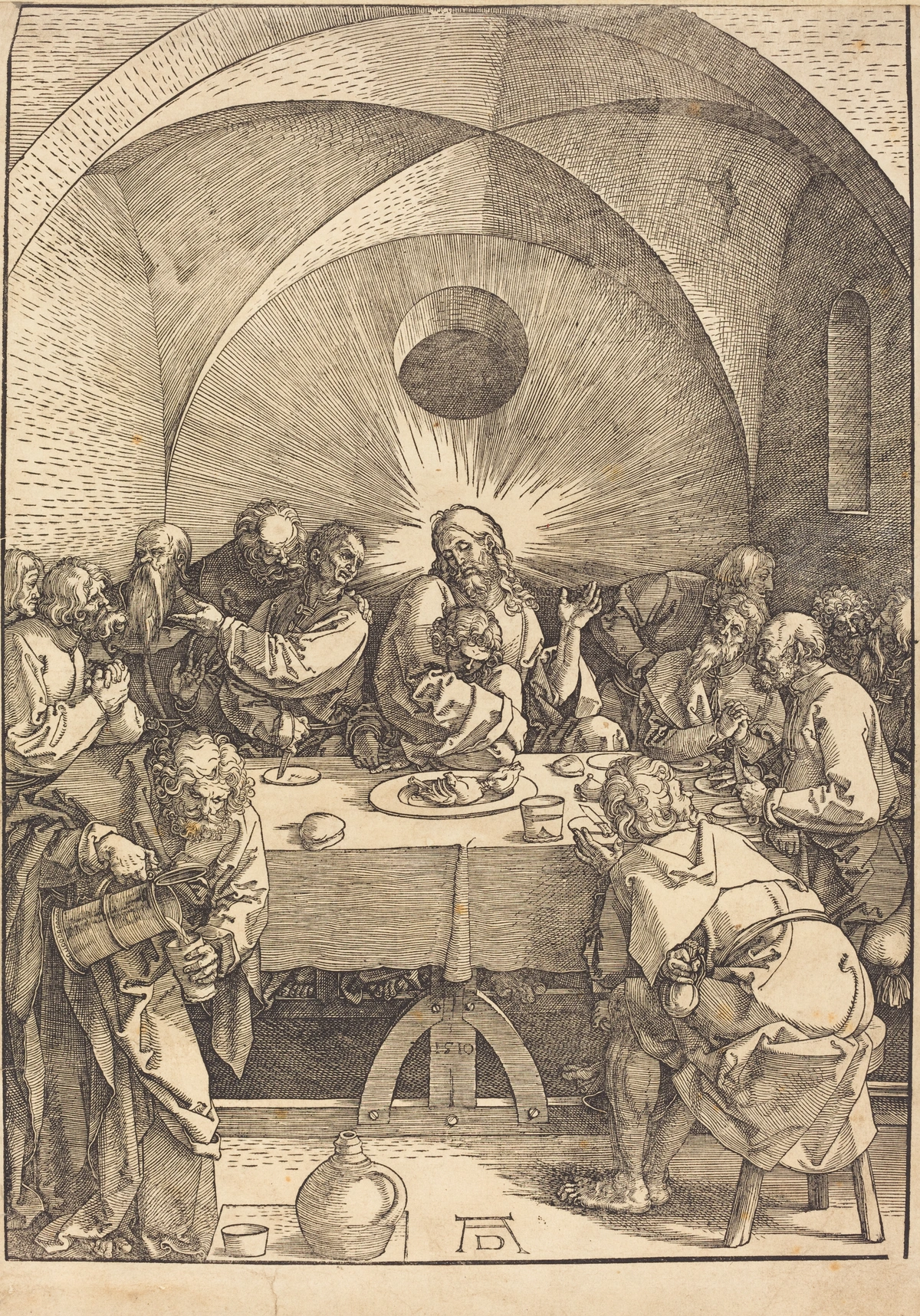
His monumental 1498 series The Apocalypse is the perfect example of this raw power, particularly the iconic The Four Horsemen of the Apocalypse. These are not subtle images; they are visceral, dynamic representations of the biblical Book of Revelation, designed to make an immediate, profound impact on the viewer. You don't just see the chaos and raw energy; you almost feel it physically. This is the undeniable power of the woodcut—strong, graphic storytelling that cuts right to the chase, perfect for spreading potent religious and moral messages during the turbulent era of the Reformation, a time when direct and emotionally charged visual communication was paramount. Dürer's astute involvement in distributing these prints across Europe meant they became powerful tools, sometimes even serving as propaganda for religious reformers, demonstrating the nascent power of mass media.
Equally iconic is Dürer's 1515 woodcut Rhinoceros. What's fascinating here is that Dürer never actually saw a rhinoceros in person. He based this incredibly detailed image on a written description and a rudimentary sketch by an unknown artist, reportedly a witness to the animal's arrival in Lisbon from India. This print, despite its charming anatomical inaccuracies (like the plate-like armor and a small horn on its back), became wildly popular across Europe, showcasing the incredible power of printmaking to disseminate information and exotic imagery to a broad audience, even if somewhat imperfectly. It's a fantastic early example of how mass media can spread both fascination and, inadvertently, misinformation—a concept we still grapple with today, isn't it? It's a testament to his imagination and skill, taking mere words and a second-hand sketch and conjuring a creature so vivid it shaped generations' perception of the animal.
Pushing Boundaries: Dürer's Pioneering Etchings and Drypoints
Dürer's relentless curiosity meant he was never content to merely master existing techniques. His investigative spirit pushed him beyond established methods, leading him to explore the nascent possibilities of what were, at the time, cutting-edge innovations: etching and drypoint. This experimental drive is what truly marks him as an engineering artist, constantly seeking new ways to manipulate materials and tools for artistic effect.
Etching: Drawing with Acid
Around 1515, Dürer was among the very first artists in Northern Europe to experiment with etching. The process, a revelation in its day, works like this: you cover a metal plate (typically iron for Dürer, though copper would later become standard due to its superior malleability and consistent etching properties) with a thin, waxy, acid-resistant coating known as a ground (think of it as a protective, soft, dark varnish, usually made of beeswax, asphaltum, and resin, dark so the drawn lines are clearly visible). Instead of laboriously pushing a burin through solid metal, you simply draw your design into this soft wax with a sharp needle, exposing the metal underneath. This is significantly easier and allows for a much freer, more spontaneous, and painterly line, akin to drawing with a pen or pencil directly on paper.
Here's a simplified breakdown of the etching process:
- Grounding: A metal plate (Dürer used iron) is covered with an acid-resistant ground.
- Drawing: The artist draws the image into the soft ground with an etching needle, exposing the metal underneath.
- Acid Bath: The plate is immersed in an acid bath. The acid bites into the exposed metal lines, creating grooves.
- Stopping Out: Crucially, the artist can selectively paint over certain lines with acid-resistant varnish after shorter immersion times. This protects those lines from further biting, allowing for astonishing variations in line depth and tone. Lines bitten for a short time are shallow and print lightly; lines left in the acid longer are deeper and print darker and bolder.
- Removing Ground & Inking: After sufficient biting, the ground is removed. The plate is then inked and printed like an engraving.
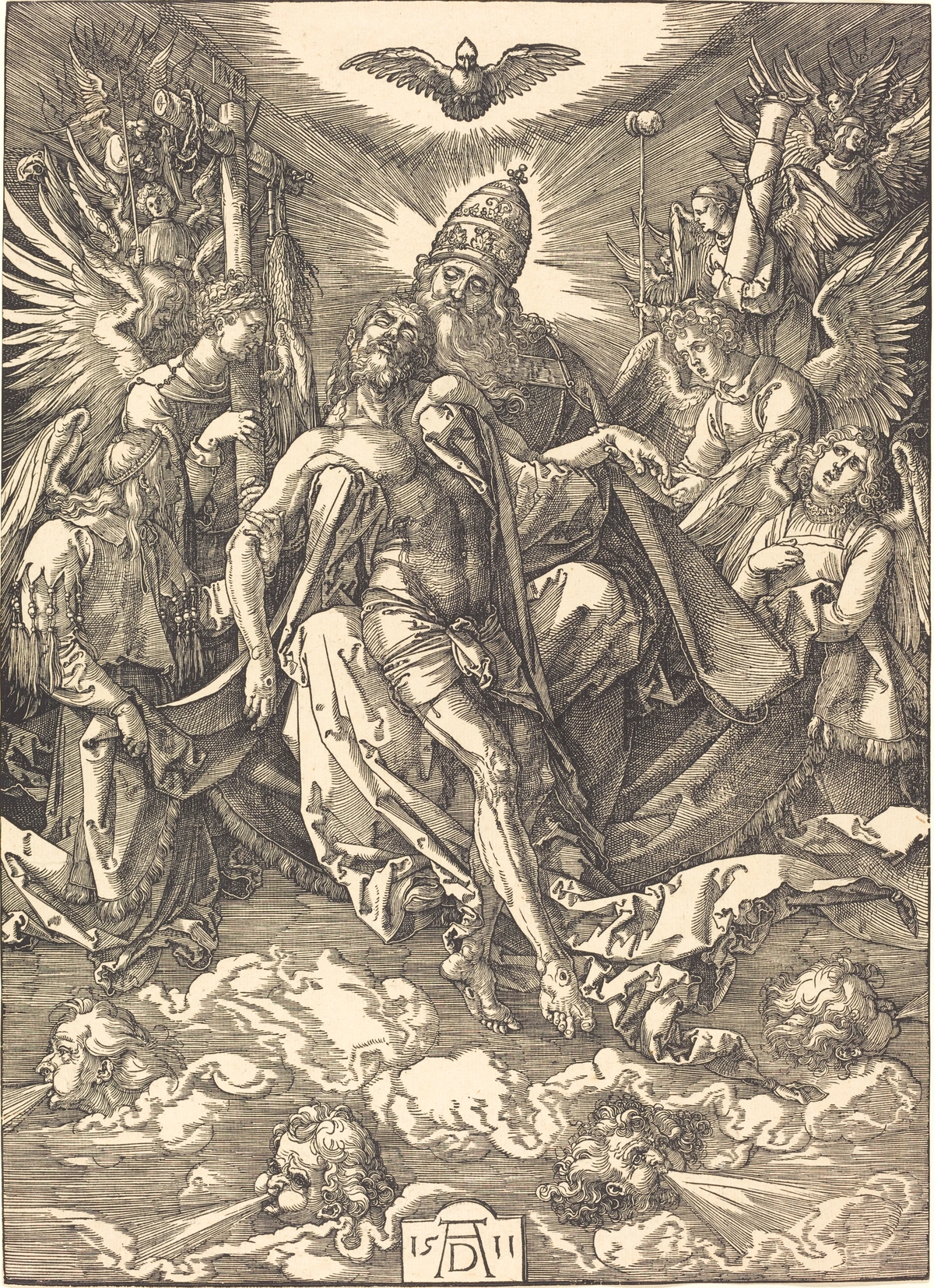
This process enables the artist to achieve a remarkable range of painterly effects and tonal gradations that were difficult to achieve with the burin alone. His etchings, such as The Desperate Man (c. 1520), have a distinctly freer, more sketchy quality, almost like a drawing directly on the plate, conveying a raw, spontaneous energy. It's often interpreted as an anguished self-portrait, capturing a profound emotional state with a fluidity of line that stands in stark contrast to the crisp precision of his engravings.
Drypoint: The Velvety Line
Another intaglio process, drypoint, was also emerging as an experimental technique with roots in goldsmithing. Here, an artist draws directly onto a bare metal plate (again, usually copper or iron) with a sharp, pointed tool, much like an etching needle but without the wax ground or acid. The act of drawing with force directly into the metal creates a distinctive effect: it pushes up a tiny, feathery ridge of displaced metal alongside the incised line. This raised ridge is called a burr. When the plate is inked and wiped, this burr catches and holds a significant amount of ink alongside the incised line, due to its raised nature. This produces a characteristically rich, velvety, soft, and slightly blurred line when printed, quite unlike the crispness of engraving. Imagine drawing with a very soft, smudgy pencil versus a sharp, clean pen—that's the sort of difference the burr makes.
While Dürer's exploration of drypoint was limited, producing only a handful of examples (like St. Jerome by the Willow Tree), these few pieces further demonstrate his insatiable investigative spirit into all forms of linear expression and his constant drive to expand the expressive capabilities of printmaking.
Dürer didn't pursue etching as intensely or for as long as he did engraving, producing only a handful of examples during his lifetime. Perhaps he felt it lacked the precise, controlled line and absolute clarity he so loved in engraving, or perhaps the iron plates available to him at the time didn't offer the permanence and consistent quality of copper that would become standard later for etchers. But, as with so many of his innovations, he was profoundly ahead of his time. Artists like Rembrandt van Rijn, more than a century later, would take etching to incredible new heights, building directly on the groundwork Dürer helped lay, proving that this 'sketchier,' more spontaneous technique could indeed achieve profound artistic depth and emotional power. Other German printmakers like Daniel Hopfer were also experimenting with etching around the same time, showing a broader trend, but Dürer's contributions were among the most significant early steps in recognizing its artistic potential.
The Scholar & Scientist: Dürer's Theoretical Foundations
Beyond his unparalleled technical mastery, Dürer's status as a "Renaissance visionary" is cemented by his profound engagement with theory and science. Unlike many artists of his time who were seen primarily as skilled craftsmen, Dürer actively embraced the role of the intellectual, the theorist, and the researcher. His travels to Italy deeply exposed him to the humanist ideals of the Italian Renaissance, where art, science, and philosophy were seen as interconnected disciplines. He wasn't just observing and copying; he was systematically dissecting and understanding the underlying principles of the visible world.
Master of Proportion and Perspective
Dürer meticulously studied the human form, aiming for an ideal of beauty rooted in mathematical harmony, much like his Italian contemporaries. His treatise, Four Books on Human Proportion (published posthumously in 1528), was a monumental achievement. It offered a comprehensive, systematic approach to depicting the human figure, detailing various body types and their mathematical ratios. This was not just an artistic exercise; it was a scientific endeavor to codify and perfect the representation of the human body, providing a foundational text for artists for centuries to come. His detailed anatomical drawings and studies often directly informed the lifelike poses and muscularity seen in his engravings, such as the powerful physique of the knight in Knight, Death, and the Devil.
Similarly, his Four Books on Measurement (1525) delved into geometry, linear perspective, and architectural design. He demystified complex mathematical concepts, making them accessible to fellow artists and craftsmen. This work taught how to accurately depict three-dimensional objects and spaces on a two-dimensional surface, a skill crucial for the realism and depth seen in his own prints, notably the intricate architectural setting of St. Jerome in his Study. This integration of rigorous geometry and scientific observation into his artistic practice elevated the status of the artist from a mere imitator of nature to a profound interpreter and systematizer of its laws.
Pioneer of Scientific Illustration and Cartography
Dürer's insatiable curiosity extended beyond the human form to the natural world. His exquisite animal studies (such as Rhinoceros) and botanical prints, often rendered with almost microscopic detail, set an entirely new standard for scientific illustration. He approached these subjects with the precision of a natural historian, capturing the unique characteristics of each creature and plant with unprecedented accuracy. This was crucial for the burgeoning fields of botany, zoology, and medicine, where accurate visual records were vital for scientific advancement. For example, his detailed studies of plants and insects found their way into his marginal drawings for Emperor Maximilian I's prayer book, showcasing his meticulous observation.
Furthermore, his understanding of geometry and his ability to render complex forms with precision made him an invaluable figure in early cartography (map-making). Accurate maps were essential for trade, exploration, and military strategy in the rapidly expanding world of the Renaissance. Dürer's contributions, though perhaps less known than his prints, helped to lay the groundwork for more precise and visually sophisticated maps, further demonstrating his role as a universal genius whose work transcended traditional artistic boundaries. While he didn't produce many large-scale maps himself, his geometrical principles profoundly influenced mapmakers of his time, contributing to the shift towards more accurate global representations.
Dürer's Unfolding Legacy: Why His Prints Still Resonate
So, why are we still talking about these intricate lines, carved blocks, and etched plates five centuries later? Because Dürer's groundbreaking work in printmaking fundamentally changed everything—not just for art itself, but for the dissemination of knowledge, the very concept of artistic ownership, and the evolving nature of visual communication. It was a true Renaissance moment, a powerful convergence where art and technology intertwined to reshape society in profound ways. His distinct techniques, each mastered and pushed to unparalleled levels of skill, weren't merely artistic curiosities; they formed the bedrock of Dürer's profound and lasting impact on the world.
Let's break down some of these enduring impacts. I think you'll find parallels that resonate even with our modern, hyper-connected world:
Impact | Then (Dürer's Era) | Now (Contemporary Parallel) |
|---|---|---|
| Mass Media & Accessibility | Prints made high-quality images and complex ideas accessible to hundreds, democratizing art beyond the church and wealthy elite, influencing public opinion and religious discourse. | The internet and social media enable rapid, widespread dissemination of content globally, creating viral phenomena and shaping public discourse. |
| Artist as a Brand & IP | Dürer's prominent monogram 'AD' established artistic authorship, quality, and value. He famously sued for copyright infringement (of his monogram) and produced iconic self-portraits, elevating the artist's status. | Modern logos, influencer branding, digital watermarks, and legal battles over digital art and NFTs. |
| Visual Language & Innovation | Mastered line to create volume, texture, light, and emotion, mimicking painting with purely linear means. Set new standards for scientific illustration, cartography, and artistic observation. | Graphic design, digital illustration, and complex rendering techniques still rely on principles of line, density, and contrast. |
| Synthesis of Art & Science | Integrated rigorous theoretical studies (perspective, anatomy, geometry, human proportion) into artistic practice, raising the intellectual status of the artist to a theorist and visionary. | Contemporary art often explores interdisciplinary connections with science, technology, and philosophy; artists as thinkers and researchers. |
| Global Influence | His prints were collected, copied, and studied across Europe, influencing artists from the Netherlands to Italy, and establishing international distribution networks. | Global art markets, international exhibitions, and the instant sharing of art on digital platforms. |
1. Art for the Masses: The Dawn of Visual Mass Media
Before Dürer, "fine art" was largely confined to unique, one-off paintings or sculptures commissioned by the church, royalty, or the super-rich. Gutenberg’s movable type printing press in the mid-15th century had already revolutionized the spread of text, but Dürer, a visionary entrepreneur, brought that same revolution to images. Prints, unlike unique paintings, could be produced in the hundreds, or even thousands, from a single durable plate or block (matrix). Suddenly, high-quality images and complex ideas were accessible to a much wider audience, transcending many social and economic barriers. This was truly the beginning of mass media for visuals, profoundly shifting art from exclusive luxury to accessible communication.

Dürer wasn't just creating the designs; he was deeply involved in the entire chain, from overseeing the printing to actively managing distribution. He established sophisticated networks with print sellers and booksellers across Europe, ensuring his work reached markets far beyond his hometown of Nuremberg. This astute commercial strategy, combined with the reproducible nature of prints, meant his imagery could rapidly convey everything from religious narratives (crucial during the tumultuous Reformation, where prints became powerful tools for conveying Lutheran theology or Catholic counter-arguments) to groundbreaking scientific observations and the burgeoning ideas of humanism. His ability to distribute his work, sometimes personally on his travels to places like Venice and the Netherlands, built a reputation that made him an international art star.
Florence, Venice, and Augsburg were also important centers for printmaking in Dürer's time, with artists like Marcantonio Raimondi (whom Dürer famously sued) in Italy influencing and being influenced. But Nuremberg, largely thanks to Dürer, became synonymous with innovation and artistic excellence in the medium. He wasn't just creating beautiful objects; he was creating accessible conduits for ideas, much like how the internet and social media function today, democratizing access and enabling widespread influence. When I think of how quickly images and ideas can 'go viral' now, I see Dürer's prints as the original viral content, sparking conversations and shifting perspectives across continents.
2. The Artist as a Brand: Intellectual Property Pioneer
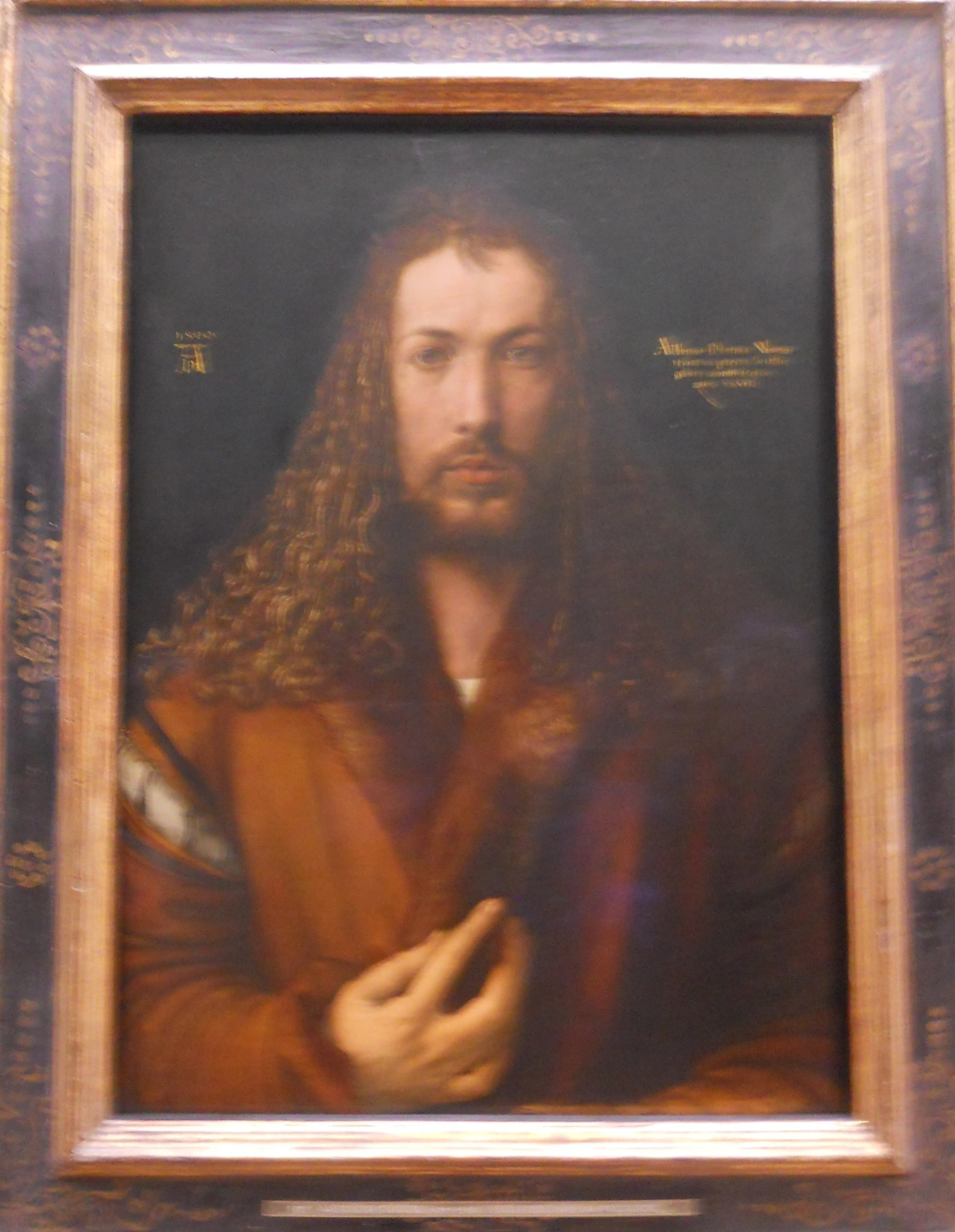
Dürer was undeniably one of the very first artists to consistently sign his work with a prominent, highly recognizable monogram—his famous interlocking 'AD'. This was far more than just a signature; it was a powerful brand, a distinctive mark of quality and authorship that became instantly recognizable and highly valued throughout Europe. He was incredibly self-aware as an artist, producing a series of iconic self-portraits (many as prints), which dramatically elevated the artist's status from a mere craftsman to that of an intellectual, a theorist, and a visionary. He understood, perhaps better than anyone before him, the intrinsic value of his name, his unique style, and his intellectual property.
His commercial strategy wasn't just about making art; it was about building an empire. He not only sold his prints directly to wealthy patrons and a wider public but also cultivated robust relationships with print dealers and booksellers. This created a thriving, international market for his reproducible art, establishing a model for artistic entrepreneurship that was centuries ahead of its time.
This foresight became strikingly clear when an Italian artist, Marcantonio Raimondi, began brazenly copying Dürer's prints—even replicating his distinctive 'AD' monogram. Dürer, incensed, actually sued him. It was a landmark case in 1506, one of the earliest recorded instances of an artist fighting for their copyright. While Dürer successfully won an injunction against Raimondi's use of his monogram, the court didn't explicitly prohibit the copying of his images themselves. Nevertheless, this legal battle set a crucial precedent for artistic ownership and the protection of an artist's unique identifier. Dürer, alongside writing influential theoretical treatises like Four Books on Measurement and Four Books on Human Proportion, was not just an artist; he was an astute entrepreneur, a pioneering legal advocate, and a fiercely independent innovator, keenly aware of his artistic and commercial legacy. His approach influenced countless artists to follow, from famous Renaissance artists to contemporary creators, solidifying the idea of individual artistic ownership. When I see modern discussions around digital watermarks or NFTs (which, I'll admit, I'm still a bit skeptical about, honestly, but the idea of verifiable ownership and unique identification is clearly centuries old), I can't help but think of Dürer. He was battling these concepts long before blockchain was even a distant sci-fi dream.

3. The Triumph of Line: A New Visual Language
More than anyone before him, Dürer unequivocally demonstrated that you could use line as a primary element of art to create absolutely everything: breathtaking volume, intricate texture, luminous light, profound shadow, and deeply resonant emotion. Heavily influenced by his travels to Italy and his meticulous study of classical art and Renaissance masters like Giovanni Bellini, he rigorously integrated principles of perspective, human anatomy, and geometry into his printmaking. This synthesis of art and science allowed him to portray the human form and complex spaces with unprecedented realism, a hallmark of the Northern Renaissance's empirical spirit.

He essentially invented a complex and sophisticated visual grammar of linear techniques: hatching (parallel lines drawn in a single direction), cross-hatching (intersecting sets of parallel lines, often at different angles, to build up rich tones and textures – imagine drawing lines, then drawing another set across them at an angle; that’s cross-hatching!), stippling (creating tone and texture using constellations of dots), and various other subtle dot-and-flick techniques. With these, he could mimic the full tonal range and painterly effects of drawing or painting purely with lines. He possessed an almost scientific understanding of how the density, direction, and weight of these lines could create the illusion of smooth skin, rough fabric, gleaming metal, or transparent glass. This was a level of graphic sophistication that still influences illustrators, graphic designers, and printmakers today, proving that a line isn't just a boundary—it's an entire world of expression.
His rigorous studies of nature and the human form, often meticulously captured in exquisite animal studies and botanical prints, set an entirely new standard for scientific illustration, cartography, and artistic observation. Dürer truly showed how a carefully carved or etched line, in the hands of a genius, could build entire worlds and convey complex narratives. It's truly fascinating to see those ancient principles of line, density, and contrast echoed in the digital canvases of today; sometimes I feel like I'm wrestling with the very same fundamental questions of form and expression when I'm working on my own pieces.

Frequently Asked Questions (FAQ) About Dürer's Printmaking
Got more questions swirling in your mind about this Renaissance genius? We've got you covered. Hopefully, these shed a little more light on his incredible legacy.
What are Albrecht Dürer's most famous prints?
His most celebrated prints are undoubtedly the three Meisterstiche (master engravings) from 1513-1514:
- Knight, Death, and the Devil
- Melencolia I
- St. Jerome in his Study
These represent the pinnacle of his engraving skill. Equally iconic and popular are his woodcut series The Apocalypse (especially The Four Horsemen of the Apocalypse from 1498), which brought him early fame, and his standalone woodcut Rhinoceros from 1515.
How can you tell the difference between a Dürer woodcut and an engraving?
The easiest way to tell is by looking closely at the lines and the overall feel of the image. The fundamental difference lies in how the image is created on the matrix and how the ink is transferred.
Feature | Engraving | Woodcut |
|---|---|---|
| Lines | Incredibly fine, sharp, precise, hair-thin; consistent. | Bolder, thicker, more robust, sometimes with subtle irregularities. |
| Tonal Range | Wide range of subtle grays to deep blacks, achieved through complex hatching and stippling. | High contrast between strong blacks and whites; fewer subtle mid-tones. |
| Texture/Feel | Crisp, often with a subtle metallic sheen from ink pulled from deep grooves. | More graphic, direct, can show slight wood grain. |
| Material Limitation | Malleability of copper allows for intricate detail and fine lines. | Wood's fibrous nature limits how thin lines can be carved without breaking. |
In essence:
- Woodcut lines tend to be bolder, thicker, and more solid, often with subtle irregularities from the wood grain. This reflects the inherent limitations of carving wood, which breaks if cut too thinly. Woodcuts have a stark, graphic quality with strong contrasts between black and white, as the ink sits on the raised surfaces.
- Engraving lines, by contrast, are incredibly fine, precise, and sharp. They show delicate hatching and cross-hatching, and intricate stippling used to create smooth, subtle shading and texture. Engravings generally achieve a much higher level of detail and tonal gradation, often with a distinct crispness or even a subtle metallic sheen where the ink is pulled from deep, polished grooves. Under magnification, woodcut lines might appear slightly jagged or fibrous, while engraving lines are clean, sharp incisions. It’s almost like the difference between a bold marker drawing and an incredibly detailed, delicate pencil sketch.
Did Albrecht Dürer invent printmaking?
No, he absolutely did not invent printmaking. Woodcut printing had existed for decades, and basic engraving techniques were commonly used by goldsmiths long before Dürer. His revolution was not one of invention, but of elevation, perfection, and popularization. He took these existing crafts, which were often seen as mere functional illustration, and transformed them into a powerful, expressive, and intellectually rigorous art form. He demonstrated a potential for artistic depth and mass communication that nobody else had fully seen or exploited, perfecting existing methods and truly making them his own. He didn't invent the tools, but he showed everyone what they could really do in the hands of a genius.

What is a burin?
A burin is the primary tool used for engraving metal plates. It's a specialized, short steel rod with an extremely sharp, often diamond-shaped or lozenge-shaped tip, fitted into a rounded wooden handle. The artist pushes this tip through the highly polished metal plate (usually copper for engraving), guiding it with immense precision and force to create the grooves that will hold the ink. Unlike a knife, which might tear or lift metal, a burin is designed to cleanly shave away tiny slivers, producing a crisp, controlled line with distinct edges. Mastering the burin requires immense physical control, a steady hand, and a lifetime of dedicated practice to achieve the varied lines, depths, and textures seen in Dürer's masterful engravings. The sheer physical effort and unwavering dedication required to wield this tool to such perfection is truly astounding.
credit, licence
What is a proof print?
A proof print is an early impression of a print, taken from the matrix (woodblock or plate) while the artist is still working on it. These are often made to check the progress of the design, identify areas for further refinement, or test different inking and printing techniques. Proofs can be highly valuable as they offer unique insights into the artist's creative process and technical decisions, often showing variations that differ from the final published edition. They're like seeing the drafts of a masterpiece, revealing the artist's journey.
What is the difference between a woodcut and a wood engraving?
While both involve carving wood for relief printing, they are distinct techniques with different approaches and capabilities:
Feature | Woodcut | Wood Engraving |
|---|---|---|
| Wood Cut | Plank-grain (with the grain) | End-grain (across the grain) |
| Tools | Knives, gouges | Fine engraving tools (like burins) |
| Detail | Bolder, more robust lines, limited fine detail. | Extremely delicate, precise lines, capable of fine detail. |
| Tonal Range | High contrast, strong blacks and whites. | Smoother tonal gradations, can mimic copper engraving. |
| Historical Context | Predates Dürer, matured with him (he used plank-grain). | Largely developed after Dürer's time (by the 18th century, with artists like Thomas Bewick). |
Key takeaway: Dürer primarily worked with traditional plank-grain woodcuts. Wood engraving on end-grain blocks, which allowed for burin-like detail in relief printing, emerged later as a distinct and highly refined technique.

Was Albrecht Dürer a guild master?
Yes, in a way that reflects the complex art world of his time. Dürer was born into a family of goldsmiths and received rigorous training within the traditional workshop system of Nuremberg. While printmaking itself wasn't always strictly regulated by a single, dedicated guild in the same way painting or sculpting might have been, his comprehensive training in drawing, painting, and particularly goldsmithing provided him with an unparalleled foundation. He operated his own highly successful workshop, employed skilled assistants, and was very much a "master" in his own right, often seen as an intellectual rather than just a craftsman. His entrepreneurial approach to producing and selling prints, often outside the immediate control of a single guild, actually gave him a unique independence that sometimes circumvented the traditional strictures for painters. He skillfully carved out his own unique and powerful position in the art world.
credit, licence
What is the difference between an original Dürer print and a later impression?
This is a really crucial distinction, especially for collectors and art historians! An original Dürer print is an impression made during his lifetime or very shortly after his death, usually under his direct supervision or by his highly skilled workshop. These prints, pulled from the original woodblock or copper plate (matrix) when it was fresh and unmarred, are considered authentic and command the highest artistic and monetary value. Key indicators include:
- Paper Quality and Watermarks: Early impressions are often on high-quality paper with specific watermarks used during Dürer's period. Watermarks, embedded into the paper during its manufacture, are unique to specific paper mills and dates, providing vital clues for authentication. Collectors and scholars meticulously cross-reference these marks with known Dürer impressions.
- Ink Quality: The ink on early impressions is typically rich, deep, and evenly distributed, showing no signs of degradation or fading. It should be consistent with the known pigments and binders used in his workshop.
- Plate/Block Condition: Lines are crisp and sharp, showing no signs of wear, re-working, or damage to the matrix. With later impressions, lines can appear faint or broken, and accidental scratches or repairs might be visible.
- Provenance: A documented history of ownership that traces the print back to Dürer's time is paramount. This can involve sale records, exhibition catalogs, and archival documents.
A later impression (or 'restrike'), by contrast, is a print made much later, sometimes centuries after Dürer's death, using the original block or plate. While technically still from the original matrix, these often lack the crispness, clarity, and subtle details of early impressions. This is due to wear and tear on the plate/block over time, or sometimes even re-working or repairs that alter the original integrity. They are generally of much lower artistic and monetary value than early, lifetime impressions. Factors like condition, the specific paper used, and detailed provenance are absolutely key in determining the authenticity and true value of a Dürer print.
How did Dürer's travels influence his printmaking?
Dürer's travels, particularly his two journeys to Italy (c. 1494-1495 and 1505-1507), were profoundly influential and transformative for his printmaking. These experiences exposed him directly to the classical art of antiquity, the revolutionary Renaissance theories of perspective and human anatomy, and the works of Italian masters like Giovanni Bellini. This exposure significantly refined his understanding of human proportion, spatial depth, monumental composition, and the ideal human form, all of which he then masterfully integrated into his printmaking. His travels also broadened his artistic network and expanded his market, allowing him to observe different printmaking traditions, learn new techniques, and, crucially, distribute his own works more widely across Europe, further cementing his international reputation as a leading artist and intellectual. His interactions with Italian artists, and his study of their mathematical approach to art, undoubtedly shaped the meticulous precision evident in his later engravings.
Where can I see Dürer's prints today?
Dürer's prints are highly sought after and are proudly held in major museum collections worldwide. If you're keen to see them in person, some of the most prominent institutions with significant Dürer holdings include:

- The British Museum (London, UK)
- The Metropolitan Museum of Art (New York, USA)
- The National Gallery of Art (Washington D.C., USA)
- The Albertina (Vienna, Austria)
- The Kupferstichkabinett (Berlin, Germany)
- Rijksmuseum (Amsterdam, Netherlands)
- Städel Museum (Frankfurt, Germany)
Many university art museums and smaller galleries also possess Dürer prints, so it's always worth checking local collections if you're keen to experience their intricate beauty firsthand.
Did Dürer use color in his prints?
Generally, Dürer's prints were conceived as sophisticated black-and-white images, relying purely on the intricate interplay of line, tone, and texture to convey form, light, and emotion. He really pushed the expressive power of pure monochrome. However, it was a very common practice in the 15th and early 16th centuries for patrons to have prints hand-colored after purchase by specialist workshops. While Dürer himself likely oversaw or approved some hand-coloring, the vast majority of surviving colored prints were not colored by his own hand but by skilled colorists working independently or in other workshops. He pushed the possibilities of pure monochrome to such an extent that, in his artistic vision, adding color might even have detracted from the intricate linear work he so meticulously crafted.














The Final Cut: A Visionary for All Time
When I look at Dürer's prints now, I no longer see an impossible, machine-made image. Instead, I see the profound artistry of a human mind driven by incredible focus, boundless patience, and a relentless pursuit of perfection. I see an exceptionally insightful artist who understood, at a fundamental level, that a simple line—when carved or etched with intention and genius—could contain an entire universe of thought, emotion, and intricate detail. He was undoubtedly a master of the Northern Renaissance, a brilliant contemporary of other famous Renaissance artists, yet his singular legacy in printmaking is uniquely and powerfully his own.
Dürer fundamentally changed our understanding of art itself. He showed us that art wasn't solely about the precious, singular object, destined for a select few. It could be reproducible, widely distributable, and genuinely democratic. In his meticulously crafted lines, you can trace the very genesis of so much of our visual world: the posters on your wall, the illustrations in the books you cherish, the images you effortlessly scroll past every day, and even the complex concept of an artist's brand (which, speaking as an artist myself, is something I'm constantly wrestling with and refining). He didn't just proficiently use the most advanced technologies of his era; he actively shaped how that technology would forever be harnessed for artistic expression, mass communication, and the sharing of ideas.
The next time you encounter a Dürer print—whether in a quiet museum gallery or even just a reproduction online—take a moment to truly pause. Lean in. See beyond the surface. Try to perceive the universe contained within those carefully carved and bitten lines. You might just see the future of art, beautifully and painstakingly, being born right there before your eyes. And perhaps, you'll even find a connection to the enduring power of line and form that resonates in the art of today, including some of the pieces you can buy and discover in the timeline on this very site. If you're ever in the area, you can also often find some of my work, and the work of artists I admire, at the den-bosch-museum.