Donald Judd's Specific Objects: Art Redefined, Beyond Minimalism
Explore Donald Judd's "Specific Objects": his radical vision, industrial materials, rejection of Minimalism, the Marfa project, and lasting influence on art, design, and architecture.

Donald Judd's Specific Objects: Redefining Art Beyond the Canvas
Let's get one thing straight. The first time I encountered a Donald Judd piece – maybe a series of stacked, gleaming boxes or a bold, cantilevered form on a wall – my unfiltered thought was, "Okay... and? Is this even art?" I know, I know. It's a common, almost protective reflex when confronted with something that seems to demand so little, yet challenges so much about what we expect art to be. If you've ever felt that initial shrug, that dismissive "huh?", you're absolutely not alone.
But stick with me, because that initial perplexity is actually the perfect entry point into one of the most radical, influential, and surprisingly profound shifts in modern art history. This isn't just about "boxes"; it's about a complete re-evaluation of what an artwork can be, how it functions, and its undeniable presence in our world. And it's a journey I personally took from skepticism to a deep appreciation for his unwavering commitment to his vision. This article will explore Donald Judd's groundbreaking concept of "Specific Objects," dissecting why his work challenged traditional art, how he rejected labels like 'Minimalism,' and why his influence continues to resonate through furniture, architecture, and contemporary art itself.
The Journey Away: From Illusion to Assertion
Before he ushered in this revolution, Judd, like many emerging artists, explored traditional mediums. I've seen some of his early paintings, and they are quite beautiful, often abstract, but still undeniably paintings – grappling with composition, color, and illusion on a flat surface. During this period, while also honing his astute critical mind as a prolific art writer, he grew increasingly dissatisfied. He concluded that these traditional forms, whether painting or even traditional sculpture, were inherently tied to illusion and representation – ideas he sought to dismantle entirely. He wasn't just trying to create a new kind of sculpture; he was, in his own rigorous way, trying to blow up the very categories of art altogether. He yearned for art to be actual, not a window into another world or a canvas for the artist's psyche. His deep-seated desire for art to simply be rather than represent fuelled his revolution; he found traditional sculpture too often concerned with pedestals, narrative, and an implied 'inside' and 'outside' that distracted from the object's physical reality.
His radical shift pushed against the prevailing tides of his time. To truly grasp what Judd was pushing against, we need a quick rewind to the art world he emerged from. The dominant force was Abstract Expressionism – think Jackson Pollock's chaotic drips and splatters, Willem de Kooning's fervent brushstrokes, or Mark Rothko's luminous color fields. This was art steeped in the artist's emotion, the grand gesture, the psychological drama unfolding on the canvas. It was about inner worlds, the sublime, and often, a hefty dose of angst. While powerful and influential for many artists, Judd saw this as a reliance on illusion and subjective emotionality.
While other movements like Pop Art also challenged the status quo with their engagement in mass culture and commercial imagery, Judd's rebellion was primarily against the inherent illusionism and subjective emotionality he saw as limiting traditional art forms. His quest was for art to exist as a factual presence in the room, not a story or an emotional outburst. This was like the quiet, deliberate cleanup crew after a very messy, emotional party, shedding all sentimentality, narrative, and illusion. If you want a deeper dive into what minimalism means in art generally, there's an extensive guide for that.
Here's a handy table summarizing the shift:
Feature  | Abstract Expressionism | Judd's Specific Objects |
|---|---|---|
| Emotional Tone | Emotional, energetic, personal, often spiritual, angsty | Intellectual, calm, impersonal, factual, present, self-evident |
| Visual Characteristics | Complex, gestural, 'messy,' unique, painterly | Simple, geometric, 'clean,' systematic, whole, industrial |
| Artist's Role | The tortured genius, whose hand and psyche are visible, expressive | The detached designer/theorist; focus on conception over manual labor, emphasizing the idea rather than the physical touch |
| Goal | Express inner worlds and emotion; create subjective experience, illusion | Present an object as a real thing in real space; create objective, self-evident presence |
More Than "Minimal": Why Donald Judd Rejected the Label
Given the aesthetic simplicity of his work, it's easy to see why many art historians would place Judd within the burgeoning 'Minimalist' movement. But Judd himself would have recoiled at me even using the word 'Minimalism'. He famously loathed labels, believing they pigeonholed artists and reduced complex ideas to simplistic catchphrases. For Judd, his work wasn't "minimal" – a suggestion of reduction or lack, implying something had been taken away, a kind of artistic austerity. To him, this fundamentally misrepresented his intent.
His objection was nuanced: a "minimal" artwork implies an essence that was somehow stripped bare, a distilled version of something more complex. Judd's works, however, were not about stripping away; they were about a complete, robust, self-evident reality. His objects were complete in their innate existence, not stripped-down versions of something else. They simply are. To label them "Minimalist" was, in his view, to miss the entire point, to suggest they lacked something rather than asserted everything they were. He was searching for absolute specificity, where an object's precise form, material, and spatial relationship was its content, requiring no further interpretation or reduction. This uncompromising stance also informed his sharp critiques of other artists, always pushing for a rigorous honesty of form and material.
This distinction is crucial to understanding why he stood apart, even as many art historians categorize him within the definitive guide to minimalism in art. He was a man of fierce opinions, a brilliant writer whose critical essays are as impactful as his art – not just for what he said, but how he said it: with unyielding logic, directness, and a relentless challenging of art world orthodoxies. His focus was on presence, not representation; on the object's innate qualities, not its symbolic meaning.
The Radical Idea: Beyond Sculpture, Into 'Specific Objects'
This is the beating heart of Judd's revolutionary contribution, and one of the key things Donald Judd is known for. In his hugely influential 1965 essay, "Specific Objects," Judd laid out his manifesto with the clarity of an engineer's blueprint. He argued that painting was, by its very nature, "a bit of a lie," creating an illusion of depth on a flat surface, while traditional sculpture too often mimicked forms or was bogged down in historical symbolism. He wanted to leapfrog these historical categories entirely, declaring traditional painting and sculpture dead for his purposes.
He articulated this through a series of defining characteristics for his Specific Object, a three-dimensional work that stands entirely on its own terms. It asserts its pure, undeniable presence. How does it do this?
- It isn't a painting: It possesses real, actual volume and occupies concrete space, rejecting the illusionistic trickery of two-dimensional art. No painted landscape here; just the tangible object itself.
- It isn't a sculpture (in the traditional sense): This is crucial. It's not carved, molded, or composed of arranged parts that represent something else. Unlike traditional sculpture, which often involves the artist's hand shaping material to depict something (like a figure or a narrative), Judd's objects are defined by their industrial fabrication and their inherent material properties. A Judd box isn't a sculpture of a box; it simply is a box. It has no internal composition or hierarchy of parts; it is a single, unified entity. The focus is on the object's physical actuality, not on what it might allude to or symbolize.
- It is a unified whole (a 'gestalt'): This concept, known as a gestalt, is crucial. A gestalt is a unified whole where the whole is perceived as more than (or fundamentally different from) the sum of its parts, and crucially, cannot be broken down without losing its essential identity. Think of it like a specific melody – if you change just one note, it's fundamentally a different melody, even if some parts remain. Similarly, a Judd object's color, material, precise dimensions, and form are inextricably linked, one single, indivisible thing. Changing one element would fundamentally alter the object's identity. Its inherent qualities – its exact color (perhaps a rich cadmium red or a deep cobalt blue), its texture, its edges, its volume – are its entire subject. This concept of the artwork existing as a pure, self-contained entity, demanding to be experienced for its literal qualities, is often referred to as objecthood. It was revolutionary because it liberated art from the need to be symbolic, narrative, or expressive, allowing the artwork itself to be the primary experience.
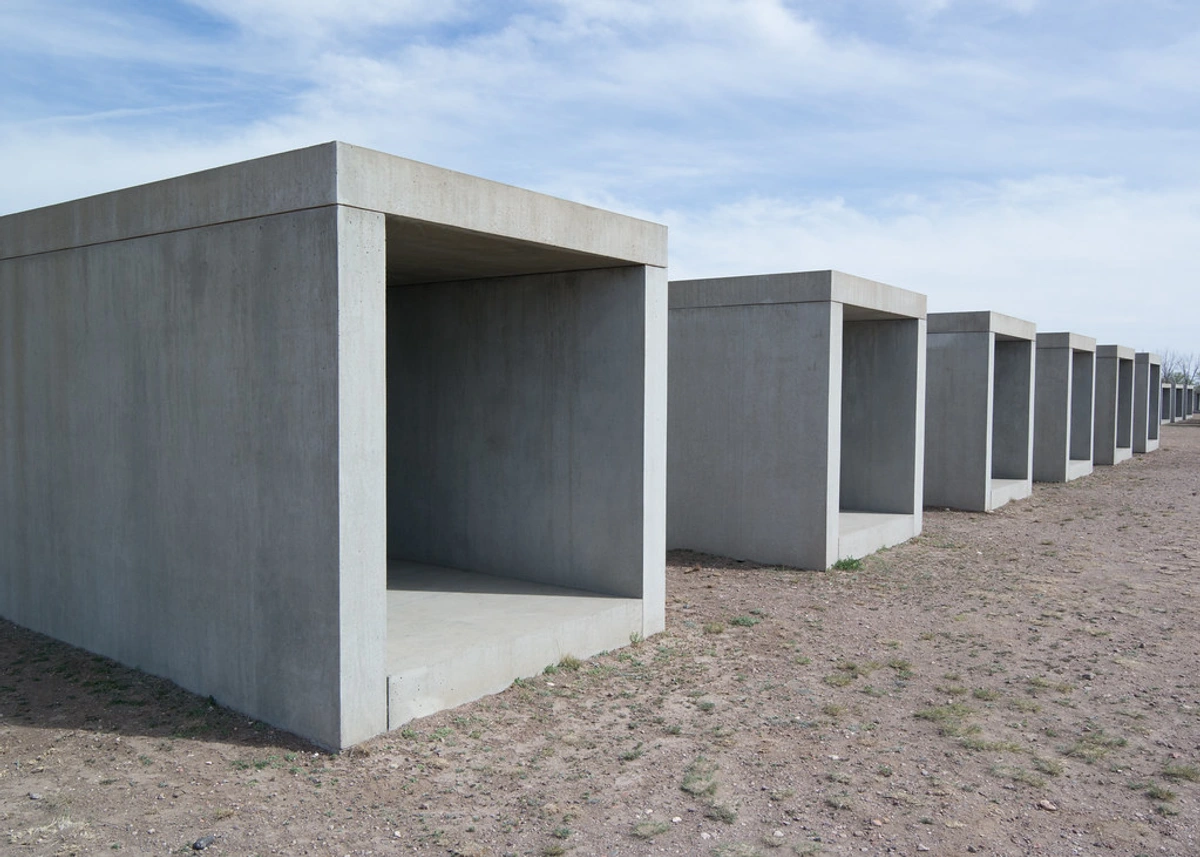
I often think of it like this: imagine a perfectly smooth, unadorned rock. You don't ask what the rock means, or what it represents. You simply observe its shape, its texture, its weight, how the light hits it. That rock exists purely as itself. A traditional statue of a person, however, is a representation. You see the bronze or marble, but your mind immediately jumps to 'person,' 'hero,' or 'myth.' You look through the material to the meaning. A Judd box, like his famous "stacks" of galvanized iron from the mid-1960s (often varying in height and number), or his wall-mounted "progressions" of anodized aluminum boxes (for example, his iconic 100 untitled works in milled aluminum, installed at the Chinati Foundation in Marfa), forces you to confront its 'box-ness' – its precise dimensions, its specific color, its material, its volume, the way light plays on its surface, and how it directly interacts with the room. It demands that you look at it, not through it. It exists purely as an object among other objects, asking nothing more than your direct observation. This rejection of representation is a key aspect of the definitive guide to minimalism in art.
Industrial Materials, Precise Fabrication, and the Philosophical Act of Delegation
Having established the theoretical framework for his "Specific Objects," Judd then turned to their physical realization. Donald Judd's choice of materials was a monumental part of his artistic statement and a direct answer to the question "What materials did Donald Judd use?" He deliberately eschewed the hallowed marble, bronze, and oil paint of fine art for industrial materials: plywood, copper, galvanized iron, anodized aluminum, and Plexiglas. Why? Because these materials carried no historical fine art baggage. They were honest, straightforward, and associated with manufacturing and construction, not with the romantic, expressive artist's studio. Their inherent qualities – reflectivity, durability, precise edges, consistent color, and the ways they interacted with light – were integral to the work, not merely a medium for a preconceived image. For instance, anodized aluminum offered a consistent, non-painted color that was intrinsic to the metal itself, creating an undeniable physical presence. Judd's meticulous drawings often included detailed specifications for how light would interact with these surfaces, making the environment an extension of the work. His famous "stacks" often utilized galvanized iron, chosen for its industrial neutrality and consistent finish, allowing the object's form to speak for itself.
This led to another incredibly radical move, one that still provokes debate: Judd didn't build most of his mature works himself. He would create incredibly precise drawings and specifications, then send them off to skilled fabricators – engineers, welders, cabinetmakers. This practice horrified purists who believed in the 'artist's touch' as the essence of creation. But for Judd, it was perfect. It deliberately removed his ego and his physical hand from the final product, ensuring it was an impersonal, perfectly realized object based purely on an idea. The artistic act, for him, was in the conception and design, not in the manual labor. This deeply challenged conventional notions of authorship, originality, and the artist's singular genius, reframing the fabricator as a crucial, almost philosophical collaborator in the realization of the conceptual design. For instance, achieving the seamless, precise corners or the exact, uniform surface finish on his metal boxes often required specialized industrial techniques that went far beyond what a single artist's studio could provide. It was a profound statement about the dissociation of sensibility – the idea that the conceptual act is distinct and primary to the physical execution. Any deviation from his exact specifications wasn't just a practical error; it was a philosophical failing, undermining the very conceptual integrity of the piece. This discussion continues to evolve in what is design in art.
His works often came in series, exploring variations in color, material, and spacing with meticulous, almost mathematical precision. This focus on systems, repetition, and seriality was a key feature of his approach, pushing art closer to the rigorous logic of design and even architecture. For instance, his "untitled" (1966) wall-mounted boxes, precisely spaced, explore the relationship between positive and negative space with unyielding logic. In his insightful critical writings – often published in Arts Magazine or Art International, but also in books like Donald Judd: Complete Writings 1959-1975 – Judd voiced strong opinions on art criticism, museum practices, and the integrity of architectural spaces, reinforcing his comprehensive vision for art's role in the world. He was a keen observer of the built environment, believing art should exist in harmony with it, influencing discussions around public art and urban planning; these writings were an extension of his art, articulating the same rigorous principles.
More Than Boxes: Furniture, Architecture, and a Whole Town in Texas
Judd's ideas couldn't be contained within gallery walls. He applied the same principles of pure form, honest material, and essential function to another field: furniture. His chairs, desks, and beds are famously stark, geometric, and often, I'll admit, not wildly comfortable. But for Judd, that discomfort wasn't a flaw; it was a deliberate statement. His furniture wasn't meant to prioritize ergonomic curves or plush upholstery; it was a three-dimensional exploration of space and form that also happened to be functional. They prioritize clarity of form and material integrity, challenging our conventional notions of domestic comfort and asserting the object's formal reality even in a utilitarian context. This deliberate lack of traditional comfort can be seen as a critique of bourgeois aesthetics, forcing the user to confront the object's formal qualities rather than simply sinking into it. His furniture is a fascinating case study in the blurry line between art and design, something you can explore further in this piece on Donald Judd's furniture design.

His ultimate, monumental project was Marfa, Texas. In the 1970s, Judd, tired of the commercial art world's constraints and the fleeting nature of temporary exhibitions, began buying vast tracts of land and defunct army buildings in the remote desert town. He chose Marfa specifically for its isolation, the vastness of the landscape, and the existing, robust military structures that could be repurposed. His vision was to transform Marfa into a permanent, unparalleled home for his work and that of a few other like-minded artists. This wasn't a casual purchase; it was a deeply intentional act to control the entire context – the art, the architecture, the vast, open landscape, and even the precise lighting conditions – allowing them to exist in perfect, permanent dialogue. The logistical challenges were immense: securing funding, restoring dilapidated military buildings in a harsh, remote climate (requiring innovative solutions for material preservation against the elements), and convincing a small, isolated community of his ambitious vision. But through sheer will and meticulous planning, he created a pilgrimage site for art lovers and the ultimate, tangible expression of his rigorous, site-specific vision. Marfa is not just a collection of art; it's an immersive experience, a living manifesto of his artistic philosophy, profoundly embodying his concerns for land use, conservation, and the integration of art with its environment. It's an answer to "How did Donald Judd influence modern art?" that extends far beyond the gallery wall. While Frank Lloyd Wright sought to integrate buildings into their natural surroundings, Judd's approach at Marfa was more about integrating art with its surroundings by carefully curating and controlling the entire environment, making the landscape itself an extension of the artwork's viewing conditions.
The Judd Legacy: Why We Still Care
So, back to that initial "huh?". Why has this seemingly simple art, these "boring boxes," had such a profound and lasting impact? Because Judd forced a fundamental change in the conversation about art. He made us stop looking through the art for a hidden meaning, a narrative, or an emotional outpouring, and start looking at the art itself. He taught us that an object, presented without pretense, can be deeply compelling. He distilled art to its essence, revealing profound complexity in apparent simplicity, answering the enduring question of "What is a Specific Object in art?" with bold, unequivocal presence. His ideas align with fundamental questions about art's autonomy and purpose, reinforcing a strictly formalist approach that found beauty and meaning in the object itself. Formalism, simply put, is the belief that an artwork's meaning and value derive solely from its visual form and composition rather than its subject matter or external context. You're meant to appreciate it for what it is, not what it represents.
His influence is everywhere, often subtly, shaping how we perceive many elements of art like line and form as complete statements, not just building blocks:
- In contemporary art: Artists continue to explore ideas of industrial fabrication, the intrinsic qualities of materials, and the pure objecthood of art. Think of artists working with light and space, like Robert Irwin or James Turrell, or those who use everyday prefabricated industrial materials to create compelling, non-representational forms. Their works, like Judd's, often demand direct engagement with their physical presence. You can also see this in contemporary works that focus on the definitive guide to understanding light in art, where light itself becomes a material.
- In design: The clean lines, honest materials, and functional clarity of modern design owe a massive, often unacknowledged, debt to Judd's rigorous aesthetic. The very principle of "less is more" finds a powerful early champion and articulator in his work. If you're interested in art for minimalist interiors, his influence is undeniable. His principles translate into selecting pieces that complement the existing architecture, respecting space, and allowing the inherent beauty of materials and forms to shine, rather than simply filling a void.
- In architecture: His meticulous focus on space, light, form, and the viewer's experience within a given environment has inspired countless architects. His work at Marfa is a prime example of this integrated thinking, where the building and its contents become a single, unified experience. Marfa's holistic integration of art, architecture, and landscape echoes some of Frank Lloyd Wright's principles, but Judd takes it further by creating an entire, controlled environment to perpetually showcase art, rather than just designing a building that fits a site.

- In how we understand basic elements: He taught us that the most fundamental elements of art like line, plane, and form could be the entire subject, not just building blocks for something else. His insistence on the work's inherent qualities opened up new avenues for artists to focus on the raw syntax of art itself.
I've come a long way from my initial skepticism. Standing in front of a Judd now is a vastly different experience. It's a quiet one. It forces me to slow down, shed my preconceived notions, and just... look. I'm not searching for a story or an emotion being conveyed. I'm just observing a thing in space, pure and unadulterated. The subtle sheen of the copper, the perfect, unyielding edge of the anodized aluminum, the way the shadows fall across precisely defined volumes. It's an exercise in mindful observation, and I promise you, it's anything but boring.
In a world that is constantly screaming for our attention with complex narratives, hidden meanings, and performative gestures, there is something incredibly powerful and grounding in an artwork that simply says, 'I am here. I am exactly what you see. And that is enough.' It's not empty; it's full of its own reality, its own absolute presence. And that, I think, is a conversation worth having, a profound lesson in seeing. If you're inspired to bring this kind of direct, impactful presence into your own space, perhaps explore what resonates with you in contemporary works at [/buy].
Frequently Asked Questions (FAQ) About Donald Judd and Specific Objects
Curious for more? Here are some of the most common questions people ask about Donald Judd and his groundbreaking contributions to art, designed to solidify your understanding of his radical vision.
Q: What is Donald Judd known for?
A: Donald Judd is primarily known for his creation of "Specific Objects," a term he used to describe his three-dimensional works that defied traditional categories of painting and sculpture. He's celebrated for his rigorous, systematic approach to form and space, his pioneering use of industrial materials (like plywood, aluminum, and steel), and his absolute rejection of illusion and representation in art. His monumental art installations in Marfa, Texas, are also a significant part of his legacy.
Q: How did Donald Judd influence modern art?
A: Judd's influence on modern art is profound. He pushed artists and viewers to reconsider the fundamental nature of an artwork – moving the focus from symbolic meaning or emotional expression to the objective presence and objecthood of the artwork itself. He normalized the use of industrial materials and fabrication processes in fine art, challenged traditional notions of artistic authorship and genius by delegating production, and inspired countless artists, designers, and architects with his emphasis on material honesty, formal clarity, and the seamless integration of art with its environment. His rigorous conceptual framework for non-representational art was revolutionary.
Q: Did Donald Judd consider himself a minimalist?
A: No, Donald Judd explicitly rejected the label "Minimalism." He felt it implied a reduction or a lack of content, whereas he saw his work as an assertion of pure presence and material reality. For him, his works were complete and self-contained, not stripped-down versions of something else. He sought absolute specificity. While art historians often categorize him within the Minimalist movement due to shared aesthetic characteristics, Judd himself strongly differentiated his philosophy, emphasizing the wholeness and particularity of his "Specific Objects."
Q: What materials did Donald Judd specifically avoid and why?
A: Judd famously avoided traditional fine art materials like marble, bronze, and oil paint, as well as any materials that carried symbolic or historical baggage. He chose industrial materials like plywood, copper, galvanized iron, and anodized aluminum because they were "honest," straightforward, and lacked the illusionistic or expressive associations of conventional art mediums. His aim was to create objects that were simply themselves, without being imbued with external meaning from their materials or the artist's hand. This reinforced his philosophy of the artwork existing purely as a factual presence, free from past associations.
Q: What is the concept of "objecthood" in Donald Judd's work?
A: Objecthood refers to the quality of an artwork existing purely as an object in its own right, rather than as a representation of something else or a vehicle for symbolic meaning. For Judd, his "Specific Objects" demanded that the viewer engage directly with their physical presence – their materials, dimensions, colors, and how they occupy real space – without imposing external narratives or interpretations. The object is the subject; its inherent qualities and physical reality are its entire content. It's about seeing the thing for what it unequivocally is, rather than what it might allude to.
Q: What is a "Specific Object" in art?
A: A "Specific Object" is a term coined by Donald Judd to describe three-dimensional artworks that transcend traditional definitions of painting and sculpture. Unlike a painting that creates illusionistic depth, or a sculpture that often represents something, a Specific Object exists as a unified, self-contained entity in real space. It emphasizes its actual material presence, precise form, and direct interaction with the environment, free from internal composition or symbolic meaning. It simply is what it appears to be. For more on this, you can explore the definitive guide to minimalism in art which delves into these very concepts.
credit, licence
Q: Why might Donald Judd's art initially seem inaccessible or difficult to appreciate?
A: Judd's art often challenges viewers because it deliberately rejects traditional art's familiar cues like narrative, symbolism, and emotional expression. This can lead to an initial feeling of "what am I supposed to get from this?" or "it's just a box." However, the accessibility lies in its directness: it asks for pure observation of form, material, and space itself. Once you shed the expectation of traditional meaning, the subtle complexities of its presence, light interaction, and precise construction reveal themselves, becoming a profound exercise in seeing.
Q: How did Donald Judd interact with the art world and its critics?
A: Donald Judd was a formidable and often contentious figure within the art world. As a prolific writer and critic himself, he held strong, unyielding opinions on art, architecture, and museum practices. He was highly critical of institutions he felt compromised artistic integrity, often preferring to control the display of his own work directly (as seen in Marfa). He valued intellectual rigor and directness over prevailing trends or commercial pressures, leading to an independent and often confrontational relationship with galleries and critics who didn't fully grasp or misrepresented his specific intentions.
Q: How can I incorporate Donald Judd's aesthetic into my home decor?
A: Incorporating Judd's aesthetic means prioritizing clarity, material honesty, and allowing objects to assert their presence. Think clean lines, natural light, and a curated selection of functional and artistic pieces that make a statement through their pure existence rather than excessive ornamentation. Use industrial or natural materials like wood, metal, and concrete. Embrace negative space around objects to give them room to "breathe" and interact with their surroundings. The goal is a mindful appreciation of objects for their intrinsic qualities, rather than decorative clutter, aligning perfectly with art for minimalist interiors.


Q: How do Judd's physical "Specific Objects" relate to modern concepts like NFTs?
A: While Donald Judd's work is profoundly rooted in tangible, physical presence and the object's interaction with real space, a brief, skeptical comparison can be made to NFTs (Non-Fungible Tokens). Both challenge traditional art market structures and notions of authorship (Judd through industrial fabrication and removal of the artist's hand; NFTs through blockchain ownership and digital scarcity). However, Judd's insistence on the absolute physicality and self-evident reality of his objects stands in stark contrast to the purely digital, often ephemeral nature of NFTs. His work champions the undeniable, material artwork as a primary, concrete experience, serving as a powerful counterpoint to the increasingly abstract and virtual art world. While both raise fundamental questions about what constitutes "art" and "value," Judd firmly grounded these discussions in the physical realm.