
The Soul of the Brush: Caspar David Friedrich's Techniques of Emotion
A deep dive into the soulful techniques of Caspar David Friedrich. Discover how he used composition, light, and mood not just to paint landscapes, but to orchestrate raw human emotion onto canvas.

Painting with Silence: How Caspar David Friedrich Mastered Emotion
Preface: This is more than just a guide to an artist's work; it's an excavation of a powerful artistic methodology. By dissecting Friedrich's core techniques, we'll uncover universal principles for creating art that is not just seen, but profoundly felt.
Before we dive in, let me share something I've learned from years of making art: the paintings that stay with us aren't the ones that shout the loudest. They're the ones that create space for our own thoughts to echo. That's exactly what Friedrich mastered—the art of creating that resonant space. I still remember standing before one of his works in a dimly lit gallery, completely forgetting where I was, transported not just to a place, but to a state of mind.
This exploration isn't just art history; it's a toolbox for any artist wanting to move beyond surface beauty and touch something deeper. Friedrich wasn't interested in pretty pictures. He was searching for something far more elusive: the soul's quiet recognition of itself in nature. Once you understand how he achieved this alchemy of paint and feeling, you'll never look at landscape—or your own creative work—the same way again.
I've always thought that if you could hear a painting, Caspar David Friedrich's work would sound like the long, slow exhale just before dawn breaks. It’s not just a landscape you're looking at; it's a mirror held up to the vast, quiet spaces within yourself. It's a profound meditation on our place in the world, a feeling more than an image. You don't just see his paintings—you feel the atmospheric weight pressing against your skin. The mist has actual dampness, the dawn light carries real cold, and the silence between you and distant peaks becomes louder than any noise. This wasn't accidental; it was the most deliberate choice an artist could make. Friedrich was essentially transforming inert materials into vessels capable of holding—and stirring—the human soul.
Friedrich never set out to merely document the world as it appeared. He was hunting something far more elusive: the invisible tremor that runs through your chest when you stand before something ancient and vast. He was after the soul's raw response to the sublime, that overwhelming mixture of terror and beauty that defies easy explanation.
Once, while sketching in his notebook, Friedrich wrote something that would become the skeleton key to his entire artistic philosophy: "The artist should paint not only what he sees before him, but also what he sees within him." Read that again. It sounds simple, but it's revolutionary. It means every mark he made—every brushstroke, every silhouetted figure, every calculated sweep of light—wasn't about capturing a place. It was about orchestrating a specific emotional state: that particular flavor of awe blended with melancholy, that distinct form of wonder mixed with dread.
This core motivation sets him apart from his contemporaries. He wasn't interested in classical narratives or historical events. For Friedrich, the real drama was psychological and spiritual, internal rather than external. He used nature as his stage and the human soul as his protagonist. His work asks us to confront existential questions: Where do we stand in the face of eternity? What is our relationship to the divine, however we define it? How do we process feelings of insignificance that are somehow both terrifying and beautiful? It's this shift from outward storytelling to inward contemplation that makes his work feel so modern and psychologically resonant, even two centuries later. To stand before a Friedrich is to be confronted not with a view, but with a void—one that you yourself must fill with meaning.
It means his genius wasn't in rendering a perfect mountain, but in figuring out how to make you feel the cold, thin air on its peak, the dampness of the fog, the profound silence that precedes the dawn. One shows you where things are; the other lets you inhabit the feeling of being there. To truly understand Friedrich is to grasp the profound challenge of translating inner silence—that complex, wordless feeling—into purely visual terms. It's like trying to describe the taste of water using only colors. Yet somehow, he managed this translation, creating visual poetry that speaks directly to our quietest selves.
This translation process is something any contemporary artist can study and apply. You don't need to paint dramatic mountains to use his principles. Whether you're working abstractly, photographing urban scenes, or creating digital compositions, Friedrich offers tools for mapping the uncharted territories of emotional experience. He wasn't just an artist documenting nature; he was an emotional cartographer charting the invisible contours of human consciousness.

This obsessive focus on interior experience represents a complete reorientation of what art could be. While his contemporaries painted external drama, Friedrich insisted that the most profound drama happens inside us—in our private reckonings with mortality, with meaning, with our own smallness against vast creation.
Nature provided his theater, but the human confrontation with existence itself was his only subject. He forces us to face questions we typically avoid: our relationship to the divine (whatever that means to us), our endurance in the face of eternity, and how we process the strange beauty found in our own insignificance. His paintings are invitations to existential reckoning disguised as landscapes.
Every element in Friedrich's compositions was deliberately chosen and positioned to shape a specific emotional journey. This wasn't haphazard arrangement; it was meticulous psychological engineering. He controlled rock placements not just for visual balance, but to block or reveal pathways. Tree angles weren't about botanical accuracy but about directing our gaze and creating emotional tension. Mist density and color temperature weren't atmospheric effects but emotional filters.
The profound implication for artists is this: your canvas isn't merely a surface for representation. It's an instrument—like a violin or piano—that can be precisely tuned to resonate with specific human emotions. Every compositional decision, from the largest horizon line to the smallest fleck of light, either contributes to or detracts from that emotional resonance. This transforms the artist's task from reproduction to conduction—conducting the viewer's inner experience.

Friedrich's creative process was remarkably deliberate and patient—almost unimaginably so in our fast-paced world. He would dedicate months, sometimes years, to developing a single composition. This wasn't procrastination; it was depth work. He created dozens of detailed drawings, watercolors, and oil studies, testing combinations of light, atmosphere, and form until he found the precise formula for his intended emotional effect.
This meticulous preparation meant every element earned its place through symbolic significance, not just compositional convenience. A lonely evergreen wasn't decoration; it was a meditation on enduring faith through harsh seasons. Gothic ruins weren't nostalgic scenery; they were explicit statements about the crumbling of old religious institutions and the emergence of something new. This layering of meaning means his 'simple' landscapes function like visual palimpsests—you can peel back layer after layer of intention and find new resonances each time you look.
The Art of Feeling Small: Rückenfigur and the Sublime
Let's start with his most audacious invention: the back-facing figure. It seems almost absurdly simple in retrospect, yet its implications are vast and deeply sophisticated. It feels so simple, so obvious in hindsight, yet its implications are vast.
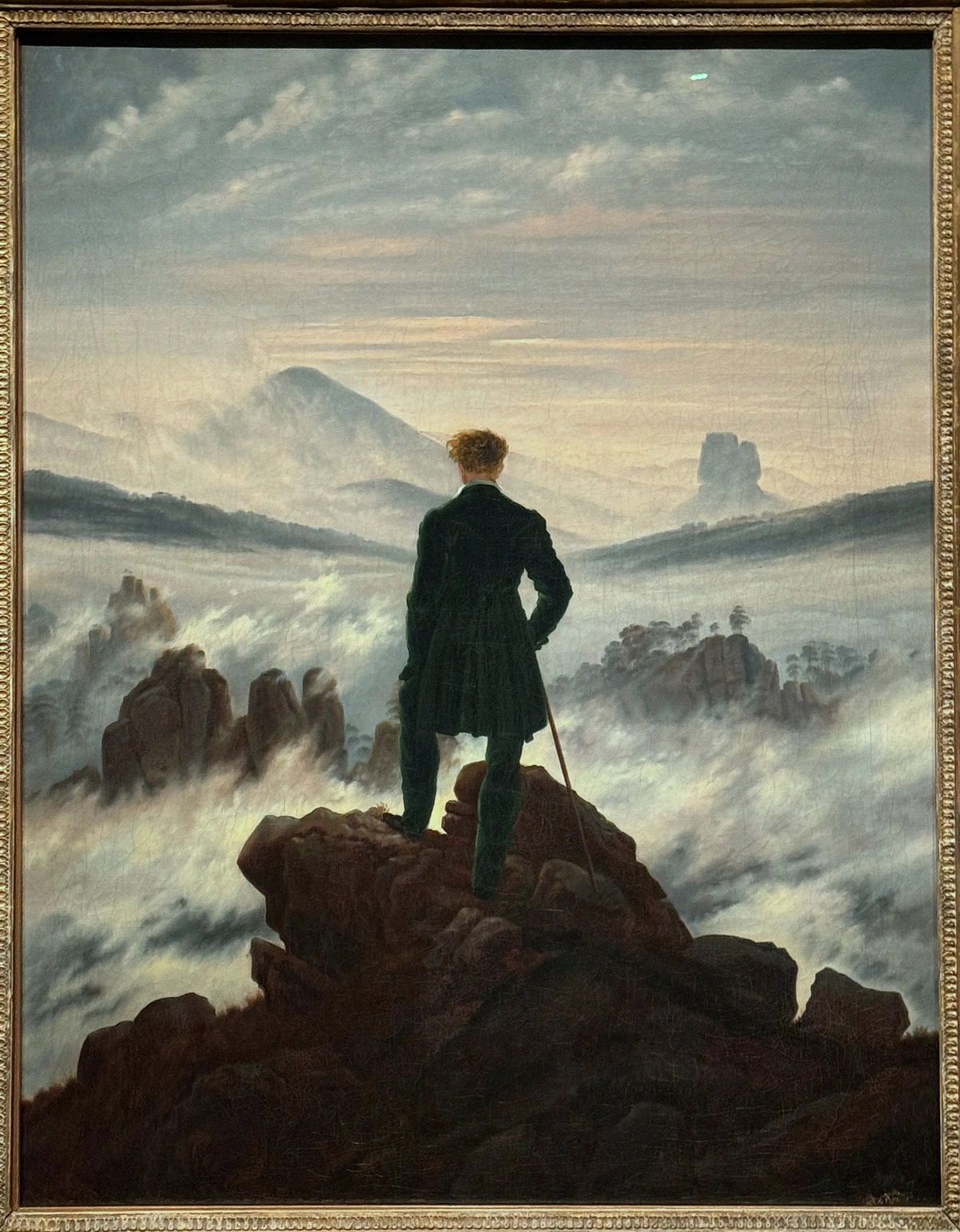
The first time you see a Friedrich painting, you're often struck by a solitary figure. They're almost always seen from behind, perched on a rock, gazing out at a churning sea or a misty, mountainous abyss. This compositional device, known as the Rückenfigur (German for "back-figure"), is not an accident of framing—it's the very heart of his method for putting you directly into the scene. It is his most profound and enduring contribution, a psychological innovation as crucial to his work as the vanishing point was to the Renaissance.
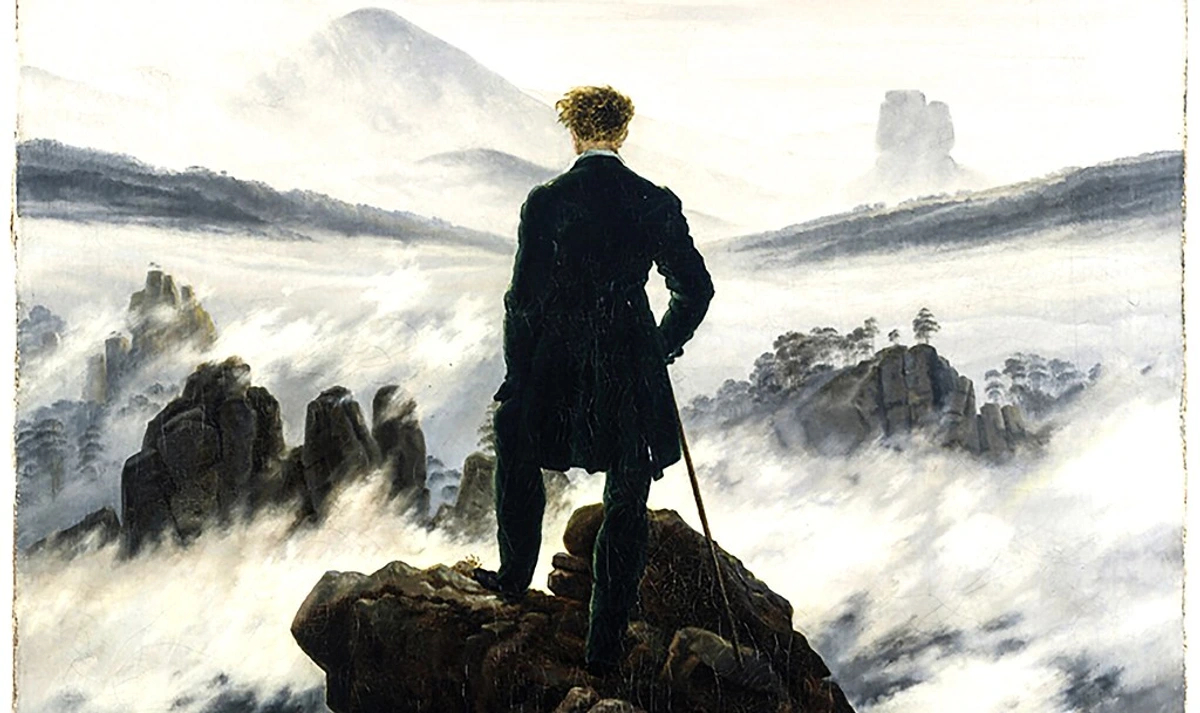
Imagine the opposite for a second. If that wanderer turned around, what would you get? A story about one specific man. Is he a weary explorer, a heartbroken lover, a king in disguise? His face would tell a tale—a specific narrative of hope, fear, or weariness—and that tale would instantly become the painting's subject. The vast, misty landscape behind him would shrink, demoted to a mere backdrop for his personal drama. Friedrich's genius was realizing that the viewer's own emotional journey is the real story, the one worth telling. He effectively invented a form of emotional non-player character—an avatar for consciousness itself.
The Psychological Mechanics of the Turned Back
The power of the Rückenfigur lies in a few precise psychological mechanisms. First is anonymization. By removing the figure's face, Friedrich strips away social cues, personality, and specific emotion. We can't tell if they're happy or sad, young or old, rich or poor. This lack of information prevents our brain from constructing a fixed narrative and forces us to project our own state of mind onto the figure. It's a blank mask, waiting for us to inhabit it.
Second is the creation of a perceptual bridge. The figure is positioned where the viewer might imagine themselves standing, creating a seamless transition from the real world into the pictorial space. You don't just observe the figure looking; your gaze merges with theirs. Your consciousness occupies the empty space of their unknown expression.
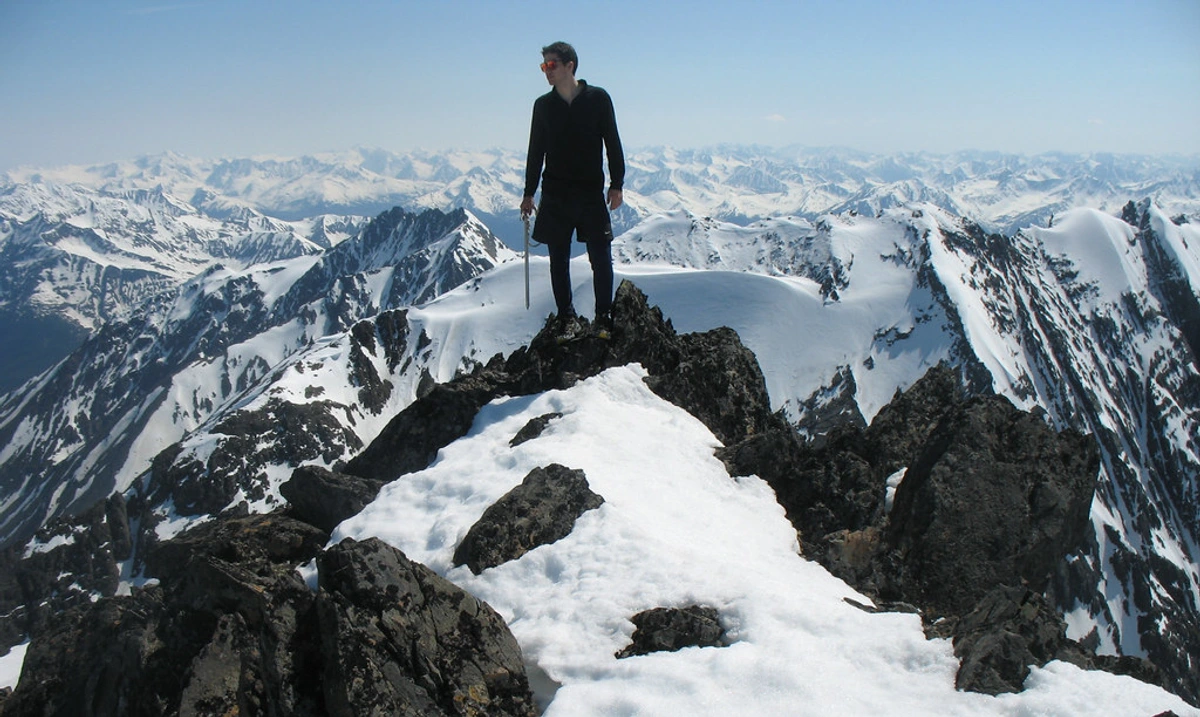
And third is invitation. A face looking out at us can feel confrontational or performative. It creates a dynamic between the subject and the observer. A back, however, is an open invitation. It says, "Come stand here with me. Look at what I'm looking at." It's a gesture of quiet inclusion rather than ostentatious display. This simple inversion transforms the entire relationship between the artwork and the viewer.
Think about it. A face tells a story. A specific expression—a smile, a grimace, a look of fear—dictates your reaction to the scene. By denying us that face, Friedrich removes the middleman. The figure becomes a silent vessel, an empty chair for your own consciousness. You aren't observing their awe. You are their awe.
This technique thrusts the viewer into a direct confrontation with the sublime. In paintings like Wanderer above the Sea of Fog, the figure isn't just looking at the view; he's being consumed by it. The sheer scale of the landscape becomes a mirror for the vastness of human contemplation. We feel small, not insignificant, but humbled and expanded by the grandeur of the natural world.
Think of the Rückenfigur as a visual algorithm. Input: A human silhouette. Process: Erase individual identity. Output: A universal vessel for subjective experience. It's an invitation to projection, a catalyst for empathy on a cosmic scale. ### The Rückenfigur's Enduring Influence
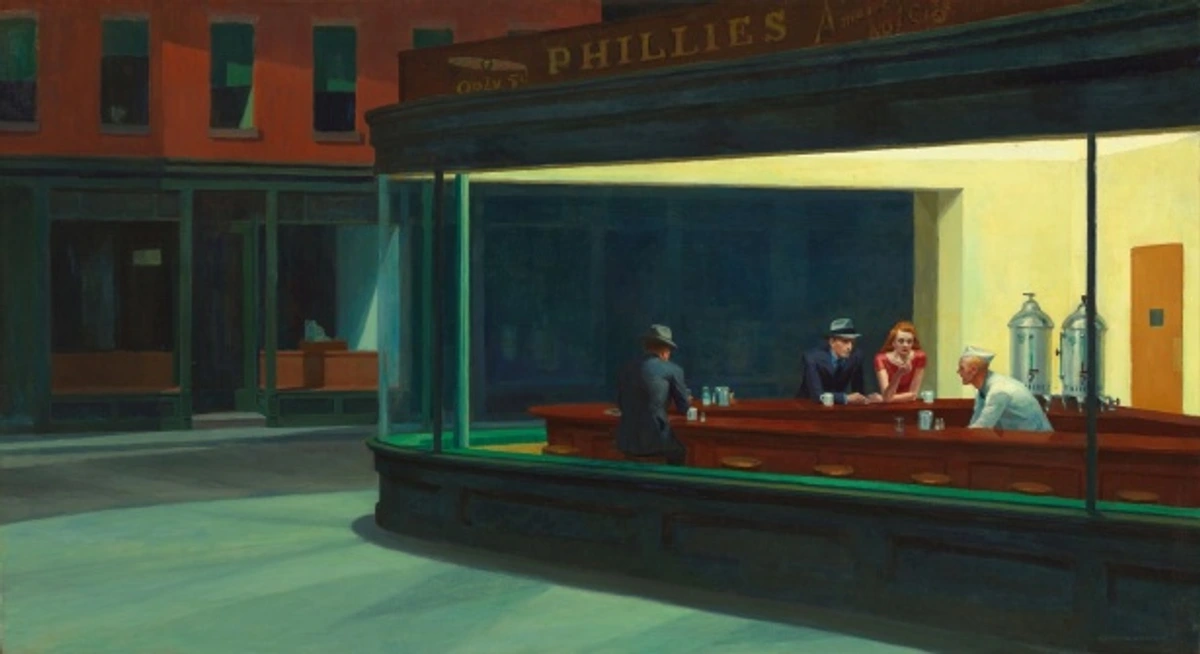
The psychological power of the Rückenfigur has resonated far beyond Friedrich's time. We see clear echoes in the haunting isolation of Edward Hopper's figures, the anonymous crowds in early photography, and even in contemporary filmmaking where directors use the backs of characters to create intimacy and contemplation. The influence extends to modern media as well—from the lone figures gazing at alien landscapes in science fiction films to the countless social media photos we take of ourselves from behind, standing before beautiful vistas.
This technique's success lies in its elegant simplicity. In a world screaming for attention, Friedrich simply turned a character's back to the audience, and in that subtraction, he opened up an infinite space for feeling. It remains one of art history's most powerful examples of how a simple compositional choice can create profound psychological engagement.

Variations on the Theme: Not All Rückenfiguren Are Equal
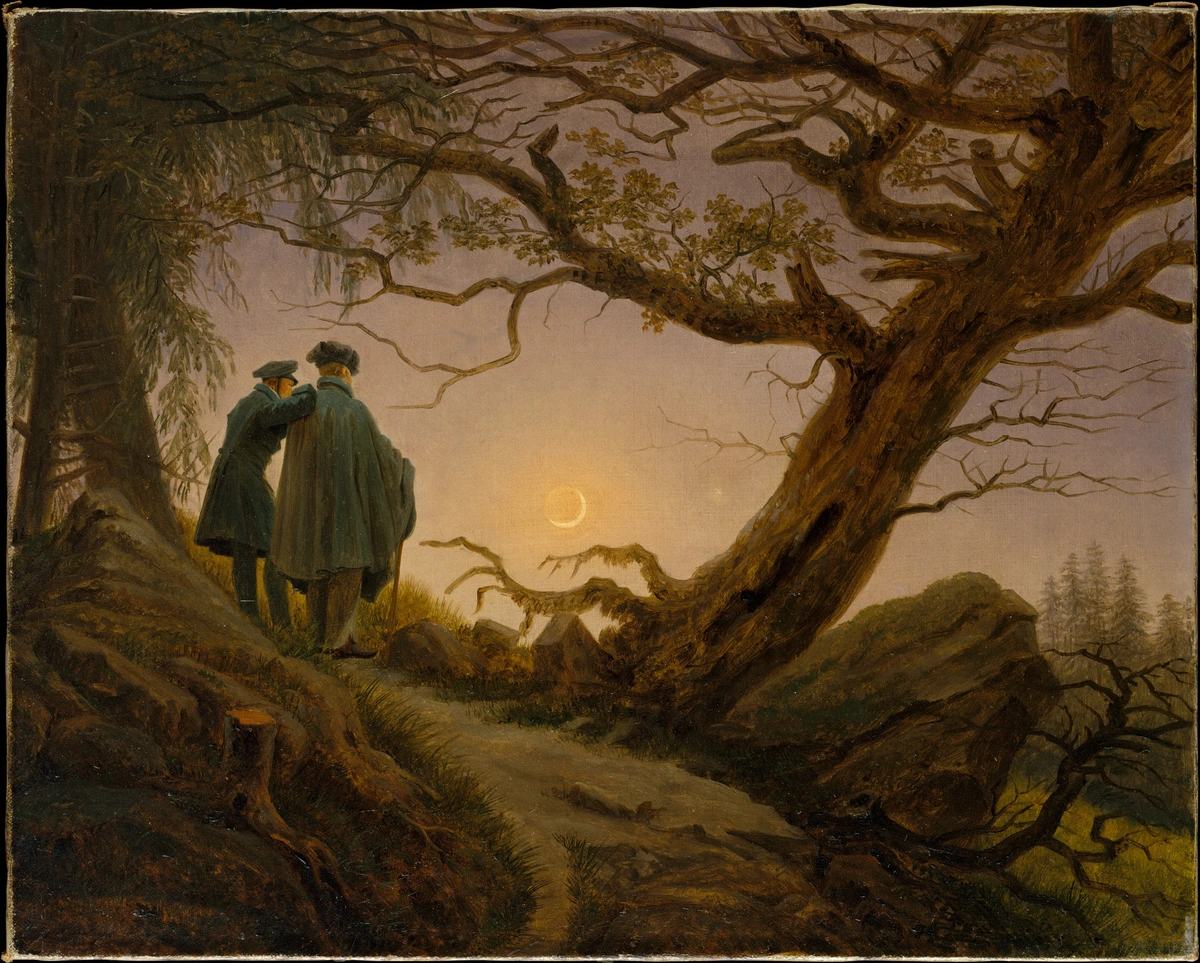
While the basic concept remains constant, Friedrich employed variations of the Rückenfigur for different effects. Sometimes we see a single, isolated figure standing atop a peak—a moment of pure, individual contemplation. Other times, we encounter two figures, like in Two Men Contemplating the Moon. These figures create a sense of shared experience, suggesting that even in our most profound moments of reflection, we might not be entirely alone. The presence of two figures provides subtle reassurance while still maintaining the contemplative focus. Then there are the small groups of figures, often in religious processions, where the individual Rückenfigur is multiplied, creating a sense of collective spiritual journey rather than solitary introspection. This demonstrates Friedrich's sophisticated understanding of how slight variations in composition can dramatically alter the emotional resonance of the scene.
This device is particularly effective because it transforms the act of viewing into an act of contemplation. You aren't just looking at a scene; you're invited to project your own inner world—your worries, dreams, and questions—onto the vastness before you. The figure creates a psychological doorway, a transition from observer to participant. When you stand before a Friedrich, you're not just examining paint on canvas—you're entering into a relationship with infinity itself, mediated by that single human form that represents both everyone and no one.
The Weight of Air: Friedrich's Command of Atmosphere
If the Rückenfigur was his psychological innovation, atmosphere was his painterly revolution. Friedrich didn't just paint air; he painted feeling using the very substance of the sky as his medium. While other landscape painters treated atmosphere as empty space—the void between significant objects—Friedrich recognized it as the connective tissue of emotion, the medium through which we experience both space and mood.
Most landscape painters are concerned with light. Friedrich was obsessed with atmosphere. He understood that the space between the viewer and the distant horizon was not empty, but alive and full of feeling. He could make the air feel cold, heavy with mist, or crisp and infinite. It's a painterly version of negative space—the "emptiness" is where the real message lives. He painted the invisible, the stuff you feel on your skin and in your bones. It's a masterclass in making the transitional, intangible elements—mist, vapor, and air—the primary subject of the work itself.
His primary tool for this was atmospheric perspective. While other artists used it as a rule-of-thumb for creating depth, Friedrich weaponized it to engineer mood. By systematically muting colors, reducing contrast, and softening edges as objects receded into the background, he built worlds with palpable physical and emotional weight.
The Technical Foundation: How He Built Atmosphere
Friedrich's method wasn't haphazard intuition; it was built on a foundation of precise technical control and profound observational understanding. His approach to atmospheric perspective involved several distinct but interconnected strategies that worked together to create his signature emotional resonance.
- Color Dulling: This wasn't merely desaturation. Friedrich manipulated specific color temperatures to create emotional distance. The vivid warm greens of a foreground forest would sink through progressively cooler, grayer tones into the muted, ethereal blues of distant peaks. This wasn't just about creating spatial depth—it was about manifesting Sehnsucht, that untranslatable German concept of profound longing or yearning. The blue distance didn't just recede spatially; it receded emotionally, becoming a visual representation of unattainable desire.
- Contrast Reduction: While foreground elements might show dramatic chiaroscuro with strong darks and lights, Friedrich systematically reduced this contrast as forms receded. Distant mountains became nearly monochromatic, their forms suggested rather than stated. This wasn't laziness or lack of detail—it was a deliberate strategy to make the far distance feel truly inaccessible and mysterious. Sharp contrast implies clarity and knowability; reduced contrast suggests the unknown and the infinite.
- Softened Edges: Friedrich avoided hard outlines in his distance work. Horizon lines, mountain ridges, and distant forests all dissolved into atmospheric haze. This created a sense of permeability between forms and space, making everything feel interconnected rather than separate. The technique mirrors how our eyes actually perceive distant objects during dawn, dusk, or in humid conditions—not as sharp outlines but as soft, merging shapes. This softening process also had spiritual significance for Friedrich, suggesting the dissolution of boundaries between the material world and the transcendent realm.
- Progressive Simplification: As forms receded into distance, Friedrich stripped away increasingly complex details. A nearby tree might show individual branches and bark texture, while distant trees became simplified silhouettes, and far mountains became nearly abstract geometric forms. This progressive simplification creates both spatial depth and emotional distance—the far becomes unknowable in its abstraction, reinforcing themes of human finitude facing cosmic infinity.
- Temperature Shifts: Beyond simple color changes, Friedrich carefully controlled color temperature throughout his atmospheric gradations. Warm foreground tones would gradually shift toward cooler blues and violets in the distance, but these shifts weren't linear or predictable. He might insert unexpected warm notes in distant clouds or cool shadows in foreground rocks, creating a more complex and emotionally resonant atmospheric fabric.
I think of Friedrich's landscapes as having a kind of "acoustic depth." A foreground rock has a sharp, immediate presence—it's close, tangible, like a clear note struck nearby. But the distant mountain ranges are like fading echoes, growing quieter, less distinct, until they merge with silence. This isn't just about seeing space; it's about feeling its quiet gravitational pull on the soul. Friedrich was painting the equivalent of a musical diminuendo—a gradual quieting that pulls the viewer's consciousness ever deeper into the canvas.
The Layers of Meaning: Beyond Physics
For Friedrich, atmospheric perspective wasn't just a tool for creating realistic space—it was a metaphysical device. The progressive dissolution of form and color as distance increased served a deeper philosophical purpose. It visualized the fundamental human experience of facing the unknown, the unknowable, and the infinite. As solid forms dissolve into mist, they parallel how human certainty dissolves when confronted with existential questions. The atmosphere becomes a visual metaphor for the veil between the material and spiritual worlds, between what we can know and what remains eternally mysterious.
Friedrich achieved these atmospheric effects through meticulous control of his materials and systematic working methods. His preparatory drawings were incredibly detailed—often executed in sepia with precise attention to light, shadow, and atmospheric conditions—and these served as the foundation for his oil paintings. In his paintings, he used thin glazes and scumbles of paint to build up atmospheric veils gradually, working from dark to light in transparent layers. This layering technique, learned from earlier masters but perfected for his atmospheric purposes, allowed him to create complex optical effects while maintaining luminosity. The semi-transparency of his glazes created actual physical depth in the paint surface, which when combined with his atmospheric perspective, generated an extraordinary sense of spatial and emotional distance. Each layer contributed not just to the illusion of space, but to the feeling of space as an emotional and spiritual medium.

For artists wanting to capture this effect, whether in traditional painting or digital media, the key is subtlety and systematic progression. It's not about simply blurring the background; it's about gradually reducing the intensity of both color and contrast while carefully managing edge quality and detail complexity. Every element in your scene should become progressively quieter, simpler, and cooler as it recedes into the distance. Think of it as composing a symphony where each section plays softer than the last, creating space for contemplation rather than overwhelming the senses.
Using the Clockwork of the Sky: Light as an Emotional Device
If atmosphere was his canvas, light was his scalpel. Friedrich used light not to reveal the world, but to question it, using it as a precise tool to shape mood and meaning. His approach to light demonstrates an almost scientific understanding of its psychological effects combined with profound symbolic intention. Where other artists used light to define form and create beauty, Friedrich used it to orchestrate spiritual and emotional experience.
Friedrich rarely painted the bright, even light of midday. Why would he? That kind of light explains everything, leaving no room for mystery. It's the visual equivalent of someone shouting the plot twist before the movie even starts.
Instead, Friedrich's preference for transitional light was central to his entire philosophy. He was drawn to liminal states—dawn, dusk, twilight, moonlight—because they represent thresholds between known and unknown worlds. These times of day are inherently unstable and emotionally charged, making them perfect metaphors for the human condition. Midday light clarifies and reveals; transitional light questions, conceals, and transforms. It's during these liminal moments that the ordinary world seems imbued with extraordinary significance, when the veil between the visible and invisible appears thinnest.
His light was never just illumination—it was always symbolic, always carrying an emotional payload. It's as if he treated photons not just as particles of light, but as carriers of human anxiety, hope, and dread. The direction, quality, and color of light in his paintings always aligned precisely with their emotional content. For Friedrich, every ray of light served a double function: revealing physical form while simultaneously conveying metaphysical meaning.
The Emotional Code of Light Direction
Friedrich employed specific light directions to create distinct emotional effects:
- Backlighting: By placing his light source behind subjects, Friedrich could create powerful silhouettes that stripped away individual identity and reduced figures to essential forms. This technique, seen in paintings like Woman at the Window, transforms the specific into the universal and emphasizes the contemplative act rather than the particular personality. Backlighting also created a sense of immanence—the feeling that light was emerging from within the scene rather than falling upon it from outside.
- Horizontal Light: Low morning or evening light stretches shadows dramatically, transforming ordinary landscapes into theaters of psychological drama. The extreme horizontality makes space feel compressed horizontally while emphasizing vertical elements like trees, figures, and architecture. This creates a sense of contained energy and emotional tension.
- Diffuse Light: Overcast or mist-filtered light eliminates strong shadows and creates an even, somber mood. This light appears throughout Friedrich's winter and ocean scenes, producing a sense of suspended time and quiet introspection.
- Punctual Light: Occasionally, small points of light appear—a sunset through clouds, a window glowing in darkness. These isolated light sources create intense focus and emotional longing, suggesting hope or divine presence in an otherwise somber world.
Understanding these different approaches helps us see that Friedrich's light wasn't just aesthetic preference—it was a sophisticated language of emotional and spiritual states, each lighting condition carefully chosen to support specific psychological narratives.
Take The Sea of Ice. The shattered ship is not dramatically spotlighted. Instead, the broken timbers are cloaked in a chilling, flat, crepuscular light that permeates the entire scene. The light doesn't dramatize the ship; it reinforces the cold, indifferent power of the ice that has crushed it.
The technique here is fascinating: the light comes from a low angle, typical of polar regions, creating long shadows that stretch across the ice. But there's no warmth in this light—even though it exists, it doesn't provide comfort. It merely illuminates destruction. This is light without mercy, highlighting nature's absolute sovereignty over human ambition. The illumination offers no hope, only confirmation of the power that has crushed the ship.
And then there are his sunrises. In Abbey in the Oakwood, a monk procession carries a coffin through a cemetery of dead oaks. A pale, barely-there sun rises behind the skeletal ruins of a Gothic abbey. The light doesn't warm the scene; it merely illuminates the coldness.
The technical brilliance here lies in the color temperature. The foreground is dominated by earthy browns and cold grays, while the sunrise creates the faintest wash of pale yellow and pink in the sky. This warm light should provide hope, but in Friedrich's hands, it feels distant and powerless against the overwhelming presence of death.
This ambiguity is the soul of his work. He refuses to give easy answers because nature itself doesn't offer them. His light is the vehicle for this profound uncertainty. Have you ever noticed we rarely see the sun's face in his paintings? He paints the effect of light, the anticipation of it, rather than the source itself. This is a profound lesson for artists: sometimes what you conceal is more powerful than what you reveal. The hidden sun becomes a metaphor for all the questions we can't answer.
The Palette of Melancholy: Color and Symbolism
Color was never merely descriptive for Friedrich; it was the vocabulary of his emotional language. He painted with a profoundly restricted palette, using color to evoke a state of mind rather than to replicate reality.
If you're looking for bright, cheerful color, you won't find it in Friedrich's work. Looking at his paintings is like listening to a piece of music written in a minor key. It can be beautiful, even transcendent, but it's inherently tinged with longing. His palette was as much a philosophical choice as it was an aesthetic one. He painted with the colors of dusk, dawn, and the deep forest, deliberately avoiding the easy vibrancy that other painters leaned on.

He used a narrow range of pigments, each chosen for their emotional resonance rather than pure visual excitement:
- Somber earth tones: Burnt umber, raw sienna, and deep forest greens form the foundation of his world. These are the colors of the soil, of rock, of things that are enduring and ancient. They ground the composition in a sense of geological time, a perspective that dwarfs human concerns into insignificance.
- Low-saturation blues and grays: These are the colors of distance, mist, and deep water. They pull you in, suggesting the infinite, the unknown, and the melancholic distance between the self and the horizon.
- Punctual use of warm tones: A single point of dull yellow for a sunrise or the warm glow of an interior through a window serves not as a celebration of warmth, but as a poignant contrast to the overwhelming coolness of the scene, emphasizing the isolation rather than relieving it.
Beyond their inherent emotional weight, colors in Friedrich's paintings function as complex symbolic language drawn from German Romantic thought, religious tradition, and contemporary philosophy. The evergreens stand for eternal life and faith, while barren oak trees signify mortality and the transience of all things—a visual dialogue between permanence and decay played out across every landscape. This wasn't arbitrary symbolism but part of a sophisticated iconographic system that would have been understood by his contemporary audience.
The Grammar of Friedrich's Symbolism
Understanding this symbolic vocabulary unlocks deeper meanings throughout his work:

- Ruined Gothic Architecture: These represent more than romantic decay—they specifically symbolize the decline of traditional religious institutions and the rise of a new, nature-based spirituality. The recurring motif of nature reclaiming human structures suggests that while human institutions crumble, something eternal in the natural world endures.
- Ships: Often appearing small against vast horizons, ships represent the journey of life, faith, and spiritual passage. They appear both as active vessels navigating dangerous waters and as wrecked remains—suggesting both hope and despair about the human spiritual journey.
- The Moon: Frequently appearing as a crescent or full orb, the moon represents eternal cycles, spiritual guidance, and forces beyond human control. Moonlight transforms familiar landscapes into mysterious otherworldly spaces.
- Mist and Clouds: These represent the veil between material and spiritual worlds, but also uncertainty, the unknown future, and the limits of human knowledge. By literally obscuring parts of the landscape, they force the viewer to fill in gaps with imagination and faith.
- Winter and Dead Vegetation: These elements symbolize mortality, loss, and the cyclical nature of existence. Yet Friedrich often juxtaposes them with symbols of eternal life (evergreens) suggesting that death isn't final but part of larger natural cycles.
- Crosses and Religious Architecture: Whether simple wooden crosses in remote landscapes or the ruins of Gothic churches, these represent both the persistence of faith and its institutional decay. Their placement in natural settings suggests that the divine can be found directly in nature rather than through organized religion.
Understanding this symbolic system reveals the density of meaning in seemingly simple landscapes. Each element carried specific cultural and spiritual resonances that would have been immediately apparent to Friedrich's original audience.
Gothic ruins in his paintings represent more than romantic decay—they symbolize the decline of traditional religious institutions and the rise of a new, nature-based spirituality. The frequent juxtaposition of ruined abbeys with thriving nature suggests that while human structures crumble, something eternal in nature endures.
This symbolic language extends to every element in his work. Ships represent the journey of life; the moon often represents the eternal cycle of time; morning mist can suggest the veil between the material and spiritual worlds.
When looking at a Friedrich, don't just ask, "What colors do I see?" Ask, "What do these colors mean?" His choices were never arbitrary. They formed a sophisticated vocabulary of visual poetry that transforms a landscape into a meditation on life, death, and transcendence.
The Artist's Toolkit: A Practical Guide to Friedrich's Methods
These principles might seem rooted in 19th-century Romanticism, but they are, in fact, timeless psychological tools. Let's break down how you can adapt Friedrich's core strategies for your own work, regardless of your style or subject matter.
Translating Friedrich's genius into contemporary art requires understanding his core principles, not copying his iconography. A figure in a frock coat on a rock might seem outdated, but the psychological mechanisms he employed are timeless.
Think of Friedrich as teaching us that a painting's power lies not in what it shows, but in what it makes the viewer feel and think. His techniques are tools for emotional manipulation in the best sense—ways to create specific states of consciousness through purely visual means. This is perhaps the most valuable lesson he offers contemporary artists.
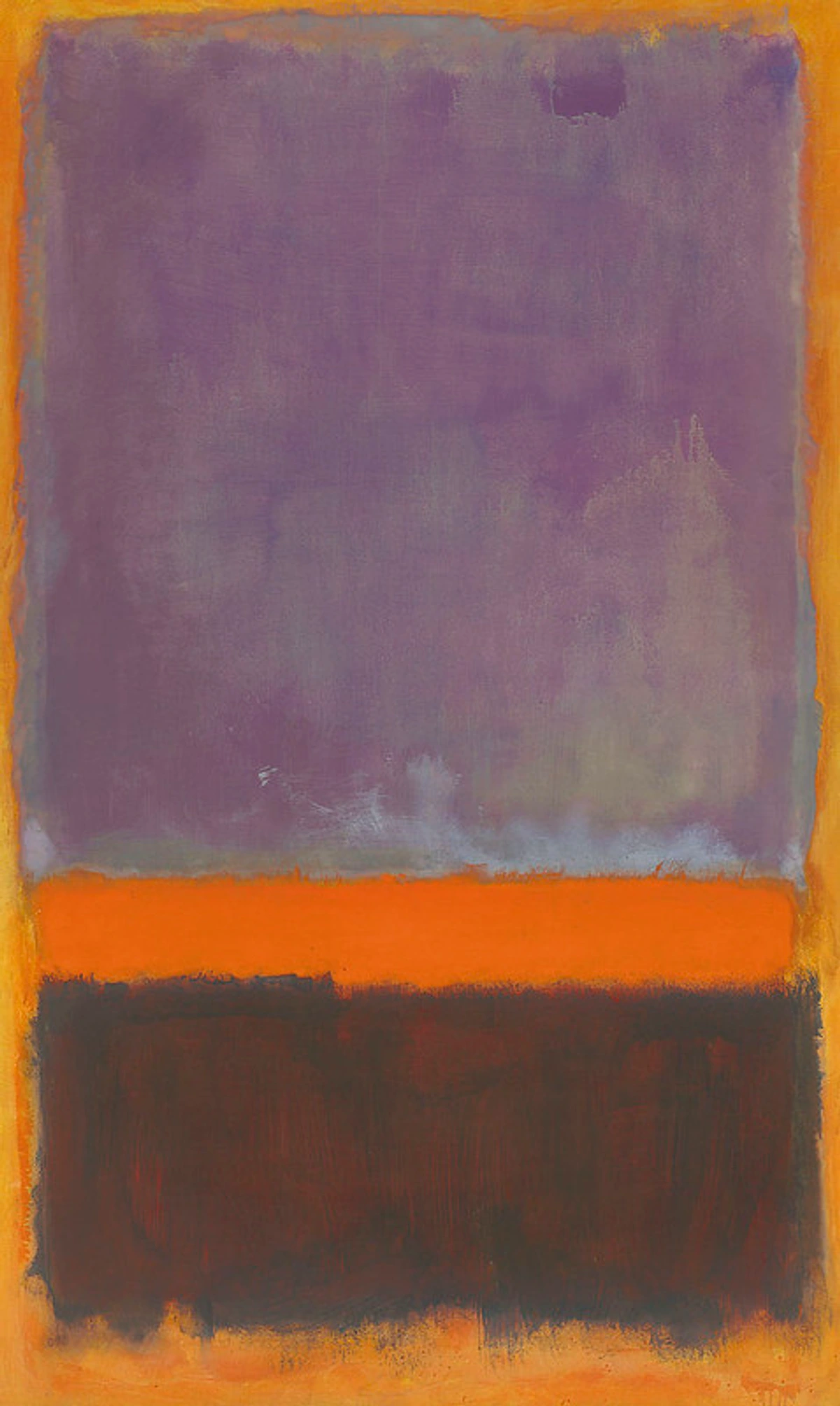
First, Begin with Emotion, Not Representation. Before you touch the canvas or digital tablet, close your eyes. What is the emotional core of what you want to express? Is it the profound loneliness of a city street at 4 AM? The overwhelming awe of standing beneath a redwood? The quiet peace of your garden? Start with this feeling, not the subject matter. This is Friedrich's most crucial lesson for contemporary artists. Instead of asking "What does this look like?" start asking "What does this feel like?" This simple shift reframes your entire creative process from documentation to communication, from reproduction to evocation. Your brushstrokes, pixels, or marks become words in a sentence that conveys a specific feeling, and your technical choices—color temperature, edge quality, value relationships—all serve that primary emotional purpose.
When you begin with emotion, you may find that your subject matter changes dramatically. A realistic cityscape might become more abstract, with exaggerated angles and compressed perspectives. A portrait might focus less on facial accuracy and more on capturing a particular psychological state through color and lighting. This approach allows your technical skills to serve a higher emotional purpose rather than simply demonstrating technical proficiency.
Start with this feeling, not the subject matter. This is Friedrich's most crucial lesson for contemporary artists. Instead of asking "What does this look like?" start asking "What does this feel like?" This simple shift reframes your entire creative process from documentation to communication. Your brushstrokes, pixels, or marks become words in a sentence that conveys a specific feeling.

Second, Apply the Rückenfigur Principle Universally. This technique is incredibly versatile across all visual media. In digital art, it could be a single point of light in a dark digital space, a glowing portal that invites the viewer to imagine what lies beyond. For a photographer, it might be a person photographed from behind, standing at a window—their posture and the quality of light telling us everything about their emotional state while maintaining their anonymity. Street photographers can use pedestrian flows where individuals face away, creating collective Rückenfiguren that represent urban anonymity and loneliness. Even in abstract work, you can create focal points that function psychologically as Rückenfiguren—areas where the visual information is deliberately incomplete, inviting the viewer to bring their own experience to complete the picture.
Think beyond figures entirely. The Rückenfigur principle is fundamentally about creating psychological entry points through strategic withholding of information. In still life photography, you might show only the back of a chair pulled away from a table, suggesting recent departure or absence. In architectural photography, you might show a building's receding side rather than its frontal facade, creating a sense of mystery about what the front reveals. The principle extends to any compositional choice that removes specific identity while maintaining human (or object) scale and presence.

Here are contemporary applications:
- Street Photography: A figure seen from behind, walking into urban fog, inviting viewers to contemplate their own journey through life.
- Abstract Art: A single, intensely colored shape emerging from a muted field creates tension and focus.
- Still Life: One bright object on a dark table transforms a simple setup into an existential question.
Friedrich would have loved exploring different mediums and subjects. The core principle remains: create a psychological entry point that allows viewers to see themselves in the work.
Third, Create Atmospheric Depth Through Layering. Friedrich's atmosphere isn't simply blurry backgrounds—it's a carefully constructed sense of space that you build layer by layer, whether you're working traditionally or digitally. This systematic approach to atmospheric perspective involves multiple coordinated strategies working together to create convincing and emotionally resonant space while maintaining the mysteriousness of distance.
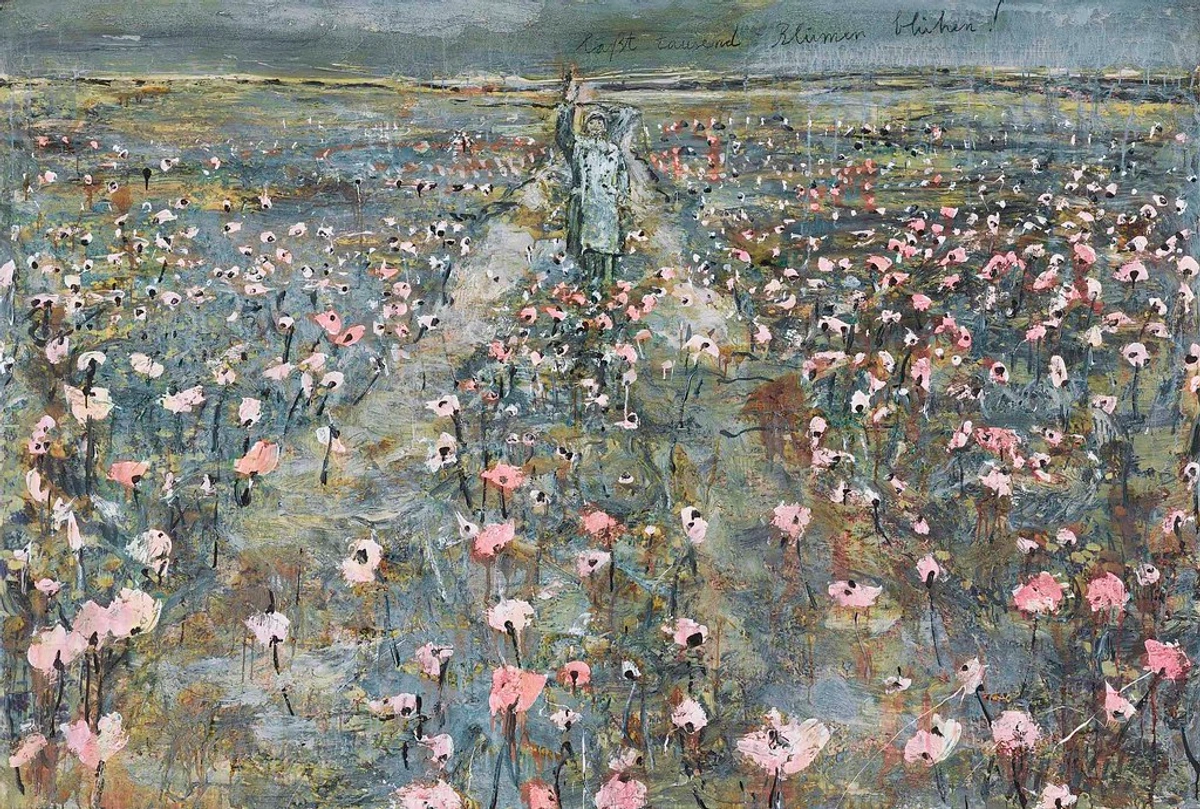
For Digital Artists: This means working systematically with layer opacity, blending modes, and adjustment layers. Create separate layers for foreground, middle ground, and background elements, and use layer masks to create gradual transitions rather than abrupt changes. Utilize hue/saturation layers to systematically desaturate distant elements. Apply subtle blur effects that increase with distance, but remember that atmospheric blur isn't just Gaussian blur—it involves color mixing and edge softening as well. Most importantly, use layer grouping to organize your atmospheric zones, allowing you to adjust entire sections while maintaining their internal relationships.
For traditional painters: Work from background to foreground, building up atmospheric veils through glaze techniques. Mix progressively more white or blue into your pigments as elements recede, and use dry-brush techniques to create soft edges. Keep your distant colors mixed with more medium and less pigment to maintain their atmospheric transparency. Consider underpainting with complementary colors to create more complex atmospheric effects, and remember that atmospheric perspective affects not just color but also texture—distant elements should have progressively less impasto and surface variation.
Common to both approaches: Think systematically about your atmospheric zones as distinct bands of space, each with its own color temperature, saturation level, value range, edge quality, and detail resolution. Create a clear atmospheric gradient that extends from the picture plane back into infinity, ensuring each zone is perceptibly different from adjacent zones while maintaining overall harmony. This systematic approach to atmospheric space creates both convincing depth and emotional resonance, turning empty space into meaningful atmosphere.
In digital painting, this means working with layer transparency and opacity. In traditional media, it involves mixing progressively more white or gray into your pigments as elements recede.
Consider how light interacts with air. In a sunset scene, the warm light would subtly tint even the 'cool' shadows on the ground, while the blue sky weakens to a pale haze near the horizon. These color shifts tell your viewer's subconscious that there's space—real, breathable space—between foreground and background. This technique transforms a flat surface into a world that has air, distance, and mystery.

Fourth, Use Light to Conceal as Much as to Reveal. Friedrich understood that what's hidden can be more powerful than what's shown. This principle is about restraint, strategic obscurity, and the power of implication over explicit statement. By keeping significant portions of your composition in shadow or partial darkness, you force the viewer's imagination to become active rather than passive.
This approach requires a different relationship between artist and subject. Instead of trying to show everything clearly, ask yourself: "What single detail, when properly illuminated, would imply the entire scene?" A backlit figure on a beach doesn't need to show facial features or detailed clothing—the silhouette against sunset light reveals everything about the moment while concealing specific identity. A photograph of hands clasped in lap, illuminated by a single window, can suggest an entire emotional state without showing the person's face.
The key is dramatic range—most successful Friedrich-influenced works show extreme contrast between areas of light and shadow. These zones shouldn't compete equally; one should clearly dominate while the other supports. The shadow areas aren't just empty darkness—they contain subtle information and contribute to the overall mood. The dramatic power comes from the tension between revelation and concealment, the known and the unknown.
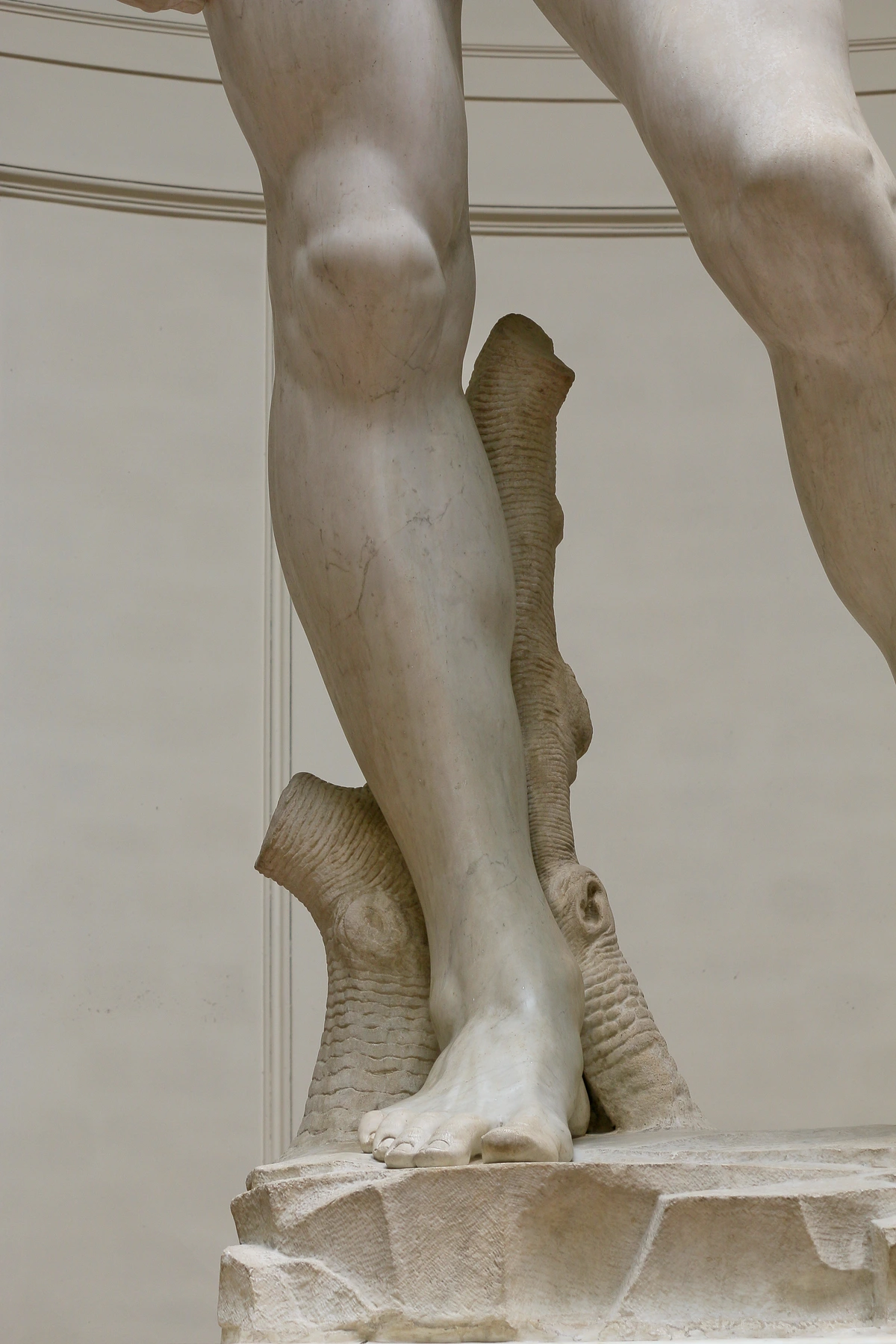
The technique also extends to compositional choices like cropping. Don't show the entire subject—let elements extend beyond the frame, suggesting a larger world outside the image boundaries. Position key subjects so light catches only specific aspects of their form. Use flare, haze, and lens effects to deliberately obscure certain areas. All these techniques honor Friedrich's principle that mystery and uncertainty often communicate more powerfully than complete information.
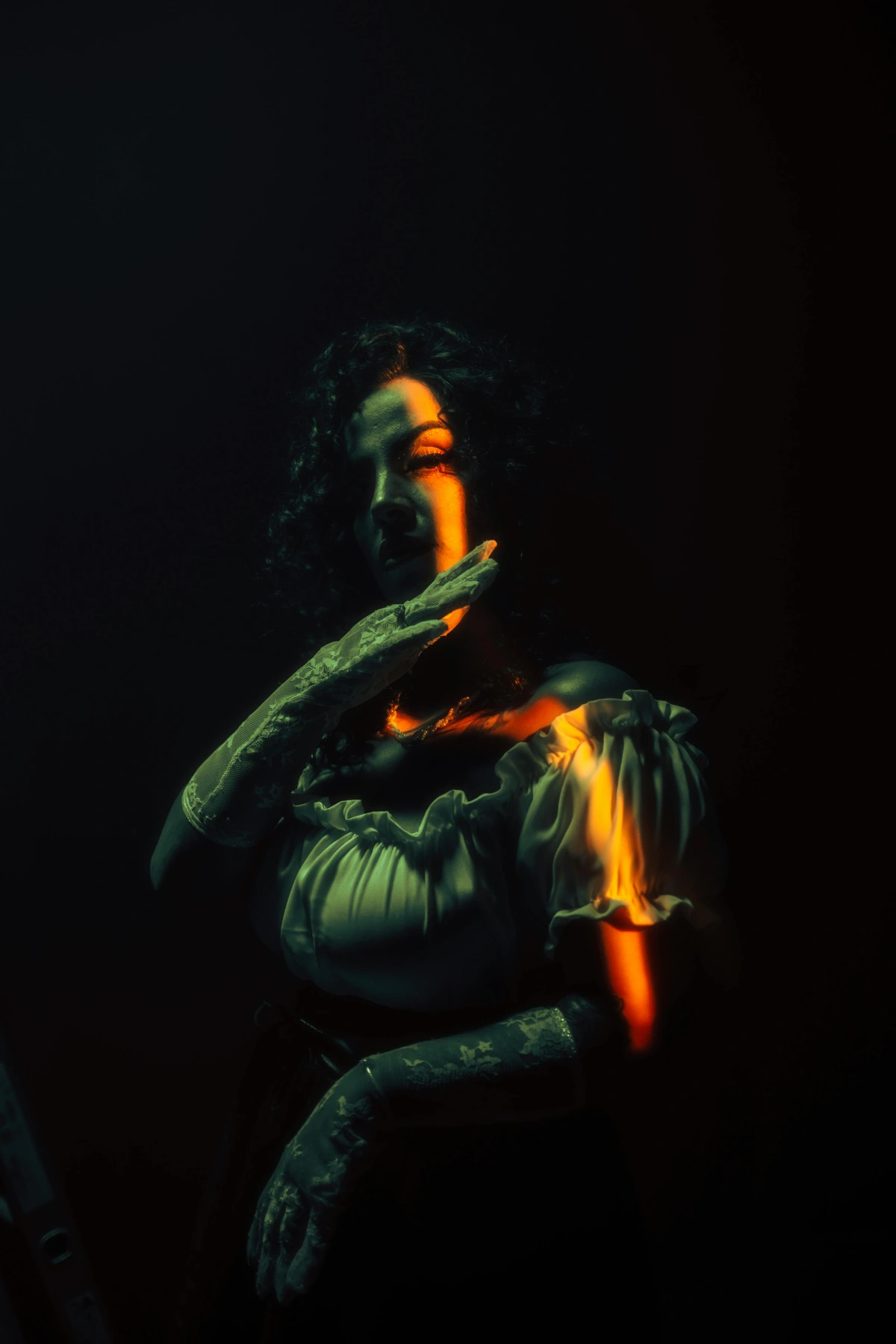
Instead of illuminating everything evenly, ask yourself: What would happen if I threw 80% of my composition into shadow? What single detail, when lit, would tell the whole story? A backlit figure becomes a silhouette that viewers can inhabit. A sunrise casting long shadows creates a sense of time, atmosphere, and mystery.
The drama isn't in the brightly lit areas—it's in what lurks at the edge of vision, what's suggested but not stated.
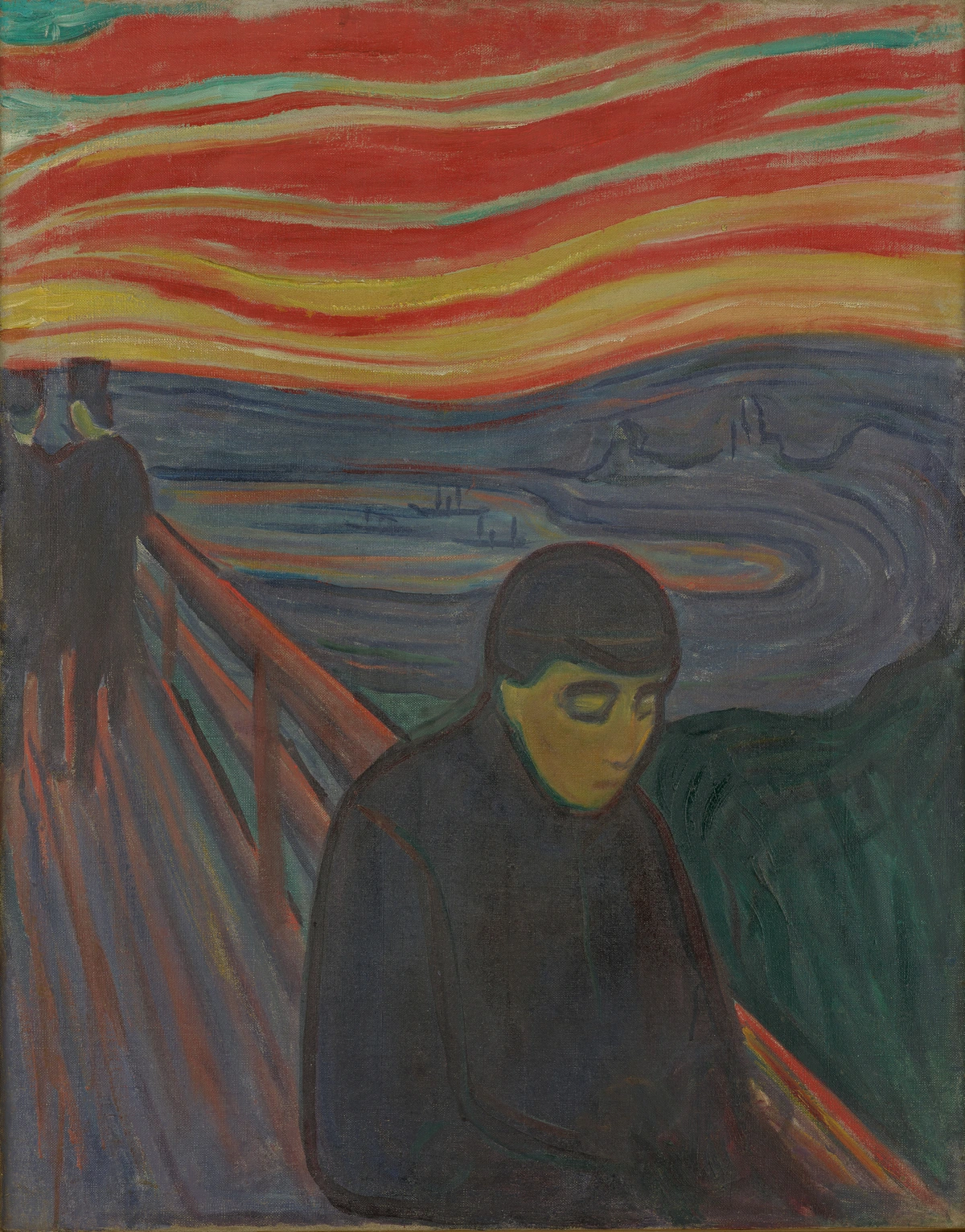
This principle is about restraint. It's about understanding that you don't have to show the viewer everything you know. In fact, by withholding information, you make them an active participant in the painting. They have to fill in the blanks, to use their imagination to solve the mystery you've presented. A fully lit scene is a statement; a scene of light and shadow is a conversation. Friedrich excelled at this, creating dramatic silhouettes and luminous backdrops that spoke of things unseen and unknown.
Finally, Let Palette Serve Mood, Not Reality. Friedrich chose his colors based on their emotional resonance, not their accuracy to nature. If the mood calls for somber tones, even a sunset should be restrained and cool. This meant carefully restricting his color range, often working with only a dozen or so pigments, and frequently limiting actual paintings to even fewer colors. This selective palette created visual harmony and reinforced the emotional tone of each piece.
This principle requires making difficult but deliberate choices. Maybe your subject is a vibrant city street, but you're exploring themes of urban alienation—desaturating your palette and muting the colors toward blues and grays might better serve your message than faithfully reproducing the scene's actual colors. Perhaps your subject is a joyful occasion, but you want to maintain a sense of quiet reverence—using a warm but limited palette with carefully controlled saturation levels can convey both joy and introspection.
Your palette is an emotional tuning fork that sets the frequency for the entire work. Before you start, decide on your emotional key—major or minor, warm or cool, saturated or muted—and stick to it throughout the piece. This doesn't mean your work should be monochromatic or monotonous; it means that all color variations should exist within the parameters you establish, creating visual harmony that supports rather than contradicts your emotional intent.
Think of the palette as your composition's emotional foundation. Just as Friedrich used earth tones, grays, and blues to create meditative, melancholic moods, you can establish specific emotional territories through systematic color choices that support rather than compete with your subject matter. When palette and mood work together, your work gains the kind of emotional coherence that makes Friedrich's paintings so psychologically powerful and memorable.
This means making difficult choices. Maybe your subject is a vibrant city street, but you're exploring themes of urban alienation—desaturating your palette and muting the colors might better serve your message than faithfully reproducing the scene.
Your palette is an emotional tuning fork. Before you start, decide on your emotional key—major or minor—and stick to it throughout the piece.
Frequently Asked Questions
To truly understand an artist, we must go beyond their techniques and delve into their intent and context. These are the questions that get to the heart of Friedrich's unique place in the history of art.
What art movement was Caspar David Friedrich part of? He's the most iconic painter of German Romanticism, a revolutionary cultural movement that swept across Europe in the late 18th and early 19th centuries. This wasn't just an aesthetic shift—it was a fundamental philosophical revolt against the cold, mechanical worldview of the Enlightenment. German Romanticism specifically emphasized feeling over reason, intuition over analysis, and individual subjective experience over objective scientific categorization. The movement was deeply influenced by German idealist philosophy (particularly Kant, Fichte, and Schelling) and sought to reconnect humanity with spiritual experience through nature and artistic creation.
Romanticism prioritized emotion, intuition, and individual experience over pure reason. Artists and thinkers of this period sought to reconnect with something they felt industrial society had lost: a sense of wonder, a recognition of humanity's smallness in the face of nature's majesty, and a more personal, direct relationship with the divine. It was about finding God and transcendent meaning in the untamed, awe-inspiring power of the natural world, rather than in organized religion or scientific categorization.
What was Friedrich's typical subject matter? His central subject was landscape, but not as mere scenery or background. For Friedrich, nature was a living text where every element—gothic ruins, storm-tossed seas, barren winter oaks, icy wastelands, distant mountains—was a symbol loaded with spiritual and philosophical meaning. He transformed landscape painting from topographical documentation into a form of religious and philosophical inquiry, using natural elements as visual vocabulary to explore profound questions about faith, mortality, divine presence, and humanity's relationship to cosmic forces larger than itself. These weren't arbitrary choices; they were carefully selected vocabulary to explore his deepest concerns: faith, mortality, the passage of time, and humanity's fragile position in the face of overwhelming natural forces.
When you see a church in his work, it is almost always a ruin, being slowly consumed by nature. This was a deliberate statement about the historical shift from traditional religious certainty to a more personal, nature-based spirituality emerging in his time.
How realistic was his work? Did he paint from life? Friedrich's process was fascinatingly modern and surprisingly systematic. He made meticulous sketches and detailed studies from direct observation in nature, often of specific, identifiable locations like the chalk cliffs on the island of Rügen or the mountains of Saxony. These field studies show an artist deeply engaged with the natural world and committed to understanding light, atmospheric effects, and geological forms through direct experience.
However, his finished paintings were composed and constructed in the studio with deliberate artistic intention overriding mere topographical accuracy. He used his on-site observations as a vocabulary or library of forms, editing and rearranging them to create highly staged compositions designed for maximum emotional and symbolic impact. He wasn't afraid to combine elements from different locations, alter proportions, or adjust lighting conditions to serve his artistic vision. So while individual elements are based on direct observation, the overall scenes are carefully constructed psychological spaces rather than literal transcriptions of specific places. This combination of empirical observation and artistic construction gives his work both naturalistic authority and powerful symbolic resonance. These field studies show an artist deeply engaged with the natural world.

However, his finished paintings were composed and constructed in the studio. He used his on-site observations as a vocabulary or library of forms, editing and rearranging them to create highly staged compositions designed for maximum emotional impact. So while elements are real, the overall scene is constructed. This allowed him to balance truthfulness to nature with the expressive needs of his artistic vision.
What was his motivation for painting? Friedrich saw nature as a direct path to divine experience, essentially bypassing the need for institutional religious mediation. His paintings were a form of spiritual practice—contemplative, reverent, and awe-filled—aimed at creating secular sacred art for an increasingly secular age. He was attempting to develop a new visual vocabulary for spiritual experience that could function outside traditional religious iconography. In this sense, his landscapes were profoundly theological projects disguised as natural observation. He sought to make the invisible visible—not through supernatural apparitions, but through careful attention to how light, atmosphere, and natural form could reveal divine presence in the material world. His motivation was fundamentally evangelistic: to help viewers recognize and experience the sacred dimensions of their own existence through contemplative engagement with nature in his paintings. He was attempting to create a secular iconography that could evoke feelings of reverence and wonder comparable to what traditional religious art once provided.
In this sense, he was building new altars for an increasingly secular age—using mountains, mist, and moonlight instead of saints and biblical scenes. A Friedrich painting asks the viewer to contemplate mortality not through the crucifixion, but through a sunset over a cemetery.
What is the meaning of the 'Rückenfigur' in his art? The Rückenfigur, or back-figure, is perhaps Friedrich's most brilliant and psychologically sophisticated invention. It is far more than just a compositional style; it's a sophisticated psychological device that fundamentally changes the viewer's relationship to the painting by removing specific narrative while enabling deep emotional identification. The Rückenfigur functions simultaneously as emotional placeholder, phenomenological bridge, and spiritual symbol. It creates what we might call "contemplative space"—a gap in the work that only the viewer's consciousness can fill, transforming passive observation into active meditation. This device acknowledges that the most profound experiences of art happen not when we're told what to feel, but when we're given space to discover our own feelings within the artist's carefully constructed framework.
By consistently depicting figures from behind, Friedrich performs several operations at once: he removes the figure's specific identity and personality, he makes it impossible for us to read their emotional expression, and he creates a vacant position that the viewer is invited to occupy. This transforms a moment of passive observation into an active, personal, meditative experience. You don't just look at the figure looking; through this visual portal, you become the figure, gazing into the sublime.
Why did Friedrich favor dawn, dusk, and moonlight? Friedrich favored dawn, dusk, and moonlight because these are liminal states—moments of transition that exist between clearly defined conditions. These times are inherently ambiguous and emotionally charged, naturally suited to his artistic goals of creating spiritual atmosphere and prompting contemplative reflection. Dawn suggests new beginnings and spiritual awakening but also vulnerability and uncertainty about what the day might bring. Dusk evokes closure, nostalgia, and the approach of darkness—metaphors for mortality and the end of life's journey. Moonlight transforms familiar landscapes into mysterious, otherworldly spaces, revealing what night conceals but in an ethereal, dreamlike manner that questions reality itself.
These transitional lighting conditions also offered technical advantages that supported his symbolic intentions. The low-angled, often colored light created dramatic shadows and silhouettes, while the naturally reduced contrast allowed for the atmospheric effects that were central to his emotional vocabulary. More fundamentally, these moments served as perfect visual metaphors for the ultimate threshold between known and unknown, temporal and eternal, material and spiritual—the very themes that preoccupied Friedrich throughout his career.
Dawn represents potential and beginning, but also vulnerability. Dusk suggests ending, nostalgia, and the approach of darkness. Moonlight transforms the familiar world into something mysterious and otherworldly. The light during these times is uncertain, casting long shadows and muting colors, which naturally creates the moodiness and mystery Friedrich sought. These moments serve as perfect metaphors for the ultimate threshold: between life and death, known and unknown, temporal and eternal.
How did his work influence later artists? Friedrich's influence extends far beyond his immediate time, creating ripple effects across continents, centuries, and artistic disciplines. After his death in 1840, his reputation declined as tastes shifted toward realism and impressionism, and he was largely forgotten for several decades. However, he was rediscovered by the Symbolists in the late 19th century, who recognized in his work a pioneering approach to using landscape for expressing psychological and spiritual states.
American Art: His atmospheric techniques and reverential approach to natural grandeur profoundly influenced the painters of the Hudson River School, particularly Albert Bierstadt, Frederic Edwin Church, and Thomas Cole. These American artists shared Friedrich's awe for the sublime in nature, creating vast, dramatic landscapes that celebrated the American wilderness with similar spiritual reverence and compositional strategies. The pervasive use of atmospheric perspective, symbolic light, and contemplative human figures in Hudson River School paintings directly reflects Friedrich's influence.
European Symbolism and Beyond: Later Symbolist painters like Arnold Böcklin and Gustave Moreau adapted Friedrich's approach to imbuing landscapes with psychological and spiritual meaning. Early 20th-century German Expressionists found inspiration in Friedrich's willingness to subordinate realistic representation to emotional and spiritual content.
Cinema: Perhaps most significantly, Friedrich's visual language profoundly shaped cinematic art. Directors like Andrei Tarkovsky, Ingmar Bergman, and later Terrence Malick translated Friedrich's visual poetry to the cinema screen, employing similar atmospheric techniques, contemplative pacing, and spiritual imagery. Tarkovsky's slow camera movements through misty landscapes and Bergman's stark, symbolic compositions both show clear debt to Friedrich's visual vocabulary.
Contemporary Photography: Modern landscape photographers like Andreas Gursky, Elger Esser, and Hiroshi Sugimoto have all drawn from Friedrich's compositional strategies and emotional restraint. The contemplative approach to landscape photography—focusing on atmosphere over spectacle, and emotional resonance over visual fireworks—directly continues Friedrich's artistic project into the contemporary era.
In America, the painters of the Hudson River School, particularly Albert Bierstadt and Frederic Edwin Church, shared his profound awe for the sublime in nature, creating vast, dramatic landscapes that celebrated the untouched American wilderness in ways that distinctly echo Friedrich's reverence. In the 20th century, his atmospheric techniques and moody compositions profoundly influenced filmmakers like Andrei Tarkovsky, Ingmar Bergman, and Terrence Malick, who translated his visual poetry to the cinema screen.
The Enduring Whisper and Contemporary Resonance
In our loud, bright, always-on world of distractions and superficial engagement, Friedrich's paintings offer a sanctuary of quiet that feels almost radical. They aren't about the thrill of the spectacle or the dopamine hit of visual novelty; they are about the profound, sometimes unsettling, feeling of being alone with the universe, confronting questions that don't have easy answers. They resist the casual scroll, demanding you slow down, lean in, and listen—not just to the painting, but to the quiet spaces within yourself that their contemplation reveals.
There's something almost subversive about engaging with Friedrich's work in an age dominated by social media algorithms and instant gratification. His paintings work on exactly opposite principles: they require sustained attention, emotional investment, and contemplative patience. They don't give you quick answers or easy emotional resolutions. Instead, they present you with vastness and silence, then step back to let you find your own meaning within that space. This isn't just old-fashioned art appreciation—it's a fundamental challenge to contemporary modes of attention and engagement.
He teaches us that art's true power isn't just to show us something beautiful or impressive, but to make us feel the silent, gravity-like pull of the infinite, to confront us with our own smallness in ways that are simultaneously terrifying and exalting. Artists like Friedrich, who choose depth over distraction, who prioritize feeling over information, who embrace ambiguity over easy answers, offer a necessary counterbalance to the noise and superficiality of modern life. They remind us that profundity often resides not in complexity or spectacle, but in the patient exploration of fundamental human experiences: solitude, awe, mortality, and the search for meaning.

In our age of social media scrolling, constant notifications, and information overload, engaging with a Friedrich painting becomes an act of profound resistance—a deliberate choice to step outside the attention economy and into a different temporal and emotional register. It forces us to slow down, to step into a moment of silence, and to confront questions we spend most of our time avoiding: What does it mean to be finite in an infinite universe? How do we find meaning in the face of our inevitable mortality? What is our relationship to forces larger than ourselves? These aren't fashionable or marketable questions, which makes Friedrich's continued relevance all the more remarkable. His work is a testament to the idea that quiet contemplation is not a sign of weakness or passivity, but one of the deepest and most demanding forms of engagement with the world around us. In a culture that celebrates extroversion, productivity, and constant activity, Friedrich's vision validates introversion, stillness, and patient attention as pathways to genuine understanding and spiritual insight. His figures aren't passive observers—they're engaged in the most fundamental human activity: trying to understand their place in the cosmos, to find meaning in the face of overwhelming mystery, to locate themselves within realities that dwarf individual human concerns.
It's a timeless lesson that extends far beyond visual art: the most resonant communication often happens not in shouting to be heard over the noise, but in the profound spaces between words, in the pauses between notes, in the gaps between brushstrokes where meaning accumulates in silence. Friedrich understood that what we leave out is as important as what we put in—that restraint and suggestion can communicate more powerfully than explicit statement. This principle applies equally to music, literature, conversation, and human relationships: the most profound truths often emerge not through forceful declaration but through patient attention to what remains unspoken yet deeply felt.














Final Reflection: The Witness Stone
In a way, we're all that lone Wanderer, perched on our own rocky outcrop of consciousness, trying to make sense of the beautiful, chaotic, overwhelming world stretching out before us. Friedrich's enduring legacy is that he gave us a mirror—not to see our faces, but to see our souls reflected in the face of the sublime. His work doesn't provide answers so much as it creates space for questions, offering us a visual vocabulary for experiences that language struggles to articulate.
His paintings function like witness stones—markers that remind us of what we might otherwise forget in the rush of daily life: that we are small, perhaps, but capable of feeling infinity; that our individual concerns are brief against cosmic timeframes, yet our capacity for wonder connects us to something eternal; that the most profound rebellion against superficiality isn't noise or spectacle, but quiet attention to what truly matters.
Two centuries after he painted them, Friedrich's silent, misty landscapes continue to whisper to anyone willing to listen. They ask us to stop, to breathe, to contemplate our place in the vast unfolding of time and space. In our hyperconnected yet spiritually fragmented world, this invitation feels more urgent than ever. Friedrich reminds us that sometimes the most revolutionary act is simply to turn our back on the noise, face the vastness, and quietly witness what it means to be alive in this astonishing universe.