
Who Is Caspar David Friedrich? The Quiet Giant of Romantic Art
A deep dive into the life, art, and soul of Caspar David Friedrich, the painter of silence. Explore his iconic works, his profound impact on Romanticism, and why his haunting landscapes are more relevant than ever.

Who Was Caspar David Friedrich? The Quiet Giant of Romantic Art
You've probably stood before a painting and felt a hush fall over you. That internal silence, where the noise of the world fades and you're left with a profound, almost unsettling sense of connection to something vast. For me, that experience is almost always synonymous with the work of Caspar David Friedrich. He wasn't just a painter; he was a philosopher who spoke in landscapes, a poet whose verses were fog and moonlight, a man who somehow managed to bottle the feeling of standing on the edge of the world.
This isn't just another art history lesson. My goal here is to peel back the layers of this enigmatic figure and show you why his work isn't just relevant to the 19th century—it's a mirror held up to our own restless, modern souls.

The Man Before the Myth: A Childhood Shaped by Shadow
To understand Friedrich's art, you have to start with a trauma that shaped his entire worldview. Born in 1774 in Greifswald, a town on the Baltic Sea, his childhood was marked by a series of devastating losses. His mother died when he was seven. A year later, his sister Elisabeth passed away. But the event that seems to have cast the longest shadow occurred when he was just thirteen.
Legend has it—and isn't it funny how the lives of great artists are so often reduced to a single, dramatic anecdote?—that he was ice-skating with his brother, Johann Christoffer. The ice broke, and Johann fell into the freezing water. Some versions of the story claim that Caspar David tried to save him but failed. Others suggest he watched in horror from a distance. Whatever the truth, the result was the same: his brother drowned, and a potent cocktail of grief and survivor's guilt was embedded deep within the young artist's psyche.
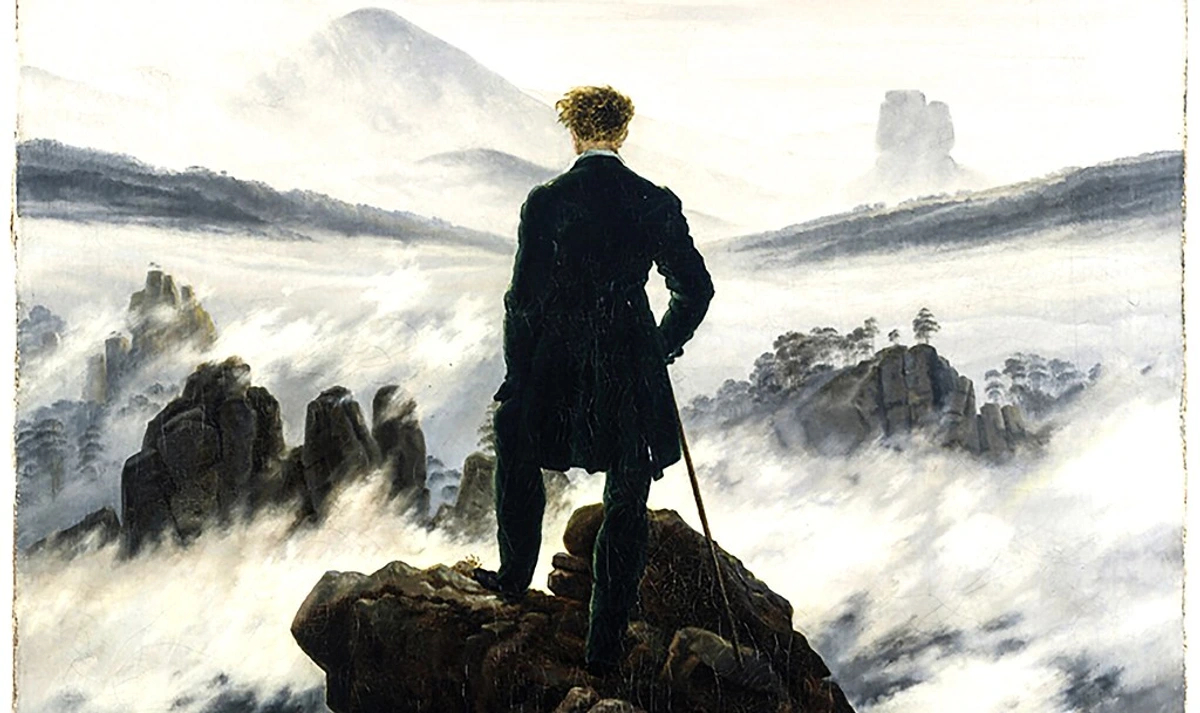
This early confrontation with death never left him. It's the quiet, unseen force that animates his work. It's there in the silhouetted figures, often with their backs turned to us, gazing into misty abysses or at distant, unreachable horizons. It’s a reminder that before we see Friedrich the Romantic painter, we have to see Friedrich the young boy who stared into the abyss and found it staring back.
Many biographies skim over this, treating it as a biographical footnote. I think it's the central key. How can you paint a sunset without first understanding the night? This man witnessed the fragility of life firsthand, and his response wasn't to turn his back on the darkness, but to find a terrible, solemn beauty within it.
The Mandate of the Romantics: Feeling Over Seeing
Friedrich came of age during the height of the Romantic movement. Think of it as a cultural course correction. The Enlightenment had given the world reason, logic, and order. It prized science and intellectualism above all else (which sounds as soulless as it probably was to many people). The Romantics rebelled against this, declaring that feeling was the highest form of truth. They championed the individual, the subjective, the mysterious, the untamed power of nature.
Forget trying to perfectly replicate a tree branch. A Romantic would ask: What does that tree branch feel like? What longing does it stir in your soul? What forgotten memory does it whisper? This wasn't just art; it was a form of spirituality.
This is where Friedrich found his voice. He wasn't interested in painting mere topographical portraits of a place. A mountain wasn't just a mountain; it was a monument to eternity. A seascape wasn't just a view of the ocean; it was a confrontation with the infinite. He wanted to capture the sublime—that strange, awe-inspiring mix of terror and wonder you feel when faced with something so magnificent it threatens to overwhelm you.
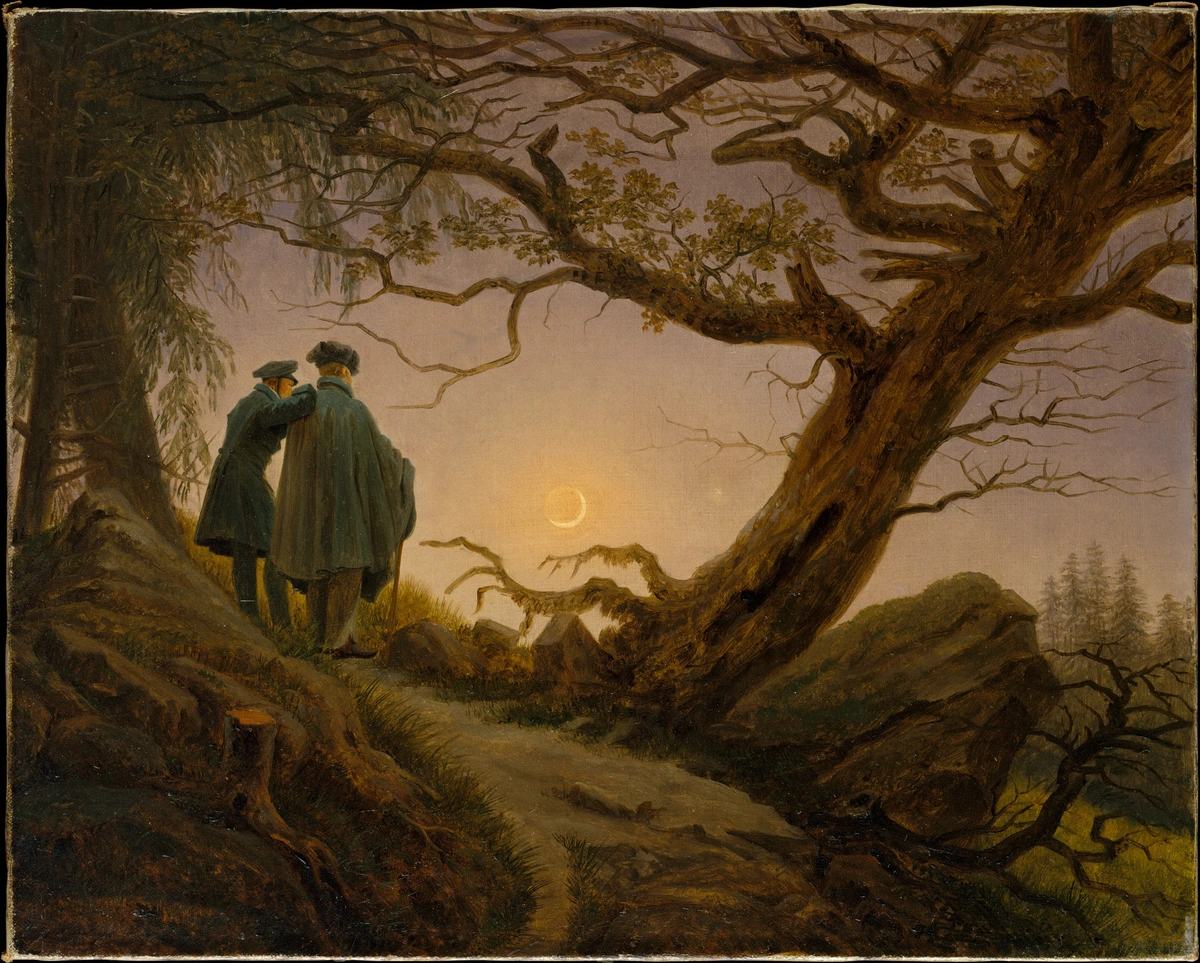
He famously said, "The artist's feeling is his law." That single sentence is the Rosetta Stone to his entire artistic philosophy.
Decoding the Iconography: A Visual Language of Longing
Looking at a Friedrich painting is like trying to understand a complex poem. Every element is a carefully chosen word. Over time, he developed a powerful visual vocabulary—an iconography of the soul, if you will. Once you learn the language, his paintings start to speak to you in a whisper.
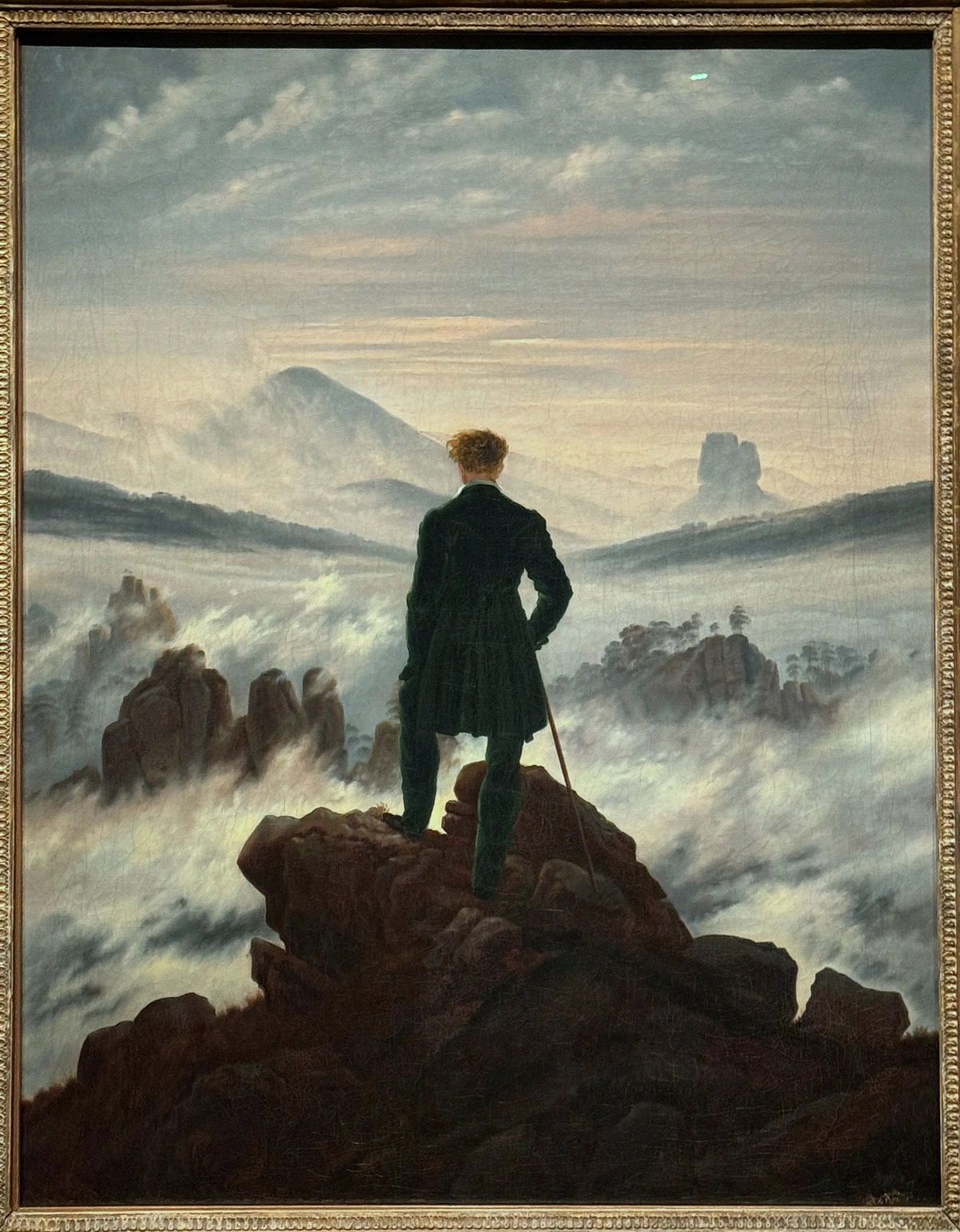
The Solitary Figure with Their Back Turned
This is perhaps his most famous signature. We almost never see the faces of his human subjects. A solitary monk stands before an expanse of sea, or a lone wanderer gazes out from a rocky precipice over a sea of fog. Why?
It forces us, the viewer, to inhabit the figure's position. We cease to be observers and become participants. We are the ones standing on that cliff, contemplating that vastness. It's an incredibly powerful psychological trick. By removing the specific identity of the figure, he makes the experience universal. It is no longer about that man's loneliness; it's about your loneliness, your sense of insignificance, your quiet wonder in the face of the universe.

The Sublime and Overwhelming Landscape
Nature is never just a backdrop in Friedrich's work; it's the main protagonist. It’s ancient, indifferent, and magnificent. It dwarfs the humans within it, not to belittle them, but to offer a kind of perspective. All your petty problems, your ambitions, your fears—they are nothing before the timeless march of these mountains and the eternal cycle of the seasons. There's a profound comfort in that insignificance, a truth I think our modern, ego-driven world has forgotten.
The Powerful Symbolism
Friedrich was deeply religious and filled his canvases with Christian and spiritual symbolism that he expected a 19th-century viewer to understand intuitively. It was a shared cultural language.
Symbol  | Meaning in Friedrich's Art | Example Painting |
|---|---|---|
| Light | The divine, hope, revelation, or the promise of eternity. The sun breaking through clouds is a recurring motif of salvation. | Morning Light |
| Darkness | Mortality, the unknown, doubt, or the trials of faith. | The Abbey in the Oakwood |
| The Cross | A literal symbol of Christian faith, but also a symbol of human suffering and redemption. | Cross in the Mountains (The Tetschen Altar) |
| Oak Trees | Strength, endurance, and the deep roots of German identity and faith. | The Abbey in the Oakwood |
| Barren Branches | Death, winter of the soul, or the stark reality of life's struggles. | Winter Landscape |
| The Sea / Mist | The infinite, the subconscious, the unknown future, or the boundary between life and death. | The Sea of Ice |
Now, this isn't just an intellectual exercise. Think of your own life. The way the morning sun streams through your window can feel like hope. A dense, gray fog can feel like confusion. Friedrich tapped into these primal feelings and codified them into a visual poetry that resonates without you even needing to know the specific doctrine behind it. He found the archetypes of the human soul.
An Anatomy of Awe: Dive into His Masterpieces
Let's pull a few of his most famous works under a microscope. I don’t want to just describe them to you; I want to think through them.
Wanderer above the Sea of Fog (c. 1818)
This is the one. The poster child for German Romanticism. If you've ever searched for "contemplative art," you've seen this. A man in a dark green coat stands with his back to us, one foot perched slightly higher than the other on a jagged rock, looking out over a turbulent ocean of fog. Rocky crags pierce the mist like islands, and distant mountains fade into a pale, hazy sky.
Most interpretations rush to label the man a "hero" of solitude, a conqueror of nature. I’m not so sure. Look at his posture. There's no swagger. He leans on his walking stick, a gesture of stillness, not dominance. He isn't conquering the mountain; he's having a silent, intimate conversation with it. The title calls him a 'Wanderer,' not a 'conqueror.' The word in German carries a sense of spiritual searching, of a pilgrimage without a specific destination.
The painting is a frozen meditation on the sublime. The figure is small, but his consciousness—his ability to perceive and reflect on this vastness—is what makes him monumental. It’s the ultimate expression of the Romantic idea: man is defined not by his power over nature, but by his deep, emotional, and spiritual relationship with it.
The Abbey in the Oakwood (1809-10)
If Wanderer is about the individual's confrontation with nature, The Abbey in the Oakwood is about the confrontation with time and mortality. We see the ruins of a Gothic abbey, its windows hollowed out, its structure crumbling. The trees surrounding it are not vibrant oaks but gnarled, leafless skeletons of trees. A procession of monks, looking like tiny, black-clad mourners, carries a coffin towards an open grave in the foreground, which is marked by a simple crucifix. The whole scene is bathed in the pale, ghostly light of a dying dawn (or is it an approaching dusk?).
Frankly, this painting is a funeral. It’s a lament for the passing of an era, a meditation on the inevitable victory of nature over man's most sacred structures. The cross, which traditionally symbolizes eternal life, is here juxtaposed with the stark, undeniable reality of death and decay. It's dark, somber, and absolutely breathtaking in its honesty. It’s a stark confrontation with the void, a theme that resonated deeply in an era shadowed by the Napoleonic Wars.
The Sea of Ice (1823-24)
This one feels almost apocalyptic. We see a shipwreck, the Griper, which was on an Arctic expedition, being crushed by a jagged, chaotic pyramid of ice shards. It’s a frozen cataclysm. The power of nature isn’t just vast here; it is violent, destructive, and terrifyingly impersonal.
This painting is a stark counterpoint to the quiet melancholy of his other works. There are no human figures to guide us, no narrative of spiritual questing. There is only the brute physical force of the natural world. It is a vision of chaos and ruin, a testament to nature's absolute indifference to human ambition and heroism. It’s a reminder that the sublime can be beautiful, but it can also be a nightmare.
Friedrich had a deep, almost obsessive interest in the ice-bound Arctic, seeing in its frozen wastes a metaphor for both a spiritual and a physical wasteland. Some scholars have even suggested that the sharp, crystalline geometry of the ice floes influenced the early 20th-century Cubists. Whether or not that's true, The Sea of Ice stands as a radical, almost abstract, and profoundly unsettling vision of nature's ultimate power.
The Ripple Effect: Friedrich's Enduring Legacy
The great irony of Friedrich's life is that he died in 1840, largely forgotten. The art world had moved on. The meticulous, heroic realism of the mid-19th century and the fleeting impressions of a new generation of painters had pushed his brooding, philosophical landscapes to the sidelines.
And yet, he couldn't stay buried.

In the early 20th century, the Symbolists and later the Surrealists rediscovered him, seeing in his work a powerful precursor to their own exploration of the subconscious and dream imagery. His stark, often haunting compositions were excavated from the dustbin of art history and hailed as masterpieces of psychological portraiture, even if the landscape was the subject.
Today, his influence is everywhere, in ways both direct and subtle.
- In Film: The work of directors like Andrei Tarkovsky (Stalker, Solaris) is saturated with a "Friedrich-ian" aesthetic. The long, contemplative takes, the human figures dwarfed by their environment, the profound sense of spiritual void—it's all there. You can see it in the cinematic language of Ingmar Bergman, Werner Herzog, and even in the dystopian landscapes of science fiction films like Blade Runner 2049.
- In Photography: The entire ethos of landscape photographers like Ansel Adams—the quest to capture not just a place, but a feeling, a sense of awe—is a direct descendant of Friedrich's Romanticism. The subject is the soul of the place, not just its topography.
He gave us a new way to see. He taught us that a landscape painting could be a window into the self. He made it okay for art to be quiet, introspective, and deeply personal. In our hyper-connected, noisy world, that feels less like a lesson in art history and more like a vital prescription for the soul.
Every artist who tries to capture a mood, an emotion, or a subtle state of mind owes a small debt to that quiet man from Greifswald who dared to turn his figures away from us, forcing us to look with him, and through him, into the great unknown.
After all, isn’t that one of the great powers of art, even today? If you're moved by a piece that hangs on your wall, a print that captures a feeling you can't name, you're participating in that same Romantic tradition. Sometimes, a piece of art just lands in your home, in your heart, precisely because it offers that silence, that space for contemplation Friedrich mastered so long ago. For any artist, creating something that invites that kind of personal reflection is the ultimate goal. It's the reason you might browse a collection of prints or paintings, looking for the one that doesn't just match your couch, but the one that speaks to the core of you, even if it's in a quiet, wordless whisper.
Frequently Asked Questions about Caspar David Friedrich
- What is Caspar David Friedrich most famous for?He's most famous for creating hauntingly beautiful landscapes that function as profound spiritual and emotional meditations. His iconic paintings, especially Wanderer above the Sea of Fog, are celebrated for their ability to evoke the sublime—that mix of awe and terror before the power of nature. He is the ultimate symbol of the introspective, soul-searching German Romantic artist.
- What was Caspar David Friedrich's style?Friedrich's style is a cornerstone of the Romantic movement. It's characterized by its atmospheric effects, meticulous detail, and symbolic depth. His paintings are never just about a place; they are about the feeling a place evokes. He used a visual language of symbols—solitary figures, dramatic light, gnarled trees, misty abysses—to explore themes of faith, mortality, divinity, and the insignificance of man in the face of the vast, eternal landscape.
- What does the "Wanderer above the Sea of Fog" symbolize?The painting is a meditation on the individual's place in the world. The Wanderer, with his back turned, represents the contemplative man. The Sea of Fog symbolizes the unknown future, the mysteries of life, or the subconscious. The craggy rocks represent the arduous journey of life. Taken together, it's a powerful statement about the power of human consciousness to stand in wonder before the infinite, even while being dwarfed by it.
- Who was Caspar David Friedrich's wife, Caroline?Caroline Bommer was the love of Friedrich's life. He married her in 1818, relatively late in his life (for the time) at age 44. She was a stabilizing force for the often-melancholic artist. We actually see her in some of his paintings, though often as a symbolic figure (like in Woman at the Window). Their marriage marked a slight, if subtle, shift in his work towards scenes of domesticity and intimate companionship.
- Why did his reputation fade after death?Art fashions change, often brutally. After his death in 1840, the dominant styles became more literal, social, and politically charged (like Realism and Naturalism). Friedrich's intensely personal, introspective, and spiritual approach was seen as old-fashioned—the product of a bygone Romantic era. It wasn't until the 20th century that artists and critics, drawn to his psychological depth and symbolic power, resurrected his reputation and firmly established him as a giant of Western art.
- Where can I see his work in person?Most of Friedrich's masterpieces are held in major museums in Germany. The Alte Nationalgalerie in Berlin and the Hamburger Kunsthalle have world-class collections of his work. Seeing them in person is a completely different experience; the texture, the subtle shifts in color, and the sheer scale create an immersive and deeply moving atmosphere.
- How did Friedrich influence future art movements?His influence was profound, though not immediate. Symbolist painters of the late 19th century saw him as a forerunner who used nature to express inner states. Surrealists admired his dream-like atmospheres. His dramatic compositions and emotional intensity can be seen echoed in cinematic works of directors like Andrei Tarkovsky and Werner Herzog. Most importantly, he legitimized landscape painting as a vehicle for the most serious philosophical and spiritual themes, paving the way for countless artists who followed.
- Is there a connection between Caspar David Friedrich and Zen Dageraad Visser's art?While separated by centuries and style—Friedrich's somber Romanticism versus the vibrant, often abstract work of artists today—the core goal can be strikingly similar. It's about capturing a mood more than a perfect likeness. It's about creating a space for contemplation. A contemporary work, like one you might find here on my site, doesn't need to be a literal landscape to make you feel something profound. Whether it's the silent awe of a Friedrich painting or the quiet energy of an abstract print on your wall, the best art invites you to pause, to feel, and to look inward. The medium changes, but the human need for that emotional and spiritual resonance is timeless.
The Final Brushstroke
So, who was Caspar David Friedrich?
He was a man who painted silence better than anyone before or since. He took the grand, philosophical questions of existence—Who are we? What is our place in the cosmos? Is there meaning in the face of death?—and translated them into mist, into mountains, into the stooped back of a single, anonymous figure.
He was not a painter for the loud or the proud. He was a painter for the quiet ones, the seekers, the introverts standing at the window at 3 AM. He was a painter who understood that our deepest connection to the divine—or whatever you want to call that sense of wonder—is often a solitary one.






In a world that constantly shouts for our attention, Friedrich's work is a sanctuary of hush. It reminds us that there is profound beauty in melancholy, deep truth in contemplation, and an undeniable power in turning away from the noise to face the immense, quiet mystery of it all.
It’s a lesson I think we could all use right about now.