R. Mutt's Fountain: Art History's Impact & Legacy | Zen Museum
A deep dive into the 'R. Mutt' Fountain: the 'urinal heard 'round the art world.' We explore the object that shattered our definition of art, paving the way for every modern movement that followed. Join me as we unpack the biggest little scandal in art history.

The 'R. Mutt' Fountain: The Urinal That Flushed Art History Down the Drain (And Started a Revolution)
Let's start with a confession. I've spent my life in the service of color, form, and abstraction, but I think the single most important object in the last century of art isn't a painting, a sculpture, or even a photograph. It's a urinal. To be specific, it's a mass-produced, off-the-shelf Bedfordshire model urinal made of glazed white porcelain. In 1917, an artist signed it “R. Mutt,” turned it on its back, and submitted it to an art exhibition. I still remember the first time I saw a photograph of it—tucked away in a dense chapter of an art history book. My immediate thought was, "This has to be a joke." And in a way, it was. But it was also the most serious challenge the art world had ever faced, a philosophical bomb that detonated a century ago and whose aftershocks are still rattling the walls of every museum, gallery, and artist's studio today. It forces a question onto us, one we're still grappling with: When you strip away the skill, the beauty, and the craft, what, in the end, makes something "art"?
I want to state something clearly before we proceed: you might be reading this because you want to understand why Fountain is considered a landmark of modern art. Or maybe you encountered it in a museum and walked away confused, thinking, "I could have done that." It's that very thought—the feeling that art should demand specialized skill or aesthetic pleasure—that this porcelain urinal puts on trial. This article isn't just about a scandal from 1917; it's about how a single object rewired our understanding of creativity, originality, and meaning itself, laying the groundwork for everything from Andy Warhol's soup cans to a shark in a tank.
That question is the real artwork. The act of posing it so starkly is what changed the game. Fountain didn't just ask it politely; it screamed it from the (proverbial) rooftops. Forget the artist's hand for a moment. Forget the hours of laborious craft. The maker of Fountain didn't carve or paint a thing.
Think about that for a second. We're conditioned to venerate the artist's hand, to see meaning in every brushstroke. But what if the thought is more important than the touch? What if the context is more powerful than the craft? Duchamp's entire creative act consisted of three simple steps: selection, re-contextualization, and a single, defiant signature. By stripping away the manual labor, he forced us to confront the idea that meaning isn't something you always make with your hands, but something you can choose with your mind. He moved the artist from the studio to the gallery, from the role of a creator to the role of a curator of ideas. It's a shift so profound it's hard to even grasp its full impact.
Calling this a quirky story does it a disservice. It's the foundational myth for the idea that an artist's intellect can be their primary tool. It was a direct attack on what the artist and poet Jean Cocteau called "retinal art," which only pleases the eye. Duchamp wanted art for the service of the mind.
Imagine a painting that's just beautiful. It's pleasant, you enjoy looking at it, but it doesn't linger in your thoughts. That's retinal art. Now imagine an object that disgusts you, or confuses you, or makes you laugh, but forces you to think, to question your own assumptions about what you're seeing. That's what Duchamp was after. He wanted to move art from the gut reaction to the cerebral cortex, insisting that an artwork's true value lies in its ability to provoke thought long after you've stopped looking at it.
It's the crack in the dam through which the entire flood of conceptual art would eventually pour. Before Fountain, art was largely a retinal experience—something to be looked at, admired for its beauty or technique. After Fountain, it became a mental one. The real work wasn't the urinal itself, but the invisible space it opened up in our minds. For someone like me, working in the realm of color and abstraction, that liberation is the air we breathe. It's the philosophical permission slip that allows an artist to prioritize an idea, a feeling, or a question over faithful representation. It’s the reason a canvas doesn’t have to look like anything other than itself.

The Powder Keg of 1917: New York and the Rebel Society
You can't understand the explosion without first mapping the powder keg. The year was 1917. The world was on fire. We were at the midpoint of a global conflict that was erasing a generation, a war that introduced concepts like trench warfare, chemical weapons, and staggering industrial-scale slaughter. Europe was tearing itself apart in the trenches of the First World War. For many young, disillusioned artists and intellectuals, the war represented the logical endpoint of Western rationalism, a disastrous failure of the systems—nationalism, logic, capitalism—that had been held sacred for centuries. It felt like the end of the world, and for many, it was. This nihilistic fury fueled the Dada movement, which roared to life in a Zurich cabaret in 1916. It was a movement defined by its rejection of logic, reason, and aesthetics. Dada was a howl of anguish, a mockery of a civilization that had led itself to the slaughter. Art, in its hands, became a weapon of absurdity and anti-art. It was performance, it was noise, it was nonsense, and it was a vicious critique of a world gone mad.
Meanwhile, a wave of avant-garde artists, writers, and thinkers had washed ashore in New York City, creating a vibrant haven. The city's air was electric, crackling with the revolutionary energy of imported movements like Cubism and Fauvism. Old rules were being gleefully ripped up, and the city was a fertile ground for new ideas. It was here, in this cauldron of intellectual and artistic energy, that the stage was set for the single most important act of artistic rebellion of the 20th century.

In the heart of this maelstrom stood the Society of Independent Artists. This wasn’t just another art club; it was founded as a direct and furious rebellion against the conservative, gate-keeping art establishment epitomized by New York's National Academy of Design. Think of the Academy as the ultimate tastemaker, deciding what was "good" and "proper" art. The Society was formed as the antidote. Its core principle was radical for the era: a no-jury, no-prizes policy. For a small fee—six dollars—any member could submit any piece of work they desired to the annual exhibition. No one would be turned away. No one was more important than anyone else.
The idea was the purest form of artistic democracy—let the public, not a panel of snobbish experts, decide what had merit. It was a utopian vision, the perfect stage for a revolution, a space where art was free from the dictates of style, subject, and commercial appeal. It was freedom, personified. Or so they claimed.

Which makes what happened next the most deliciously ironic act of artistic sabotage in history. The Society had created the perfect conditions for its own undoing. They preached freedom, but they weren't ready for true freedom. It's one thing to be open to different styles of painting; it's another to accept a urinal as a sculpture. Subversion requires a system to subvert, and the Society's lofty, self-righteous ideals provided the ideal backdrop. It was like setting a beautiful, intricate trap and just waiting for someone clever to spring it. By rejecting an object simply for not being "art," they exposed their own secret prejudices and proved the revolutionary idea's point better than any public display ever could. They became part of the artwork themselves.
The Artist's Deft Hand: Marcel Duchamp and the Readymade
So, who was the mastermind behind this act of artistic anarchism? The man behind the pseudonym was Marcel Duchamp. By 1917, he was already a notorious figure in the art world, a kind of art-world celebrity known for his brilliant mind and his disdain for convention. He had caused a scandal at the 1913 Armory Show in New York with his painting Nude Descending a Staircase, No. 2. Critics mocked it as “an explosion in a shingle factory,” and the public was both baffled and fascinated. But Duchamp wasn’t just pushing boundaries; he was interrogating the very DNA of art. He was becoming deeply frustrated with what he called "retinal art"—paintings that were meant to be visually pleasing but asked little of the mind. He wanted an art that served thought, not just the eye. He was less interested in how things looked, and more interested in how they meant.
The concept was simple on the surface, yet devastatingly complex in its implications: take a mass-produced, utilitarian object that holds no aesthetic interest on its own, and, through the sheer force of the artist's selection and will, designate it as a work of art. It's a deceptively simple formula that managed to pose the most profound questions imaginable.
This was a radical departure. For centuries, art was about the unique object made by a skilled individual. Duchamp threw that out the window. He wasn't interested in the object's history, its craft, or the manufacturer's intent. He was interested in what happened to it—and to us—when it was stripped of its function and placed in a new context. He was playing a game of intellectual chess, and the board was the entire history of art.
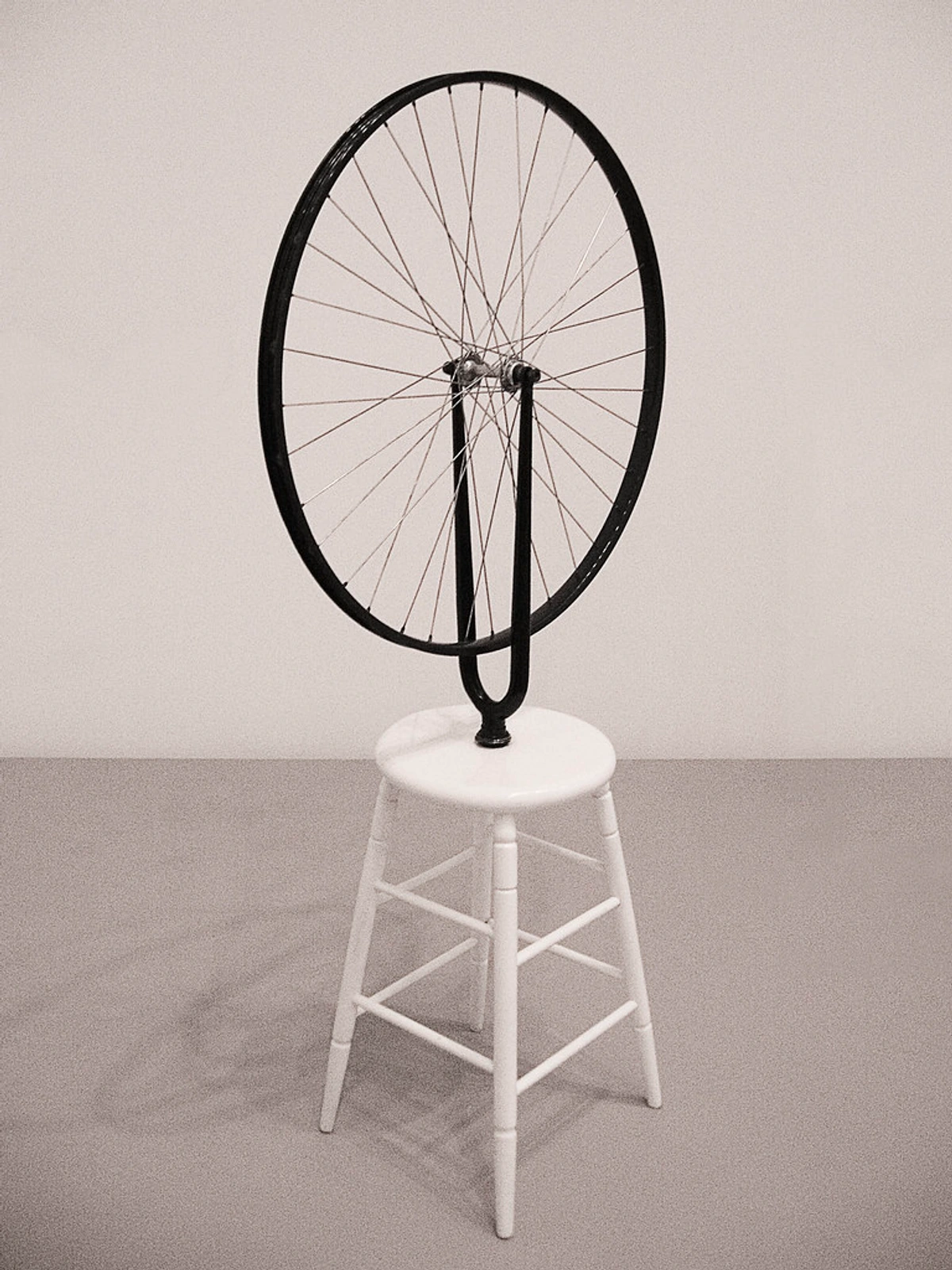
He had been exploring this idea for years before 1917. His first true readymade in 1913 had been a bicycle wheel mounted upside-down on a kitchen stool. He enjoyed watching it spin; its purpose was purely cerebral, a kinetic sculpture that also managed to be anti-art. In 1914, he bought a standard galvanized iron bottle rack and simply kept it in his studio, another readymade. And then, in a move that was perhaps the ultimate act of defiance against the very medium he had dedicated his life to, he gave up painting. He famously worked on his monumental piece, The Large Glass, but his output slowed to a trickle. His real art was the thought process. He was no longer a painter; he was something new—an intellectual engineer whose studio was his own mind. These readymades were not jokes to him; they were experiments in redefining the source of art's value, shifting it from the hand and eye to the brain.
The Act of Creation: Purchase, Pivot, and Inscription
The story of Fountain's creation is not one of divine inspiration in a lonely studio, but something far more calculated and, frankly, more interesting. It began with a trip. The story goes that Duchamp, along with his friend and patron Walter Arensberg, visited the J. L. Mott Iron Works, a well-known plumbing supply company on Fifth Avenue in New York. He didn't go to a scrapyard or pick through trash; he bought a brand new, gleaming white porcelain urinal from the showroom—a standard, factory-made Bedfordshire model.
This detail is crucial. It underscores that the object's very banality, its complete lack of uniqueness, its status as one of thousands of identical objects, was central to his idea. The art wasn't in the uniqueness of the object, but in the uniqueness of the thought applied to it. He didn't seek something beautiful or unique; he sought the absolute opposite: the generic, the overlooked, the purely functional. The ultimate anti-art gesture.
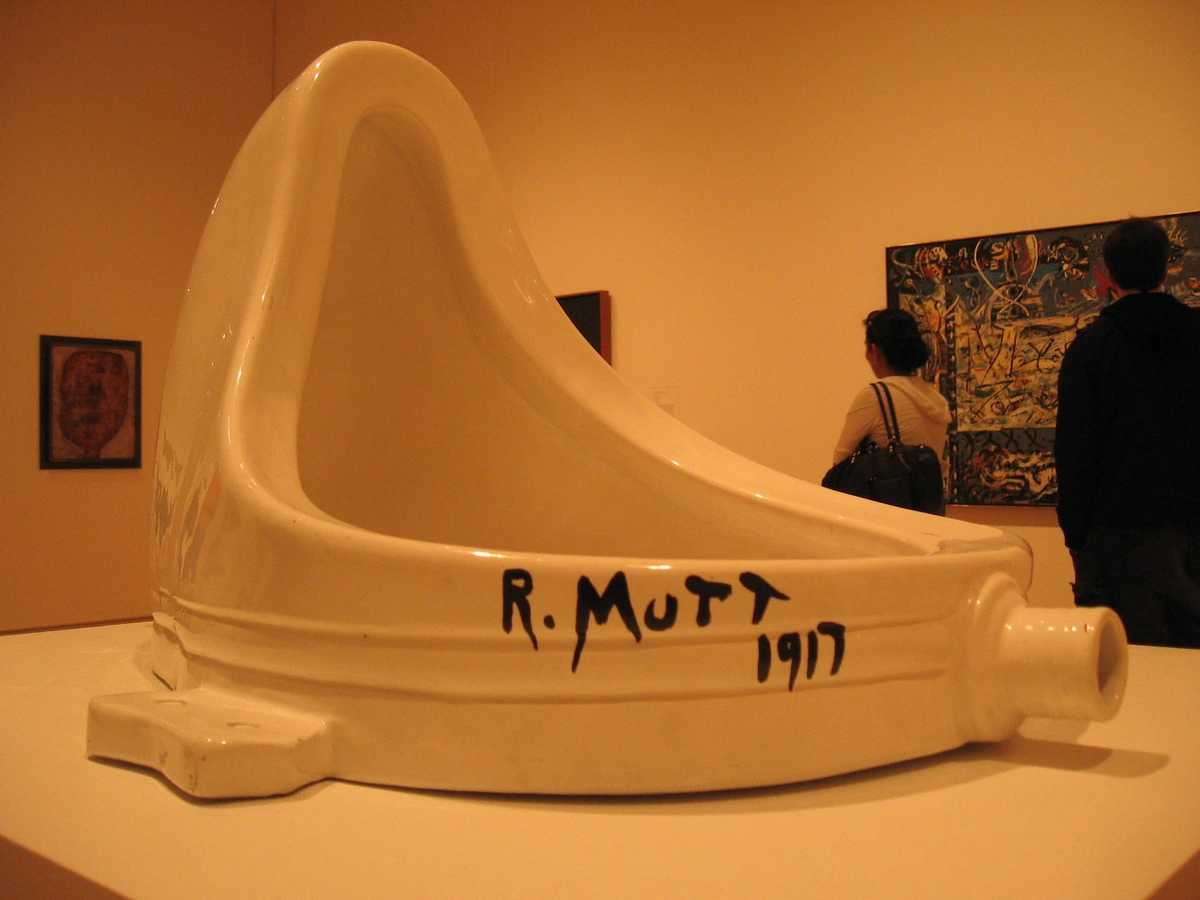
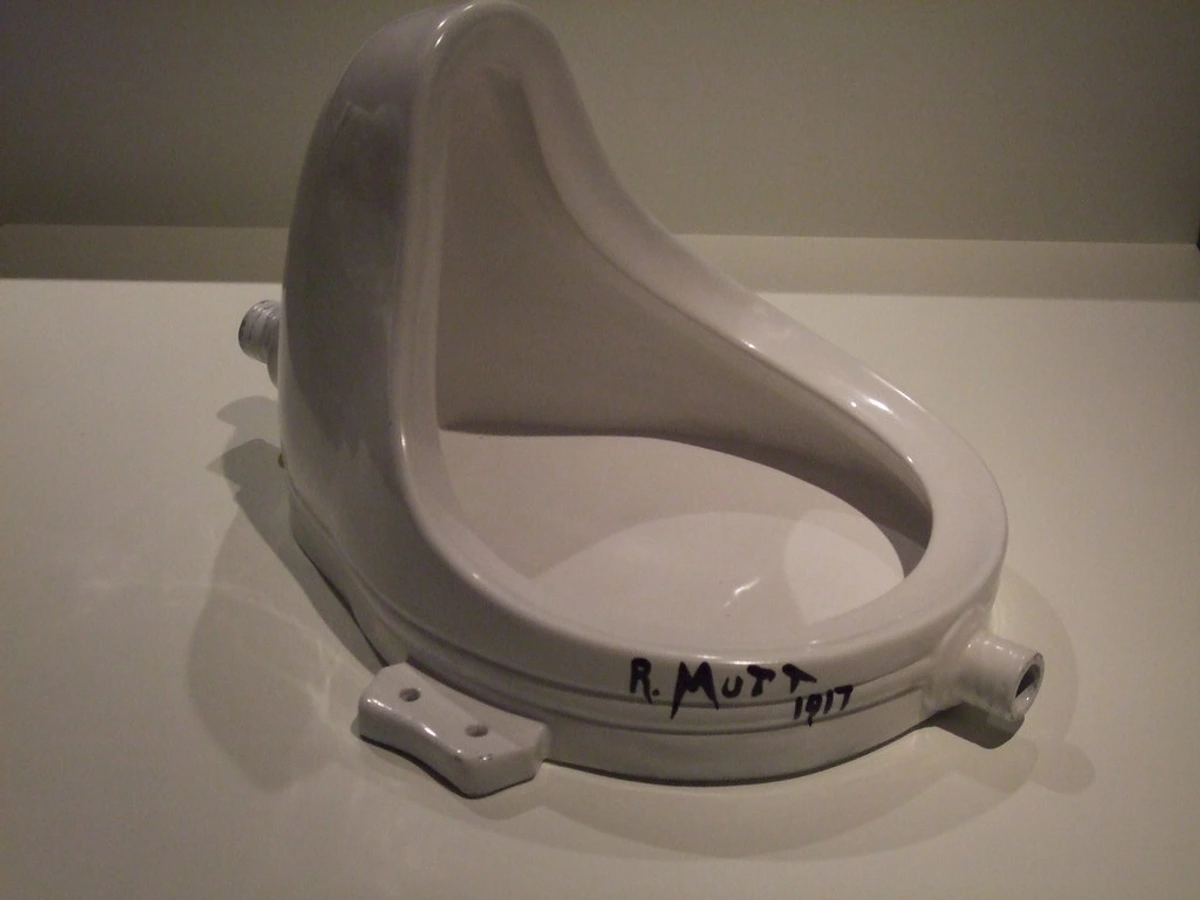
Back in his studio, or perhaps in collaboration with another artist for submission under the pseudonym, the "creation" began with a single, almost imperceptible gesture: the pivot. He laid the urinal on its back, pivoting it 90 degrees from its functional position. In this new orientation, its familiar purpose vanished.
This 90-degree rotation is perhaps the most important gesture in 20th-century art. It’s a deceptively simple act, but its implications are staggering. A functional object, designed for one specific use, is suddenly rendered useless. Its form is exposed, stripped of its purpose. The drain holes, once a conduit for waste, now point skyward like empty, sightless eyes. The smooth, rounded hood, once a functional guard, becomes a strange, biomorphic curve. It's a gesture of pure re-contextualization that forces the viewer's brain to short-circuit its own assumptions.
In that moment, the urinal ceases to exist as a urinal. It becomes a formal sculpture, an object to be contemplated, a shape in space. The violence of this conceptual shift cannot be overstated. It is an act of profound negation—not just negating the object's function, but negating the idea that an object has to be any one thing at all. It's a masterclass in how a simple shift in perception can utterly obliterate the boundary between the mundane and the profound.
This act of pivoting forces an entirely new way of seeing. Suddenly, its shape hints at something else entirely. Some have seen the rounded hood as a veiled head, like a shrouded Madonna or a mysterious deity. Others have compared its smooth, flowing lines to the soft curves of a reclining nude from classical sculpture, finding an echo of ancient sensuality in industrial porcelain. And still others have noted its uncanny resemblance to a meditative Buddha, sitting in tranquil silence. The transformation is genuinely uncanny. A brutally functional object, something designed to be ignored, is suddenly imbued with a formal, almost spiritual quality.
It was a urinal one minute, and a sculpture the next. The only thing that changed was its position in space. This simple fact is the core of its power. It proves that context, perspective, and the artist's intentionality can utterly transform any object's meaning, revealing an infinite number of hidden forms within the most mundane of things. It forces an uncomfortable question: Is the beauty we see in art actually in the object, or is it a quality that we, the viewers, bring to it through the act of looking?

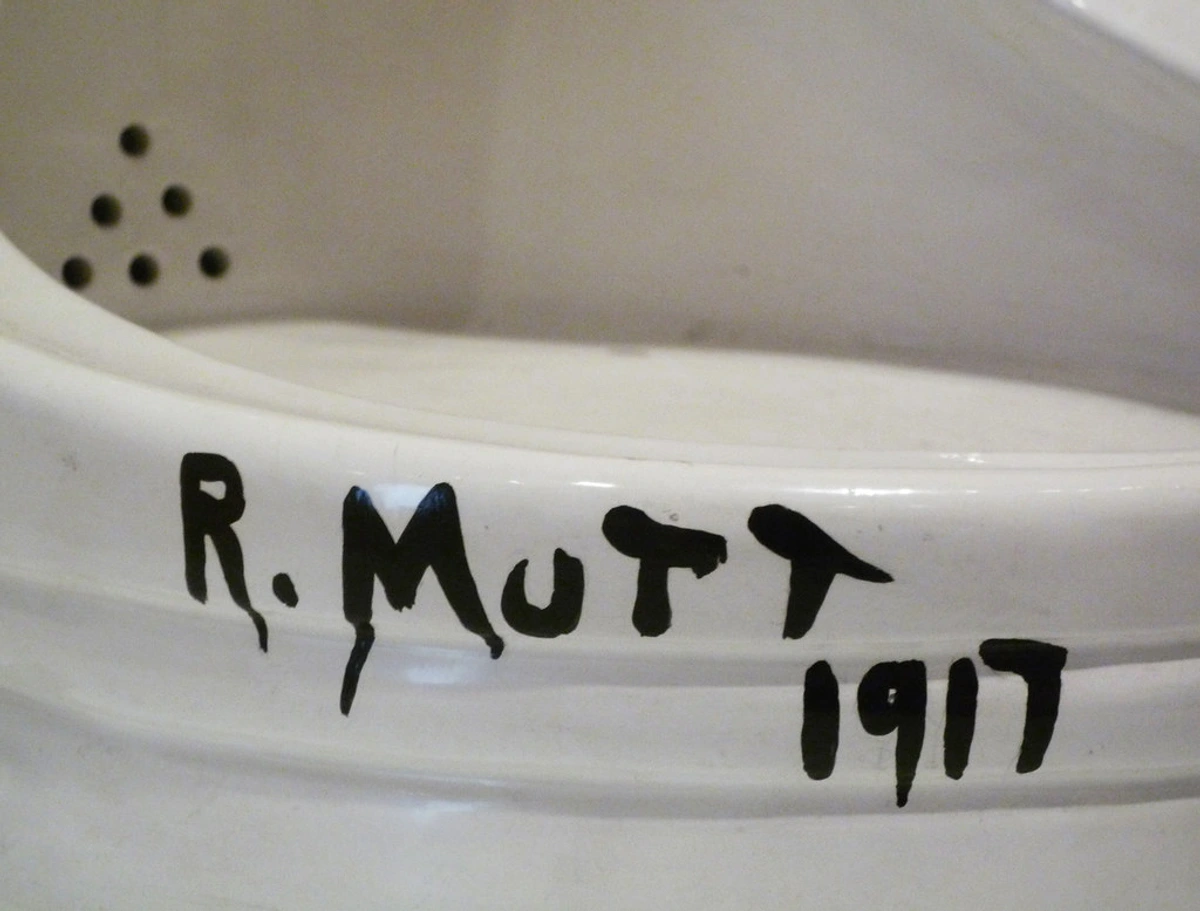
The final step was the signature. He did not sign it with his own famous name, but with the invented pseudonym “R. Mutt 1917” in black paint. This was not an act of self-promotion, but of deliberate self-erasure. It was the final conceptual lock that sealed the work. In just three moves—purchase, pivot, and inscription—Duchamp completed a work that would take art history decades to fully digest.
Deconstructing the Signature: "R. Mutt" and the Power of the Pseudonym
Let's pause here and break down the poetry of that signature. It's not just a name; it's a multi-layered strategy and a work of art in itself.
The name "R. Mutt" was a piece of linguistic play, a Dada poem in just two syllables. It was likely a nod to the popular "Mutt and Jeff" comic strip, adding a layer of lowbrow American pop culture humor. More cleverly, there was the J. L. Mott Iron Works, the company from which he purchased it—"R. Mutt" is a not-so-distant echo of "Armott." It's a direct trail of breadcrumbs. And finally, "Mutt" in German can imply poverty or struggle (Armut), another inside joke for those in the know. The name was a rich soup of hidden references, a private smile from the artist.
Why use a pseudonym at all? This was perhaps the most radical strategic choice. By removing his own artistic celebrity from the equation, Duchamp forced the idea to stand on its own. He created a ghost artist, a mystery. The critics couldn't debate the merits of the famous Marcel Duchamp; they had to debate the urinal itself and the unknown "Richard Mutt." It was the ultimate separation of the artist from the idea, forcing the art world to confront the object without the influence of a famous name. The number, 1917, forever roots the piece in its historical moment, turning a mass-produced bathroom fixture into a historical document.
With the signature in place, the artwork was officially "complete." The next step was to submit it. Duchamp, a board member himself, paid his $6 entry fee, listing "Richard Mutt" as the artist. He then roped in his friend, the influential photographer Alfred Stieglitz, to photograph the piece. It's a detail worth pausing on: Duchamp always understood the power of media and documentation. Stieglitz shot it in his famous gallery, "291," against the backdrop of a modernist painting by Marsden Hartley.
This act of documentation was itself a brilliant move. It was a way to elevate a piece of plumbing into the realm of serious aesthetic consideration. Stieglitz shot it in his famous gallery, "291," against the backdrop of a modernist painting by Marsden Hartley. The dramatic, high-contrast lighting and the careful framing gave the urinal a weight and presence it never had on the showroom floor. He lit it like a classical sculpture, emphasizing its curves and hollows. The photograph transformed the object, turning it from a readymade into an icon. This photograph would become the only "surviving" record of the original work, and the primary vehicle through which its influence spread across the globe.
In many ways, Stieglitz's photograph is the original artwork. The actual urinal was lost, thrown away like trash. But the photograph remained, a perfectly preserved image of the idea. Duchamp understood this perfectly: the concept was the art, and the photograph was its most potent and durable medium. He wasn't just creating a sculpture; he was creating a reproducible image of an idea, a ghost that could be printed, published, and spread around the world without any fear of decay or loss.
The Scandal: Art Hides Behind a Partition
The board of the Society of Independent Artists was, to put it mildly, in a state of collective apoplexy. The moment Fountain arrived, the utopian ideals of the society shattered like glass.
Imagine the boardroom. A group of self-proclaimed artistic rebels, champions of absolute freedom, now staring at a gleaming white urinal. It must have been a scene of almost comical horror. Here was their sacred principle—artistic democracy—incarnated in the most aggressively non-art object imaginable. It was a crude joke, an insult. The idealism of their manifesto was about to collide head-on with the reality of their own deep-seated prejudices. Despite their sacred 'no-jury' rule, an emergency board meeting was called. They had to figure out what to do with this... thing.
The Hidden Truth: Baroness Elsa von Freytag-Loringhoven
But what if Duchamp wasn't the originator, but a kind of co-conspirator—or even the receiver of the idea? A compelling, though still debated, theory points to another radical figure in the New York Dada scene: the Baroness Elsa von Freytag-Loringhoven. She was a force of nature—a poet, a performance artist, and a sculptor who lived her life as a work of art. She was known for creating assemblages from found objects, junk, and garbage, long before it was fashionable.
Some scholars now believe it was the Baroness, not Duchamp, who found the urinal and had the idea to submit it. The story goes that she presented it to Duchamp, who, recognizing its conceptual brilliance, signed it and submitted it under his pseudonym, “R. Mutt,” to protect her from the scandal and to ensure the work would be taken seriously by the (entirely male) art establishment.
This isn’t just historical trivia; it completely re-writes the myth. If true, it means the most famous act of artistic subversion in the 20th century may have been the work of a brilliant, fearless woman who was then systematically erased from the story. It transforms Duchamp from a lone genius into a savvy collaborator, and it reframes Fountain not just as a critique of the art world, but as a symbol of the avant-garde's own hidden biases. It’s a ghost story within a ghost story, where the primary author herself is the missing phantom.
Inside that committee room, a fascinating philosophical battle unfolded. Duchamp, as a board member (and the true artist), remained calm and collected, arguing for its acceptance. He coolly defended the artist’s right to define what art is. He later commented that he simply wanted to test their 'freedom,' to see if the society's radical principles were truly as deep as they claimed. Others were outraged. One board member, the painter George Bellows, allegedly stormed out, declaring it 'impossible to exhibit a sanitary appliance.' The very object they championed for its rebellion against aesthetic norms had become a litmus test they were about to fail spectacularly. The hypocrisy was breathtaking.
The debate was fierce. It highlighted a fundamental clash between artistic freedom as a principle and aesthetic taste as an instinct. In the end, their version of "democracy" was circumvented by a secret, informal vote—the ultimate act of institutional hypocrisy. The sacred, founding "no-jury" policy was conveniently forgotten in a moment of crisis, proving that no rule is strong enough to withstand the weight of pure, unadulterated prejudice. Fountain was not listed in the catalogue, and it was never formally shown to the public. According to the most popular version of the story, it was hidden from view, perhaps behind a partition during the installation, a shameful secret, and then mysteriously disappeared—either "lost" or simply thrown away. The original, iconic urinal was gone, discarded like the trash they believed it to be.
The rebellion against the art establishment had been quashed by the rebels themselves. It was a classic case of being careful what you wish for. Duchamp and his patron Walter Arensberg, in a quiet but firm protest of the board's hypocrisy, resigned from the Society. The scandal didn't end there, though. It was about to get its own publication.
But the artwork had already succeeded beyond Duchamp's wildest expectations. The scandal was the artwork. By rejecting Fountain, the Society's members unwittingly proved its central thesis. Who were they, the self-proclaimed liberators of art, to set boundaries? If their freedom was conditional—if it excluded anything that made them uncomfortable—then it wasn't freedom at all.
Fountain had held a mirror up to the art world's deepest prejudices and forced it to stare at its own reflection. It wasn't just a prank; it was an experiment in sociology and psychology, and the board members were its unwitting subjects. The real art, as Duchamp might have said, wasn't in the porcelain; it was in the heated debate, the moral outrage, and the philosophical questions that now echoed through the committee room. This initial failure was more valuable than any success could have been. Duchamp had exposed the ultimate hypocrisy: that even the most radical art movements often come with their own unspoken rules and limits. The artwork was complete not when it was signed, but when it was rejected.
The Ripple Effect: How Fountain Changed Everything
John Cage's Silence: The Sound of Thought
The influence of Fountain wasn't confined to objects. It also changed how we think about sound. The composer John Cage, a profound admirer of Duchamp, credited the readymade with freeing him from traditional musical constraints. In his infamous composition 4'33", a pianist sits at a piano and plays nothing for four minutes and thirty-three seconds.
The "music," Cage argued, isn't the silence, but the ambient sounds that happen during it: a cough from the audience, the hum of the air conditioning, the rustling of programs. It's an auditory readymade. He didn't write any notes; he simply chose a specific duration of time, chose to perform silence, and in doing so, forced the audience to become aware of the music that surrounds them every day. He moved music from the notes on a page to the thoughts and perceptions inside the listener's head. It's a direct conceptual descendant of Duchamp.

In fact, the original Fountain disappeared from history. It was likely discarded as trash, a fittingly anonymous end for an object whose existence was purely conceptual. The art survived not as an object, but as an idea, documented by Stieglitz's photograph, the fierce debates, and the pages of the avant-garde journal, The Blind Man.
The Blind Man: The Artwork Becomes a Headline
The scandal was too delicious to stay hidden. Duchamp and his close circle of collaborators saw to that. They quickly launched a small magazine, which they defiantly titled The Blind Man, to publish the photograph and defend the work. They didn't just let the provocation simmer; they poured gasoline on the fire in print.
In its pages, they published Stieglitz's now-iconic photograph. More importantly, they published essays and anonymous statements defending the piece. The most famous of these, defending the work of "Richard Mutt," reads like a Dada-ist manifesto: "Whether Mr. Mutt with his own hands made the fountain or not has no importance. He CHOSE it. He took an ordinary article of life, placed it so that its useful significance disappeared under the new title and point of view – created a new thought for that object."
This act of aggressive self-publication was the final stroke of genius. It proved the work was not just a passive object, but an active, ongoing event. The scandal, the committee debate, the photograph, the magazine articles—all of these components were part of the artwork. This is a profound point, maybe the most profound point of all: the artwork's power was so immense that it didn't need to physically exist. It existed as a debate, a photograph, and a publication. Stieglitz's photograph became the primary vehicle for its transmission, a ghost of an idea that haunted the 20th century and set the stage for everything that followed.
Decades later, in the 1950s and 60s, with the art world finally catching up to his ideas, Duchamp would authorize the creation of seventeen replicas for major museums. These were not treated as cheap imitations but as essential works of art in their own right. This act further muddied the waters between original and copy, and proved that the idea was always the most durable material.
The Replicas: An Idea Reborn
Decades passed. Art moved on, but the ghost of Fountain lingered. In the 1950s and 60s, with the art world finally catching up to his ideas, Duchamp was persuaded to authorize the creation of seventeen replicas for major museums. These were not treated as cheap imitations but as essential works of art in their own right. This act further muddied the waters between original and copy, and proved that the idea was always the most durable material. Duchamp wasn't precious about "the original." For him, the concept was the masterpiece, and it could be re-created at will. This itself was a revolutionary idea that would influence future generations.
The true impact of Fountain wasn't the scandal, but the slow, persistent leak it sprung in the art world's collective consciousness. After the initial shock, its influence began to seep through the cracks. It was the philosophical permission slip for almost every radical art movement that followed, from Pop Art and Minimalism to performance and conceptual art. It was a quiet revolution that took fifty years to win, a slow motion explosion that continues to this day.
Imagine you're Andy Warhol in the 1960s, staring at a pile of supermarket cartons. Before Fountain, he might have been "just a commercial illustrator." After Fountain, he could point to Duchamp and declare a Brillo Box a sculpture, forever blurring the lines between high art and the shelves of a grocery store. Pop Art is unthinkable without the readymade.
And it didn't stop there. Think of Jeff Koons' gleaming vacuum cleaners, displayed in pristine vitrines, or Damien Hirst's shark suspended in formaldehyde. These are the gilded grandchildren of Fountain. They use the logic of the readymade—the display of a pre-existing object—to critique consumerism, spectacle, celebrity, and even death.
The Shadow of the Readymade
It's crucial to understand that Duchamp wasn't interested in creating a new "style" of art. In fact, he grew tired of the readymade quickly, worrying that people would start appreciating the objects for their formal qualities, turning them into a kind of aesthetic fetish. He never wanted them to be 'beautiful' in a traditional sense. His goal was to ask a question, and once the question was asked, the object itself became almost an afterthought.
This is a crucial part of his genius, and something that's often misunderstood. He didn't want to start a factory producing readymades. He wanted to create a single, perfect philosophical provocation and then walk away, leaving the art world to cope with the wreckage.
For me, a painter of abstraction, the legacy is even more personal. When I'm in the studio, building a composition purely from color and gesture, I'm working in a space that Duchamp helped to clear. He moved the artist's primary function from maker-of-things to thinker-of-thoughts. This seismic shift in perspective was the permission slip for everything that followed. It freed us from the obligation to represent the world as it appears, allowing us to explore it as it feels, as it is.










He gave artists the freedom to present an idea, a question, or an emotion as the primary substance of the work. This intellectual liberation is what allows a painting today to be about the feeling of sunlight, or the sound of a city, or the memory of a specific shade of blue. The canvas is no longer a window onto the world; it’s a record of a thought, an arena where ideas and emotions collide. That’s the true legacy of Fountain—not just for the artists who followed, but for every single person who has ever stood in front of a piece of art and wondered, 'Why?'
It allowed for the pure emotional non-objectivity of Abstract Expressionism, which prioritized feeling over figuration. Think of Jackson Pollock's drips or Mark Rothko's floating color fields—they are pure feeling. It also paved the way for the quiet, intellectual rigor of 1960s Minimalism, where artists like Donald Judd and Dan Flavin used industrial materials to create art about space, light, and the viewer's experience. A Judd box isn't "about" anything other than its own material existence and its relationship to the gallery wall. Its meaning is entirely in the idea of its geometry.
And then, of course, there's Conceptual Art, the movement that took Duchamp's challenge as its sole principle. For artists like Sol LeWitt, who famously said 'The idea becomes a machine that makes the art,' or Lawrence Weiner, language itself became a medium. Artists would create art not as an object you could hang on a wall, but as a set of instructions, a written statement, or a performance. Think of Yoko Ono's Painting to Hammer a Nail In. The thought was the art. Fountain was their bible, their foundational text. It proved that an object's context—not its materials, its beauty, or the labor invested in it—was its ultimate meaning. It was the ultimate victory of the mind over the hand.