Hannah Höch's Dada Collage Techniques: A Rebellious Cut & Paste
Peek into the mind of Dada's rebel collagist, Hannah Höch. This guide unpacks her radical methods to inspire your own playful, powerful art.

Hannah Höch's Dada Collage: Like Stealing Fire from the Gods
They told her the kitchen was no place for a revolution. But that’s exactly where Hannah Höch decided to tear the world apart and rebuild it, one glossy magazine page at a time. If you’ve ever felt like the world’s rules were made to be broken, you already understand the impulse behind this groundbreaking artist. She didn't just participate in the Dada movement; she helped define its sharpest, most critical edge, becoming the primary female voice in a notoriously male-dominated arena and forging a new artistic language from the overlooked materials of everyday life.
It’s a strange historical coincidence that while the scientific community was beginning to understand that $E=mc^2$, Höch and the Dadaists were applying a similar logic to culture, proposing that any given mass-produced image contained a vast, hidden energy, a potential for destruction and creation that could be unlocked not with a particle accelerator, but with a simple pair of scissors.
Her story isn't just a history lesson. It’s a masterclass in creative rebellion, a guide on how to dismantle a broken system using its own discarded parts. This is your backstage pass to her mind, her method, and a practical framework for how you can apply her world-changing techniques to your own art.
I often think about how radical it must have felt to forgo the blank canvas and the expensive oil paints. The act of choosing what was essentially considered junk—a pile of old magazines—as a primary medium was an act of defiance in itself. It tells me that the best art often comes from resourcefulness, from a deep engagement with the world as it is, not as we're told to perceive it on a stretched piece of linen. Höch’s story feels like proof that constraints aren’t barriers; they are the very fuel for innovation. It’s one thing to say "think outside the box," it’s another thing entirely to find the box you were put in and decide to repurpose its cardboard for something beautiful.
The Dada movement, born in 1916 in Zurich’s Cabaret Voltaire, wasn’t just another art movement; it was a roar of pure frustration—a middle finger to a Europe that had torn itself to shreds in World War I. Its founders, including Hugo Ball, Emmy Hennings, and later joined by figures like Tristan Tzara and Hans Arp, believed that if the logic and reason of the Enlightenment had led to such industrialized madness, then the only logical response was madness itself. They took the 19th century’s faith in progress and turned it into a grotesque puppet show, a deliberate mess of nonsense poetry, performance, and visual noise that rejected all established values.
It was chaos with a purpose. Hannah Höch wasn’t just part of this chaos; she weaponized it. While her male counterparts were often loud and performative, she worked with a quieter, more surgical precision. Using a pair of scissors like a scalpel, she began the lifelong project of dissecting a society she saw as deeply fractured, using the new language of mass media as her primary text. Where the male Dadaists might rant and posture, Höch looked. She observed the mechanisms of power and propaganda, and her critique came not from shouting, but from carefully arranged, deeply unsettling imagery.
What I find so compelling about Höch, born Johanne Höch in 1889 in Gotha, Germany, is that she didn’t use the traditional tools of an artist. Her canvas wasn’t a blank, stretched piece of linen; it was the flood of mass media—the advertisements, the news photos, the celebrity portraits from publications like Berliner Illustrirte Zeitung—that was just beginning to wash over Weimar Germany.
Her formal training wasn’t in fine art, but in the applied arts. She studied glass design, which feels like a crucial clue to her later genius. That discipline taught her to see beauty and meaning in fragmented, everyday materials, not just the ‘precious’ media of high art. She looked at the burgeoning magazine culture and saw it for what it truly was: a terrifyingly effective tool for shaping perception, a form of propaganda for a new consumerist reality. Her art became a way to talk back, to twist the message, and to show the deep hypocrisies hidden in plain sight.
The Alchemist's Toolkit: How Höch Made Magic from Magazines
You’re standing in a crowd, and everyone is shouting a different slogan. How do you make sense of it? That’s the feeling a Hannah Höch collage gives me. Her genius wasn't just in what she cut, but how she assembled the fragments to create a new, jarring, and often hilarious meaning.
I think her method can be broken down into two distinct phases, almost like a scientific process. The first was one of collection and deconstruction, a kind of cultural scavenging. The second was a process of alchemical reconstruction, where disparate elements were fused to create a new compound that was both beautiful and toxic to the status quo.
Phase 1: The Art of the Incision – Cutting with Purpose
Höch’s scissors were her primary tool, and she treated them with the same seriousness a painter would give to a fine brush, or a surgeon to a scalpel. This wasn't a simple act of cutting; it was a targeted incision, a deliberate act of extraction designed to isolate specific cultural signifiers from their original ecosystem. She performed what she and her contemporaries called photomontage. The term, derived from the German Fotomontage, literally means “assembling” (Montage) a new image from photographic parts. But to call it "assembling" is too gentle. It was a process of aggressive deconstruction first, then a forced reconstruction. She was translating the original image’s manufactured authority into a completely new, often subversive, message.
I imagine her method was like that of an anthropologist or an archaeologist of the present moment, hunched over a kitchen table—a space traditionally devalued as “women’s work,” hence her ironic masterpiece title—sifting through stacks of publications. She wasn’t just cutting out pictures; she was extracting cultural artifacts. Each cut was a choice. Did she capture the politician’s entire figure, or just the smug curve of his mouth? Did she isolate the new woman’s face, or deliberately leave the disembodied hand of her husband gripping her shoulder in the corner? The negative space she created was as important as the image itself.
This act of removal was part of the art itself. By physically severing an image from its origin, she performed a symbolic act of liberation, often violent in its implication. The cut-out figure was stripped of its old meaning, now an orphaned signifier waiting to be adopted into a new, critical family. A fresh, raw edge of paper was a visual scar, a reminder that this image had been wrenched from its context. This violent separation is the very heart of Dada’s revolt against a seamless, orderly narrative. By cutting, she could reassign meaning with brutal efficiency. A handsome soldier, clipped from a patriotic recruitment poster, could suddenly find himself dancing with a machine part. A glamorous socialite, plucked from the society pages, might be given the body of an infant or have her head replaced with a lightbulb. It was an act of defiance. She was hijacking the message by replacing it with a visual pun, a political satire, or a poignant observation about identity, turning propaganda back on itself with surgical precision.
Phase 2: The Alchemist's Lab – Merging Mismatches
Once the pieces were cut, the real alchemy began. You have to understand, Dada composition laughs in the face of classical rules like balance and harmony. For Höch, the most potent meaning lived in the juxtaposition—the deliberate and shocking pairing of things that do not belong together, creating a semiotic collision. And, it’s worth noting, in the accumulation—the layering of dozens, sometimes hundreds, of fragments to create a visual noise that mimicked the overwhelming sensory assault of modern urban life.
This is what makes her work feel so alive, even a century later. She’d stick a child's head onto a wrestler's body, creating a jarring commentary on war’s infantilization of men. She’d place a map of Europe over a woman’s face, rendering the female body a contested territory. She’d mix scales so a teacup was the same size as a factory or a human figure was dwarfed by a giant pair of scissors. The spatial logic is intentionally fractured, rejecting Renaissance perspective for a more honest depiction of a fractured reality. I’ve always thought this deliberate distortion of scale is one of the most powerful tools for conveying emotion in art; it mirrors how our own anxieties can make small problems feel huge. The jarring visual breaks your brain in the best possible way, forcing you to ask why. Why this head on that body? Why that text next to this image? Your brain, desperate for a logical story, starts to invent one, and in that act of invention, it starts to expose the hidden assumptions and prejudices that usually lie dormant. That moment of cognitive friction is where the magic happens—it is the very engine of critical thinking.
It’s a bit like a DJ mixing two completely different songs to create something entirely new. The result is a kind of dissonant harmony, a visual clash that resolves not into peace, but into a powerful, often critical, new idea. This deliberate irrationality forces your brain to abandon its search for a single, linear meaning and instead embrace a multitude of contradictory interpretations simultaneously. It’s the collision of these fragments that generates the heat—and the light—in a Höch collage. I’m reminded of the absurdist plays of the time, where characters spoke in non-sequiturs and plot was secondary to mood. Höch was doing the same, but with imagery ripped from the headlines, creating a visual static that mimics the noise of modern consciousness.
Words as Weapon: The Power of Text
Höch didn't treat text as a secondary element; it was another weapon in her arsenal. A clipped headline that read “Die Neue Frau” (The New Woman) pasted over a picture of women in restrictive corsets became an immediate, sharp critique of the contradictions inherent in this new ideal. The text, often pulled from fashion magazines or political news, immediately frames the image, forcing a dialog. A snippet of an advertisement for a sewing machine, when paired with an image of soldiers, suddenly suggests the machinery of war stitched the fabric of society together, or mended the broken bodies. This word-and-image montage operates on principles akin to Soviet Constructivist typography but with a distinctly Dadaist absurdity, puncturing the high-minded seriousness of political art with a dose of black comedy.
This practice turns simple pictures into complex arguments. The text comments on the image, and the image mocks the text in a constant feedback loop of meaning. It’s a form of concrete poetry made with scissors and glue, where the physical arrangement of words creates meaning beyond their literal definition. It’s a visual essay that’s both beautiful and deeply argumentative, leaving the viewer to piece together the conclusion from the deliberately scattered evidence. Höch effectively pioneered a form of media literacy, showing how to deconstruct the messages that were already being constructed to manipulate the public.
Decoding the Masterpieces: How Theory Becomes Practice
Analyzing Höch's key works is like looking at a master engineer’s blueprint. We can see the individual techniques—the incision, the juxtaposition, the textual irony—combine into a potent and complex whole, where the final work is something far greater than the sum of its severed parts.
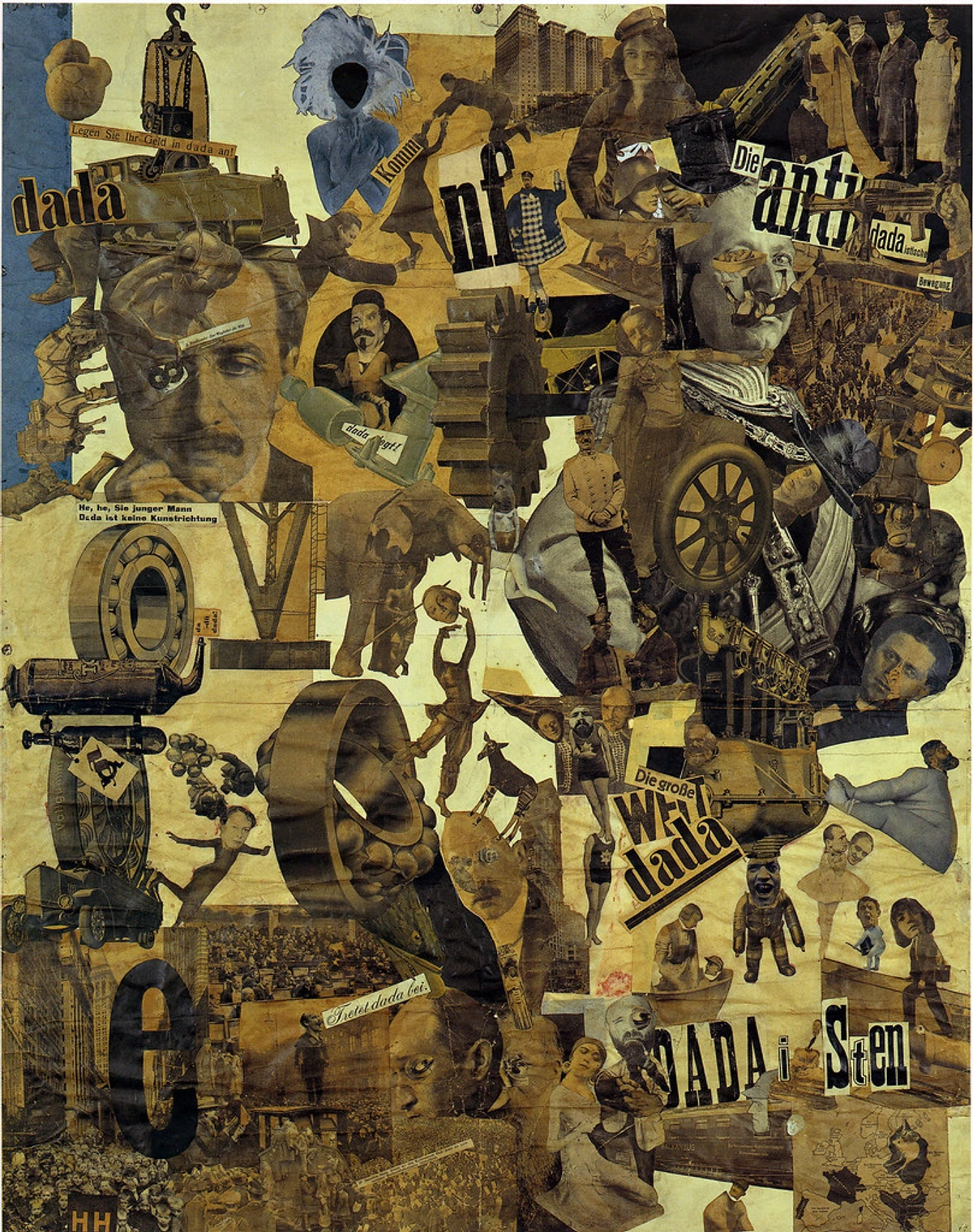
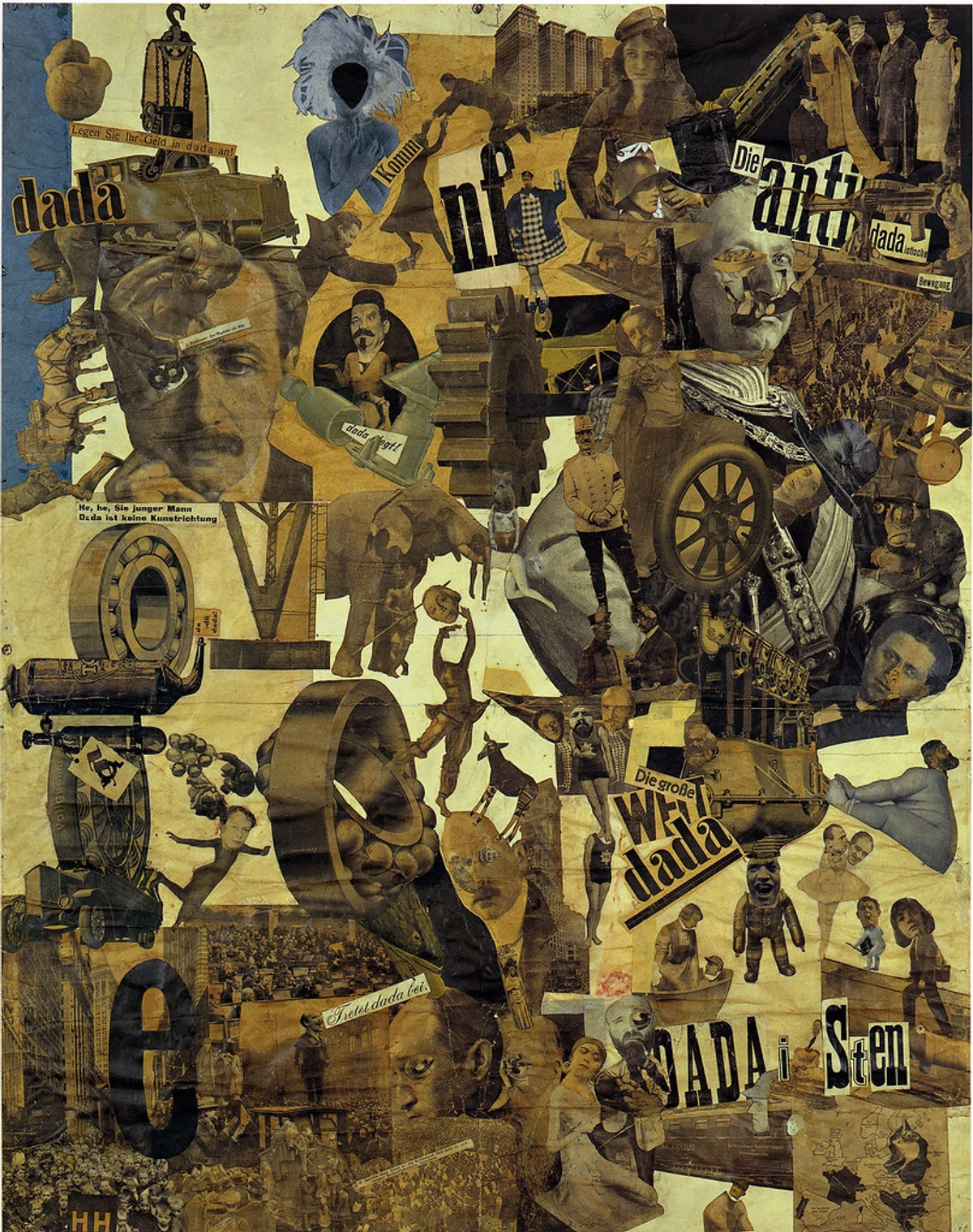
Cut with the Kitchen Knife Dada through the Last Weimar Beer-Belly Cultural Epoch of Germany (1919-20)
We have to talk about this piece. It is the ultimate example of Höch’s entire philosophy in action. The title itself is a masterpiece of satire, using the domestic, "feminine" kitchen knife to carve up the fat, complacent "beer-belly" of German culture. It promises a domestic tool but delivers a sprawling political map. The composition is a whirlwind of clippings from the mass media that defined the Weimar period.
Element  | What Höch Included | Why It Was Chosen |
|---|---|---|
| Political Leaders | Kaiser Wilhelm II, military figures | To represent the “Anti-Dada Welt,” the old patriarchal order. |
| The “New Woman” | Athletes, dancers, working women | To champion the emerging female identity, part of the “Dada Welt.” |
| Technology & Machinery | Cars, gears, industrial parts | To symbolize both progress and the dehumanizing force of the modern age. |
| Dada Artists | Herself, Raoul Hausmann, others | To literally insert the radical movement into the heart of the established world. |
The work maps out the “Dada Welt” (Dada World) versus the “Anti-Dada Welt,” creating a hilarious, frenetic, and deeply critical portrait of a society caught between a devastating past and an uncertain future. It feels like a visual archive of a moment in time, but compiled by an absurdist historian with a wicked sense of humor. While it looks chaotic, the composition is surprisingly balanced, with the rotund belly of the "Anti-Dada" figures physically weighed down in the lower portion, while the dynamic figures of the "Dada Welt" seem to be energetically slicing and dancing their way upward. It’s a painting of a society in motion, and the motion is violent, hilarious, and utterly bewildering.
The Beautiful Girl and the "New Woman" Series: A Feminist Critique
If you really want to understand Höch’s critical eye, look at her work on the “Neue Frau” (New Woman). This series is a vital, and often overlooked, cornerstone of early feminist art. In the 1920s, German women had just gained the right to vote, and the media was suddenly filled with images of a new, modern female archetype: the bobbed-hair, cigarette-smoking, androgynous flapper.
Höch’s genius was in seeing this image as just another construction. She saw past the superficial freedom to question what this new identity was really built on—and often, she concluded, it was just consumerism and a new set of patriarchal expectations. She pasted the heads of these “New Women” onto bodies in jarring contexts—sometimes athletic, sometimes mechanical, sometimes infantilized.
In The Beautiful Girl (c. 1919-20), Höch creates what might be one of the first great feminist critiques of consumerism. The “New Woman” is shown not as a liberated individual, but as a creature literally assembled from the products of the new industrial age: a BMW logo for an eye, a car chassis for a torso, a light bulb for a head, and athletic legs made of tire treads. She’s a beautiful girl, alright—one manufactured and sold by corporations. It’s a direct assault on the idea that freedom can be bought and that an identity can be constructed solely through the purchase of new products. It was a powerful deconstruction of an icon, questioning the nature of freedom itself. Was this new woman truly an agent of her own destiny, or had she simply been sold a different kind of cage, one made of shiny chrome and advertising slogans instead of iron and domestic duty? Looking at this piece now, it feels chillingly prescient, a century-old warning about the relationship between identity, gender, and consumer culture.
Your Turn: How to Steal Höch's Playbook for Your Own Art
You don't need a world war to start an artistic revolution. You just need a pair of scissors and the courage to be a little weird. If your work is feeling safe, stale, or predictable, Höch’s methods are a playground of possibilities for breaking out of a creative rut. The goal here isn’t to replicate her exact style, but to internalize her process. Here’s a practical guide to applying her techniques to your own work.
Step 1: The Hunt – Become a Cultural Scavenger
Start with what you have, not what you think you need. Don't go out and buy an expensive sketchbook or a set of new magazines. Grab what’s around you: old newspapers, discarded junk mail, packaging from a delivery box, a cereal box, or even the badly translated manual for a cheap appliance. Höch’s subject was the mass media of Weimar Germany; yours is the media-saturated world you live in right now.
A practical method to try: For one week, designate a folder on your phone or a physical box in your studio. Every time you encounter a piece of media that makes you feel something—anger, amusement, confusion, desire—deposit it. Screenshot a strange ad, tear out a manipulative headline, save the packaging from a product that promises to change your life. At the end of the week, you’ll have a treasure trove of raw, emotional material to work with. Don’t judge it yet, just collect it.
Step 2: The Deconstruction – Don't Create, Find.
This is perhaps the toughest mental shift for any artist. You are not a creator yet; you are a hunter-gatherer. Make it a game. Challenge yourself to spend an hour just cutting out anything that catches your eye, not what you think you “need.” Let your intuition guide you.
I often find it helpful to do this while listening to music, letting my conscious mind relax so my subconscious can guide the scissors. Is it a strange hand gesture from a watch ad? Cut it. Is it the peculiarly vacant smile on a stock photo model? Snip it. Is it a bizarrely cheerful headline about a corporate scandal? Clip it. Build a collection of interesting fragments without any goal in mind. This process is a form of active, critical media consumption, a way of taking stock of the world as Höch described it.
Step 3: The Alchemy – Let Your Fragments Collide
Now, for the fun part. This is where the Höchian magic happens. Clear a space on your table and start placing your fragments next to each other. Don’t force it. Just see what happens. This is an exercise in listening and observing.
What kind of energy emerges when you put that politician’s smiling face right next to the body of a tiger? What does that perfume ad say when it’s placed beside a picture of a garbage dump? You’re not looking for a picture-perfect scene; you’re looking for a spark of meaning, a jolt of surprise, a moment of absurd recognition. That ‘click’ you feel is the Dada spirit coming to life. This is the art of dissonant juxtaposition in practice. It’s about arranging clippings like a detective arranging clues, looking for the story that emerges from the static.
Step 4: The Leap – Commit with a Decisive Glue-Down
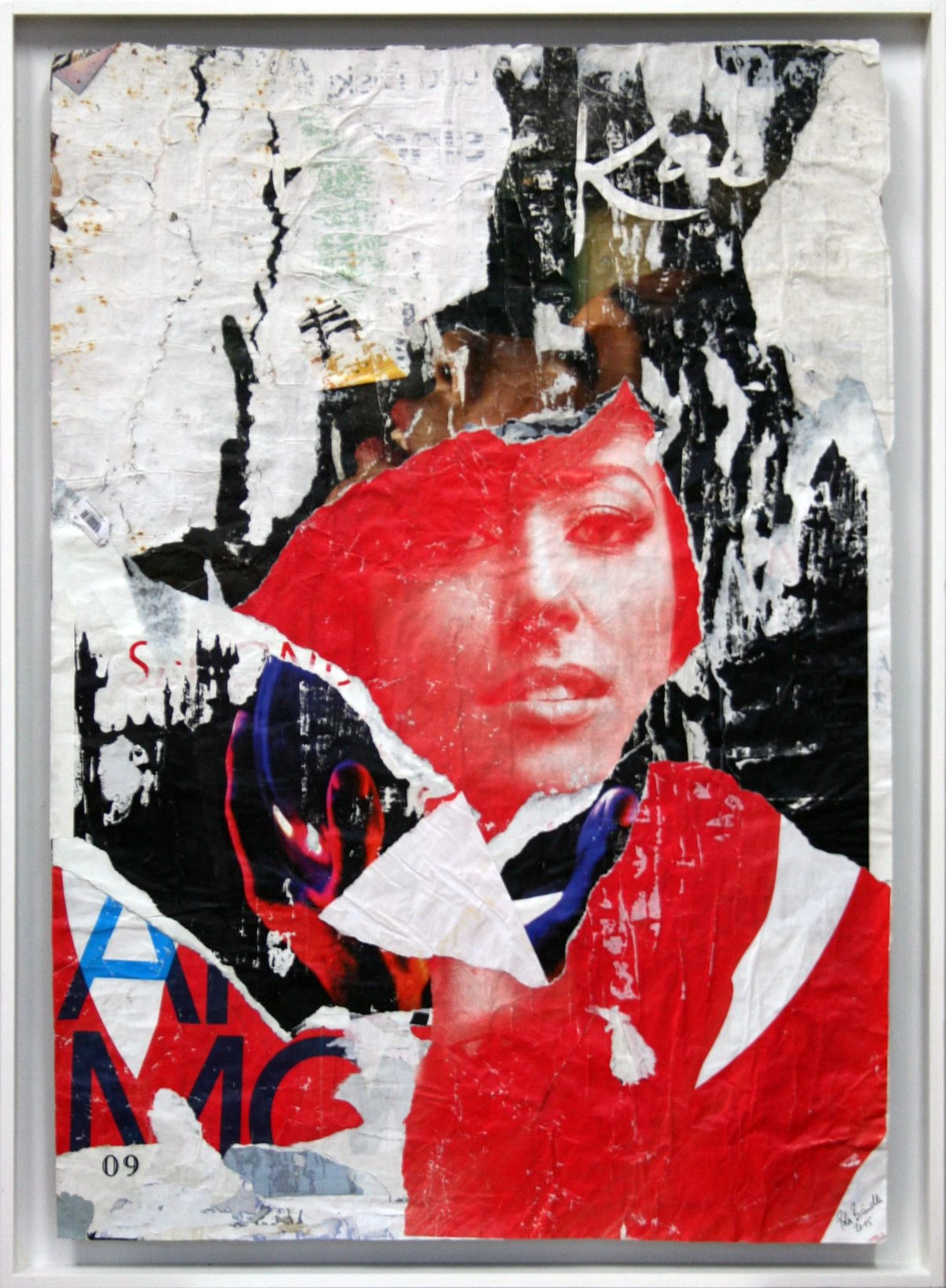
Finally, the leap of faith. Glue it down. Don’t agonize over the placement forever. Höch’s work feels fast, energetic, and decisive, and you should trust that same impulse in yourself. The goal is not to create a masterpiece, but to capture a moment of insight, however messy.
When a juxtaposition feels provocatively wrong, when it creates that little jolt of cognitive dissonance in your own mind, you are almost certainly on the right track. That feeling of “wrongness” is often the first sign that you’ve stumbled upon a new, unexplored truth. And if you look at it five minutes later and hate it? Good. That’s part of the process. Dada was about process, not product. Sometimes the most Dada thing you can do is to destroy your own creation, toss the pieces back into the box, and start again, reminding yourself that nothing is precious.
The Timeless Legacy: Why Höch's Gaze Still Matters
Ultimately, Hannah Höch’s greatest technique wasn't a technical skill but a philosophical one: a relentless, critical gaze. She looked at the polished surface of her world and saw the cracks. She saw the profound contradictions in how women were portrayed—as both modern, independent “New Women” and as traditional domestic ideals. She saw the hypocrisy of political parties promising order while sowing chaos. Her art was a mirror held up to society, and the reflection wasn't flattering—it was fractured, ironic, and demandingly complex.
That’s the real, urgent challenge she leaves for us. It’s not just about making an interesting picture. It's about stepping outside the endless scroll of images we consume and asking: What story are these pictures really telling? What ideologies are they selling under the guise of entertainment or information? Your art doesn't have to be political, but it must be an act of seeing critically. It can be a comment on your job, your relationships, the ads that chase you across every website, the curated perfection of social media. Collage gives you the power to re-edit reality, to cut and paste your own version of the truth. In a world of pre-packaged narratives, she shows us how to pick up our own scissors, both real and metaphorical, and become the editors of our own experience.
Common Questions About Hannah Höch and Her Collage Techniques
Why wasn't Hannah Höch a painter?
She could paint, and she did. But for the Dadaists, painting felt like a lie. It was about creating a new illusion on a blank canvas. Collage and photomontage were more honest. They started with the real illusions—the photographs and advertisements that were already shaping people’s perceptions—and used them to expose the lies, turning the language of mass media against itself. It was a way of fighting fire with fire, a form of ideological ju-jitsu that used the enemy’s own strength to bring it down.
Did the male Dadaists respect her work?
This is the question that cuts to the heart of Höch’s struggle and the ingrained sexism of the avant-garde. The truth is complicated. Some, like her longtime partner and fellow Dadaist Raoul Hausmann, recognized her immense talent. But the Berlin Dada group, led by figures like George Grosz and John Heartfield, was very much a boys' club that often dismissed her or relegated her work to that of a "girlfriend."
They initially tried to exclude her from their major 1920 Dada Fair, with some members arguing that her work was merely "craft" and not serious art. Yet, she persisted, demanding her place. This tension became a part of her art itself, with works like Da Dandy offering a sharp critique of the performative masculinity within the Dada circle. She ultimately created some of the most enduring and critically sharp works of the entire movement, often exploring the “New Woman” and challenging gender roles in a way her male counterparts never did.
What kind of glue or adhesive did Höch use?
It sounds like a trivial detail, but for an artist whose work needs to last, it’s essential. While I couldn't find an exact brand on her shopping list, early 20th-century collage artists often used two primary methods:
- Wheat Paste: A simple, traditional adhesive made from wheat flour and water. It's archival but can be tricky to work with.
- Rubber Cement: More common for photomontage, this was likely her primary choice. It allowed for repositioning before it set and dried clear and flat, which was perfect for getting seamless, invisible edges on her cut-outs.
If you're trying this at home, a good glue stick (acid-free for longevity) or a liquid PVA glue applied carefully with a brush works wonders today. The key is to avoid too much moisture, which can cause magazines to wrinkle.
Is it stealing to use other people's pictures?
Höch and the Dadaists would have cackled at this question. That was the entire point! It was an early, radical form of appropriation art—taking a found object from mass media and recontextualizing it to give it a new, often subversive, meaning. Think of it as the ultimate act of rebellion: taking the propaganda and advertisements that sought to control you and using them to build your own defiant truth.
From a modern legal standpoint, this concept is debated under the doctrine of fair use, which allows for the use of copyrighted material for purposes like criticism, comment, or parody, provided the use is "transformative." Höch's work is a perfect example of transformation. The original image’s power is already a form of manipulation; her art hijacks that power. It's a critique, a parody, a satire. But in spirit, for Höch, it was strictly about creative and ideological liberation, a way of talking back to the world with its own vocabulary.
Where can I see her original work today?
There is a profound difference between seeing a reproduction online and standing in front of an original. You can see the texture of the old paper, the slight discoloration of the glue, the faint pencil lines where she might have sketched an idea. Seeing Cut with the Kitchen Knife... at the Berlinische Galerie in Berlin is an overwhelming experience that no digital image can replicate. It's a large, chaotic, brilliant work, roughly 114 x 90 cm (about 45 x 35 in), that commands physical space.
For those unable to travel to Berlin, many other major museums hold her work. The Museum of Modern Art (MoMA) in New York, the Tate Modern in London, and the National Gallery of Art in Washington, D.C., all have significant pieces in their collections. Her influence is undeniable; a direct line can be drawn from her incisive photomontages to the culture-jamming of postmodern artists like Barbara Kruger and the punk aesthetic of Jamie Reid’s Sex Pistols album art.
Was Höch primarily an abstract or a figurative artist?
While her work is rooted in the fragments of reality, her compositions are often abstract and non-linear. She rejected traditional composition and perspective. The figures she used were real, but their arrangement was symbolic and chaotic, built on a flat, layered picture plane that owed more to Cubism than to Renaissance depth.
The question of abstraction versus figuration feels like a false choice here. She dismantled the real in order to construct something conceptual and new. So, she is perhaps best thought of as a figurative artist who assembled her figures into an abstract, conceptual reality, reflecting a broken and disordered world. Her subject was always the real world, but her language was one of fragmentation and reassembly.




So, what story do you want to tell back? That is the ultimate invitation of Hannah Höch.