
Caspar David Friedrich's Romantic Painting Techniques
Dive into the soul-stirring techniques of Caspar David Friedrich, the master of Romantic landscape painting. Learn how his use of light, symbolism, and Rückenfigur creates profound emotional resonance.

When a Painting Isn't Just a View: Caspar David Friedrich and the Art of Feeling Lost in a Landscape
A Note on Our Philosophy
The articles on Zen Museum are crafted to be the most comprehensive, authoritative, and deeply engaging resources available. We go beyond surface-level facts to synthesize concepts, draw unexpected connections, and explore the emotional core of art. Our aim is to give you not just information, but insight—a richer way of seeing that resonates long after you've finished reading. We believe in slow, thoughtful exploration, much like the art of Caspar David Friedrich himself.
Ever stumbled across a painting that stops you dead in your tracks? Not because it's loud or flashy, but because the silence in it is deafening. Most landscape art is background music—pleasant, decorative, easy to ignore. Then there are the paintings of Caspar David Friedrich. You don't just look at a Friedrich; you feel a chill down your spine, a knot of existential wonder in your gut. A lone figure stands on a precipice, their back to you, looking out into an abyss of fog. You're not a tourist in that landscape; you're a solitary soul confronted by the infinite. That, I've come to realize, is the magic trick. He wasn't just painting a place; he was painting a state of mind.
My own work lives in the world of abstraction, in color fields that vibrate with their own internal energy. The connection might not seem obvious. So why am I, a contemporary artist focused on shape and color, so utterly captivated by a 19th-century German Romantic who painted moody seascapes and gothic ruins? Because Friedrich was a master architect of emotion. He used the raw materials of nature—the texture of bark, the chill of a distant mountain—as tools to probe the deepest questions of human existence: faith, mortality, and our fragile, insignificant-yet-profound place in the cosmos. He wasn't depicting God; he was creating a visual space for you to have an encounter with the divine, the sublime, or that breathtaking, awful feeling of being dwarfed by the universe. He believed that direct representation of religious figures was almost a kind of idolatry, and that the truest path to the divine was through the unmediated grandeur of the natural world.

Let's pull back the curtain and see how he did it.
The Man Behind the Mist: Friedrich's Life and Times (1774-1840)
Before we delve into the philosophy and technique, it helps to understand the man. Caspar David Friedrich's life was steeped in loss from an early age, a factor that undeniably shaped his artistic vision. Born in 1774 in Greifswald, a Baltic Sea port town, he was the sixth of ten children. Tragedy was a constant companion: his mother died when he was seven, and by the time he turned thirteen, a sister, brother, and another sister had all passed away. The most formative tragedy, however, occurred in 1787 when he witnessed his younger brother Johann Christoffer fall through the ice on a frozen lake and drown while trying to save Caspar himself. This profound early encounter with mortality and the unforgiving power of nature is a thread that runs through his entire body of work—you can almost feel the icy dread in his desolate winter scenes.
He wasn't a rustic painter living in a shack by the sea; his art was born from disciplined craftsmanship, not untutored genius. He was a well-trained, sophisticated artist who honed his craft at the prestigious Copenhagen Academy, the leading art school in Northern Europe at the time. It was there he moved away from purely topographical views and began the inner journey that would define his mature work. Later, settling in Dresden, a city known as the 'Florence on the Elbe', he found himself at the epicenter of German Romanticism, a city humming with intellectual and artistic fervor. His career had a meteoric rise. In 1805, he won a prize in a Weimar competition judged by the iconic writer Johann Wolfgang von Goethe. His true breakthrough came with his 1808 masterpiece, The Cross in the Mountains (The Tetschen Altar). This painting was revolutionary—and scandalous. For the first time, a pure landscape was presented as an altarpiece, a concept so radical it sparked a furious public debate. It was a declaration of his core belief: that God was best worshipped not in a cathedral filled with gold leaf, but in the silent, sacred vastness of the natural world.
The Fading Light: A Fall into Obscurity
For a time, he was a celebrated figure. The intellectual salons of Dresden buzzed about his work. But as the 19th century wore on, the winds of artistic fashion shifted decisively. The rise of Realism, with its unflinching gaze at the social and material conditions of the here-and-now, made his symbolic, introspective landscapes seem old-fashioned, even escapist. He fell out of favor with critics, his commissions dried up, his health declined, and a debilitating stroke in 1835 left him partially paralyzed, barely able to paint. He died in 1840, largely forgotten, his work relegated to attics and provincial museum storage rooms.
This arc—from celebrated innovator to forgotten relic—is a cautionary tale of how an artist's singular vision can be both of its time and tragically ahead of it. What was once seen as profound became 'merely' melancholic; what was once a philosophical statement became an old-fashioned scene. The world simply wasn't ready for the stark psychological terrain he had spent his life mapping. The Romantic fire he had helped to kindle was being extinguished by the cold, hard light of industrial progress.
The Philosophical Toolkit: Germanic Thought and Feeling
Imagine trying to understand a song without knowing what 'melancholy' or 'joy' feels like. To truly appreciate Friedrich, you can't just look at his brushstrokes; you have to get inside the intellectual engine of his era. Before we dive into his technical methods, we have to understand the ideas that fueled his vision. He was a painter of ideas, deeply embedded in the philosophical currents of his time. Three concepts from the German Romantic movement were his primary guides: the Sublime, Weltschmerz, and Nature as Revelation. These weren't just academic terms; they were lived, felt realities for Friedrich and his contemporaries, reacting against the cold rationalism of the Enlightenment.
The Sublime: The Awe in Terror
The Sublime was the concept of the day, a philosophical obsession. But this wasn't about mere prettiness. Think of it not as "beautiful" but as "terrifyingly awesome." It’s the feeling you get when you stand at the edge of the Grand Canyon or watch a thunderous storm roll in—a mix of awe, fear, and wonder that completely overwhelms your senses. For philosophers like Immanuel Kant and artists like Friedrich, this feeling was the highest form of aesthetic experience, the closest you could get to a spiritual encounter without a church. It was a confrontation with something so vast and powerful it made human concerns feel microscopic. Friedrich’s goal wasn't to paint a pretty scene; it was to bottle that feeling and put it on a canvas, to make you confront your own smallness in the face of infinity.
Think of the Sublime not as "beautiful" but as "terrifyingly awesome." It’s the feeling you get when you stand at the edge of the Grand Canyon or watch a thunderous storm roll in—a mix of awe, fear, and wonder that completely overwhelms you. For Romantics, this feeling was the closest you could get to a spiritual experience without a church. Friedrich’s goal wasn't just to paint a pretty scene; it was to bottle that feeling and put it on a canvas.
Weltschmerz: The Romantic Wound
Then there's Weltschmerz—literally, "world-pain." It’s a sort of romantic melancholy, a deep-seated sadness about the state of the world mixed with a longing for something purer, something more ideal. It’s not clinical depression; it's a creative, poetic sorrow that finds a strange beauty in decay and meaningful solace in solitude. Think of it as the 19th-century German version of disillusionment, a feeling that resonated powerfully in the wake of the Napoleonic Wars and the dawning of an industrial, bureaucratic age. It's the feeling of being a displaced soul in a world that feels increasingly pragmatic and indifferent, a sentiment that resonates with an almost eerie clarity in our modern, often alienating world.
Nature as Revelation: Reading the Book of the World
Finally, for Friedrich, Nature was a form of scripture. He was a devout Lutheran, but his cathedral was the forest, his altar the mountain peak, his choir the whispering sea. He believed that the divine was immanent in the natural world, a constant, visible presence. By contemplating a distant mountain peak, a gnarled oak, or the silent fall of snow, you could achieve a kind of transcendent understanding that no theological text could fully capture. This is why his paintings feel so reverent and silent. You're meant to meditate on them, not just glance. This was a radical stance, part of a broader movement reacting against the cold, mechanical logic of Enlightenment rationalism, which sought to dissect and explain everything. Friedrich and his contemporaries argued that the most profound truths—about God, about existence—could only be felt in the marrow of one's bones, and nature was the ultimate conduit for that feeling. This revolutionary idea—that art should bypass the intellect and speak directly to the soul—is the very bridge that connects Friedrich's misty horizons to the color fields of abstract art centuries later.
The Technical Blueprint: How Friedrich Built Emotion
It was never an accident. Every brushstroke was a calculated choice aimed at a specific emotional target.
Atmospheric Perspective: The Science of Melancholy
This is Friedrich's signature move, a technique he weaponized for emotional effect. While most artists used atmospheric perspective to create an illusion of realism, Friedrich used it to create an illusion of infinity. Unlike linear perspective, which organizes objects in space with geometric precision, atmospheric perspective exploits a simple scientific fact: light scatters over distance, making faraway things appear hazy, cool-toned, and indistinct. It's the reason why distant mountains look blue. For Friedrich, this wasn't just a tool for depth; it was a psychological lever. He amplified these effects dramatically, pushing colors towards icy blues, lavenders, and grays much more aggressively than his contemporaries. The physical distance on the canvas became a chilling metaphor for the gulf between our mortal selves and the divine, or the gap between the fleeting 'now' and the eternal.
Element  | Near Objects | Far Objects | Emotional Effect & Metaphorical Meaning |
|---|---|---|---|
| Clarity | Sharp, detailed (bark texture, individual leaves) | Blurred, hazy, indistinct | Creates a sense of the unknowable and mysterious; symbolizes the future, the afterlife, or the forgotten past. |
| Color Saturation | Rich, warm, earthy (browns, ochres, dark greens) | Muted, desaturated, cool (pale blues, grays, lavenders) | Evokes a psychological coldness and emotional distance, reinforcing feelings of isolation and the unreachable. |
| Contrast | High contrast (strong darks and lights) | Low contrast, uniform tones | Directs the viewer's focus inward and onward, suggesting a far-off, heavenly or dreamlike state beyond immediate grasp. |

Look at his paintings with this in mind. The foreground is often a detailed rocky crag or a dark-leaved tree, rendered in warm, earthy tones with sharp clarity. Then, a middle ground of ships or ruins, rendered slightly fainter. But the background—the mountains, the sky, the endless sea of fog—dissolves into a dreamlike, ethereal haze. He’s literally painting infinity. He’s painting the future, the afterlife, the great beyond, things that are inherently unknown and unknowable. It’s a masterclass in using optical science to trigger a soul-level response, turning a technical tool into a profound emotional and philosophical statement.
The Rückenfigur: Standing in for Your Soul
This might be his most brilliant psychological tool. The Rückenfigur (pronounced ROO-ken-fig-oor) is German for "figure from the back." It's that solitary person, always with their back turned, gazing into the vista. For an artist working with figures, how to place them in a scene is always a critical decision. Friedrich's choice to turn them away was a stroke of narrative genius.
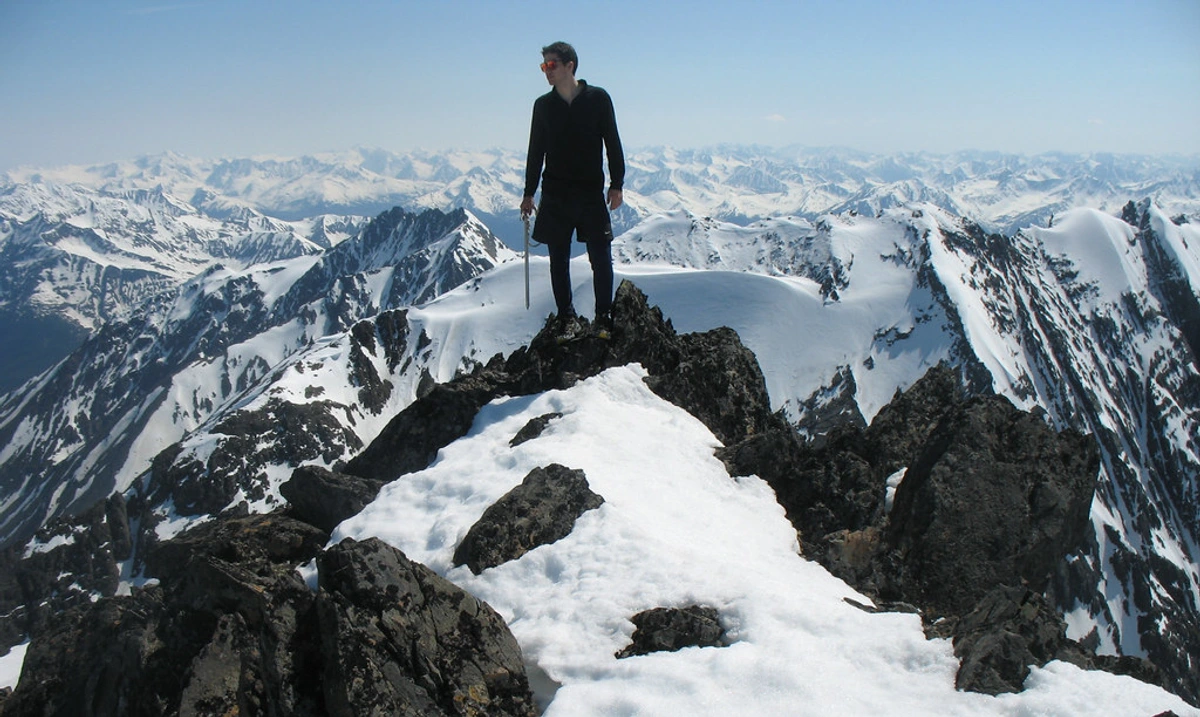
Why is this so powerful? Fundamentally, it's an empty vessel for us to inhabit. Without a face, the figure has no specific identity, emotion, or story that might conflict with our own. It's not about them; it's about you. By denying us the face, Friedrich forces a shift from observation to participation. You are no longer a passive viewer looking at a person looking at a view; you become the person looking at the view.

Think about it in cinematic terms. The Rückenfigur functions almost as a first-person camera shot or a player character in a video game. The figure's body acts as a surrogate for our own, placing us directly on the cliff's edge, in the quiet woods, or by the winter graveside. This device dissolves the final barrier between the viewer and the painted world, transforming a static image into an immersive, emotional journey. It turns a painting into a mirror for the soul, reflecting our own inner landscape of contemplation, wonder, or dread back at us. Without ever showing a face, Friedrich created the most profound form of portraiture: a portrait of the act of seeing itself, an exploration of human consciousness in the face of the infinite.
Chiaroscuro: The Drama of Symbolic Light
Friedrich's use of light is never about simple illumination; it's about revelation. He borrowed the dramatic chiaroscuro of Baroque masters like Caravaggio—that intense, almost violent play of light and dark—but stripped it of its theatrical drama and infused it with an icy, haunting spirituality. For him, light was divine. A sunrise wasn't a weather report; it was the promise of redemption piercing the gloom. A single beam of moonlight striking a cross in a snowy graveyard was the sudden, quiet intimation of hope in the face of death.
Here's the crucial part: he almost exclusively painted in his studio. He'd assemble these worlds from memory, detailed sketches, and his imagination, giving him the kind of absolute control a film director has over a set. This 'composite' method wasn't about deception; it was about essence. It let him place light not to mimic a particular time of day, but to choreograph a spiritual experience—a sliver of dawn to symbolize an awakening (Forest with Chapel), or the dying embers of sunset to evoke time's relentless march (Times of Day series). In his hands, light becomes the protagonist, the finger of God pointing at something we're supposed to notice. It's both beautiful and, in its focused, almost unnatural intensity, slightly terrifying.
A Symbolic Language: Nature's Vocabulary
Every element in a Friedrich painting, from the grandest mountain to the most insignificant leaf, is loaded with meaning. He created a private visual lexicon, a secret language where nature speaks directly to the human condition. This is where his work transcends mere depiction and enters the realm of allegory. It's a powerful reminder to any artist, whether you work with figures or pure abstraction, that the marks you make can become a personal vocabulary of emotion and meaning.
- Gothic Ruins: Represent the transience of human achievement and the ultimate victory of nature over human civilization. Works like Abbey in the Oak Forest and Ruins of Eldena Abbey are potent meditations on mortality, showing old abbey graveyards being reclaimed by winter and root, dust returning to dust.
- Gnarled Oak Trees: A symbol of enduring faith and national resilience. In paintings like The Solitary Tree, an oak tree stands alone, its roots clinging to rocky soil, much like faith clings on through hardship and spiritual drought.
- Fog / Mist: A veil between the known and the unknown, life and death, the present and the eternal. It's the great mystery, a visual metaphor for the limits of human knowledge and the promise of an afterlife, as seen in works like The Sea of Ice.
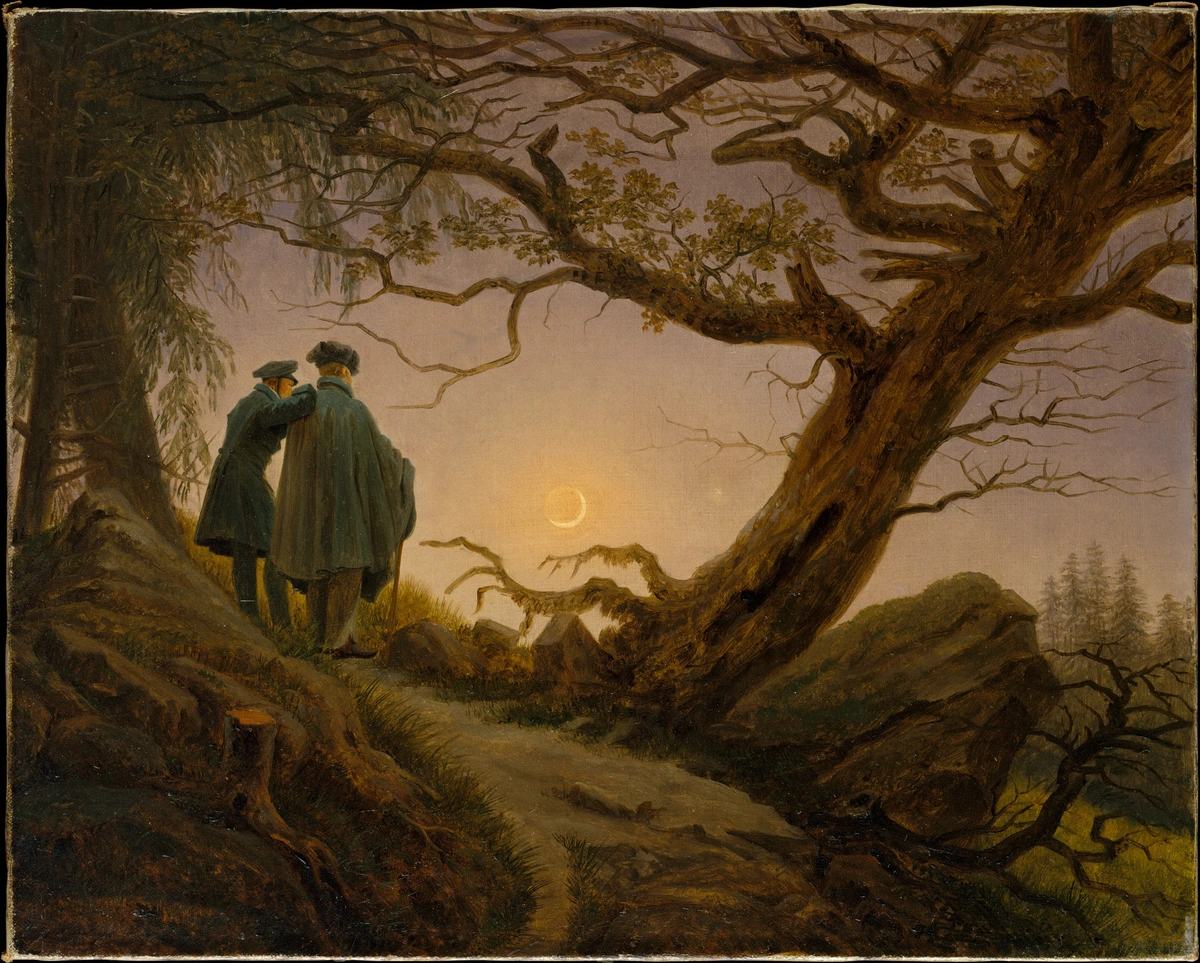
- The Moon and Nocturnal Scenes: The moon is a melancholic, contemplative symbol, but also one of constancy in the ever-changing night sky. The darkness of his night scenes represents the internal gloom of the soul, while the moon's light offers a promise of divine guidance and hope (Two Men Contemplating the Moon).
The Artist's Lexicon: A Personal Dictionary
He rarely just painted "a tree." He painted an idea using a tree. It’s like learning a new language; once you understand this vocabulary, his paintings shift from being beautiful landscapes to complex philosophical poems. The following table summarizes how Friedrich's symbolic language works, transforming observation into deep personal and political expression.
Symbol | Visual Motif | Deeper Meaning / Allegory |
|---|---|---|
| Gothic Ruins | Crumbling archways, overgrown abbeys | The transience of human power (especially the Church), the eventual triumph of nature over civilization, mortality. Seen in Abbey in the Oak Forest. |
| Oak Tree | A single, weathered oak, often isolated | German national identity and resilience; enduring faith in the face of hardship (as seen during the Napoleonic Wars). |
| Sea of Fog | An endless, uniform blanket of white mist | The unknown future; the afterlife; the unfathomable mind of God; a barrier between the self and the infinite. |
| Rückenfigur | A solitary figure viewed from behind | A surrogate for the viewer; the act of contemplation itself; representing humanity's small but central place in the cosmos. |
| Moon | A crescent or full moon in a dark sky | Constancy amidst change; divine guidance; the light of faith piercing spiritual darkness; melancholy reflection. |
| Wrecked Ship | Broken hull and masts amid ice or waves | The futility of human ambition against natural forces; the danger of life's journey. A stark symbol of failure and mortality. Seen in The Sea of Ice. |
| Distant Peaks / Mountains | Hazy, blue, ethereal mountains on the horizon | The promise of the eternal and the divine; the unreachable ideal; an allegory for the afterlife or heaven. |
| Dawn / Sunset | The sun breaking over a horizon | The promise of redemption and renewal (dawn), or the melancholic passage of time and the end of life (sunset). |
| Polar Ice / Sea | Jagged, chaotic shards of ice; vast empty ocean | The awesome, destructive power of nature; the futility of human ambition; the primordial, untamable state of the world before man. |
Unraveling a Masterpiece: Wanderer above the Sea of Fog
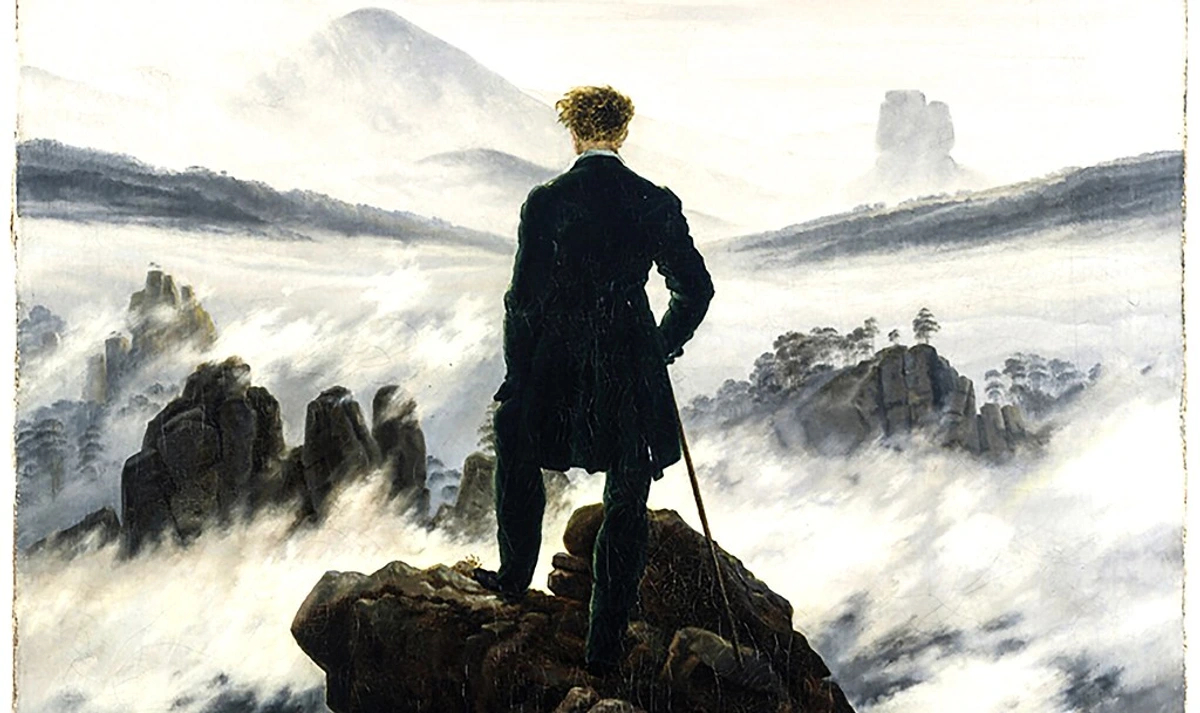
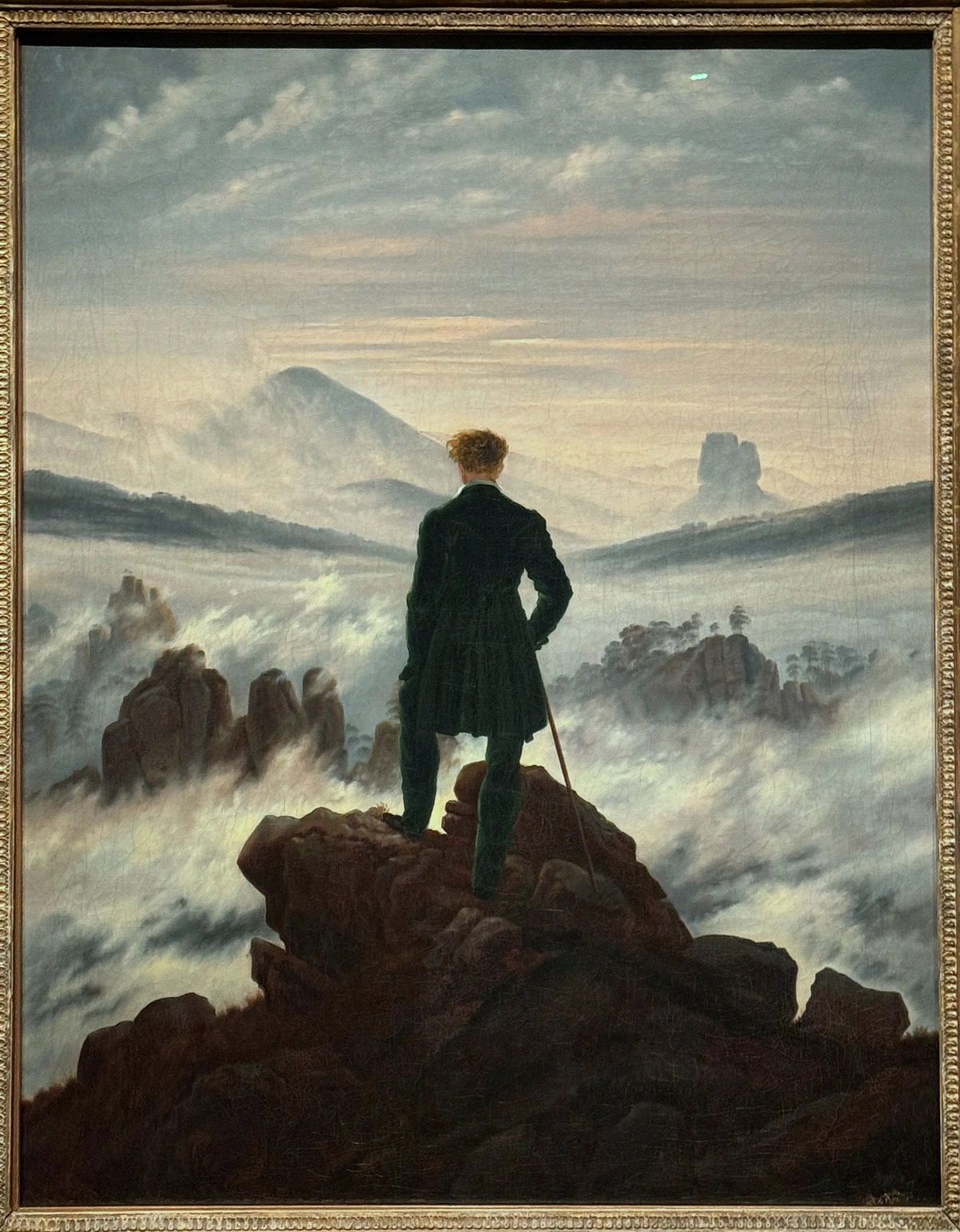
Let's put it all together by dissecting his most famous work, Wanderer above the Sea of Fog (c. 1818). This isn't just his masterpiece; it's arguably the Mona Lisa of landscape painting, the one image that has come to define not just Friedrich, but the entire German Romantic movement. The painting is a perfect storm, a convergence of every technique and philosophical idea we've discussed. It's the ultimate distillation of the Romantic soul.
Here we have the ultimate Rückenfigur. The figure, said to be a certain Colonel Warnstedt, is stable and central, silhouetted against the brilliant white fog, giving him an air of calm, confident contemplation, perhaps even defiance. But the rocks he stands on are craggy, treacherous, a representation of the difficult climb to reach this vista of understanding.
He uses atmospheric perspective to absolute perfection. The closest rocks are a dark, warm brown. The middle-distance peaks are softer, grayer. And the farthest mountains are just faint blue ghosts dissolving into the atmosphere, creating an almost infinite sense of space that dwarfs the human figure.
The whole painting is a profound question. Is the man a heroic individual mastering his world, the very embodiment of Romantic self-realization? Or is he a tiny, insignificant speck about to be swallowed by the sublime and unknowable vastness? The genius is that the answer is "yes." It's both. Friedrich holds both ideas in a perfect, tense balance. He captures the exhilarating terror of freedom—the realization that we are both the potential masters of our fate and utterly at the mercy of forces beyond our control. This paradoxical state, the simultaneous experience of empowerment and insignificance, is the core of the Romantic spirit. It's the ultimate selfie, capturing not a face, but a feeling of existential awe.
A Gallery of Masterpieces: Deeper Dives into Friedrich's Oeuvre
Let's pause and consider a few more of his pivotal works. These paintings are not just standalone images; they're chapters in a lifelong exploration of the same core themes, each revealing a new facet of his genius.
Title | Date | Key Elements | Deeper Meaning / Emotional Impact |
|---|---|---|---|
| The Monk by the Sea | 1808-1810 | A solitary monk, a dark shore, an immense, empty sea, a vast sky. | An exercise in radical minimalism that was shocking for its time. The lack of a middle ground is intentionally disorienting, placing the viewer directly into a confrontation with infinity and their own profound loneliness before God and nature. |
| The Sea of Ice | 1823-1824 | The wreckage of a ship crushed by jagged, chaotic shards of ice. | Based on accounts of polar expeditions, the brutally cold palette conveys the awesome, destructive power of nature and the utter futility of human heroism against it. |
| Two Men Contemplating the Moon | c. 1825-1830 | Friedrich and his friend August Heinrich pose as the two men. | A more intimate, personal work. Their simple country clothes symbolize a rejection of the modern world. The moon is faith, the dead oak tree the dying old world, and the green sapling at its base signifies new life and renewal. |
Friedrich's Echo: From Romanticism to Modernism and Beyond
The rediscovery of Caspar David Friedrich in the early 20th century is a story of vindication. An artist who died in obscurity suddenly found his voice echoing a century later, speaking directly to a new generation grappling with a modern world.
The Rediscovery: A Vindication of Vision
The story of Caspar David Friedrich's rediscovery in the early 20th century is a profound vindication for any artist who has ever felt misunderstood. For decades, his name was little more than a footnote, his paintings dismissed as relics of a bygone era. Then in 1906, an exhibition in Berlin featuring 32 of his works sent a shockwave through the art world. Suddenly, his singular vision resonated with a generation grappling with the alienation of modern life and the disillusionment following the First World War. The metaphors were no longer old-fashioned; they were terrifyingly contemporary.
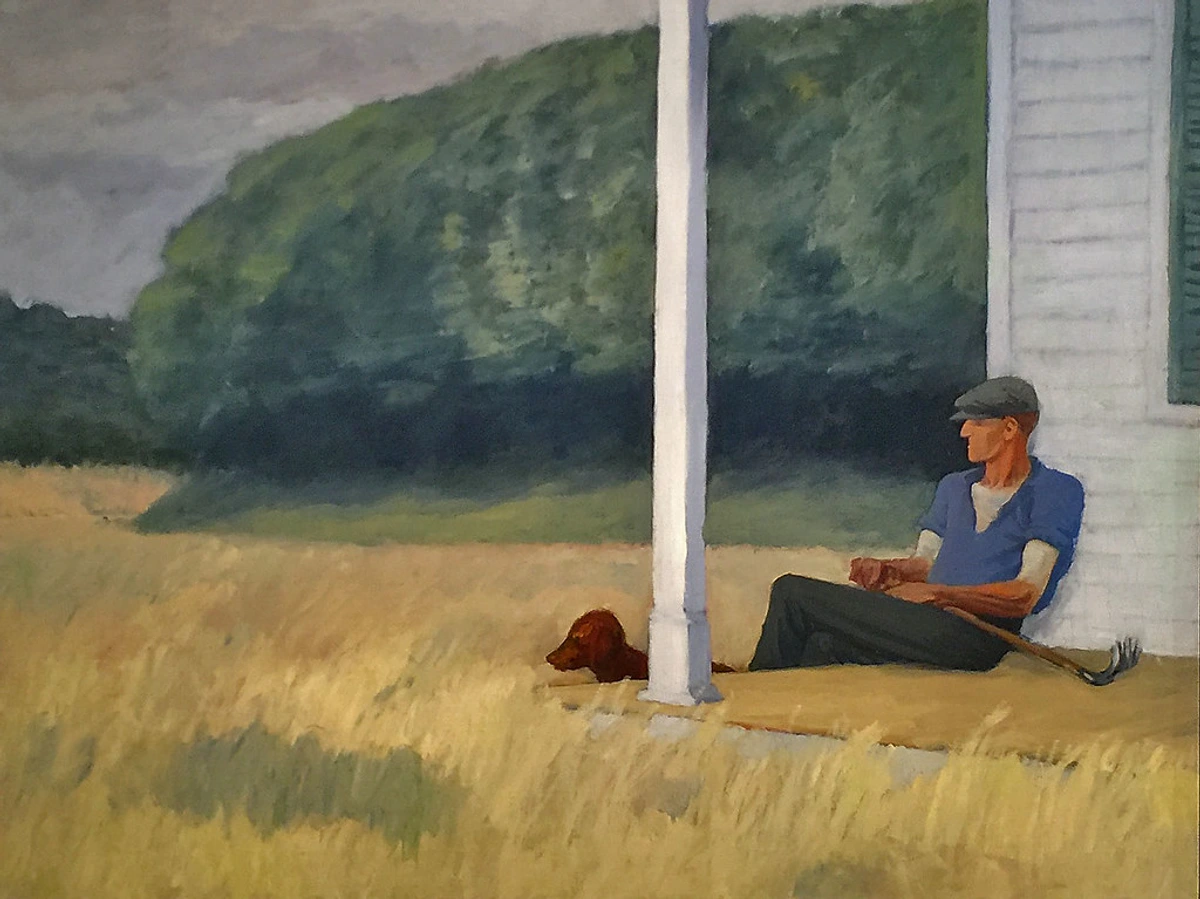
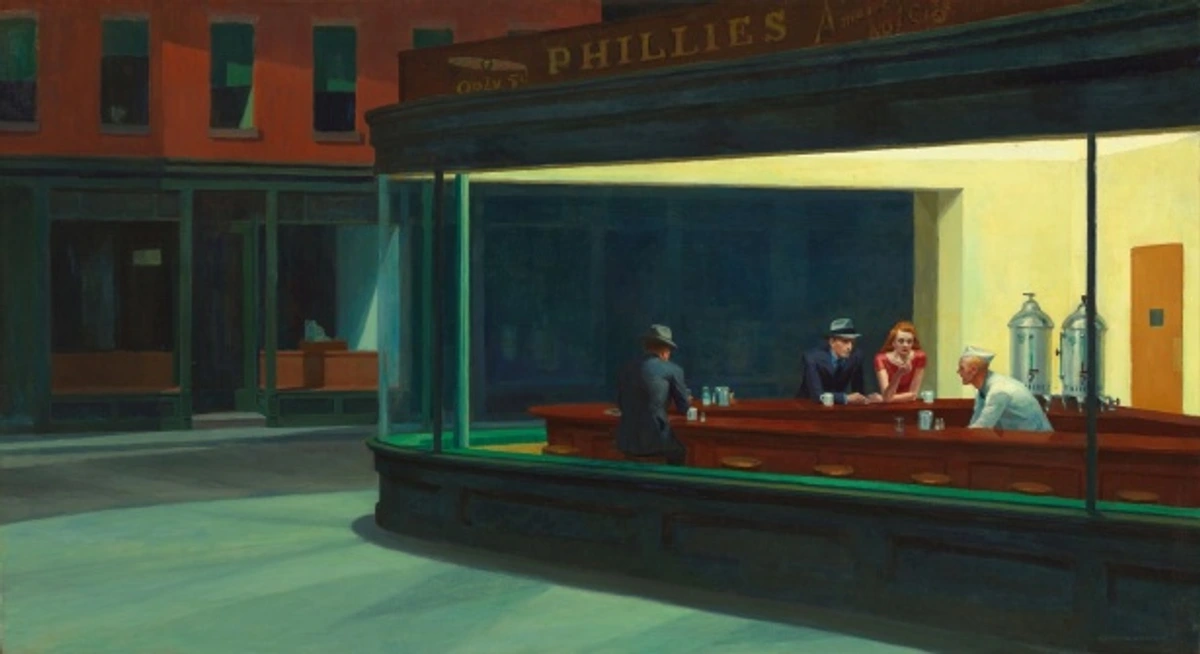
The eerie, unsettling emptiness of his landscapes found a strange echo in the work of the Surrealists like Giorgio de Chirico, with his empty, sun-drenched Italian piazzas. These "Metaphysical Town Squares" feel like Friedrich's misty landscapes translated into an urban, architectural dream. Later, the hyperreal, bone-deep isolation found in the works of Edward Hopper feels like a direct descendant of Friedrich's psychological landscapes. Consider Hopper's Nighthawks: the Rückenfigur is replaced by figures isolated within a glass box, still gazing outward into a dark, empty street, their environment a primary character, a psychological force in its own right.
But the most radical and unexpected connection is with the Abstract Expressionists. It might seem like a leap from a realistically painted mountain to a canvas covered in seemingly random color. But the goal is the same: to evoke a direct emotional response without needing to represent a specific object. Both Friedrich and Rothko are asking the viewer to stand before the canvas and feel something—awe, dread, contemplation.
From a Romantic Palette to a Modern One
I can't help but draw a line from Friedrich's technique to the work of many contemporary artists. While my canvases are worlds apart—explosions of color, abstract shapes—I see a profound kinship in the goal. Friedrich used meticulously painted rocks and trees as an emotional anchor. Many abstract artists use blocks of color and gestural marks. He used subtle gradations of cool blues to push the horizon into infinity. Contemporary artists might use a deep, receding purple or a luminous yellow to create a sense of space that pulls you in.
The language is different—representational versus abstract—but the conversation is the same: how do you translate an internal feeling, a state of being, into a two-dimensional space?
If you're an artist, studying Friedrich is less about copying his trees and more about absorbing his mindset. It's about learning to see the landscape not as a subject to be depicted, but as a vocabulary to be mastered in service of an emotion. Ask yourself: What is the feeling I want to evoke? How can every shadow, every highlight, every compositional choice serve that feeling? How can I paint the invisible—loneliness, faith, wonder, dread? It's about using the tools of the craft not just to represent the world, but to build a new one from the inside out. It’s a lesson from the 19th century that feels more relevant than ever in our visually saturated age.
The Enduring Shadow: Friedrich's Modern Resonance
A Legacy Cast in Shadow and Light: Friedrich's Modern Resonance
Have you ever felt profoundly alone in a crowd, scrolling through a feed of happy faces while nursing a quiet sense of disconnect? That feeling, which is so peculiarly modern, is precisely where Caspar David Friedrich’s work finds its most potent echo. Why does a painter of misty mountains and lonely monks, dead for over 180 years, still captivate us so deeply? In an age defined by hyper-connectivity and endless digital noise, Friedrich's deep, almost painful celebration of solitude feels less like a historical artifact and more like a radical act of resistance. His work speaks directly to a modern sense of alienation and the profound, aching desire for a genuine, unmediated experience with the world.
Friedrich's Echo in Contemporary Culture
His legacy is not confined to museums; it's everywhere, if you know where to look. It's a visual language so deeply embedded in our collective unconscious that we absorb it without even realizing. This deep cultural resonance is precisely the kind of connection we strive to illuminate in our articles, linking the art of the past to the pulse of the present.
- Cinema: The vast, awe-inspiring, and utterly inhuman landscapes of films like 2001: A Space Odyssey owe him a huge debt. The lone explorer dwarfed by a sublime, alien wilderness is a direct descendant of the Rückenfigur.
- Video Games: The entire genre of atmospheric, open-world games is drenched in his aesthetic. The moody world-building of titles like The Witcher 3: Wild Hunt or the contemplative isolation of The Long Dark are pure Friedrich, allowing the player to inhabit that solitary figure's position. Even games like Firewatch or The Legend of Zelda: Breath of the Wild use vast, empty landscapes to evoke a sense of profound, personal discovery and quiet awe.
- Photography: Contemporary fine art photographers like Gregory Crewdson and Toshio Shibata create scenes of unsettling psychological intensity that feel like Friedrich transferred to suburban America or the engineered landscapes of Japan. Crewdson's elaborately staged scenes of suburban ennui are like modern-day Friedrichs, isolating a single human figure in a setting charged with unspoken narrative. Similarly, Ansel Adams' monumental black-and-white landscapes of the American West trade Friedrich's mist for crisp clarity, but achieve the same goal: a confrontation with a sublime, overpowering natural world.
- Music: This visual language is embedded in popular music as well. The cover art for countless post-rock albums (like Godspeed You! Black Emperor or Sigur Rós) features vast, empty landscapes that are pure Friedrich. The melancholic visual landscapes of music videos, from Lana Del Rey's wistful glances into the sunset to Bon Iver's wintry self-exile, use the Rückenfigur motif to convey introspection and emotional depth.
The Sublime and the Sorrowful: A Modern Environmental Warning
Perhaps most powerfully today, his work offers a terrifyingly relevant lens through which to understand our modern environmental anxiety. When we look at his The Sea of Ice now, we don't just see a 19th-century shipwreck inspired by polar expedition reports; we see the terrifying power of a natural world we have recklessly destabilized through climate change. His paintings become a pre-emptive elegy for a planet we are struggling to save. They remind us why we should care on a visceral, emotional level: because nature isn't just a resource to be strip-mined, it's a source of the sublime, a place where we can still feel the profound sense of wonder and smallness essential to the human experience. The chill you feel looking at a Friedrich today isn't just art appreciation; it's the quiet, creeping recognition of our own fragile, profound place in a cosmos that is beautiful, powerful, and utterly indifferent.
Frequently Asked Questions
Why did Caspar David Friedrich paint people with their backs turned? He used the Rückenfigur (figure from the back) as a brilliant psychological device. By making the figure anonymous and turning them away, he removes any barriers of personality or story. This allows the viewer to step directly into their place and experience the sublime or melancholic emotion firsthand. It's an invitation to inhabit the painting, transforming it from an image to be observed into an experience to be felt.
What does the fog symbolize in Friedrich's paintings? Fog is his master symbol, a recurring visual motif that acts as a veil between the known and the unknown. It represents the mysterious, the infinite, and the boundary between the material world and the spiritual or eternal realm. It creates a sense of ambiguity and unknowable space, often symbolizing the future, death, or the unfathomable presence of God.
What painting techniques did Friedrich use to create his unique atmosphere? His most important technical tool was a masterful application of atmospheric perspective. He used it not just for depth, but to create a powerful mood of sublime distance, pushing the horizon into an unknowable infinity. He also used dramatic chiaroscuro (sharp contrasts of light and dark) to infuse scenes with spiritual energy, and imbued natural elements with deep symbolic meaning. He famously worked in his studio in Dresden, creating composite landscapes from detailed sketches rather than painting directly from nature, which gave him total control over the final emotional impact.
How can you create an emotional response with landscape painting today? While the Romantic era is gone, its core principle is timeless: the landscape is a state of mind. Focus on the feeling, not just the fidelity of the view. Ask yourself what emotion you want the viewer to feel, and then use every tool at your disposal to amplify it. Use color to create a psychological temperature, light to guide the eye and create drama, and composition to create a sense of balance or unease. Think about what a stark shadow, a soft-focus horizon, or a lonely tree feels like, and build your entire painting around that emotional core.
There's something humbling about standing in front of a Friedrich, even digitally. In our fast-paced world of instant gratification, his paintings are a stark contrast. They represent a form of "slow art," demanding that you stop. That you be quiet. That you feel profoundly alone for a moment and confront the scale of your own existence against the backdrop of eternity.





He teaches us that art isn't about escaping reality, but about finding a deeper, more resonant one right here in the stillness. It's about learning to see the world not just as a collection of objects, but as a mirror for our own soul—full of mystery, terror, beauty, and an undeniable power that can, if we let it, make us feel impossibly, wonderfully small.