Terracotta Army: Immortal Legions & Qin Shi Huang's Legacy - Ultimate Guide
Explore China's Terracotta Army: 8,000+ unique clay warriors, Emperor Qin Shi Huang's grand vision, masterful craft, strategic pits, and enduring legacy. Your ultimate guide to ancient Chinese ambition and art.

The Terracotta Army: Emperor Qin Shi Huang's Immortal Clay Legions – Your Ultimate Guide
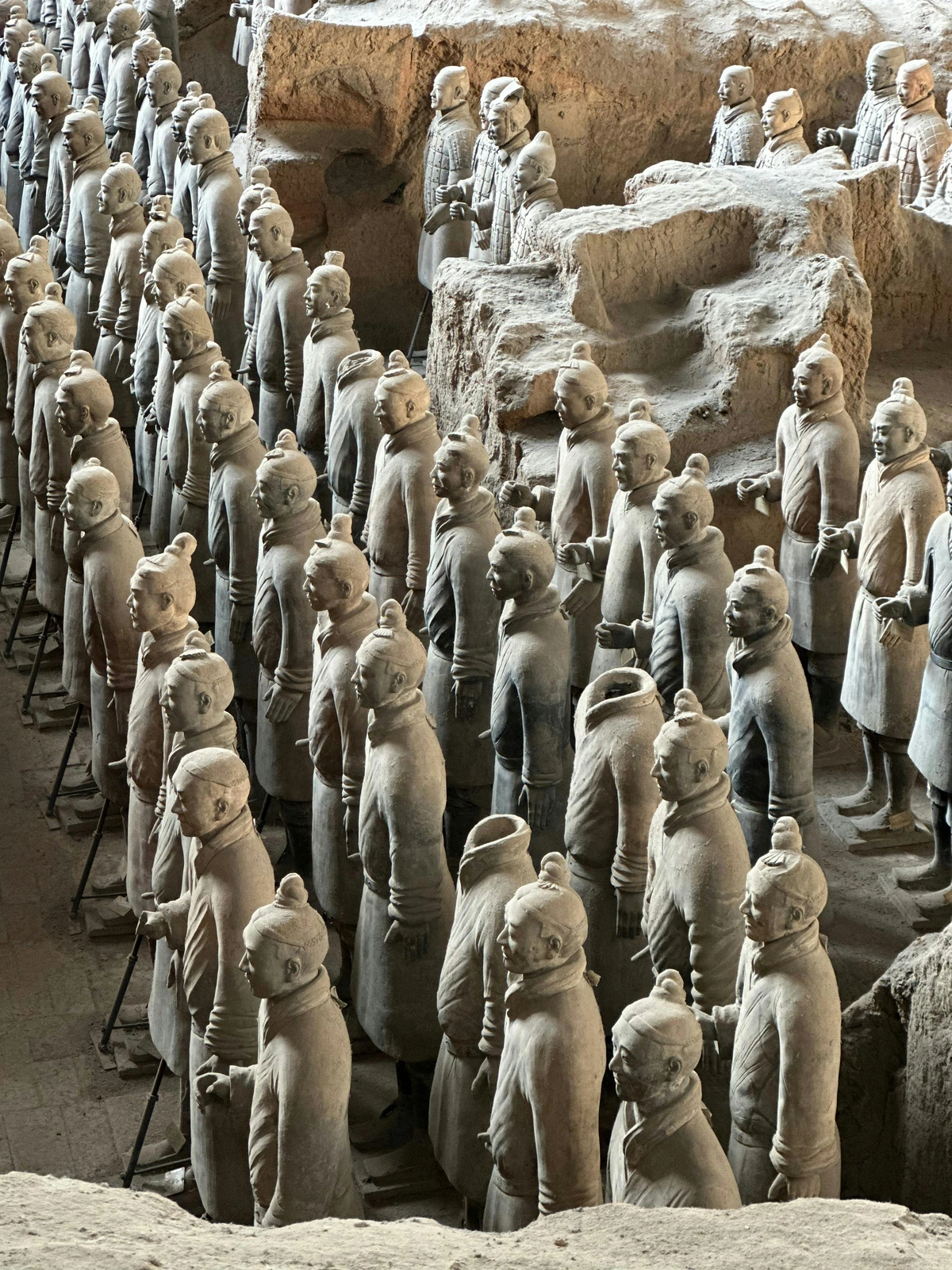
Imagine stepping into an underground realm, not of myth, but stark reality. Over 8,000 life-sized warriors, each bearing unique features, stand in silent, eternal vigil, poised to defend an emperor in the afterlife. For over two millennia, this subterranean legion remained hidden, a secret whispered only to the earth. This is the Terracotta Army, the breathtaking immortal guard of China's first Emperor, Qin Shi Huang. The sheer scale, the intricate detail, the audacious will behind such a monumental undertaking… it honestly stops me in my tracks. As an artist, I often marvel at the drive to create something so vast, so enduring, to leave an indelible mark on history – a drive I recognize in the ambitious canvases of my own studio, though perhaps on a slightly different scale. If this dedication to detail and the powerful presence of these figures resonate with you, perhaps you'll find a similar spirit of enduring craft in my own contemporary pieces. Curious about that artistic journey? You can explore it on my /timeline.
credit, licence
The Accidental Discovery: Unearthing a Lost Empire
The story of the Terracotta Army begins not with grand expeditions, but with a humble accident. In March 1974, local farmers in Lintong County, near Xi'an in Shaanxi province, China, were drilling a well. Imagine their astonishment—or perhaps their initial fear—when their spades struck not water, but ancient pottery fragments, then human-like heads emerging from the earth. What they had stumbled upon was not merely an archaeological site, but the monumental subterranean guard of China's first Emperor, Qin Shi Huang.
This wasn't just a handful of statues; it was an entire hidden world. The initial finds quickly expanded into pits containing thousands upon thousands of figures. Current estimates place the army at over 8,000 soldiers, alongside 130 chariots with 520 horses, and 150 cavalry horses. Most of these colossal numbers are still patiently awaiting future excavation in pits near the vast mausoleum complex. These figures are, of course, ever-evolving estimates; the sheer scope of this underground empire continues to reveal itself with each painstaking archaeological effort. The immediate challenge upon discovery was not just excavation, but the rapid preservation of these delicate artifacts. The swift change in humidity and exposure to air caused the vibrant original paints, which once adorned every warrior, to flake and fade almost instantly—a poignant reminder of art's fragility and the relentless race against time in archaeological conservation. It also highlighted other vulnerabilities, from the fragility of the clay itself to the potential for mold and insect damage in unexcavated areas, demanding a constant, unseen battle against decay.
What Exactly Is This Immortal Army? Defining the Terracotta Figures
Now that you know how it was found and the grand vision behind it, let's get to the core: what exactly is the Terracotta Army? Officially known as the "Terracotta Warriors and Horses," this isn't just a collection; it's an entire sculptural military force, an astounding array of life-sized terracotta figures depicting the armies of Qin Shi Huang, the formidable first Emperor of a unified China. The sole, chilling purpose of this immortal army? To safeguard the emperor in his afterlife, guaranteeing his perpetual imperial rule in the spiritual realm, just as he had dominated the earthly one. It's a statement of ambition so grand, it’s almost unfathomable – a truly persistent farewell, if you ask me.
But this legion extends beyond just warriors. Within the vast mausoleum complex, archaeologists have also unearthed a diverse retinue, including intricately crafted terracotta figures of acrobats, strongmen, musicians, and even civil officials. The acrobats, sculpted in dynamic poses of precarious balance and athletic skill, were there to entertain; the musicians, with delicate hands poised on instruments, to provide harmony and ritual sound; and the civil officials, in their precise robes and stoic expressions, to continue advising and managing the emperor’s eternal bureaucracy. This was more than just a military guard; it was an entire imperial court, meticulously assembled to accompany, serve, entertain, and advise the emperor in his eternal kingdom, mirroring the complex bureaucracy and vibrant court life of his earthly reign. This profound belief in a continued, fully functional life after death resonates throughout many ancient cultures, from the elaborate tombs and colossal treasures necessitating immense provisions for the Egyptian pharaohs' belief in an afterlife (see our guide to ancient Egyptian art) to the detailed funerary offerings found in Mesopotamian royal tombs – a shared human aspiration for a legacy beyond the grave.
The Emperor's Grand Vision: Unification, Legalism, and the Quest for Immortality
To truly understand the Terracotta Army, we must delve into the mind of the man who commanded its creation – a ruler whose ambition was as immense as his empire was vast.
The Architect of Unified China
Qin Shi Huang was, undeniably, an extraordinary and ruthless leader whose vision irrevocably shaped the course of Chinese history. Emerging from the brutal Warring States period (roughly 475-221 BCE), an era characterized by constant, devastating conflicts between rival states vying for supremacy, shifting alliances, and rapid military innovations, he achieved the monumental feat of unifying a collection of disparate, often clashing, states into the first centralized imperial China. His reign, from 221 to 210 BCE, was an era of unprecedented national cohesion, marked by the standardization of currency, weights, measures, and even writing systems – truly mind-boggling achievements that were essential for mobilizing the vast resources needed for his colossal projects. He also initiated the first sections of what would eventually become the Great Wall, leaving an architectural legacy that defies time. These fundamental policies would profoundly influence subsequent Chinese dynasties for centuries, laying the groundwork for imperial administration.
The Iron Fist of Legalism
His political philosophy, Legalism, was a strict doctrine that prioritized law, order, and centralized authority above all else. Legalism, unlike more humanistic philosophies, held that human beings were inherently selfish and could only be controlled through strict laws and severe punishments (and rewards for obedience). You can see this philosophy visibly reflected in the highly organized, standardized yet strikingly individualized structure of his posthumous army. It’s a system of absolute control, a rigid hierarchy, meticulously extended even beyond death. The sheer discipline and order embedded in the army's formation and the uniformity of its ranks are direct echoes of Legalist principles applied to the afterlife itself. Yet, his reign was also riddled with controversies that seem almost contradictory. Notably, he ordered the notorious "burning of books and burying of scholars." This wasn't merely destructive; it was a deliberate act to suppress dissenting thought, consolidate intellectual control, and eliminate any historical narratives that challenged his legitimacy – an extreme application of maintaining order, and perhaps a chilling parallel to the absolute secrecy surrounding the construction of his mausoleum. It's a brutal paradox, this suppression of knowledge by a ruler so obsessed with immortalizing himself. As an artist, I grapple with how to preserve ideas and emotions, and this act of erasure feels like a profound negation of that creative impulse – a stark reminder of how power can seek to control even history itself.
The Eternal Kingdom: A Quest for Perpetual Order
But his ultimate, consuming obsession was, perhaps, an eternal life and an eternally protected one. Qin Shi Huang’s profound belief in an afterlife mirroring his earthly kingdom was deeply ingrained in ancient Chinese cosmology and his relentless desire for perpetual order. This conviction propelled the creation of his entire subterranean empire, which extends far beyond the warrior pits. Imagine, for a moment, a vast unexcavated tomb chamber at the heart of the complex, rumored by ancient historians to contain rivers of mercury and dazzling replicas of palaces – a truly comprehensive vision of an eternal kingdom. He genuinely believed he would rule in the afterlife just as he did in life, and for that, he needed his formidable army, and indeed, his entire court, by his side. Just try to imagine the HR department's memo for that project! It's estimated that hundreds of thousands of forced laborers, skilled artisans, and artists toiled for decades, often under brutal, secretive, and utterly unforgiving conditions. The secrecy (to prevent sabotage or rebellion) and the harshness (grueling labor, severe punishments) underscore the absolute power of the emperor. The human cost of such staggering ambition must have been immense – a stark, often overlooked, reminder of the sacrifices demanded for imperial legacy. The incredible secret of this underground world was kept for over two millennia, a testament not only to the immense power and fear wielded by the emperor but perhaps also to the swift collapse of the Qin Dynasty, which allowed the site to remain undisturbed and forgotten for so long.
Craftsmanship and Individuality: The Masterpiece in Clay and Bronze
This is truly where the Terracotta Army shifts from mere historical artifact to a profound artistic statement, and it gets incredibly fascinating for me as an artist who constantly grapples with the nuances of creation. The construction represents an astonishing, almost paradoxical, blend of mass production and individual artistic genius – a concept I often explore in my own abstract work: how to find unique expression and soul within a larger, cohesive vision. For these warriors, local yellow-red clay, likely sourced from the immediate vicinity of the mausoleum, was the primary material.
Sculpting an Immortal Army
Artisans employed sophisticated techniques, combining coiling (building up walls with ropes of clay) and slab-building (joining flat sheets of clay) for the hollow torsos and limbs, then meticulously hand-sculpting finer details. Imagine hundreds of workshops running concurrently, each specializing in different body parts, yet all adhering to a master plan. The challenge? Firing these colossal, hollow figures in massive kilns at scorching temperatures exceeding 900 degrees Celsius (1,650°F) without them collapsing or cracking – a true testament to advanced ancient ceramic technology and engineering. If you're interested in understanding the magic behind working with clay, our guide to ceramics offers a great starting point.
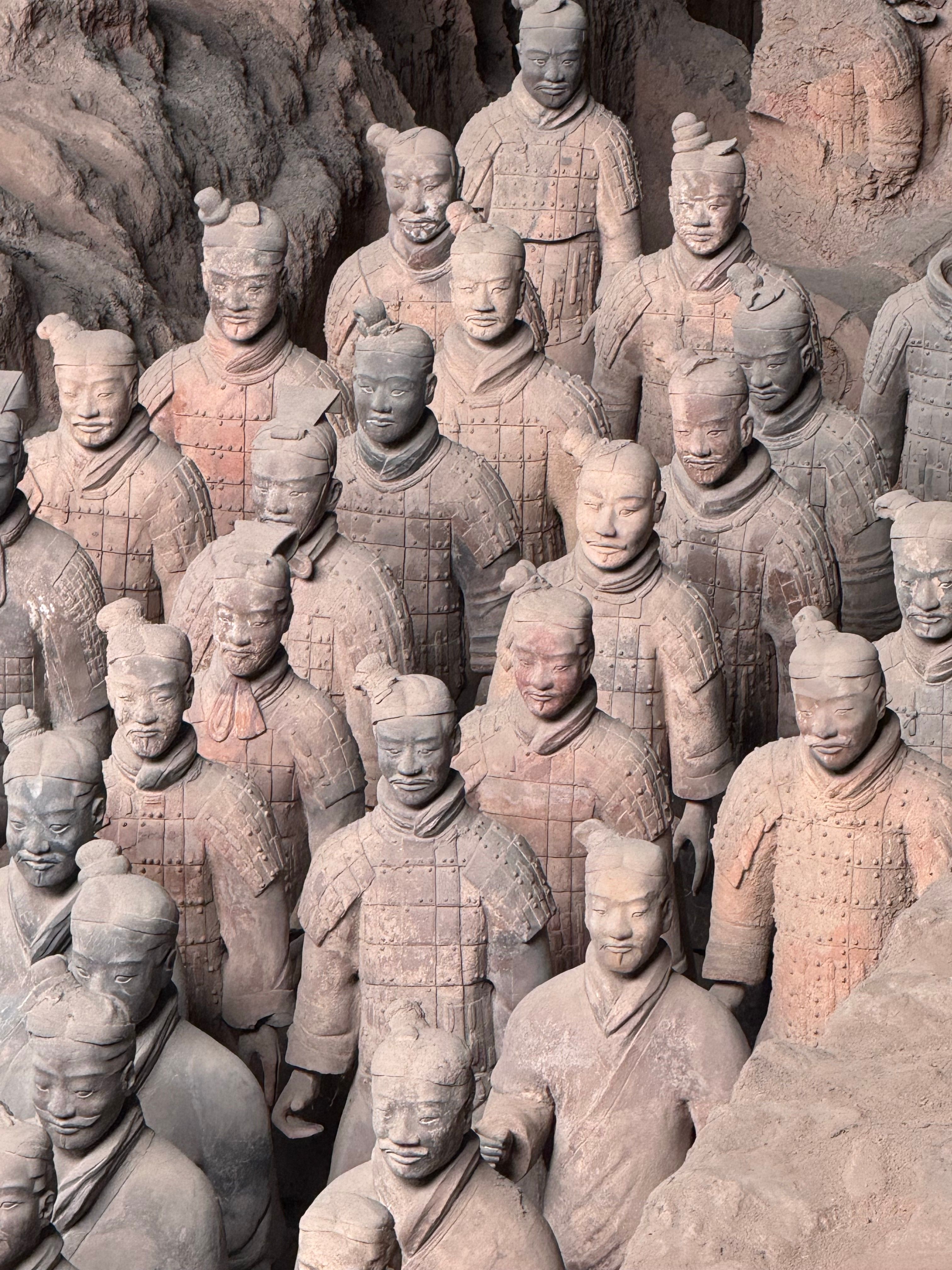
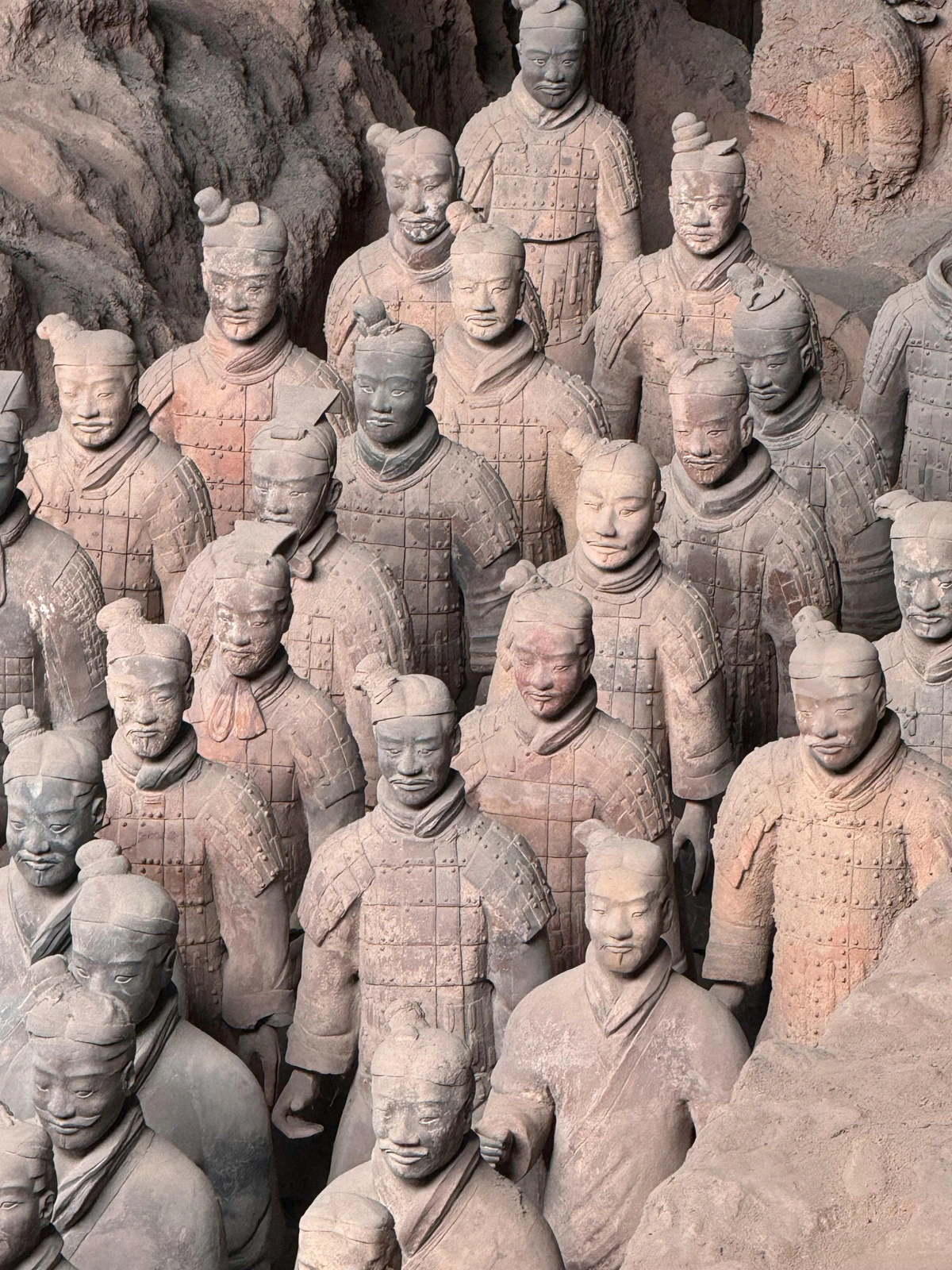
But here’s the true marvel: while common body parts followed standardized molds for efficiency (the ancient Chinese equivalent of a high-tech assembly line!), the heads were individually sculpted and attached. This means no two warriors are exactly alike. Each boasts unique facial features, distinct hairstyles, and even varied ear shapes. This incredible personalization suggests a genuine diversity within the Qin army itself, perhaps reflecting soldiers from different regions or even ethnic groups within the newly unified empire. It's an ancient form of individual portraiture on an imperial, mass-scale, balancing the need for disciplined uniformity with a recognition of human individuality – a fascinating artistic and strategic choice.
Original Colors and Their Loss
Originally, these silent sentinels weren't just earthy clay; they were painted in vibrant, lifelike colors – rich reds, deep greens, regal purples, and striking blues. These pigments were applied over a lacquer base derived from tree sap, which provided a smooth canvas for mineral pigments. Imagine cinnabar red from mercury sulfide, malachite green from copper carbonate, azurite blue, and the incredibly rare 'Han purple' derived from barium copper silicate – a color so complex, it was rediscovered by modern science only recently! Picture a subterranean world bursting with such brilliant color. Heartbreakingly, much of this pigment has faded or flaked away since excavation. Upon exposure to air and rapid changes in humidity and temperature, the delicate lacquer base dries, curls, and delaminates, causing the paint to detach almost immediately. As an artist who obsesses over color, I can only try to conjure the initial vibrant spectacle, now mostly lost to time. It’s a powerful, tangible reminder of art's inherent fragility and the relentless, often invisible, battle conservators face – a challenge akin to the delicate work required for fresco painting or the careful preservation of ancient oil paintings. Thankfully, modern preservation techniques are continuously being refined to protect any newly discovered colored surfaces.
Weaponry and Metallurgy
Beyond the figures, the craftsmanship extended to their original weaponry. The warriors were once armed with real bronze weapons – swords, spears, crossbows, and arrows – many of which were still remarkably sharp when discovered, thanks to a sophisticated chromate coating, an early form of rust-proofing! This advanced metallurgical technique involved treating the bronze with a chromium salt solution, creating a thin, protective layer that inhibited corrosion for over two millennia. It's truly astonishing what ancient engineers achieved. While much of this weaponry was looted in antiquity or has deteriorated, ongoing archaeological efforts continue to uncover and preserve these crucial historical artifacts, offering invaluable insights into Qin military technology and advanced metallurgy.
And then there are the diverse ranks and roles within this clay army, each meticulously distinguished by intricate armor, posture, and symbolic weaponry:
- Infantrymen: The dense formations of foot soldiers, often clad in lamellar armor (small, overlapping plates), forming the formidable backbone of the army, ready for direct engagement.
- Archers: Both kneeling and standing, identifiable by their lighter armor and specific posture, strategically positioned for long-range attacks, often in specialized square formations to unleash devastating volleys.
- Cavalrymen: Mounted on magnificent terracotta horses, distinguished by their shorter robes and flexible armor for ease of movement, representing the mobile units crucial for flanking maneuvers and rapid deployment.
- Charioteers: Accompanied by their grand chariots and powerful horses, these units were essential for shock tactics, breaking enemy lines, and serving as mobile command posts, typically wearing heavier armor.
- High-ranking Generals: Distinguished by their elaborate, often heavier lamellar armor, dignified poses, and commanding presence, these figures stood as the strategic leaders of the immortal legions, often with intricately sculpted stern expressions that conveyed their authority and wisdom.
It’s truly a living snapshot of an entire ancient military structure, frozen in time and clay – a testament to an empire's belief in eternal war and eternal dominion.
The Pits: A Subterranean World of Strategic Military Genius
The Terracotta Army is not simply a random collection of statues; it’s a masterclass in ancient military strategy, meticulously laid out in several massive subterranean pits. Each pit is designed to replicate real-world battlefield formations, offering an astonishing glimpse into the strategic thinking of the Qin military command. Stepping into these vast, covered pits – some of which remain tantalizingly unexcavated – is like entering a frozen moment of ancient warfare, revealing a carefully planned underground world. Can you imagine the tactical genius involved in planning such a detailed, eternal army, complete with rammed earth walls, timber roofs, and sophisticated drainage systems to protect its inhabitants?
Pit Number  | Contents | Strategic Role & Description |
|---|---|---|
| Pit 1 | Main infantry, chariots, vanguard | The largest and most visually overwhelming pit, housing an estimated 6,000 warriors and horses. Arranged in a rectangular battle formation, it primarily consists of infantry and chariots, with three rows of vanguard (frontline) warriors forming the front line, facing east, ready to meet and engage any enemy. This is the iconic sight you'll see in most photos, a truly awe-inspiring confrontation. |
| Pit 2 | Cavalry, archers, chariots, mixed units | This pit offers a fascinating insight into a more diverse and tactically flexible force. It includes specialized units like kneeling archers and standing archers (often positioned in strategic square formations to unleash devastating volleys), swift cavalry (mounted on terracotta horses, poised for rapid flanking maneuvers), and armored chariots. This pit represents the mobile and specialized units, designed for strategic deployment, reflecting highly advanced ancient military strategy for surprise attacks or rapid defense. |
| Pit 3 | Command post, high-ranking officers, single chariot | Significantly smaller and U-shaped (a configuration often used to protect a central command), this pit is widely believed to be the crucial command center for the entire army. It contains fewer figures, predominantly high-ranking officers, and a single elaborate chariot, possibly for the commanding general. Its strategic position and composition clearly suggest it was the brain of the operation, tasked with coordinating the massive forces in the other pits, much like a modern general's headquarters orchestrating a grand campaign. |
| Pit 4 | Empty | This pit remains hauntingly unfinished, a silent and poignant testament to the abrupt halt of the colossal project. Construction was most likely cut short due to the sudden death of Emperor Qin Shi Huang in 210 BCE, swiftly followed by widespread peasant uprisings and civil unrest that led to the rapid collapse of the Qin Dynasty just four years later. The empty pit stands as a powerful, untouched symbol of an empire's ambition cut tragically short – a ghostly reminder of what might have been, a silent symphony left unplayed. What if he had lived longer? How might that have changed history? |
Beyond the Warriors: A Glimpse into the Imperial Court and Broader Mausoleum Complex
The Terracotta Army, for all its military might, is truly just one magnificent component of an even vaster mausoleum complex. This underground empire extends far beyond the warrior pits, painting a comprehensive picture not merely of a military guard, but of an entire imperial court meticulously assembled to accompany Emperor Qin Shi Huang into his next life. It's a testament to his belief that his afterlife should mirror his earthly dominion in every opulent detail.
We've already touched on them, but it bears repeating: the intricately detailed terracotta figures of acrobats, strongmen, musicians, and civil officials each served a specific purpose. The acrobats and strongmen, sculpted with powerful musculature and dynamic expressions, were there to entertain; the musicians, captured in poised stances with delicate, sculpted hands, to provide harmony and ritual sound; and the civil officials (including scribes and stablemasters), in their precise robes and stoic expressions, to continue advising and managing the emperor’s eternal bureaucracy. They were all intended to replicate the complex social structure and vibrant life of his earthly rule, ensuring his eternal comfort and dominion. Beyond these, archaeologists have also unearthed bronze birds, exotic animals, and even miniature replicas of palaces and gardens, further emphasizing the opulent and comprehensive nature of this subterranean kingdom.
Perhaps even more dazzling than the clay figures are the two incredibly intricate bronze chariots and horses discovered within the complex. Cast at nearly half-life-size, these ceremonial chariots are masterpieces of ancient metallurgy. They boast thousands of individual components, elaborate harness fittings with exquisite golden and silver inlays, and remarkable anatomical accuracy in the horses, complete with muscle definition and expressive eyes. Crafted using the advanced lost-wax casting technique, these aren't just utilitarian vehicles; they are a dazzling testament to the advanced metalworking, engineering, and artistic skill of the Qin Dynasty. They showcase a level of technological and aesthetic sophistication that transcends simple clay figures, offering invaluable insights into ancient Chinese metallurgy and design, and adding another opulent layer of grandeur to the emperor’s subterranean palace. The complexity and artistry of these bronze pieces also highlight the range of materials and expertise employed in constructing this vast eternal empire.
Timeline: Emperor Qin Shi Huang & The Terracotta Army
To truly grasp the monumental scope of the Terracotta Army, it's incredibly helpful to place it within the timeline of Emperor Qin Shi Huang's extraordinary, often brutal, and always ambitious reign. This isn't just a chronology; it’s the narrative backbone of a legacy that reshaped a nation and spawned an immortal army. This timeline charts the key moments that led to its creation and its eventual rediscovery, demonstrating how deeply intertwined this archaeological wonder is with the foundational history of imperial China.
Year/Period | Event | Significance & Lasting Impact |
|---|---|---|
| 259 BCE | Birth of Ying Zheng (later Qin Shi Huang). | The beginning of the life of the future first Emperor, whose insatiable ambition would directly lead to the creation of the Terracotta Army and the unification of China. |
| 247 BCE | Ascends the throne of Qin state at age 13. | The start of his long rule. It's believed that work on his vast mausoleum complex, including the initial stages of the Terracotta Army, began soon after, a testament to his early and profound belief in an afterlife kingdom and the need for eternal protection. |
| 230-221 BCE | Conquest of Six Warring States. | A period of relentless military campaigns culminating in the unification of China for the first time, establishing the powerful Qin Dynasty. This centralized control and access to immense resources were absolutely crucial for undertaking such monumental projects as the Terracotta Army and fundamentally altered China's political landscape. |
| 221 BCE | Proclaims himself Qin Shi Huang (First Emperor). | Formalizes the new imperial system and his supreme, almost divine, authority. His desire for eternal rule, protection, and a mirror image of his earthly dominion solidifies the ultimate purpose of his immortal army, setting a precedent for future dynastic ambitions. |
| 220-210 BCE | Standardization of currency, weights, measures, writing, and roads. Also initiates the Great Wall's construction. | These reforms demonstrate his relentless drive for unification and absolute control, a philosophy clearly mirrored in the standardized yet individualized nature of the terracotta figures. These fundamental policies would profoundly influence subsequent Chinese dynasties for centuries, laying the groundwork for imperial administration and cultural cohesion. |
| 210 BCE | Death of Qin Shi Huang while on an inspection tour. He is buried in his mausoleum. | The emperor's sudden death marked a critical turning point. The colossal project of the mausoleum, including the Terracotta Army, likely halted or significantly slowed almost immediately, a fact starkly evidenced by the unfinished Pit 4, leading to the rapid destabilization of the empire. |
| 206 BCE | Fall of the Qin Dynasty. | The empire collapses amidst widespread rebellions and bitter power struggles (involving figures like Xiang Yu and Liu Bang), giving way to the Han Dynasty. The mausoleum complex, no longer maintained, falls into obscurity and remains largely undisturbed, its incredible secret preserved by time and earth for over two millennia due to the vastness of the area and subsequent historical neglect. |
| March 1974 CE | Accidental discovery of Pit 1 by local farmers drilling a well near Xi'an. | Marks the incredible, serendipitous rediscovery of one of the greatest archaeological finds in human history, finally unveiling the hidden immortal army to a bewildered modern world and forever changing our understanding of ancient China. |
| 1979 CE | Opening of the Museum of Qin Terracotta Warriors and Horses to the public. | A pivotal moment that allowed the world to finally witness this monumental archaeological wonder, sparking ongoing international research, conservation efforts, and immense public fascination, solidifying its status as a UNESCO World Heritage site and a global icon. |
Preservation and the Weight of Time: An Ongoing Battle for Immortality
Preserving the Terracotta Army is a monumental and ceaseless undertaking, a continuous, often unseen, battle against the relentless march of time and the very act of its discovery. Excavation, while revealing these wonders, inherently exposes them to elements that can cause rapid deterioration, particularly the vibrant original pigments we discussed earlier. This is precisely why many figures are displayed in situ – that is, in their original location – within massive, climate-controlled hangars, allowing for both public viewing and meticulous, ongoing conservation efforts. This approach significantly minimizes the risk of damage from movement and environmental shifts, allowing researchers to study them in their intended context.
Modern conservation employs a truly sophisticated arsenal of techniques. From creating precisely controlled micro-climates within exhibition halls to applying nanometer-thick coatings that immediately seal and protect newly exposed pigments from oxidation and desiccation. Specialized adhesives are used to reattach detached fragments, and advanced 3D imaging helps reconstruct damaged figures digitally, guiding physical restoration with pinpoint accuracy. The challenges extend beyond the terracotta itself; the intricate bronze chariots and weaponry require different, equally specialized preservation methods to prevent corrosion and structural degradation, demanding a diverse range of scientific and artistic expertise. It’s a constant, silent struggle against entropy, a race against time that demands constant innovation. Ongoing archaeological efforts also constantly uncover new sections of the mausoleum, revealing more about the sheer scale of the emperor's vision and the countless figures yet to be fully unearthed.
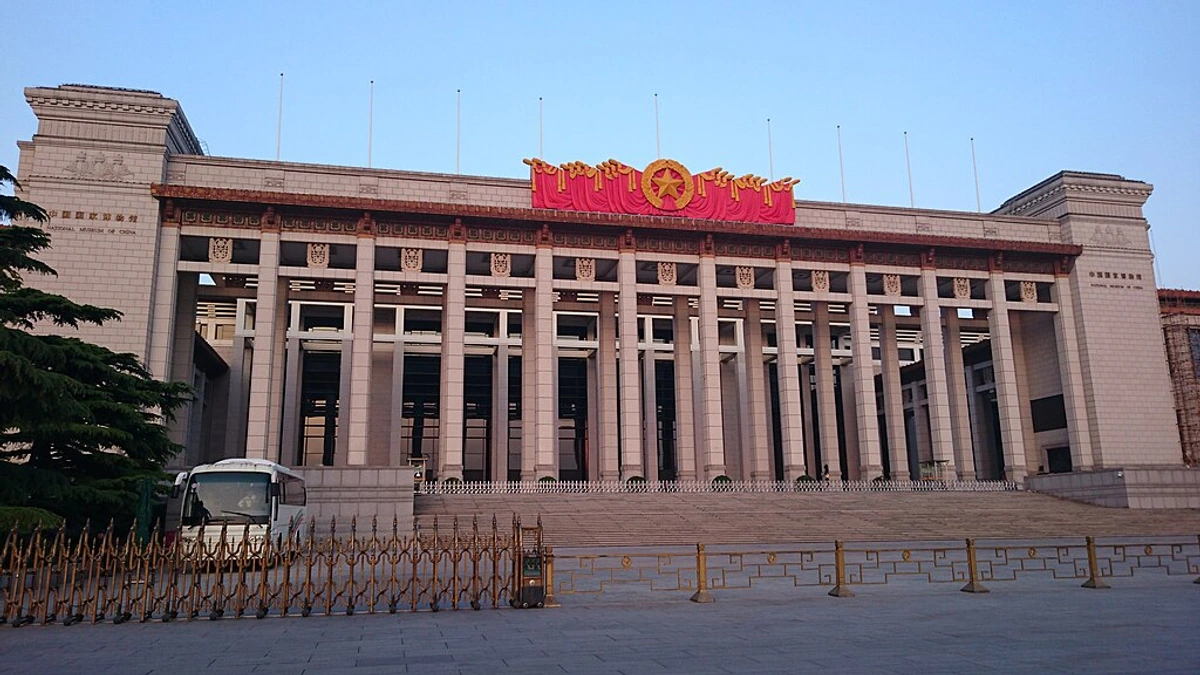
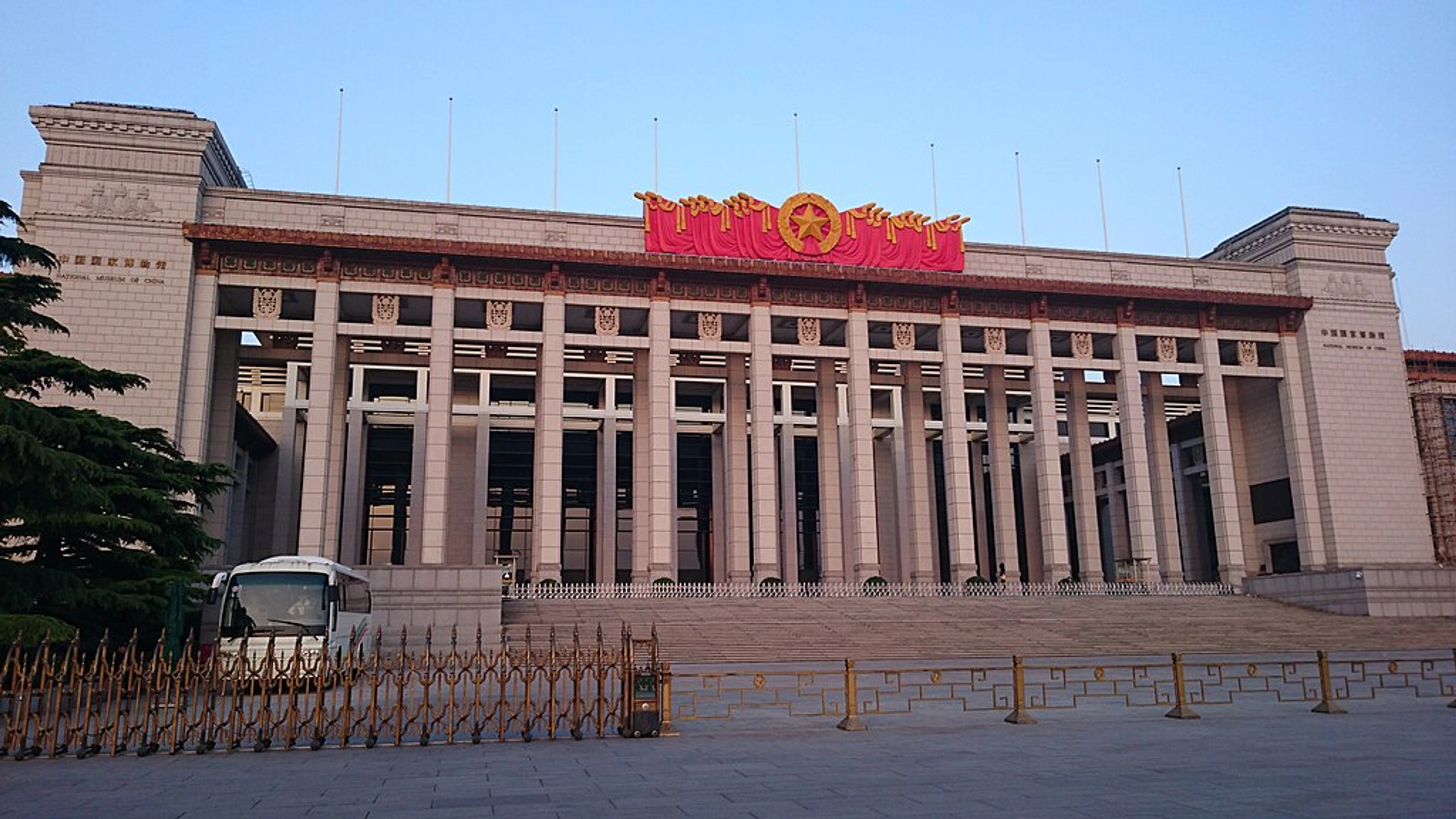
It truly makes you pause, doesn't it? This ongoing dialogue between discovery and decay, between ancient materials and cutting-edge modern science, feels almost like an artwork in itself. As an artist, I often find myself contemplating the incredible efforts museums worldwide – institutions like the National Museum of China or the renowned Metropolitan Museum of Art (with its magnificent Asian art collections) – put into preserving our shared human story. It’s a delicate, painstaking balance of discovery, rigorous scientific study, and long-term conservation, a struggle familiar to anyone working with fragile historical art or even simply aspiring for longevity in contemporary paintings and abstract artworks. Our creations, whether millennia-old clay warriors or a freshly painted canvas, are all, in their own silent way, running a race against the ages. The ethical considerations of excavation versus preservation also remain a continuous debate, ensuring that this ultimate guide covers every facet of this incredible historical saga.
My Personal Take on its Significance: Echoes of Creation and Legacy
For me, the Terracotta Army isn't merely a historical artifact; it’s a profound narrative sculpted in clay that resonates deeply with my own artistic process and understanding of human endeavor. It speaks volumes about the enduring human condition – our boundless aspirations, our deepest fears, and our relentless, often desperate, pursuit of legacy. It is a physical manifestation of an entire belief system, yes, a monumental art project driven by imperial decree, but crucially, executed by countless skilled hands and ingenious minds. The vastness and the details of the Terracotta Army reflect a primal human drive to exert control, to leave an indelible mark, and to conquer the very concept of mortality through monumental creation – a pursuit I find both awe-inspiring and slightly terrifying.
That powerful blend of a singular, grand vision with thousands upon thousands of individual, meticulous touches is a tension I constantly explore in my own abstract compositions. How do individual brushstrokes, geometric elements, or layered textures contribute to a larger, unified message? It’s much like how a Cubist work or an abstract expressionist piece aims for a cohesive, emotional impact. The Terracotta Army reminds me that even the most monumental, power-driven ambitions can inspire creations of enduring beauty and profound historical weight. Like the emperor's grand vision, I too hope my creations, though on a vastly different scale, can evoke emotion, spark reflection, and offer a lasting impression.
This silent, immortal guard also makes me consider my own abstract work. While it’s unlikely to protect anyone's afterlife – and let's be honest, that's not its purpose – I deeply hope it can offer a moment of quiet contemplation, a vibrant splash of color, and a sense of timelessness to those who encounter it. If the dedication to detail and the powerful presence of these figures resonate with you, perhaps you'll find a similar spirit of enduring craft in my own contemporary pieces. Explore my work and perhaps /buy something for your own space. After all, the urge to create and to preserve is a universal one, whether it's an emperor's army or a painter's canvas.
Frequently Asked Questions About the Terracotta Army
Curious for quick answers? Here are some of the most common questions people ask about this extraordinary archaeological wonder, providing concise and authoritative information for a truly ultimate guide.

Where is the Terracotta Army located?
The Terracotta Army is located near the ancient city of Xi'an in Shaanxi province, China. Specifically, it's part of the vast Mausoleum of the First Qin Emperor and is primarily housed within the purpose-built Museum of Qin Terracotta Warriors and Horses, which is a major tourist destination and a UNESCO World Heritage site.
Who commissioned and built the Terracotta Army?
It was commissioned by Emperor Qin Shi Huang, the first emperor of a unified China. Construction began shortly after his ascension to the throne in 247 BCE, involving hundreds of thousands of forced laborers, skilled artisans, and artists who worked for decades under intense and often brutal, secretive conditions. The scale of the project, including sourcing local yellow-red clay and organizing vast workshops, was immense.
When was the Terracotta Army discovered?
The first major pits containing the warriors were accidentally discovered by local farmers in March 1974 while they were drilling a well for water. This serendipitous find immediately became one of the 20th century's most significant archaeological discoveries, unveiling a lost empire.
What was the primary purpose of the Terracotta Army?
The primary purpose of the Terracotta Army was to serve as a funerary army for Emperor Qin Shi Huang. It was meticulously designed to protect him in his afterlife and ensure his continued imperial rule in the spiritual realm, mirroring his earthly power and reflecting his profound belief in eternal dominion and order. It was also part of a larger, complete subterranean court.
How many warriors are there?
Current estimates suggest there are over 8,000 soldiers, accompanied by 130 chariots with 520 horses, and 150 cavalry horses. However, many figures are still buried and remain unexcavated within the vast mausoleum complex, meaning this number is a continuous estimate that may increase with future discoveries.
Are all the warriors unique in appearance?
Remarkably, yes! While standardized molds were used for common body parts for efficiency, the heads were individually sculpted and attached. This meticulous process gave each warrior unique facial features, hairstyles, and expressions, showcasing an incredible level of artistic detail and a desire for realism and individuality within the army's vast ranks. No two are exactly alike, reflecting a blend of mass production and individual artistry.
Can visitors see the Terracotta Army today?
Absolutely! The Museum of Qin Terracotta Warriors and Horses is a major international tourist attraction and a UNESCO World Heritage site. Visitors can explore the three main excavated pits, which are protected by massive climate-controlled hangars, offering a direct view of the warriors in situ (in their original discovered location) and ongoing archaeological work. There are also exhibits showcasing other artifacts from the mausoleum complex.
What materials were used to create the warriors and other figures?
The figures are primarily made of terracotta clay, a type of earthenware pottery. They were fired in specialized kilns at high temperatures, then finished with a lacquer undercoat and vibrant mineral paints. In addition to clay, sophisticated bronze was extensively used for ceremonial chariots and actual weaponry, demonstrating advanced metallurgy and lost-wax casting techniques. Bronze birds and animals were also found.
What other figures were found in the mausoleum complex besides warriors?
Beyond the military figures, archaeologists have unearthed a diverse imperial entourage, including detailed terracotta figures of acrobats, strongmen, musicians, and various civil officials (like scribes and stablemasters). These were all intended to serve, entertain, and advise Emperor Qin Shi Huang in his afterlife, mirroring his earthly court. Other discoveries include bronze birds, exotic animals, and miniature replicas of palaces and gardens, painting a comprehensive picture of his eternal kingdom.
Wrapping Up: An Echo Across Millennia
The Terracotta Army isn't just a historical footnote; it’s one of those rare, transcendent historical sites that truly defies the boundaries of time and imagination. It stands as a physical echo of a powerful emperor's profound belief system, an unparalleled testament to ancient human ingenuity, and a stunning, almost unbelievable, example of large-scale artistic and engineering endeavor. Every time I delve into its story, I’m reminded of the incredible narratives hidden just beneath the surface of our world, patiently waiting to be rediscovered, continually revealing the vast and sometimes overwhelming ambitions that have shaped our history. This silent, powerful guard continues to inspire awe and wonder, millennia after it was first laid to rest, an enduring testament to the human quest for permanence.
The sheer dedication and coordinated effort required to manifest such a monumental vision, whether in ancient clay or the contemporary abstract art I create, speak to a fundamental, universal human drive: to create, to connect, and to leave a lasting legacy. It’s a reminder that history is not just written, but sculpted, built, and painstakingly preserved, and that art can truly conquer death. We invite you to explore more stories that bridge the ancient and the contemporary, just as we strive to do in our own art. Keep exploring, keep questioning, and perhaps, keep creating – because the whispers of the past continue to shape our present and inspire our future.