Myron's Discobolus: Unveiling Ancient Greek Mastery, Potential & Control
Dive deep into Myron's Discobolus, exploring its lost bronze original, Roman copies, and profound philosophy of potential, discipline, and kalokagathia. An artist's take on a timeless icon.

Myron's Discobolus: Unveiling Ancient Greek Mastery, Potential & Control
I remember the first time the Discobolus truly spoke to me. It wasn't just another classical statue in a museum; it was a profound question carved in stone, asking about the nature of human striving. He’s everywhere, isn't he? On posters, in textbooks, a silent sentinel of athleticism. But past that initial recognition, a deeper current tugged at my artist's mind: what makes this particular moment, this specific coiled tension, so utterly timeless? What profound message is he truly trying to convey? Myron, the ancient Greek sculptor, didn't just capture an athlete; he captured a philosophy of pure, unreleased potential, a masterclass in control, balance, and the raw essence of the human condition. It’s a piece that invites you to look beyond the physical act and into the deeper currents of the human spirit. For me, that’s where the true art, the real story, lies. In this article, I want to unpack the historical context, artistic genius, and enduring philosophical insights embedded within this iconic work.
The Architect of Motion: Myron of Eleutherae & His Lost Bronze Masterpiece
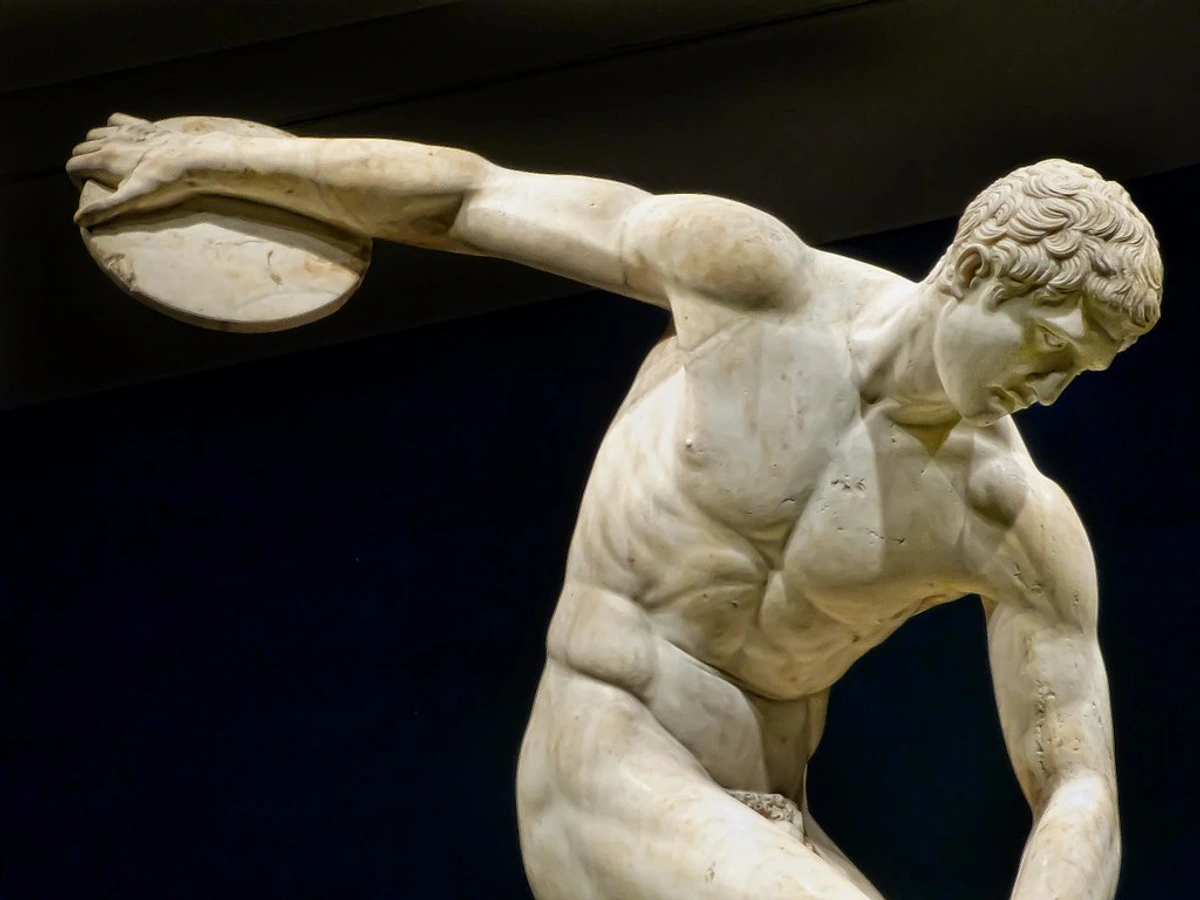
First, let's get one crucial thing straight. Every Discobolus you’ve ever seen is a copy. A Roman-made marble replica of a Greek original that has been lost to the ravages of time. The original sculptor was a man named Myron of Eleutherae, who worked around 460-450 BC. Myron wasn't just a sculptor; he was a visionary, renowned for bringing life and motion to static materials. Imagine the buzz in ancient Athens when a new Myron was unveiled! Ancient writers, like Pliny the Elder, lauded his extraordinary skill, even hyperbolically claiming his statue of a cow was so lifelike, bulls would attempt to mount it. This anecdote, while possibly embellished for promotional effect, paints a picture of a sculptor pushing artistic boundaries with a revolutionary approach to realism, a true pioneer of his time.
Myron was active during Greece's early Classical period, a vibrant era following the Persian Wars that saw the flourishing of Athenian democracy, philosophy (think early Socrates and Plato), and intense intellectual and artistic development. This socio-political climate fostered ideals of human excellence, both physical and intellectual, which Myron's work perfectly embodied. He was celebrated not only for his anatomical precision but for his ability to freeze motion itself. While the Discobolus is his most famous work, he also created other celebrated (though now lost) bronzes, such as a group depicting Athena and Marsyas, capturing the dramatic instant when Athena discards her flute and the satyr Marsyas discovers it. This shows Myron's consistent fascination with capturing precise, emotion-laden moments of action.
This historical context is vital to understanding the statue's legacy. Imagine if all we had of a legendary rock concert were the bootleg t-shirts sold outside; you get the general idea, but you miss the raw energy and original performance. That's a bit like our relationship with Myron's Discobolus. The Romans, being avid admirers and collectors of Greek art, replicated countless masterpieces, often adapting them to their own aesthetic preferences and available materials. They weren't just copying; they were interpreting.

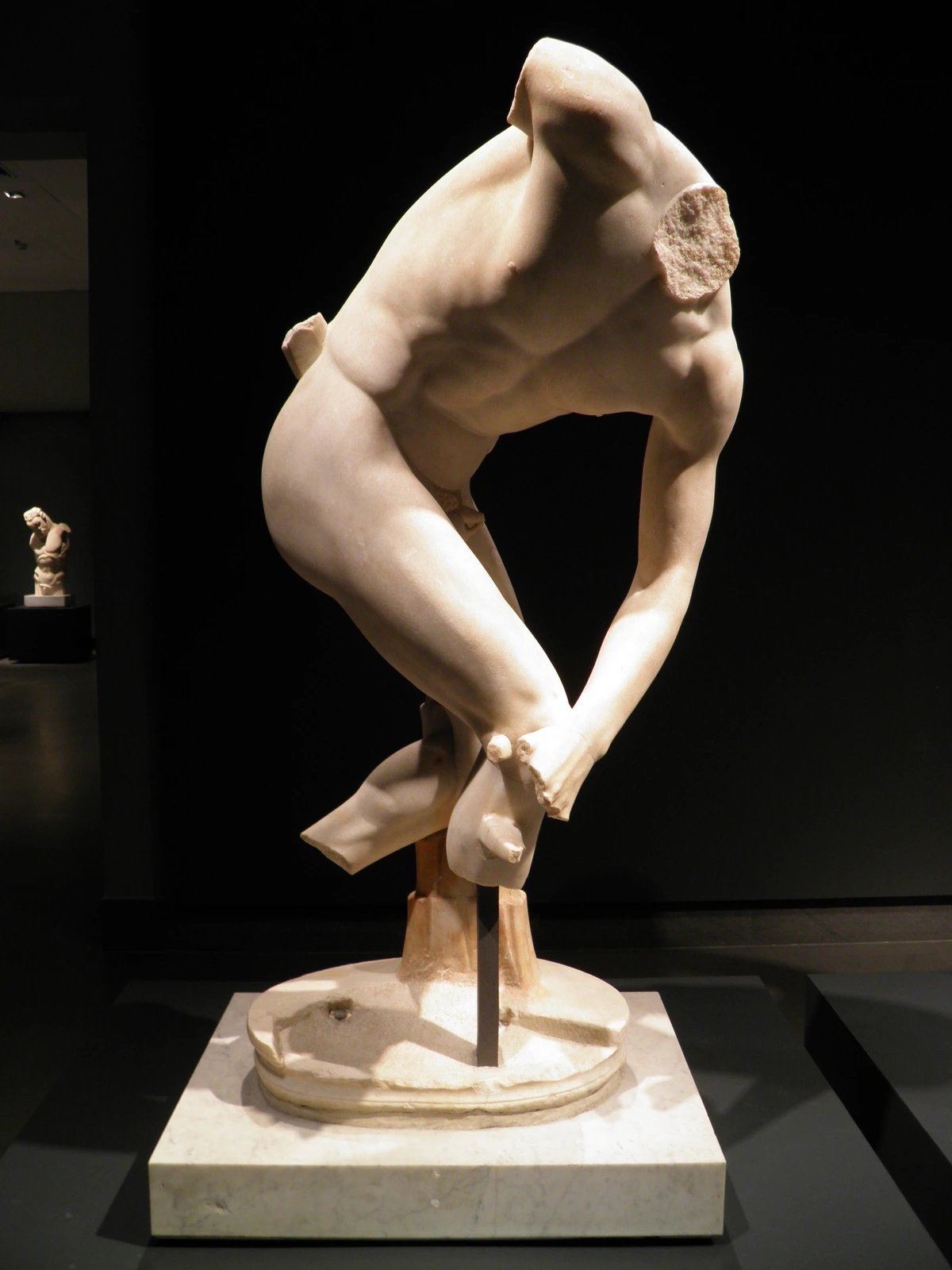
The original Discobolus was cast in shimmering bronze. This material choice was no accident. Bronze, being both versatile and strong, allowed Greek sculptors to create more daring, open compositions that defied gravity. They could depict outstretched limbs and dynamic postures without the need for additional, heavy support structures. A bronze sculpture, strong and self-supporting, wouldn't have needed the clunky tree stumps or struts we so often see supporting the heavier, more brittle marble copies. These supports, while necessary for the marble, ironically add a static element that was never part of Myron's truly dynamic vision. Furthermore, bronze offered a distinct sheen and allowed for finer detail in musculature and hair, lending a warmer, more lifelike appearance that caught the sunlight beautifully. But bronze, alas, is a valuable commodity. Over the centuries, countless Greek bronze masterpieces were melted down for weapons, tools, coins, or other art. Marble, however, tends to survive, often buried and forgotten in the earth. So, what we have are these marble "ghosts," Roman interpretations of a lost masterpiece, each with its own subtle stylistic fingerprints and the compromises imposed by a different medium.
The Anatomy of Imminent Explosion: Rhythmos, Tension, and Dynamic Balance
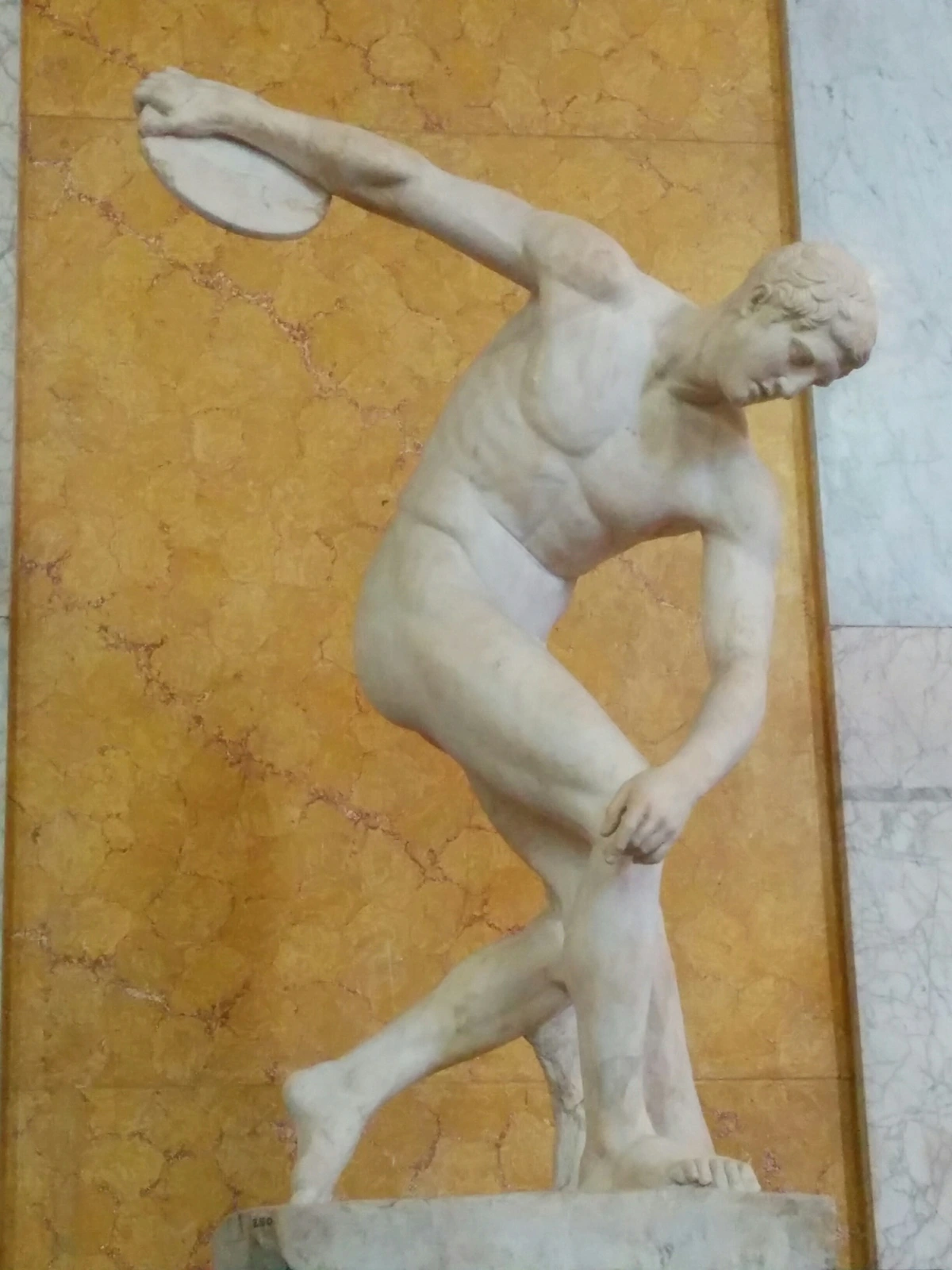
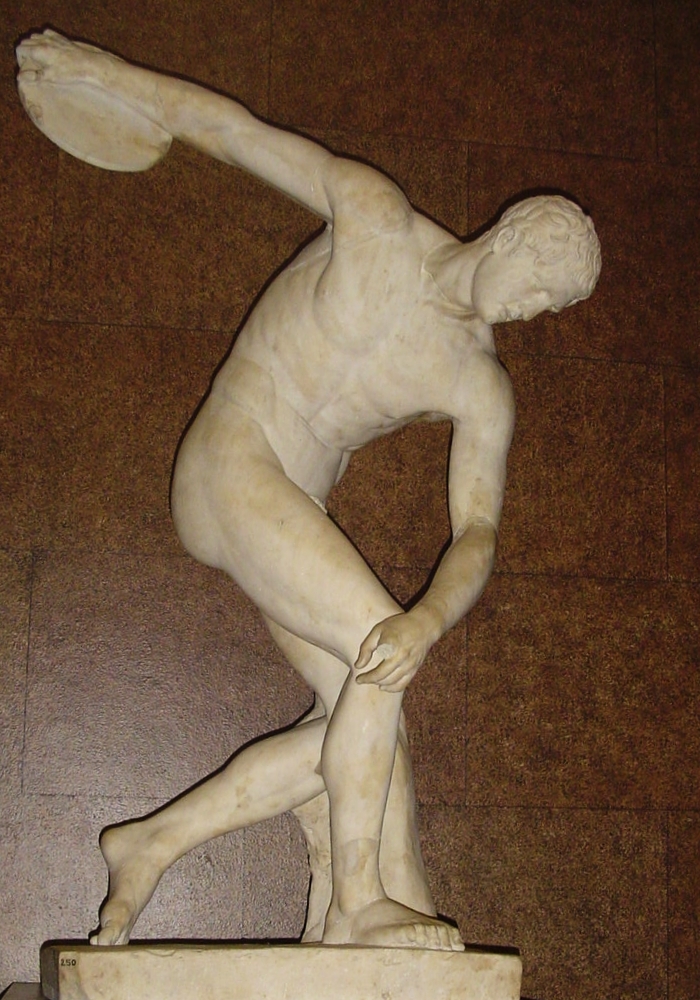
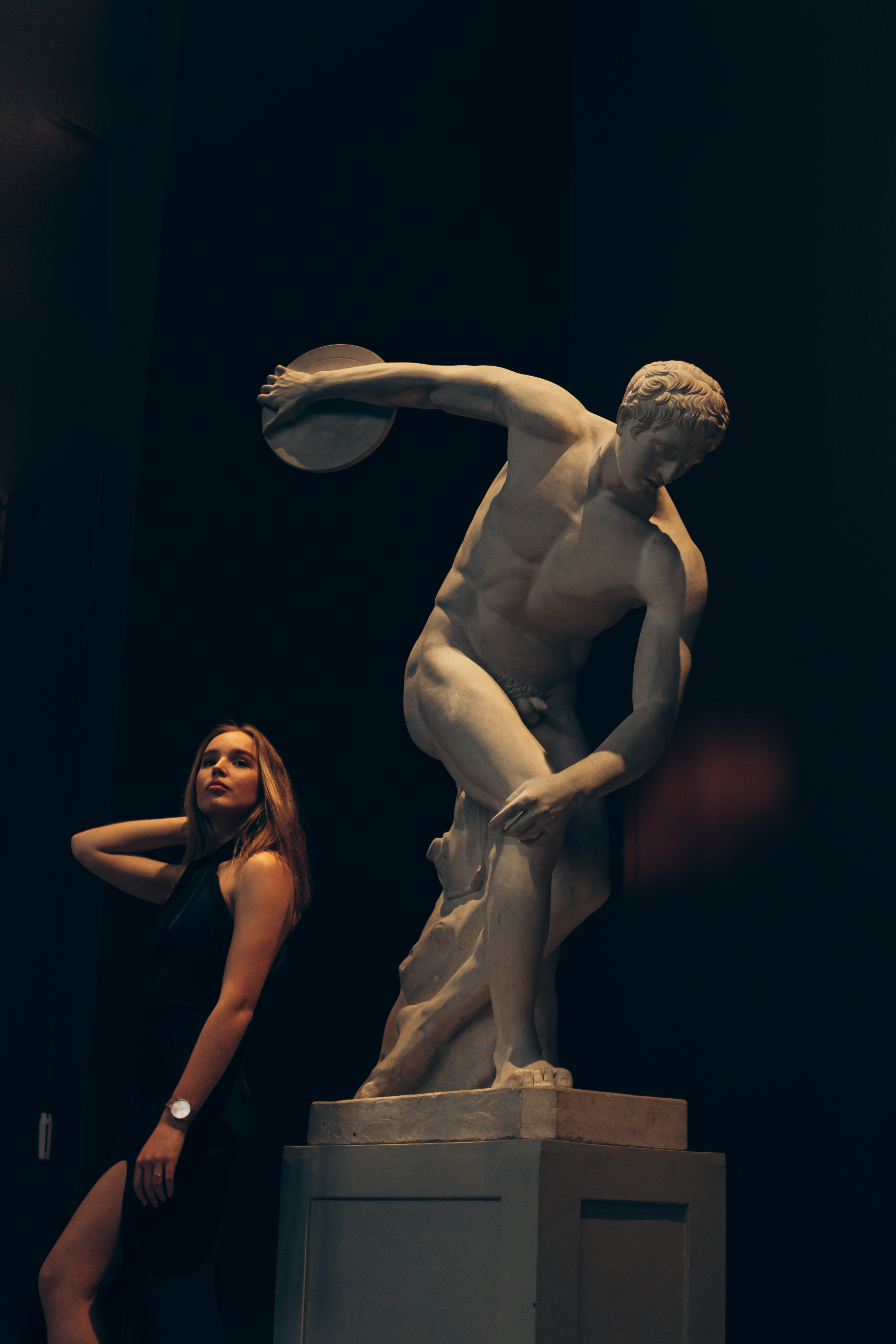
The real genius of the Discobolus isn’t just Myron's anatomical accuracy; it’s his daring gamble on capturing this precise moment. He didn't show the throw itself, or the triumphant victory pose after. Instead, he chose the absolute peak of the backswing, that split-second of stillness just before an explosion of kinetic energy. The entire body is a coiled spring, vibrating with unreleased power, like a drawn bowstring held taut, full of potential energy but utterly still. You can almost feel the taut sinews of his thighs, the steel cables of his back muscles, ready to propel him forward.
Look at the composition. His body forms a graceful, tense arc, an S-curve of potential. This S-curve, where opposing forces are held in balance, visually embodies the intense stored energy ready for release. His right arm is extended back to its limit, the discus heavy in his hand (imagine the weight of a real ancient discus, often around 4-5 kg!), a tangible mass on the cusp of release. His torso twists in opposition, his left arm braces against his right knee, and his toes grip the earth, anchoring him to the ground. It's a masterclass in understanding balance in art composition.
Everything is in a state of perfect, temporary harmony, or what the Greeks called rhythmos – a concept embodying dynamic balance and the implied movement within stillness. Unlike the more static, harmonious balance of Polykleitos's contrapposto (as seen in his Doryphoros), Myron's rhythmos conveys an active, impending shift. It's a frozen moment that implies incredible, imminent motion, a concept far more complex than a simple athletic pose. It's a snapshot of maximum tension, a silent scream of impending action. Capturing this kind of complex, twisted anatomical pose also required a deep understanding of perspective and foreshortening, making objects or body parts appear shorter than they are in reality to create an illusion of depth, as seen in this illustrative drawing:
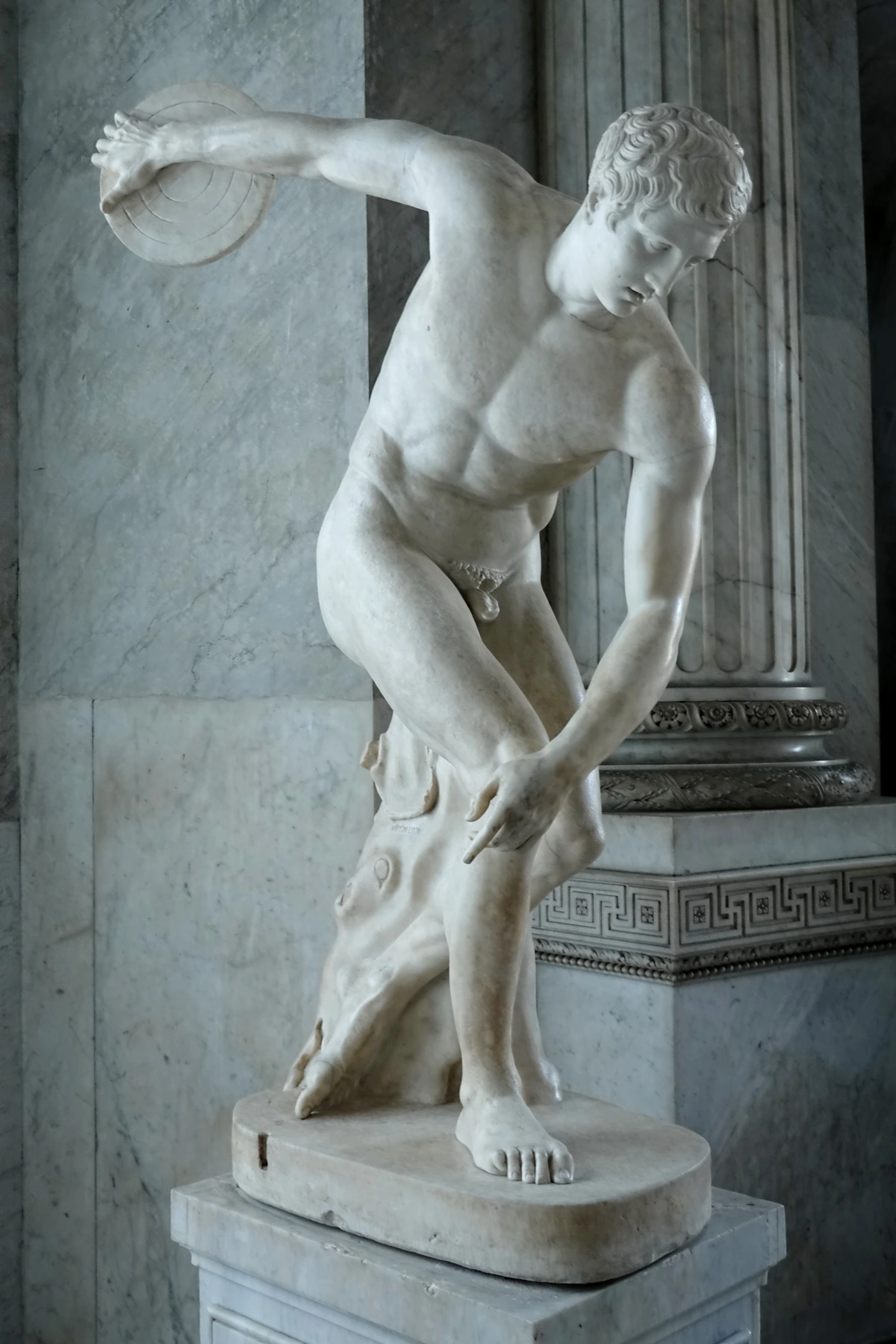
Myron's ability to render this visually speaks volumes about his artistic prowess.
The Biomechanics of the Throw
While the Discobolus is fundamentally an artistic and philosophical statement, Myron's keen observation of human motion extends even to the subtle physics of the discus throw. For a real athlete, this coiled position is about generating maximum torque and angular momentum. The deep rotation of the torso, the stretch reflex in the powerful leg and back muscles, the precise angle of the arm and discus – all these elements are crucial for a powerful, accurate throw. Modern sports science, with its slow-motion analysis and biomechanical models, confirms the efficiency of such a pose. Myron captures this scientific precision, translating biomechanical efficiency into aesthetic brilliance, long before the terms 'torque' or 'kinetic energy' existed. It's a testament to his genius that the pose feels so right, so perfectly balanced on the edge of release, even to a modern eye familiar with high-speed video analysis of athletic feats. It’s like he intuitively understood the physics of optimal performance and sculpted it into eternity.
The Serene Paradox: Calm Face, Intense Body – Kalokagathia and the Severe Style
This is the part that always fascinated me, and frankly, used to puzzle me. His body is screaming with tension, muscles taut, ready to unleash phenomenal power. But his face? It’s calm, detached, almost serene. There’s no grimace of effort, no focused scowl of intense concentration. It’s strikingly impassive.
And no, this isn't a mistake on Myron's part. It’s the entire point, a powerful artistic statement. This calm expression was a key feature of the Severe Style of early Classical Greek art, which flourished roughly from 490 to 450 BC—precisely the era Myron was active. This style wasn't just about stern faces; it was a deliberate shift from the smiling, somewhat artificial 'Archaic' figures that preceded it (think of the characteristic 'Archaic smile' and stylized, almost wig-like hair seen in earlier kouroi). This was a period of intense intellectual and social change in Greece, an era that demanded gravitas and a new kind of noble realism in its art. Other examples, like the Kritios Boy or the bronze warriors from Riace, also display this new somber, concentrated expression, a mark of intellectual and emotional depth.
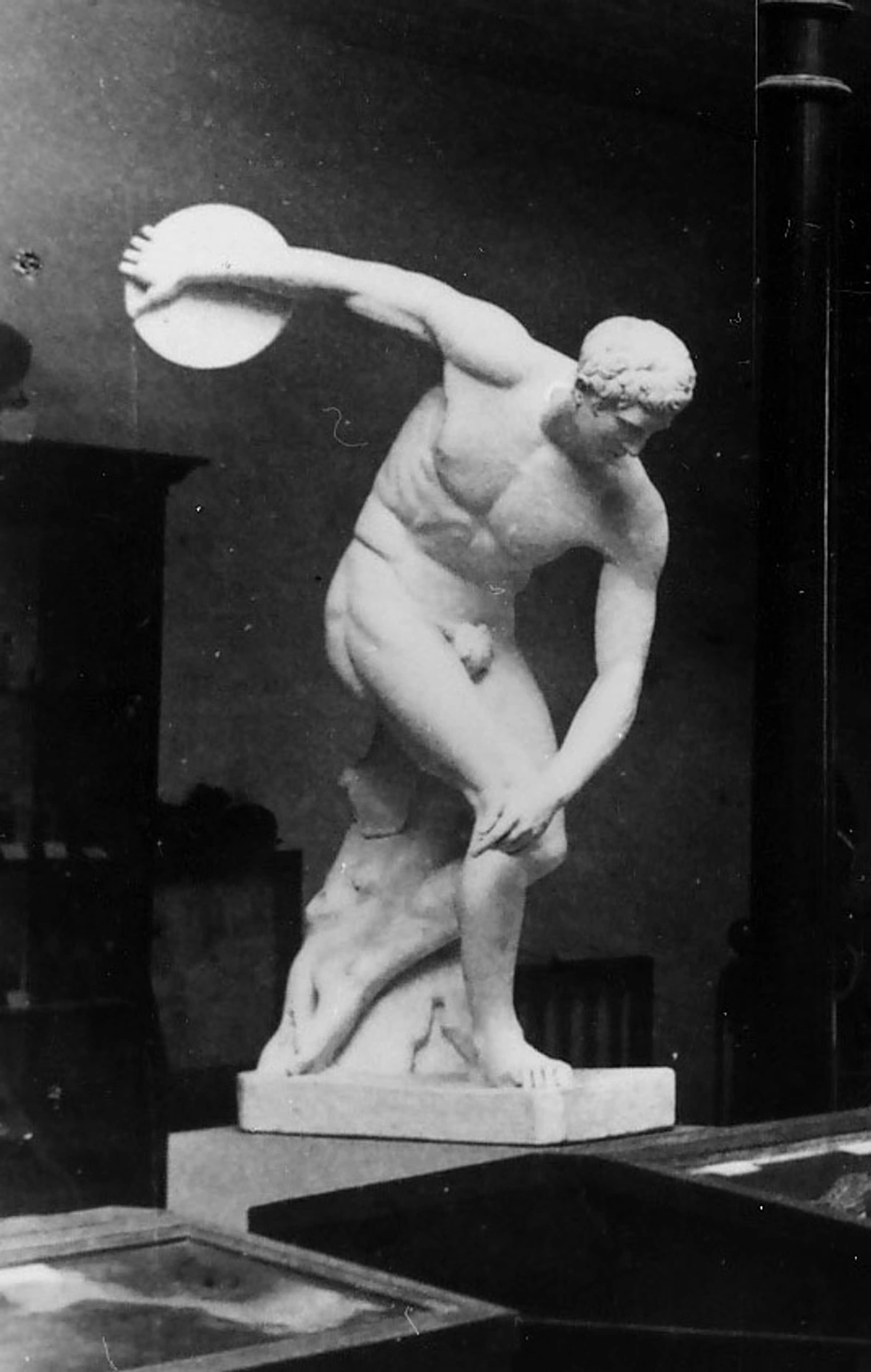
The impassive face of the Discobolus, therefore, isn't a lack of emotion, but a statement – a deliberate suppression of fleeting pain or exertion in favor of an enduring, ideal composure. It’s the visual representation of mind over matter, the cool logic of philosophy presiding over the hot blood of physical struggle. It represented rational thought triumphing over raw emotion and physical strain. His serene face is a symbol of a mind in complete command of a powerful body, embodying the Greek ideal of kalokagathia – a term that basically means being beautiful, good, and noble, all at once.
It's a profound wholeness of being where physical prowess, moral virtue, and intellectual discipline are inseparable. It wasn't just about personal aesthetics; it was a civic ideal. The 'beautiful and good' citizen was one who contributed to the polis (city-state), who embodied physical strength for defense, moral virtue for governance, and intellectual acuity for philosophical discourse. The Greeks believed that physical beauty was a reflection of inner goodness. An athlete, in their eyes, wasn't just a strong body, but a cultivated mind and virtuous spirit. So, while his body may be in a temporary state of coiled chaos, his face represents eternal order and self-mastery. The stillness of the face becomes the ultimate expression of power.
More Than a Sport: The Discobolus as a Philosophical Blueprint
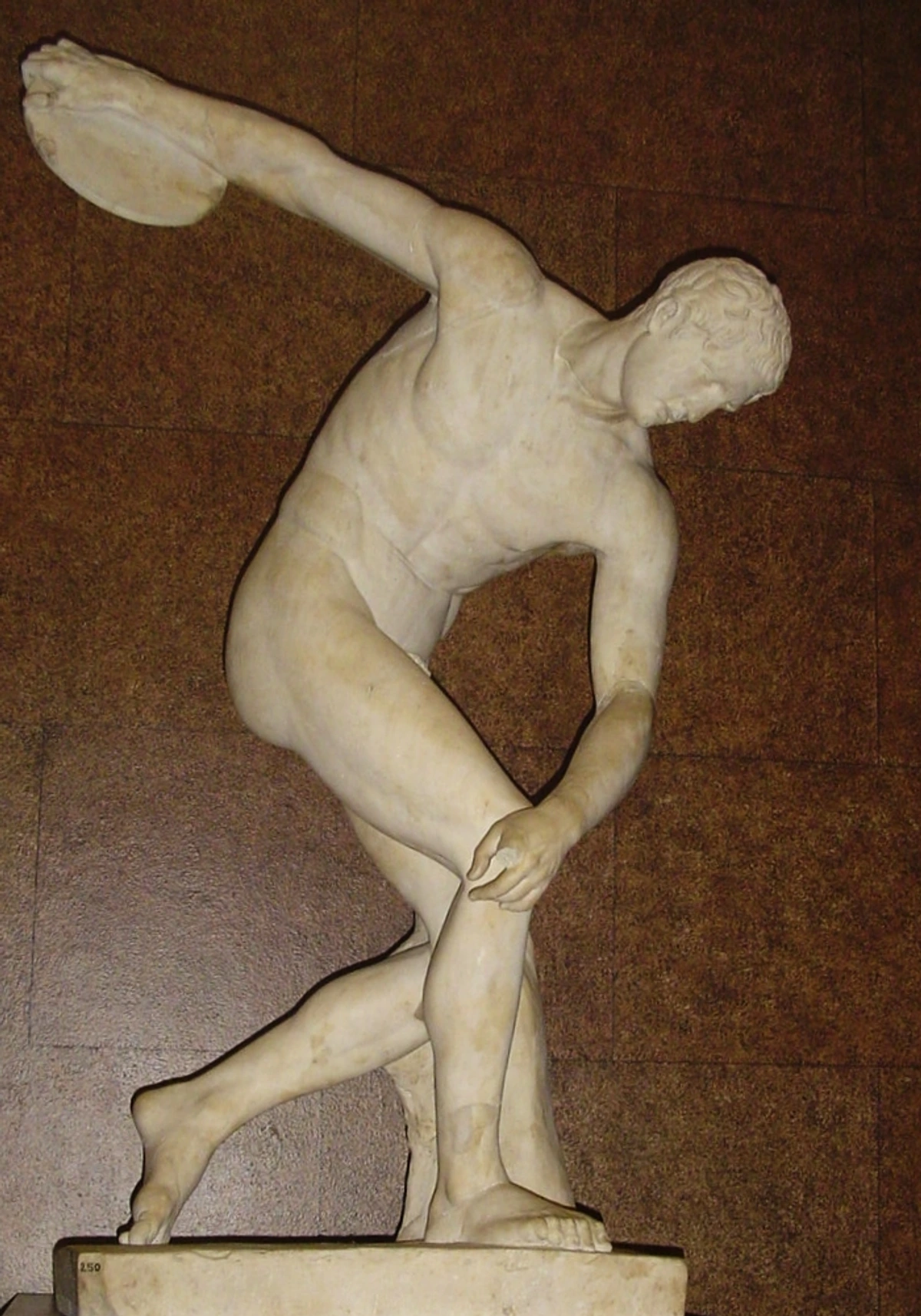
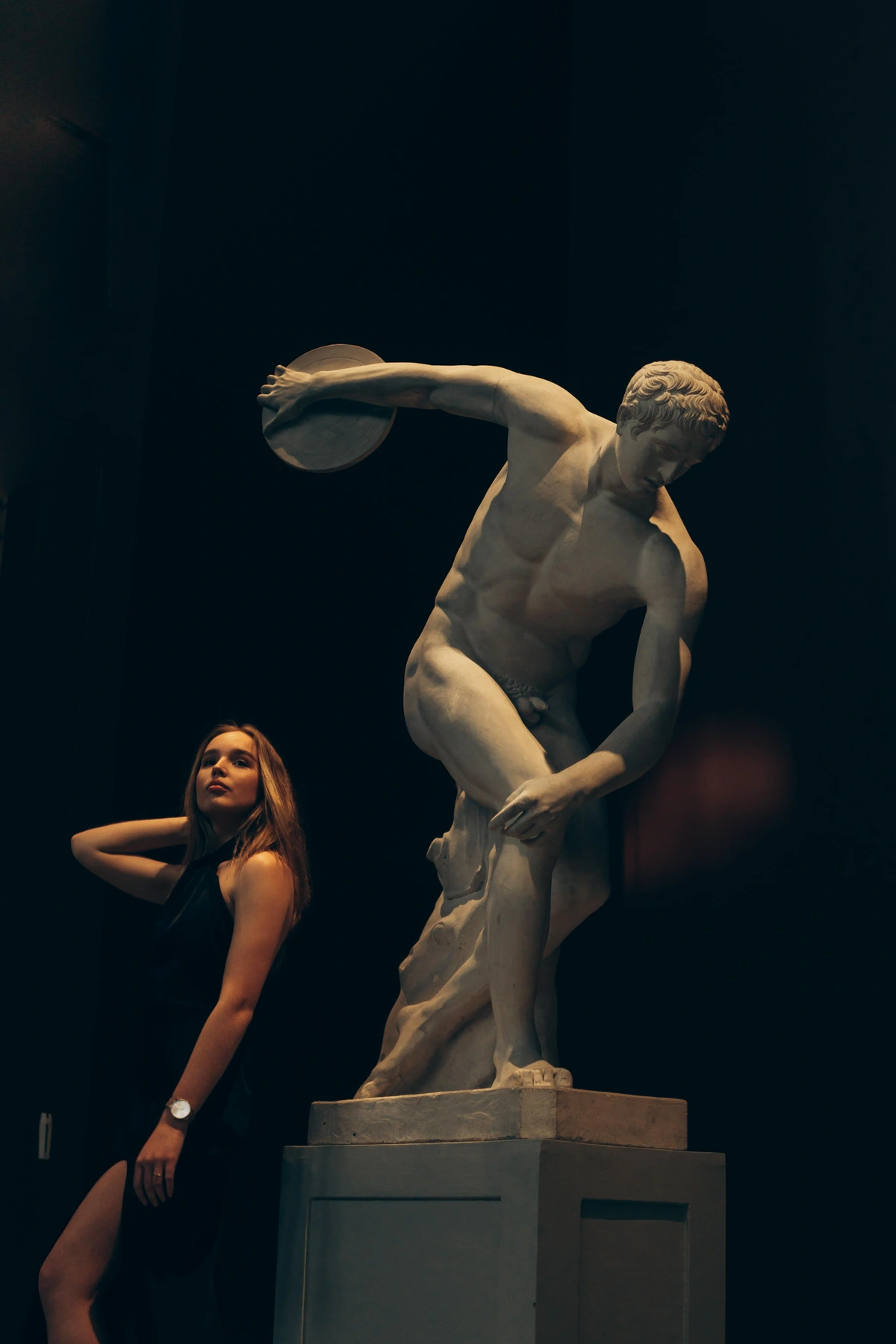
So if the Discobolus isn't just a sports statue, what is it truly communicating? I’ve come to see it as a profound meditation on several big ideas that resonate far beyond ancient Greece. It’s a blueprint for understanding human potential, a timeless guide to mastery, and a stark reminder of the power held in a single, decisive moment. As an artist, these are the concepts I grapple with daily in my own work, especially in the process of moving from abstract contemplation to a concrete creation. It's the silent hum of the universe before creation, the blank canvas waiting for its story.
Concept  | The Meaning Behind the Marble | Key Visual Element | Why it Matters (An Artist's Perspective) |
|---|---|---|---|
| Potential Energy | The statue isn't about the action itself, but the promise of action. It's a metaphor for human potential, the moment before you launch your big idea, make a life-changing decision, or begin a monumental artwork. The precise musculature and tense S-curve visually embody this coiled, unreleased power. | Coiled S-curve of the body, taut muscles. | This concept resonates with the universal human drama of standing on the precipice of action, where the thrill and terror of infinite possibilities collide. It's the silent hum of the universe before creation, the blank canvas waiting for its story, much like I feel before starting a new abstract piece. |
| The Ideal Human (Kalokagathia) | This isn't just a portrait of one athlete. It's the Greek blueprint for the perfect citizen: physically capable, mentally controlled, balanced, and harmonious in mind and body. This ideal emphasized holistic excellence. | Serene face on a powerful body. | It offers a timeless model of aspiration: the pursuit of excellence not just in one domain, but across all aspects of human existence – physical, moral, intellectual. A quest for true human flourishing, a goal I think all meaningful art should strive for. |
| Order over Chaos | In a world of messy emotions and unpredictable events, the Discobolus represents a perfect, rational order imposed on the human form. Its composition is almost mathematically precise, a triumph of human will over raw physicality. The symmetrical balance amidst impending motion creates this powerful statement. | Deliberate, almost geometric composition. | This reflects a fundamental human desire for control and meaning in a chaotic world, finding beauty in precision and rational design even in the most dynamic scenarios. It's the calm eye of the storm, a feeling I often seek to evoke when I bring balance to chaotic textures in my own abstract compositions. |
| A Fleeting Moment | It captures something fundamentally impossible: freezing a moment of fluid motion without losing the sense of that motion. It’s art wrestling with the nature of time itself, making the ephemeral eternal. | The 'snap' before the throw. | This is art's ultimate magic: making the ephemeral eternal. It invites us to ponder the nature of time, change, and the power of a single, defining instant. Like a perfectly timed photograph, but in stone, enduring millennia. |
| Discipline & Mastery | The serene face amidst peak physical exertion speaks to the intense mental discipline required for true mastery, demonstrating inner peace over outward strain. The mind, unwavering, directs the body's raw power. | Calm facial expression. | A powerful lesson that true strength isn't just brute force, but the focused will and composed mind that directs it. It’s a constant internal struggle for self-mastery, a battle I face whenever I pick up a brush and try to channel raw inspiration into a controlled vision. |
| Artistic Innovation | Myron dared to break from the static representations of his predecessors. He innovated by choosing a moment between actions, implying movement rather than depicting it directly, dramatically influencing the course of Western sculpture. | Focus on pre-action tension. | For any artist, true innovation means seeing beyond what's expected. Myron showed that the most powerful statements aren't always about what you show, but what you imply, pushing the boundaries of what a medium can convey. |
An Enduring Journey: From Antiquity to Appropriation
To truly appreciate Myron's audacity, it's helpful to consider his contemporary, Polykleitos, and his famous 'Doryphoros' (Spear-Bearer). Polykleitos sought to codify the 'perfect' human form through mathematical proportions and a pose called contrapposto, where the body's weight is shifted to one leg, creating a harmonious, albeit static, balance. The Doryphoros is a masterclass in controlled repose, a scientific ideal of measured perfection, deeply influencing the understanding of proportion in art. Myron, however, pushed beyond this. He wasn't just illustrating perfect proportions; he was capturing the dynamic principle of movement, making the fleeting eternal. While both figures embody kalokagathia, Myron's Discobolus introduces an element of implied narrative, a moment pregnant with future action, a subtle yet crucial artistic distinction that dramatically influenced the development of dynamic sculpture, paving the way for the expressive forms of the later Hellenistic period.
The Reception of the Discobolus Through History
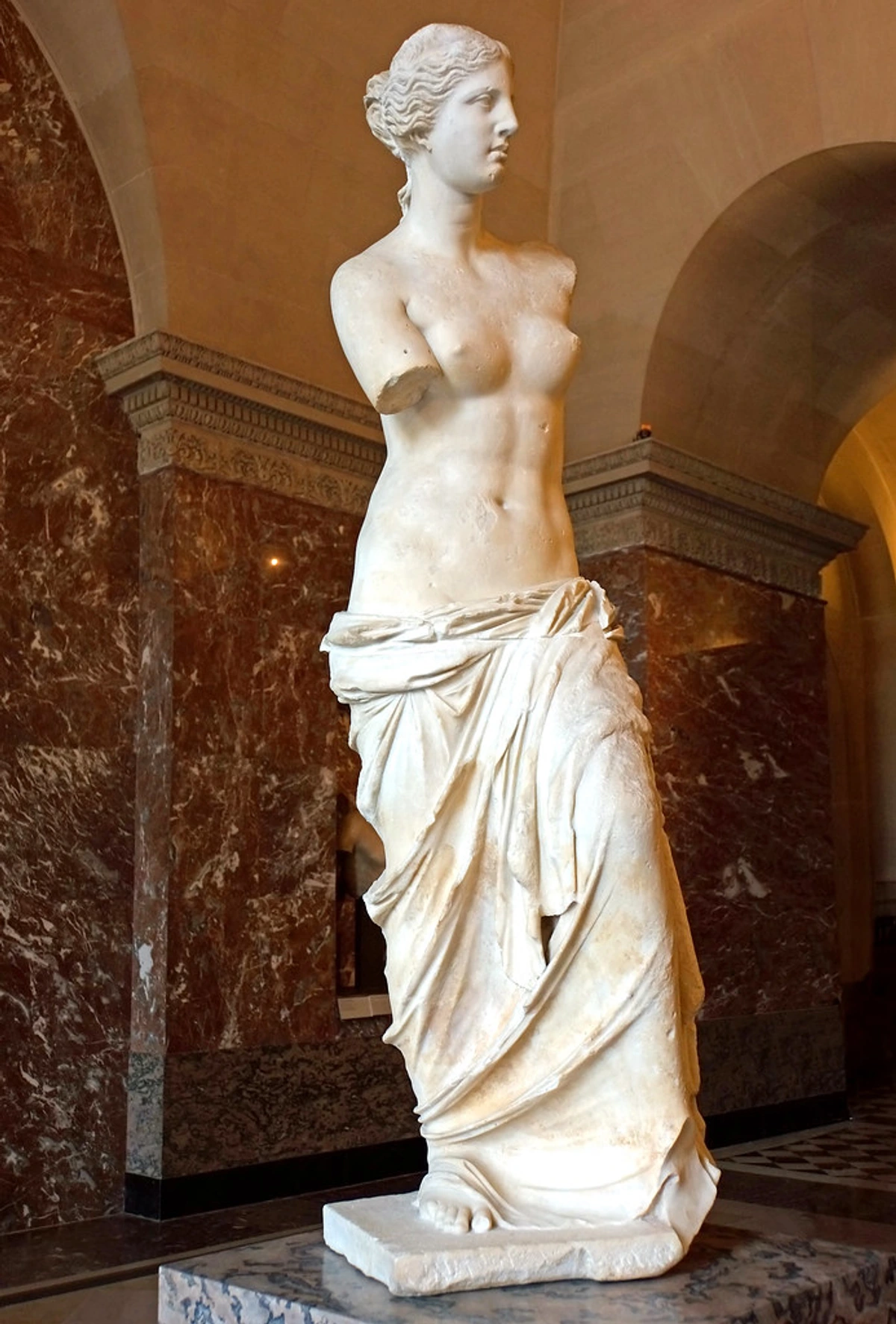
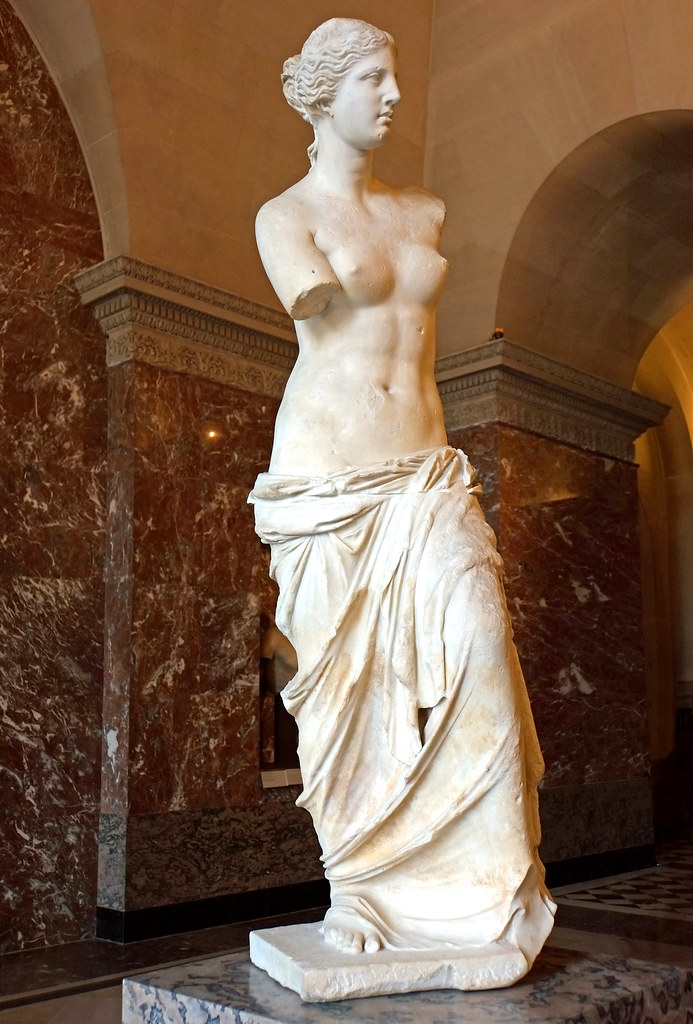
The story of the Discobolus certainly didn't end in ancient Rome. After being lost for centuries, the main versions we know today were unearthed during the Renaissance, fueling Europe's renewed obsession with classical antiquity. Artists of the Renaissance went wild for it, studying its anatomy and composition, seeking to emulate the idealized human form in sculpture. It quickly became a textbook example of classical perfection, influencing sculptors like Antonio Canova in the Neoclassical period, who, through works like his Venere Italica, echoed the classical pursuit of idealized forms, albeit with a different emotional sensibility than the Severe Style. This rediscovery was a pivotal moment for Western art, demonstrating the enduring influence of ancient Roman art on Western aesthetics and defining what is classical art for generations.
However, like many powerful symbols, its legacy also has a dark side. In the 20th century, the statue was notoriously co-opted by the Nazis. Adolf Hitler himself was obsessed with it, acquiring one of the best copies (the Lancellotti Discobolus, though it was eventually returned to Italy) and showcasing it as a central symbol of the supposed "Aryan" physical ideal and racial purity. The Nazis, in their warped historical revisionism, sought to link their abhorrent ideology to the perceived glory and aesthetic perfection of ancient Greece and Rome. They presented a selective, distorted view of kalokagathia, emphasizing only the physical perfection and stoic control, while completely ignoring the equally vital moral virtue and intellectual discipline that were central to the original Greek ideal. They saw in its idealized form a powerful tool for propaganda, stripping it of its original complex meaning. It’s a chilling reminder of how easily profound art can be twisted to serve hateful ideologies, something I constantly reflect on when I create my own work, mindful of the messages I’m sending.
Today, thankfully, it has been largely reclaimed as a universal symbol of athleticism, the Olympic spirit, and the enduring power of Classical art. It represents an ideal that transcends any single culture: the beauty of the human body in controlled motion, a testament to human aspiration.
The Discobolus in Popular Culture
Beyond the hallowed halls of museums, the Discobolus has flexed its iconic muscles in popular culture too. From being a frequent motif in sports branding (think Olympic imagery, stadium art, or even gym logos) to a cameo in films and television shows, his dynamic silhouette has become shorthand for athletic prowess and classical beauty. He’s appeared in everything from animated parodies (like in Disney's Hercules) to serious documentaries, embodying the timeless pursuit of human excellence and reminding us of our shared visual heritage. You'll find him referenced in literature, advertisements, and even as a source of artistic inspiration for contemporary artists grappling with themes of potential, performance, and the human form. He's also a staple in discussions around the rigorous physical training seen in performance art or modern dance, where the body's precise control and expressive potential are paramount. It seems his quiet tension continues to speak to new generations, inspiring everything from high art to everyday branding.
FAQ: Your Deepest Discobolus Queries, Deciphered
Here are answers to some of your most pressing questions about Myron's Discobolus, from its lost original to its profound significance:
Where is the original Discus Thrower statue?
The bronze original by Myron is lost to time. Sadly, this is a common fate for many ancient Greek bronze sculptures, often melted down for their valuable metal. The most famous and complete marble copies, invaluable Roman interpretations, are found in major museums today. The British Museum in London houses one well-known version. The National Roman Museum (Palazzo Massimo alle Terme) in Rome holds another significant example, the Lancellotti Discobolus—a piece with its own complex history of acquisition and return. Other notable copies are in the Vatican Museums and the Louvre. These institutions serve as vital custodians of our shared cultural heritage, preserving these echoes of a lost masterpiece for future generations, allowing us to still connect with Myron's vision today. While the original is gone, the dream of discovering a lost bronze masterwork still drives archaeological efforts in the Mediterranean.

What is the Discobolus made of?
The original sculpture by Myron was cast in bronze, a popular and versatile material for Greek sculptors. Bronze allowed for more dynamic poses and typically didn't require external structural supports. It also offered a distinct sheen and allowed for finer detail. The surviving copies, however, are almost all marble. The switch to marble by Roman copyists often necessitated the addition of structural supports, such as tree stumps or struts, due to marble's greater weight and brittleness. This is a key difference in how we experience the copies versus how the original would have appeared – the bronze would have felt lighter, more graceful, truly floating in its moment of captured motion. An ancient Greek discus, for context, would have been made of bronze or stone, typically weighing between 1.5 kg and 5 kg (3 to 11 lbs).
Who sculpted the Discus Thrower?
A celebrated Greek sculptor named Myron of Eleutherae created the original bronze piece. He was active in the mid-5th century BC, specifically between 460-450 BC, and was renowned for his ability to capture movement and realism in his athletic figures. He was a contemporary of other great Greek sculptors like Phidias (known for the Parthenon sculptures) and Polykleitos (famous for his Doryphoros and his canon of proportions), each contributing uniquely to the definition of classical aesthetics with their own innovations in depicting the human form.

Why is the statue naked?
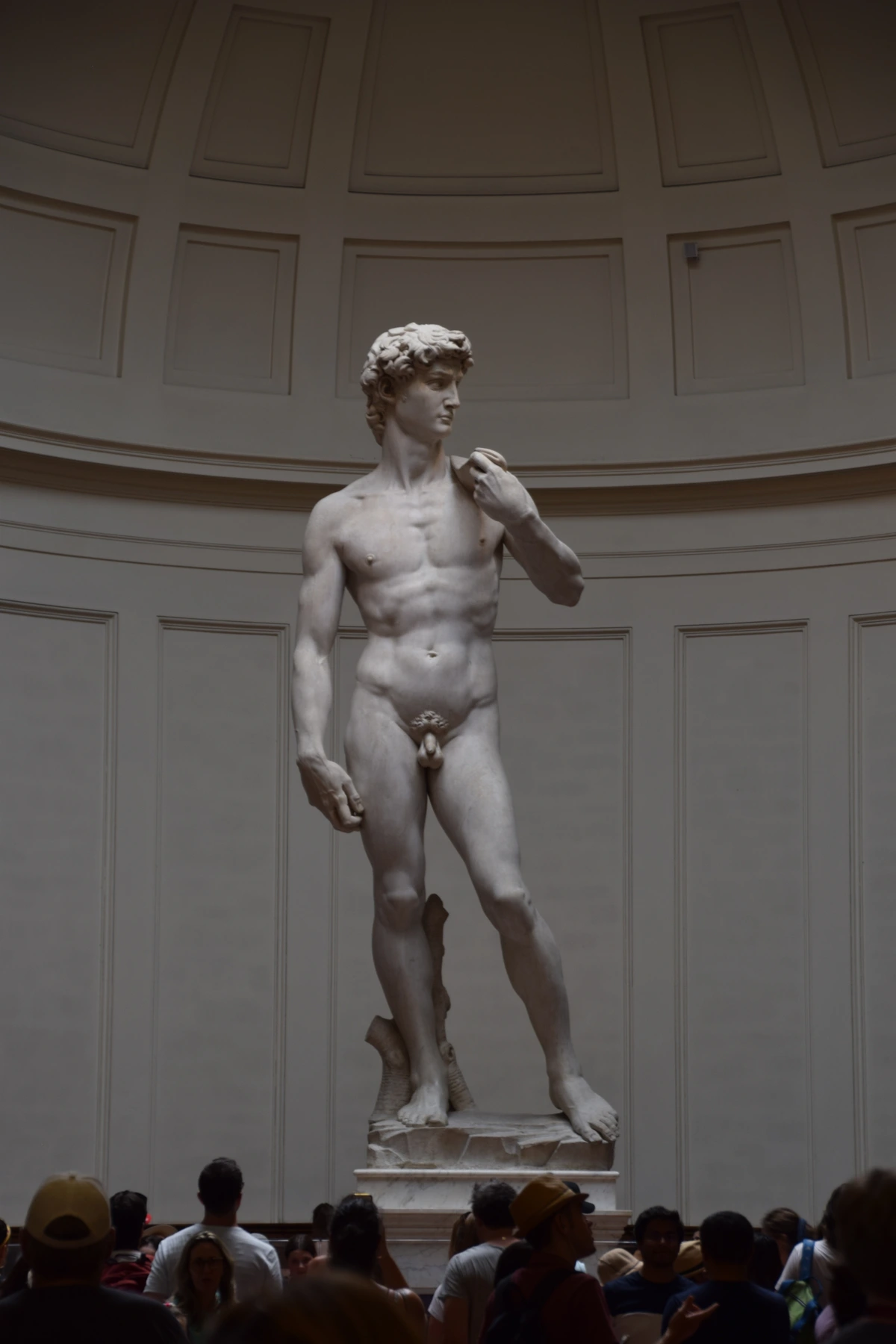
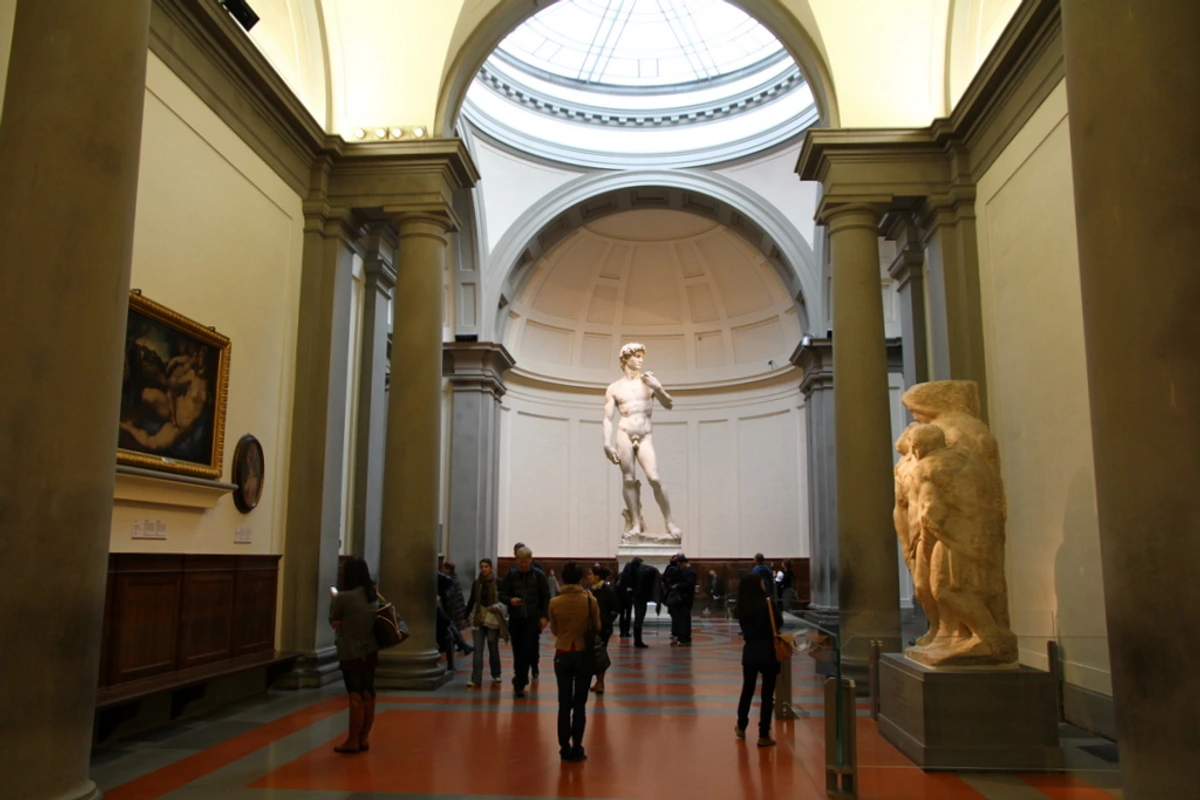
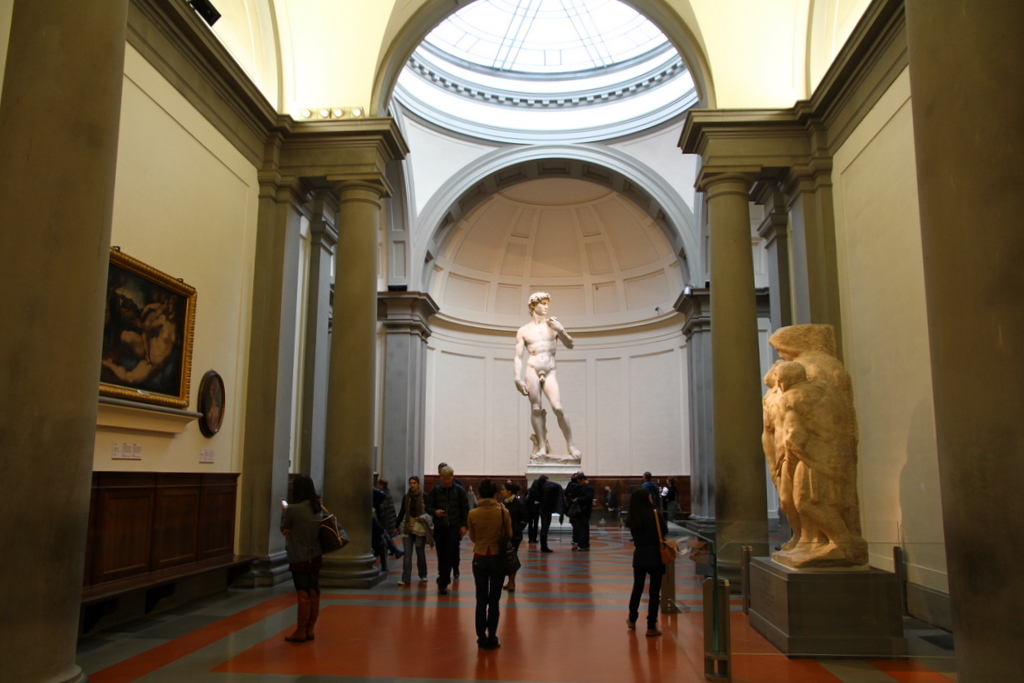
Greek athletes typically trained and competed in the nude, a practice deeply ingrained in their culture. This wasn't merely practical; it was tied to a profound cultural celebration and idealization of the male human form. The nude body was seen as a reflection of divine perfection, strength, and intellectual purity. It also symbolized the democratic ethos of the games, where all men, regardless of social standing, competed on equal terms, stripped of all outward identifiers of wealth or status. The emphasis was on the natural form as inherently perfect and pure, often connecting to deities who were also depicted nude. This tradition greatly influenced later artists, including Renaissance masters like Michelangelo, whose 'David' similarly presents the idealized male nude, drawing directly from these classical precedents.

What does Discobolus mean?
It’s pretty straightforward! "Discobolus" is a Latinized form of the Greek word "Diskobolos" (Δισκοβόλος), which literally means "discus thrower" (derived from diskos, "discus," and ballein, "to throw"). Simple, yet it perfectly encapsulates the action, and the icon, Myron created. No hidden meanings there, just a direct label for a timeless act.

Where was the original Discobolus likely displayed?
While the exact location of Myron's original bronze is unknown, Greek athletic sculptures like the Discobolus were typically commissioned for and displayed in public sanctuaries, gymnasia, or athletic complexes (like the palaestra) where contests took place. They also served as votive offerings in major Panhellenic sanctuaries (like Olympia or Delphi), meaning they were gifts or dedications to a deity, often in gratitude for a victory or in hope of divine favor. This public placement reinforced the statue's connection to physical excellence, religious devotion, and civic pride, serving as a constant reminder of the ideals of Athenian democracy and human achievement. They were meant to be seen, contemplated, and to inspire citizens and athletes alike. The importance of athletics in Greek society extended beyond mere sport; it was crucial for military training, religious festivals, and offered a path to social prestige.
What's the main artistic significance of Myron's Discobolus?
Its main artistic significance lies in its groundbreaking capture of a fleeting, dynamic moment in human motion, rather than a static pose. Myron's innovative use of rhythmos—creating implied movement within stillness—combined with the paradox of a serene face on a maximally strained body, revolutionized sculpture. It infused the medium with psychological depth and philosophical commentary on human potential and self-control. This dramatic departure from previous static representations profoundly influenced subsequent art history, paving the way for more dynamic and expressive sculptural forms in the Hellenistic period, the Renaissance, and the Neoclassical movement. It taught artists that true realism wasn't just anatomical accuracy, but the ability to convey the energy of life, the potential of the next moment. It is often considered the epitome of the Greek Classical period's focus on capturing dynamic human movement and ideal form.
How does the Discobolus relate to Contrapposto?
While the Discobolus features a dynamic twist that might seem related to contrapposto, Myron’s approach is fundamentally different. Contrapposto, as perfected by Polykleitos, describes a harmonious, balanced shift of weight where one leg bears the body's weight and the other is relaxed, creating a serene, static S-curve. The Discobolus, however, captures a moment of extreme, almost violent, potential energy. Its twist is not a relaxed balance but a tightly coiled spring, a preparatory motion before action. It’s a dynamic imbalance held in perfect tension, implying explosive future movement, rather than the composed equilibrium of contrapposto. Myron pushed beyond merely depicting ideal form to illustrating ideal action.
Beyond the Marble: A Universal Invitation to Potential
In the end, the Discobolus endures because it speaks to something fundamental within us. That feeling of being on the cusp of something—a moment of perfect balance before we commit and let fly. It’s the tension between thought and action, control and release, stillness and motion. For me, as an artist, it echoes the silent intensity of the creative process, the potential residing in the blank canvas or the unworked clay, just before the first stroke or sculpt begins. I've often felt that same coiled energy, the internal debate of when to move from contemplation to execution. It's a reminder that even in my most abstract compositions, there's an underlying rhythm, a dynamic balance that implies a story untold until the final brushstroke.
That initial feeling of profoundness I first experienced in the museum has only deepened with this exploration. This ancient figure, in his profound stillness, holds a mirror to our own boundless possibilities, a constant invitation to consider the power held in an instant.
Key Takeaways:
- Lost Bronze, Enduring Copies: The original was a dynamic bronze, with Roman marble copies simplifying Myron's vision due to material limitations.
- Master of Moment: Myron's genius lies in capturing the split-second of coiled potential before explosive action.
- Serene Paradox: The calm face amidst a strained body embodies kalokagathia – the Greek ideal of mind over matter, intellectual and moral virtue complementing physical prowess.
- Universal Metaphor: The Discobolus represents not just athleticism, but the human journey of discipline, potential, and the decisive moment of action.
The next time you see a picture of him, or perhaps are lucky enough to stand before one of the magnificent copies in a museum, take a second. Don't just see a sportsman. See a question frozen in marble for 2,500 years, asking you: What are you on the verge of doing? What unreleased potential lies coiled within you, waiting for that perfect, decisive moment to unfold? Because, as Myron reminds us, true mastery often begins in the quiet tension before the throw.
If you're inspired by the interplay of tension and release, order and chaos, you might find a connection with my own work at Zen Dageraad Visser. To see how art evolves through history, consider exploring the timeline of artistic movements, or visit the Den Bosch Museum for more contemporary explorations of form and emotion.




Further Exploration
Ready to delve deeper into the art that shapes our understanding of the human form and its philosophical dimensions? Explore these related articles: