Decoding Gustave Courbet: The Rebel's Brushstrokes That Shaped Art
Discover how Courbet's visceral techniques—impasto, earthy palettes, and raw realism—defied tradition and birthed modern art. A masterclass in rebellion.

Decoding Gustave Courbet: The Rebel's Brushstrokes That Shaped Art
I’ll never forget standing before ‘The Stone Breakers’ in person. Those cracked, weathered textures weren’t just paint—they felt real. As if the grit from that canvas might fall into my palm. That’s Courbet’s magic. His brushwork doesn’t just show reality; it wields it. Gustave Courbet didn’t just paint scenes—he smashed the very idea of what painting should be. And his techniques? Pure, unapologetic rebellion.
This isn’t some dry art history lecture. We’re digging into the how—the visceral, sometimes messy methods that birthed Realism. How did he make paint crackle like bark? Why did his peasants look like kings? Let’s break it down, brushstroke by defiant brushstroke.
Who Was Gustave Courbet? The Making of an Artistic Anarchist
You can’t understand Courbet’s brush without understanding his boots—caked in the mud of Ornans, his hometown in eastern France. Born in 1819, he arrived in Paris not as a prodigy from the École des Beaux-Arts, but as a determined outsider. He famously rejected formal training, claiming the only teachers he needed were "the works of the masters" and the world itself. This wasn’t false modesty; it was a declaration of independence.
Imagine the Parisian art scene of the 1840s as a grand theater—all mythical heroes, flawless nudes, and landscapes bathed in an impossible golden light. The Académie des Beaux-Arts decided what was worthy. And peasants, laborers, or gritty provincial funerals? They weren’t even on the stage. Courbet saw this world of polished illusion as a lie. His rebellion wasn’t just about style; it was a philosophical revolt. He believed art must engage with the present, with the tangible reality of ordinary life. It had to be "real," or it was nothing at all.
This conviction led to the iconic moment in 1855. Denied entry to the Universal Exhibition, he didn’t sulk. He built his own pavilion right next door, calling it the Pavilion of Realism. It was the first solo artist exhibition in modern history, a monumental act of defiance that changed the game. It declared: there is a new path for art, and it runs directly through the heart of the world as it is, not as we imagine it should be.
The Foundation: Courbet Core Techniques
Courbet’s work was a middle finger to the prim, polished salons of Paris. He rejected mythological fluff and angelic light. Instead, he built his world on four pillars:
Technique  | Core Purpose | The "Why" Behind It | Example in His Work |
|---|---|---|---|
| Impasto | Creating physical texture that interacts with light. | To deny the flatness of the canvas and force the viewer to confront the painting as an object, not a window. | Thick, layered strokes in The Desperate Man create a tangible sense of psychological turmoil. |
| Earthy Pigments | Grounding the scene in observable, physical nature. | A rejection of idealized, salon-friendly pastels in favor of colors that mirrored the real world of soil, stone, and weathered skin. | Dominant browns, ochres, and siennas in The Artist’s Studio anchor this allegorical scene in material reality. |
| Direct Compositions | Presenting subjects without theatrical framing or obvious focal points. | To mimic the way we encounter scenes in life—un-staged, flat, and without a predetermined narrative. | Burial at Ornans is famously monumental yet compositionally claustrophobic, like a candid group photograph. |
| Plein Air Commitment | Capturing the immediate sensory experience of a place. | To bypass the filtered memory of the studio and confront the landscape’s raw, transient character directly. | The stormy skies and churning water in The Wave were painted on-site, conveying a sense of immediate, sensory immersion. |
Deep Dive: Brushwork That Barks (Not Whispers)
You've probably seen reproductions of Courbet, but standing before one is a different story. The canvas isn’t a smooth surface; it’s a topography. His trademark was thick, meaty impasto, a technique where paint is laid on so heavily that it stands out in relief. He didn’t suggest a walnut’s roughness—he piled paint like gravel. Imagine sculpting with a palette knife while painting. That’s his energy. Notice how ‘The Quarry’ has actual crevices? That’s hours of loaded brushwork scraping into wet layers. Why? Because texture isn’t decoration—it’s argument. Each stroke screams: ’This exists. It’s heavy. It matters.’
But here’s the secret to his genius that often gets missed: his brushstroke vocabulary was insanely diverse. For every thick, impacted area, there's a passage of breathtaking subtlety. Look closely, and you’ll find velvet-smooth skin or whisper-thin foliage. He wasn’t just messy—every textured glob had purpose. That calculated contrast is what makes his work so visually compelling. It forces your eye to move, to feel the difference between hard rock and soft flesh, between still water and turbulent sky. In paintings like Bathers, the roughness of the riverbed demands you first feel the water before you truly see the figures within it. It’s a masterclass in controlling the viewer’s sensory experience through physical contrast.
A Palette Made of Earth: Courbet's Theory of Color
Forget the perfect rose-cheeked peasants of academic art. Courbet’s palette was a geologist’s dream. He reached for earthy ochers, deep umbers, slate greys, and oxidized greens—colors with weight and grit, colors that smelled of rain-soaked roads and freshly turned soil. This wasn't an accident of taste; it was a core tenet of his Realism. Yet he wielded these so-called 'ugly' colors like a poet uses metaphors. That muddy path in The Stream isn't a sign of lazy brushwork. It's the exact, observed hue of earth turned by plows. The cracked, weathered skin of his peasants in The Stone Breakers isn't presented as grotesque; it's honored with unflinching honesty.
What’s truly clever, and what many miss, are his subtle shifts in tonality. Notice the way he captures the golden sheen on a haystack in The Gust of Wind? It’s pure joy amidst the dominant earthy tones. He wasn’t against beauty; he was against falsity. He redefined what beauty could be. You won’t find celestial skies or divine light in his work. Instead, his light is tangible—it's the humid glow of dawn-dampened hay, the cold luminescence of twilight-dusted leaves, the sharp glint of sun on a rocky outcrop. He wasn’t painting a mood; he was painting a specific place at a specific time, and that commitment gives his work a profound sense of truth.
Composition as Confrontation: The Unflinching Frame
Academic art was obsessed with illusion—creating fake stages with deep, receding perspectives to pull the viewer into a fantasy. Courbet burned that playbook. His compositions are famously flat, squared-off, and unapologetically blunt. Think of his frames not as windows, but as doors—blocking your escape and forcing you to confront what’s in front of you. In The Wrestlers, there’s no dramatic vanishing point leading your eye to a heroic climax. Instead, you’re faced with two men locked in an earth-bound struggle, their bodies filling the space, framed by a plain, almost wall-like tree line. Why flatten the picture plane so aggressively? Because, for Courbet, life doesn’t unfold with artistic polish or convenient focal points. By denying the tricks of classical perspective, he makes the struggle itself the only thing that matters.
He also broke the pictorial fourth wall. In his magnificent Bonjour Monsieur Courbet, he depicts himself as a traveler, greeted by his patron. Courbet himself looks directly, challengingly, at the viewer. It’s a staggering act of self-assertion. He is not a humble artist seeking approval; he is a force of nature demanding acknowledgment. The composition isn’t about the landscape or the patron; it’s about the artist’s claim to his own reality, placing him on equal footing with the world he observes. It’s confrontation as a compositional strategy.
Material Alchemist: The Tools and the Truth
Courbet’s commitment to realism went beyond what he painted to how he painted. This wasn’t a man who believed in preciousness. Sand was mixed directly into his paints to build up the gritty texture of cliffs in his seascapes like The Wave. He used palette knives to scrape lines into wet layers, creating furrows in fields or the fissures in a quarry wall. And his canvases? Often rough, unprimed jute—burlap sacks! Not the fine, silk-smooth linen of the academy. This wasn’t an accident or a sign of poverty; it was theory. The very material of his work had to reflect its subject. The coarse support was a philosophical statement: the painting is an object, grounded in the real world. His materials whispered poverty while his technique shouted existence.
Courbet was also a master of underpainting. He would often begin with bold monochrome layers, typically in shades of umber or grey, to establish the entire composition using only light and dark. Think of it as a tonal blueprint for the painting. Only after this powerful structure was in place would he build up his famous earthy palette on top. Why such a rigorous process? It was a test of structural truth. By ensuring the painting worked in black and white, he prevented himself from hiding compositional weaknesses behind pleasing color gradients. Every shadow and muscle had to fight for its visibility from the very start, creating a raw, unshakeable foundation.
Courbet vs. The Salon: The Scandal That Birthed Realism
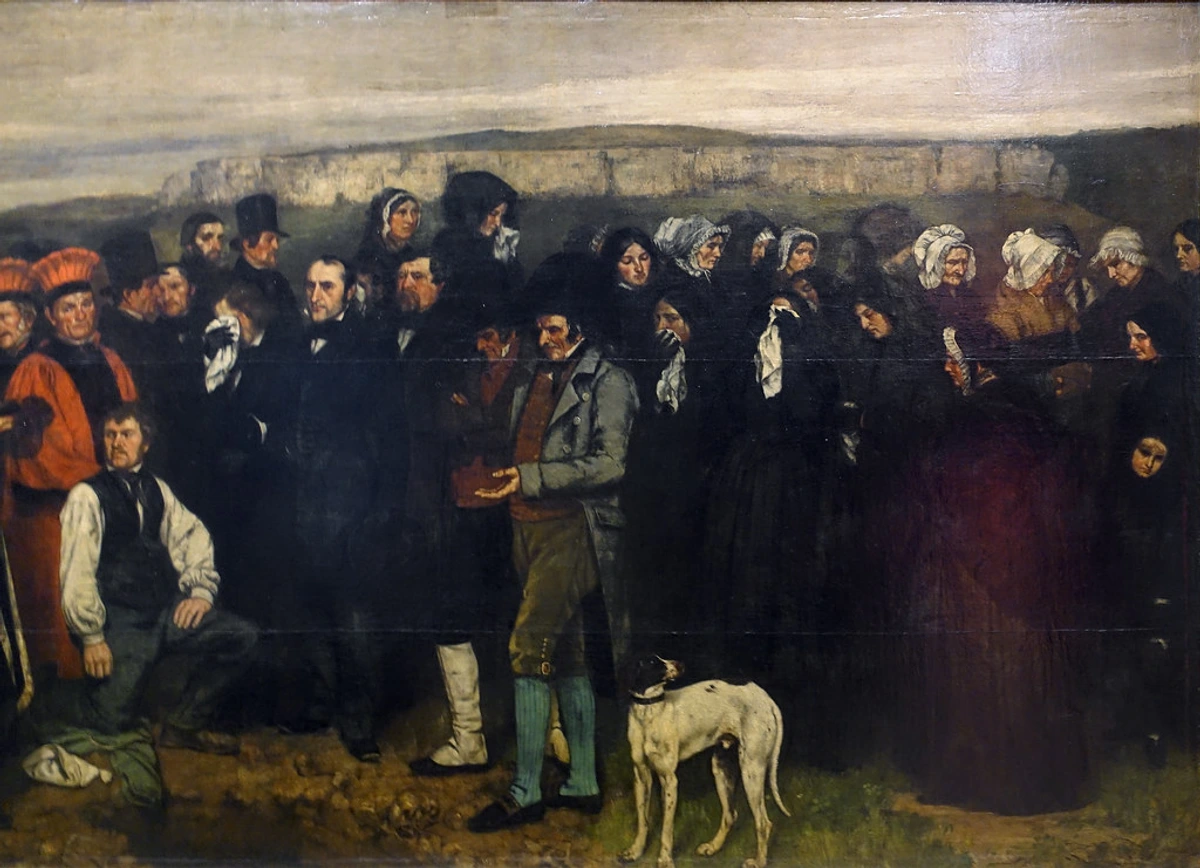
Imagine you’re in Paris, 1855. The air is thick with the perfume of the Universal Exhibition, a celebration of modern progress. In the art pavilions, the official Salon celebrates classical perfection: goddesses dripping with dewy light, heroic history paintings, and landscapes polished to a high sheen. Into this world of refined illusion, Courbet carries a monumental canvas, over ten feet wide. It’s not a myth. It’s a funeral. Specifically, A Burial at Ornans. No angels, no allegories, no heroic drama. Just a procession of villagers from his provincial hometown, their faces registering everything from genuine grief to boredom. The scandal was seismic. He had dared to paint dirt—literal and figurative—as dignified as history.
This was the essence of Courbet’s rebellion. His technique was his protest. The thick impasto, which caught the harsh lights of the museum gallery like burlap catches the wind, forced viewers to confront the painting as a rough, physical object. He didn’t allow you to fall into an illusion. By flattening the perspective, he rejected the academic tradition of the painting as a ‘window into fantasy.’ And by choosing a subject of mundane, provincial grief on a scale reserved for kings and gods, he shattered the hierarchy of genres. He didn’t just paint peasants; he made them impossible to look away from or dismiss.
Modern Takeaway: What Artists Can Steal from Courbet's Rebellion
Courbet’s genius wasn’t just technical—it was ideological courage. In an age of Instagram filters and digital perfection, his defiant embrace of the real offers a powerful lesson for any creative person today.
- Texture as Story: Don’t just paint a tree—scrape and build paint to show its bark-ravaged age. Let the material carry the narrative of time and endurance.
- Embrace the ‘Unpretty’ Palette: Muddy yellows can feel more honest than golden ones. Honor the grime, the patina, the raw umber of the real world. Authenticity outshines artificial beauty.
- Bold, Unapologetic Framing: Center your subject without decorative fluff. Let them occupy the space just as they do in real life—un-staged and powerful in their own right.
- Material Experimentation is Philosophy: Don’t be afraid to mix sand, use a palette knife, or paint on an unexpected surface. The physicality of your work is part of its meaning. It’s messy, but it lives.
Courbet FAQ
Q1: Was Courbet REALLY self-taught?
Absolutely. He famously and proudly rejected the formal training of the École des Beaux-Arts. His real teachers were the works of the Spanish masters he copied at the Louvre (particularly Velázquez and Ribera), the Dutch landscapes he studied, and most importantly, the relentless observation of the world around him. This is why his supposed ‘errors’ in perspective or anatomy often feel more truthful and alive than the ‘perfect’ but soulless work of his academic contemporaries.
Q2: Why do his paintings look so... textured?
That extremely physical texture is a technique called impasto. He loaded his brushes (and often his palette knives) very thickly, applying paint in heavy, often rough strokes. The goal was to make the painting’s physicality a visual and even tactile experience. A wheat field needed thick, baked-on-looking paint to convey the feeling of sun and heat. A rock face needed to have literal fissures. This approach makes his paintings almost sculptural and is a huge part of why his skies feel like they could crack and his rivers seem to flow right off the canvas.
Q3: Did Courbet intentionally use ‘cheap’ colors?
Not exactly—they were unconventional for the time. He adored a palette rooted in the earth: terre verte (a natural green earth pigment), raw and burnt sienna, and a range of umbers. These were the pigments of the ground, of forests and soils, not the bright, chemically mixed pastels that were popular for creating idealized scenes. This choice was a quiet but powerful rejection of the ‘sophisticated’ artifice of the Salon, grounding his work in the tangible, material world he sought to portray.
Q4: How was Courbet different from other Realists like Millet?
This is a fantastic question that gets to the heart of Courbet’s unique radicalism. While both painted rural life, their approach was worlds apart.
- Subjectivity vs. Objectivity: Jean-François Millet often imbued his peasants with a sense of biblical dignity, a gentle, poetic piety. Think of The Gleaners—it’s respectful, almost reverent. Courbet, on the other hand, was more confrontational and documentary. He presented his subjects with a blunt, almost stark objectivity. In The Stone Breakers, there is no romantic sheen, no spiritual halo. It’s a depiction of back-breaking labor, full stop.
- Technique: Millet’s brushwork, while powerful, tends to be softer, with more blended edges and a smoother paint surface. Courbet’s is famously coarse, aggressive, and physically textured with heavy impasto.
- Composition: Millet often used more traditional compositional structures. Courbet’s are famously flattened and direct, rejecting academic tricks of perspective to present his subjects head-on.
In short, Millet gives us the peasant as a figure in a solemn poem. Courbet gives us the peasant as a fact of life. Millet’s work is a quiet prayer; Courbet’s is a defiant shout.
Q5: Which Courbet paintings are essential to see in person?
While seeing any Courbet in the flesh is transformative, three works stand out as absolute must-sees:
- A Burial at Ornans (Musée d’Orsay, Paris): The sheer scale is the first shock. It’s a history-painting-sized canvas devoted to a local, provincial funeral. Standing before it, you feel the weight of its audacity. The composition forces you into the crowd, making you a witness to this unheroic, profoundly human event.
- The Artist’s Studio (Musée d’Orsay, Paris): This is Courbet’s monumental, enigmatic masterpiece. It’s a real allegory summing up his entire artistic and social world. Seeing it in person allows you to get lost in the details, to see the allegorical figures on the left and the real portraits of his patrons and friends on the right. It's a complex manifesto in paint.
- The Origin of the World (Musée d’Orsay, Paris): Yes, this one. Its fame (or notoriety) precedes it, but in person, you experience it not just as a subject, but as a painting. You feel the brushstrokes, the tenderness mixed with brutal honesty. It is Courbet’s entire philosophy distilled into one small, radical canvas: raw, unapologetic, and utterly alive.
Why Courbet's Rebellion Still Matters Today
Courbet didn’t invent realism, but he weaponized it for the modern era. He proved that paint could be more than just an illusion. It could be dirt. It could be protest. It could be a voice for those who had been excluded from the grand narratives of art. In our current age of polished digital perfection, curated social media feeds, and increasingly virtual lives, his commitment to raw, physical, unfiltered reality feels more necessary than ever.
His legacy isn’t just a set of techniques; it’s a grant of permission. Permission to be messy. To honor the soil under your nails. To find beauty in the mundane and truth in the un-prettified. It’s a reminder that art, at its most powerful, isn’t an escape from the world, but a direct and unflinching confrontation with it.







Courbet’s brush didn’t just change art—it taught us how to see the world with new eyes. Every crackle of impasto, every muddy, honest hue, every unblinking stare from his canvases serves as a timeless reminder: that truth, stubborn and textured, will always be the most revolutionary act.