Barnett Newman: The Force Behind the Void
Journey through the life and revolutionary art of Abstract Expressionist Barnett Newman. Explore his signature 'Zips,' minimalist philosophy, and profound impact on modern art in this comprehensive guide.

Barnett Newman: The Force Behind the Void
Standing before one of his canvases for the first time felt like trespassing on sacred ground. Those vertical bands of raw color weren't just paint—they were beacons of raw humanity. I remember distinctly thinking, "This is it?" Then, after what felt like an eternity, the space between the lines started to breathe. That’s when you understand Barnett Newman. He wasn't making pictures; he was making experiences. Today, we dive into the life and revolutionary work of the artist who used the space between things to redefine what art could be.
The Genesis of a Minimalist Giant
Barnett Newman wasn't born an icon. He was born in 1905 on the Lower East Side of New York City, the son of Jewish immigrant parents from Poland. His early life was steeped in hardship—his father's clothing business struggles, the need to work young. But running his father's stationery store in Manhattan put him in the heart of America's burgeoning contemporary art scene, rubbing shoulders with the likes of Mark Rothko and Adolph Gottlieb long before they were household names.
You know what I find fascinating? He didn't fully commit to being an artist until he was almost forty. He started out as a philosopher and teacher, even writing essays that championed native American art. This intellectual DNA is key to understanding his work. He wasn't just splashing paint; he was wrestling with big ideas about existential dread (what he called the "sublime"), the human condition, and the very nature of space itself.
Newman's educational journey was anything but linear. He attended the City College of New York and later earned degrees from both Art Students League and Brooklyn College, but his real education came from the streets of 1930s New York. During the Great Depression, he worked as a substitute teacher and later as a park supervisor in the Bronx, experiences that deeply influenced his understanding of space, scale, and the human relationship to environment.
His personal life was marked by profound relationships. In 1936, he married Annalee Greenhouse, a fellow artist who became his lifelong partner and collaborator. Together they navigated the treacherous waters of the New York art world, supporting each other through decades of obscurity before Newman's eventual breakthrough. Their marriage wasn't just personal—it was artistic. Anne was his first and most important critic, often helping him see what his own work was trying to become.
The 'Zip': When Nothing Became Everything
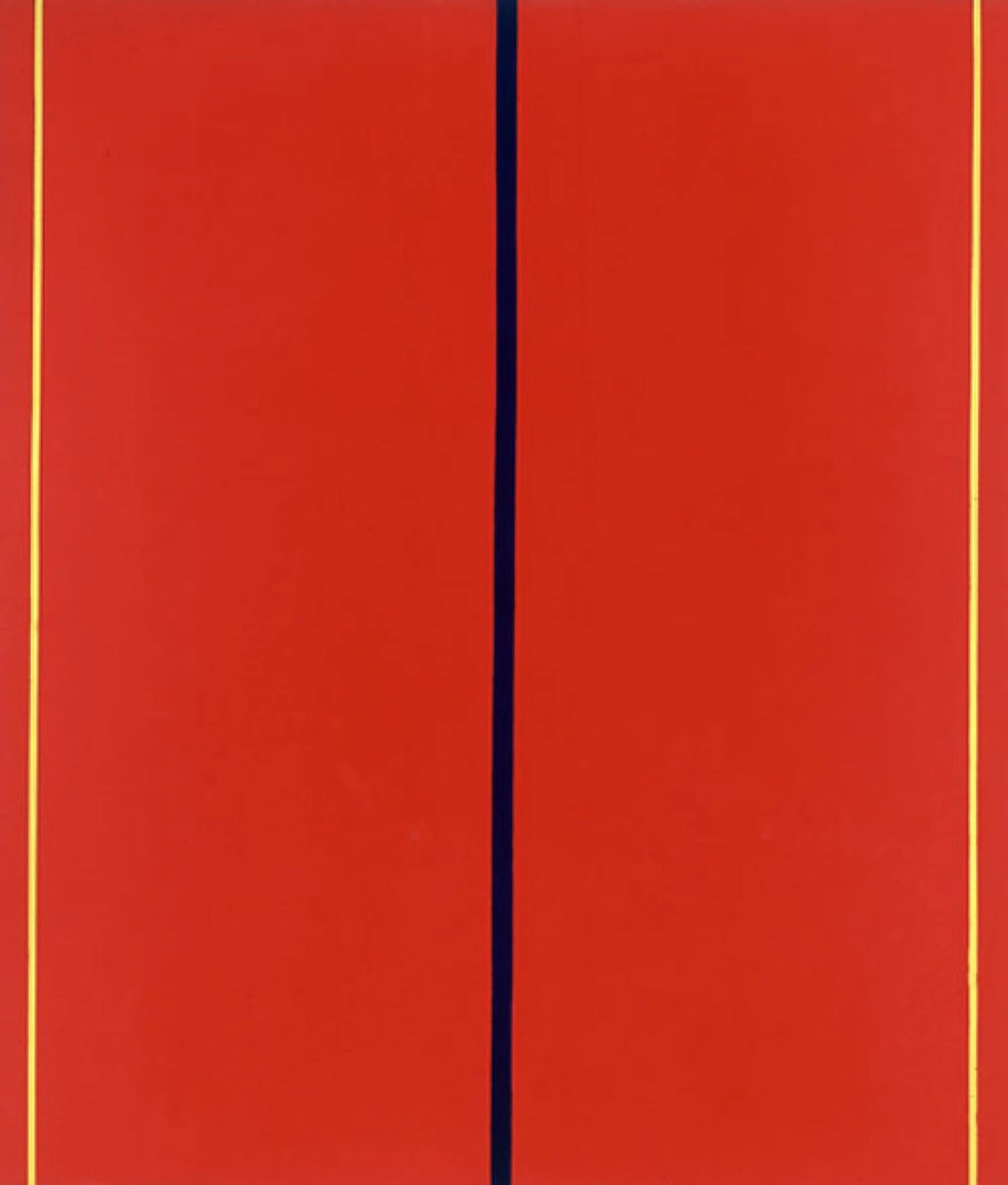
Newman's artistic breakthrough wasn't a grand technique explosion. It was quiet. It was a line.
Picture a vast canvas. Most artists would cover it. Newman? He’d make a single vertical slash of pure, unapologetic color. He called it a "Zip". Simple, right?
Here's the 'how' behind the awe:
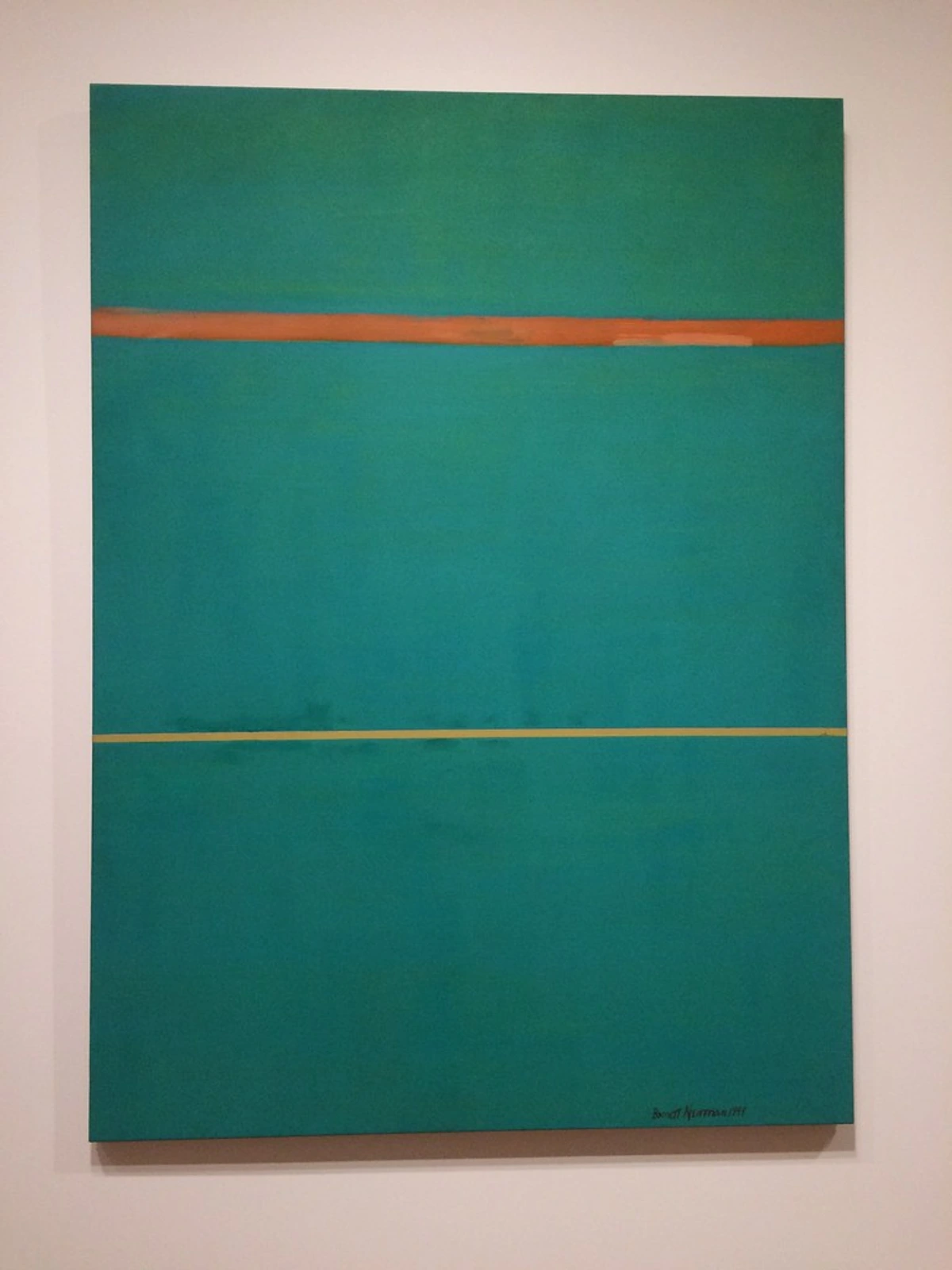
- Canvas as Space, Not Surface: He treated the canvas not as something to be filled, but as a void to be activated. The Zip wasn't on the canvas; it pierced through it, connecting two dimensions.
- Color as Identity: Forget blends. Newman used unmodulated, pre-mixed color straight from the tube. His signature blues ("Viridian Blue") and blazing oranges ("**Zinniker Orange"") became his artistic signature, chosen not for aesthetic appeal but for their psychological and emotional impact.
- The Ritual of Application: Newman's painting process was almost meditative. He would prepare his canvases meticulously, applying multiple layers of gesso to create a perfectly smooth, luminous surface. The application of color was deliberate and precise—he often used masking tape to create crisp edges, then applied the color in multiple thin layers to achieve maximum saturation and depth.
- The Philosophy of Scale: Newman believed that scale was essential to the sublime experience. His works grew progressively larger throughout his career, culminating in massive canvases that could overwhelm the viewer physically. This wasn't ego—it was conviction. He wanted viewers to feel small in the presence of the artwork, to experience the same awe one might feel standing before nature's grandest landscapes.
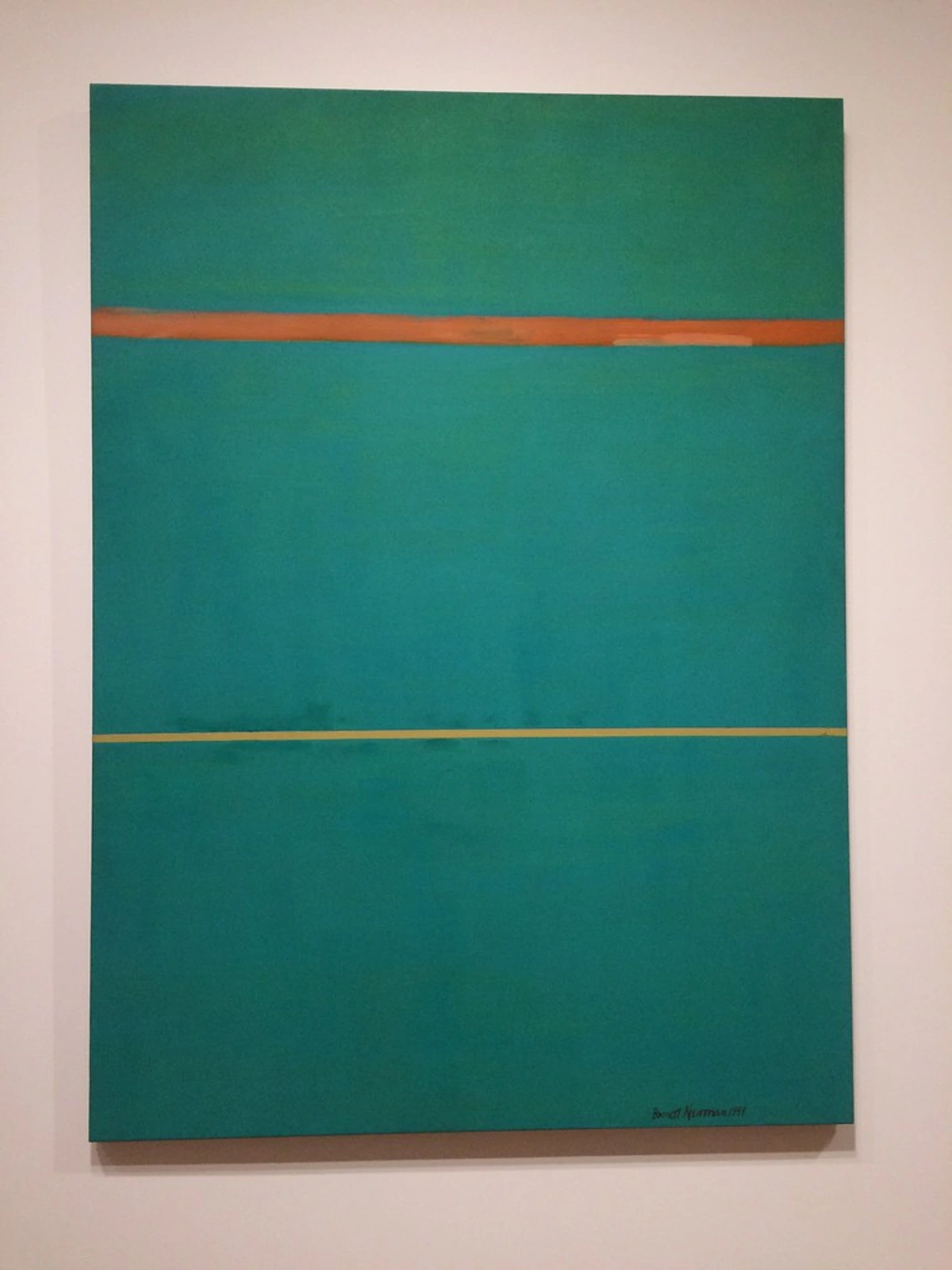
courtesy of MoMA, CC BY-SA 3.0
- The Sublime Experience: The Zip’s power lies in the negative space it carves out. It forces you, the viewer, to confront the immense, silent space around it. This isn't decoration; it's a confrontation with the infinite, a moment of shared awe between you, the art, and the raw potential of the universe. He aimed to evoke the kind of overwhelming, almost terrifying feeling you get standing before the ocean at dawn or staring at a star-filled sky – the "sublime".
Newman vs. The Abstract Expressionists: A Comparative Analysis
The Abstract Expressionist movement wasn't a monolith—it was a diverse collection of artists exploring similar territory from different angles. Newman stood apart from his contemporaries not just stylistically, but philosophically. While others focused on emotion, process, or form, Newman was obsessed with the relationship between viewer and artwork, the experience of presence in space.
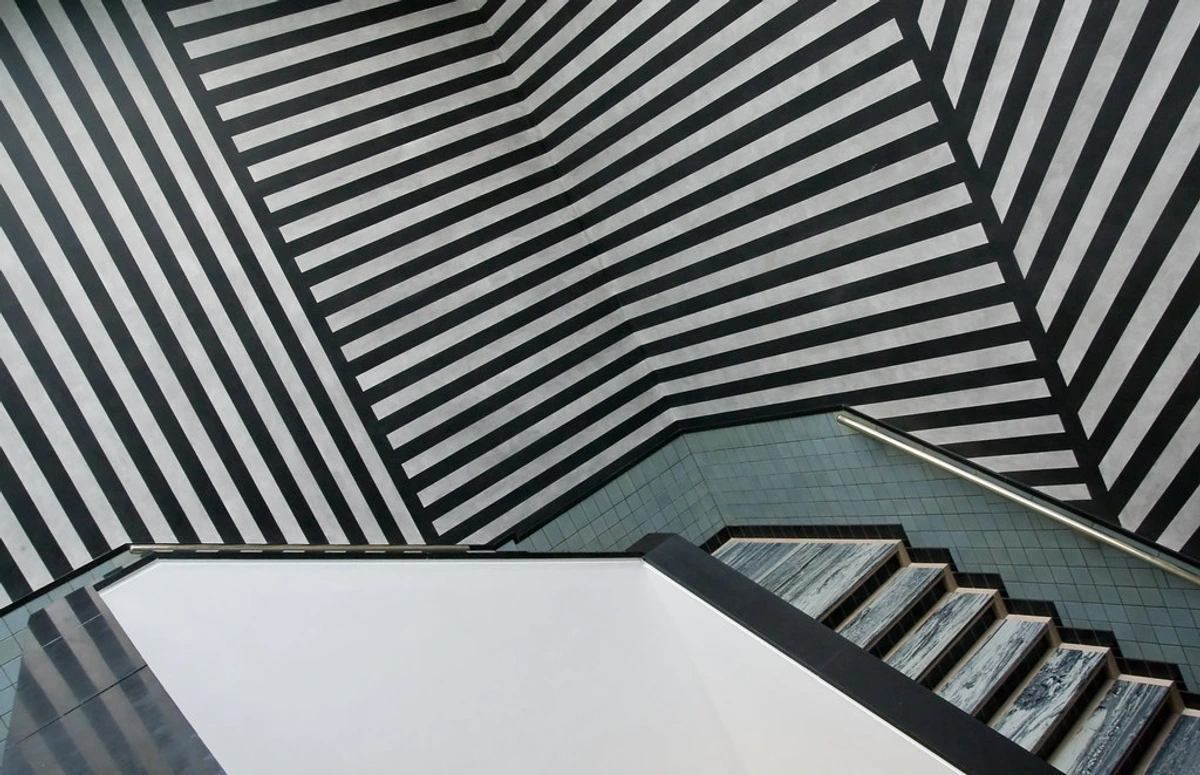
Artist  | Signature Style | Key Philosophy | Scale & Impact |
|---|---|---|---|
| Barnett Newman | Zips (vertical bands of color) | The Sublime, Existential Space, Minimalist Presence | Monumental scale; creates immersive, contemplative environments |
| Mark Rothko | Soft-edged Rectangles (color fields) | Tragic Expression, Myth, Human Emotion | Spiritual intensity; intimate, meditative focus |
| Jackson Pollock | Action Painting (drips, splatters) | Unconscious Mind, Process, Energy | Energetic, chaotic; emphasizes the act of creation |
| Willem de Kooning | Figurative Abstraction (gestural brushwork) | Tension, Form, Reveal vs. Conceal | Powerful, often aggressive; explores figuration's limits |
A Life Less Linear: The Struggle and Triumph
Newman’s career wasn’t a smooth upward trajectory.
- The Early Struggle: For decades, he painted and wrote while working part-time as a teacher and even a park supervisor. His first solo show in 1948, featuring his "Onement" series (the very first Zip painting!), was met with near-universal incomprehension and scorn. Critics literally didn't know what to do with that much canvas left empty.
- The Breakthrough: The 1960s were his renaissance. The art world, exhausted by complexity, began to embrace minimalism. Suddenly, his radical emptiness seemed profound. His monumental works were exhibited widely, and his influence exploded. It’s incredible how his early rejection fueled his conviction. He once said, "The artist must create a spark before he can make a fire." Igniting that spark took decades.
- Later Years & The Stations: In the 1960s, he produced his most famous series, "The Stations of the Cross." Using dramatic black and white Zips, he created a powerful, somber meditation on suffering and sacrifice. His works grew larger, his colors more potent, his vision ever more focused on that essential connection between viewer and void.
Why Newman Still Matters: The Legacy of the Line
Newman’s influence stretches far beyond the 20th-century art world.
- The Architect of Minimalism: He paved the way for artists like Agnes Martin (her subtle grids) and Donald Judd (his rigorous structures). He proved that less could be overwhelmingly more, forcing viewers to participate actively in the meaning-making process. The space is the artwork.
- The Sublime in Contemporary Art: Think about vast installations today, or even the impact of large-scale color fields in modern spaces. Newman’s core idea – using art to evoke a profound, almost transcendent experience – is foundational.
- Market Value & Access: His works now command staggering sums (e.g., "Onement VI" sold for $43.8 million in 2013). While this can feel distant, it underscores his lasting significance. For those of us not purchasing originals, the impact is in how we perceive space and color in our own lives – on walls, in nature, in the digital space we inhabit every day.
- NFT Skepticism: The NFT market sometimes appropriates terms like "revolutionary" and "disruptive" for digital art. While the technology is new, the fundamental questions Newman explored – presence, materiality, and viewer experience – remain deeply physical. He worked with monumental, tangible surfaces that command physical space. Translating that intangible scale into digital tokens feels, frankly, like a poor substitute for the visceral experience of standing before a 20-foot Zip. It’s a digital echo, not the real thing.
How to approach a Newman painting? Spend time with it. Don't look for figures or stories. Stand close. Feel the texture of the paint. Then step back. Let the space wash over you. Allow yourself to be confronted by the sublime quiet he created. It’s an act of engagement, not passive viewing.
Frequently Asked Questions About Barnett Newman
What is a "Zip"? A Zip is Newman's signature mark: a single vertical band of unmodulated color applied directly to a large canvas of a single color field. It’s meant to act as a "rupture" in the solid field of color, creating drama, defining space, and evoking the sublime.
Why are his paintings so simple? Isn't it just a stripe? The simplicity is deceptive. Newman’s work is conceptually complex. The "emptiness" forces the viewer to become part of the experience, questioning space, presence, and their own perception. It’s not "just a stripe"; it’s a carefully orchestrated confrontation with vastness and the human scale within it. The power lies in what it removes, not what it adds.
How much are Newman's paintings worth? Newman is one of the highest-selling artists of the 20th century. Major works regularly command prices in the tens of millions of dollars. For example, "Anna's Light" sold for $105.7 million in 2014. His significance as a foundational Abstract Expressionist drives immense market value.
Where can I see original Newman paintings? His works are held in major museums worldwide. Key locations include:
- Museum of Modern Art (MoMA), New York City (/den-bosch-museum)
- Tate Modern, London
- National Gallery of Art, Washington, D.C.
- Art Institute of Chicago
Did Barnett Newman make prints or smaller works? Yes, though less known than his monumental paintings. He produced several significant etchings, lithographs, and woodcuts in his later career. These often translate his "Zip" concept and use of color into more intimate formats, using techniques like soft-ground etching to achieve subtle tonal variations. While smaller in scale, they embody the same philosophical intent.
How was Newman received by other artists? Initially, even fellow Abstract Expressionists were divided. Pollock reportedly dismissed early Zip works as "mama's curtains." However, as his vision matured and the art world shifted, figures like Rothko acknowledged his profound contribution. By the 1960s, he was revered as a pioneer whose work opened entirely new paths for art-making.
Conclusion: Embracing the Void
Looking back, Newman’s journey from humble beginnings to becoming a giant of abstract art is a testament to unwavering vision. He proved that the most powerful art doesn't fill the canvas; it creates a space between itself and the viewer. His Zips aren't just lines; they are doorsways – silent, potent invitations to confront the vastness within and around us.



The next time you see a massive swath of color, think beyond the pigment. Think about the space it commands. Think about what it leaves unsaid. That silent power? That’s Barnett Newman's enduring legacy. And in a world obsessed with noise and complexity, maybe his most profound lesson is learning to appreciate the force that resides in the void.