url
url

Hannah Höch: The Radical Visionary Who Cut Up History
Have you ever scrolled through your social media feed and felt like you're watching a million different realities crash into each other? That sense of beautiful, terrifying fragmentation—where fashion models and war zones exist in the same thumb scroll, where political promises and consumer fantasies bleed together—that's exactly what Hannah Höch was dissecting with her scissors a century ago.
I remember the first time I saw a Hannah Höch photomontage up close. I thought I understood Dada—those chaotic performances, the absurd readymades—but here was something different. This wasn't just sticking pictures together for effect. It was surgery on reality itself. Höch took the fractured, feverish world of Weimar Germany and reassembled it with a political scalpel and an uncanny poetic eye, revealing layers of meaning that the original images desperately tried to hide.
What makes her work feel so urgent today is how it anticipated our current predicament. We're drowning in images—manipulated, filtered, algorithmically curated to confirm our biases and sell us things. Höch was already there, a century ahead of us, showing how mass-produced images construct our sense of normalcy, gender, race, and power. If you've ever felt like the world doesn't make sense, that the promises of progress and technology somehow don't add up to a better life, you're already speaking Höch's language. She lived through one of the most turbulent periods in modern history—World War I, the collapse of empires, the birth of new media, the rise of fascism—and instead of turning away, she grabbed a pair of scissors and started telling the truth.
Who Was Hannah Höch?
Hannah Höch (1889-1978) was a German Dada artist who didn't just join the avant-garde—she fundamentally reinvented it. While art history often frames her as the woman who pioneered photomontage, that descriptor barely scratches the surface of what she actually accomplished.
Think about it this way: when most people imagine Dada, they picture wild performances in Zurich cabarets or Marcel Duchamp's witty readymades. But Höch was doing something entirely different in Berlin. She took the most ephemeral, disposable materials—yesterday's magazines, newspaper clippings, advertisements—and revealed them as carriers of ideology, not neutral reflections of reality. Her work wasn't just technically innovative; it was politically incendiary, socially critical, and psychologically penetrating.
What's crucial to understand is how she operated within the Dada movement while simultaneously critiquing it. The Berlin Dadaists were her colleagues, but they were also an exclusive boys' club. Höch had to fight tooth and nail for recognition, and her work consistently shone a light on the movement's blind spots, particularly when it came to women's experiences and voices. She wasn't just making art about society; she was making art about the art world itself—a kind of meta-critique that feels remarkably contemporary.
What's fascinating is how she operated within the Dada movement while simultaneously critiquing it. The Berlin Dadaists were her colleagues, but they were also a boys' club. Höch had to fight tooth and nail for recognition, and her work consistently shone a light on the movement's blind spots, particularly when it came to women's roles and experiences.
Born Anna Therese Johanne Höch in Gotha, Germany, she began her artistic training in 1912 at the School of Applied Arts in Berlin-Charlottenburg, studying glass design—a traditionally "feminine" craft that would later inform her subversive use of domestic tools in her art. Her early career was interrupted by the First World War, during which she worked with the Red Cross. It wasn't until 1915, when she entered into a relationship with Raoul Hausmann, a key figure in the Berlin Dada group, that her artistic direction truly coalesced.
You could say Höch's entire artistic philosophy was forged in the tension between inclusion and exclusion. She was there when Dada was ripping apart bourgeois conventions, but she was also acutely aware of how those same radical men still expected her to make the coffee. This outsider-within position became her superpower, giving her a unique angle of vision on both mainstream society and the avant-garde that claimed to oppose it.
The World That Made Hannah Höch: Weimar Berlin
To understand Höch's artistic urgency, you need to grasp the world she inhabited. Imagine Berlin in 1918: a defeated empire, economic collapse, political violence in the streets, and yet an explosion of creative energy. The old certainties were gone. Kaiser Wilhelm had fled, and in the vacuum emerged the Weimar Republic—a fragile democracy experimenting with new forms of government, art, and social life. This era was a pressure cooker of conflicting forces: reactionary militarism versus revolutionary socialism, decaying tradition versus radical modernity, economic despair versus hedonistic excess.
This was also the age of the New Woman (die neue Frau). Women had just gained the right to vote (1919 in Germany), were entering the workforce in unprecedented numbers, and were challenging traditional gender roles. They cut their hair into bobs (the Bubikopf), wore trousers, smoked in public, and demanded sexual freedom. Höch didn't just observe this transformation; she lived it and made it central to her art. Her work dissected the modern woman as both a symbol of liberation and a new target for consumerism and commodification.
Meanwhile, printed media was exploding. Illustrated magazines like Uhu, Die Dame, and Berliner Illustrirte Zeitung brought images from around the world into German living rooms. Photography was becoming the dominant visual language. Höch recognized something profound: these mass-produced images weren't neutral. They carried the values, biases, and hidden agendas of the society that created them. So she decided to hijack them.
To understand Höch's artistic urgency, you need to grasp the world she inhabited. Imagine Berlin in 1918: a defeated empire, economic collapse, political violence in the streets, and yet an explosion of creative energy. The old certainties were gone. Kaiser Wilhelm had fled, and in the vacuum emerged the Weimar Republic—a fragile democracy experimenting with new forms of government, art, and social life.
This was also the age of the New Woman (die neue Frau). Women had just gained the right to vote (1919 in Germany), were entering the workforce in unprecedented numbers, and were challenging traditional gender roles. They cut their hair short, wore trousers, smoked in public, and demanded sexual freedom. Höch didn't just observe this transformation; she lived it and made it central to her art.
Meanwhile, printed media was exploding. Illustrated magazines brought images from around the world into German living rooms. Photography was becoming the dominant visual language. Höch recognized something profound: these mass-produced images weren't neutral. They carried the values, biases, and hidden agendas of the society that created them. So she decided to hijack them.
Photomontage: More Than Just Collage
Let's pause here because the distinction is crucial. Photomontage in Höch's hands wasn't decorative crafting or aesthetic play. It was radical image warfare—a way of hacking the visual codes of her time. While collage had existed before (the Cubists used it, for instance, and artists like Kurt Schwitters were exploring assemblage), Höch and her Berlin Dada contemporaries transformed it into something with sharp political teeth.
The key difference? Scale and source. Cubist collage often used materials like newspaper fragments, wallpaper, or sheet music to explore formal questions about painting and reality. Höch's photomontage specifically used mass-media photographic imagery to expose how that imagery constructed social reality—gender roles, class hierarchies, racial categories, political power. She wasn't interested in formal experimentation for its own sake; she was interested in ideological critique.
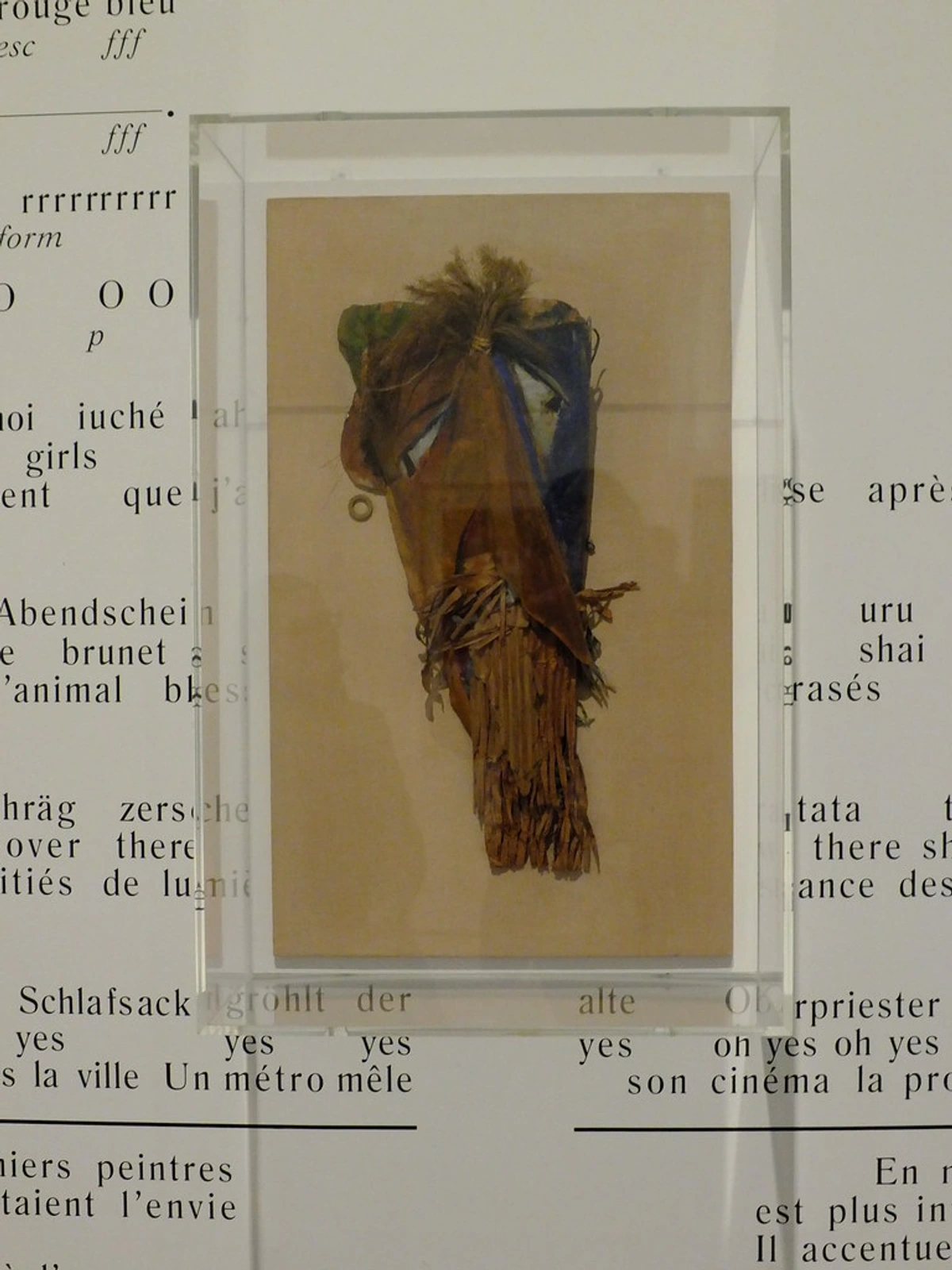
I think of it this way: if painting builds a world from scratch, photography captures the existing world, then photomontage exposes how that "captured world" is actually constructed. Höch was deconstructing the illusions of her time.
Her technical process was both simple and sophisticated:

- Source Material: She scavenged popular magazines like Uhu, Die Dame, and Berliner Illustrirte Zeitung. These weren't high-art sources; they were everyday visual consumption—exactly what made them potent.
- Cutting: With surgical precision, she would isolate elements—a woman's eyes, a politician's mouth, machinery parts, African masks from ethnography magazines.
- Reassembly: She'd paste these fragments together to create jarring, dreamlike compositions that revealed hidden connections and contradictions.
The power of her work came from precisely calculated dissonance. A perfectly coiffed bourgeois woman's head might be attached to the body of a dancer, surrounded by industrial gears and tribal artifacts borrowed from ethnographic magazines. The effect was explosive: it revealed how arbitrary and unstable these supposedly natural categories—femininity, modernity, civilization, race—actually were.
I think of Höch's photomontages as visual philosophy. Where philosophers like Walter Benjamin and Theodor Adorno were developing critical theories about culture and society, Höch was creating critical practice—actual visual demonstrations of how ideology works, how images construct our sense of reality, and how power operates through seemingly neutral representations.
Her method was fundamentally deconstructive (before deconstruction became a formal philosophical movement). She took images that presented themselves as objective, natural, or given, and showed them to be constructed, ideological, and contested. In doing so, she created a new visual language for political critique—one that has influenced countless artists, designers, and activists ever since.
Key Works That Changed Everything
"Cut with the Kitchen Knife Dada through the Last Weimar Beer-Belly Cultural Epoch of Germany" (1919)
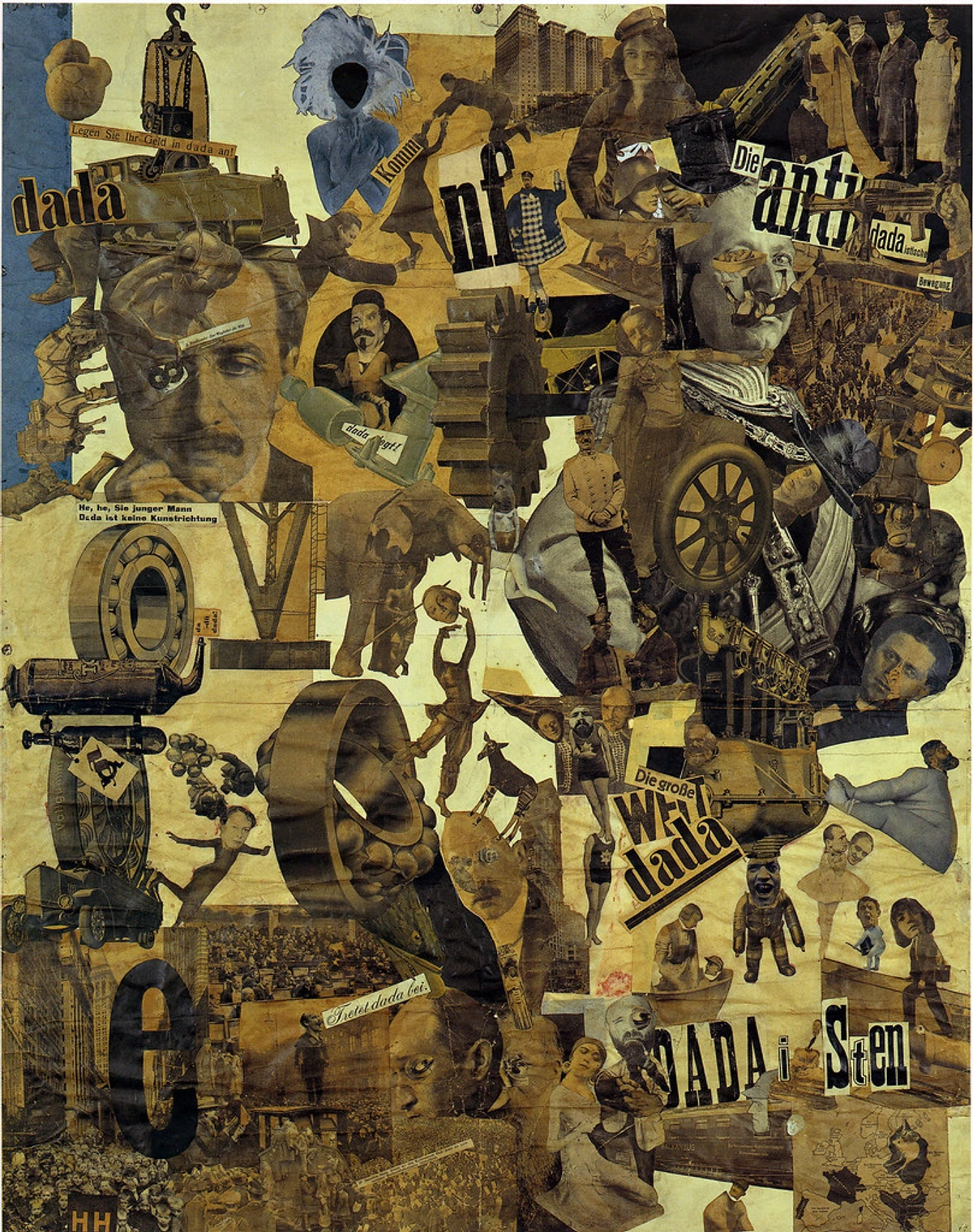
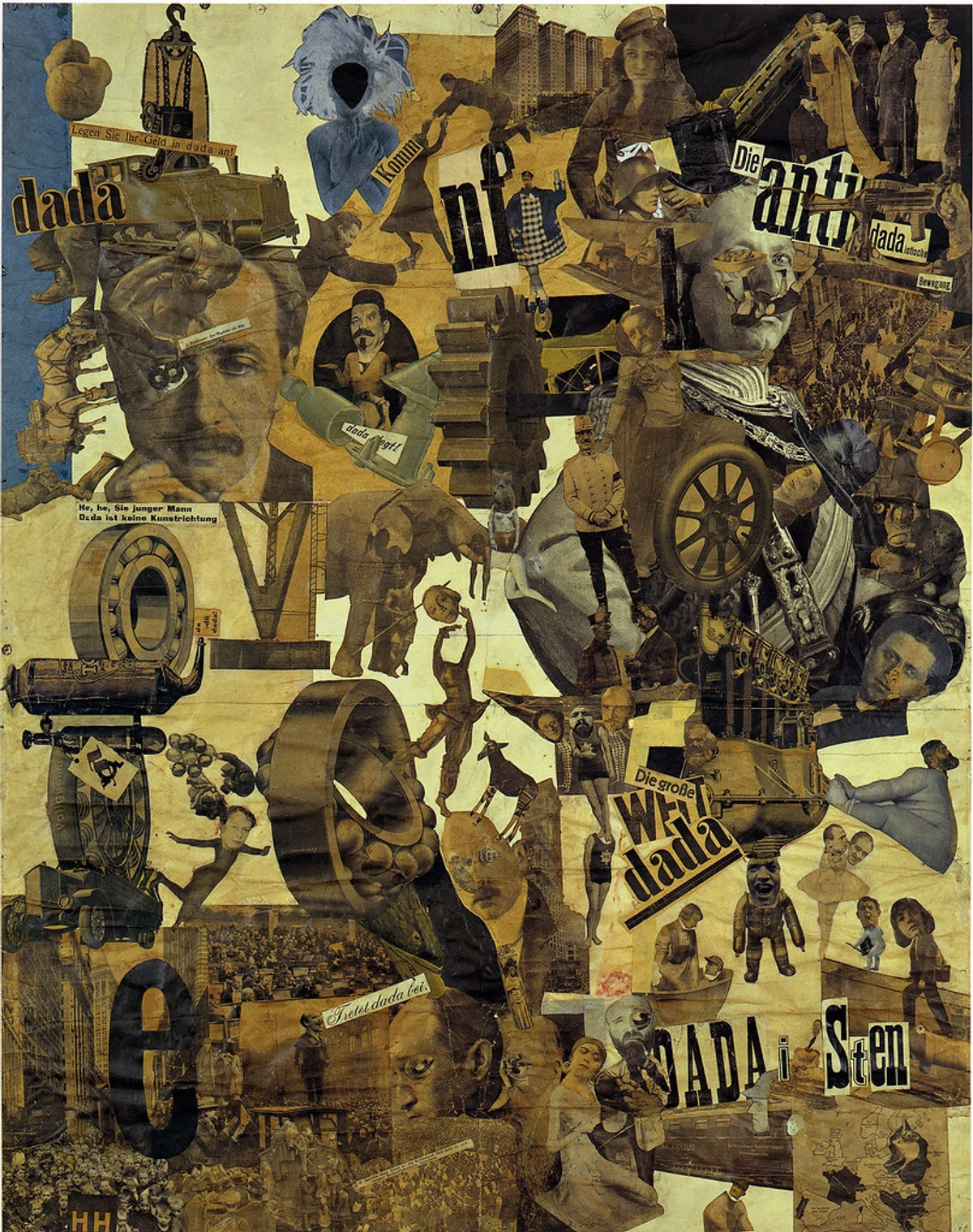
Yes, that's the actual title in all its sprawling, absurd, brilliant glory. It's pure Höch: simultaneously witty and aggressive, poetic and unapologetically political. Measuring approximately 3.5 by 3 feet, this monumental photomontage is a chaotic panoramic portrait of Weimar Germany at its moment of birth, and it stands as arguably Höch's masterpiece and one of the most psychologically penetrating Dada works ever created.
What makes this piece revolutionary is how it operates on multiple levels simultaneously. There's the literal level: a dizzying array of contemporary figures—politicians like Friedrich Ebert and Philipp Scheidemann, artists like Raoul Hausmann and herself, industrialists, dancers, soldiers—jumbled together with machinery, text fragments, and architectural elements. But then there's the deeper structural level: the way Höch divides the composition into competing zones of meaning, creating visual chaos that somehow coheres into devastating political insight.
The title itself is a masterpiece of compression: the "kitchen knife" transforms women's domestic space into revolutionary weaponry; the "Weimar beer-belly" targets the complacent male establishment; "Dada through" suggests both penetration and duration. She's simultaneously critiquing bourgeois society, the art world, political leadership, gender expectations, and the very idea of German culture itself.
The composition explodes with fragments of contemporary figures—politicians, artists, intellectuals—jumbled together with machinery, text, and map fragments. The title itself is a mouthful of Dada absurdity, but it's also deadly serious. The "kitchen knife" suggests women's domestic space turned into a weapon. The "Weimar beer-belly" targets the complacent male establishment.
Look closely and you'll find Höch's fellow Dadaists (like Raoul Hausmann, her lover at the time) present, but you'll also notice her subtle critiques. She's both inside and outside the movement simultaneously.

"High Finance" (1923)
This devastating critique of capitalism came during the depths of German hyperinflation. Höch combines images of greedy-looking industrialists and bankers with machinery and architectural fragments, creating a vision of capitalism as a monstrous, dehumanizing force. The work feels terrifyingly contemporary in our own era of economic instability.
"Da-Dandy" (1919)
A biting commentary on fashion, consumerism, and class in Weimar Germany. Höch takes images of elegantly dressed women and juxtaposes them with machine parts and fragmented text, revealing how femininity was packaged and sold to the "New Woman." What appears liberating on the surface becomes, under Höch's scrutiny, another form of constraint.
"German Girl" (1930)
Created just three years before Hitler's rise to power, this work shows the militarization of German society and traditional gender roles. A young German woman is surrounded by images suggesting discipline, martial culture, and nationalist conformity. It's a chilling premonition of the Nazi era, showing how ideals of femininity would be co-opted by fascist ideology.
"Mother" (1930)
Höch's complex relationship with traditional motherhood comes through in this work. Rather than celebrating maternal ideals, she shows motherhood as another identity constructed by society—another role women were expected to perform. The work is neither wholly critical nor celebratory; like so much of her art, it reveals contradictions rather than offering simple answers.
"Love in the Bush" (1925)
Part of her exploration of gender in the Weimar era, this piece examines how relationships and sexuality were portrayed in mass media. The title itself is ironic, suggesting that "love" in modern times had become both domesticated and wild, both advertised and fundamentally misunderstood. She shows how even our most intimate experiences are shaped by the images around us.
The First International Dada Fair and Gender Politics (1920)
The famous First International Dada Fair in Berlin (1920) is a case study in Höch's complex relationship with the movement. This exhibition at Dr. Otto Burchard's gallery was arguably Dada's most significant public manifestation in Germany, featuring works by all the major Berlin Dadaists. Höch contributed several important pieces, including revolutionary photomontages that challenged everything the establishment held sacred.
Yet the exhibition catalog tells a different story. It lists Höch as providing "handicrafts" rather than art, and she was tasked with much of the organizational work—a classic case of gendered artistic labor being devalued. The male Dadaists, despite their radical politics, still viewed a woman's contributions through the lens of domestic craft rather than serious artistic practice.
This wasn't just a personal slight; it revealed the movement's blind spots. While Grosz and Heartfield attacked bourgeois militarism and capitalism, they remained largely silent about patriarchy within their own ranks and society at large. Höch wasn't content with this selective radicalism. Her work at the fair and elsewhere consistently pushed beyond the movement's comfort zones, asking uncomfortable questions about power that went beyond class and economics.
Still, her works hung alongside the men's, and in many cases surpassed theirs in complexity and daring. The fair also marked a turning point in the recognition of photomontage as a legitimate art form. Höch's presence, despite the marginalization, forced the art world to contend with a female voice that refused to be silenced.
Her final break with Hausmann in 1922 coincided with the waning of Berlin Dada as a coherent movement. The social and economic crises of the Weimar Republic deepened, and many of the male Dadaists moved toward more explicit political parties and organizations. Höch took a different path, maintaining her artistic independence while deepening her exploration of themes the movement had only begun to address.
credit, licence
Hannah Höch in her studio, 1926. Her work space was filled with magazines, scissors, and glue—the tools of her unique artistic practice.
The Dada Movement: Her Context and Her Critique
Höch was the only woman in the Berlin Dada group, and it wasn't easy being the lone female voice in a movement that prided itself on being radical. The male Dadaists—figures like George Grosz, John Heartfield, and Raoul Hausmann (with whom she had a tumultuous relationship)—often marginalized her contributions.
The famous First International Dada Fair in Berlin (1920) is telling. While Höch contributed several important works, the exhibition catalog lists her as providing "handicrafts" and she was tasked with the organizational work—a classic case of gendered artistic labor being devalued. Yet her work hung alongside the men's, and in many cases, surpassed theirs in complexity and daring.
What I find remarkable is how she used her outsider status as fuel. Her photomontages frequently included pointed commentary about the Dada movement itself. She wasn't just attacking bourgeois society; she was holding up a mirror to her fellow avant-garde artists, showing them their own unexamined assumptions about women, power, and privilege.
This tension between belonging and critique might be the key to understanding Höch. She needed the Dada movement's energy and anti-establishment stance, but she refused to accept its limitations. In doing so, she became one of its most enduring voices.
Post-War Revival and Late Career (1945-1978)
After the war, Höch faced a devastated Germany and a divided Berlin. The country she had known was gone, replaced by occupation zones that would eventually harden into East and West Germany. She was 56 years old in 1945, with a considerable body of work behind her, yet she felt compelled to begin again.
This period saw her return to photomontage, but with a different tone. The explosive energy of her Dada years was replaced by something more contemplative, sometimes even melancholic. Works from the 1950s and 1960s still contain sharp social observation, but they feel more philosophical, less immediately confrontational. She was witness to Germany's reconstruction, the Cold War division of her country, and the emergence of a new consumer society—all themes that found their way into her late work.
What's remarkable about Höch's late career is her refusal to be confined to her Dada legacy. Yes, she was rediscovered as a pioneering modernist, but she continued to evolve. Her late photomontages grappled with the space age, nuclear anxiety, environmental concerns, and the changing roles of women in post-war society. She remained relevant by continuing to engage with contemporary visual culture, even as she entered her seventies and eighties.

International recognition began to grow in the 1950s and 1960s. She participated in major exhibitions, including shows at the Museum of Modern Art in New York, and her work was acquired by important collections. Younger artists and critics began to see her as a crucial link between historical avant-garde movements and contemporary political art. Feminists rediscovered her in the 1970s, recognizing her pioneering exploration of gender issues decades before the women's liberation movement.
Höch continued working almost until her death in 1978 at the age of 88. Her final works retain her characteristic sharp eye and formal inventiveness, proving that artistic radicalism doesn't diminish with age. In a culture obsessed with youth and novelty, Höch remains a powerful example of sustained creativity across an entire lifetime.
Early Life and Artistic Formation (1889-1918)
Hannah Höch was born Anna Therese Johanne Höch on November 1, 1889, into a middle-class family in Gotha, Germany. Her childhood was outwardly conventional, but even her earliest choices hinted at the independent path she would forge. She was expected to leave school early to help with her younger siblings, a path she actively resisted, demonstrating a fierce determination from a young age.
Her formal artistic education began in 1912 at the School of Applied Arts in Berlin-Charlottenburg. Significantly, she studied glass design and graphic arts. This was considered "women's work"—decorative, functional, safely outside the realm of serious "high art." But Höch was absorbing crucial lessons. She was learning about the relationship between craft and industrial production, and about the aesthetic potential in everyday materials. This "low art" training would become the foundation of her subversive "high art" practice.
The First World War interrupted her studies. In 1914, she returned to Gotha and worked with the Red Cross. This experience wasn't just a pause; it was a brutal education in the human cost of the nationalist fervor she would later eviscerate in her art. By 1915, she was back in Berlin, continuing her studies and, crucially, taking a part-time job at the Ullstein Verlag publishing house. Her job was to design patterns for handicrafts publications—the very magazines she would later cut up.
This job was her Trojan horse. She was inside the machine that produced the visual culture aimed at German women—magazines full of fashion plates, domestic advice, and illustrations reinforcing traditional roles. She saw firsthand how the sausage was made, and she was taking notes.
Then, in 1915, she met Raoul Hausmann. Their meeting was an artistic and personal explosion. He was a married man and a central figure in the nascent Berlin Dada group. Their intense, tumultuous relationship introduced her to the avant-garde circles of Berlin. Together, they began experimenting with collage and photomontage around 1918, along with other Dadaists like George Grosz and John Heartfield.
What Höch brought that was uniquely hers was her intimate knowledge of women's magazines and her acute awareness of the contradictions in modern women's lives. While the men were attacking external political structures, Höch was developing a language to critique the intimate, everyday architectures of power that shaped identity.
The years 1918-1919 were her artistic crucible. She participated in Dada events, had affairs with both Hausmann and Kurt Schwitters, and created her most important early photomontages. These works were urgent responses to the world collapsing and being reborn around her: the fall of the German Empire, the violence of the street battles, the precarious birth of the Weimar Republic, and the seismic shifts in women's social roles. She emerged from this period not just as a member of Dada, but as its most incisive and enduring critic.
Understanding Hannah Höch means understanding how an artist's biography becomes their artistic vocabulary. Born in 1889 to a middle-class family in Gotha, Germany, Höch was expected to follow a conventional path. But even her earliest artistic training carried clues about her future direction.
I find it fascinating that she began studying glass design and graphic arts at Berlin's School of Applied Arts in 1912. This was considered "women's work"—decorative, functional, safely outside the realm of serious "high art." But Höch was absorbing crucial lessons about materials, composition, and the relationship between craft and industrial production. When the First World War erupted in 1914, her studies were interrupted. She returned to Gotha and worked with the Red Cross, an experience that exposed her to the human cost of the nationalist fervor she would later critique in her art.
By 1915, she was back in Berlin, enrolled at the Museum of Applied Arts and supporting herself by working part-time at the Ullstein Verlag publishing house, designing patterns for handicrafts publications. This job wasn't just a way to pay the bills—it was her education in mass media. She was literally inside the machine that produced the magazines she would later deconstruct. Every day, she handled the publications popular with middle-class German women, publications full of fashion plates, domestic advice, and illustrations reinforcing traditional gender roles.
When she met Raoul Hausmann in 1915, her artistic world exploded. Hausmann introduced her to the avant-garde circles of Berlin, and together they began experimenting with collage and photomontage around 1918. It's important to understand: photomontage wasn't yet an established technique. Höch and Hausmann were inventing it together, along with other Berlin Dadaists like George Grosz and John Heartfield. What Höch brought that was uniquely hers was her intimate knowledge of women's magazines and her acute awareness of the contradictions in modern women's lives.
The years 1918-1919 were Höch's artistic coming-of-age. She had affairs with both Hausmann and Kurt Schwitters, participated in Dada events, and began creating her most important early photomontages. These weren't mere formal experiments—they were urgent responses to the world around her: the collapse of the German Empire, the violence in the streets, the precarious birth of the Weimar Republic, and the seismic shifts in women's social roles.
This systematic, almost scientific approach to analyzing her source materials reveals Höch's incredible intellectual rigor. She wasn't randomly combining images; she was constructing a visual vocabulary for critiquing the architecture of modern consciousness. The table below summarizes the patterns in her visual language:
Element  | Typical Source | Conceptual Function |
|---|---|---|
| Female Figures | Fashion magazines (Die Dame, Uhu), society pages, advertisements | Deconstruction of beauty standards; revealing how femininity is constructed and commodified |
| Male Figures | Political publications, military magazines, industrial journals | Exposure of patriarchal power structures in politics, military, and capitalism |
| Mechanical Elements | Technology magazines, automobile advertisements, industrial catalogues | Critique of technology-worship; exploration of how modernity dehumanizes |
| Non-European Artifacts | Ethnographic publications, anthropological museums, travel magazines | Questioning of colonial ideology; challenging European notions of "civilization" |
| Text Fragments | Newspaper headlines, advertising slogans, political propaganda | Creation of ironic juxtapositions; direct political commentary through appropriation |
| Maps & Architecture | Atlases, travel magazines, geographical publications | Deconstruction of nationalism; questioning fixed boundaries and territories |

This systematic approach to source material shows Höch's incredible intellectual rigor. She wasn't just randomly combining images; she was building a visual language for critiquing modern society.
Legacy and Contemporary Relevance: Why Höch Still Matters Today
Höch's influence on contemporary art is immense but often underappreciated. She essentially invented the grammar of political photomontage, and you can see her DNA in everything from punk zines to the digital activism of today. What strikes me as most relevant is how prescient her work feels in our social media age—we navigate a world saturated with manipulated images, deepfakes, AI-generated content, and propaganda bots. Höch was already wrestling with these issues a century ago: How do repeated images construct our sense of reality?
Her work speaks directly to numerous contemporary artists and movements:
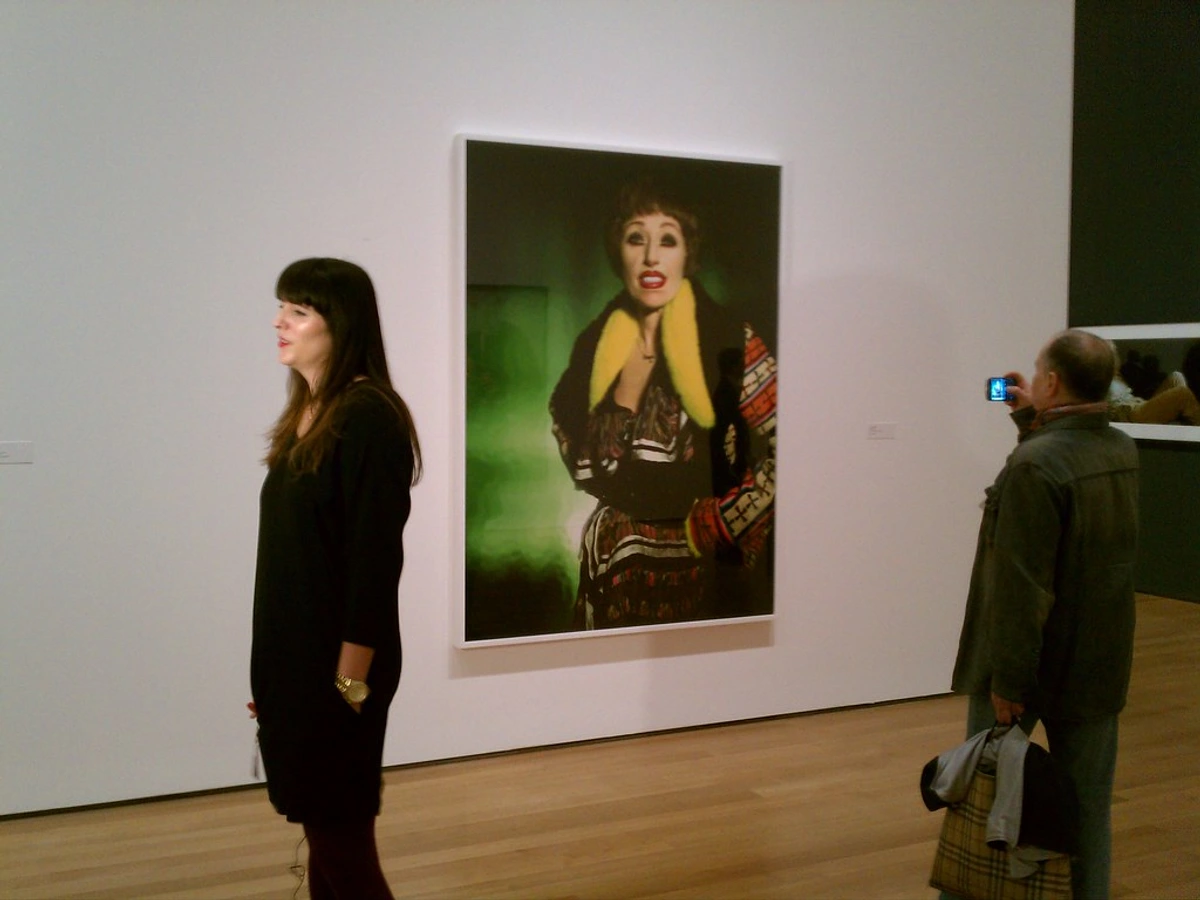
- Feminist Art: Artists like Cindy Sherman, who deconstruct female identity through staged photography, or the Guerrilla Girls, who use statistics and provocative imagery to critique sexism in the art world, build on Höch's pioneering exploration of gender politics.
- Appropriation Art: Richard Prince's rephotography of advertisements, Sherrie Levine's appropriations of male modernist artists, and countless others owe a debt to Höch's radical recontextualization of found imagery.
- Digital and Post-Internet Art: The practice of remixing, memes, and digital collage culture all descend from Höch's insight that every image can be material for new meaning. When you see a politically charged digital montage, you're witnessing Höch's legacy.
- Political Art: Martha Rosler's "House Beautiful" series (which combines images of domestic interiors with war photography), Alfredo Jaar's media critiques, and countless activist artists use Höch's method of creating critical juxtapositions that reveal hidden power structures.
What's particularly powerful about Höch's ongoing relevance is how her work anticipated intersectional thinking. Before the term existed, she understood that gender, race, class, and colonialism were interconnected systems of power. Her photomontages reveal these connections with visual clarity that remains profound today.
In our current moment of fake news, algorithmic manipulation, and constant visual persuasion, Höch offers more than historical interest—she offers a toolkit for critical seeing. She teaches us that every image has an agenda, that reality is constructed through representation, and that we have the power to dismantle and reconstruct those representations. This makes her not just historically important but genuinely useful for navigating our current visual landscape.
Perhaps most importantly, Höch demonstrated that the margins of a movement—the outsider position, the perspective of those excluded from the center—can be the most powerful vantage point for critique. It's a lesson for anyone working in any field: sometimes you see more clearly when you're not invited to the main table.
Visual Analysis: Decoding Höch's Revolutionary Methods
Understanding Höch requires more than just knowing about her life and times—it means learning to read the visual arguments embedded in her photomontages. Her work operates on multiple levels simultaneously: formal composition, symbolic juxtaposition, and political critique all working together to create meaning that's both immediate and layered.
Key Visual Strategies Höch Used:
- Decapitation and Re-membering: Höch frequently severed heads from bodies, placing bourgeois heads on working-class bodies, male heads on female forms, or human heads on mechanical or animal forms. This strategy literalized how identity is constructed through dismemberment and false reassembly.
- Scale Manipulation: By dramatically altering the scale relationships between elements—a giant ear next to a tiny politician, an enormous gear overshadowing a fashion model—Höch created visual metaphors for power imbalances and social hierarchies.
- Absurd Juxtapositions: She combined elements from completely incompatible contexts: ethnography magazines with fashion spreads, industrial catalogues with romantic illustrations, machine parts with flowers. These combinations revealed how modernity's different strands—imperialism, industrialization, gender ideology—were actually part of the same system.
- Recursive Critiques: Some works include images of Dadaists or other artists, creating commentary on the avant-garde itself. This layering allowed her to occupy multiple positions simultaneously—insider and outsider, participant and critic.
- Text-Image Tensions: When she incorporated text fragments, the words often contradicted or ironized the images. This technique exposed how propaganda works by creating false alignments between language and reality.
- Spatial Confusion: Her layering of translucent papers and complex compositions created ambiguous spaces that mirrored the psychological disorientation of living through rapid social change.
Höch's visual strategies weren't just aesthetic choices—they were philosophical arguments made through composition. Every cut, every placement, every juxtaposition carried intellectual weight. This is why her work rewarded—and continues to reward—close, prolonged looking. The more time you spend with a Höch photomontage, the more it reveals about the structures of power and representation that shape our world.
A Practical Guide: Where and How to Experience Höch's Work
If you want to experience Höch's work firsthand, you're in luck—major museums around the world hold her pieces in their collections. The challenge is that photomontage is inherently fragile; the glued paper and aging materials mean works can't be constantly displayed. You'll need to check exhibition schedules or plan ahead.: Where to Experience Her Art
If you want to experience Höch's work firsthand, you're in luck—major museums around the world hold her pieces in their collections. However, photomontages are inherently fragile; the glued paper and aging materials mean works can't be constantly displayed. You'll need to check exhibition schedules or visit during special exhibitions.
Key Museum Collections:
- Berlinische Galerie (Berlin): Germany's most comprehensive Höch collection, including works from throughout her entire career. Essential for understanding her evolution across decades.
- Museum of Modern Art (New York): Several key Dada-period photomontages, often displayed in the permanent collection's galleries dedicated to early 20th-century art.
- Tate Modern (London): Important works, particularly from her later career and post-war period, offering insight into her mature style.
- National Gallery of Art (Washington, D.C.): Strong collection of German modern art including significant Höch pieces, especially works from the 1920s and 1930s.
- Stedelijk Museum (Amsterdam): Given her relationship with Til Brugman and time spent in the Netherlands, this museum has notable holdings of her work.
- Los Angeles County Museum of Art (LACMA): Has acquired important photomontages, especially works that traveled to the United States during her lifetime.
When viewing Höch's work in person, pay attention to details that reproductions can never capture: the texture of aged paper, subtle color variations, the three-dimensional quality created by layered materials, and the physical evidence of her cutting and pasting. Viewing a Höch photomontage in person feels like examining an archaeological artifact from our visual culture's history.
Pro tip: Check museum websites for exhibitions focused on Dada, Weimar art, or feminist art movements. Höch's work often appears in these thematic shows, sometimes alongside works by female contemporaries like Sophie Taeuber-Arp or later artists she influenced like Martha Rosler.
Each of these works rewards close looking. They're not just historical artifacts; they're complex meditations on power, identity, and representation that continue to resonate.
Visiting Höch's Work Today
If you want to experience Höch's work firsthand, you're in luck—major museums around the world hold her pieces in their collections. The challenge is that photomontage is fragile; the glued paper and aging materials mean works can't be constantly displayed. You'll need to check exhibition schedules or plan ahead.
Major Collections Worldwide

Major Public Collections:
Museum | Location | Significance | Key Works |
|---|---|---|---|
| Berlinische Galerie | Berlin, Germany | Most comprehensive collection worldwide | Works from all periods of her career |
| Museum of Modern Art | New York, USA | Several key Dada-period works | "Cut with the Kitchen Knife" (1919) |
| Tate Modern | London, UK | Strong holdings in German modernism | Later works from 1950s-1970s |
| National Gallery of Art | Washington D.C., USA | Excellent German art collection | Various Dada and Weimar-era works |
| Los Angeles County Museum of Art | Los Angeles, USA | Growing German collection | Various photomontages |
| Centre Pompidou | Paris, France | Major European modern art collection | Dada and Surrealist works |
| Stedelijk Museum | Amsterdam, Netherlands | Strong modern art collection | Various photomontages |
When you do get to see her work in person, notice the textures, the subtle color variations in the aged paper, and the three-dimensional quality that reproductions can't capture. A Höch photomontage in person feels like an archaeological artifact from our visual culture's history—fragile, layered, with the cuts still visible, the glue still holding fragments together against time itself.
When you do get to see Höch's work in person, take your time and look closely—notice the textures, the subtle color variations in the aged paper, the precise cuts, the slight shadows where paper overlaps. The three-dimensional quality that reproductions can't capture becomes visible, and you can see how she built these complex visual arguments layer by layer. A Höch photomontage in person feels like an archaeological artifact from our visual culture's history—fragile, layered, with the cuts still visible, the glue still holding fragments together against time itself.
Many museums also showcase Höch's work in thematic exhibitions about Dada, German modernism, feminist art, or photomontage. Keep an eye out for these curated contexts—they provide invaluable insight into how Höch's work dialogues with broader cultural and artistic movements.
Frequently Asked Questions
What makes Hannah Höch's photomontage different from regular collage?
This is fundamental to understanding her contribution. While collage (from the French "coller," to glue) has roots in Cubism and earlier folk traditions, Höch's photomontage specifically used printed photographic images from mass media. Think of it this way: the difference between arranging decorative papers and performing surgery on your culture's visual propaganda.
Her innovation was recognizing that magazine photos and newsprint images weren't neutral—they carried ideological messages about society, gender, beauty, politics, and power. Every advertisement, fashion plate, and politician's portrait was already making an argument. Höch's method involved deconstructing that propaganda and reassembling it into counter-propaganda that revealed the original's hidden assumptions.
The key difference lies in intention and source material. Where Cubist collage incorporated materials to explore formal relationships between painting and reality, Höch's photomontage used found printed imagery to expose how reality itself gets constructed through mass media. She wasn't just making art about art; she was making art about how society manufactures consent and normality through images.
Why did Hannah Höch stay in Germany during the Nazi period?
This remains one of the most debated—and ethically complex—questions about her life. The simple answer is that we don't know for certain, and any explanation involves speculation about impossible choices under totalitarianism.
Some factors scholars consider:
- Practical Constraints: Emigrating was incredibly difficult, especially for a woman without significant financial resources or international connections. The process required visas, sponsors, and often meant leaving everything behind.
- Personal Ties: She had aging parents in Germany and maintained relationships that might have made leaving feel like abandonment.
- The Complexity of "Inner Emigration": Many German intellectuals who remained developed strategies of "inner emigration"—maintaining intellectual independence while appearing to conform. For an artist, this might mean continuing to work while avoiding overt political content.
- Survival vs. Resistance: What we do know is that her Dada-era work would have been classified as "degenerate art" (entartete Kunst) by the Nazis, making her position extremely dangerous. Her survival likely depended on maintaining a low profile, living in relative isolation in Berlin-Heiligensee, and focusing on landscapes, abstractions, and less provocative subjects.
It's important to remember that many artists who stayed didn't survive. Those who did often faced impossible moral compromises. Höch's endurance shouldn't be romanticized as heroic resistance, but it shouldn't be dismissed either. Sometimes survival itself, especially for a female artist whose work had been so explicitly political, was a form of defiance.
How did being a woman affect her career in the Dada movement?
Being the only woman in Berlin Dada fundamentally shaped both Höch's daily experience and her artistic vision, giving her a unique double-consciousness that became her greatest strength.
Consider the contradictions she navigated:
- Gendered Labor: Despite contributing major artworks, she was expected to perform organizational and domestic tasks for the group. The Dada Fair of 1920 famously listed her contributions under 'handicrafts' rather than art—a revealing slip that shows how her colleagues viewed her work.
- Intellectual Dismissal: She later recalled how male Dadaists viewed her as 'only a girl' doing frivolous paper cutting. This dismissal meant her most radical insights were initially overlooked, allowing her to develop ideas without the pressure of constant scrutiny.
- Institutional Exclusion: While her male colleagues could access certain networks and opportunities, Höch had to forge her own path. This independence forced her to develop a stronger individual artistic voice.
- Critical Perspective: Most importantly, marginalization gave her a unique angle of vision. While male Dadaists attacked bourgeois militarism and capitalism, Höch saw how those same power structures operated within the avant-garde itself—and within gender relations. Her outsider-within position allowed her to critique both mainstream society and the movement that claimed to oppose it.
Rather than limiting her, being a woman in Dada gave Höch access to experiences and insights her male colleagues couldn't see. It taught her that revolution had to include everyone, not just the people already invited to the planning meetings.

What was Hannah Höch's relationship with Raoul Hausmann?
Höch and Raoul Hausmann had an intense artistic and romantic relationship from roughly 1915 to 1922. Hausmann was a central figure in Berlin Dada, and his theories about photomontage certainly influenced Höch. However, their partnership was complicated and ultimately destructive. Some scholars argue about who "invented" photomontage in their circle—both claimed credit, as did other Dadaists like Hausmann's wife, Hannah Höch. The relationship ended badly, but it was during these years that Höch created her most important early works. The romantic and artistic entanglements of the Berlin Dada group remain a subject of ongoing research and debate among art historians.

How is Hannah Höch relevant to contemporary art and digital culture?
Höch feels more relevant than ever because she essentially predicted our current visual culture, where image manipulation isn't the exception but the norm. Think about it: every Instagram filter, every deepfake video, every meme that remixes political imagery, every AI-generated image—they're all working with the questions Höch first posed nearly a century ago.
Her contemporary relevance shows up in several key areas:

- Social Media and Digital Culture: We live in a world where everyone has a portable printing press (our phones) and access to infinite source material (the internet). Höch understood that images aren't neutral reflections of reality but arguments about reality. Every time someone creates political memes or deconstructs advertisements on social media, they're using Höch's basic insight.
- Fake News and Media Literacy: Höch's work teaches us to question the reality presented by mass media, a crucial skill in an era of algorithmic manipulation, targeted propaganda, and information warfare.
- Intersectional Feminism: Before the term existed, Höch was practicing intersectional analysis—examining how gender, race, class, and colonialism interconnect. Contemporary artists tackling these issues walk on ground Höch first cleared.
- Remix Culture and Appropriation: From hip-hop sampling to Richard Prince's rephotography to digital art, contemporary culture is built on the principle of recombining found elements. Höch was doing this with scissors and glue, proving that originality doesn't require starting from scratch—sometimes the most radical act is rearranging what's already there.
- Political Art: Every time you see a politically charged digital collage, a zine critiquing consumer culture, or an activist graphic exposing power structures, you're witnessing the legacy of Hannah Höch's scissors.
Did Hannah Höch only make photomontages?
No, though photomontage is what she's famous for—and it represents her most revolutionary contribution to art history. But Höch had a long and incredibly varied career, working consistently from her early twenties until her death at age 88. Her practice was much broader than a single medium.
Beyond photomontage, she worked in:
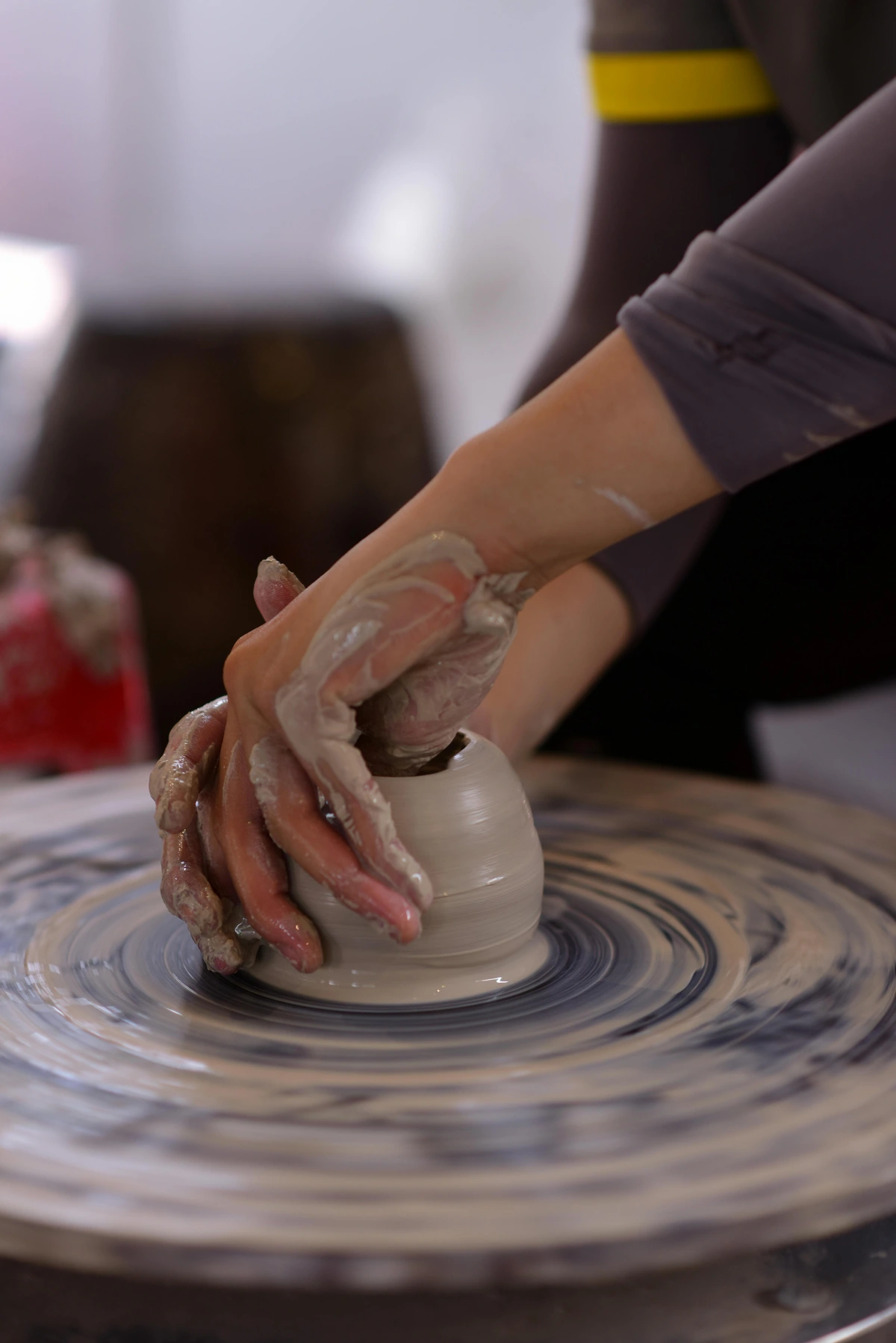
- Painting: From her student days studying glass design through her later career, Höch painted in oil and watercolor. Her paintings range from early expressionistic landscapes to later abstract works. During the Nazi period especially, painting became her primary medium as it was less politically dangerous than photomontage.
- Drawing: She was an accomplished draftsperson, creating detailed pencil and ink drawings throughout her life. These works show her formal skills and her ongoing exploration of line, composition, and visual rhythm.
- Collage (Non-Photographic): While photomontage used printed images, she also made collages with colored paper, fabric, and other materials, exploring pure formal relationships independent of found photographic content.
- Mixed Media and Experimental Works: Especially in her later career, she combined media, sometimes incorporating photomontage elements into paintings or drawings, creating hybrid works that defied simple categorization.
What's crucial to understand is that these different media weren't separate tracks but an integrated practice. What ties everything together is her consistent sensibility—a sharp eye for composition, an interest in fragmentation and reassembly, and an ability to find the uncanny in the everyday. Her choice of medium was strategic: she used photomontage when she wanted to engage directly with contemporary visual culture, but pursued painting and drawing when she needed to work more abstractly or when political conditions required discretion.

What can contemporary artists learn from Hannah Höch?
So much. At a moment when young artists often feel pressured to specialize early, master expensive techniques, and play the gallery game, Höch offers an alternative model of artistic development that feels both radical and deeply human.
Here's what I think artists can learn from her example:
- Use What's Around You: Höch proved that the most powerful materials might be the magazines in your recycling bin, not expensive art supplies. Her work demonstrates that engaging with everyday visual culture can be more relevant than escaping to a purely aesthetic realm. This is especially crucial for artists without access to institutional resources.
- Embrace Your Marginal Position: Being the only woman in Dada gave Höch a perspective her male colleagues lacked. Rather than seeing marginalization as a limitation, she used it as a lens for seeing more clearly. Artists today who feel excluded from mainstream art worlds might remember that outsider positions can offer unique critical advantages.
- Let Ideas Drive Technique: Höch's cuts aren't always clean; some compositions are deliberately jarring or unresolved. But the conceptual urgency carries the work. She proves that having something essential to communicate matters more than technical perfection. Sometimes a rough edge or awkward juxtaposition creates meaning that polished execution would erase.
- Stay Curious Across Decades: Höch evolved continuously from her twenties through her eighties. She engaged with changing visual culture, modified her methods, and remained intellectually alive. This suggests that artistic radicalism doesn't have to peak early—it can deepen with age and experience.
- Live Your Questions: Höch never stopped asking how images construct reality, how power operates through representation, and how gender, race, and class shape visual culture. Artists today might focus less on finding definitive answers and more on developing the capacity for sustained questioning across a lifetime of work.
- Make Art That Thinks and Feels: Höch's best works prove false the distinction between intellectual rigor and emotional power. Her photomontages make you analyze power structures while also feeling the disorientation and wonder of fragmented identity. This integration of thinking and feeling might be her most important lesson for contemporary practice.

Conclusion: Why Hannah Höch Still Matters
I want to leave you with this thought: Hannah Höch matters because she showed us that art can be both a mirror and a scalpel. It can reflect the world as it is while simultaneously cutting through the illusions that hold that world together. In an age of Instagram filters and algorithmic propaganda, we need Höch's critical eye more than ever.
Her work reminds me that the most radical art often comes from the margins—from people who've been told they don't belong, who've been excluded from the conversation, but who refuse to stay silent. Höch took the most ephemeral materials (yesterday's magazines) and transformed them into lasting critiques of power. She demonstrated that you don't need expensive materials or institutional approval to make art that challenges the status quo.
The next time you flip through a magazine or scroll through social media, remember Hannah Höch. Remember that the images around us aren't neutral—they're constructing a version of reality that serves someone's interests. And remember that with a critical eye and a pair of scissors (or a digital editing tool), you can cut through the propaganda and show people something they've never seen before, something that might just change how they think about the world.










That's what Hannah Höch did. And nearly a century later, we're still catching up to her vision.