Art Brut: The Unfiltered Rawness That Redefines Art & My Journey
Explore the raw, untamed world of Art Brut – its origins with Dubuffet, key characteristics, and ethical considerations. Discover how this pure expression has profoundly influenced my own abstract art and artistic philosophy.

Art Brut: The Raw, Unfiltered Creativity That Continues to Fascinate Me
I've always been drawn to the wild edges, the places where rules fray and something genuinely new erupts, often in ways that challenge my own neatly organized artistic practice. And in art, few things have ever quite delivered that delightful, unsettling gut punch like Art Brut. I remember stumbling across a documentary about it years ago, late one night – it wasn't just interesting, it completely rewired how I thought about "good" art. Everything I assumed about training, intention, and market value seemed, well, kind of irrelevant. It was a liberation, really, and it sent me spiraling, questioning if my own abstract work, despite its raw aesthetic, was truly as 'unfiltered' as I sometimes imagined. This article is my attempt to untangle that feeling, to dig into the raw essence of Art Brut, and hopefully, challenge your own comfortable definitions a little too.
What is Art Brut? The Uncooked Truth and Its Genesis
So, what exactly are we talking about here? Art Brut, a term coined by the French artist Jean Dubuffet in 1945, literally means "raw art" or "brut art." Imagine art that hasn't been put through any kind of filter: no art school polish, no gallery expectations, no commercial agenda. It's art in its purest, most immediate, and utterly unrefined form. This deep dive into Art Brut was precisely sparked by my own quest for genuine 'rawness' in my creative journey. It's created by individuals operating entirely outside the conventional art world, often with no awareness that what they're doing is even "art" in the accepted sense. This isn't just self-taught art; it's art from a completely different universe. While Dubuffet was instrumental, early advocates like André Breton and Paul Éluard also recognized the profound, unmediated power of these creations, helping to lay the groundwork for its broader appreciation.
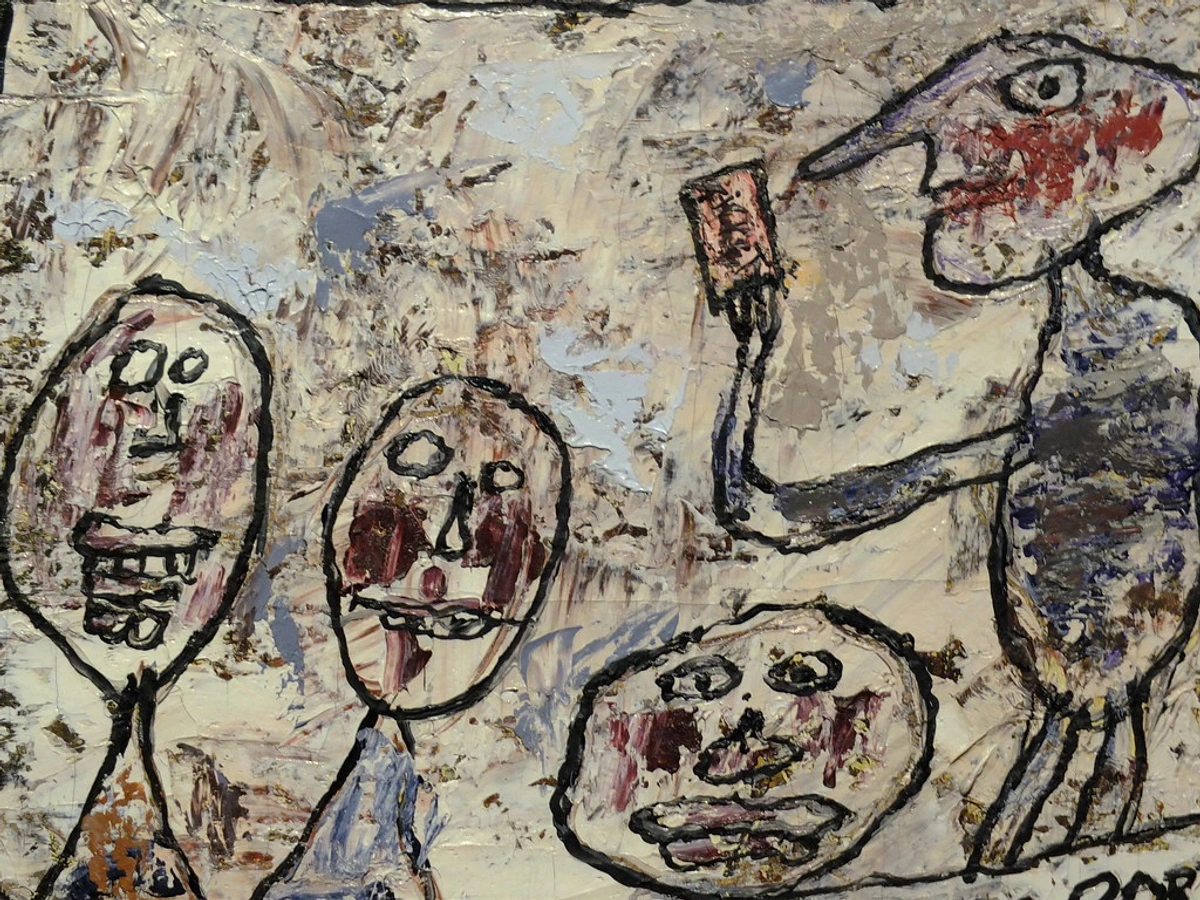
This particular Dubuffet piece, with its distorted figures and bold, almost childlike lines, perfectly encapsulates that sense of an unburdened, direct artistic voice – a visual 'gut punch' in its own right.
A Brief, Yet Revolutionary, History of Rawness
To truly understand this concept, we need to talk about Dubuffet himself. He was, by the 1940s, pretty fed up with the perceived artificiality and academicism of mainstream art. But it was more than just personal frustration; the profound trauma of World War II had left many searching for authenticity and meaning beyond the established norms, and Dubuffet was no exception. He found it in the most unexpected places: psychiatric hospitals, prisons, and among isolated individuals in society's shadows. He wasn't just collecting; he was on a quest for something "more real," an unadulterated creative impulse untouched by cultural conditioning or market pressures. He declared their work to be more vital, more authentic than what was being produced in the polite salons of Paris.
This was revolutionary, even audacious. The art establishment, as you can imagine, wasn't exactly thrilled to be told that the creations of the "insane" or "untrained" were more profound than their own. But Dubuffet persisted, building a remarkable collection that became the foundation for the Compagnie de l'Art Brut and later, the Collection de l'Art Brut in Lausanne, Switzerland. It’s a bit of a paradox, isn't it? While the art originated entirely outside the conventional art world, it was through Dubuffet's vision and efforts that it eventually found its way into institutions, sparking conversations that continue to this day.
The Hallmarks of Raw Expression: What Does it Look Like?
So, what are the tell-tale signs of this raw, untamed creativity? Sometimes, it’s just a feeling, a raw energy that hits you. But there are often several striking characteristics:
- Autonomy & Inner Necessity: These artists create solely for themselves, driven by an almost unbearable internal urge. This isn't just a vague feeling; it's often a profound, almost psychological imperative. It's as if an internal pressure valve demands release, and creation is the only way. Think of Adolf Wölfli, who spent decades in a psychiatric hospital, creating an entire mythological universe – complete with its own history, language, and musical compositions – all documented in thousands of intricate drawings and writings. He had to create, or perhaps, the world inside him would have simply exploded.
- Unconventional Materials & Techniques: Forget oil paints and canvas. Art Brut artists use whatever comes to hand: mud, coffee grounds, found objects, scrap paper, cardboard, walls, even their own bodily fluids. The choice of material is often born of sheer necessity and the immediate availability of a surface or tool to manifest an urgent vision. Aloïse Corbaz, for instance, used crayon, colored pencils, and even toothpaste on large paper sheets, often sewing them together to create monumental narratives. This isn't about artistic choice as much as it is about relentless expression with whatever is available – a truly wild kind of recycling.
- Intense Personal Vision & Unique Logic: The works are deeply subjective, reflecting incredibly complex inner worlds, vivid fantasies, obsessions, or spiritual experiences. They aren't trying to depict external reality; they're showing their reality, which can be intensely disorienting and utterly captivating. Sometimes, this results in a lack of conventional narrative coherence, replaced instead by the artist's own idiosyncratic systems of meaning. Imagine an artist meticulously cataloging a dreamscape that only they inhabit, with its own logic and inhabitants, bringing it to life with an almost obsessive detail that can feel both alien and profoundly human.
- Lack of Formal Training: This is a non-negotiable criterion. These creators haven't been to art school, haven't studied perspective or color theory. Their artistic language is entirely self-invented, often developing idiosyncratic systems of symbolism and representation.
- Lack of Self-Consciousness: This is crucial and, frankly, what gives Art Brut much of its purity. These artists typically have no awareness of an "art market" or "art world" expectations. Their work is unburdened by the desire for critical acclaim or commercial success, making it uniquely pure. Contrast that with the often market-driven motivations in today's art scene – it's like looking at a creature from another dimension. It’s hard enough for me to ignore what people might think when I’m painting, let alone being completely free of such thoughts! What raw impulse is driving your creative spirit?
Art Brut vs. Outsider Art: A Subtle, Yet Important, Distinction
Okay, so this is where things can get a little nuanced, and if you find it confusing, you’re in good company – it certainly tangled my brain for a while. You might hear the term Outsider Art used interchangeably with Art Brut, and while they're definitely related, Dubuffet's definition of Art Brut is very specific. It refers strictly to the works he collected and championed, created by individuals operating completely outside any cultural or artistic influence. Outsider Art, a broader umbrella term coined by art critic Roger Cardinal, includes Art Brut but also encompasses other self-taught, visionary, or folk artists who might have some awareness of the art world, or whose work has been promoted by enthusiasts or dealers.
Think of it this way: all Art Brut is Outsider Art, but not all Outsider Art is Art Brut. Art Brut is like a very specific, untamed breed of wild dog, whereas Outsider Art is the broader category of all "unconventional dogs." A self-taught folk artist like Grandma Moses, for instance, created beautiful, narrative paintings outside academic traditions, but she was aware of an audience and sold her work, placing her firmly in the Outsider Art category without being strictly Art Brut by Dubuffet's stringent criteria. If you're interested in diving deeper into this fascinating realm, you can explore what exactly is Outsider Art here.
Why This Rawness Resonates So Deeply
For me, Art Brut serves as a profoundly powerful reminder that creativity isn't solely the domain of the trained or the celebrated. It's a primal urge, a fundamental human need to express. While my abstract art aims for a kind of raw expression, it comes from a very different place – a conscious engagement with a market and an audience. Art Brut, by contrast, throws a beautiful wrench into the institutionalized art world. It critiques the very structures that define artistic value, challenging notions of taste, training, and commercial viability, effectively democratizing art by asserting that profound creative genius can arise from anywhere, unbidden and unpolished. It's a testament to the raw, unfiltered human spirit.
Encountering Art Brut shifted something fundamental in my artistic philosophy and approach. It pushed me to look beyond technical perfection and embrace a more visceral, less polished aesthetic in my creative journey. I started actively seeking out the "imperfections" in my own abstract work, understanding that the raw, immediate mark can often convey more emotion and authenticity than a perfectly rendered line. This has significantly influenced my process, encouraging me to lean further into spontaneous gestures and the often surprising results of mixed media, valuing the journey of creation over a predetermined outcome. It's a constant, humbling challenge, urging me to stay true to my unique vision and the underlying impulse that makes me paint, much like embracing the power of imperfection or engaging in intuitive painting.
Ethical Considerations in Appreciation
What’s more, there are deep ethical considerations here. Many of these artists were institutionalized, marginalized, and never intended their work for public consumption. While celebrating their genius, how do we, as an art world and as viewers, appreciate this art responsibly without exploiting the vulnerable individuals who created it? It’s a complex, ongoing dance that challenges our very notions of ownership and display.
Actively ensuring responsible appreciation means prioritizing the creator's dignity and context. This involves careful provenance research to understand the work's journey, potentially strict anonymization when appropriate, and robust educational initiatives by institutions to inform the public respectfully about the artists' lives. We must avoid sensationalizing or commodifying suffering. For many creators of Art Brut, the act of making was likely profoundly therapeutic or cathartic, a means of processing intense inner worlds or coping with their circumstances. It's not "art therapy" in a clinical sense, but a deeply personal, often desperate, form of self-expression. However, it's also crucial not to romanticize their suffering or their work. To do so risks reducing their complex lives to mere artistic output, obscuring the very real challenges they faced. We appreciate the art, yes, but we also respect the human behind it, understanding their context without exploiting or sensationalizing it.


Frequently Asked Questions about Art Brut
To address some common curiosities about this fascinating world, let's dive into a few frequently asked questions.
Q: Is Art Brut a style? A: Not really in the conventional sense of, say, Cubism or Impressionism. It's more of a category or a classification of art based on the creator's circumstances and motivations, rather than a shared aesthetic or technique. The works themselves are incredibly diverse, reflecting individual, internal universes.
Q: Who coined the term Art Brut? A: The French artist Jean Dubuffet coined the term in 1945 after encountering art created by institutionalized individuals and others outside the mainstream art world.
Q: Are there "famous" Art Brut artists? A: While these artists operated entirely outside the traditional concept of "fame" or commercial recognition, certain creators within Dubuffet's collection and beyond have gained significant recognition within the Art Brut and Outsider Art worlds. Names like Aloïse Corbaz (known for her elaborate, intensely personal narratives and unique use of materials), Adolf Wölfli (who created an entire mythical universe in his work, encompassing music, history, and language), and Henry Darger (whose epic novel-illustrations depict a fantastical world of child-soldiers with incredible detail and scope) are often cited for their extraordinarily rich and complex bodies of work. Another compelling figure is Carlo Zinelli, whose vibrant, rhythmic compositions often filled vast canvases, repeating figures and symbols in a hallucinatory manner. Their stories are as compelling as their art, often remarkable for the sheer volume and intricate detail of their creations, born from an overwhelming internal drive. The challenge, of course, is that their "fame" is retrospectively assigned by the art world, not sought by the artists themselves, which is a subtle yet important distinction.
Q: Where can I see Art Brut? A: The most significant collection is the Collection de l'Art Brut in Lausanne, Switzerland. However, many museums worldwide now have dedicated sections to Art Brut or Outsider Art, recognizing its importance. My own museum in 's-Hertogenbosch seeks to bridge some of these gaps between conventional and unconventional art, often exploring similar themes of raw expression.
Q: What about commercialization or appropriation of Art Brut? A: This is a tricky area. While the original artists often had no commercial intent, their work, once discovered, inevitably enters a market. The ethical challenge lies in ensuring that any commercialization benefits the artists (or their estates, where appropriate) and that their work isn't appropriated or misinterpreted for commercial gain without respecting its origins and context. It's a fine line between sharing and exploiting, one that the art world continually grapples with to ensure responsible stewardship.
Q: What are the challenges in defining Art Brut? A: The main challenge lies in its very definition – the strict criterion of being entirely "outside" cultural influence. As the art world increasingly embraces diverse forms of expression, and as works become known and exhibited, the purity of this "outsider" status can be debated. It’s a nuanced task even for experts, making precise categorization difficult and ever-evolving, a living debate rather than a fixed definition.
Q: What about the therapeutic aspect of Art Brut creation? A: For many Art Brut creators, the act of making art was a deeply personal, often solitary and intensive, process that served as a vital outlet. It could be profoundly therapeutic, a way to process inner worlds, cope with difficult circumstances, or simply to survive. While not "art therapy" in a clinical sense (as it was often unguided and self-driven), it highlights creativity as a fundamental human need for expression and meaning, regardless of external recognition.
Q: How has technology impacted the appreciation of Art Brut? A: The internet and digital platforms have dramatically increased the visibility of Art Brut and Outsider Art. Works previously confined to private collections or specialized institutions are now accessible to a global audience. This widespread exposure fosters greater awareness and appreciation, but it also amplifies the ethical considerations around digital reproduction, artist rights, and respectful contextualization, reminding us that new accessibility brings new responsibilities.
Conclusion: Why Art Brut Still Matters (Especially to Me)
In a world constantly pushing for perfection and conformity, Art Brut stands as a defiant, beautiful anomaly. It's a whispered secret, a raw scream, a private universe made visible. It teaches us that art isn't just about technical skill or market value; it's about the urgent, undeniable need to create, to connect with an inner world and bring it into being, no matter the medium or the audience. It’s a messy, glorious, utterly human endeavor.
For me, as an artist navigating my creative journey, the spirit of Art Brut is a constant, humbling reminder. It pulls me back to the core impulse, away from distractions, urging me to stay true to my unique vision, much like the incredible artists of the Art Brut movement did. Sometimes, when I’m staring at a blank canvas, wondering what to paint for the next collection on /buy, I think of Wölfli and his thousands of pages, and I just have to laugh at my own 'creative blocks.'
So, what untamed truth is bubbling up inside you, waiting for release?