
Donatello: Renaissance Master, Revolutionary Art & Enduring Influence
Explore Donatello's groundbreaking art with a contemporary artist's personal journey. Discover his innovative techniques, iconic sculptures like David, Saint George & Mary Magdalene, his profound Humanist impact, workshop legacy & mastery of materials.

The Ultimate Guide to Donatello: My Unexpected Journey into Renaissance Sculpture
You know, I’ve always found the idea of "ultimate guides" a bit daunting. Like, who am I, a contemporary artist wrestling with abstract concepts and trying to make ends meet, to tell you everything about Donatello, one of the titans of the Italian Renaissance? But here’s the thing: sometimes, the most profound insights come from the least expected places, from someone who approaches history not with a textbook but with a heart full of questions and a pair of eyes trained to see beyond the obvious. So, consider this less of a dry historical dissertation and more of a personal conversation over a strong cup of coffee about why Donatello still resonates with me, deeply, hundreds of years later, and how his groundbreaking approach to human emotion in stone and bronze utterly transformed my perception of art. In this guide, we'll journey through his humble Florentine beginnings, explore the innovative crucible that shaped him, dissect his revolutionary techniques, marvel at his iconic masterpieces, and finally, understand why his profound influence continues to reverberate through the art world today. This isn't just about dates and techniques; it's about the very pulse of human expression that he captured, and what that means for an artist working today. Donatello, you see, sort of crashed through my preconceptions like a battering ram, revealing a raw, visceral human element that I hadn't expected, and frankly, didn't know I was missing until I encountered it. His legacy isn't just etched in stone; it's a living force, the very pulse of artistic innovation that continues to drive me in my own artistic journey, a relentless pursuit of new ways to express human experience through art. This guide is my attempt to share why his daring realism, profound emotional depth, and groundbreaking techniques utterly transformed my perception of what sculpture could be, and why, as a contemporary artist, I find myself still learning from this Renaissance master.
Who Was Donatello, Really? More Than Just Dates and Bronze
Early Life and Formative Years
Born Donato di Niccolò di Betto Bardi around 1386 in Florence, Donatello wasn't born into royalty or even a particularly wealthy family. His father was a wool carder, which, if you think about it, is a pretty humble beginning for someone who would redefine sculpture. His early years were spent apprenticed to a goldsmith, a path that undoubtedly honed an incredible attention to detail, a precision in metalwork, and a keen understanding of material properties – skills crucial for a sculptor. Imagine trying to create intricate designs on tiny pieces of gold; that kind of meticulousness translates directly into the subtle contours and expressive details we see in his monumental works. Later, he worked in the studio of Lorenzo Ghiberti, a master of bronze casting whose own monumental work on the Florence Baptistery doors was reshaping Florentine art. In Ghiberti’s workshop, Donatello absorbed the intricacies of sophisticated bronze techniques, particularly the lost-wax method—a complex, multi-stage process involving wax models, clay molds, and molten metal that would have been a demanding education in precision and patience. This hands-on experience, coupled with his early goldsmith training, endowed him with an unparalleled understanding of materials. It also likely introduced him to the nuanced rendering of the human form, an understanding that he would push further by mastering concepts like contrapposto, the natural, balanced pose where the weight rests on one leg, causing a subtle shift in the body's alignment and making figures appear incredibly lifelike and dynamic. It was a stark departure from the stiff, frontal poses prevalent in Gothic sculpture, injecting human figures with a newfound sense of movement and psychological presence, a subtle dance between rest and readiness. Imagine the hours spent observing, sketching, and manipulating clay and wax, all while soaking up the technical wizardry of his time, often under the shadow of the nascent Florence Cathedral where he also secured some of his earliest commissions for architectural sculpture from powerful guilds like the stonemasons and woodcarvers, who valued art for both its beauty and its capacity to elevate civic pride. This wasn't some academic, cloistered existence; this was a workshop, full of sweat and noise and the constant challenge of bringing stone and metal to life, forging an artist whose hands knew the demands of his craft intimately. It reminds me a bit of the messy reality of my own studio, far from the clean images you often see in art magazines; true creation is often a gritty business. I mean, just last week, I nearly glued my hand to a canvas trying to achieve a certain texture—that kind of real-world struggle, that's what connects us to these masters. For a deeper dive into the lives of Renaissance artists, you might consider the writings of Giorgio Vasari, whose Lives of the Most Excellent Painters, Sculptors, and Architects (though written later) offers crucial, if sometimes anecdotal, insights into Donatello's character and working methods.
Florence: A Crucible of Innovation
What strikes me, looking back at his life, is how much he was a man of his time, yet so utterly ahead of it. Florence in the early 15th century was a hotbed of innovation, a veritable explosion of ideas in art, science, and philosophy. It was also a city-state fiercely proud of its independence, fueled by powerful mercantile families like the Medici, who became crucial patrons. The Medici, keen to project both their piety and civic virtue, commissioned Donatello for significant works, including sculptures for their private palaces and public spaces, cementing his reputation and influence. But it wasn't just the Medici; Florence's powerful guilds, like the Art of the Stone and Woodcarvers or the armorers' guild (for whom Saint George was made), also played a pivotal role in commissioning art that bolstered civic identity and religious devotion. This was a time when Humanism was sweeping through Italy, a philosophical movement that placed human dignity, achievement, and potential at the forefront, actively reviving classical antiquity's emphasis on rational inquiry and the human experience, moving away from the purely divine focus of the Middle Ages. Donatello wasn't just observing this seismic shift; he was a key force in driving it forward. His meticulous study and revival of classical Roman forms—such as the dignity of Roman portrait busts, the dynamic realism of sarcophagi reliefs, and the heroic scale of equestrian statues—combined with an unprecedented focus on individual psychology and realistic anatomy, directly embodied Humanist ideals in stone and bronze. His sculptures dared to capture the inner life and emotional complexity of real people, not just idealized symbols, effectively celebrating human achievement and civic virtue. The powerful mercantile families, particularly the Medici, saw their own civic virtue and ambition reflected in art that celebrated both classical grandeur and contemporary Florentine identity. Their generous patronage of artists like Donatello wasn't just about piety; it was a strategic investment in public image and cultural legacy, effectively turning Florence into the epicenter of a new artistic era. Donatello was even friends with Filippo Brunelleschi, the architect who famously rediscovered linear perspective, a concept that profoundly influenced how artists depicted space and which Donatello skillfully applied to his reliefs. It’s that feeling of looking at the established way of doing things and thinking, "Yeah, but what if we did this instead?"—a feeling every artist chasing innovation can absolutely relate to, including my own pursuits of abstract art, where I constantly seek new visual languages (you can explore some of my latest works in the art for sale section).
Breaking the Mold: Donatello's Revolutionary Style
If there’s one thing Donatello taught me, it’s that true innovation often comes from a deep understanding of tradition, followed by a polite (or not-so-polite) kick to the established order. Before him, sculpture was often very much a part of the architecture, or if it was freestanding, it retained a certain formality, a stiffness inherited from the Gothic period. Figures were idealized, symbolic, almost ethereal. Donatello changed all that, working across a diverse range of materials—marble, bronze, wood, and terracotta—each presenting its own unique challenges and opportunities, which he mastered with unparalleled skill, often pushing their limits to achieve his vision. Mastering bronze, for example, meant understanding complex casting processes that few artists of his time could rival. Working in wood, Donatello embraced its inherent grain and texture, allowing for a raw, almost rustic expressiveness, as seen in his intensely emotional Mary Magdalene Penitent. This choice of material, though less 'noble' than marble or bronze, allowed for direct carving that conveyed a sense of immediate, visceral emotion. Marble, conversely, demanded precision and a deep knowledge of form, while terracotta, being more pliable before firing, offered incredible flexibility for capturing delicate details and spontaneous gestures. However, working with terracotta also required careful firing to prevent cracking and ensured its durability, a testament to Donatello's comprehensive understanding of his craft. He knew each material’s soul, you could say, and how to coax the most profound expression from it.
He introduced a naturalism, a raw emotional intensity, that was startling. His figures felt alive, like you could have a conversation with them – or, more likely, they'd scowl at you for interrupting. These revolutionary techniques weren't just theoretical exercises; they were brought to breathtaking life in a series of works that continue to captivate us today. He pioneered techniques that would become hallmarks of the Renaissance. Take rilievo schiacciato, for instance. It's a fancy Italian term, but it essentially means "flattened relief." This wasn't just a stylistic quirk; it was a fundamental rethinking of how to depict space. Instead of high, bulging forms typical of traditional relief, he could create breathtaking depth and perspective with incredibly subtle, almost imperceptible variations in the surface. Imagine a master painter using subtle shifts in color and light, often employing techniques like atmospheric perspective or vanishing points, to create the illusion of vast landscapes on a flat canvas; Donatello achieved a similar illusion of boundless space in marble, sometimes barely a millimeter deep. Achieving this required incredible precision, carefully abrading and chiseling away infinitesimal layers of stone to trick the eye. It’s mind-boggling, almost like an ancient form of holographic art. He redefined how sculptors approached narrative and perspective, making it possible to tell complex stories with unprecedented pictorial depth. And it wasn't just marble; his work in terracotta, exemplified by the tender Pazzi Madonna (circa 1420-1422), showcases his ability to infuse even common materials with profound grace and emotional resonance, using the medium's inherent softness to capture a delicate intimacy.
It wasn't just about technique, though. It was about purpose. Donatello wanted his sculptures to engage with the viewer, to convey psychological depth. He dared to show vulnerability, defiance, even ugliness, because that’s part of the human experience, isn't it? This raw, spiritual connection also resonated deeply in a religious context; his more human, less idealized figures, like his Mary Magdalene, spoke to a populace grappling with sin and redemption in a way that distant, perfect saints often couldn't. At a time when the Church was undergoing its own periods of reform and introspection, Donatello's figures offered a relatable, tangible representation of spiritual struggle and salvation, connecting directly with the viewer's own lived experience. He understood that true piety often stemmed from lived experience and imperfection, a truth I try to explore in my own abstract works by embracing imperfection and raw emotion, a philosophy you can read more about in My Journey With Mixed Media: Blending Materials For Abstract Expression. There’s a universality to that pursuit, connecting us across centuries.
Donatello's Key Innovations: A Snapshot
Innovation  | Description |
|---|---|
| Contrapposto | Natural, weight-shifted human pose, revived from antiquity. |
| Rilievo Schiacciato | "Flattened relief" technique, creating deep illusionistic space in shallow carvings. |
| Freestanding Nude Bronze | His David was the first since antiquity, a bold assertion of humanism. |
| Psychological Realism | Infusing figures with raw emotion, vulnerability, and individual character. |
| Mastery of Materials | Expertise across marble, bronze, wood, and terracotta, pushing each medium's expressive potential. |
| Equestrian Statuary | Gattamelata revived classical monumentality for secular figures. |
Iconic Works That Still Grab Me By the Collar
Alright, enough with the grand theories – let's talk about the masterpieces. Because really, that’s where Donatello’s genius shines through, telling stories not just in stone, but in the very souls of his figures. These are the pieces that, even today, centuries later, still have the power to stop me in my tracks and make me think.
Saint George (circa 1417)
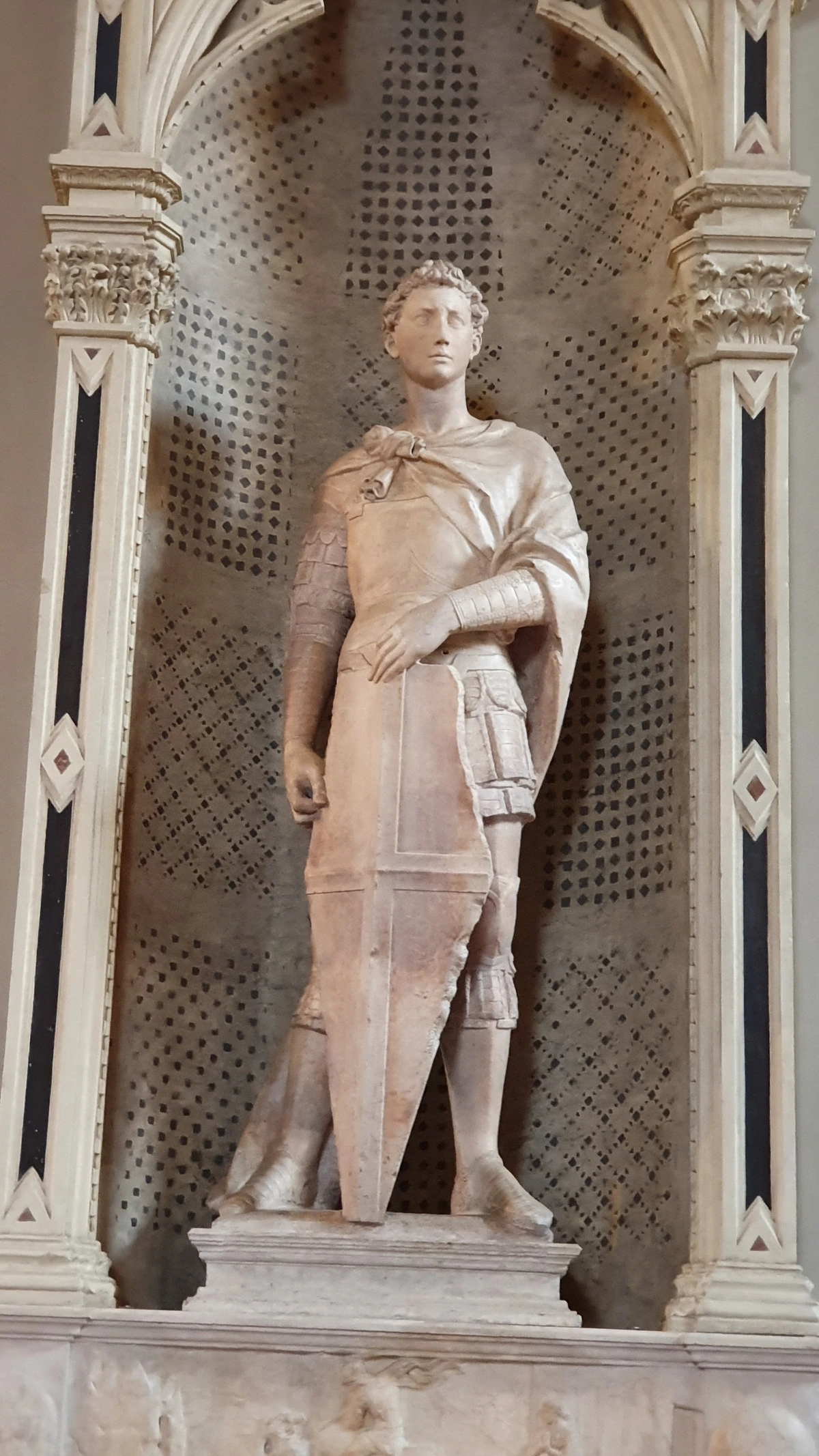
Now, if David is all about subtle psychology, Saint George is about forthright, youthful determination. Carved in marble for the Orsanmichele church in Florence, this statue (circa 1417) depicts the patron saint of the armorers’ guild. But forget the typical heroic stance. Donatello’s Saint George isn't triumphant; he's waiting. He’s poised, shield at the ready, brow furrowed in concentration, eyes scanning the horizon. There's an incredible sense of inner strength and readiness, a quiet defiance. It’s not just a statue; it’s a moment frozen in time, capturing the very essence of youthful courage before the battle begins, a kind of noble tension I often try to evoke in my own compositions. You can almost feel the air thick with anticipation around him, a prelude to heroism.

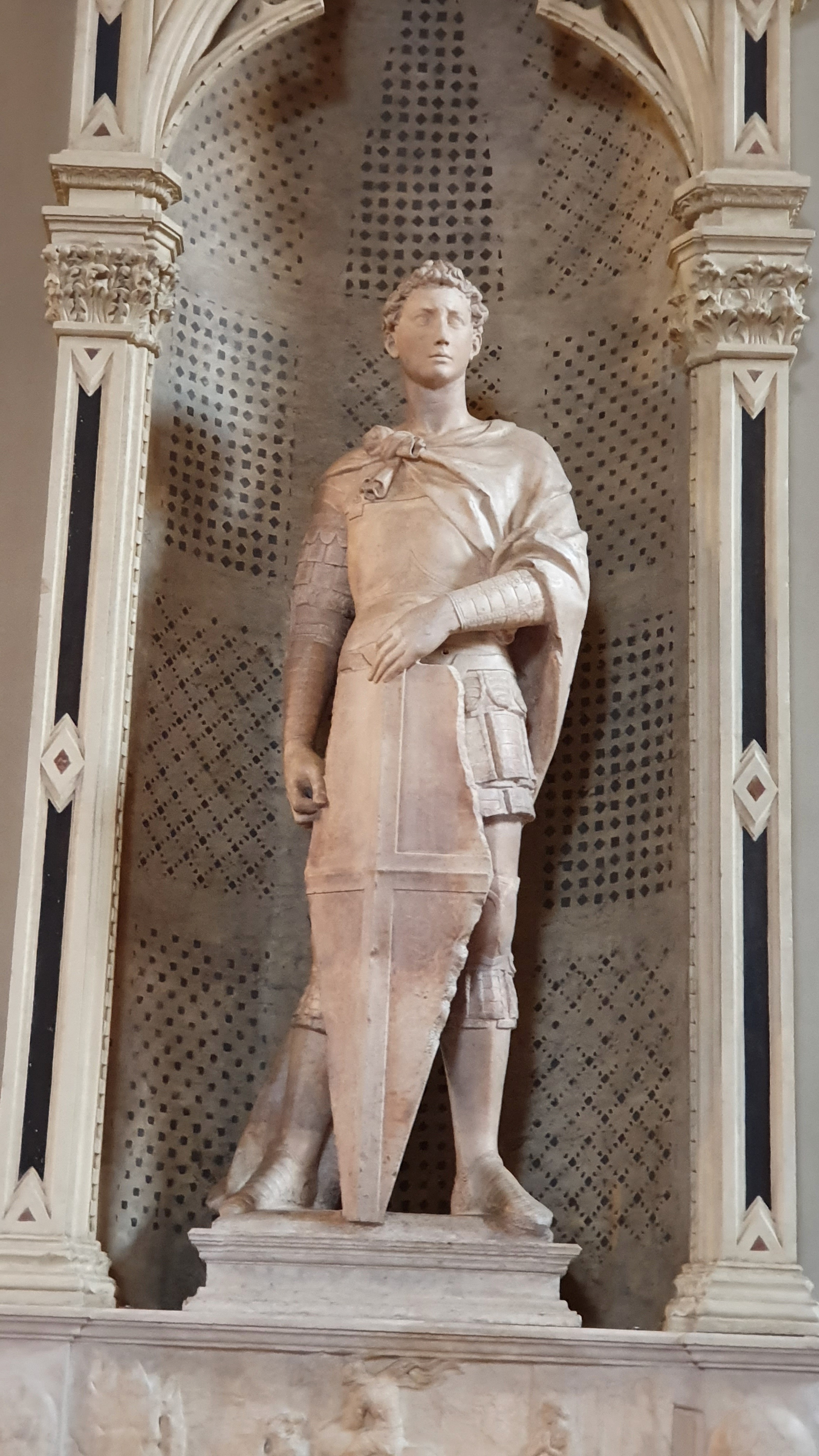

It’s this kind of detail, this insight into the human condition, that makes his work timeless. You see the stress, the readiness, the youthful strength. It's captivating, isn't it? And then, almost as an afterthought, beneath the main figure, Donatello created one of his most famous rilievo schiacciato panels, depicting Saint George slaying the dragon. It's a masterclass in perspective and illusion, making you feel like you're peering into a whole other world, just a few millimeters deep. Incredible. If you're ever in Florence, you simply have to see this in person; the sensation of depth he achieves is truly remarkable, especially when you consider the physical limitations of working with stone. For more on the art of Florence, check out this art lover's guide to Florence.
The Gattamelata Equestrian Statue (circa 1445-1453)
Moving beyond Florence, Donatello also left an indelible mark in Padua with his monumental Gattamelata equestrian statue (circa 1445-1453). This colossal bronze sculpture, depicting the condottiero (mercenary captain) Erasmo da Narni on horseback, was revolutionary. It was the first large-scale bronze equestrian statue since antiquity, a bold statement that resurrected classical grandeur but imbued it with a new sense of Renaissance humanism. For me, it speaks volumes about Donatello's understanding of scale, presence, and the power of public art to commemorate and inspire. It’s not just a portrait; it’s a symbol of command and authority, a masterclass in projecting dignity and strength, almost making you believe the horse and rider could spring to life at any moment. The sheer engineering feat of casting such a massive bronze piece alone is mind-boggling, a testament to his command of sculpture materials and techniques.
The David (Bronze) (circa 1440s)
This one is a showstopper. Cast sometime in the 1440s, Donatello’s David is often cited as the first freestanding nude bronze statue since antiquity. And it’s… audacious. He’s not the hulking, muscular hero Michelangelo would later give us. Donatello’s David is a young, slender, and youthful boy, with a delicate build, wearing nothing but a hat and boots, with Goliath’s severed head casually resting at his feet. There's a certain insouciance about him, a youthful arrogance mixed with a hint of vulnerability. It’s deeply psychological. This portrayal stands in stark contrast to earlier, more traditional depictions of David as a triumphant, fully-clothed warrior, emphasizing instead a divine intervention and youthful cunning over brute force. Was Donatello suggesting something about inner strength over brute force? Or perhaps commenting on Florence's own underdog status against more powerful rivals? Goliath's severed head, typically a symbol of victory, also carries a potent allegorical weight. For Florence, it represented the triumph of intellect and divine favor over brute tyranny, a narrative that resonated deeply with the self-image of the independent city-state. This portrayal stands in stark contrast to Michelangelo's later David, which emphasizes heroic physical might and idealizes the human form. Donatello, however, offers a more intimate, almost fragile victory, highlighting the youth's cunning and divine favor over sheer brawn. I think about this piece a lot when I consider how modern society still grapples with definitions of strength and heroism, and the complexities of coming of age.
Mary Magdalene Penitent (circa 1453-1455)
This wooden sculpture (circa 1453-1455) is a stark contrast to the idealized beauty of much Renaissance art. Donatello depicts Mary Magdalene Penitent as an emaciated, wild-haired old woman, her face ravaged by penance and suffering. It's unsettling, raw, and incredibly powerful. It forces you to confront human frailty and the harsh realities of spiritual devotion. Theologically, her figure embodies the profound power of repentance and divine grace. Her emaciated form and disheveled appearance are not meant to be repulsive, but rather a vivid, almost shocking portrayal of spiritual transformation through extreme asceticism, a challenge to the viewer to reflect on their own piety and salvation. Historically, the Magdalene's image had often been idealized, but Donatello dared to show her profound human struggle and redemption, making her intensely relatable to a devout populace. It’s a testament to his willingness to depict the full spectrum of human experience, not just the pretty parts. And honestly, as an artist, that willingness to explore the uncomfortable, the imperfect, is something I deeply admire and try to bring into my own work; it’s where the real truth often lies. You can also explore the broader context of Renaissance art to see how truly revolutionary this piece was.
The Feast of Herod (circa 1423-1427)
For the Siena Baptistery, Donatello created another masterpiece of relief sculpture, The Feast of Herod (circa 1423-1427). This bronze relief uses his signature rilievo schiacciato to extraordinary effect, depicting multiple narrative moments within a single scene. The biblical story tells of Salome, Herod's stepdaughter, who, at her mother Herodias's urging, dances for Herod and demands the head of John the Baptist as her reward. Donatello masterfully captures the dramatic climax. Donatello guides your eye from left to right, first showing Salome gracefully dancing on the far left, then presenting John the Baptist's head to Herod in the middle ground. The central moment captures Herod recoiling in horror, surrounded by horrified onlookers whose expressions convey a vivid emotional spectrum – from shock to sorrow. Even the musicians in the background react to the unfolding tragedy, their poses adding to the dramatic tension – all compressed into a shallow, dynamic space. It's pure narrative drama, an emotional crescendo frozen in metal. What truly captivates me is how he manages to convey such intense psychological depth and a sense of unfolding tragedy within such confined dimensions. It’s a powerful example of art not just illustrating a story, but experiencing it. And Donatello’s artistic evolution didn't stop there. His later works, like the powerful bronze pulpits for San Lorenzo (circa 1460-1466), showcase his continued innovation in narrative relief, blending emotional intensity with complex composition that some consider precursors to Mannerism. And then there's his Annunciation Tabernacle for Santa Croce (circa 1435), a breathtaking marble relief that showcases his mastery of architectural integration and intricate detail, conveying tender emotion with delicate skill. He was truly a chameleon of form and feeling, always pushing the boundaries of what sculpture could achieve, often employing polychromy (painted finishes) to enhance the lifelike quality and emotional impact of his figures, a common practice that deepened their resonance with viewers.
Donatello's Echo: His Enduring Influence
Donatello didn’t just make great art; he changed the game. He basically laid the groundwork for the High Renaissance, inspiring generations of artists who followed. Think of Michelangelo – his David, while dramatically different in its heroic idealization, owes a massive debt to Donatello’s pioneering work in freestanding sculpture, daring to represent the human form in all its vulnerable glory. Donatello’s David captures a psychological moment of youthful triumph, whereas Michelangelo’s embodies an idealized, contemplative hero before the fight, yet both stand as monumental explorations of the human condition in marble. Even the profound emotional intensity in Michelangelo's Pietà can be traced back to Donatello's willingness to depict raw human suffering with unsettling realism. Donatello’s emphasis on naturalism and emotion became fundamental to how art was created for centuries, influencing artists like Andrea del Verrocchio (whose own David sculpture clearly builds on Donatello’s innovation) and even the young Leonardo da Vinci, who would have intensely studied Donatello's works, especially his mastery of drapery and emotional expression. His influence wasn't confined to sculpture either; painters like Masaccio also drew inspiration from his realistic figures and revolutionary sense of space, significantly impacting the development of linear perspective and anatomical accuracy in painting. Donatello’s groundbreaking use of perspective in relief, for example, directly informed how painters constructed their illusionistic spaces. Moreover, Donatello’s highly active workshop, a bustling hub of creative energy, served as a crucial training ground, disseminating his groundbreaking techniques and artistic philosophy to numerous apprentices and assistants. Figures like Bertoldo di Giovanni, his pupil and later the director of the Medici academy, carried Donatello's legacy forward, teaching the next generation of Renaissance masters, including Michelangelo himself. Even centuries later, artists like Benvenuto Cellini and Gian Lorenzo Bernini, masters of their own eras, would echo Donatello's daring in their dramatic bronze figures and psychologically charged compositions, proving his influence transcended mere technique to define a powerful artistic lineage.
He also engaged in significant intellectual sparring with his contemporaries. His famous friendly rivalry with Filippo Brunelleschi, particularly over their respective crucifixes for Santa Croce, highlights the vibrant intellectual climate of early Renaissance Florence. While Brunelleschi sought idealized perfection, presenting a polished, classically inspired Christ, Donatello embraced a more realistic, human portrayal, showing a Christ ravaged by suffering. This debate pushed both artists to new heights, clarifying the emerging Renaissance emphasis on human experience by contrasting idealized form with raw emotion. And let's not forget his early mentor, Lorenzo Ghiberti, whose own monumental bronze reliefs for the Florence Baptistery doors initially set the standard for the era. While Ghiberti's work was lauded for its graceful idealism, Donatello's more robust and psychologically intense style was a clear departure, pushing the boundaries of realism in a way that Ghiberti's polished classicism, for all its beauty, did not. He showed that art could be more than decorative or purely symbolic; it could be a mirror reflecting the complexities of the human soul, a powerful comment on human frailty and strength. For more on another Renaissance giant, consider reading the ultimate guide to Michelangelo.
For me, his influence isn't just historical. It's a constant reminder that art, real art, is about pushing boundaries, about asking difficult questions, and about connecting with the deepest parts of what it means to be human. It’s about creating something that endures, that speaks across time and culture. And maybe, just maybe, that’s the underlying goal of my own work too, even if my canvases are a riot of colors and abstract forms, very different from his bronze and marble. I sometimes think about my own artistic timeline and how every artist, knowingly or not, builds upon the shoulders of giants like Donatello. His works aren't just artifacts; they're conversations with the past, invitations to reflect on enduring themes. You can still visit places like the Bargello Museum in Florence and stand before his Saint George, and feel that quiet strength radiating out, almost like he's still waiting, still watching. It’s an experience I recommend to anyone who wants to feel the pulse of history, even if you just find yourself in 's-Hertogenbosch and visit my museum for contemporary abstract art; the essence of connecting with art remains the same, a bridge between creator and observer, a timeless dialogue that Donatello so eloquently initiated.
FAQ: Pondering Donatello's Legacy (and Mine)
Why is Donatello considered so important?
Honestly, because he single-handedly dragged sculpture into the Renaissance, essentially inventing the modern sculptor's approach. He didn't just bring back classicism; he fused it with a startling naturalism and psychological depth that had been absent for a thousand years. He made figures feel real, human, full of inner life, capable of expressing profound emotion – from the youthful defiance of Saint George to the ravaged piety of Mary Magdalene Penitent. Plus, he pioneered techniques like rilievo schiacciato and created the first freestanding nude bronze since antiquity. He was a trailblazer, period, defining the future of sculpture for centuries to come by brilliantly synthesizing classical forms with contemporary observation of the human condition.
What was Donatello's most famous work?
While many would point to his bronze David (and for good reason, it’s revolutionary!), fame can be subjective. For me, it's less about a singular "most famous" and more about the diverse impact of his entire oeuvre. His Saint George also stands out as a powerful representation of youthful defiance and a technical marvel of subtle human emotion, and his Mary Magdalene Penitent is unforgettable for its raw, unsettling emotional intensity. Then there's the monumental Gattamelata equestrian statue, a symbol of revived classical grandeur and military might that profoundly influenced public monuments for centuries. It’s like asking a parent which child is their favorite – tough to pick just one! Each piece holds its own unique significance in the tapestry of art history, offering different facets of his genius.
Did Donatello invent anything?
'Invent' is a strong word for art, but he certainly innovated massively and reinvented sculpture for his era. His rilievo schiacciato technique was truly novel, allowing for pictorial depth in very shallow relief, essentially creating the illusion of three dimensions within two. Beyond specific techniques, his greatest 'invention' was perhaps a new artistic language: a brilliant synthesis of classical forms and ideals with an unprecedented observation of human anatomy and psychology. His approach to humanizing religious and classical figures, injecting them with naturalism and psychological complexity, set a new standard, effectively inventing the modern Renaissance sculptor's approach to form and emotion. He wasn't just building on tradition; he was actively forging new paths, and that, to me, is the true essence of invention in art.
Who were Donatello's key contemporaries and rivals?
Donatello operated in a vibrant artistic environment. His early mentor, Lorenzo Ghiberti, was a significant figure whose graceful, idealized bronze reliefs (like the famed 'Gates of Paradise' for the Baptistery doors) initially set the standard for the era. Their early collaboration and later competition for commissions undoubtedly spurred Donatello's ambition, pushing him to differentiate his own robust and psychologically intense style. Perhaps his most famous friendly rivalry was with the architect Filippo Brunelleschi. Their intellectual debates, particularly over their respective crucifixes for Santa Croce (Brunelleschi's idealised, Donatello's raw and human), epitomized the shift in artistic thought from idealism to realism, pushing both to excel. These interactions pushed Donatello to constantly refine his vision and techniques, proving that a little competition can be a powerful catalyst for genius.
Where can I see Donatello's work today?
The best places are in Florence, Italy, especially the Bargello Museum (where his David and Saint George are often exhibited) and the Duomo Museum. His Gattamelata is in Padua. While you won't find Donatello's originals in my museum in Den Bosch for contemporary abstract art, the spirit of artistic innovation and human connection that he championed is something I strive to embody in my own works. So, in a way, you're always encountering his legacy, wherever truly expressive art is found.
Wrapping Things Up: My Donatello Takeaway
So, there you have it. My admittedly rambling, but hopefully heartfelt, 'ultimate guide' to Donatello. You know, I started this journey feeling a bit daunted by the idea of an 'ultimate guide,' but diving into Donatello's world has reminded me that true understanding comes not from exhaustive lists, but from personal connection and deep, often unexpected, resonance. He was more than just a master craftsman; he was a revolutionary, a psychologist with a chisel, a storyteller in stone and bronze. His enduring contribution to art history lies in his audacious embrace of humanism, his groundbreaking technical innovations, and his fearless pursuit of psychological realism, profoundly shaping the trajectory of sculpture for centuries to come. He reminds me that art isn't just about technical skill; it's about courage, about humanity, about daring to see the world, and yourself, in a new light. His unwavering pursuit of truth in depiction, even when uncomfortable, is a profound lesson for any artist, including myself, who tries to translate human experience into abstract forms and vibrant colors. It's about finding that raw, honest connection, whether with a biblical figure or an abstract concept on a canvas. And perhaps that’s the greatest lesson I take from him: don't be afraid to break the mold, even if it means getting a few strange looks. Because sometimes, that's exactly what's needed to create something truly timeless, something that resonates with people hundreds of years later. Now, if you'll excuse me, I feel inspired to go make some art – maybe a little less bronze, a little more color, but definitely with a nod to that restless spirit that defined Donatello, the artist who crashed into my preconceptions and left me profoundly changed. He reminds me that even in abstract art, the human story, in all its messy glory, is still the most compelling subject. You can also dive into Why I Paint Abstract: My Personal Philosophy and Artistic Vision to see how these ideas translate into my own practice.