Rodin's 'The Thinker': The Visceral Truth of Creation and Universal Struggle
Beyond quiet contemplation, Rodin's 'The Thinker' embodies a raw, physical battle of creation. Uncover the sculpture's true meaning, from its infernal origins to its universal resonance.

Rodin's 'The Thinker': The Visceral Truth of Creation and Universal Struggle
We've all seen him, haven't we? That iconic statue that instantly screams 'deep thoughts,' a universal shorthand for quiet contemplation. But what if we've been looking at him all wrong, mistaking profound struggle for simple pondering? For years, I certainly did, accepting the serene 'philosopher' myth without question. My own studio, a battlefield of blank canvases and stubbornly abstract ideas, has taught me better.
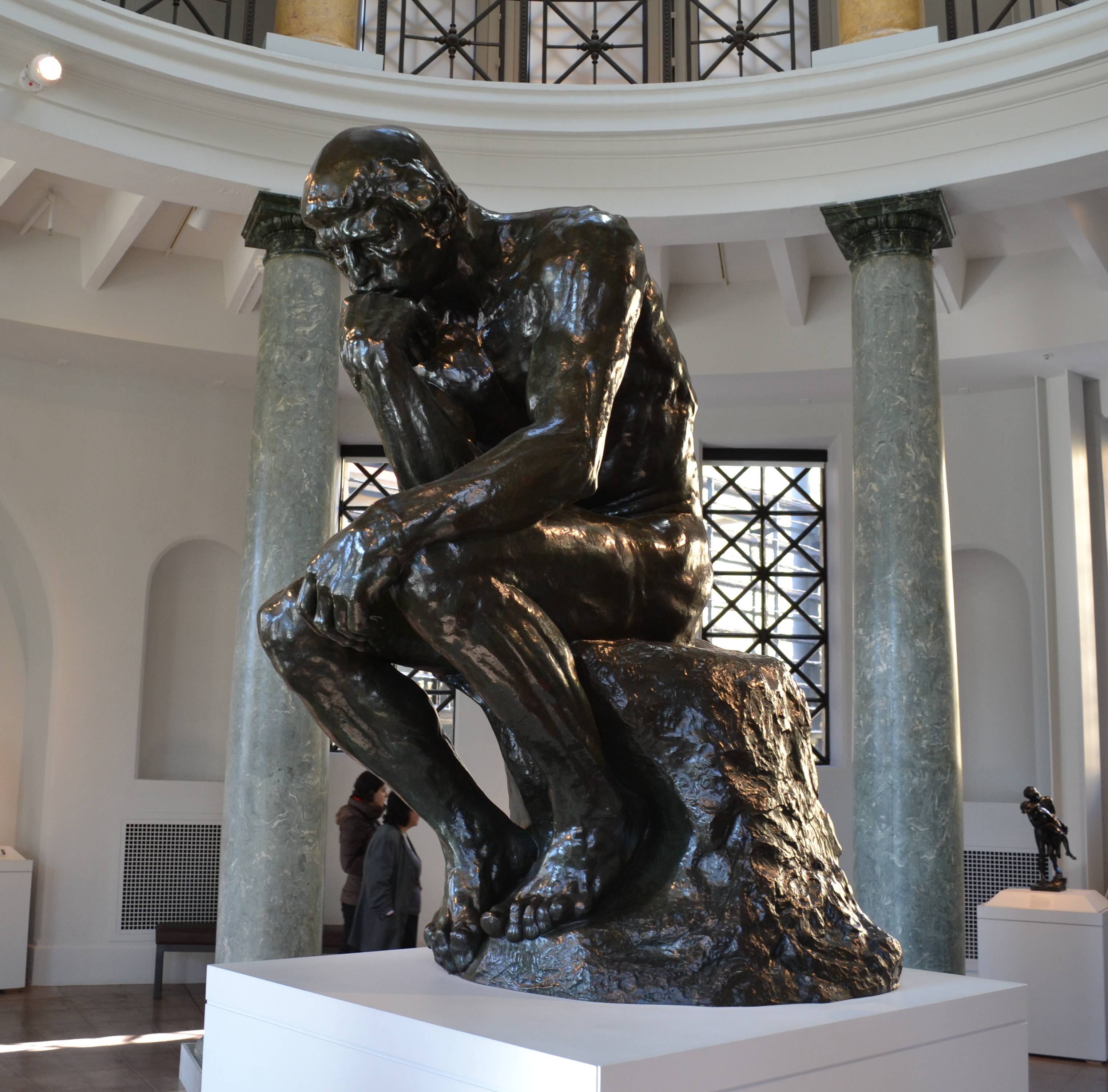
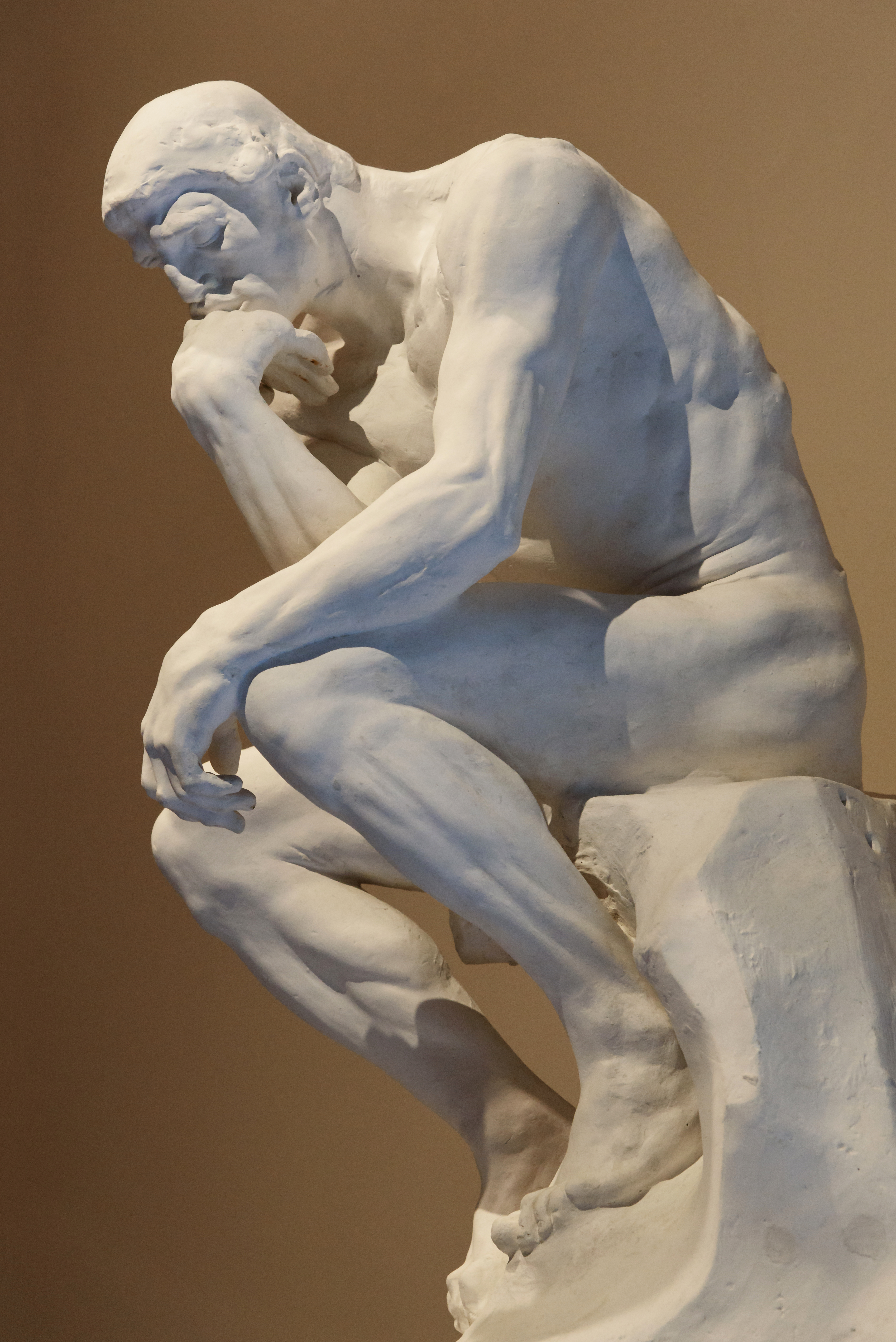
Then, something shifted, something truly clicked. I found myself doing what Rodin's figure does: I stopped and really looked. My first, instinctive reaction was, "Man, that looks uncomfortable." He’s not just chilling, is he? His impossibly muscular body is coiled, every sinew tense, every muscle engaged. This isn't just a mood; it's a physical exertion, a body contorted by the sheer weight of a mind at work. His brow is a roadmap of concentrated agony, etched with a visceral intensity. His fist isn't gently resting on his chin; it's pressed hard against his mouth, a gesture of deep internal conflict, perhaps even a contained, unspoken scream. This isn't abstract philosophy; this is raw, physical work. This is a battle of the mind so fierce that the body itself aches with the effort, echoing the feeling I often get when trying to untangle a particularly stubborn creative problem in my own work. It’s the agonizing truth of creation, made manifest.
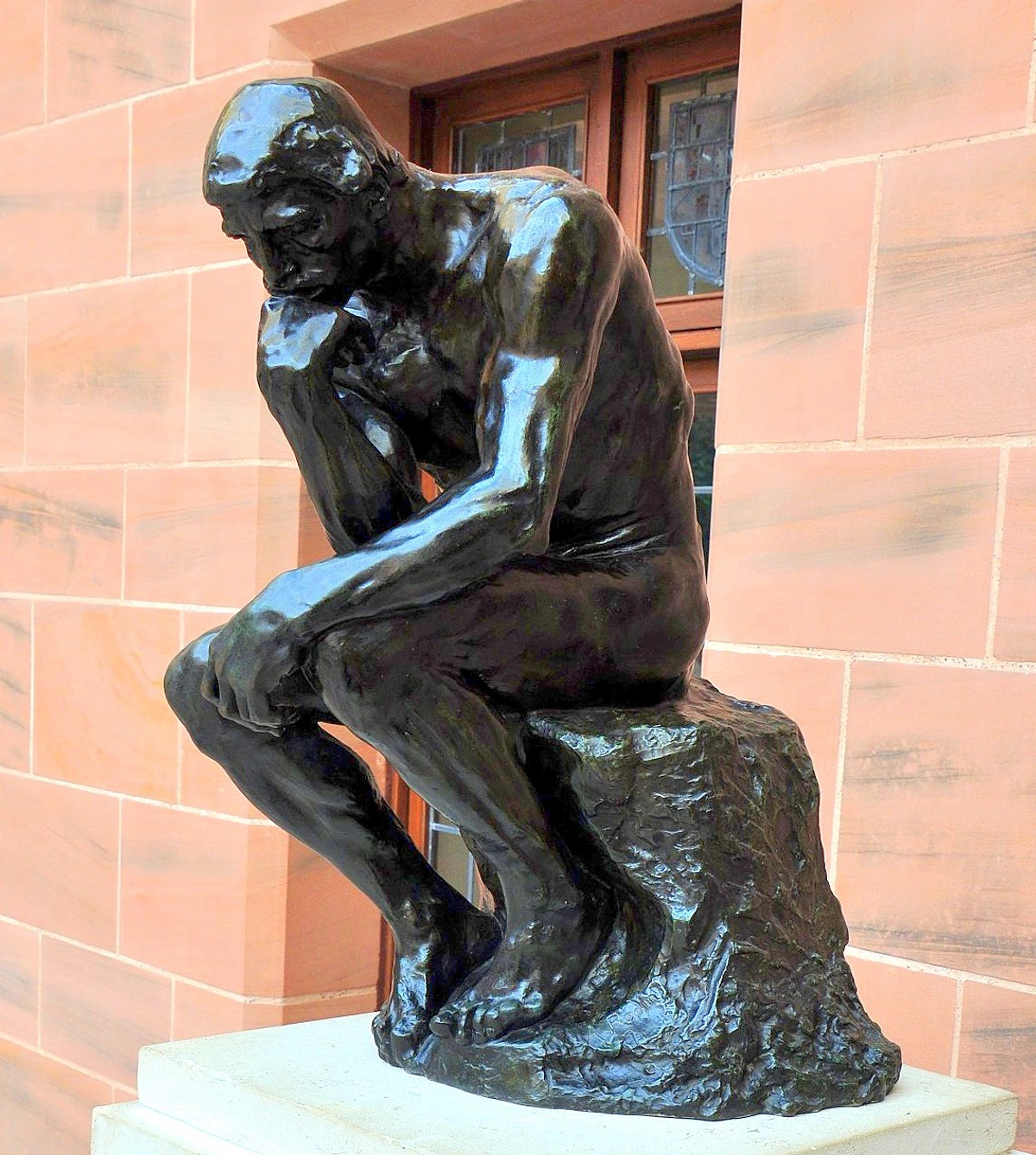
This physical intensity is not accidental; it’s deeply rooted in the sculpture's dramatic and often-overlooked genesis. To truly unlock the secret of this bronze titan's intensity, to grasp the sheer physical struggle he embodies, we must journey back to his surprising birthplace – not a quiet study, but the very gates of Hell.
The Unexpected Genesis: Gazing into Hell's Abyss
Here’s the biggest surprise for most people, and it fundamentally reshapes everything we think we know about the sculpture: 'The Thinker' was never intended to be a standalone piece. Not initially, anyway. He was conceived as a single figure, originally called 'The Poet,' within a colossal, chaotic masterpiece that Auguste Rodin spent decades on and, famously, never fully finished: 'The Gates of Hell.'
Rodin’s approach was a radical departure from the prevailing academic styles of late 19th-century France. While his contemporaries often favored idealized classical forms, smooth, polished surfaces, and clear narrative-driven sculptures (think: the elegant historical tableaux and idealized figures of sculptors like Antonin Mercié or Paul Dubois, meticulously rendered with classical grace), Rodin shattered these conventions. He was challenging an establishment that valued serenity and overt storytelling, opting instead for raw, unvarnished emotion and intense physicality. This wasn't just different; it was revolutionary, foreshadowing the emotional intensity of Symbolism and the expressive power of early Modernism. He believed the body itself was the ultimate vessel of human emotion, capable of expressing complex inner states through its very posture and musculature.
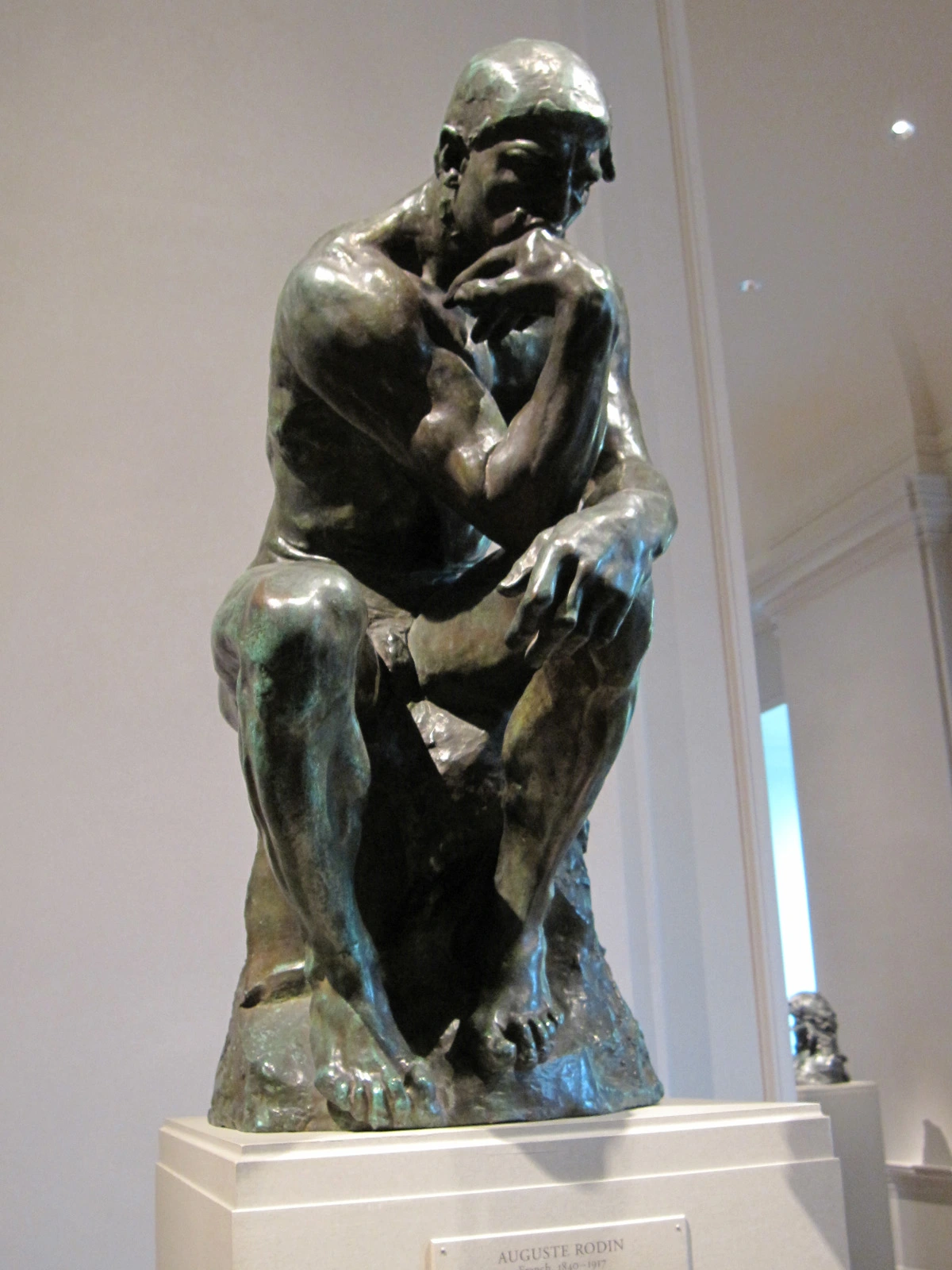
Commissioned in 1880 for a new decorative arts museum in Paris, Rodin chose a subject of immense scale and profound human drama: Dante Alighieri's Inferno, the first part of the Divine Comedy. Dante’s Inferno itself is a journey through nine circles of Hell, a vivid allegorical depiction of sin, punishment, and the human condition at its most debased. It explores themes of divine justice, free will, and the consequences of moral choices, making it a powerful foundation for Rodin's exploration of human suffering.
His plan for 'The Gates of Hell' was breathtaking: to cover massive bronze doors with a swirling, tumultuous mass of over 180 tormented figures. Imagine a torrent of human sin and suffering, a tableau of eternal torment where the damned are not mere characters but embodiments of our deepest fears and failures: the eternally entwined lovers Paolo and Francesca, caught in their whirlwind of lust; the emaciated Ugolino, gnawing at the heads of his dead children, consumed by hunger and despair; or the desperate forms of The Three Shades, condemned to eternal restlessness. These aren't just characters; they are embodiments of humanity at its most broken, its most vulnerable, its most damned. Each figure a testament to human fallibility and eternal suffering, a microcosm of existential angst.

And who was perched right at the top, in the center of the lintel, looking down on all this suffering? 'The Poet' – Dante himself. Rodin conceived him as the ultimate creator, envisioning and writing his terrible and beautiful poem. So, 'The Thinker' is Dante, watching his own creation, the infernal visions, unfold below him, grappling with the immense moral and existential weight of damnation, of human suffering, and the agonizing process of giving form to such a horrific vision. This context changes everything, doesn't it? He’s not just pondering; he's witnessing and grappling with the immense moral and existential weight of damnation, of human suffering, and the agonizing process of giving form to such a horrific vision. Once we understand his original placement within this infernal panorama, his posture begins to reveal a profound narrative of creation and despair. From the depths of Hell, Rodin's mastery of form reveals the visceral reality of creative struggle.
The Anatomy of Agony: Sculpting Thought into Form
Forget the serene philosopher; this is a creator, a poet, wrestling with the immense weight of sin, damnation, and human suffering. It’s a physical, gut-wrenching act of creation and profound introspection. What kind of monumental task demands such a physical commitment? My take? It's the kind of all-consuming creative struggle, the philosophical weight of depicting Hell, the challenge of translating abstract concepts into tangible form, and the sheer ambition of 'The Gates of Hell' that makes you feel like your very bones are aching.
For Rodin, thinking wasn't a delicate cerebral exercise. It was a full-body sport, a wrestling match where the mind's effort contorted every muscle, strained every sinew. He was obsessed with the idea that the body was the ultimate vessel of human emotion, a concept he deeply admired in the works of Michelangelo, particularly his powerful figures on the Sistine Chapel ceiling whose dynamic poses and sheer physical grandeur conveyed intense inner states. Breaking from traditional art that often depicted intellectuals as frail, minds disconnected from bodies, Rodin shattered that convention. He gave his 'Poet' the physique of a titan – a powerful, muscular form. Why? Because for Rodin, thought was a powerful, all-consuming force. He believed the mind's struggle was so intense that the entire body had to participate, much like an athlete's body strains with mental effort during a grueling competition. This is what I call his "philosophy of the body" – that true thought is a somatic, rather than merely cerebral, experience.
That 'uncomfortable' feeling? It's deeply familiar to me, sitting in my own studio, wrestling with a blank canvas or a composition that just isn't clicking. The mental strain of trying to untangle a particularly stubborn creative problem can make your shoulders ache, your jaw clench, your entire body tense. Rodin understood this visceral link between profound mental effort and physical manifestation better than anyone. He didn't just pose his models; he observed them in moments of intense effort, capturing the truth of a body under strain. He performed exhaustive anatomical studies, and collected hundreds of plaster fragments of hands, feet, and torsos – each a small masterpiece of expressive form in itself, allowing him to precisely capture the nuances of a body under psychological and physical stress.
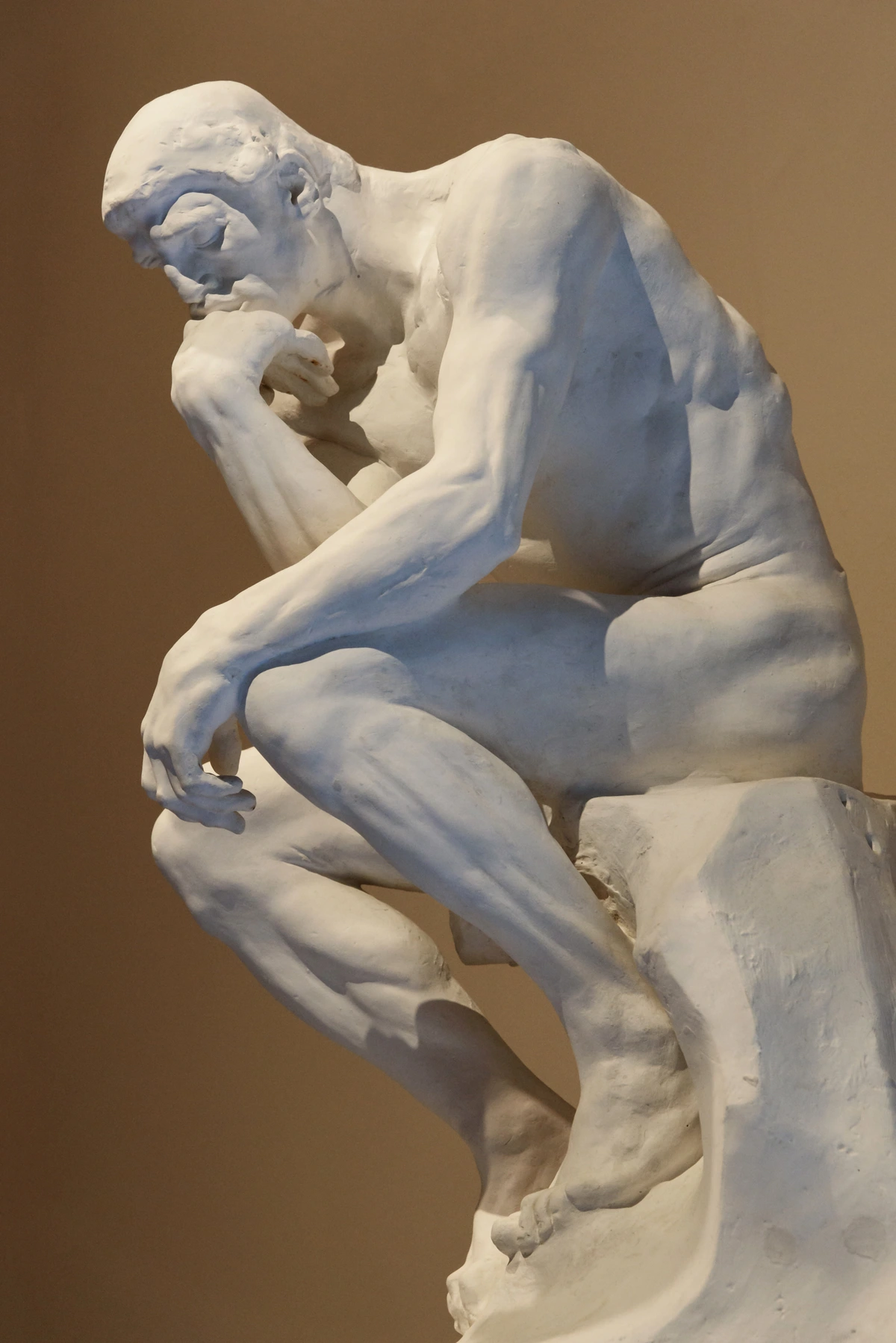
Let’s look closely at the anatomical details that convey this struggle:
- Toes: They grip the rock beneath him, digging in as if holding on for dear life, anchoring him in his torment or intense focus. Just as his toes grip the rock, I sometimes feel my own hands clench the brush, my feet rooted to the floor, desperate to hold onto an idea that’s threatening to slip away. It's a primal, almost desperate hold. They embody a grounded intensity.
- Legs: His legs are tightly coiled, the muscles taut and bulging, creating a powerful, spring-like tension that suggests a contained explosive energy, ready to unleash or restrain the mind's profound turmoil. This isn't relaxation; it's readiness for battle, a coiled spring of creative force.
- Torso: There's a slight twist to his torso, adding to the dynamic tension, suggesting internal torsion and resistance, a physical embodiment of a mental knot being wrestled with. Every muscle is engaged in this silent war, just as my core engages when I try to find balance in a complex composition. His arched back, every vertebra straining, conveys immense effort and the physical burden of an invisible weight on his shoulders—the weight of creation, moral judgment, or perhaps the suffering of all humanity. It's an internal cry made external, mirroring the way my own shoulders tense and ache when I'm deep in an artistic problem.
- Arms: His right arm, a column of bronze, provides rigid support for a head heavy with profound, perhaps agonizing, thought. The palpable tension in his forearms seems to hold up not just his head, but metaphorically, the immense weight of the world (or Hell, in this case). His left arm hangs heavy, adding to the gravitas. I know that feeling when an arm feels like a lead weight after hours of concentrated work.
- Hands: His fist is not gently resting; it's clenched or pressed hard against his mouth, a powerful gesture speaking of inner turmoil, a desperate attempt to contain overwhelming visions, an unspoken scream, or perhaps a primal need to bite back at the harsh realities he witnesses. This is a contained explosion of emotion, much like clenching my jaw when an idea won't materialize.
It's the perfect, almost shocking, union of mind and might. He's not just thinking; he's wrestling with an idea, with a vision, with the very fabric of human experience. Rodin, with his meticulous studies of anatomy, often from dozens of live models, allowed him to imbue his figures with an almost shocking realism, translating internal psychological states into external, palpable physicality. His revolutionary vision involved depicting inner psychological states through raw, external physicality, often leaving surfaces intentionally rough – a technique known as non-finito (Italian for "unfinished"). This was a deliberate artistic choice to convey raw energy, the ongoing process of creation, and profound human emotion. For 'The Thinker,' this means the rough textures on his musculature, the less defined edges, all contribute to the feeling of an unending, unresolved internal struggle, making the act of thought feel immediate, visceral, and ceaseless. It’s like seeing a sculptor's clay before it's perfectly polished, or a contemporary artist's work that embraces raw texture and visible brushstrokes – you feel the hand, the effort, the ongoing negotiation with the material, the raw creative impulse before the final polish. This technique, also seen in works like his powerful Burghers of Calais, leaves parts of the sculpture intentionally 'unfinished,' emphasizing the raw energy, the ongoing process of creation, and profound human emotion rather than polished idealization. This was a radical departure from the academic traditions of smooth, idealized forms and narratives that merely illustrated stories, often seen in the more polished works of his contemporaries like Antonin Mercié or Paul Dubois.
From Dante to Everyman: The Universal Resonance of the Struggling Soul
But Rodin, a master of giving form to the formless, didn't intend for this powerful figure to remain confined to Hell's fiery embrace forever. Rodin first exhibited 'The Thinker' as a standalone piece in 1888, deliberately removing him from the explicit context of 'The Gates of Hell.' This act caused his meaning to explode, transforming him from a specific literary figure into a universal archetype. He was no longer just Dante; he became a bronze Rorschach test onto which we could project our own deepest reflections. It's like he became a mirror, reflecting the quiet battles we all fight within our own minds, those moments of intense concentration or internal debate, a timeless representation of humanity's existential wrestling match. It's a testament to the idea that the profound agony of creation in a specific context (Dante's Inferno) can resonate as the universal struggle of humanity itself.
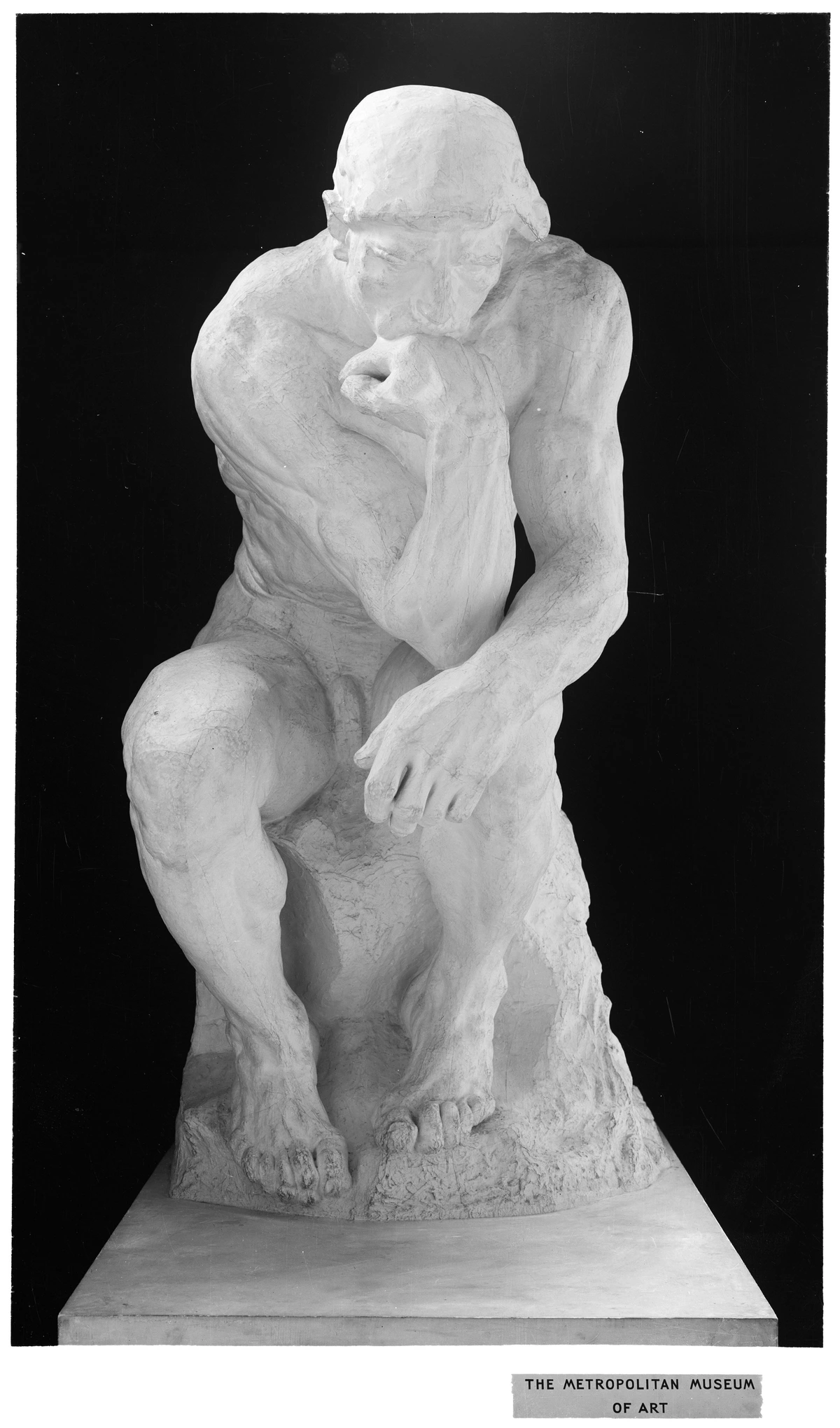
Rodin himself articulated this evolution beautifully: "My Thinker suggests not only a dream in his head, but that his arms, his legs, his whole body are also thinking." He became an archetype: humanity contemplating its destiny, grappling with its place in the universe, asking those fundamental questions about morality, free will, and the meaning of suffering. He could be a worker resting, a poet searching for the perfect word, a scientist on the verge of a breakthrough, the writer wrestling with a plot twist, a student staring at a daunting exam question, or even a historical figure like a general pondering a crucial battle strategy. The power of this piece lies in its ability to embody nearly any profound internal struggle.
His nudity is absolutely key to this universality. By removing clothing, Rodin stripped him of any specific era, profession, or social status. While nudity in classical sculpture often symbolized heroism or divinity, Rodin reclaimed it to represent the raw, universal human struggle of thought itself. By stripping him bare, Rodin revealed man in his most essential, primal state, transcending the superficialities of fashion, era, or social rank. This allows him to embody not just an individual's struggle, but the universal human experience of grappling with existence, unfettered by societal artifice – much like how a foundational character design often strips away specific markers to embody a pure archetype. He is the raw, unvarnished human spirit, defined only by his formidable capacity for both body and mind to engage in thought. He is all of us, in our moments of intense, solitary concentration, wrestling with a problem or a creative challenge.
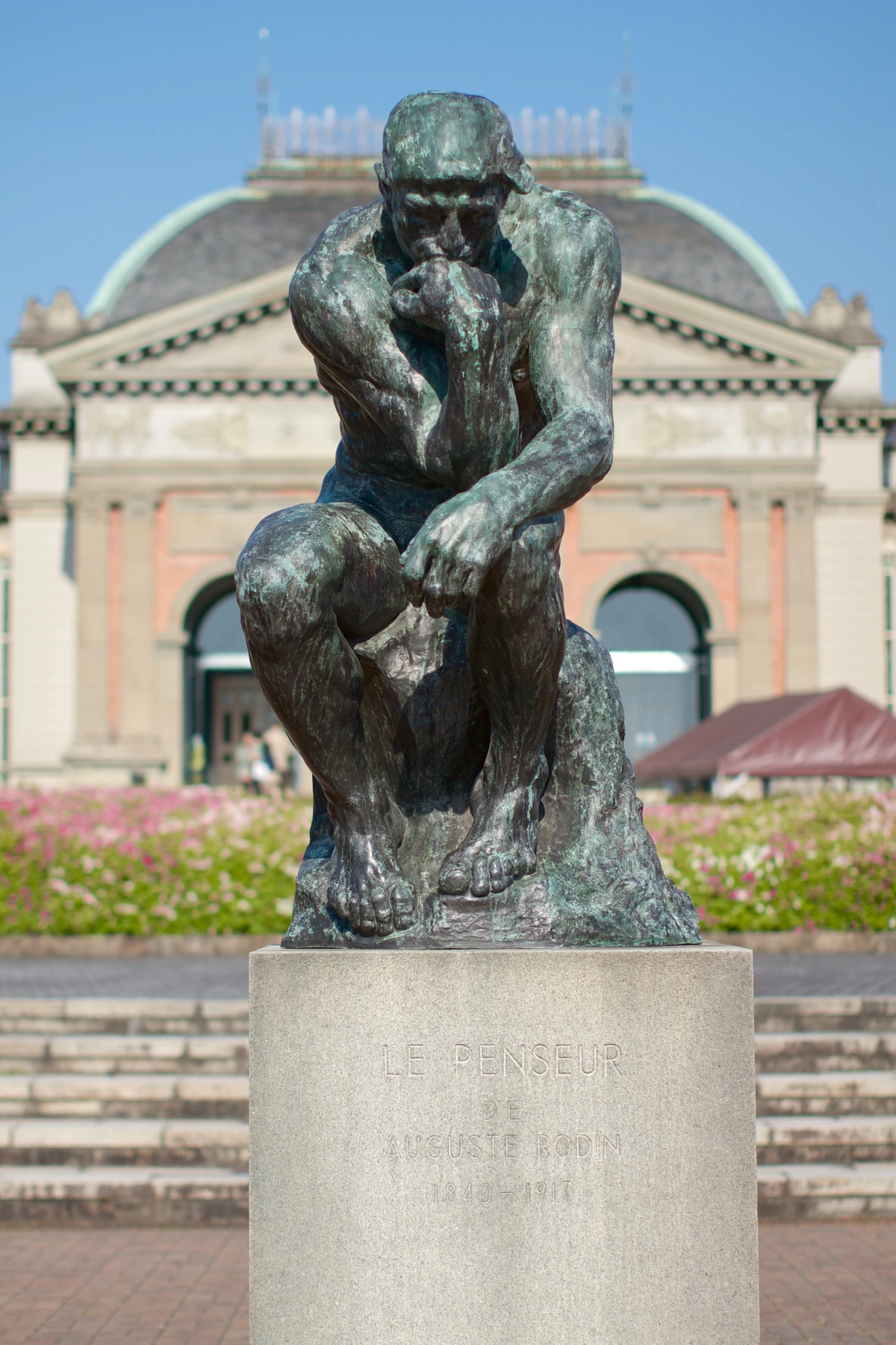
The popular 'Philosopher' interpretation, while widespread, often misses the point of his inherent struggle. People frequently imagine him as serene, calmly musing on abstract concepts. Yet, his actual pose, as we've explored, screams anything but serenity. Why, then, does the serene 'Philosopher' image persist? Perhaps it's a collective desire for intellectual comfort, an idealization of thought divorced from its messy, human reality. We want to believe profound thought is calm, elegant, effortless. But Rodin’s Thinker tells a different, more challenging truth: true insight often demands agony, a battle of will and intellect. This popular misinterpretation, however, highlights his enduring appeal as an icon of intellect, regardless of its accuracy regarding Rodin's initial intent. Similarly, the turn of the 20th century saw immense social and industrial upheaval. Rodin, with his profound empathy for the human condition, began to envision his Thinker not just as an intellectual hero but as a symbol of the common 'Worker,' elevating the intellectual dimension of physical labor and recognizing the profound thought behind everyday toil. This was a democratic ideal for his time, aligning with the rise of labor movements and a growing appreciation for the dignity of manual work amidst the era of industrialization and its challenges, suggesting that intellectual struggle was not exclusive to academics, but inherent to all humanity.
The proliferation of 'The Thinker' is a testament to this universal appeal. There are more than 20 authorized original bronze and plaster casts created by Rodin's studio during and after his lifetime, distinguishing them from countless unauthorized copies. These authorized versions are located in museums and public spaces around the globe, from Paris to Tokyo, Copenhagen to Buenos Aires, and Philadelphia. Each one invites new interpretations, reflecting the times and the cultures that engage with it.
Here’s a quick breakdown of the evolving interpretations of this profound Rodin sculpture:
Interpretation  | Context and Evolution | Core Meaning | Key Artistic Elements | Viewer Experience |
|---|---|---|---|---|
| The Poet (Dante) | Original placement on 'The Gates of Hell' (c. 1880). Rodin's initial intent. | The creator grappling with the immense and terrible vision of his own work, witnessing eternal damnation. | Explicit literary context, rough textures, coiled posture, intense witnessing of suffering. | A sense of profound moral and existential weight, the agony of creation. |
| The Universal Man | Exhibited as a standalone sculpture (post-1888), deliberately isolated by Rodin for universal appeal. | A symbol of all humanity engaged in the act of creative and intellectual thought, wrestling with destiny. | Nudity, timelessness, powerful musculature, embodying fundamental human questions. | Relatability, a mirror to one's own internal battles, connection to the human condition. |
| The Philosopher | Popular cultural view (widespread, often a misinterpretation) due to societal desire for comforting intellectual images. | An icon of intellect, deep contemplation, and abstract thought. | Assumed serenity (contrasting actual tension), focus on mental activity, idealized wisdom. | Intellectual comfort, admiration for thought, sometimes a disconnect from its physical reality. |
| The Worker | Rodin's later social interpretation (c. 1900), reflecting industrial age social changes. | A symbol of the thinking working-class man, a hero of modern life, dignifying labor. | Emphasis on physical labor's intellectual dimension, powerful physique, democratic ideal. | Appreciation for the intellect in everyday toil, a sense of shared human dignity. |
| The Modern Icon | Contemporary pop culture (pervasive imagery) in memes, advertising, film, and parody. | A shorthand for 'deep thoughts' or intellectual effort, often used ironically or humorously. | Ubiquity, cultural appropriation, adaptability across media, simplified meaning. | Familiarity, humor, recognition, sometimes a trivialization of its deeper meaning. |
A Monumental Journey: Craft, Controversy, and Cultural Echoes
Public Unveiling and Fierce Debate
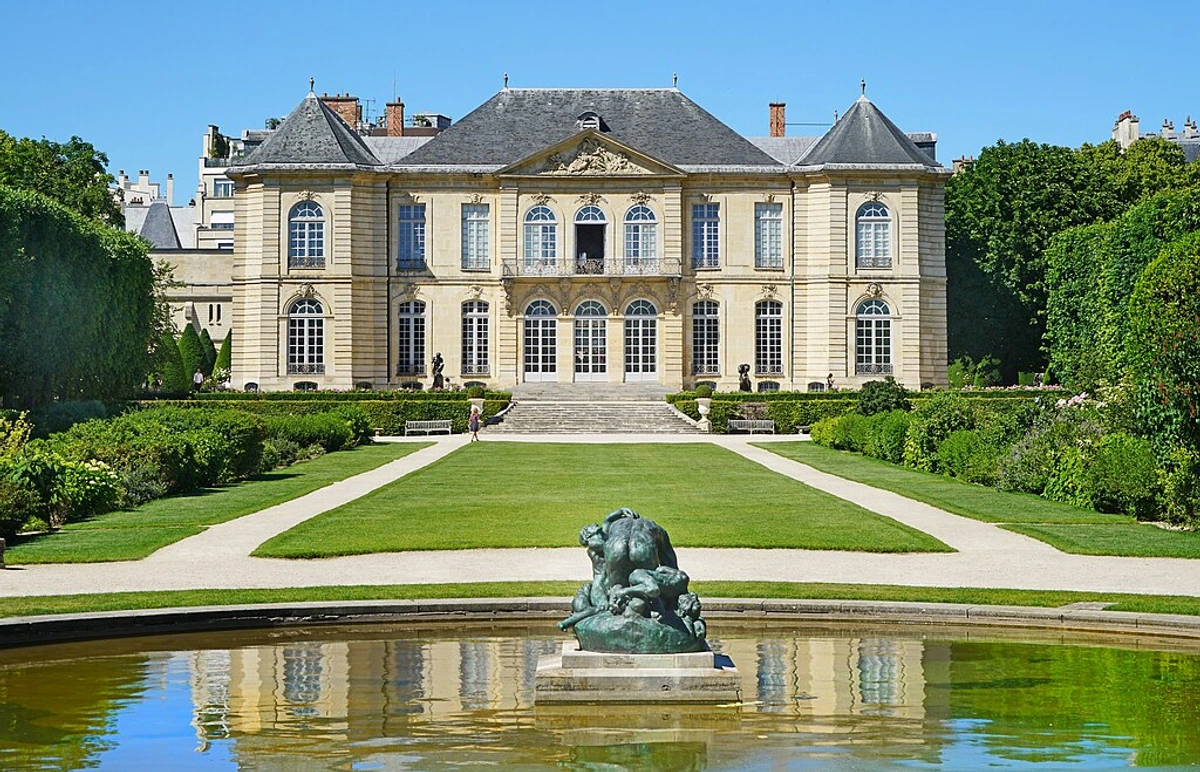
The original monumental bronze version, significantly enlarged in 1904, became public property and was controversially placed outside the Panthéon in Paris in 1906. This was more than just a placement; it was a powerful statement, an official tribute to France’s greatest minds, signaling that thought itself was a national treasure worthy of public veneration. However, not everyone agreed. Its raw nudity and intense, almost animalistic, physicality were deemed inappropriate by some for such a revered national monument. Critics scoffed, declaring him too 'bestial' and 'unrefined' for the hallowed halls of national intellect, a stark contrast to the polished marble figures and classical grace they were accustomed to. This debate over its suitability underscores Rodin's radical departure from academic traditions, a true challenge to the artistic establishment of his time. His bold decisions, like the raw physicality of 'The Thinker,' often sparked heated debate, cementing his reputation as both a controversial figure and a groundbreaking artist who redefined sculpture for the modern age. It eventually led to its relocation to the Musée Rodin in 1922, where the earliest plaster model from around 1881 and the first large-scale bronze cast also reside. This museum remains the definitive place for Rodin's work.
Bronze and the Lost-Wax Legacy
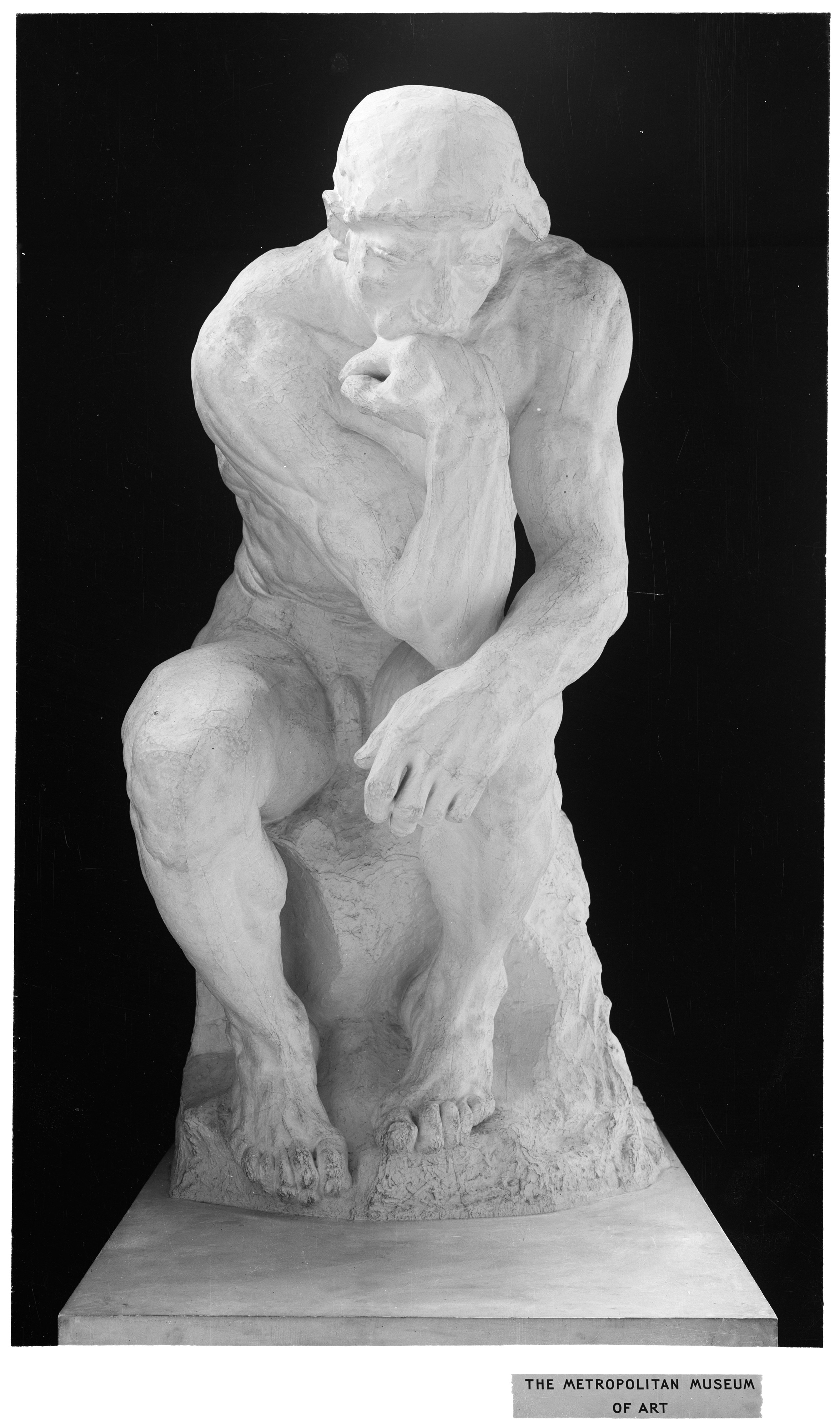
It’s important to remember that 'The Thinker' exists in various scales, from the intimate original plaster model (around 70 cm high) to the imposing monumental bronze version (nearly 2 meters tall), first unveiled in 1904. Each scale profoundly impacts the viewer's experience; the monumental scale of outdoor versions, for instance, commands a different kind of awe – making the viewer feel smaller, emphasizing the enormity of the ideas, and elevating the act of thinking to a grand, public spectacle – compared to smaller, indoor casts which might invite a more intimate, personal contemplation. This isn't a figure made of fleeting thought; it's solid bronze, heavy and immutable, mirroring the monumental, almost crushing, weight of the ideas it represents. The choice of bronze, a material renowned for its permanence and ability to capture intricate detail, perfectly aligns with the enduring power of Rodin’s subject. He understood that to convey eternal struggle, he needed an eternal medium.
Rodin meticulously modeled his figures first in clay or plaster—like the crucial 1881 plaster model, which is roughly the size of a human hand and a masterpiece in itself—allowing for fluid artistic expression. These models were then painstakingly scaled up and cast into bronze using the ancient lost-wax method (cire perdue). This intricate process begins with a wax model, which is then encased in a refractory mold. When the mold is heated, the wax melts away, leaving a cavity into which molten bronze is poured. Once cooled, the mold is broken, revealing the bronze sculpture. This ensures an exceptional fidelity to the original model's intricate details and textures, capturing every sinew and furrow Rodin so carefully sculpted. This is why the lost-wax method is so crucial; it allows for the precise reproduction of the artist's original vision in a durable, monumental medium. Bronze, with its immense strength, durability, and ability to hold fine detail, offered Rodin the permanence and gravitas he needed to convey the eternal struggle of his subject. Unlike more fragile materials like marble, bronze could withstand outdoor display and capture the dynamic energy of his figures without risk of breakage, allowing for monumental scale.





Rodin's Studio: A Forge of Emotion
To understand the visceral quality of 'The Thinker,' it helps to imagine Rodin's studio. Picture a place bustling with activity, a controlled chaos where the air might have smelled of clay, plaster, and metal. He wasn't a solitary genius working in isolation; he collaborated intensely with a team of skilled assistants, creating countless studies in clay and plaster. His method involved continuous observation of live models, not just in static poses, but in motion and moments of intense emotional expression, allowing him to capture the raw energy and psychological depth that became his hallmark. He would often create multiple fragments – hands, feet, torsos – studying every nuance before assembling them into a cohesive whole, a testament to his obsession with the body as a vessel for inner life. This rigorous, hands-on approach, the very forge of emotion, directly contributed to the profound anatomical realism and emotional intensity seen in 'The Thinker.'
The Thinker in the Modern Imagination
Today, 'The Thinker' has transcended high art to become a ubiquitous cultural icon. From his cameo in 'The Simpsons' as a parody of academic pretension, to his appearance in films like Night at the Museum, to countless advertisements symbolizing focused intellect (or ironically, a struggle with mundane tasks like trying to figure out a new gadget), to pervasive memes and even references in literature, 'The Thinker' has become a cultural shorthand. This adaptability highlights our collective, often humorous, relationship with the idea of deep thought and creative block. This journey into pop culture is fascinating, and it vividly illustrates how different eras place different values on art. You can observe the diverse applications of this single image and how it reflects cultural shifts, perhaps even paralleling themes found on my own artistic timeline.
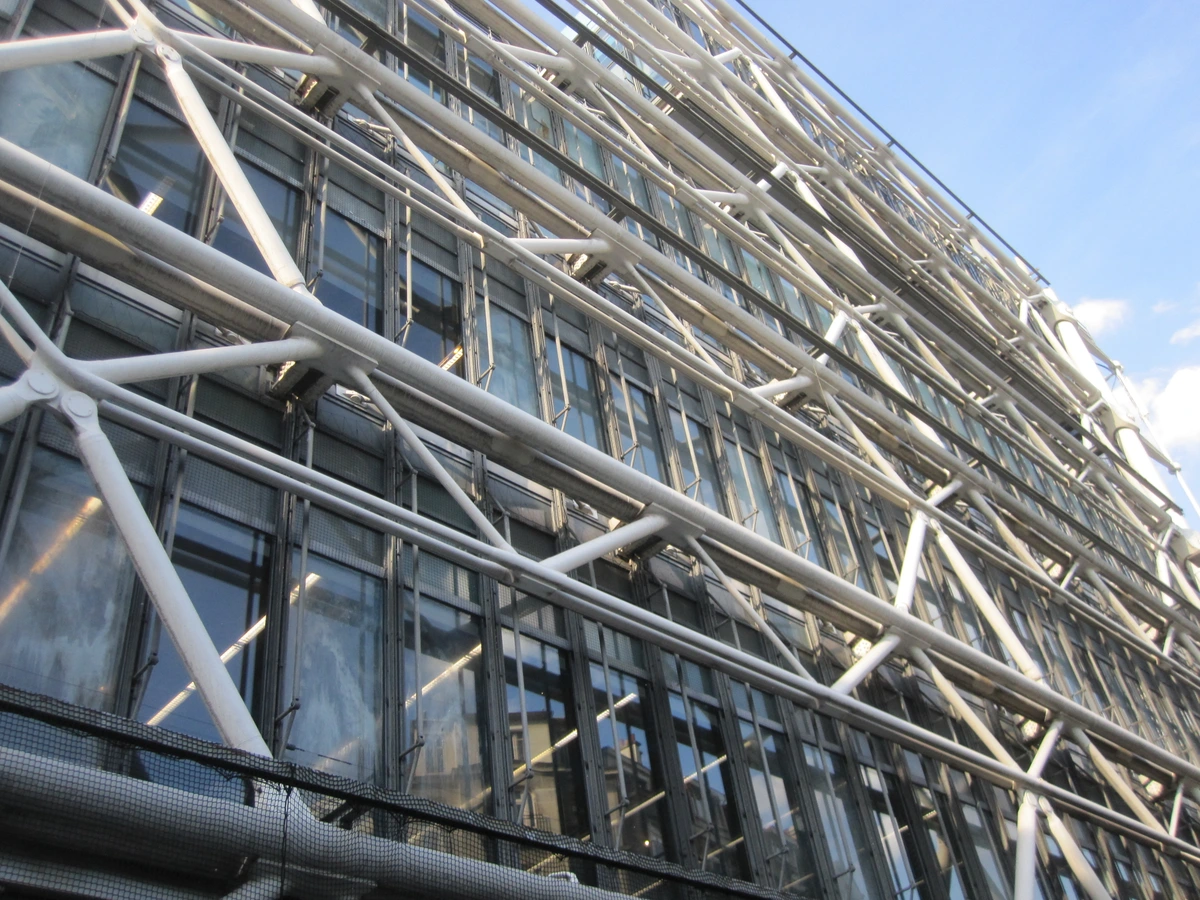

Seeing one of these powerful casts in person, perhaps at a museum like the one in 's-Hertogenbosch or the Kröller-Müller Museum, offers a different, more profound experience. You feel its sheer physical presence, the cool weight of the bronze mirroring the heavy, internal struggle it so powerfully embodies. It's a testament to its enduring power, its ability to continually provoke thought and reflection across generations and cultures.
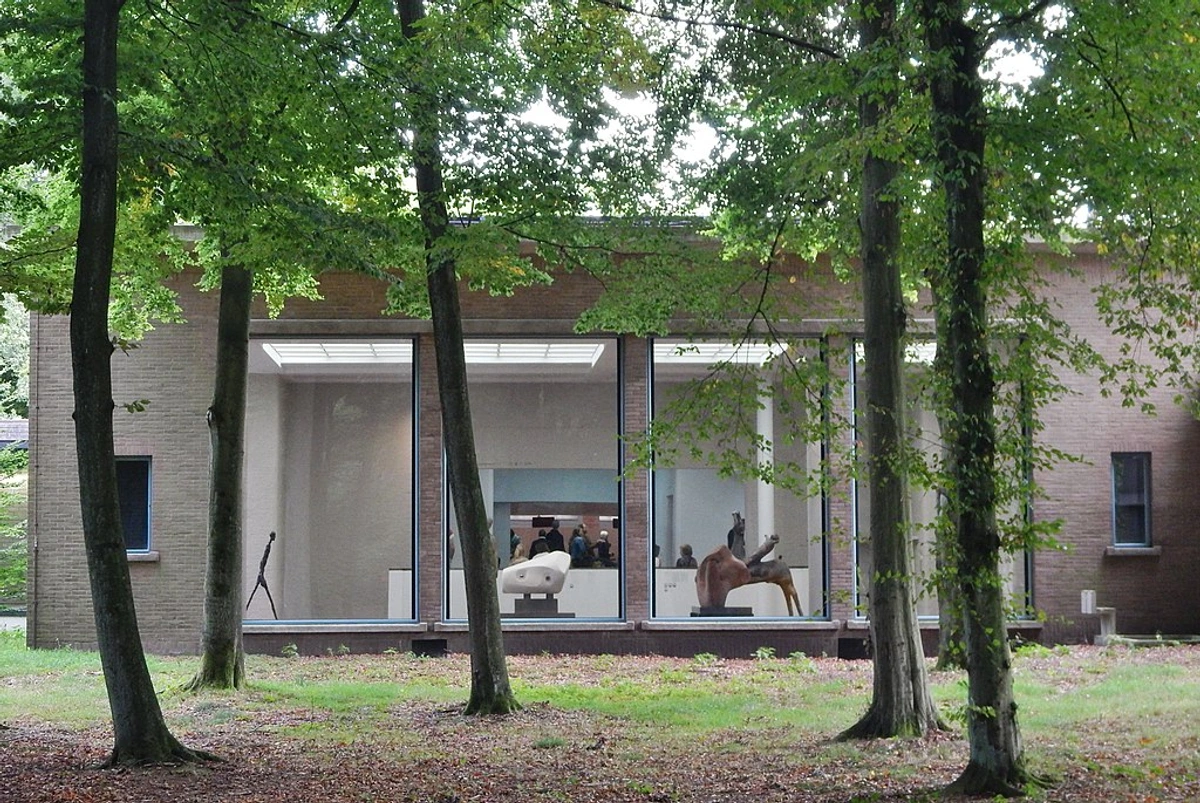

The proliferation of 'The Thinker' also comes with a caveat: the distinction between Rodin's authorized casts and the countless unauthorized copies is vital. These unapproved reproductions, often varying wildly in scale, material quality, and detail, not only dilute the artist's original intent and legacy but can fundamentally misrepresent the power and nuance of his work. A genuine, authorized bronze from Rodin's studio or estate offers a palpable connection to his revolutionary vision, a testament to his hand and profound artistic genius, and a crucial link to authentic provenance.

Beyond the Bronze: Rodin's Enduring Question
In the end, Rodin's 'The Thinker' doesn't offer a comfortable answer. He is the question, embodied in bronze. He reminds me that whether I'm facing the daunting blankness of a canvas, grappling with a complex problem, or simply trying to make sense of the overwhelming flow of information in our modern world, true understanding is found in the relentless, often uncomfortable, journey of thought itself. It's the silent scream of an artist, a philosopher, a worker – an Everyman.
Rodin's bold decision to depict mental activity through overwhelming physicality, a choice initially seen by some as crude or unrefined, was revolutionary. It challenged centuries of artistic convention – which often favoured idealized beauty, narrative clarity, and smooth, polished surfaces – and forced viewers to confront the raw, sometimes uncomfortable, truth of human introspection. He sits as a permanent monument to the silent, internal struggles and triumphs that define us as human beings – the effort it takes to create, to understand, to simply think. And he invites us, with every tense muscle and furrowed brow, to project our own deepest thoughts and wrestling matches onto his bronze frame. Rodin, through works like 'The Thinker,' fundamentally altered the course of sculpture. He elevated the human body to a vessel of psychological drama, challenging centuries of academic tradition and paving the way for future artists to explore raw emotion and the complexities of the inner self. His legacy is not just in individual masterpieces, but in his revolutionary approach to art itself, a testament to his enduring impact on how we perceive art and the human form.
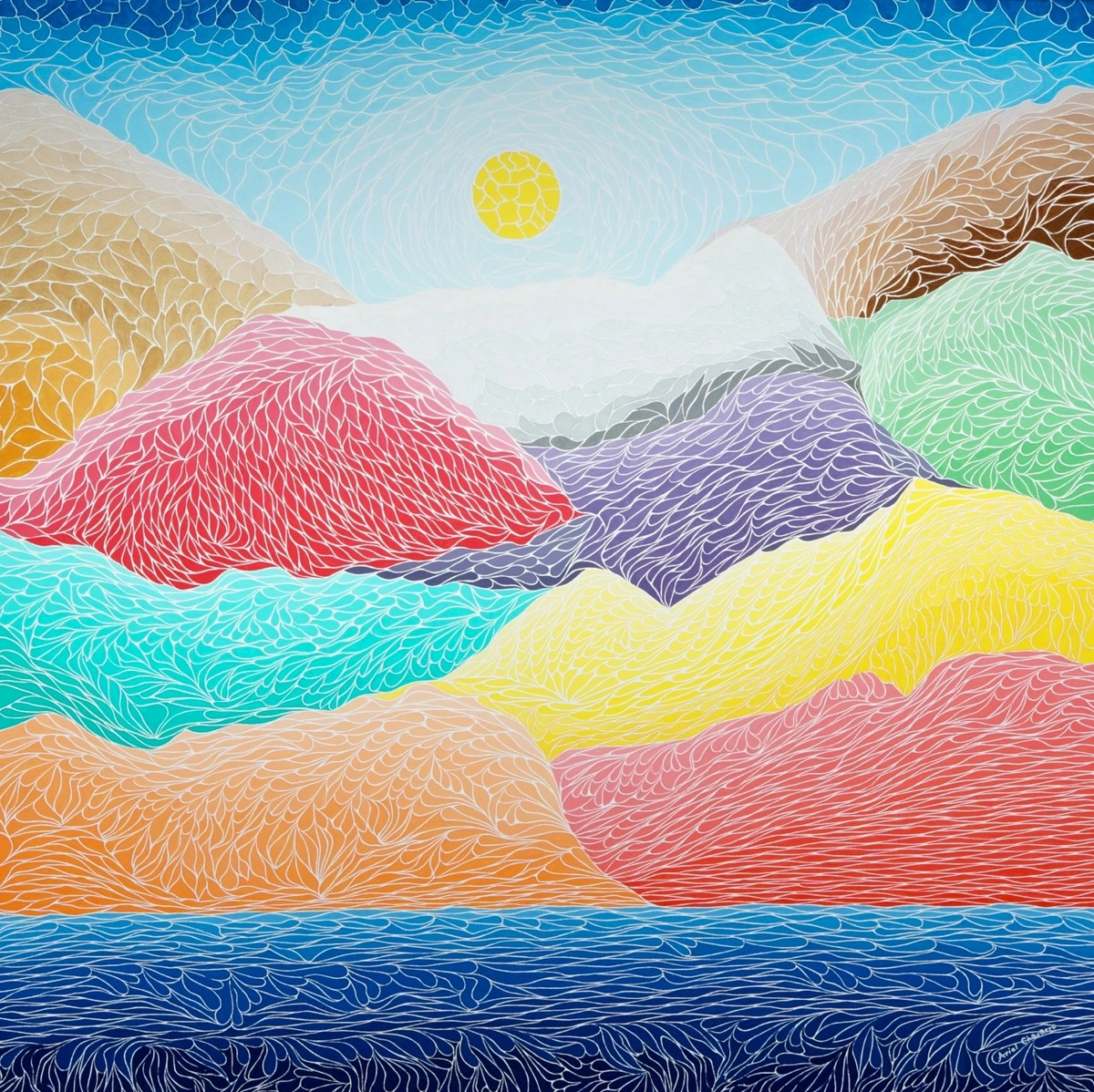

So, the next time you stand before one of his monumental casts, don't just see a statue. Feel the tension in his muscles, the furrow in his brow. And let that powerful, silent struggle echo your own: what profound question are you wrestling with? What creative challenge demands your complete, visceral engagement, just as 'The Thinker' grapples with his infernal visions? This deep engagement is exactly the kind of process that brings forth original art, much like the pieces you'll find in my own art collection, each a testament to a unique creative journey. The Thinker endures because his struggle is, profoundly, ours. This enduring testament to the human spirit, in all its messy, beautiful, agonizing striving, is precisely what fuels the creation and appreciation of art that truly speaks to us.

Frequently Asked Questions About Rodin's 'The Thinker'

- What is 'The Thinker' thinking about? Initially, as 'The Poet' within 'The Gates of Hell,' he represents Dante Alighieri contemplating the damnation and suffering of the Inferno, witnessing the eternal torment of specific figures like Paolo and Francesca and Ugolino. He is grappling with the immense moral and existential weight of creating such a horrific vision. When exhibited as a standalone piece, deliberately removed from its original context by Rodin, his meaning broadened to symbolize universal human thought, intellectual struggle, the act of creation itself, and humanity confronting its own destiny. He embodies any profound internal wrestling match.
- What is the original context of 'The Thinker'? He was originally conceived as 'The Poet' for Auguste Rodin's monumental 'The Gates of Hell,' a bronze doorway depicting scenes from Dante's Inferno. He was positioned at the top of the lintel, observing the tormented figures below, embodying Dante's struggle as the creator and witness to infernal visions.
- Why is 'The Thinker' naked? Rodin deliberately sculpted him nude to achieve universality. By removing clothing and specific historical attire, he stripped the figure of any particular social status, profession, or era. While nudity in classical sculpture often symbolized heroism or divinity, Rodin reclaimed it to represent the raw, universal human struggle of thought itself. His nudity highlights his formidable capacity for both physical and mental engagement in thought, making him a symbol of the essential human being grappling with existence, unfettered by societal artifice.
- What material is 'The Thinker' made of? The most famous versions of 'The Thinker' are cast in bronze. Rodin first modeled his figures in clay or plaster, such as the important 1881 plaster model. These were then painstakingly scaled up and cast using the ancient lost-wax method (cire perdue). This intricate process, involving multiple molds and layers of wax, ensures exceptional fidelity to his original model's intricate details and textures. Bronze provides the permanence and gravitas the subject demanded and captures the dynamic energy of his figures without risk of breakage.
- What is the significance of Rodin's 'non-finito' technique in 'The Thinker'? Rodin intentionally left parts of 'The Thinker' with a rough, 'unfinished' surface, a technique known as non-finito (Italian for "unfinished"). This was a deliberate artistic choice to convey raw energy, the ongoing process of creation, and profound human emotion rather than a polished, static conclusion. For 'The Thinker,' it underscores the relentless, unresolved nature of his internal struggle, making the act of thought feel immediate, visceral, and ceaseless, emphasizing the process over the final state. It challenged academic traditions of smooth perfection.
- How many 'Thinkers' are there? There are over 20 authorized original bronze and plaster casts made during and after Rodin's lifetime, distributed in museums and public spaces worldwide. These are distinct from the countless unauthorized reproductions that often lack artistic integrity, accurate scale, and historical provenance, fundamentally misrepresenting the power and nuance of his work.
- Where can I see 'The Thinker'? The original plaster model (c. 1881) and the first large-scale bronze cast (1904) are at the Musée Rodin in Paris. Other authorized casts are located in prominent museums globally, including the Metropolitan Museum of Art (New York), the National Museum of Western Art (Tokyo), the Ny Carlsberg Glyptotek (Copenhagen), the Philadelphia Museum of Art, and the Kröller-Müller Museum (Netherlands), among others. A notable cast can also be seen at the museum in 's-Hertogenbosch.
- What was Rodin's revolutionary vision? Rodin's vision involved depicting intense inner psychological states through explicit, often exaggerated, external physicality – his "philosophy of the body." This directly challenged centuries of academic tradition that favored idealized, serene forms. He focused on raw emotion, dynamic movement, and the process of creation, often using techniques like non-finito (unfinished surfaces) to convey raw energy, ongoing struggle, and the profound process of creation. He elevated the human body to a vessel of psychological drama, redefining sculpture for the modern age, making the body itself a language of emotion.
For a more concise look at this topic, you can also review our guide on what is the meaning of Rodin's The Thinker.