Borodyanka Through the Lens: The Unflinching Truth of Documentary War Photography
documentary photography exploration of Borodyanka, Ukraine, as captured by artists and photographers during the conflict

Borodyanka Through the Lens: The Unflinching Truth of Documentary War Photography
You've seen the headlines, the tickers at the bottom of news feeds, the endless scroll of digital noise. We are force-fed a constant barrage of information, a digital storm where one tragedy is quickly replaced by the next. But what happens when the news cycle moves on, when the world's attention shifts, and the camera lens stays? We are force-fed a constant digital storm where one tragedy is quickly replaced by the next, a numbing scroll of headlines that flicker across our screens and vanish into the ether. It becomes something else entirely. It evolves from a report into a testament.
I want to talk about what it really means to look at these images, not as a detached observer scrolling past another catastrophe on your phone, but as a human being trying to make sense of a world that often feels senseless. This process isn't just about what the photographer saw; it's about what you bring to the image, your own experiences, fears, and hopes, and how that combination creates a meaning that is unique to you.
That evolution, from fleeting report to lasting testament, is the subject of our exploration today. It's about how a single image, a series of frames, can transform a geopolitical event—a headline from a place you may have never heard of—into a profoundly, heartbreakingly human story. This is not just about photojournalism; it's about the very nature of seeing, remembering, and understanding conflict in an age where our attention is the most valuable, and most exploited, commodity. We've all felt it—the numbing cascade of crisis after crisis on our feeds, each one demanding our outrage, our sadness, our clicks, until we have nothing left to give and we simply scroll on. Documentary photography, real documentary photography, asks us to stop. It demands we pause.
Let's focus on one such testament, found not in a grand capital or a strategic port city, but in a quiet town called Borodyanka. Before the world knew its name, it was just another dot on the map, a place where people lived, loved, and raised families. This is about what documentary photography does when the world is watching, and crucially, when it has looked away. It's an unflinching visual record of what happens to the ordinary when it is engulfed by the unthinkable, transforming a geopolitical event into a profoundly, heartbreakingly human story. The 2022 invasion of Ukraine created a stark new reality, and with it, a new kind of documentation—one that moves beyond the fleeting, sensationalized imagery of the news cycle. Borodyanka, a town of around 13,000 people before the conflict, became a focal point not just for military strategists, but for photojournalists and artists like Banksy, who sought to understand and communicate the human truth amidst the ruins.
Let's be clear from the start: this isn't just about a dot on a map. To truly understand the photographs that come out of Borodyanka, you must first grasp the immense weight that name now carries. Today, for many Ukrainians and for those who have followed the conflict, the name 'Borodyanka' carries a specific gravity—a stark symbol of the war's brutal, relentless impact on everyday life, a byword for destruction that was unusually fierce even within a conflict defined by it.
To understand Borodyanka is to understand a new phase of modern warfare: urbicide, the deliberate and systematic destruction of cities to erase their identity and people. Its fate was not an accident of war, but a calculated dismantling of a community's physical and social fabric. The visual testament that emerged became a global symbol, a historical marker that documentary photographers were uniquely positioned to capture. It's the logical endpoint of an idea: if you can't occupy a people, you try to erase the very stage on which their lives are lived.
The events that unfolded there in the early weeks of the full-scale invasion were not a brief skirmish but a prolonged siege followed by an occupation. Have you ever tried to truly picture that? A 'siege' sounds medieval, but here it meant the slow, violent unraveling of the 21st century. The town was heavily shelled, and its high-rise apartment blocks—soviet-era edifices housing hundreds of families, filled with retirement funds, first apartments, and baby photos—became primary targets, part of a wider strategy of terror. When Ukrainian forces eventually regained control, the true extent of the devastation was revealed. The occupation ended, and the world was finally allowed to see. Images of the nine-story apartment blocks, sliced open like giant dollhouses, became some of the most emblematic of the entire war. The world had seen rubble before, but this was different. This was a systematic unraveling of the domestic sphere, made violently public. It was the violation of the private made staggeringly, unforgettably public.
Think of photographers like Evgeniy Maloletka, whose images of the bombed apartment blocks became synonymous with the invasion’s brutality. Or Lynsey Addario, whose ground-level shots captured the human element amid the architectural carnage. These weren't just pictures of buildings; they were portraits of interrupted lives, of the sudden and violent erasure of the mundane. The very nature of a high-rise apartment block—a vertical stack of unrelated lives—lent a horrifying clarity to the images; each floor, each exposed room, a different family's tragedy frozen in time.
For a photographer arriving in that aftermath, the mission becomes almost archaeological. You're not just capturing a moment in time; you are attempting to piece together a shattered narrative from the physical evidence left behind. It's a process that requires a different kind of seeing, an eye for the mundane detail that suddenly holds immense emotional gravity. Consider the internal calculus of the photographers who walked those streets—Evgeniy Maloletka, Daniel Berehulak, or Lynsey Addario. They weren't just seeing concrete and rebar; they were seeing the silent witness of thousands of personal dramas, the evidence of meals cooked, of children playing, of quiet evenings, all violently interrupted.
I think about the sheer scale of it. Not just the structural damage, which is immense, but the human cost, which is incalculable. It's one thing to see the numbers on a page, quite another to stand amidst it. Reports from the ground spoke of bodies buried in the rubble for weeks. The air was thick not just with dust, but with the agony of uncertainty for the families of the missing. Photographs from that time show people not as victims, but as archaeologists of their own lives, sifting through the debris of their past, searching for a future that had been stolen from them.
This is where the documentary photographer transforms from a mere observer into a conduit for memory. Their work is an active, forceful act of bearing witness—a resolute refusal to let these individual stories be ground down into the cold, anonymous statistics of war. When you look at a photograph of Borodyanka's aftermath, you're not just seeing a building. You are seeing a home, a specific history, a future that was violently interrupted. The photographer is archiving not just destruction, but the ghost of a life that was lived. Let's be honest, it's a role I can't imagine for myself. The weight of it. The responsibility. To be a respectful guest in someone else's absolute worst moment.
A Technical Dissection: The Anatomy of an Iconic Image
Let's stop scrolling for a moment and just look. Let's break down a typical image from Borodyanka: the iconic cross-section of a residential high-rise. We'll read it like a text.
- Subject Matter: Nine-story concrete apartment block with its facade sheared off.
- Compositional Analysis:
- Strong Vertical Lines: The vertical edges of the remaining structure and the horizontal lines of the floors create a sense of architectural formalism, contrasting sharply with the chaotic rubble.
- Juxtaposition of Intimacy and Scale: A wide-angle lens pulls you in, making you feel like you could step into the living rooms. Yet, the sheer number of visible floors conveys the massive scale of the human tragedy.
- Focus and Depth of Field: A deep depth of field ensures every detail is sharp, from the twisted rebar in the foreground to the skeleton of the building in the back. The photographer wants you to see everything.
- Emotional Efficacy: The horror lies in the remnants of the mundane: a floral bedspread, a pastel-painted child's wall, a light fixture dangling over a void. These are the emotional anchors that transform a building into a collection of broken homes.
The Anatomy of a Documentary Image: More Than Just Ruins
It would be easy to see these images and think it's just a catalogue of destruction. A simple before-and-after of progress and loss. But that misses the point entirely. The power of documentary photography lies in its specific, unflinching details. It's in the small things that survive the big disasters. These are the details that embed themselves in your memory long after you look away.
I think of it this way: you can be told a building was destroyed, and you understand it intellectually. It becomes a fact, a statistic. But when you see a single, intact teacup sitting on a windowsill in a room that has no fourth wall, that's the detail that makes your brain stop. It connects the abstract idea of 'war' to the specific reality of someone's morning tea being interrupted forever. It's a ghost story, told through a teacup.
Imagine standing in the wreckage. The photographer's eye isn't just drawn to the collapsed concrete. It's drawn to the incongruous potted plant, somehow still alive on a splintered windowsill. It's drawn to the child's drawing, taped to a wall that no longer has a ceiling. These are the details that punch you in the gut. Take that potted plant. In a sea of grey dust and shattered concrete, its green leaves represent defiance. It's a statement, however small, that life persists. The photographer who chooses to focus on that plant is making a conscious choice. They are telling us where to look, what to feel. Similarly, a child's drawing isn't just a piece of paper; it's a ghost of a childhood that may have been lost forever. It's a heartbreaking inventory of a life that was being lived until the sky fell in. It forces a question that no report can answer: Who drew this? Where are they now?
The Psychological Impact of the "Surviving Object"
Psychologically, these images work on us because they create cognitive dissonance. A child's toy and a tank shell crater shouldn't occupy the same frame. A pristine picture frame hanging on a wall that is no longer there violates our sense of order. The photographer captures this dissonance, forcing our brain to reconcile the objects of a peaceful, domestic life with the reality of its violent end. This potent detail transforms a news photo into a question: what happened to the person who drew that picture? Who would have drunk from that cup? This question is the engine of empathy.
This deliberate, conscious construction of an image is what separates a mere snapshot from a story that will endure. The photographer is making hundreds of micro-decisions in a fraction of a second. It's a high-speed negotiation between ethics, aesthetics, and the brutal, unpredictable reality of the scene.
The Photographer's Toolkit in Conflict Zones
To truly appreciate the craft behind these images, it helps to understand the photographer's toolkit. Most people think it's about having a good camera, and sure, that helps. But it’s not just about pointing and shooting; it’s about choosing the right tool for the emotional task at hand. This is where technical skill meets profound empathy. Every piece of gear in their bag is a different kind of sentence structure, a different way of asking you, the viewer, to feel something.
Equipment/Technique  | Impact & Purpose | Why it Matters in Borodyanka |
|---|---|---|
| Wide-Angle Lens | Creates a sense of immersion and vertigo. It pulls the viewer into the space. If a telephoto is like looking through a telescope, a wide-angle is like opening a door and walking in. | Used to photograph the interior of a sliced-open apartment block, making you feel like you're standing in the living room, looking at the sky where a wall used to be. It emphasizes the sheer scale of destruction on a human level, making the abstract concrete. |
| Telephoto Lens | Compresses distance, isolating subjects and flattening perspective. It’s like a sniper scope for the soul. | Allows a photographer to capture a survivor's expression from a respectful distance, or to show an apartment block dwarfed by the landscape of wreckage around it, emphasizing the overwhelming scale of loss without intruding on private grief. |
| Harsh Midday Light | Reveals details with brutal honesty, eliminating the softening effect of shadows. No filters, no flattering sunset. | War photography often pointedly avoids the 'golden hour'. The goal is to show the reality as it is—bleak, unforgiving, and uncompromising. The dust in the air, the cracks in the concrete, the exhaustion on a face—harsh light reveals it all, unsparingly. |
| Shallow Depth of Field | Blurs the background to focus the viewer's attention on a single, sharp subject. It forces you to look at one thing. | A photographer uses this to isolate a single object—a teacup, a family photo—against the blurred chaos of the surrounding room. It's a visual metaphor for finding one person's story amid the general catastrophe. It forces us to contemplate that one object, and the story it tells. |
| Black and White | Removes the distraction of color to focus on form, texture, and emotion. It can feel more timeless, more stark. | It can do two things: either strip a scene down to its brutal, graphic reality, or lend a certain classical, historical weight, reminding us that these tragedies are part of a long, terrible human story. |
| The Photographer's Notebook | The tool for names, dates, and stories. The context that a camera can't capture. | Perhaps the most important tool. It holds the name of the person in the photo, the date the building fell, the story of the family who lived on the third floor. It's what separates a powerful image from a nameless statistic. |
Choosing a lens isn't just a technical decision; it's an ethical and narrative one. A wide-angle lens invites the viewer into a shared space, a moment of communal horror. A telephoto lens is an act of discreet observation, respecting a subject's private grief while still recognizing its public importance.
These choices aren't arbitrary. They are made by the photographer to guide your eye, your mind, and ultimately, your heart. They compose a frame that holds beauty and horror in a single breath—a shaft of sunlight illuminating a flock of birds flying over a crater—forcing us to confront the maddening fact that they can, and do, coexist in the same shattered space. This juxtaposition is one of the most powerful tools in the photographer's arsenal, a way to articulate the unspeakable complexity of life in a war zone without saying a word.
It's a form of creative expression under the most extreme pressure imaginable. While my own artistic practice, which you can explore in my collection, often explores the relationship between structure and chaos in a more abstract, metaphorical way, the underlying impulse is not so different. It is the human need to find a sense of meaning and order, to trace a line through the noise, even when everything seems to be falling apart. The photographer in Borodyanka is doing the same, but their canvas is reality itself.
The Unseen War: A History of Photographing Conflict
The impulse to document the raw truth of war isn't new. It has a lineage, a visual history of its own. Before Borodyanka, there were other names, other places, other photographers who stared into the same abyss. Understanding this history is crucial, because it shows us that the images from Ukraine are not an isolated phenomenon, but part of a long, painful, and essential tradition of bearing witness.
The Photographer's Burden: Witness and Responsibility
The act of photographing in a place like Borodyanka is fraught with an enormous ethical weight. It's a burden I can hardly imagine. Think about it: you are an outsider with a camera, moving through the most profound trauma of other people's lives. The ethics aren't just about what to shoot, but how to shoot it. It's the difference between a picture that feels stolen and one that feels like a shared, painful truth. One is exploitation. The other is an act of profound, shared humanity.
This responsibility shapes every single image. It demands a profound respect for the subjects. It means not staging a photo, not directing grief for a more "powerful" composition. The aim is to document, not to create propaganda from either side. The power comes from the reality of the scene, raw and unvarnished. The most powerful images from Borodyanka carry with them the profound weight of this authenticity. You can feel the photographer's restraint, the deliberate choice to bear witness without intrusion, the decision to let the scene speak for itself.
The Internal Monologue: An Unending Storm of Questions
I try to put myself in their shoes. What does that internal monologue sound like? It must be a constant, rolling thunder of questions, each one a moral landmine.
- "Am I intruding?": This is the first and most persistent question. Standing before a woman weeping over the ruins of her home, the impulse might be to look away. But the ethical photographer knows her story needs to be told. The question becomes how to be present without being invasive. Sometimes it means waiting, sometimes it means using a longer lens to create a respectful distance, sometimes it means simply asking: "May I?"
- "Whose story am I telling?": Is it my story as an observer, or is it the story of the person I'm photographing? The answer must always be the latter. The photographer's job is to be a conduit, not the subject. This means stepping back, both physically and emotionally, to allow the reality of the situation to speak for itself.
- "How will this be used?": In today's media landscape, an image can be taken out of context, twisted by algorithms, or used for propaganda. While a photographer can't control everything, they can work with reputable agencies, add careful captions, and be transparent about the scene and its context.
- "Am I bearing witness, or am I just a trauma tourist?": This is the question that keeps you up at night. There's a fine line. Bearing witness is an act of solidarity. It's the belief that making the world see an injustice is the first step toward preventing the next one. Trauma tourism is voyeurism. The difference often lies in the photographer's long-term commitment and their relationship with the community. Are they there for a day, or will they return? Do they see the people as collaborators in their work, or as subjects to be captured? This is the ultimate test of a photographer’s ethical compass.
It is a high-wire act of sensitivity, purpose, and profound moral courage. You are there to tell a story that the world needs to see, a story that survivors want told, yet you are walking through the most intimate and painful ruins of people's lives. It requires a deep understanding that you are a guest in their grief. The photographer is not a God, looking down. They are on the ground, eye-to-eye, sharing the same dust-filled air. The people of Borodyanka—those who return, those who search, those who simply stand and stare at what was once their home—are not 'subjects.' They are collaborators in the act of remembrance. You are not taking something from them; you are helping them hold something up for the world to see.
Why These Images Matter: Beyond the Headlines, Beyond the Scroll
So, in a world saturated with images—a world where a war zone is just a swipe away on your phone—why do these specific, often difficult, photographs of Borodyanka even matter? It's a fair question, perhaps the most important one. It gets to the very heart of what art and documentation can do in a time of war. It's a question I ask myself when I see my own work hanging on a wall. Does it matter? Does it do anything at all, besides just... being?
It's easy to feel helpless, to think that one more image of a ruined building changes nothing. But that cynicism, however understandable, misses the profound, multi-layered function of this work. It’s not about changing the world overnight; it’s about a slower, deeper change.
First and most fundamentally, they create a permanent and inviolable record. News is, by its nature, fleeting. It's the media equivalent of a sugar rush—a burst of energy and attention that crashes as soon as the next story breaks. But a powerful, thoughtfully composed photographic series remains. It acts as a dam against the river of forgetting. These images become historical documents—evidence that future historians, and more importantly, future generations of citizens, will use to understand the true human cost of conflict. They are anchors in the storm of information.
Second, they build empathy on a molecular level. Our brains are not wired to comprehend large numbers; they are wired for story. It is one thing to hear a news anchor state that 'over 500 buildings were destroyed.' The number is abstract. It slides right off the brain. It is another thing entirely to see a photograph of a single, half-broken toy dinosaur left behind in the rubble of what was once a child's room. That's the key. That's where the connection happens. That specific, intimate detail acts as a key, unlocking an emotional understanding that data simply cannot. It's the difference between hearing a statistic and meeting a person.
This is where art and journalism intersect. The photographer isn't just a journalist; they are an artist, using the tools of composition, light, and narrative focus to make us feel something that a spreadsheet of casualties never could. This principle of emotional connection is something I explore in my own work. Just as that toy dinosaur tells a story of a life interrupted, a single, deliberate brushstroke can convey an emotion that a thousand words cannot. It's about finding the universal in the specific.
Finally, they resist and complicate the easy, comfortable narratives that we so often crave. War reporting is frequently simplified into a stark tale of heroes and villains. Documentary photography of the kind seen in Borodyanka actively resists that oversimplification. It forces us to see the uncomfortable, messy complexity. It demands that we acknowledge the individual human lives, with all their histories and dreams, that were caught in the gears of a conflict far larger than themselves.
These images refuse to let us off the hook. They deny us the comfort of easy answers. In a world of soundbites and social media activism, they are a demand for nuance. They are a record not just of what happened, but of what was lost, what was felt, and what can never be repaired. In their unflinching gaze, they hold up a mirror to our own capacity for destruction and, occasionally, our capacity for breathtaking resilience.
This is perhaps the most vital function: they act as a historical anchor, a bulwark against revisionism. As time passes, political narratives shift, memories fade, and inconvenient truths are elided. A photograph stands as a witness that cannot be easily erased. They become court exhibits in the trial of public memory, ensuring that the full, human cost of political decisions is never entirely forgotten.
These images are not entertainment. They are not content to be consumed and discarded. They are a direct challenge. They are an invitation—a moral imperative, even—to truly look, to see past the headlines, to understand the cost, and to remember what is so easily forgotten. They are a vital stitch in the fabric of our collective memory.
Looking at them is hard. It should be hard. But in that act of looking, we honor the resilience of those who survived, and we remember those who did not. We refuse the anesthetic of distance. We choose to see, and in doing so, we become witnesses too.
The Aftermath: Rebuilding and the Role of Art
Beyond the immediate documentation of destruction, photographers and artists have continued to tell the story of Borodyanka. This second chapter is just as crucial, charting the long, arduous path from ruin to recovery. It's a story of community, resilience, and the human need to find beauty and meaning even in the most broken places. If the first chapter is about what was lost, the second is about what remains and what will grow again. This long-term view is what elevates the work from simple reportage to a deep, historical document.
Street Art and Symbols of Defiance
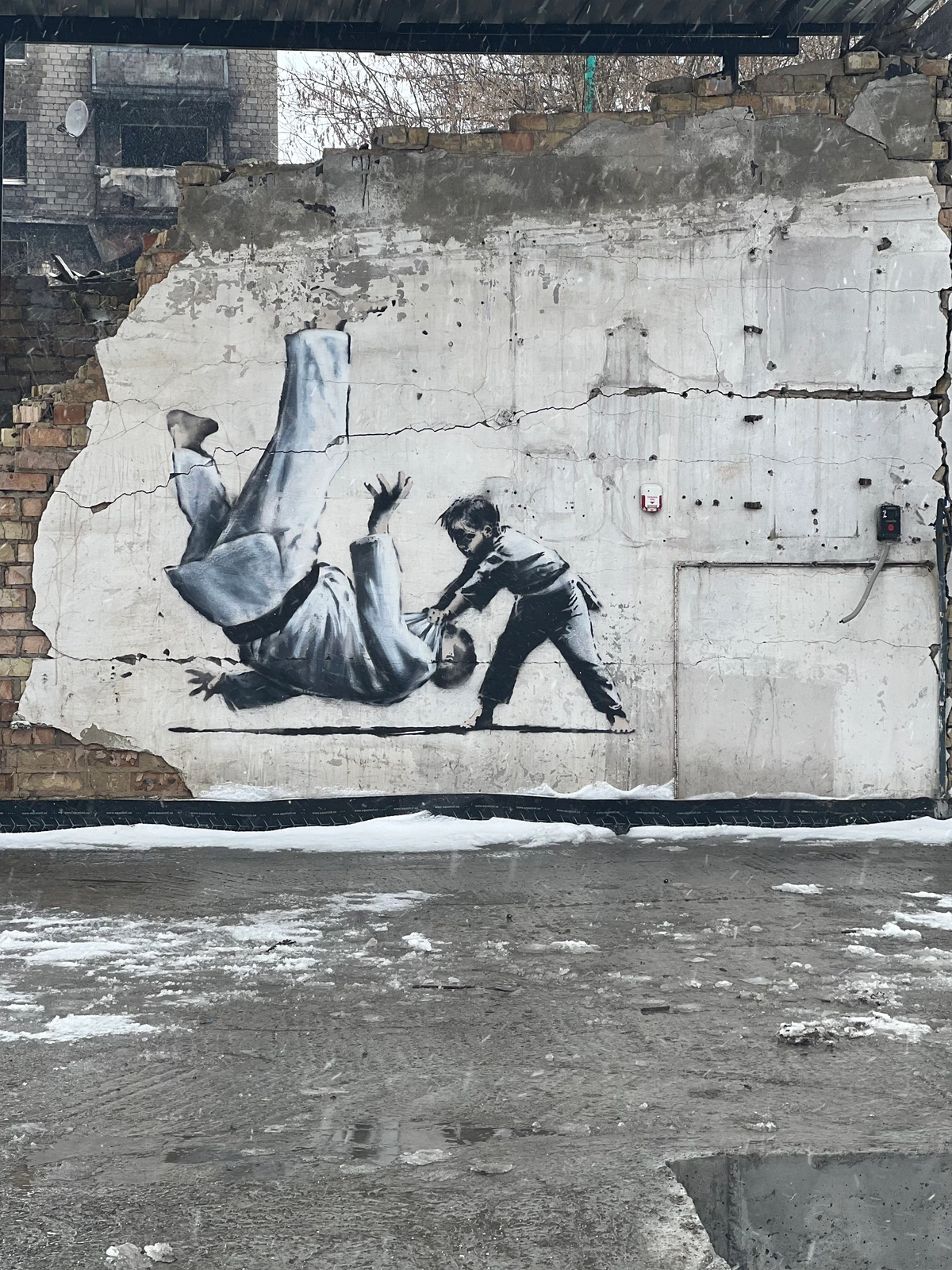
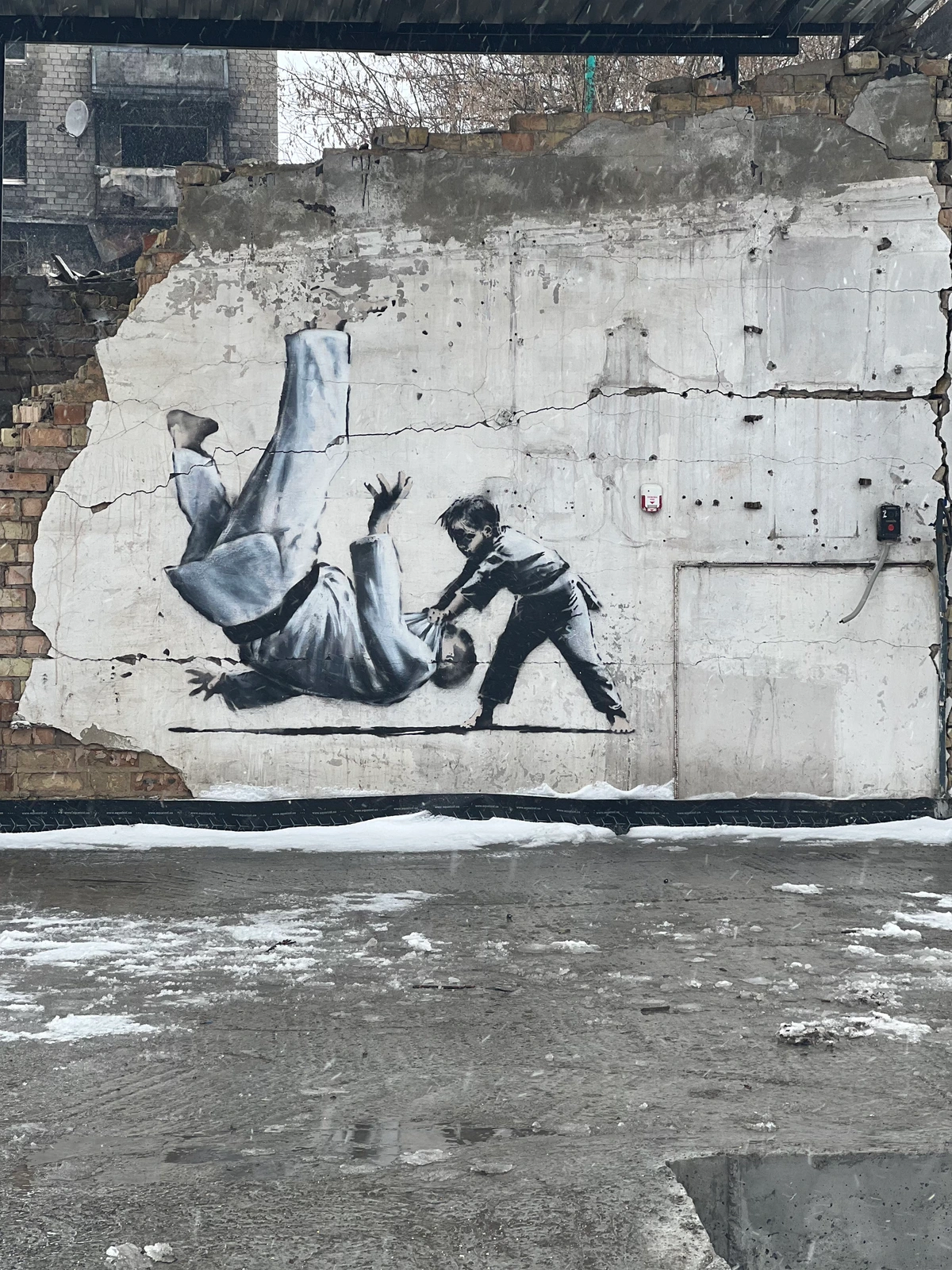
The photographs of Borodyanka's ruins are now archived alongside a very different kind of image: street art. The renowned, anonymous artist Banksy was among those who left their mark. His murals, appearing in towns across Ukraine, offered a different kind of testament. A mural in Borodyanka depicted a young girl using a judo throw to flip a larger adult—a powerful, defiant image of the underdog fighting back.
This art does more than just decorate a ruined wall. It transforms the site of trauma into a space of commentary and, sometimes, hope. It's a way for the community to reclaim its narrative, to assert that this place is not just a monument to destruction, but a place where people live, fight, and resist. It becomes part of the town's new identity, a layer of meaning painted directly onto the scars of war. A Banksy mural on a bullet-riddled wall is not merely art; it is a new piece of evidence, a counter-narrative of resilience laid directly onto the canvas of destruction.
The Long Road to Recovery: Photography's Later Chapters
The story doesn't end when the news cameras leave. A new wave of photographers focuses on the quieter, less dramatic, but equally important story of return and rebuilding. This is where documentary work becomes a multi-year project, requiring a different kind of discipline and patience.

- Documenting the Unseen Labor: This work captures the immense effort of clearing rubble by hand, of restoring electricity and water. It's a story of persistence, of communities coming together to do what international aid organizations and governments often cannot.
- The Return of Life: These images are perhaps the most hopeful. They show children playing on a newly installed swing set next to a ruin. A family planting flowers in a small patch of dirt cleared in front of their damaged home. These are not dramatic images of conflict, but they are profound images of defiance.
- Layers of Memory: As time passes, photographers will return to capture how a new town is built upon the foundations of the old one. They will document the memorials that are erected and the ways in which people choose to remember.
Borodyanka is a case study in the power of seeing. It shows us that the camera's role isn't just to record an event, but to participate in the process of remembering, understanding, and rebuilding.
Frequently Asked Questions
Why do photographers risk their lives to take these pictures? It’s a question with no simple answer, but it often boils down to a powerful sense of purpose. Many photographers feel a profound obligation to bear witness to injustice and suffering, believing that their work can make a difference and ensure that these stories aren't forgotten. It's a deep-seated commitment that outweighs the personal danger. For some, it's a moral imperative; they see a wrong and feel compelled to document it. For others, it's about fulfilling the historic mission of the journalist: to hold power to account and give a voice to the voiceless.
Do photographers get consent from people in these difficult situations? This is arguably the most crucial ethical issue in the entire field, and it requires a nuanced answer. The short answer is: when humanly possible, absolutely yes. Ethical photographers operate under a strict personal code and will always seek to explain who they are, why they are there, and what they intend to do with the images.
However, in the chaos of a public aftermath or an active conflict zone, this isn't always feasible. A person might be in a state of shock. In these cases, the key distinction becomes the photographer's intent and their approach. Are they trying to capture a newsworthy event with respect and dignity, or are they aggressively intruding to get a sensational shot that exploits vulnerable individuals? The intent is visible in the final image and is the dividing line between a journalist and a 'war tourist'.
How can we tell if a war photo is real or staged? This is a monumental challenge in the digital age, where misinformation and propaganda are weaponized daily. Developing a critical eye is a responsibility we all share.
Here are a few things to look for:
- The Source is Key: Start with the credibility of the photographer and the publication sharing the image. Are they a known, reputable news organization? Or is the source a nameless "viral" social media account with a political agenda?
- Corroboration is Crucial: A single, shocking image from an unknown source should be treated with extreme caution. Real events generate multiple pieces of evidence. Look for other images, video clips, or on-the-ground reporting from multiple sources.
- Look for the "Too Perfect" Shot: Be wary of images where the composition, lighting, and emotion feel unnaturally heightened. Real conflict is messy and unpredictable.
- Understand the Rules of Ethics: Reputable photojournalists adhere to strict ethical codes. Staging scenes, moving objects, or digitally manipulating an image is forbidden.
- Read the Caption and Check the EXIF Data: A genuine photojournalist's caption will be detailed and factual. Checking an image's metadata (EXIF data), if possible, can help verify the time and camera model.
What happens to these photos after they are taken? The journey of an image is rarely a straight line. The first and most immediate path is newswire distribution, appearing in major international outlets. This is the workhorse function of photojournalism—informing the world as events unfold.
But for the most powerful images, the story doesn't end with the 24-hour news cycle. Many are carefully curated for gallery exhibitions, where they can be viewed in a contemplative space, free from the churn of online news. Others are compiled into deeply moving and powerful photo books, which serve as lasting historical documents.
In the modern era, many photographers also share their work directly with the global public through social media, bypassing traditional media gatekeepers to tell stories that might otherwise be ignored. Platforms like Instagram become digital galleries. The ultimate goal remains the same: to ensure the story reaches as many eyes and hearts as possible.
Is it disrespectful for a photographer to make art from such tragedy? This is a profound question, and one that photographers themselves grapple with daily. The distinction often lies not in the creation of a powerful image, but in the photographer's intent.
Is the goal to aestheticize suffering? If so, that crosses a line into exploitation. But if the goal is to use the formal tools of art—composition, light, and narrative structure—to communicate the harsh reality of a situation with greater clarity, then it's something else entirely.
In this view, the tragedy isn't the material for the art; the art is the necessary vehicle to communicate the tragedy so it is not ignored. A well-composed image forces us to look when our instinct is to turn away. When done with integrity, it's an act of profound respect, not exploitation.











I believe that what draws me to these images, and what, I suspect, draws you to them as well, is this deeply human search for truth in the midst of chaos. It is a fundamental artistic impulse. Whether that truth is captured through the unflinching, documentary lens of a photographer in Borodyanka or expressed through the abstract forms and colors on a canvas in my own work, the ultimate goal is the same: to make us feel something real, to make us think more deeply, and to connect us more profoundly to the world, even when that connection is painful.
Perhaps the most profound connection between documentary photography and abstract art is their shared obsession with framing. The photographer uses the viewfinder to crop a moment of reality and give it meaning. The painter uses the canvas to do the same, creating a new reality from emotion and form. Both are acts of holding a frame up to the chaos of the world and saying, "Look. Look here, right now." And in that shared, focused act of looking, we find not just a story, but ourselves.