Uncovering Paris's Art Nouveau Secrets: A Personal Architectural Journey
Join me on a personal exploration of Paris's enchanting Art Nouveau architecture. Discover hidden gems, iconic facades, and the stories behind the city's most whimsical buildings in this comprehensive guide for art and travel lovers.

# Uncovering Paris's Art Nouveau Secrets: Your Ultimate Architectural Journey
## The Allure of Art Nouveau in Paris: A Personal Discovery
Is there any greater joy than stumbling upon architectural beauty? I mean it. You know those moments when you turn a corner, and there it is – a building that doesn't just *stand* there, it sings? For me, that feeling intensifies tenfold in Paris, especially when I'm tracking down the city's **[Art Nouveau](/finder/page/art-nouveau-artists)** masterpieces. It’s like a treasure hunt, but the treasure isn't buried; it's right there, boldly, beautifully, and sometimes bizarrely adorning the very fabric of the city, whispering tales of a rebellious past. I mean, who doesn't love a good treasure hunt, especially when the clues are etched in wrought iron and sculpted in stone?
I remember my first real encounter. I was probably on my way to a museum – the Musée d'Orsay, perhaps, or maybe even the Musée des Arts décoratifs – and I just... looked up. Not at the grand Haussmannian facades that define so much of Paris, but at something that seemed to writhe and flow with an almost organic life. Curved lines, intricate ironwork, windows that seemed to melt rather than be cut, as if sculpted by nature itself. It was a revelation, a splash of untamed beauty amidst the disciplined elegance of Paris. And honestly, it changed the way I see the city forever, sparking a lifelong fascination with this ephemeral, yet impactful, artistic movement. I’ve always found that the most profound shifts in perspective often come from the simplest acts, like simply looking up.
Paris, a city often synonymous with classical grandeur and Haussmannian symmetry, holds a vibrant, undulating secret: its exquisite **Art Nouveau architecture**. This isn't just about buildings; it's about a revolutionary spirit that swept through the city at the turn of the 20th century, seeking to infuse everyday life with art, nature, and raw elegance. It was a brief, dazzling moment where art truly breathed life into the [urban landscape](/finder/page/art-inspired-by-urban-landscapes), a passionate attempt to break free from the past. Join me as we uncover these hidden gems, transforming a simple stroll into an immersive journey through a pivotal artistic era, and perhaps, like me, you'll find your own perspective on the City of Lights forever altered. I truly believe that to understand a city, you must understand its art, and Paris's Art Nouveau tells a story unlike any other.
### What Exactly Was Art Nouveau Doing in Paris, Anyway?
Before we dive into our architectural pilgrimage, let's quickly set the scene. [Art](/finder/page/history-of-art-guide) Nouveau, born in the late 19th century and flourishing into the early 20th, was a global phenomenon, but it had a distinct Parisian flair, a certain *je ne sais quoi*. It was a passionate rebellion against the rigid academic styles of the past, a resounding cry for a new art for a new century. Imagine artists and architects, utterly fed up with the stifling conventions of the **École des Beaux-Arts** and the heavy, historicist ornamentation that defined the opulent but often uninspired **Belle Époque**. They yearned for something fresh, something inspired by nature, sensuality, and exquisite craftsmanship – a true "new art" for a rapidly industrializing world. This profound desire for authenticity and the handmade was a direct reaction to the dehumanizing aspects of [mass production](/finder/page/how-mass-production-changed-art-accessibility), emphasizing organic forms, custom artistry, and a deep connection to the natural world, a kind of artistic idealism. This burst of creativity found its perfect stage during the **1900 Universal Exposition in Paris**, where Art Nouveau's presence was undeniable, showcasing its radical vision to a global audience and turning the city into a vibrant showcase. It's a fascinating counterpoint to what came next, the more streamlined [Art Deco movement](/finder/page/ultimate-guide-to-art-deco-movement), which would eventually eclipse its free-flowing predecessor. But for a glorious two decades, from roughly 1890 to 1910, Art Nouveau reigned supreme, transforming the Parisian streetscape with its audacious beauty and a sense of vital, organic energy, forever changing the trajectory of [art history](/timeline).
In Paris, this meant embracing flowing, organic lines – famously dubbed ""whiplash lines" – botanical motifs, elaborate ironwork (hello, Hector Guimard!), and a bold use of new materials like glazed ceramics and exposed concrete, often integrated with traditional stonework. It was audacious, sometimes controversial, and always, always distinctive. The core philosophy was to create a **total work of art**, known as *Gesamtkunstwerk*, where every detail, from the grand façade to the tiniest doorknob, from the intricate wallpaper to the very structural elements of the building, was meticulously designed to create a singular, harmonious aesthetic experience. This wasn't merely a style; it was truly a multidisciplinary movement that touched everything from monumental architecture to elegant furniture, from exquisite [Art Nouveau jewelry](/finder/page/ultimate-guide-to-art-nouveau-jewelry) and [interior design](/finder/page/the-evolution-of-art-in-interior-design-from-grand-salons-to-modern-minimalism) to captivating graphic arts and even everyday objects. If you're curious about the deeper artistic philosophy and its evolution, I've previously explored the [definitive guide to the Art Nouveau movement](/finder/page/definitive-guide-to-art-nouveau-movement) and its profound [influence on modern design](/finder/page/art-nouveau-influence-modern-design). It's a captivating study in how an [art movement](/finder/page/what-is-the-symbolism-art-movement) can truly permeate every aspect of visual culture, aiming to elevate daily life into an artistic statement.
### The Context: Belle Époque and Fin de Siècle Mood
To truly grasp Art Nouveau's revolutionary spirit, we need to understand the atmosphere in which it blossomed. The **Belle Époque** (Beautiful Era), roughly from the end of the Franco-Prussian War in 1871 to the outbreak of World War I in 1914, was a period of optimism, economic prosperity, and cultural innovation in Paris. It saw technological advancements, scientific discoveries, and a flourishing of arts and entertainment. Yet, beneath this glittering surface, there was also a **Fin de Siècle** (End of the Century) mood – a sense of cultural weariness, anxiety, and a longing for spiritual renewal and escape from the perceived materialism and conventions of the age. Art Nouveau, with its embrace of nature, sensuality, and spiritual symbolism, offered a powerful artistic antidote to this complex emotional landscape. It was a yearning for authenticity and a break from academic rigidity, perfectly reflecting a society grappling with rapid change. I sometimes think of it as a city collectively sighing, then deciding to express that longing through exquisite curves and vibrant colors. It was a very human reaction, really.
## The Visionaries: Architects Who Shaped Parisian Art Nouveau
Beyond the stylistic elements, it's the audacious visionaries who brought this new aesthetic to life that truly fascinate me. These pioneering [Art Nouveau artists](/finder/page/art-nouveau-artists) weren't content to simply design buildings; they sculpted urban landscapes, challenged long-held conventions, embraced revolutionary new materials, and ultimately crafted immersive experiences. Their contributions left an indelible, undulating mark on the Parisian cityscape, transforming it from a canvas of classical grandeur into a gallery of organic forms and daring innovations.
While numerous talents contributed, a few names truly dominate the Parisian Art Nouveau architectural landscape, becoming my personal unsung heroes. These were the pioneers who dared to dream differently, turning rigid structures into living sculptures, each imbued with a unique personality and a compelling story to tell.
### Anatole de Baudot: The Pioneer of Reinforced Concrete
While not as overtly flamboyant as some of his contemporaries, **Anatole de Baudot** played a crucial role in pushing architectural boundaries and demonstrating the modern potential of new materials. He was a pupil of Viollet-le-Duc, a leading theorist of rational architecture, and a pioneer in the early use of reinforced concrete. This allowed for unprecedented structural freedom and the creation of larger, more open spaces, fundamentally altering architectural possibilities. His most famous Art Nouveau work, the remarkable **Église Saint-Jean-de-Montmartre** (also known as Saint-Jean-l'Évangéliste de Montmartre) in the 18th arrondissement, stands as a powerful testament to his innovative approach. Here, de Baudot masterfully blended the structural efficiency of reinforced concrete with delicate decorative elements inspired by natural forms, achieving an unprecedented lightness and fluidity. It’s a profound testament to how Art Nouveau embraced new technologies, proving that industrial materials could be elevated to serve an artistic vision. De Baudot utilized reinforced concrete not just for its strength and cost-effectiveness, but for the unprecedented structural freedom it offered, allowing for the creation of innovative cantilevers and sweeping, open spaces that defined a new era of architectural possibility. He truly saw it as a material capable of [artistic expression](/finder/page/the-history-of-acrylic-painting-from-industrial-innovation-to-artistic-medium), a far cry from its purely utilitarian perception at the time. I think it’s easy to overlook the engineers and structural innovators in the grand narrative of art, but their contributions are just as vital, wouldn't you agree? It's a powerful reminder that true architectural innovation often lies at the dynamic intersection of art, science, and engineering, forging new paths for artistic expression. His influence, while subtle, laid groundwork for the modernist movements that followed, showcasing how Art Nouveau wasn't just about ornamentation, but also about structural ingenuity.
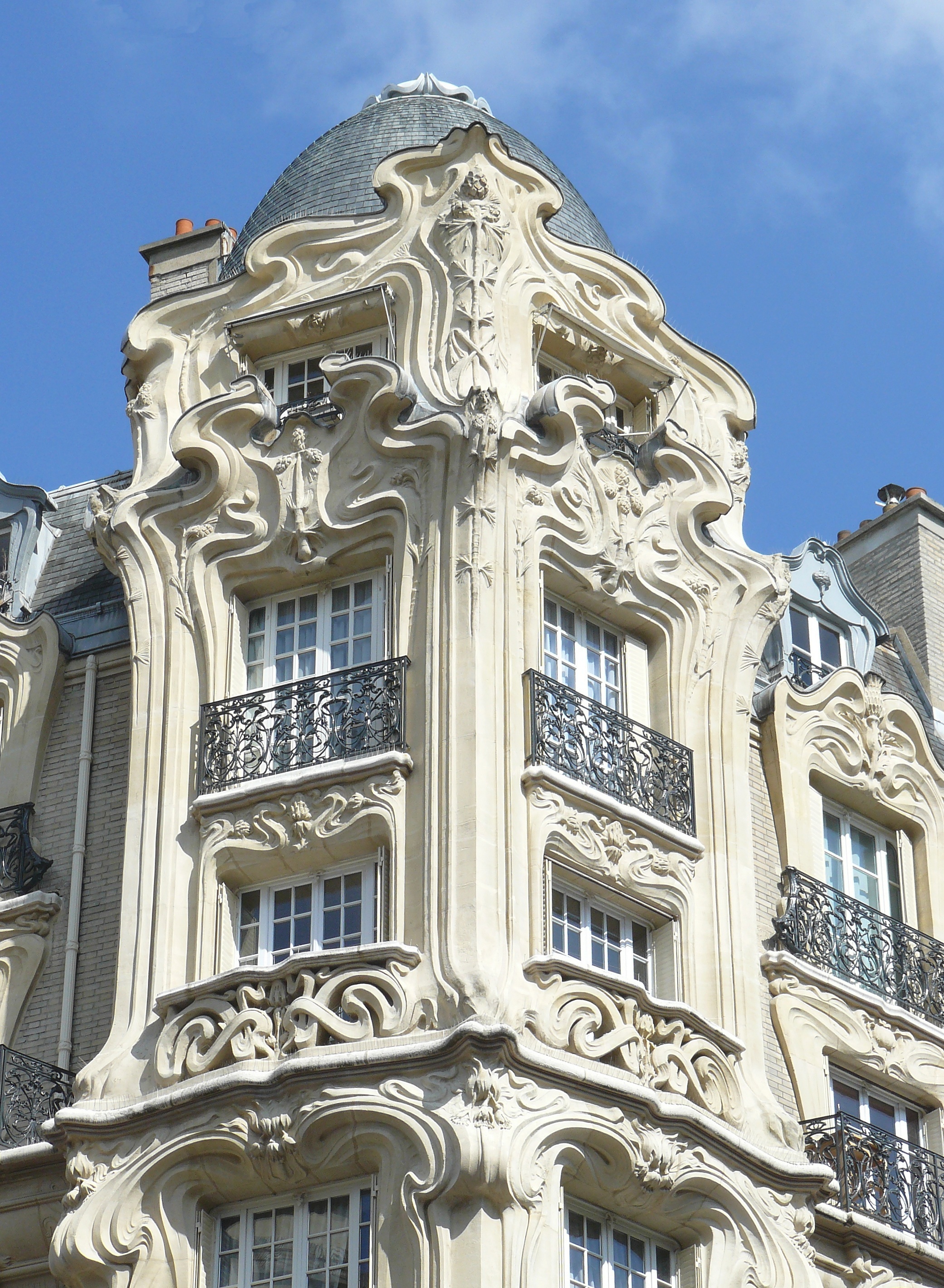
[credit](https://upload.wikimedia.org/wikipedia/commons/f/fd/Immeuble_rue_de_l%27%C3%A9glise_d%C3%A9tail_1.jpg),
[licence](https://creativecommons.org/licenses/by-sa/3.0)
### Charles Plumet: The Elegant Craftsman
**Charles Plumet** brought a refined elegance to Parisian Art Nouveau, often [drawing](/finder/page/definitive-guide-to-drawing-techniques) from regional French architectural traditions while infusing them with the movement's characteristic curves and natural motifs. He was a master of residential design, creating sophisticated apartment buildings and private mansions that exuded a quiet luxury, a kind of understated opulence. His work often features harmonious proportions, delicate ironwork, and subtle sculptural details that blend seamlessly with the building's overall form. A prime example is his exquisite work on the **Immeuble de la Rue de Lota** (3 Rue de Lota) in the 16th arrondissement. Here, Plumet showcases his mastery of integrating subtle classical elements with Art Nouveau's characteristic organic sensibility, creating structures that were both undeniably modern and yet possessed a timeless grace. His facades often feature understated, yet highly detailed, sculpted floral motifs and beautifully executed wrought iron balconies that seem to ripple with movement, contributing to a sense of sophisticated calm. He was also notable for his masterful use of brick and stone, creating textured, nuanced surfaces that played with light and shadow, giving his buildings a tactile richness often missing in more purely decorative styles. Beyond Rue de Lota, Plumet's work also graced buildings like the **Immeuble at 30 Rue de Sèvres** and **Immeuble at 153 Boulevard Malesherbes**, showcasing his consistent dedication to a sophisticated, understated Art Nouveau that prioritized livability and refined aesthetics. It's a wonderful contrast to the more flamboyant styles, proving elegance can also be revolutionary.
### Hector Guimard: The Metro Maestro
When you think of Parisian Art Nouveau, the first image that often springs to mind (for me, at least) are those iconic Métro entrances. And for good reason! **Hector Guimard** was the mastermind behind them. His work isn't just functional; it's pure, unadulterated Art Nouveau – all sinuous curves, organic forms resembling plants, and his distinctive "Métro" typeface. Each entrance is a small, public sculpture, transforming the mundane act of entering a subway station into an artistic experience. But Guimard's genius extended far beyond the Métro entrances that cemented his public fame. He was a prolific designer of numerous private residences and apartments, such as the exquisite **Castel Béranger** (1895-1898) at 14 Rue La Fontaine, which became an early and flamboyant icon of the style, and the more refined, personal **Hôtel Guimard** (1909-1912) at 122 Rue Mozart. His integrated design philosophy meant he often oversaw every detail, from the grand architectural lines to bespoke furniture, custom fireplaces, and even wallpaper, creating a truly harmonious and all-encompassing artistic environment. His innovative use of cast iron, often painted his signature 'Guimard green,' allowed for the mass production of these intricate, organic forms, democratizing the style in a way few other architects achieved. It's a powerful testament to the *Gesamtkunstwerk* ideal, where every element contributes to a unified and deeply personal artistic statement. His audacity and prolific output made him arguably the most recognizable name associated with Art Nouveau in Paris, influencing everything from the grandest façade to the smallest detail of a doorknob.
Here's a quick look at some of Guimard's most notable contributions:
| Work Name | Location (Arrondissement) | Key Features |
| :---------------------------- | :------------------------ | :--------------------------------------------------------------------------- |
| Castel Béranger | 16th | Early flamboyant residential icon, whimsical details, integrated design |
| Hôtel Guimard | 16th | His personal residence, total work of art, refined details |
| Métro Entrances | Various (e.g., 16th, 18th) | Iconic green cast iron, organic forms, distinctive typography, public art |
| Immeuble Jassedé | 16th | Another significant residential project, showcasing his developing style |
| Synagogue de la Rue Pavée | 4th | Rare religious Art Nouveau, elegant and structurally innovative |
| Immeuble Trémois | 16th | Distinctive facade, flowing lines, sculptural details, early Art Nouveau charm|
### Tony Garnier: Bridging Eras with Concrete
While perhaps better known for his groundbreaking urban planning and early modernist visions for industrial cities, **Tony Garnier** also dabbled in the Art Nouveau aesthetic, particularly in his early works. His contributions, though less overtly decorative than some of his contemporaries, demonstrated an innovative use of materials like exposed reinforced concrete and a focus on functional yet aesthetically pleasing design. His early projects hinted at the structural freedoms that new materials offered, paving the way for the architectural movements that would follow Art Nouveau. It’s fascinating to see architects like Garnier, who would later profoundly influence Modernism and functionalist design, pass through the fertile, experimental grounds of Art Nouveau, absorbing its lessons in form and material potential. His work, in its understated way, contributed to the movement's broader aim of breaking free from historical pastiche and embracing structural honesty. While much of Art Nouveau reveled in elaborate ornamentation, Garnier's early flirtations with the style focused more on the functional and structural expression of materials, foreshadowing the modernist emphasis on "form follows function" that would soon emerge. His unbuilt, but highly influential, project **Une Cité Industrielle** (1901-1904), while largely modernist in concept, retained a certain organic sensibility in its integration with nature and its innovative use of concrete, echoing Art Nouveau's material explorations. It was a forward-thinking approach that anticipated the future of urban design and materials science, a subtle nod to the future woven into the fabric of the past.
### Henri Fivaz: The Eclectic Innovator
While less widely celebrated than some of his more flamboyant peers, **Henri Fivaz** brought a unique, often eclectic, sensibility to Parisian Art Nouveau. His work frequently blends the characteristic organic curves and floral motifs with surprising, almost neo-Gothic or even Byzantine influences, creating truly distinctive and imaginative facades. He wasn't afraid to experiment with form and texture, often incorporating richly sculpted stone and vibrant ceramic details that gave his buildings a compelling, storytelling quality. One notable example of his whimsical approach can be found at the **Immeuble at 28 Rue de Fécamp** in the 12th arrondissement, where intricate carvings and a playful asymmetry hint at a deeper artistic narrative, as if the building itself is a character in a forgotten fable. His buildings are a delightful reminder that Art Nouveau in Paris was a broad church, embracing a wide spectrum of artistic expression, often with a delightful touch of theatricality. I always appreciate an artist who isn't afraid to mix their metaphors, architecturally speaking!
### Jules Lavirotte: The Wild One
If Hector Guimard embodied the elegant, botanical side of Art Nouveau, then **Jules Lavirotte** was... well, he was flamboyant, daring, and wonderfully, unashamedly over-the-top. His buildings are not just structures; they are true spectacles, often featuring an explosion of sculpted figures – from enigmatic mythical beasts to sensuous human forms – all intricately intertwined with swirling botanical motifs and highly ornate, often iridescent, ceramic tiles. Lavirotte wasn't afraid to push every boundary of taste and convention, and his facades are a joyous, almost defiant, riot of texture, color, and form, often deliberately eschewing conventional symmetry and proportion. I always feel a little thrill when I spot a Lavirotte building; it's like discovering a hidden carnival, a whimsical and voluptuous defiance of the architectural norms of the time, a building that truly revels in its own artistic freedom. He truly believed in the power of architecture as a canvas for unbridled artistic expression, rejecting the staid classicism of his era with a flourish.
His most famous work, the magnificent **Immeuble Lavirotte** at 29 Avenue Rapp in the 7th arrondissement, is an absolute must-see. It's truly a marvel of sculpted figures, vibrant glazed earthenware (produced by the master ceramist Alexandre Bigot), and a theatrical doorway that seems to beckon you into another world. The sheer audacity of its design, especially when juxtaposed with its more reserved Haussmannian neighbors, is what makes it so captivating and a true icon of the style. Lavirotte delighted in pushing boundaries, often incorporating sensuous female forms, mythical beasts, and exaggerated botanical motifs that practically burst forth from the stone. But don't stop there! Also seek out his **Immeuble at 34 Avenue Rapp**, just a stone's throw away from his most famous edifice, offering a slightly different, yet still opulent, expression of his genius, perhaps a touch more restrained but no less imaginative in its detailing. It's important to note that Lavirotte's "Céramic Hôtel" is sometimes confused with Paul Auscher's more famous Hôtel Céramic; Lavirotte's other significant works include residences at **23 Avenue de Messine** and **3 Square Rapp**, each brimming with his characteristic inventiveness, and the intriguing **Immeuble at 29 Avenue Charles Floquet** in the 16th arrondissement, which further illustrates his diverse approach.

[credit](https://upload.wikimedia.org/wikipedia/commons/2/25/Secession_Vienna_June_2006_007.jpg),
[licence](https://creativecommons.org/licenses/by/2.5)
### Henri Sauvage: The Innovator of Terraced Buildings
**Henri Sauvage** brought a distinct practical elegance to Parisian Art Nouveau, often focusing on hygiene and light within urban living. He's renowned for his innovative terraced apartment buildings, which were designed to maximize sunlight and air circulation, a radical idea for early 20th-century Paris. His use of white ceramic tiles on facades was not only aesthetically pleasing but also practical, allowing for easy cleaning in a bustling city. The **Immeuble at 26 Rue de Sèvres** in the 6th arrondissement is a brilliant example of his vision, a pioneering terraced apartment building that maximizes natural light and air circulation. Its striking white ceramic tile façade (again, often from Alexandre Bigot) was not only aesthetically pleasing but also highly practical for urban hygiene – a radical idea for early 20th-century Paris. It makes you think about how architecture can subtly and profoundly improve daily life, doesn't it? Sauvage's commitment to hygiene, light, and modern living was quite revolutionary for its time, proving that beauty and practicality could, and indeed should, coexist in a harmonious urban dwelling. His terraced designs, which allowed for maximum southern exposure, were a precursor to later modernist housing concepts, demonstrating a profound understanding of urban dwellers' needs for light and fresh air in a rapidly industrializing city. His work profoundly influenced later discussions around healthy urban environments and public housing. Other notable works include the **Immeuble at 19-21 Rue de la Faisanderie** in the 16th, further showcasing his innovative use of terracing and ceramic cladding. It's a testament to how Art Nouveau could be both beautiful and utterly practical.
### Octave Raquin: The Floral Enthusiast
**Octave Raquin** was another architect who embraced the floral exuberance of Art Nouveau. His designs are characterized by their delicate yet abundant use of botanical motifs, often rendered in stone or ironwork, that seem to bloom across facades. His residential buildings in the 16th arrondissement, though perhaps less overtly dramatic than Lavirotte's flamboyant creations, offer a charming and accessible entry point into Art Nouveau's softer, more naturalistic side. Raquin's designs are characterized by their delicate yet abundant use of botanical motifs – particularly stylized flowers, leaves, and intertwining vines – often rendered in finely sculpted stone or elegant ironwork that seems to bloom across facades. Look for his intricate balconies and subtle, yet pervasive, floral details on buildings like those found on **Rue de Longchamp** and **Rue Boileau**, where the natural world is celebrated with a refined hand. His notable work at the **Immeuble at 24 Rue Octave Feuillet** is another prime example of his subtle, yet impactful, naturalistic approach. Raquin's work often feels like a gentle, romantic conversation between architecture and nature, a less confrontational but equally heartfelt expression of the Art Nouveau ethos, emphasizing grace over grandiosity. His thoughtful integration of nature into urban dwellings speaks to a desire for serenity amidst the bustling city. It's a reminder that beauty doesn't always have to shout to be heard.
### Édouard Arnaud: The Master of Ironwork
While Hector Guimard perfected the art of casting iron for public works, **Édouard Arnaud** was a master of more delicate and intricate wrought ironwork for private residences. His creations, particularly his balconies, grilles, and railings, are flowing compositions of organic lines, often featuring stylized flowers, leaves, and sinuous curves. Arnaud's work adds an exquisite, almost jewel-like, layer of detail to many Parisian Art Nouveau buildings, transforming what might have been mere utilitarian elements into sculptural masterpieces. His creations, particularly his balconies, grilles, and railings, are flowing compositions of organic lines, often featuring stylized flowers, thistles, leaves, and wonderfully sinuous curves that evoke a sense of natural movement. You'll often find his elegant ironwork gracing the facades of buildings in the chic residential areas of the 16th arrondissement, a testament to the era's dedication to bespoke craftsmanship and the elevation of every detail to art. His balustrades frequently feature complex, multi-layered scrolls and curves, often terminating in delicate flower buds or abstract organic patterns, transforming mere safety barriers into captivating visual poems, such as those found on buildings along **Avenue Victor Hugo**, **Rue Benjamin Franklin**, and **Rue de la Pompe**. His work truly exemplifies the Art Nouveau ideal of integrating [fine art](/finder/page/illustration-vs-fine-art-whats-the-difference) into everyday functional elements, proving that even a barrier could be a breathtaking piece of art.
### Paul Auscher: The Hôtel Céramic Masterpiece
Another significant player was **Paul Auscher**, particularly known for his **Hôtel Céramic** at 14 Rue de la Faisanderie in the 16th arrondissement. This building is a designated [UNESCO World Heritage](/finder/page/best-museums-in-new-york-city) site, and for very good reason. Its façade is a truly stunning and unique example of glazed stoneware (ceramic, naturally!), with intricate floral, vegetal, and abstract motifs that seem to organically crawl and undulate up the building's surface. The delicate yet robust ceramic work, created by the renowned ceramist Alexandre Bigot, showcases the era's profound mastery of new materials and decorative techniques. It's a little less overtly wild and theatrical than Lavirotte's creations, but no less impactful, showcasing a refined elegance and a seamless integration of art and architecture that defines a distinct facet of Art Nouveau. This UNESCO World Heritage site is a powerful reminder of Art Nouveau's diverse expressions, showcasing a refined and luxurious approach that still pushes the boundaries of [decorative art](/finder/page/the-precipice-between-craft-and-fine-art) in architecture. It’s a building that whispers sophisticated elegance rather than shouts flamboyant exuberance, and I find that subtlety utterly captivating, inviting closer inspection to appreciate its myriad details. Its designation as a UNESCO World Heritage site underscores its unique artistic merit and its pivotal role in showcasing the innovative application of glazed ceramics in architectural ornamentation. Auscher's work here demonstrates a sophisticated synthesis of practicality and profound aesthetic vision, elevating a commercial enterprise into a lasting work of art. It stands as a vibrant testament to the movement's versatility.
### Georges Biet: The Unassuming Master
While perhaps not as widely recognized as a Guimard or Lavirotte, **Georges Biet** quietly contributed a number of elegant and structurally inventive Art Nouveau buildings to the Parisian landscape. Often working in collaboration with ceramicists like Alexandre Bigot, Biet integrated delicate floral reliefs and flowing lines into residential facades with a subtle sophistication. His approach often highlighted the quality of materials and precise craftsmanship over overt theatricality, making his buildings refined examples of the style's more understated expressions. Keep an eye out for his nuanced contributions, especially in the 16th arrondissement, which often feature beautifully proportioned bay windows and intricate yet harmonious ceramic decorations. His work at the **Immeuble at 5 Rue des Écoles** (5th arrondissement) and **131 Boulevard Raspail** (6th arrondissement) are excellent examples of his refined yet distinct Art Nouveau aesthetic, seamlessly blending into the urban fabric with quiet distinction. Biet's buildings are a testament to the idea that Art Nouveau could be both innovative and gracefully integrated into existing urban contexts, a true master of subtle impact.
## Key Characteristics and Motifs of Parisian Art Nouveau: Your Ultimate Spotter's Guide
Okay, so you've got the historical context and met some of the key players who brought Art Nouveau to life in Paris. Now, before we embark on our journey to find these masterpieces on the city's streets, let's establish a mental checklist of precisely what to look for. Parisian Art Nouveau isn't just a style; it's a rich visual language, expressed through specific motifs, innovative materials, and a distinctive philosophical approach that tells a story of audacious innovation, a profound rejection of industrial uniformity, and a passionate, almost spiritual, return to nature. Knowing these key elements will transform your stroll through Paris into a delightful and deeply rewarding treasure hunt, enabling you to "read" the visual narratives embedded within these extraordinary structures!
### The Organic Line: "Whiplash Curves" and Botanical Forms
This is perhaps the most defining feature, the very heartbeat of the style. Forget the straight lines and rigid symmetry of classical architecture. Art Nouveau celebrates the **curvilinear line**, often dubbed the "whiplash line" for its dynamic, energetic quality that seems to lash out with artistic freedom. You'll see it everywhere: in the dramatic, swirling ironwork of balconies and grilles, the elegant swoop of a window frame, the subtle curve of a door lintel, or even the undulating flow of a building's overall massing. These lines directly mimic natural forms – the slender stem of a flower, the delicate tendril of a vine reaching for light, the graceful curve of a human body in motion, or the sinuous flow of water. It’s a profound celebration of life, growth, and dynamic movement, a deliberate antidote to the static rigidity of earlier architectural styles. You’ll find these sensuous curves not only in the obvious places, like elaborate balcony railings or sinuous door frames, but also in the less apparent structural elements, like cornices that subtly undulate or window apertures that gracefully swell and taper. It's truly a pervasive language of motion and vitality, embodying a desire to animate inanimate structures and connect them intimately with the living world. It’s almost as if the buildings themselves are breathing, reaching, and growing right before your eyes.
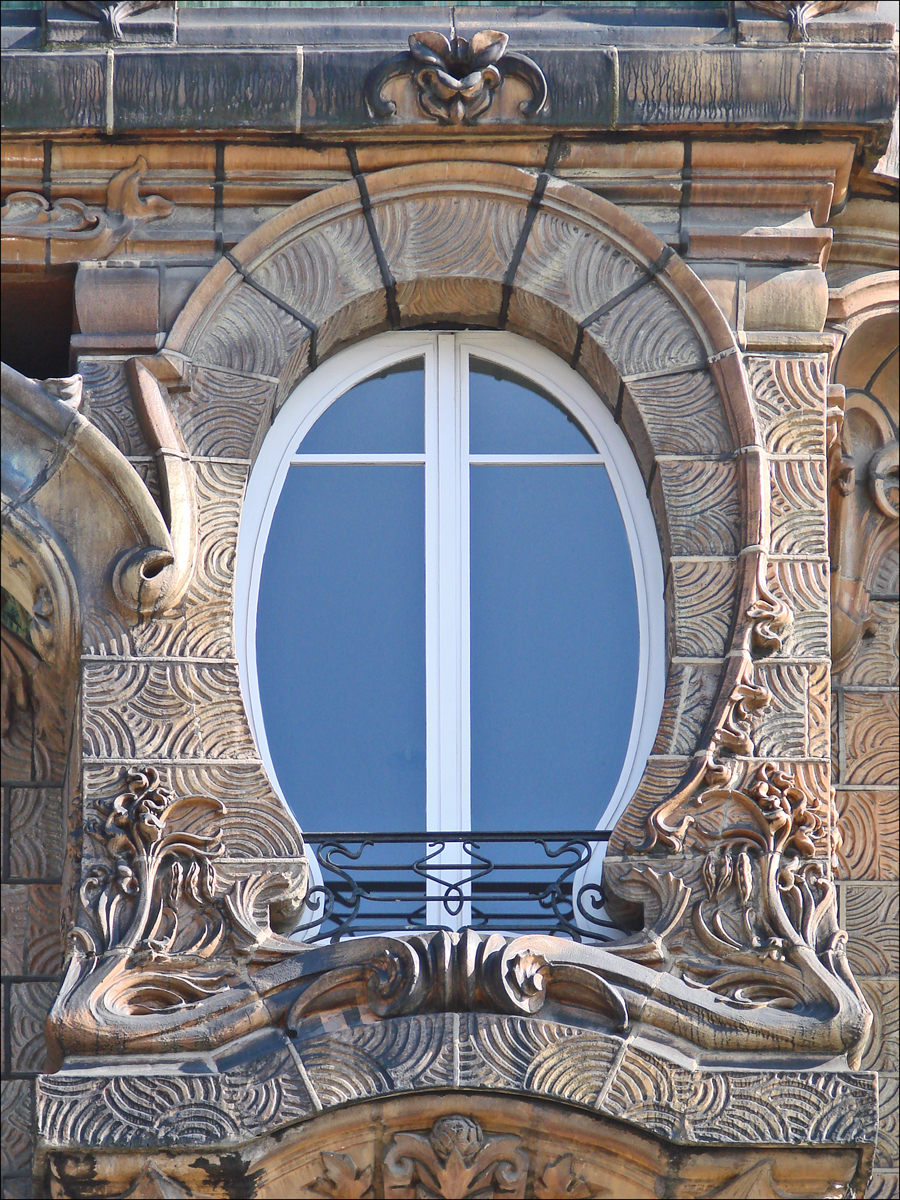
[credit](https://live.staticflickr.com/5094/5510662576_e5fb3c8b8a_o.jpg),
[licence](https://creativecommons.org/licenses/by/2.0)
### Nature as Muse: Floral and Faunal Motifs
[Art Nouveau artists](/finder/page/art-nouveau-artists) drew endless inspiration from the natural world, transforming its forms into a rich lexicon of decorative motifs. Look for intricate carvings of **flowers** (lilies, irises, thistles, orchids, mistletoe, poppies, cyclamen, and even more exotic blooms are common), **leaves**, and **vines**. You might even spot stylized **insects** (dragonflies, butterflies, cicadas, bees) or **birds** (peacocks, swans) integrated into facades, mosaics, or [stained glass](/finder/page/what-is-stained-glass-art). This wasn't just decoration; it was a philosophical statement, a rejection of industrial sterility in favor of organic vitality and the celebration of life itself. Beyond the common lilies and irises, you might discover more symbolic flora like the thistle (a national emblem of Scotland, but adopted in French Art Nouveau for its resilience and protective qualities) or water lilies, evoking notions of purity and fluid beauty. These motifs often appear intertwined, forming complex, organic patterns that seem to grow directly out of the building's surface, almost as if the building itself is a living organism, a concrete manifestation of the natural world. It’s a profound connection to the earth, a desire to bring the wildness of nature into the heart of the city.
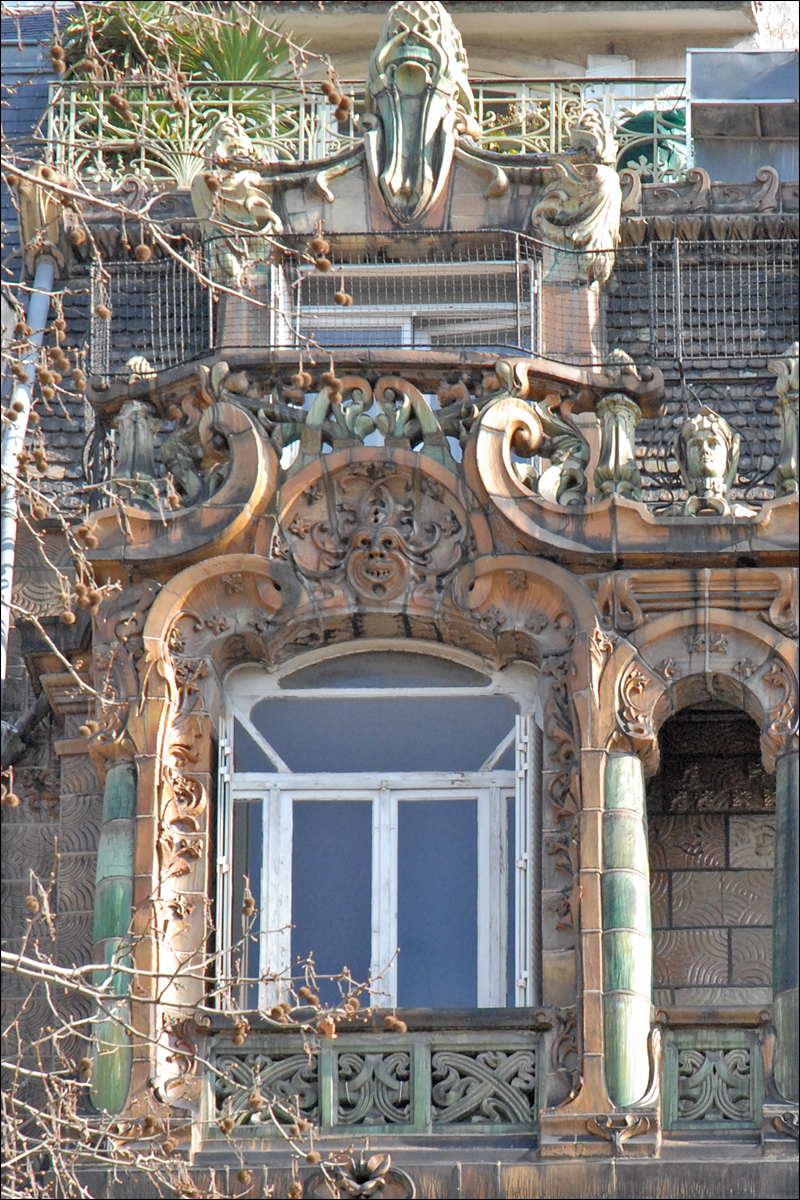
[credit](https://upload.wikimedia.org/wikipedia/commons/f/f1/Immeuble_art_nouveau_de_Jules_Lavirotte_%C3%A0_Paris_%285510062873%29.jpg),
[licence](https://creativecommons.org/licenses/by/2.0)
### Innovative Materials and Craftsmanship
Beyond traditional stone, Parisian Art Nouveau bravely embraced and innovatively utilized new, often industrial, materials, but always transforming them with an artisanal skill that countered the very industrialization it reacted against. This paradoxical willingness to experiment with the modern while retaining a handcrafted aesthetic is one of the movement's most intriguing and defining aspects. Here's what to look for:
* **Wrought Iron (Fer Forgé):** This is arguably the signature material of Parisian Art Nouveau, epitomized by Hector Guimard's iconic Métro entrances. But beyond those famous public works, look for incredibly delicate, often asymmetrical and highly dynamic ironwork in balconies, grilles, railings, and even structural elements. It's often meticulously manipulated to resemble intertwining plants, delicate insect wings, flowing hair, or abstract natural phenomena like waves or flames. This material allowed for an incredible degree of expressive freedom, transforming what could have been rigid barriers into delicate, sculptural masterpieces that softened the urban hardscape and brought a sense of fluid movement to static facades. The skill involved in creating these intricate *fer forgé* pieces was immense, elevating the blacksmith's craft to an art form.
* **Glazed Ceramics/Stoneware:** Jules Lavirotte and Paul Auscher were masters of this vibrant material. These colorful, often iridescent or matte-glazed tiles and sculptural elements add striking texture, [vibrant color](/finder/page/mastering-color-mixing-for-expressive-abstract-art), and an undeniable sense of luxury and whimsy to facades, making them truly pop amidst the grayer Parisian stone. The renowned ceramist **Alexandre Bigot** was *the* key figure in innovating and producing these incredible architectural ceramic elements, collaborating with many of the era's leading architects. His workshops produced everything from iridescent, jewel-toned tiles to large-scale sculptural reliefs, often featuring a rich interplay of matte and glossy finishes that added incredible depth and tactile appeal to facades, becoming synonymous with the Art Nouveau aesthetic in Paris. His innovations allowed architects unprecedented freedom in color and texture, pushing the boundaries of what was possible with architectural decoration.
* **Stained Glass:** Look for vibrant, often opaque stained glass panels in doors, windows, and skylights, depicting natural scenes or abstract patterns. These weren't just decorative; they filtered and diffused light, bathing interiors in soft, colored hues and creating an ethereal atmosphere, particularly in private residences. Artists like **Jacques Gruber**, **Henri Rapin**, and **Louis Barillet** (who also created stunning windows) were masters of this craft in France, creating masterpieces for both public and private commissions, often employing techniques like *pâte de verre* or leading that allowed for subtle shading and nuanced color transitions, further enhancing the organic feel and contributing to the immersive *Gesamtkunstwerk*. The interplay of light and color was a crucial element in creating the total artistic environment.
* **Exposed Concrete:** While perhaps less overtly decorative, architects like Anatole de Baudot pioneered the use of reinforced concrete. This allowed for unprecedented structural freedom, enabling architects to create bold, fluid forms, cantilevered balconies, and larger, more open interior spaces that were simply impossible with traditional masonry and timber construction methods. It represented a crucial technological leap that Art Nouveau artists harnessed to achieve their aesthetic goals. This allowed for innovative structural solutions that freed facades from being purely load-bearing, enabling more dynamic, open designs and the integration of large, expressive fenestration (window arrangements) that were hallmarks of the style's modern aspirations, truly pushing the boundaries of what architecture could achieve structurally and aesthetically. This embrace of a modern, industrial material, while still seeking artistic expression, highlights the movement's paradoxical nature and forward-thinking spirit.
* **Woodwork and Marquetry:** Within interiors, elaborate woodwork and marquetry (inlaid wood veneers) were frequently used for furniture, paneling, and doors, often echoing the botanical motifs seen on exteriors. Designers like the famed **Louis Majorelle** (from Nancy, but whose work was widely sought in Paris, known for his stunning marquetry and bronze details, often depicting water lilies and other natural motifs), **Émile Gallé** (another Nancy School master, whose glass and furniture were highly influential for their intricate botanical inlays), and **Hector Guimard** (who designed his own furniture for his buildings, creating truly integrated environments) created pieces that were both functional and sculptural, blurring the lines between art and utility. Imagine elegant chairs with lily pad backs or tables with twisting, vine-like legs, crafted from exotic woods and inlaid with mother-of-pearl or contrasting timbers. These were not just items of utility; they were artworks in themselves, blurring the lines between applied art and fine art, often reflecting the influence of the [Arts and Crafts movement](/finder/page/the-arts-and-crafts-movement-a-return-to-handcrafted-beauty). Exotic woods like mahogany, rosewood, and ebony were favored, often combined with lighter inlays of sycamore or fruitwood to create striking contrasts and intricate pictorial narratives, often depicting fantastical landscapes or stylized natural motifs. The attention to detail was such that even simple door handles or stair newel posts became miniature sculptures, ensuring a seamless artistic experience throughout the space.
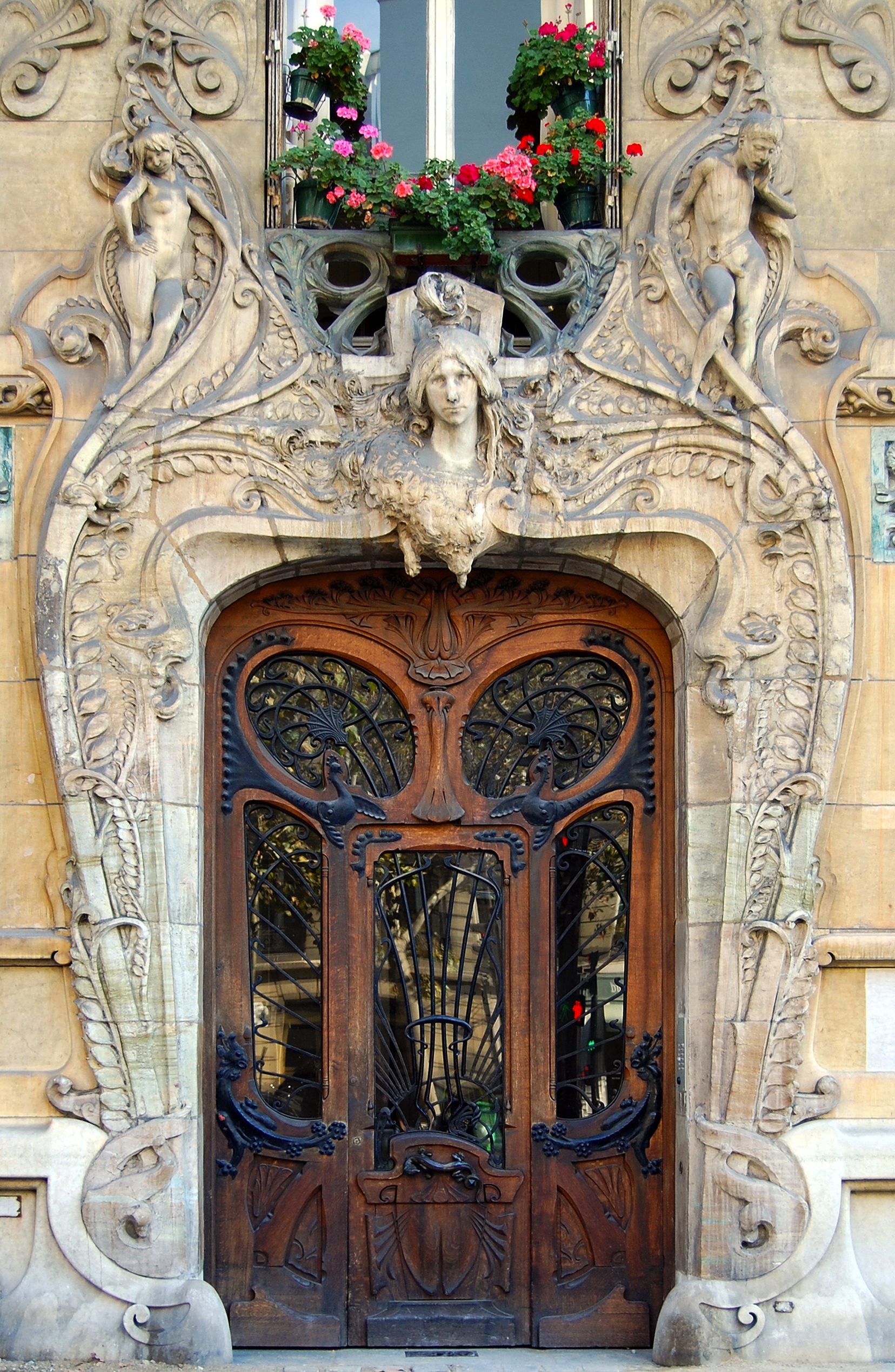
[credit](https://upload.wikimedia.org/wikipedia/commons/4/47/XDSC_7288-29-av-Rapp-paris-7.jpg),
[licence](https://creativecommons.org/licenses/by-sa/3.0)
* **Mosaics:** While less common on grand public facades, mosaics were often found in smaller decorative panels, entranceways, floors, or in conjunction with ceramic work, adding another layer of intricate detail and vibrant color, particularly in interiors or more modest residential buildings. They frequently depicted stylized botanical patterns or abstract designs, further enriching the tactile and visual experience of Art Nouveau spaces. These were often meticulously hand-crafted, showcasing the artisan's dedication to detail.
### Symbolism and Allegory
Art Nouveau wasn't just about aesthetics; it often imbued its forms with deeper meanings, drawing from a rich tapestry of mythology, folklore, and natural symbolism. Look for **symbolic female figures**, often sensuous and ethereal, representing nature, beauty, or a new modernity – frequently depicted with flowing hair or draped in organic forms. Mythical creatures (like dragons, griffins, or sphinxes), allegorical scenes, and subtle narratives were frequently woven into the ornamentation, particularly in the work of architects like Jules Lavirotte. This use of symbolism added an intellectual layer to the visual richness, inviting viewers to ponder the deeper philosophical underpinnings of the "new art" and its connection to deeper human experiences and aspirations.
### Typology and Building Types
Parisian Art Nouveau manifested across a range of building types, though it found its most expressive freedom in **private residences and apartment buildings** (*hôtels particuliers* and *immeubles de rapport*). These commissions allowed architects greater artistic license, resulting in the flamboyant facades and integrated interiors we often associate with the style. Public infrastructure, most famously the **Métro entrances**, provided an opportunity to democratize art, bringing beauty to everyday urban life. Even some **commercial establishments** (like the grand department stores or restaurants that aimed for a luxurious, immersive experience) and a few **religious buildings** (like Anatole de Baudot's Église Saint-Jean-de-Montmartre) embraced the new aesthetic, showcasing the movement's versatility and widespread appeal. This wide range of application underscores Art Nouveau's ambition to permeate every aspect of modern life, proving that art isn't just for [museums](/finder/page/best-museums) but for the streets and homes too.
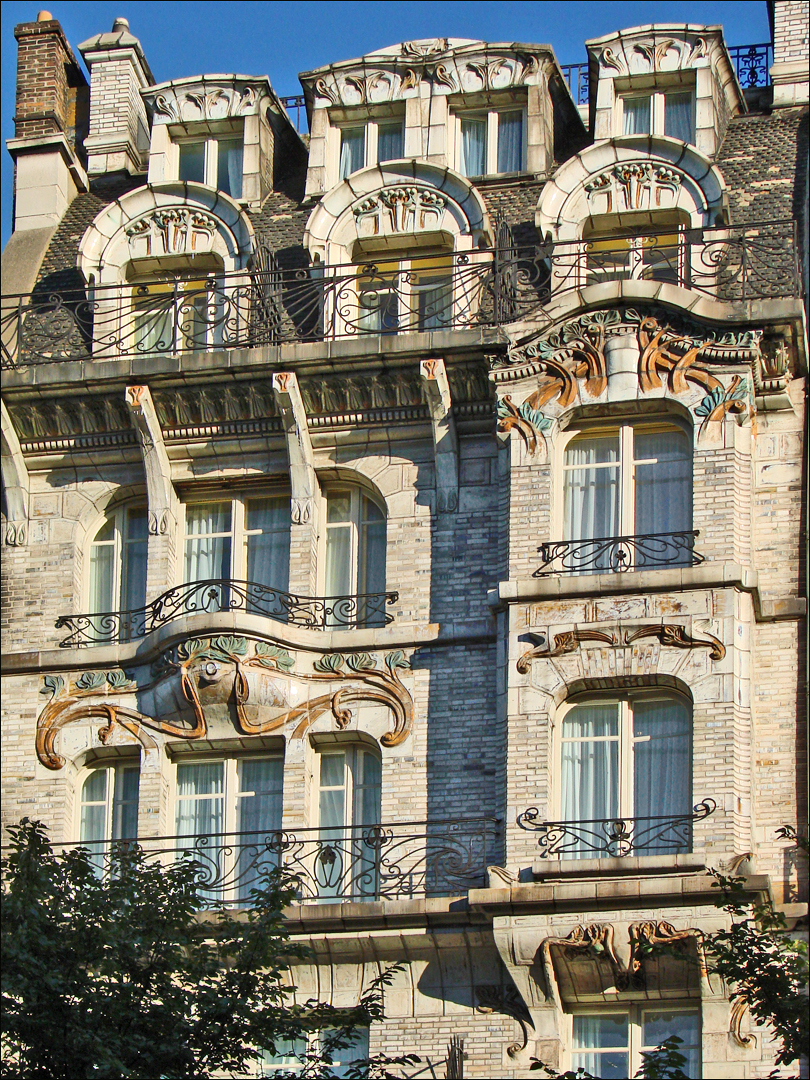
[credit](https://live.staticflickr.com/4108/5072808987_5e2d0fd5ff_o.jpg),
[licence](https://creativecommons.org/licenses/by/2.0)
### Typography and Lettering
Another subtle yet pervasive characteristic of Art Nouveau in Paris was its distinctive **typography and lettering**. Designers like Hector Guimard created entire custom alphabets, known as the "Métro" typeface, for their architectural projects. These flowing, organic letterforms echoed the curvilinear lines of the architecture and decorative motifs, creating a harmonious and integrated aesthetic even in something as utilitarian as signage. From carved stone inscriptions to elaborate iron nameplates, the lettering itself became an art form, adding another layer of handcrafted artistry to the urban environment. This attention to detail, even in the smallest textual elements, speaks volumes about the *Gesamtkunstwerk* ideal that permeated the movement. It’s a wonderful reminder that every detail counts in creating a truly immersive artistic experience.
### Color Palette
The Art Nouveau color palette, particularly in Paris, was as distinctive as its forms. While the grandeur of Haussmannian architecture often relied on muted tones of grey and beige stone, Art Nouveau introduced a more vibrant and naturalistic spectrum. Look for **earthy greens, ochres, and warm browns** in ceramic and stained glass, echoing the natural world and the lushness of botanical motifs. **Deep blues and purples**, often used in glasswork, mimicked atmospheric effects or the iridescence of insects, adding an almost mystical quality. Accents of **gold, bronze, and rich reds** brought a touch of luxury and sensuality, often found in metalwork or interior textiles, hinting at exotic influences. The overall effect was a sophisticated yet organic visual richness that distinguished these buildings from their more conventional neighbors, inviting the eye to linger and explore the subtle interplay of hues and textures. This departure from muted palettes was a deliberate statement, asserting a new, more expressive aesthetic, truly making the buildings feel alive with color.
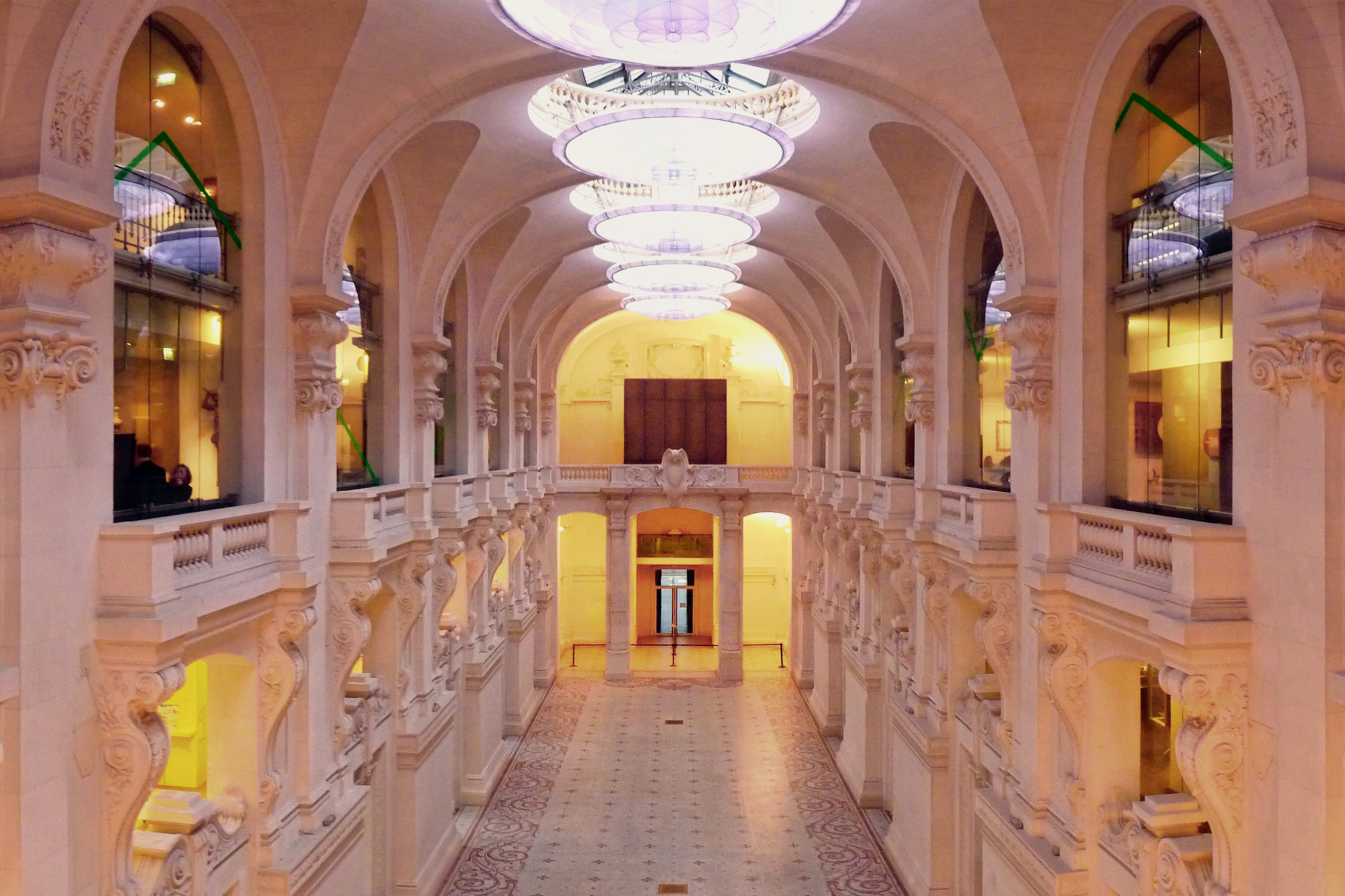
[credit](https://upload.wikimedia.org/wikipedia/commons/6/64/Mus%C3%A9e_des_Arts_d%C3%A9coratifs%2C_Paris_1.jpg),
[licence](https://creativecommons.org/licenses/by-sa/3.0)
## Your Personal Walking Tour: Where to Find Parisian Art Nouveau Gems
Okay, so you're convinced, right? You want to see these architectural beauties with your own eyes, to feel that sense of discovery firsthand. Good. Because honestly, there's no substitute for experiencing them in person. There’s a certain magic to strolling through the charming Parisian streets and suddenly encountering these architectural dreams – these unexpected bursts of sinuous lines and organic forms, each telling a silent story of a bygone era's artistic rebellion. It’s like the city itself is a living canvas, always revealing new layers. Here's how I approach my Art Nouveau hunts in Paris, broken down by arrondissement, to help you plan your own immersive journey and uncover these treasures, turning every street corner into a potential revelation.
### 1. The 16th Arrondissement: An Open-Air Museum
If you only have time for one area, make it the 16th. This chic residential district is practically an open-air museum of Art Nouveau, a place where the movement's full expressive range is on vibrant display. It's where many wealthy Parisians, seeking to express their modernity and individuality, built their elaborate homes at the turn of the century, and the architects really let loose, unfettered by strict Haussmannian planning codes. The relative spaciousness of the 16th arrondissement, compared to the denser, more historically preserved central areas, allowed for more ambitious and distinctive designs, often allowing buildings to stand out more prominently and giving architects greater freedom to express their vision. This district, often overlooked by those focusing solely on the grand Parisian landmarks, is a true haven for Art Nouveau enthusiasts. The wider streets and larger plots here allowed architects greater freedom to create expansive, individually expressive facades, making it a perfect starting point for your exploration. You'll find a delightful blend of the opulent and the quirky, all imbued with that unmistakable organic flair, making it an endlessly rewarding area for discovery. It's truly a testament to a period of daring artistic experimentation.
* **Castel Béranger (14 Rue La Fontaine):** Hector Guimard's first major residential work, often called the "Art Nouveau Building." It's playful, asymmetrical, and a fantastic example of his early style. Look for the whimsical details, the stylized cats, and the intricate ironwork. I always feel like I've stepped into a fairytale when I see it – a truly fantastical residential block.
* **Hôtel Mezzara (60 Rue La Fontaine):** Another stunning work by Hector Guimard, this private mansion showcases his signature organic forms and meticulous attention to detail in its ironwork and decorative elements. It's often overlooked but is a true gem, demonstrating Guimard's ability to adapt his style to a more formal, private dwelling, a quieter expression of his genius.
* **Hôtel Céramic (14 Rue de la Faisanderie):** As mentioned, Paul Auscher's masterpiece and a UNESCO World Heritage site. The sheer detail of the ceramic work by Alexandre Bigot is breathtaking, a symphony of glazed stoneware that ripples across the facade, a true marvel of applied art in architecture. It's a testament to the period's innovative use of materials.
* **Immeuble at 43 Rue de la Fontaine (Louis Sorel):** While the previously mentioned 34 Avenue Rapp by Lavirotte is in the 7th, this building by Louis Sorel offers another fantastic example in the 16th. Look for the ornate balconies and a blend of geometric and floral motifs that characterize a slightly different, yet equally captivating, Art Nouveau expression. Sorel often brought a distinct geometric flair, balancing the organic curves.
* **Immeuble at 29 Avenue Charles Floquet (Jules Lavirotte):** Yes, Lavirotte made his indelible mark here too! This building, though perhaps less overtly wild than his Avenue Rapp masterpiece, still powerfully showcases his distinctive love for sculptural detail and expressive, almost organic, forms. It's a fantastic spot to compare the subtle (and not-so-subtle) variations in his audacious style. It's like seeing a different facet of a brilliant diamond.
* **Immeuble at 3 Rue François Millet (Louis Sorel):** A charming example of Sorel's work, featuring delicate ironwork and an understated elegance, a more serene take on the Art Nouveau spirit.
* **Immeuble at 11 Rue du Général Camou (Louis Sorel):** Another beautiful residential building by Sorel, characterized by its refined proportions and graceful Art Nouveau details, a testament to his consistent aesthetic.
* **Hôtel Rosze (46 Rue du Général Foy):** While not purely Art Nouveau, this elegant building showcases strong influences of the style in its delicate ironwork and sculpted motifs, blending seamlessly with a more classical structure. It’s a lovely example of the style's widespread subtle permeation.
### 2. The 7th Arrondissement: Lavirotte's Domain
Beyond the iconic Immeuble Lavirotte at 29 Avenue Rapp, explore the surrounding streets for more subtle, but equally charming, examples of the style. This area really showcases how Art Nouveau managed to integrate itself, often with a cheeky flourish and defiant ornamentation, into the otherwise rigid Haussmannian fabric of the city. Don't be afraid to wander down side streets; you'll often be rewarded with an unexpected undulating balcony, a unique sculpted doorway, or an ornate building façade that hints at the rebellious spirit within. It's a brilliant study in [Art Nouveau vs. Art Deco: Key Differences](/finder/page/art-nouveau-vs-art-deco-key-differences) as you see the two styles coexisting and contrasting, sometimes even on the same street, a testament to Paris's layered and evolving architectural history. While the 16th arrondissement showcases the grandeur, the 7th offers a glimpse into how Art Nouveau bravely inserted itself into more established, aristocratic neighborhoods, often with a bold and almost defiant presence. The proximity to the Eiffel Tower also makes this area a popular, albeit sometimes crowded, spot for architectural exploration, offering a unique juxtaposition of styles. It’s like a secret conversation between architectural eras.
* **Immeuble at 3 Avenue Anatole France:** Another striking Jules Lavirotte creation, just a short walk from Avenue Rapp. Here, his characteristic use of sculpted figures and glazed ceramics is evident, making it another must-see for those who appreciate his audacious style.
* **Immeuble at 12 Rue du Champ de Mars:** While perhaps not as flamboyant as Lavirotte's other works, this building offers a more restrained yet beautiful example of Art Nouveau, with delicate ironwork and subtle botanical motifs integrated into its facade.
* **Immeuble at 28 Rue du Général Mangin (Henri Fivaz):** A compelling example of Fivaz's eclectic style, blending organic forms with subtle classical undertones.
* **Immeuble at 122 Rue La Fontaine (Hector Guimard):** A lesser-known but beautiful example of Guimard's work, offering a more residential and intimate scale compared to his public Métro entrances.
<!-- Removed duplicate image, will re-use where more relevant or add new ones. -->
### 3. The 9th Arrondissement: A Touch of Elegance
While the 16th and 7th arrondissements are undoubtedly epicenters, the 9th arrondissement offers some notable Art Nouveau treasures, often integrated seamlessly into bustling commercial and entertainment areas. This showcases how the style, despite its artistic aspirations, also found its place in the vibrant public life of Paris, adding a touch of elegance and whimsy to everyday commerce and leisure. It's a testament to the movement's adaptability and its ability to infuse even the most utilitarian structures with artistic flair. It's like finding a hidden jewel amidst the bustling marketplace.
* **Maxim's Restaurant (3 Rue Royale):** While the exterior of this famed establishment leans more classical, make sure to step inside (or at least admire the entrance) for a breathtaking glimpse of its opulent, perfectly preserved Art Nouveau interior. It's a lavish, dazzling example of the *fin de siècle* aesthetic, where every detail, from the murals by Édouard Niermans to the exquisite lighting fixtures and custom furniture, contributes to a cohesive artistic vision. It's a rare and invaluable chance to experience the full *Gesamtkunstwerk* of a high-end Art Nouveau space, preserved almost perfectly as a living museum piece, allowing you to step directly into a bygone era of Parisian glamour. It's like a portal to a more luxurious time.
* **Grand Hôtel (2 Rue Scribe):** Look for the subtle Art Nouveau details in the public areas and ironwork of this historic hotel, particularly around the magnificent Winter Garden. Designed by Édouard Niermans (who also worked on Maxim's), its delicate glass and metal work, often featuring graceful botanical motifs, offers a sophisticated example of Art Nouveau's integration into grand commercial spaces. It proves that even grand hotels embraced the 'new art'.
* **Immeuble (23 Rue Drouot):** This building offers a lovely example of Art Nouveau with its delicate iron balconies and carved stone details, often overlooked amidst the bustling commercial streets. It’s a testament to how the style permeated even more utilitarian structures, adding beauty to the everyday.
* **Musée Gustave Moreau (14 Rue de la Rochefoucauld):** While primarily known for Symbolist painting, the museum's lavish interior, particularly the spiral staircase, features stunning Art Nouveau-influenced details in its ironwork and decorative elements, making it an unexpected treat. It's a delightful blend of Symbolism and Art Nouveau, a truly unique experience.
* **Printemps Haussmann (64 Boulevard Haussmann):** While predominantly a grand department store, its magnificent domed stained-glass ceiling, designed by Édouard Chimot, is a breathtaking Art Nouveau masterpiece. It's a testament to how the style graced commercial spaces with luxurious artistry, transforming shopping into an aesthetic experience.
### 4. Métro Stations: Guimard's Public Art
No Art Nouveau tour of Paris is complete without admiring the Métro entrances. While many have been removed or replaced, several beautiful original examples remain, offering a tangible link to the era. It's almost as if these entrances are time capsules, transporting you back to the turn of the century. Look for the iconic green cast iron structures at:
[credit](https://upload.wikimedia.org/wikipedia/commons/e/eb/Basilique_du_Sacr%C3%A9_C%C5%93ur_de_Montmartre_%40_Paris_%2834188687416%29.jpg),
[licence](https://creativecommons.org/licenses/by/2.0)
### 5. Other Arrondissements with Notable Gems
While the 16th, 7th, and 9th are undeniable hotspots, Art Nouveau's reach extended across Paris. Don't hesitate to venture further afield for more unique discoveries. Sometimes the most rewarding finds are those off the beaten path.
* **18th Arrondissement:**
* **Église Saint-Jean-de-Montmartre (Place des Abbesses):** Anatole de Baudot's groundbreaking work in reinforced concrete, a vital example of structural innovation blended with Art Nouveau aesthetics. It's a powerful statement of modernity in a historically rich district.
* **6th Arrondissement:**
* **Immeuble at 26 Rue de Sèvres (Henri Sauvage):** A pioneering terraced apartment building showcasing Sauvage's commitment to light, air, and hygiene through its distinctive white ceramic tile facade. It's a testament to his forward-thinking urban design.
* **12th Arrondissement:**
* **Immeuble at 28 Rue de Fécamp (Henri Fivaz):** A compelling example of Fivaz's eclectic style, blending organic forms with subtle classical undertones and vibrant ceramic details. It truly stands out with its unique narrative facade.
* **10th Arrondissement:**
* **Gare de l'Est (Place du 11 Novembre 1918):** While a grand railway station, look for subtle Art Nouveau elements in its interior decoration and ironwork, particularly around the concourse, reflecting the era's embrace of new materials and decorative styles even in massive public infrastructure. It's a quiet testament to the movement's pervasive influence.
* **Porte Dauphine (16th Arrondissement):** The most complete and arguably the most beautiful original Guimard Métro entrance, complete with its intricate glass canopy. It's a truly iconic symbol of Parisian Art Nouveau.
* **Abbesses (18th Arrondissement, Montmartre):** Another stunning example, albeit without the full canopy, offering a great contrast against the backdrop of Montmartre's more traditional charm. It’s a whimsical entrance to a historic neighborhood.
* **Cité (4th Arrondissement):** A simpler but still elegant Art Nouveau entrance, located near Notre Dame. It proves that even in the historic heart of Paris, Art Nouveau found its place.
* **Palais Royal - Musée du Louvre (1st Arrondissement):** While a modern replica, it beautifully showcases the iconic Guimard style and serves as a popular photo spot for enthusiasts. It’s a testament to the enduring appeal of his designs.
* **Châtelet (1st Arrondissement):** Features several Guimard elements, including railings and distinctive signage. It’s worth seeking out these subtle touches in a bustling area.
* **Cadet (9th Arrondissement):** A more discreet, but original, Guimard entrance. A quiet, elegant nod to the movement in a busy district.
Every time I pass one of Guimard's Métro entrances, I'm reminded of the incredible foresight of these artists to elevate everyday infrastructure into genuine works of art. It just brings a little unexpected joy to the mundane, which I think is a rather lovely philosophy for life, don't you think? These iconic entrances, though initially met with mixed reactions (some found them too 'vegetable-like' or ostentatious, especially compared to the grandeur of Haussmann's Paris!), have become enduring and beloved symbols of Parisian Art Nouveau, truly democratizing art and bringing beauty to the daily commute for millions. There were once over 140 such entrances across the city, and while many have been lost to changing tastes and urban development, the surviving ones are now carefully preserved as national treasures, cherished for their artistic and historical significance. These entrances, initially quite controversial and even derided by some as 'noodle style,' ultimately became beloved symbols of Paris, enduring testaments to the movement's ability to imbue functional urban infrastructure with profound artistic beauty. For a broader look at this architectural style across the continent, don't miss our guide to [Art Nouveau Architecture in Europe](/finder/page/art-nuveau-architecture-key-examples-europe).
## Beyond Architecture: Art Nouveau in Parisian Decorative Arts and Interiors
While the majestic facades grab our attention, Art Nouveau was never confined to exteriors. It was a holistic design philosophy, permeating every aspect of life, aiming to create a harmonious aesthetic experience known as the *Gesamtkunstwerk* (total work of art). Paris, with its rich tradition of craftsmanship and luxury, became a hub for this movement in decorative arts, where every object, from a delicate vase to an ornate piece of furniture, became a canvas for artistic expression, blurring the lines between fine art and applied art. It was a true revolution in how art was perceived and integrated into daily existence.
[credit](https://upload.wikimedia.org/wikipedia/commons/f/fd/Front_Fa%C3%A7ade_of_the_Centre_Pompidou_2.jpg),
[licence](https://creativecommons.org/licenses/by-sa/4.0)
### Furniture and Interior Design
Imagine stepping into a Parisian apartment at the turn of the century. You wouldn't find rigid, heavy Victorian pieces. Instead, furniture would echo the undulating lines of the architecture – sinuous curves, organic forms, and exquisite marquetry often depicting botanical motifs. Designers like **Louis Majorelle** (known for his stunning marquetry and bronze details, often depicting water lilies and other natural motifs), **Émile Gallé** (from Nancy, but whose glass and furniture were highly influential in Paris with his intricate botanical inlays), and **Hector Guimard** (who designed his own furniture for his buildings, creating truly integrated environments) created pieces that were both functional and sculptural. Think about elegant chairs with lily pad backs or tables with twisting, vine-like legs, crafted from exotic woods like mahogany and inlaid with mother-of-pearl or contrasting timbers. These were not just items of utility; they were artworks in themselves, blurring the lines between applied art and fine art, often reflecting the influence of the [Arts and Crafts movement](/finder/page/the-arts-and-crafts-movement-a-return-to-handcrafted-beauty). The Nancy School, particularly with masters like Majorelle and Gallé, profoundly shaped this aspect of Parisian Art Nouveau, creating a distinctive regional flair that blended seamlessly with the Parisian aesthetic, emphasizing meticulous handcraftsmanship and bespoke design.
### The Role of Salons and Exhibitions
Beyond formal architectural commissions, Art Nouveau's decorative arts flourished in specialized salons and exhibitions throughout Paris. Events like the annual **Salon des Artistes Décorateurs** provided crucial platforms for designers to showcase their innovative furniture, textiles, and objects. These gatherings allowed the public and patrons to directly engage with the *Gesamtkunstwerk* ideal, seeing entire room ensembles meticulously designed in the Art Nouveau style. This direct exposure was vital in popularizing the movement and demonstrating its comprehensive artistic vision, from the grandest architectural gesture to the smallest, most intimate domestic detail. It was a bustling marketplace of ideas and beauty, where trends were set and tastes evolved.
### Stained Glass and Lighting
Light was another crucial element, often treated as a material itself within Art Nouveau interiors. **Stained glass**, often depicting lush floral scenes, stylized female figures, or abstract patterns, filtered sunlight into interiors, casting colorful hues and creating an ethereal atmosphere. Artists like **Jacques Gruber**, **Henri Rapin**, and **Louis Barillet** were masters of this craft in France, creating masterpieces for both public and private commissions, utilizing new techniques to achieve vibrant, translucent effects. While **Tiffany lamps**, though American, found immense popularity across Europe, French designs also flourished, featuring natural forms, often with iridescent or opalescent glass that mimicked the subtle shifts of color found in the natural world. Lighting fixtures themselves became intricate sculptures, crafted from bronze, iron, or glass, often taking the form of blooming flowers or twisting vines, seamlessly enhancing the overall artistic ambiance of a room and extending the organic motifs from the exterior indoors. It's a wonderful example of how every detail, no matter how small, contributed to the cohesive vision of the *Gesamtkunstwerk*, turning ambient light into an artistic statement.
### Posters and Graphic Arts
Paris was also the birthplace of iconic Art Nouveau posters, particularly those by **Alphonse Mucha**. His distinctive style, characterized by sensuous, flowing lines, intricate ornamentation, and idealized female figures (often adorned with elaborate jewelry and flowing hair), captured the essence of the style. These vibrant advertisements for everything from theater performances (Sarah Bernhardt was a frequent subject) to champagne and bicycles, captured the essence of the style, making art accessible to the masses through commercial means and transforming the streets of Paris into an open-air gallery. Beyond Mucha, artists like **Jules Chéret** (known as the "father of the modern poster" for his dynamic, colorful lithographs), **Théophile Steinlen** (famous for his iconic *Le Chat Noir* poster), and **Henri de Toulouse-Lautrec** (though more often associated with Post-Impressionism, he embraced Art Nouveau's graphic innovations, particularly its sinuous lines and decorative typography, for his vibrant Moulin Rouge posters) pushed the boundaries of lithography, transforming street posters into highly prized artworks. The sinuous lines, delicate color palettes, and idealized female figures of these works are instantly recognizable and remain highly collectible today, offering a fascinating glimpse into Parisian popular culture of the era and the powerful fusion of art and commerce.
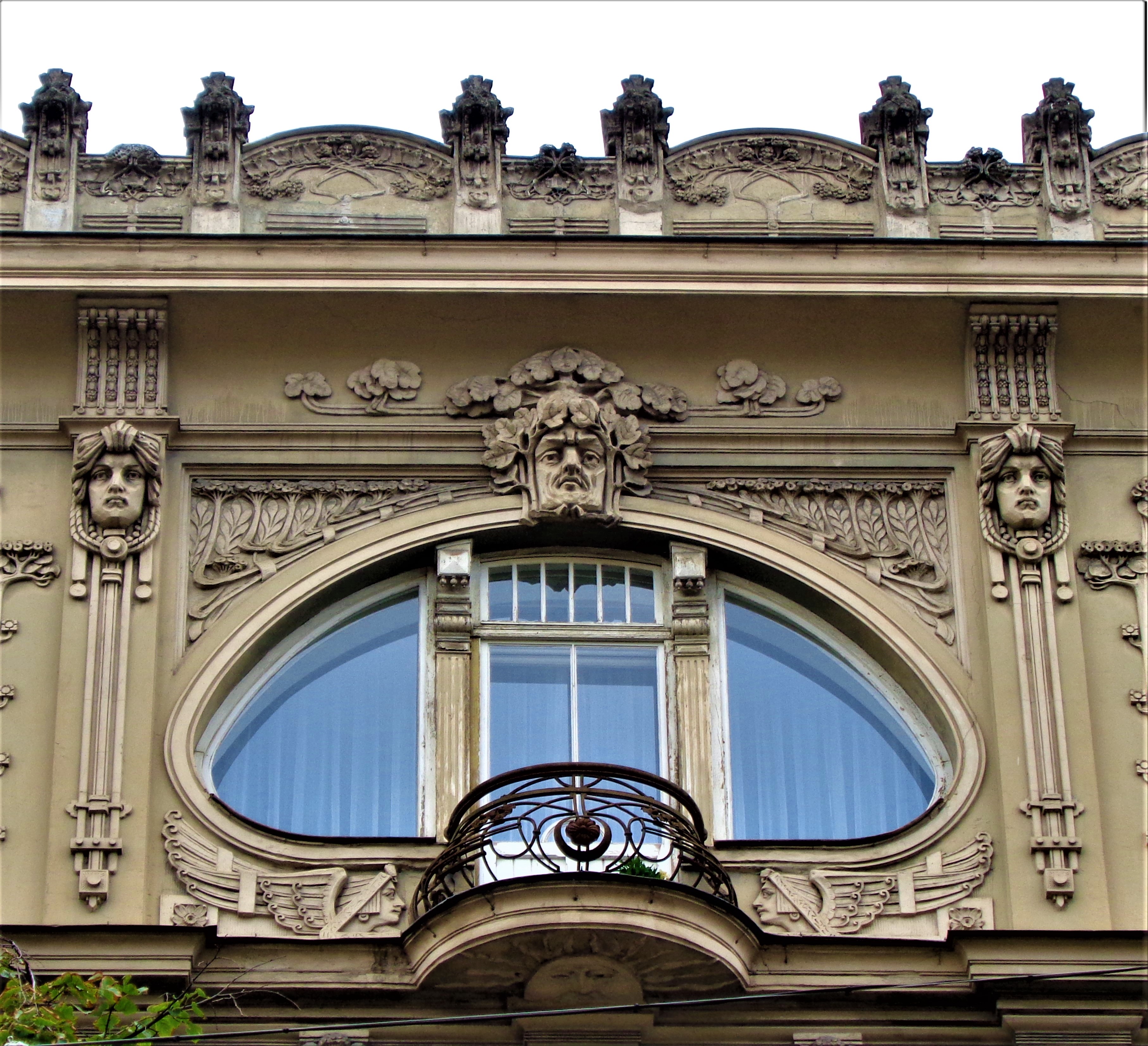
[credit](https://upload.wikimedia.org/wikipedia/commons/2/25/Art_Nouveau_Architecture_in_Riga_%281%29_02.jpg),
[licence](https://creativecommons.org/licenses/by-sa/4.0)
### Textiles and Ceramics
From intricately woven tapestries to delicately painted vases and ceramic tiles, Art Nouveau artists applied their vision to every surface, seeking to elevate the decorative arts to the same level as painting and sculpture. The same organic patterns seen on buildings adorned fabrics and wallpapers, and ceramics transformed everyday objects into exquisite works of art. Key ceramists like **Alexandre Bigot** (who collaborated with Lavirotte and Auscher, producing iconic architectural ceramics), **Émile Muller** (known for his innovative terracotta and stoneware), and the prestigious **Sèvres National Manufacture** (which produced exquisite porcelain) produced stunning decorative and architectural ceramics, often employing new glazes and forms that captured the spirit of the age. The rejection of mass production meant an emphasis on skilled craftsmanship, ensuring each piece was unique, a direct counterpoint to the growing industrialization of the era. Textile designers like **Eugène Grasset** and **Maurice Dufrêne** created exquisite fabrics and wallpapers featuring stylized botanical motifs, ensuring that the Art Nouveau aesthetic permeated every corner of the domestic sphere, making the home a truly immersive artistic environment.
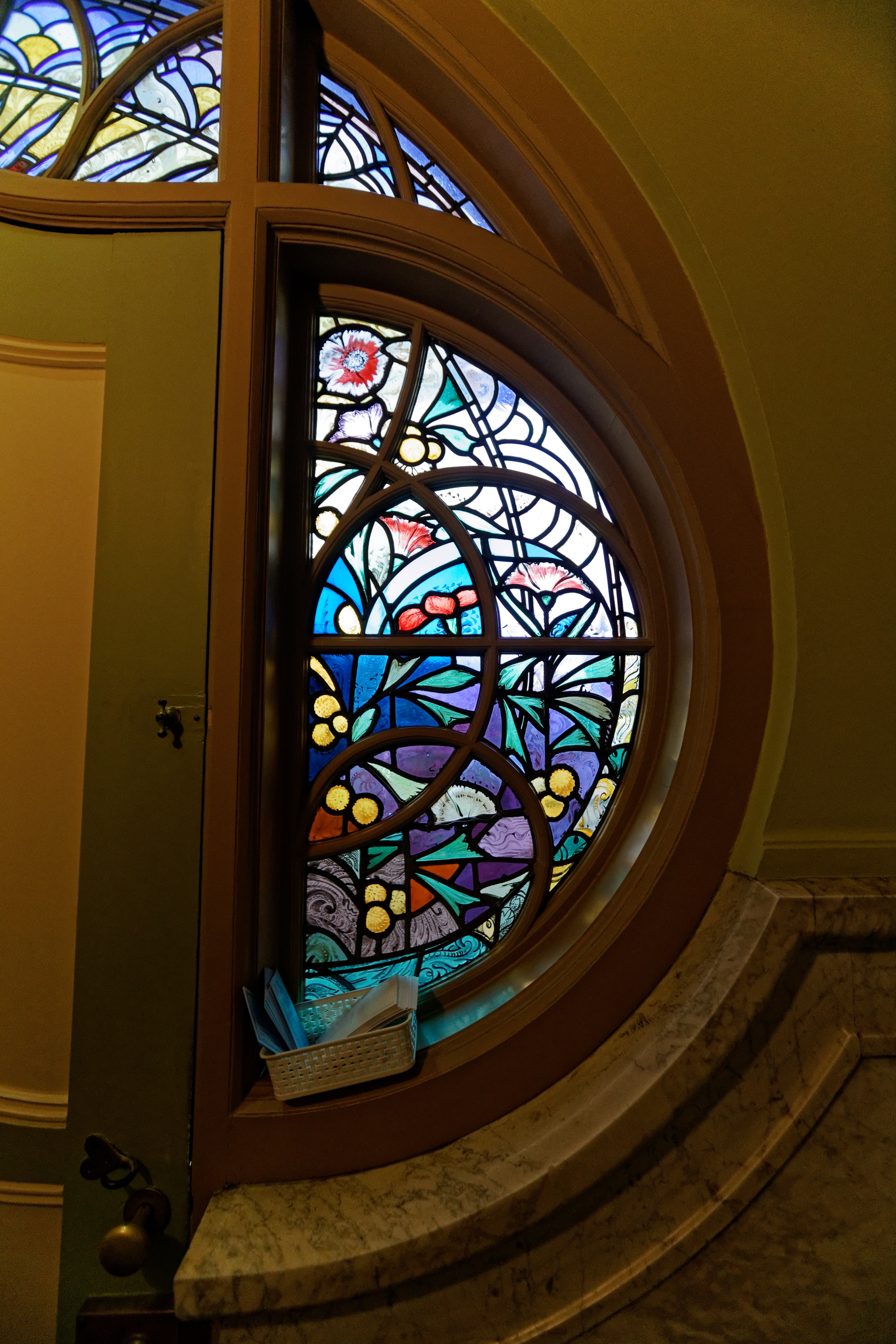
[credit](https://upload.wikimedia.org/wikipedia/commons/3/3f/Museum_House_Rams_Woerthe_1899_by_Architect_A.L._Van_Gendt_-_Art_Nouveau%2C_Jugendstil_29_Stained_Glass_by_Adolf_le_Comte.jpg),
[licence](https://creativecommons.org/licenses/by-sa/4.0)
### Sculpture and Figurative Elements in Interiors
Beyond the grand facades, sculpture played a significant role within Art Nouveau interiors, often adding a layer of allegorical depth and sensuality. From caryatids supporting fireplaces to decorative panels adorning walls, and even freestanding sculptures, the human form, often idealized and sensuous, was frequently integrated, representing nature's beauty or mythical narratives. Artists like **Jean Carriès** created expressive ceramic sculptures, while the decorative works of **François-Rupert Carabin** blurred the lines between furniture and sculpture, creating highly organic and often provocative pieces that challenged conventional forms. These elements contributed to the immersive quality of Art Nouveau spaces, making every corner an artistic discovery and emphasizing the continuous flow of art throughout the environment.
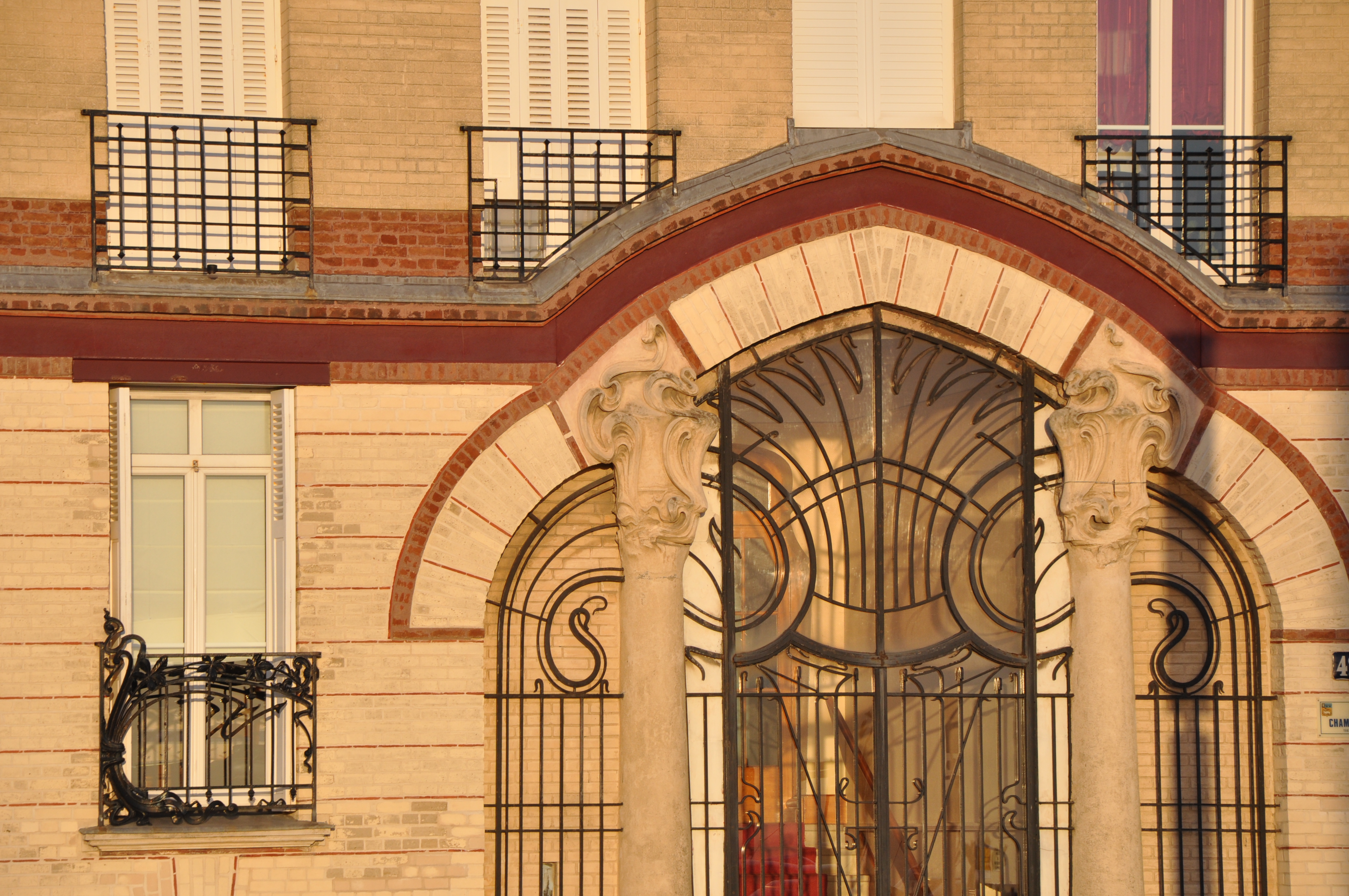
[credit](https://upload.wikimedia.org/wikipedia/commons/c/cc/Le_Havre_%28France%29%2C_art_nouveau_facade.JPG),
[licence](https://creativecommons.org/licenses/by-sa/3.0)
credit, [licence](https://creativecommons.org/licenses/by-sa/4.0)
### Jewelry: Miniature Masterpieces
And we can't forget **jewelry**, those miniature masterpieces that embody the essence of Art Nouveau on a personal scale. Designers like **René Lalique** (renowned for his innovative glasswork and enamel techniques) and **Henri Vever** (a master goldsmith and collector) transformed precious metals and gemstones into delicate, organic forms, often featuring insects (like dragonflies and cicadas), plants (orchids, mistletoe), and idealized female figures. Enamelwork (particularly plique-à-jour and basse-taille techniques, which allowed for translucent, jewel-like effects), opals, and semi-precious stones were favored, creating pieces that were artistic statements rather than mere displays of wealth. If you're fascinated by these wearable sculptures, you might enjoy my [ultimate guide to Art Nouveau jewelry](/finder/page/ultimate-guide-to-art-nouveau-jewelry), where I delve deeper into this exquisite facet of the movement, exploring how these miniature artworks reflected the larger artistic and philosophical trends of the era.
### Bookbinding and Publishing
The Art Nouveau aesthetic also extended to the world of books, transforming them into objects of art that were as beautiful to behold as they were to read. Elaborate, often hand-tooled leather bindings featured flowing lines, stylized floral motifs, and intricate gold tooling. Publishers and illustrators embraced the movement's graphic qualities, creating stunning book covers, title pages, and illustrations that mirrored the organic forms and elegant typography seen elsewhere. Artists like **Henri Bellery-Desfontaines** and **Eugène Grasset** were renowned for their exquisite book designs, making the act of reading a visually luxurious experience and further demonstrating the *Gesamtkunstwerk* ideal that infused the entire movement.
## Quick Reference: Parisian Art Nouveau Gems
Here’s a little table to help you plan your explorations. I know I always appreciate a good cheat sheet when I'm wandering a new city (or even an old favorite!).
[credit](https://encrypted-tbn0.gstatic.com/images?q=tbn:ANd9GcS0j1xATY0zFxvD0EWoDK2dnqZNXCKVAOxCGJwjSBWbmGAgOXX4EKzBEUAKdw6p0fsSZSM&usqp=CAU),
[licence](https://creativecommons.org/licenses/by/3.0)
| Building Name / Location / Métro Station | Architect | Arrondissement | Key Features | Style Note |
| :-------------------------------------------------- | :------------------ | :------------- | :---------------------------------------------------------------------------------------------------------------------------------------------------------------------------------------- | :-------------------------------------------------------------------------------- |
| **Immeuble Lavirotte** (29 Avenue Rapp) | Jules Lavirotte | 7th | Highly ornate facade, sculpted figures, glazed ceramics by Bigot, theatrical doorway. | Flamboyant, daring, wonderfully over-the-top; a true spectacle. |
| **Castel Béranger** (14 Rue La Fontaine) | Hector Guimard | 16th | Asymmetrical, eclectic mix of materials, whimsical details (cats, foliage), first major Art Nouveau residential building. | Playful, organic, integrated design; feels like a fairytale. |
| **Hôtel Céramic** (14 Rue de la Faisanderie) | Paul Auscher | 16th | UNESCO site, stunning glazed stoneware facade by Alexandre Bigot, intricate floral and abstract motifs. | Elegant, refined, seamless art & architecture integration. |
| **Hôtel Mezzara** (60 Rue La Fontaine) | Hector Guimard | 16th | Private mansion, signature organic forms, meticulous ironwork and decorative elements. | Overlooked Guimard gem, more restrained but equally compelling. |
| **Immeuble at 34 Avenue Rapp** | Jules Lavirotte | 7th | Distinctive ceramic reliefs, flowing lines, integrated sculptures, more subdued than its famous neighbor. | Lavirotte's range, opulent yet slightly more restrained. |
| **Guimard Métro Entrances** (Porte Dauphine) | Hector Guimard | 16th | Iconic green ironwork, organic forms resembling plants, distinctive "Métro" lettering, glass canopies. | Public art democratizing beauty, an everyday artistic experience. |
| **Guimard Métro Entrances** (Abbesses) | Hector Guimard | 18th | Iconic green ironwork, organic forms, without the full canopy, picturesque Montmartre setting. | Iconic, whimsical, a perfect contrast to Montmartre's charm. |
| **Église Saint-Jean-de-Montmartre** | Anatole de Baudot | 18th | Pioneering reinforced concrete, delicate decorative elements, structural lightness, blend of industrial & artistic. | Profound blend of art, science, and engineering. |
| **Immeuble at 26 Rue de Sèvres** | Henri Sauvage | 6th | Pioneering terraced apartment building, white ceramic tile façade by Bigot, maximizes light and air. | Practical elegance, revolutionary urban living, hygiene focus. |
| **Immeuble de la Rue de Lota** (3 Rue de Lota) | Charles Plumet | 16th | Refined elegance, harmonious proportions, delicate ironwork, classical elements infused with Art Nouveau curves. | Sophisticated blend of tradition and modernity, quiet luxury. |
| **Hôtel Guimard** (122 Rue Mozart) | Hector Guimard | 16th | His personal residence, showcasing a total work of art with integrated furniture and details. | Rare glimpse into Guimard's private artistic universe, *Gesamtkunstwerk* ideal. |
| **Immeuble at 29 Avenue Charles Floquet** | Jules Lavirotte | 16th | Sculptural details and expressive forms, demonstrating his adaptable yet distinctive style. | Another fascinating Lavirotte, revealing subtle variations in his audacity. |
| **Immeuble at 3 Avenue Anatole France** | Jules Lavirotte | 7th | Striking ceramic reliefs and sculpted figures, a powerful example of his flamboyant creativity. | Exuberant, short walk from Avenue Rapp, worth seeing for its sheer inventiveness. |
| **Maxim's Restaurant** (3 Rue Royale) | Édouard Niermans | 9th | Opulent, perfectly preserved Art Nouveau interior, murals, lighting fixtures, custom furniture. | Lavish time capsule of *fin de siècle* glamour and a full interior experience. |
| **Immeuble at 28 Rue de Fécamp** | Henri Fivaz | 12th | Eclectic blend of organic curves with neo-Gothic/Byzantine influences, sculpted stone, vibrant ceramics. | Unique and imaginative façade, testament to Art Nouveau's diverse expressions. |
| **Immeuble at 43 Rue de la Fontaine** | Louis Sorel | 16th | Ornate balconies, blend of geometric and floral motifs, delicate ironwork. | Captivating, slightly different Art Nouveau expression. |
| **Immeuble at 24 Rue Octave Feuillet** | Octave Raquin | 16th | Delicate yet abundant botanical motifs, finely sculpted stone, elegant ironwork. | Gentle, romantic conversation between architecture and nature. |
| **Immeuble at 5 Rue des Écoles** | Georges Biet | 5th | Elegant and structurally inventive, delicate floral reliefs, subtle sophistication. | Understated, refined example of the style, quality craftsmanship. |
| **Hôtel Guimard Annexe** (17 Rue de La Fontaine) | Hector Guimard | 16th | Elegant residential building with characteristic organic ironwork and integrated details. | A more subdued, yet distinctly Guimard, residential gem. |
| **Hôtel Deron Levet** (8 Rue du Général Mangin) | Henri Fivaz | 7th | Eclectic facade with a mix of organic and symbolic sculptural details, showcasing his unique approach. | A compelling, imaginative work that demands closer inspection. |
| **Immeuble Rue de Sèvres** (30 Rue de Sèvres) | Charles Plumet | 6th | Elegant residential building with subtle Art Nouveau curves and delicate stone carving. | Exemplifies Plumet's refined approach and harmonious design. |
[credit](https://images.pexels.com/photos/28892480/pexels-photo-28892480.jpeg?cs=srgb&dl=pexels-adrien-olichon-1257089-28892480.jpg&fm=jpg),
[licence](https://creativecommons.org/public-domain/)
## The Enduring Spirit of Art Nouveau: Beyond the Facade
While we've primarily focused on the majestic architecture, it's impossible for me not to think about how this pervasive artistic spirit truly transcended mere buildings and translated into other forms. Art Nouveau wasn't just about monumental structures; it was a holistic movement, a deep philosophical approach to beauty and life itself. It was about seeing and creating beauty in everything, from a grand public staircase to a humble, everyday vase, and profoundly elevating the mundane through conscious art. The same organic forms, the passionate love of exquisite craftsmanship, the radical rejection of rigid formality – you see it across the board, in everything from delicate [Art Nouveau jewelry](/finder/page/ultimate-guide-to-art-nouveau-jewelry) to monumental posters. This universal application, this drive to infuse art into every aspect of life, is what truly sets it apart, in my opinion, making it one of the most comprehensive design movements in history.
It makes me think about my own art, actually. While I often lean towards more [abstract](/buy) and [geometric](/buy) forms in my creations, there’s an undeniably shared desire to break free from convention, to imbue color and line with raw emotion and dynamic movement. The way Art Nouveau artists used flowing, vital lines to evoke natural growth, or how they seamlessly integrated decorative elements into functional objects, always inspires me profoundly. It’s a powerful reminder that art shouldn't be confined to a canvas or a pedestal in a museum; it can, and should, be an integral part of our daily lives, transforming the mundane into the magical. Perhaps that's why I find myself so drawn to creating pieces that feel vibrant and alive, echoing that same life-affirming energy that pulsed through the Art Nouveau era. The Art Nouveau commitment to breaking free from academic strictures, to letting lines and colors express raw emotion and unbridled movement, resonates deeply with my own artistic philosophy. While my work often leans towards more [abstract](/buy) and [geometric](/buy) forms, that underlying desire to imbue art with a unique, living energy is a direct descendant of the Art Nouveau spirit. Maybe one day you'll even see some of my work, perhaps at my [Den Bosch museum](/den-bosch-museum), taking some subtle cues from this incredible, revolutionary period. Who knows? There's definitely a compelling connection to the [Vienna Secession](/finder/page/the-vienna-secession:-art-nouveau's-radical-austrian-cousins) there too, with their equally radical approach to integrating art into every facet of life, showing how a shared artistic rebellion can manifest in diverse, yet equally compelling, ways across Europe. This enduring spirit reminds us that true artistic movements are not just about aesthetics, but about a profound way of seeing and interacting with the world. It’s a philosophy that transcends time and medium, influencing artists even today.
[credit](https://upload.wikimedia.org/wikipedia/commons/6/60/Frank_Lloyd_Wright_-_New_York%2C_NY_-_Solomon_R._Guggenheim_Museum_%28R%29.jpg),
[licence](https://creativecommons.org/licenses/by/4.0)
## Frequently Asked Questions About Art Nouveau Architecture in Paris
### Q: What was the role of the World's Fairs in Art Nouveau's popularity?
A: The **Paris Universal Exposition of 1900** was absolutely crucial in propelling Art Nouveau onto the global stage. It provided an unprecedented platform for architects and designers to showcase the "new art" in grand pavilions, decorative arts displays, and even the entrances to the newly inaugurated Métro system. The style's emphasis on unity and innovation resonated deeply, making it the dominant aesthetic of the Exposition and cementing its international reputation. These fairs were vital for diffusing the style and inspiring artists and patrons worldwide, effectively turning Paris into the world's Art Nouveau capital for a time. It truly put the 'new art' on the map, so to speak.
### Q: What's the best way to start my Art Nouveau tour in Paris?
A: For a truly immersive introduction, I'd highly recommend starting your Art Nouveau pilgrimage in the **16th arrondissement**, particularly around Rue La Fontaine. This area is a concentrated treasure trove with many iconic buildings like Hector Guimard's Castel Béranger and Paul Auscher's Hôtel Céramic, allowing you to see a significant number of masterpieces within a relatively short and pleasant walking distance. Once you've absorbed the elegance of the 16th, you can then branch out to the 7th arrondissement for Lavirotte's more flamboyant masterpieces or systematically seek out Guimard's iconic Métro stations spread across the city, perhaps ending your day with a visit to Maxim's for a full interior experience (if your budget allows!). It’s like easing into a good book, one chapter at a time.

[credit](https://commons.wikimedia.org/wiki/File:MuseeDOrsay.jpg),
[licence](https://creativecommons.org/licenses/by-sa/3.0/deed.en)
### Q: What are the main characteristics of Art Nouveau architecture in Paris?
A: Parisian Art Nouveau is distinctively characterized by its strong emphasis on **organic forms**, dynamically **curving ""whiplash" lines**, **floral and botanical motifs**, intricate **ironwork** (especially in balconies and Métro entrances), the integration of **sculptural elements**, and often a bold use of new materials like **glazed ceramics** and exposed concrete. It's less about strict symmetry and more about dynamic, fluid compositions inspired by nature.
### Q: Was Japanese art influential in Parisian Art Nouveau?
A: Absolutely! **Japonisme**, the widespread fascination with Japanese art and aesthetics that swept through Europe in the late 19th century, had a profound and undeniable impact on Art Nouveau across the continent, and Paris was certainly no exception. The delicate, flowing lines, the innovative asymmetrical compositions, the often flattened perspectives, and the deep reverence for nature found in Japanese woodblock prints (like those by Hokusai and Hiroshige) strongly influenced the curvilinear forms, botanical motifs, and even the use of negative space seen in Parisian Art Nouveau architecture, decorative arts, and particularly graphic design. It was a vital and inspiring source for artists seeking to break away from rigid traditional Western academic styles and embrace a new visual vocabulary, offering a fresh aesthetic counterpoint to the prevailing European norms. The influence can be seen in the graceful asymmetry of compositions and the stylized natural forms, giving Art Nouveau a distinctly modern edge. It truly opened up new avenues for artistic expression.

[credit](https://www.flickr.com/photos/pedrosz/41067351765),
[licence](https://creativecommons.org/licenses/by-nc-sa/2.0/deed.en)
### Q: How did Art Nouveau challenge traditional art academies?
A: Art Nouveau arose in direct opposition to the conservative, historicist approach championed by institutions like the **École des Beaux-Arts**. It rejected their rigid hierarchies, their emphasis on classical motifs, and their separation of "fine arts" from "applied arts." Art Nouveau artists sought to dissolve these boundaries, promoting the idea that everything, from a building to a teacup, could be a work of art. This rebellious spirit advocated for artistic freedom, innovation, and a return to nature as the ultimate source of inspiration, directly challenging the established academic norms of the time. It was a declaration of artistic independence, if you ask me.
### Q: Who are the most famous Art Nouveau architects in Paris?
A: The two most prominent and instantly recognizable figures are undoubtedly **Hector Guimard** and **Jules Lavirotte**. Guimard is renowned for his iconic, organic Métro entrances and his residential masterpiece, the Castel Béranger. Lavirotte, on the other hand, is celebrated for his highly flamboyant, theatrical, and sculptural residential buildings, such as the Immeuble Lavirotte on Avenue Rapp, which burst with ceramic and stone ornamentation. Other significant names include Charles Plumet, Paul Auscher (of Hôtel Céramic fame), and Henri Sauvage, each contributing their unique flair to the Parisian Art Nouveau tapestry. Don't forget pioneering figures like Anatole de Baudot, whose structural innovations were equally crucial, even if less visually flamboyant. They were truly the rock stars of their era, each with a distinctive style.
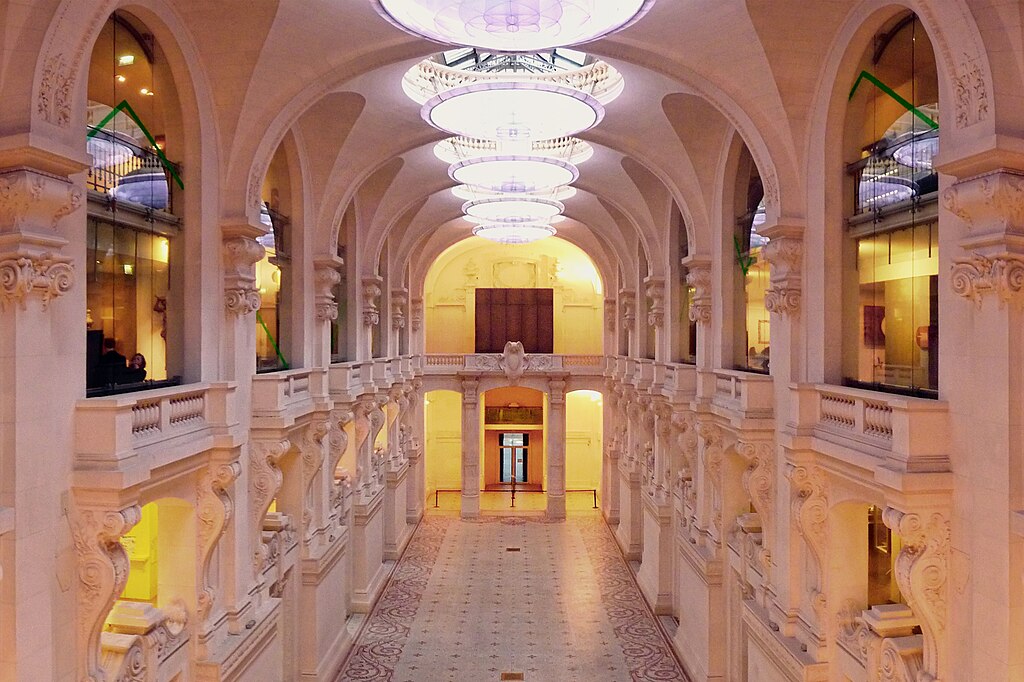
[credit](https://commons.wikimedia.org/wiki/File:Mus%C3%A9e_des_Arts_d%C3%A9coratifs,_Paris_1.jpg),
[licence](https://creativecommons.org/licenses/by-sa/3.0)
### Q: Are there any famous Art Nouveau interiors still accessible in Paris?
A: While the vast majority of Art Nouveau interiors are preserved within private residences, several public spaces offer a glorious glimpse into this immersive aesthetic. **Maxim's restaurant** (3 Rue Royale, 9th arrondissement) is perhaps the most famous, renowned for its opulent and remarkably preserved Art Nouveau interior, offering a true *fin de siècle* experience (though it is an exclusive establishment). You can also experience the ambiance inside some of Hector Guimard's Métro stations, particularly Porte Dauphine, which retains its charming glass canopy. Occasionally, museums (like the Musée d'Orsay or Musée des Arts décoratifs) host exhibitions or have permanent collections featuring Art Nouveau furniture and decorative arts. Keep an eye out for hotels that have retained original Art Nouveau elements in their lobbies, bars, or dining rooms, offering a more accessible way to step back in time. For an immersive look at a private dwelling, even if from the exterior, the **Hôtel Guimard** (122 Rue Mozart, 16th arrondissement) was his personal residence, a true *Gesamtkunstwerk*. It's a wonderful opportunity to step back in time and truly feel the spirit of the era.
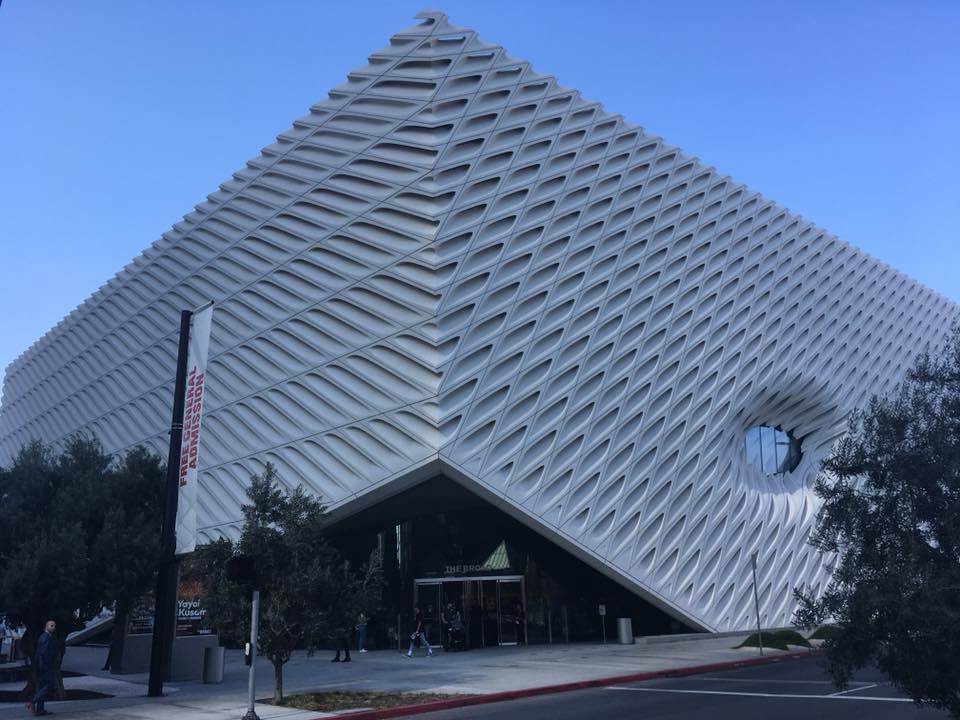
[credit](https://upload.wikimedia.org/wikipedia/commons/3/39/The_Broad_LA_2017.jpg),
[licence](https://creativecommons.org/licenses/by-sa/4.0)
credit, [licence](https://creativecommons.org/licenses/by-sa/4.0)
### Q: Where can I see the best examples of Art Nouveau architecture in Paris?
A: For the most concentrated and impressive collection of examples, the **16th and 7th arrondissements** are absolutely essential. Key areas include: **Rue La Fontaine** in the 16th (for Hector Guimard's Castel Béranger and Hôtel Mezzara), **Avenue Rapp** in the 7th (for Jules Lavirotte's spectacular Immeuble Lavirotte and Immeuble at 34 Avenue Rapp), and **Rue de la Faisanderie** in the 16th (for Paul Auscher's UNESCO-listed Hôtel Céramic). And, of course, no Art Nouveau tour is complete without admiring Hector Guimard's iconic Métro entrances, particularly at **Porte Dauphine** (16th) and **Abbesses** (18th), which are public masterpieces in themselves. Don't forget the **Église Saint-Jean-de-Montmartre** by Anatole de Baudot for a vital example of reinforced concrete innovation. These are the showstoppers, the places where the style truly shines.
[credit](https://live.staticflickr.com/8797/17242473422_c0954abef8_b.jpg),
[licence](https://creativecommons.org/licenses/by/2.0/)
### Q: Are there any less-known Art Nouveau architects worth discovering in Paris?
A: Absolutely! While Guimard and Lavirotte often steal the spotlight, exploring the works of lesser-known architects can be incredibly rewarding. Figures like **Charles Plumet** offered a refined elegance, subtly blending Art Nouveau curves with regional French traditions. **Henri Fivaz** brought an eclectic, often whimsical touch, incorporating neo-Gothic or Byzantine influences. And architects like **Georges Biet** quietly contributed elegant and structurally inventive residential buildings, often in collaboration with master ceramists. Don't forget **Octave Raquin**, known for his delicate botanical motifs that bloom across facades. These architects, though less overtly flamboyant, collectively paint a richer, more diverse picture of Parisian Art Nouveau, proving that beauty truly is in the details, and often in the unexpected corners of the city. Their subtlety is a quiet rebellion in itself, don't you think?
### Q: How long did Art Nouveau flourish in Paris?
A: Art Nouveau had a relatively intense but brief flourishing period in Paris, primarily from around **1890 to 1910**. While its influences lingered a little longer, the style began to wane in popularity as tastes shifted towards the more streamlined and geometric forms of early Modernism and, eventually, [Art Deco](/finder/page/ultimate-guide-to-art-deco-movement). However, its impact on design, craftsmanship, and the very concept of integrating art into daily life was profound and enduring, leaving an indelible mark on Parisian architecture and culture. It was a fleeting, yet brilliant, artistic explosion that paved the way for future design revolutions. A beautiful, albeit brief, moment in art history.
### Q: What role did the Arts and Crafts movement play in Art Nouveau in Paris?
A: The **Arts and Crafts movement**, though originating primarily in Britain, had a significant, albeit indirect, influence on Art Nouveau in Paris. Both movements shared a fundamental rejection of industrial mass production and a deep commitment to **handicraft, quality materials, and the elevation of applied arts**. Parisian Art Nouveau designers, particularly in furniture and interior design (like Louis Majorelle and Émile Gallé), absorbed this ethos, emphasizing bespoke craftsmanship, natural forms, and the integration of art into everyday objects. While Art Nouveau embraced more sensual, curvilinear forms and often new industrial materials (like cast iron and concrete) in a way Arts and Crafts did not, the underlying philosophical drive for beauty, authenticity, and the *Gesamtkunstwerk* (total work of art) was a powerful shared thread. It was like two different branches reaching for the same sun, if you know what I mean.
### Q: What challenges face the preservation of Art Nouveau buildings in Paris?
A: Preservation is indeed an ongoing and vital effort. The unique nature of Art Nouveau architecture presents specific challenges: the delicate nature of some materials (like intricate glazed ceramics, custom stained glass, and finely wrought ironwork), the significant costs associated with specialized restoration, and the relentless pressures of modern urban development and changing property ownership. The intricate details, often custom-made, require highly skilled artisans for repairs, adding to the complexity. However, the good news is that many significant Art Nouveau buildings are now protected as historical monuments by the French government, and passionate local associations work tirelessly to document, advocate for, and safeguard this unique and irreplaceable architectural heritage. It's a constant, delicate dance between celebrating history and navigating the demands of the present, isn't it? Public awareness and appreciation are also key to ensuring these treasures endure. It's a battle worth fighting, I think, to keep these beauties alive.
[credit](https://www.pexels.com/photo/stunning-gothic-interior-of-sainte-chapelle-30444213/),
[licence](https://creativecommons.org/public-domain/cc0/)
credit, [licence](https://creativecommons.org/licenses/by-sa/4.0)
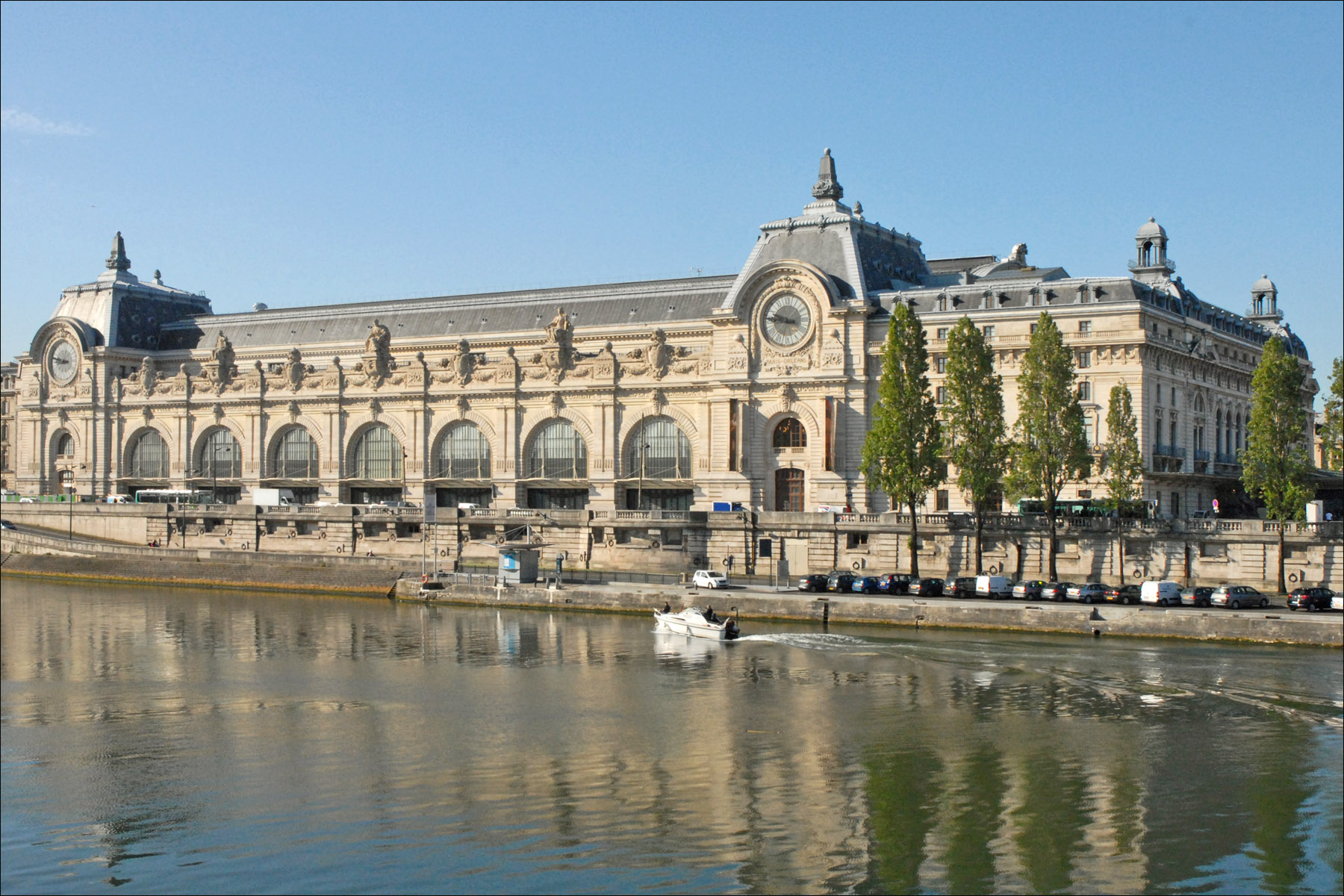
[credit](https://upload.wikimedia.org/wikipedia/commons/d/de/Le_mus%C3%A9e_dOrsay_%28Paris%29_%284725795882%29.jpg),
[licence](https://creativecommons.org/licenses/by/2.0)
### Q: What's the best time of year to explore Art Nouveau in Paris?
A: I've found that the **spring (April-June) and fall (September-October)** are truly ideal for an Art Nouveau architectural hunt in Paris. The weather is generally mild and pleasant for extensive walking, the light is often beautiful for photography, and the crowds are a little thinner than in the peak summer months. While summer offers long daylight hours, it can be quite hot and tourist-heavy, making leisurely exploration less comfortable and potentially obscuring some facade details with foliage. Winter days are shorter and colder, though the city still holds a unique charm, and many interiors are just as captivating then. Ultimately, any time is a good time if your passion for discovery is strong enough!
### Q: Is Art Nouveau still preserved in Paris?
A: Absolutely! Parisian Art Nouveau is not just a relic of the past; it's a living part of the city's architectural fabric. Many significant Art Nouveau buildings have been meticulously well-preserved and are officially protected as historical monuments by the French government. While some interiors of private residences may have been altered over time (though some, like Maxim's, remain untouched, offering rare glimpses into the *Gesamtkunstwerk* ideal), the stunning facades – which are often the most defining and publicly visible feature of Parisian Art Nouveau – remain largely intact. This allows us to continuously appreciate their original beauty, artistry, and the visionary spirit of their creators, making Paris a fantastic open-air museum for the style and a continuous source of inspiration. It’s like the city cherishes its artistic rebellion, ensuring it lives on for future generations.
### Q: How does Parisian Art Nouveau compare to other European Art Nouveau styles?
A: Parisian Art Nouveau often has a more pronounced emphasis on **ornamental facades** and **wrought ironwork**, heavily influenced by botanical forms and the local French aesthetic, and often incorporating elegant classical undertones. Compared to, say, the more abstract and geometric forms of the [Vienna Secession](/finder/page/the-vienna-secession:-art-nouveau's-radical-austrian-cousins) (Jugendstil) or the more gothic-inspired elements found in parts of Belgium (like Victor Horta's work in Brussels), the Parisian style is distinctively fluid and often quite playful in its ornamentation. You might also notice differences when comparing it to the more robust, almost organic-Gothic style seen in Barcelona with Gaudí, or the more rectilinear and symbolic approach of the Glasgow Style exemplified by Charles Rennie Mackintosh. Each city's interpretation of Art Nouveau truly reflects its unique cultural and artistic landscape, which I find endlessly fascinating – a testament to the movement's incredible adaptability. It's like a different dialect of the same beautiful language.
[credit](https://images.pexels.com/photos/3166708/pexels-photo-3166708.jpeg),
[licence](https://creativecommons.org/public-domain/)
credit, [licence](https://creativecommons.org/licenses/by-sa/4.0)
## Tips for Your Art Nouveau Hunt in Paris: Maximizing Your Discovery
Embarking on an Art Nouveau tour of Paris is a truly delightful and profoundly rewarding experience – a genuine adventure for the eyes and the imagination. But a little strategic planning, I've found, can make it even more fruitful and ensure you don't miss a single sinuous curve, a delicate botanical detail, or a whimsical sculpted figure. Here are some of my top, tried-and-true tips for fellow architectural explorers, designed to help you maximize your discoveries and truly immerse yourself in this captivating era, transforming your visit into a treasure hunt of unparalleled beauty – because who doesn't love a good treasure hunt?
[credit](https://upload.wikimedia.org/wikipedia/commons/d/d2/Tulips_sculpture_by_Jeff_Koons_in_the_Bilbao_Guggenheim_Museum.jpg),
[licence](https://creativecommons.org/licenses/by-sa/4.0)
* **Look Up, Look Closely (and Don't Forget Down!):** This might seem obvious, but it's truly crucial! Art Nouveau details are often high up on facades, in balconies, around windows, and particularly around doorways. But also critically glance at street level for subtle tile work, unexpected grilles, or even ornate door handles. Don't rush; take your time to truly observe the intricate ironwork, the expressive sculpted figures, and the vibrant ceramic flourishes. Sometimes the smallest detail tells the biggest story, doesn't it? If you're really serious about those high-up architectural flourishes, a small pair of binoculars can be your secret weapon! Also, don't be afraid to cross the street and look back at a facade from a distance; this often reveals the full, harmonious composition that might be missed when standing too close. And truly, pay attention to the craftsmanship; the rejection of industrial uniformity means every curve and detail was a conscious artistic choice.
* **Check for Current Exhibitions:** Before you go, quickly research if any Parisian museums (like the Musée d'Orsay, Musée des Arts décoratifs, or even smaller [galleries](/finder/page/best-galleries)) are hosting special Art Nouveau exhibitions. These can offer rare glimpses into interiors, decorative arts, and provide deeper context that complements your architectural strolls. It's like finding a bonus level in your architectural treasure hunt!
* **Wear Comfortable Shoes:** You'll be doing a lot of walking, especially in the 16th and 7th arrondissements where many treasures are tucked away on residential streets. Paris is best explored on foot, and these architectural treasures are scattered across charming, sometimes cobblestoned, avenues.
* **Carry a Map (or use a mapping app with pins):** While this article gives you a fantastic starting point, having a detailed physical map or using a mapping app with pre-pinned locations will be invaluable for navigating between sites and discovering unexpected gems along the way. Many dedicated Art Nouveau walking tour maps are available online or in specialist guidebooks. I highly recommend taking the time to pin your desired locations on Google Maps beforehand; it makes on-the-go navigation so much smoother. Consider downloading offline maps too, just in case your data signal decides to take a vacation in some of the quieter streets. Nothing breaks the artistic immersion like a lost internet connection, believe me!
* **Distinguish Authentic Guimard Métro Entrances:** While many iconic Guimard Métro entrances survive, some are modern replicas. The original ones are typically made of cast iron, often painted green, and may feature a glass canopy (like Porte Dauphine). Replicas, while beautiful, are more recent additions. A quick search can usually confirm authenticity for each station, adding another layer to your architectural detective work!
* **Learn Basic Art Nouveau Terminology:** Familiarize yourself with terms like "whiplash curve," *fer forgé* (wrought iron), *Gesamtkunstwerk* (total work of art), and specific motifs like thistles or irises. Knowing this vocabulary will significantly enhance your ability to identify and appreciate the intricate details you encounter, turning a casual glance into an informed observation.
* **Consider Guided Tours:** If you prefer a more structured experience and want in-depth historical context, consider joining a specialized Art Nouveau guided walking tour. Local experts can often point out details you might otherwise miss and share fascinating anecdotes about the architects and the era. It’s a great way to deepen your appreciation without the hassle of navigation.
* **Research Opening Hours for Interiors:** If you plan to visit a building with an accessible interior (like the Église Saint-Jean-de-Montmartre or specific museums featuring decorative arts), always check its opening hours and any potential entry requirements in advance. Some sites might also have specific tour times or require reservations.
* **Look Beyond the Major Names:** While the works of Guimard and Lavirotte are undeniably spectacular, challenge yourself to discover the more subtle contributions of architects like Charles Plumet, Henri Sauvage, or Georges Biet. Their buildings often reveal a different, equally captivating facet of Art Nouveau, proving that the movement was a rich tapestry of styles, not just a few dominant threads. It’s like discovering hidden gems within a crown of jewels.
* **Respect Private Residences:** Remember that the vast majority of Art Nouveau buildings are private homes. Admire them from the street, take your photos respectfully, and be mindful of residents' privacy. No one likes a peeping Tom, even if you're admiring their historical facade! A little discretion goes a long way in ensuring a pleasant experience for everyone.
* **Embrace the Unexpected:** Sometimes the most rewarding discoveries are the ones you stumble upon purely by chance. Don't be afraid to let curiosity guide you down an intriguing side street; you never know what Art Nouveau surprise – perhaps a forgotten mosaic, a unique doorway, or an ornate street lamp – awaits! Allow for serendipity in your explorations; Paris has a way of revealing its secrets when you least expect it. I've often found my favorite spots by simply getting a little lost.
* **Learn a Little French:** While English is widely spoken in tourist areas, knowing a few basic French phrases can enhance your interactions and make asking for directions or ordering coffee a more pleasant experience. Plus, it's a great way to immerse yourself in the local culture! A simple *bonjour* goes a long way.
* **Consider Public Transport for Distant Sites:** While walking is undoubtedly the best way to explore concentrated Art Nouveau areas, don't hesitate to use Paris's incredibly efficient Métro system to jump between arrondissements or reach those more distant Art Nouveau sites. Remember, the Métro stations themselves are part of the Art Nouveau experience, after all – consider them moving architectural exhibitions! It’s art on the go!
* **Pack Snacks and Water & Visit a Museum:** A long day of architectural exploration can be surprisingly tiring. Having some refreshments and a water bottle on hand will keep your energy up and save you from desperately hunting for a café when you're deeply engrossed in a discovery. Stay hydrated and fueled for your adventure! To truly complement your outdoor architectural tour, also consider visiting a museum that houses Art Nouveau decorative arts, like the **Musée d'Orsay** (which has a dedicated Art Nouveau section) or the **Musée des Arts Décoratifs** (MAD Paris), where you can see furniture, ceramics, glass, and jewelry up close, gaining a full appreciation for the *Gesamtkunstwerk* ideal and resting your feet simultaneously. It’s the perfect way to bring the interiors to life after admiring the exteriors and understanding the movement's full scope beyond just facades. A little indoor art break is always a good idea.
* **Bring a Camera (and a Charger!):** You'll want to capture the beauty. Ensure your camera or phone is fully charged, and seriously consider carrying a portable power bank, as you'll undoubtedly be snapping a lot of photos of these incredible facades and details! Capturing the beauty is part of the fun, but a dead battery can quickly dampen the spirits – I speak from personal, frustrating experience.
* **Capture the Details (and Respect Copyright!):** Don't just take wide shots; zoom in on the intricate ironwork, the sculpted figures, the ceramic patterns. These are often where the true artistry lies. Remember, however, that some interiors, especially in museums or private establishments, might have photography restrictions, so always be mindful and respectful of local rules and residents' privacy. A little respect goes a long way, and sometimes the best photos are the ones you just take in with your eyes.
* **Best Time to Visit:** To fully enjoy your architectural hunt, consider visiting during the spring or fall. The weather is generally pleasant for walking, and the light is often beautiful for photography. Summer can be hot and crowded, with the downside that some details might be obscured by foliage. Winter days are shorter and colder, which can make prolonged outdoor exploration less comfortable, but the bare trees can sometimes offer clearer views of architectural details. Spring, with its blossoming gardens, and autumn, with its crisp air, offer the most balanced and beautiful conditions for this kind of architectural appreciation, in my experience. Truly, it’s all about chasing that perfect light!
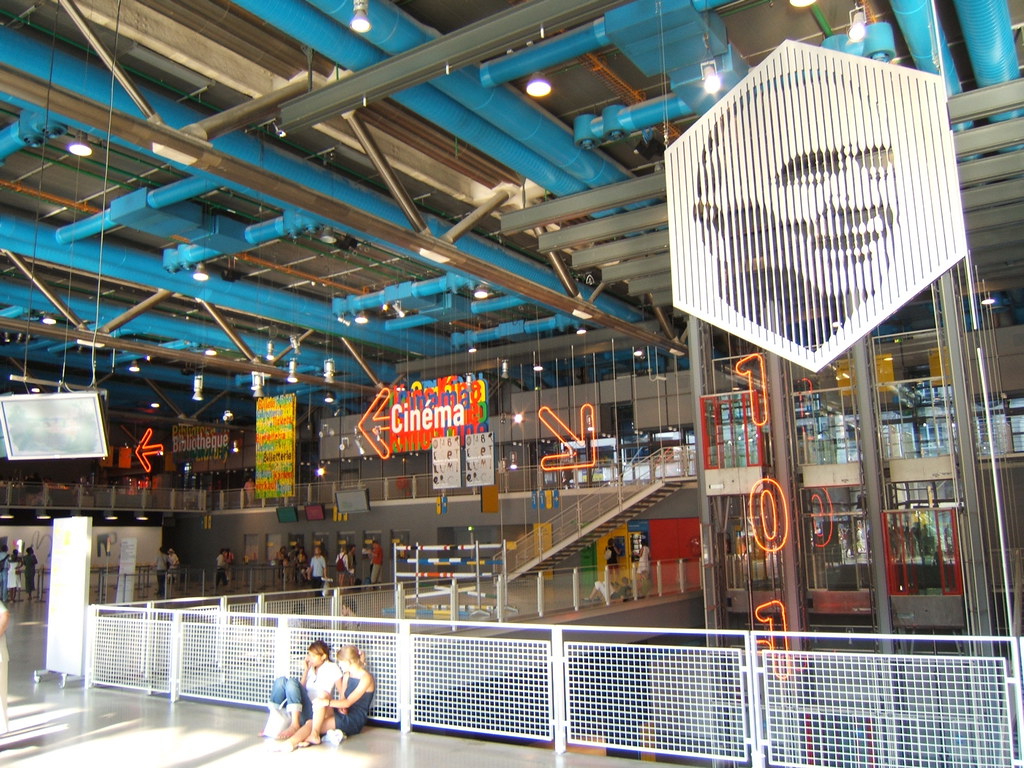
[credit](https://live.staticflickr.com/22/27846401_276bee31c8_b.jpg),
[licence](https://creativecommons.org/licenses/by/2.0/)
## A Final Thought on Paris's Enduring Artistic Soul
Paris, for all its grand boulevards and classical beauty, has always harbored a rebellious streak, an innovative artistic soul that relentlessly yearns for expression and fresh perspectives. Art Nouveau architecture stands as a vibrant, undulating testament to that very spirit. It's a powerful reminder that beauty isn't static or confined to rigid rules; it evolves, it flows, it surprises, and it often challenges the status quo. And isn't that just the most wonderful, life-affirming thing? For me, these buildings aren't merely historical artifacts; they are living stories, compelling narratives etched in stone, iron, glass, and ceramic, speaking volumes about a time when artists and architects dared to dream differently, embracing nature and innovation in equal measure. They serve as a powerful counterpoint to the city's more formal structures, adding a layer of whimsical, organic charm that is truly unique. It’s a quiet rebellion, one that continues to inspire.
So, next time you're in the incomparable City of Lights, promise me you'll look up. Really *look* up, and then look closely. You might just find your own piece of artistic magic – a swirling iron balcony that seems to dance, a ceramic façade bursting with unexpected color, or a Métro entrance that feels like a portal to another, more whimsical era. Let these architectural wonders spark your imagination and serve as a powerful reminder that art is truly everywhere, waiting to be discovered, woven into the very fabric of our daily lives, transforming the mundane into the magical. And if you're ever curious about the grand, interconnected sweep of art history and how movements like [Art Nouveau Movement](/finder/page/definitive-guide-to-art-nouveau-movement) fit into the bigger picture, or its [influence on modern design](/finder/page/art-nouveau-influence-modern-design), my [timeline](/timeline) offers a broader perspective on this constant, fascinating dialogue between the past and the present. It's a journey, not just through a city, but through a mindset – one that dares to infuse life and beauty into every single detail. Happy hunting, and may your Parisian journey be filled with beautiful surprises and endless artistic inspiration, transforming every corner you turn into a new discovery! It’s a journey I always look forward to, and I hope you will too.